Emir Kusturica: The Life Story Behind the Underground Director
In this post
- Sarajevo Streets and a Boy Who Watched Everything
- Prague, Film School, and the First Films
- When Father Was Away and the First Palme d’Or
- Time of the Gypsies and a World of Music
- Arizona Dream, America, and Underground
- Black Cat, White Cat, and a New Home in the Hills
- Later Films, Books, and a Life Still Argued About
- The Village, the Festival, and Cinema as a Home
- My Take:
Emir Kusturica makes films that feel like a village festival and a family argument happening at the same time. His stories are loud, funny, sad, and full of music, and they come from the world he grew up in, a place where different peoples, religions, and languages lived side by side. He is one of the few directors alive who has won the Palme d’Or, the top prize at the Cannes Film Festival, not once but twice. That alone would make him famous, but his life is much wider than two prizes.
He was born in Sarajevo, in what was then Yugoslavia, and he grew up in a city where a mosque, a church, and a synagogue could stand close together. That mix shaped everything he later filmed. His characters drink, dance, argue, fall in love, and make terrible mistakes, and the camera loves them even when they are at their worst. He does not film tidy people. He films people who are alive in a messy, stubborn way, and audiences around the world recognised something true in that.
What makes his story worth telling is how far he travelled from that beginning, and how much he refused to change for anyone else. He studied film in Prague, he made his name in Yugoslavia, he worked in America and France, and then he went back to the hills of Serbia and built a whole wooden village with his own hands, in a way. He also plays music in a band, he writes books, and he speaks his mind in a way that has made many people argue about him. Love him or argue with him, it is hard to ignore him.
This is the story of a boy from Sarajevo who became one of the most talked-about directors in world cinema, a man whose films won the biggest prizes and divided audiences, and who kept building his own world, on screen and in real life, exactly as he wanted it.
Sarajevo Streets and a Boy Who Watched Everything
Emir Kusturica was born on 24 November 1954 in Sarajevo, the capital of Bosnia and Herzegovina, which was then part of Yugoslavia. His family was Muslim by background, and his father worked in the city, but the young Emir grew up in streets where Serbs, Croats, Bosniaks, and Jews lived as neighbours. That everyday mix of languages, music, and customs became the raw material of his films. He learned early that a single street could hold many different worlds, and that people who seemed different could share the same jokes, the same food, and the same sorrows.
As a boy, he was drawn to stories and to images. Sarajevo in the 1960s was a lively city, with cinemas, theatres, and cafes, and a young person with a curious mind could soak up a great deal simply by watching and listening. He played football like many boys of his age, and he spent time with friends in the neighbourhood, but he also developed a love for film that set him apart. He watched films closely, not just for the story but for the way a scene was put together, and he began to dream of making films of his own.
His family did not push him toward cinema, and the path was not laid out for him. He had to find his own way, and that meant leaving home to study. The decision to study film abroad was a bold one for a young man from Sarajevo, because it meant living far from his family and learning a new language and a new way of life. But it also gave him the training he needed, and it put him in the company of other young filmmakers who took cinema seriously as an art, not just as entertainment.
The Sarajevo of his childhood stayed with him for the rest of his life. Even when he filmed in other countries and worked with stars from America and Europe, the heart of his work stayed in the Balkans. The weddings, the funerals, the brass bands, the arguments at the dinner table, and the long nights of music and drink all come from that place. He did not invent that world for the camera. He carried it with him, and he spent his career trying to show it to the rest of the world.
Prague, Film School, and the First Films
After finishing school, Kusturica went to Prague to study at the famous film school known as FAMU. Prague was one of the great centres of European cinema, and the school had trained many respected directors. There he learned the craft of directing in a serious way, how to work with actors, how to plan a shot, how to edit a scene so that it carried feeling, and how to tell a story with images as well as words. He was a student who took the work seriously, and his student films showed a talent that his teachers noticed.
His early work already showed the style that would make him famous. He liked long takes, crowded scenes, and a mix of comedy and sadness in the same moment. He did not want his films to look clean and tidy. He wanted them to feel alive, as if the camera had wandered into a real celebration or a real quarrel. That approach took skill, because a scene with many people, animals, and music can easily fall apart, but Kusturica learned to control that chaos and turn it into energy on the screen.
When he returned to Yugoslavia, he began to make films and television work that brought him attention at home. His first feature film, Do You Remember Dolly Bell, was released in 1981, and it told a gentle, funny story about a young man growing up in Sarajevo in the 1960s. The film won prizes at the Venice Film Festival, and it showed that a new voice had arrived in Yugoslav cinema. Audiences liked its warmth, and critics liked the way it mixed humour with a real sense of place.
The success of that first film gave him the chance to make bigger work. He was still young, but he was already trusted with stories that mattered, and he used that trust to make films about ordinary people caught in the changes of a country. He did not rush. He built his reputation one film at a time, and each film taught him something new about how to handle actors, music, and the crowd scenes that would become his trademark.
When Father Was Away and the First Palme d’Or
In 1985, Kusturica made When Father Was Away on Business, a film set in Yugoslavia in the early 1950s, a time of political fear and suspicion. The story is told through the eyes of a young boy whose father is sent away to work in a labour camp, and the film shows how a family tries to live a normal life while politics presses in from every side. It is funny in places and painful in others, and it showed that Kusturica could handle a serious subject without losing his warmth or his humour.
The film was a great success. It won the Palme d’Or at the Cannes Film Festival in 1985, the highest honour in world cinema, and it was nominated for the Academy Award for Best Foreign Language Film. For a director who was only thirty years old, this was a remarkable achievement. It put him on the world stage, and it meant that his next films would be watched with great interest by audiences and critics in every country.
What the film proved was that Kusturica could take a story from his own part of the world and make it speak to people everywhere. A viewer in France or America did not need to know the details of Yugoslav politics to understand a boy who misses his father, a mother who tries to hold a family together, and neighbours who watch each other with a mix of kindness and fear. The film worked because its feelings were human, and its humour kept it from becoming a lecture.
After that success, Kusturica had the freedom to choose his projects, and he used it carefully. He did not chase easy commercial success. He kept making films about the Balkans, about people on the edge of society, and about the music and madness of everyday life. He knew that the world was now listening, and he wanted to use that attention to tell stories that only he could tell.
Time of the Gypsies and a World of Music
In 1988, Kusturica made Time of the Gypsies, a film about a young Romani man named Perhan who has the power to move objects with his mind and who is drawn into a world of crime and trouble. The film was shot with many non-professional actors from Romani communities, and it was made in the Romani language, which was a bold choice for a film meant for audiences around the world. It won the Best Director prize at Cannes, and it became one of his most loved films.
The film is full of music, colour, and movement, and it shows a community that most films had ignored or treated badly. Kusturica did not present the Romani people as simple or as a problem to be solved. He showed them as families, with love, ambition, jealousy, and hope, and he let their music carry much of the story. The score, by Goran Bregovic, became famous in its own right, and the partnership between the two men would shape some of the best-known Balkan films of the years that followed.
Time of the Gypsies also showed how far Kusturica was willing to go for a scene. He filmed in real places, with large crowds, animals, and weather that could not be controlled, and he kept the camera close to the action so that the audience felt part of the crowd. It was not a tidy film, and it was not meant to be. It was a film that tried to capture life as it is lived, with its noise, its beauty, and its danger all mixed together.
The success of the film made Kusturica a leading figure in European cinema. He was no longer just a talented young director from Yugoslavia. He was a filmmaker whose work was shown at the biggest festivals, discussed in newspapers around the world, and studied by students. But he stayed close to the world he knew, and he kept returning to the Balkans for his stories, even as his fame grew far beyond it.
Arizona Dream, America, and Underground
In the early 1990s, Kusturica went to America to make Arizona Dream, a film starring Johnny Depp, Faye Dunaway, and Jerry Lewis. It was a strange, dreamlike film about a young man who is drawn into the world of his uncle, and it was very different from his earlier work. The film divided critics, and it did not find a large audience at first, but over time it gained admirers who liked its odd humour and its feeling of a dream that will not quite end. It showed that Kusturica was willing to take risks, even when the risk did not pay off at once.
Then came the hardest years of his life, as Yugoslavia broke apart in war. Sarajevo, his home city, was put under siege, and the country he had grown up in ceased to exist in the form he had known. Like many artists from the region, Kusturica was caught in arguments about the war, about identity, and about who belonged where. He made choices that many people disagreed with, and he was criticised in the press in Bosnia and in other countries. Those arguments have followed him ever since, and they are part of his story whether his admirers like it or not.
In the middle of that storm, he made Underground, released in 1995. The film tells the story of two friends in Belgrade from the Second World War through the wars of the 1990s, using a wild mix of comedy, fantasy, and tragedy. It is a long, loud, and crowded film, full of music, weddings, and underground shelters, and it won his second Palme d’Or at Cannes. It was one of the most talked-about films of the decade, praised by many as a masterpiece and attacked by others for the way it treated the history of Yugoslavia.
Underground remains his most famous film, and also his most argued-about. Supporters say it is a work of imagination, not a history lesson, and that its wild humour is a way of coping with a terrible time. Critics say it simplifies a painful history. Whatever a viewer thinks, the film showed Kusturica at the height of his powers as a filmmaker, able to fill the screen with life, music, and chaos, and to make a film that no one else could have made.
Black Cat, White Cat, and a New Home in the Hills
After Underground, Kusturica made Black Cat, White Cat in 1998, a joyful comedy about Romani families on the banks of the Danube, full of weddings, pigs, geese, and deals that go wrong in funny ways. It was a lighter film, and audiences loved its energy and its humour. It showed that even after the darkness of the war years, Kusturica could still make a film that celebrated life, and it reminded viewers why they had fallen in love with his work in the first place.
In the years that followed, he made Life Is a Miracle in 2004, a love story set during the war in Bosnia, and he continued to work with music, forming and performing with the No Smoking Orchestra, a band that mixed rock, folk, and Balkan brass. The band toured around the world, and Kusturica played guitar and sang, enjoying the direct contact with a live audience that film does not give. Music had always been at the heart of his films, and now it became a large part of his public life as well.
He also built Drvengrad, a wooden village in the hills of Serbia near Mokra Gora, on land he bought and developed himself. The village, whose name means wooden town, has houses, a church, a cinema, and streets named after people he admires. It became the home of the Kustendorf film festival, where young filmmakers gather each year to show their work and to talk about cinema. For Kusturica, it was a way of building the world he films, in real wood and stone, and of giving young artists a place to learn.
Drvengrad showed a new side of him, not just as a director but as a builder and a host. He invited filmmakers, musicians, and students to come to the hills, to watch films, to play music, and to argue about art late into the night. It was a personal project, shaped by his tastes and his memories, and it became one of the most unusual places in European cinema.
Later Films, Books, and a Life Still Argued About
In his later years, Kusturica continued to make films, including Promise Me This in 2007 and On the Milky Road in 2016, in which he acted alongside Monica Bellucci. These films did not reach the same heights as his earlier work in the eyes of many critics, but they kept his style alive, with their crowds, their animals, their music, and their mix of comedy and sorrow. He also wrote books, including a memoir about his life and his father, and he continued to speak in public about politics, history, and the Balkans.
His public statements have kept him at the centre of arguments. He has taken positions on the wars in Yugoslavia, on Serbia, and on Russia that many people in Bosnia and in the West strongly disagree with, and he has been criticised in newspapers and by other artists. He has also been defended by people who say that an artist should be judged by his films, not by his politics. This argument is not settled, and it is likely to follow his name for as long as his films are watched.
What is not in doubt is his place in film history. Two Palme d’Or prizes, a string of films that are still shown at festivals and in film schools, and a style that is instantly recognisable put him among the most important European directors of his generation. Young filmmakers still study the way he handles a crowd, the way he uses music, and the way he lets a scene run long enough for real life to show through.
Today he lives and works between Serbia and the wider world, still making films, still playing music, and still running his village in the hills. He has a wife, Maja, and children, and his family life has stayed largely private. His story is not a simple one, and it does not end with a neat lesson. It is the story of a gifted filmmaker who gave the world unforgettable images of the Balkans, and who also became a figure people argue about, which may be the price of refusing to be quiet.
The Village, the Festival, and Cinema as a Home
Drvengrad is more than a film location, and it is more than a tourist attraction, because it is a place Kusturica built with his own vision, a wooden village in the hills where the houses are made of timber, where the streets have names that honour artists he admires, and where a small cinema shows films to visitors who have travelled far to be there. He bought the land, he planned the village, and he built it slowly, house by house, turning a hillside into a home for cinema, and that project tells us as much about him as any of his films, because it shows a man who wanted to build something real, with his hands, in a place he loved.
The Kustendorf film festival, held in Drvengrad each winter, has become a gathering for young filmmakers from around the world, who come to show their short films, to listen to older directors, and to argue about cinema late into the night, in a village where the snow falls, where the wood smoke rises, and where the atmosphere is closer to a family gathering than to a formal festival. Kusturica hosts the event himself, he watches the films, he talks to the students, and he gives them advice that comes from a lifetime of making films, and that generosity has made the festival loved by a generation of young directors.
His work with the No Smoking Orchestra is another part of this later life, because the band is not a side project, but a real touring group, with concerts in many countries, with a sound that mixes rock, folk, and Balkan brass, and with Kusturica himself on guitar, singing, and leading the crowd. The concerts are loud, joyful, and chaotic, much like his films, and they give him something film cannot give, which is direct contact with an audience, in a room, in real time, where the music either works or it does not, and where the crowd answers back.
He has also written books, including a memoir about his father and his life, and a novel, and these books show a different side of him, a writer who thinks about memory, about family, and about the country he grew up in, in words rather than in images. Writing gave him a way to say things that film could not say, to reflect on his life, and to tell stories that were too personal, or too quiet, for the screen, and his books have been read widely in Serbia and in other countries.
His later films, including Promise Me This and On the Milky Road, did not win the same prizes as his earlier work, and some critics said they repeated his old style without adding anything new, but they kept his voice alive, with their crowded scenes, their animals, their music, and their mix of comedy and sorrow, and they showed that he was still willing to make films his own way, even when the fashion had changed. He did not try to copy younger directors, and he did not try to make a film for a market. He made the films he wanted to make.
Today, Drvengrad remains his home base, a place where he lives, works, and welcomes visitors, and where the village itself has become a symbol of his cinema, a world built by hand, full of colour, full of music, and full of people who love film. It is a strange and wonderful place, and it is a fitting home for a director who has always built his own world, on screen and in real life, exactly as he wanted it.
For a young filmmaker, Drvengrad is a lesson in itself, because it says that a director does not have to wait for a studio, or for a big budget, or for permission from anyone, but can build a place, gather people, and make cinema happen, in a village, in the hills, with wood, with music, and with friends. That is a hopeful message, and it is one that Kusturica has lived, not just spoken, and that is why the village matters, beyond the films themselves.
My Take:
I think the first thing to say about Emir Kusturica is that his films made me feel a place I had never visited. I had never been to Sarajevo or to a village on the Danube, and I did not know the history of Yugoslavia in detail, yet when I watched his films, I felt as if I had been at a wedding there, or at a table where people were arguing and laughing at the same time. That is a rare gift. Many directors show you a place. Kusturica makes you feel as if you have lived in it for a week, and that feeling stays with you after the film ends.
I admire the courage of his early work most of all. When Father Was Away on Business is a film about a child and a family, but it is also a film about fear, about a state that can take a father away and leave a family to explain it to a child. To make that film in the 1980s, in Yugoslavia, and to make it funny as well as sad, took real nerve. He did not shout his message. He let a boy’s eyes carry it, and that choice made the film stronger, because the audience had to feel the fear through a child, which is harder to ignore than a speech.
I also admire the way he uses music. In his films, music is not background. It is a character. A brass band can carry a wedding, a funeral, or a chase, and the same tune can sound joyful in one scene and heartbreaking in the next. That is how music works in real life in the Balkans, as far as I can tell, and Kusturica understood it better than almost any other director. When I hear a Balkan brass band now, I think of his films, and that is a sign of how deeply his work has entered the way people hear that music.
But I have to be honest about the hard part of his story, which is the war and what he said and did during it. I do not pretend to know the full truth of a war I did not live through, and I do not want to take sides in a few short paragraphs about a man whose own country was torn apart. What I can say is that his choices hurt many people who had loved his films, especially in Bosnia, and that hurt is real and should not be brushed aside. A great artist can still make choices that disappoint the people who believed in him, and that disappointment is part of his story too.
I think about Underground a great deal, because it is the film that divides people most. When I watch it, I see a wild, funny, and sometimes beautiful film about friendship and about a country that falls apart. I also understand why people who lived through the siege of Sarajevo felt angry that a film could turn that suffering into a carnival. Both feelings can be true at the same time. A film can be a work of imagination and still feel wrong to someone who lived the real thing, and that tension is worth sitting with instead of rushing past it.
What I learn from Kusturica is that an artist does not have to be safe to be important. He took risks with every film, with casting non-actors, with filming in a language many viewers did not speak, with mixing comedy and tragedy until the audience did not know whether to laugh or to cry. That risk-taking is what made his best films unforgettable. Safe films are easy to forget. His films, even the ones I argue with, are not easy to forget, and that is a kind of success that prizes alone do not measure.
I also think about Drvengrad, the wooden village he built, because it tells me something about what he wanted when the big film world became tiring. He did not buy a house in Paris or Los Angeles and disappear into comfort. He went to the hills and built a place where young filmmakers could gather, watch films, and argue about art. I like that choice. It says that he still believes cinema is something you do with other people, in a real place, not just something you sell. It also says that he wanted to leave something behind that was not only a film.
His work with the No Smoking Orchestra matters to me too, because it shows that he never wanted to be only one thing. Many directors stay behind the camera and never risk looking foolish in front of a live crowd. Kusturica picked up a guitar and sang, and he toured, and he let audiences see him try something hard in public. I respect that willingness to be a beginner again, to be laughed at, to be loud and imperfect, because it is the same spirit that makes his films feel alive instead of polished and dead.
There is a sadness in his story as well, and it is the sadness of a man whose home changed under his feet. He was born in a country called Yugoslavia, in a city where many peoples lived together, and that country no longer exists. No film can bring it back. His films keep a version of it alive, with its music and its humour, but the real place went through a war that killed many people and scattered many families. I think some of his later anger and stubbornness comes from that loss, and I can understand the grief even when I do not agree with everything he says about it.
For a young filmmaker, I think the lesson is to film the world you know, not the world you think the market wants. Kusturica filmed weddings, funerals, brass bands, and crowded kitchens, and the world came to him. He did not try to copy Hollywood. He brought Hollywood to the Balkans, and he made the Balkans feel like the centre of the world for two hours. That is a brave way to work, and it is a reminder that a small place, filmed with love and honesty, can speak to everyone.
I also take a warning from his story, which is that talent does not protect a person from being wrong, and fame does not make a person’s opinions true. I can love his films and still disagree with his politics. I can admire his craft and still listen to the people who say his films hurt them. That is not a contradiction. It is how a grown-up audience should watch art, with open eyes and an open mind, willing to praise what is good and to question what is not.
In the end, I think Kusturica will be remembered first for his images, and that is probably right. The wedding on the river, the boy watching his father leave, the brass band playing while a house burns, the village in the hills at sunset, these are images that stay in the mind long after the arguments fade. I hope future viewers watch his films with both admiration and honesty, enjoying the music and the laughter, and also remembering the real people and the real history behind the stories. That is the best way to honour a complicated artist, by seeing the whole of him, not just the part that is easy to love.
I keep thinking about Drvengrad, because it is the most personal thing Kusturica ever built, more personal than any single film, and it tells me that he wanted a home for cinema, not just a career in it. A man who builds a wooden village in the hills, with a cinema, with a church, and with streets named after his heroes, is a man who believes that film is something you live with, not something you sell, and I find that belief moving, even when I disagree with his politics, because it is a belief in art as a way of life.
I also think about the young filmmakers who come to Kustendorf each winter, with their short films, their hopes, and their fears, and about what it must mean to them to show their work to a director who has won two Palme d’Or prizes, and to hear him talk about their films, honestly, and with care. That is a generous thing to do, and it is a thing that many famous directors do not do, because they are too busy, or too important. Kusturica does it, year after year, in the snow, in his village, and I respect that generosity.
His music with the No Smoking Orchestra also teaches me something, which is that an artist should not be afraid to look foolish, to pick up a guitar, to sing badly, and to enjoy it, because that willingness to be imperfect in public is a kind of freedom. Many directors stay behind the camera, safe, and controlled, and they never risk embarrassment. Kusturica risks it, on stage, in front of a crowd, and that risk makes his films feel alive, because the same spirit is in them, a willingness to be loud, messy, and human.
I think about his books too, and about what it means for a filmmaker to write a memoir about his father, because a film is a public work, made with many people, but a book is a private work, made alone, and it asks the writer to be honest in a different way. His memoir shows a son thinking about his father, about Sarajevo, and about a country that no longer exists, and that honesty, in words, is as powerful as anything in his films, and it makes me see him as a writer, not just a director.
There is a lesson here about building your own place, and it is a lesson I want to remember, because Kusturica did not wait for Paris or Hollywood to give him a home. He built one, in the hills of Serbia, with wood, with stone, and with friends, and he invited the world to come to him. That is a brave way to live, and it is a reminder that a person does not have to go where the power is. A person can build power where he is, if he is willing to work, and to invite others to join him.
I also reflect on the criticism that his later films repeat his old style, and I think there is some truth in it, because Promise Me This and On the Milky Road do feel familiar, with the same crowds, the same animals, and the same jokes, and a viewer who has seen his earlier films may feel that he is repeating himself. But I also think that a director has a right to his style, and that repeating a style is not the same as failing, because a painter can paint the same landscape many times, and each time it is different, and Kusturica’s later films, even when they are imperfect, still carry his voice.
Another thought that stays with me is about the price of being outspoken, because Kusturica speaks his mind, and he has paid for it, with criticism, with lost friendships, and with a reputation that is divided. I do not agree with everything he says, and I do not think his fame makes his opinions true, but I do think that a society needs artists who speak, even when they are wrong, because silence is also a choice, and because an artist who says nothing is an artist who has given up. I would rather argue with him than ignore him.
I think about the brass band in his films, and about how that sound has become the sound of the Balkans for many people around the world, and I realise that a director can change the way the world hears a place, just as a writer can change the way the world reads it. Before Kusturica, many people outside the Balkans had never heard a Balkan brass band. After him, they hum those tunes, they dance to them, and they associate them with weddings, with joy, and with life, and that is a gift he gave to his region, a gift of sound.
For a reader who wants to understand him, I would say to watch his films, then to read about Drvengrad, then to listen to the No Smoking Orchestra, because together they give a fuller picture than any single film can, a picture of a man who is a director, a musician, a writer, and a builder, all at once, and who refuses to be only one thing. That refusal is part of his strength, and part of his difficulty, because a person who is many things is harder to understand, and harder to judge, than a person who is only one thing.
I also think about the future, and about what will happen to Drvengrad when Kusturica is gone, because a village built by one man, with his vision, is a fragile thing, and it needs people who believe in it to keep it alive. I hope it survives, because it is a unique place, a home for cinema, and a reminder that film is not only an industry, but a community, and that a community needs a place to gather, to watch, and to argue, and Drvengrad is such a place.
In the end, I think the extra chapter of his life, the village, the festival, the band, and the books, makes his story richer, not simpler, because it shows a man who kept building, kept playing, and kept writing, even after he had won the highest prizes, and who did not stop when the world had already honoured him. That is a kind of restlessness I admire, a refusal to rest, and a belief that there is always more to make, more to say, and more to build.
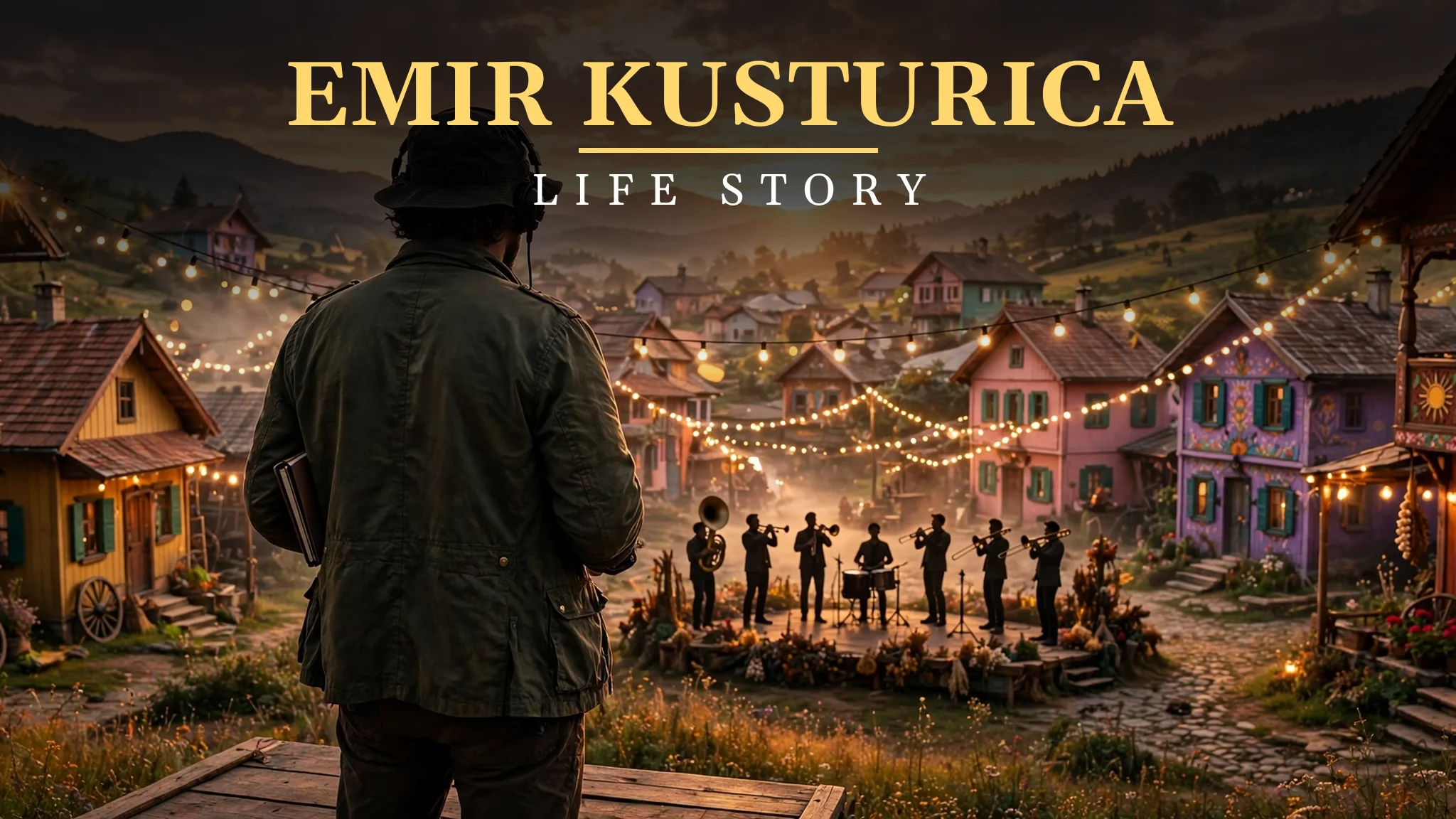
Finally, I return to the image of the village at sunset, with its coloured houses, its string lights, and its brass band, because that image, which is also the image on the cover of this story, captures what Kusturica does best, which is to make a place feel alive, with music, with light, and with people, and to invite the viewer to step into it, even for a few hours. I hope future viewers accept that invitation, with open eyes, and with an open mind, ready to enjoy the music, and ready to ask hard questions, because that is the best way to watch his films, and to remember his life.
Frequently Asked Questions
When was Emir Kusturica born and where did he grow up?
Emir Kusturica was born on 24 November 1954 in Sarajevo, in what was then Yugoslavia and is now Bosnia and Herzegovina. He grew up in a city where different peoples and faiths lived close together, and that mix of cultures shaped the music, humour, and crowded family life in his films.
Which films won Emir Kusturica the Palme d’Or at Cannes?
He won the Palme d’Or twice, for When Father Was Away on Business in 1985 and for Underground in 1995. He is one of the few directors to have won the festival’s top prize two times, and both films were set in the world of the former Yugoslavia.
What is Drvengrad and why did Kusturica build it?
Drvengrad, which means wooden town, is a village Kusturica built in the hills of Serbia near Mokra Gora. It has wooden houses, a church, a cinema, and streets named after people he admires, and it hosts the Kustendorf film festival for young filmmakers each year.
What is the No Smoking Orchestra?
The No Smoking Orchestra is a band Kusturica plays with, performing a mix of rock, folk, and Balkan brass music. He plays guitar and sings with the band, and they have toured in many countries, bringing the music heard in his films to live audiences.
Why is Emir Kusturica a controversial figure?
He is controversial mainly because of his public statements and choices during and after the wars that broke up Yugoslavia, which many people in Bosnia and elsewhere strongly disagreed with. His films are also debated, especially Underground, which some praise as a masterpiece and others criticise for the way it treats history.
What are Emir Kusturica’s best-known films for a new viewer?
A good starting point is Do You Remember Dolly Bell, When Father Was Away on Business, Time of the Gypsies, Underground, and Black Cat, White Cat. Together they show his humour, his music, his crowded style, and the Balkan world he films better than any other director.


