Ennio Morricone: The Life Story Behind Cinema's Greatest Composer
In this post
- A Boy From Rome and the Trumpet
- Radio, Pop Songs, and Learning the Craft
- The First Film Scores and Sergio Leone
- The Mission, The Untouchables, and the World Stage
- Cinema Paradiso, Malena, and the Music of Memory
- The Hateful Eight, the Oscar, and the Final Years
- The Sound of a Hundred Films: How Morricone Worked
- My Take:
Ennio Morricone wrote the music that the world hums without knowing who wrote it. The whistle from The Good, the Bad and the Ugly. The lonely oboe from The Mission. The sad and beautiful theme from Cinema Paradiso. The harmonica from Once Upon a Time in the West. These melodies are part of the life of everyone who has ever watched a film, and they were all written by one quiet man from Rome, a man who wrote more than four hundred film scores and who never stopped working, even when he was ninety years old.
He was born in Rome in 1928, the son of a trumpet player, and he learned music as a child, first the trumpet, then composition, at the great conservatory of Santa Cecilia. He worked in radio, he arranged pop songs, and he wrote music for the theatre, before he ever wrote a note for a film. When he finally did, with a small film in 1961, he began a career that would last for almost sixty years, a career that would change film music forever.
Morricone won an Oscar for The Hateful Eight when he was eighty-seven, the oldest person ever to win a competitive Oscar, and he was given an honorary Oscar in 2007 for his lifetime of work. He was a shy and private man, a man who worked every day, who loved his family, and who believed that music was a serious art, not a decoration. This is the story of how a boy from Rome became the greatest film composer who ever lived.
A Boy From Rome and the Trumpet
Ennio Morricone was born on 10 November 1928 in Rome. His father, Mario Morricone, was a trumpet player who worked in orchestras and in the theatre, and his mother, Libera, was a housewife. Ennio grew up in a home where music was a part of everyday life, and where his father taught him to play the trumpet when he was still a small boy. He learned to read music before he could read books well, and he learned that music was not a hobby. It was a job, a craft, and a way of life.
As a child, he played the trumpet in his father’s orchestra, and he learned to listen, to follow a conductor, and to play in a group. He also learned to love the sound of the trumpet, an instrument that would become the voice of his film music, the lonely sound that plays over the desert in his Westerns, the sound that says more than words ever could. He was a serious boy, a quiet boy, and he worked hard at his music, because he knew that talent was not enough. You had to practise, every day, for years, to become good.
When he was twelve years old, he entered the Conservatorio di Santa Cecilia in Rome, one of the most respected music schools in Italy. He studied the trumpet, and then he studied composition, learning to write music for orchestra, for choir, and for solo instruments. His teachers were strict, and the training was hard, but Morricone took to it with a passion. He loved the great composers, Bach, Mozart, and Beethoven, and he also loved the music of his own time, the strange and new sounds that were changing music in the twentieth century.
He graduated from the conservatory in the 1940s, and he began to work as a musician, playing the trumpet in orchestras and writing music for radio and for the theatre. He was a young man in a Rome that was rebuilding itself after the war, a city full of music, of film, and of hope. He did not yet know that he would become famous. He only knew that he loved music, and that he wanted to write it for the rest of his life.
Radio, Pop Songs, and Learning the Craft
In the 1950s, Morricone worked for RAI, the Italian public broadcaster, writing music for radio dramas and for television. He also worked for the record company RCA, arranging pop songs for some of the most famous Italian singers of the time. This work taught him a great deal. He learned to write music quickly, to write for different instruments, and to write music that people would remember. He learned that a good melody is a simple thing, a few notes that stay in the ear, and that the hardest thing in music is to write something simple and true.
He also wrote music for the theatre, and he worked with some of the best directors and actors in Italy. He was a young composer who was learning his craft, and he was not yet famous, but people in the music world knew his name, and they knew that he was talented. He was a quiet and hardworking man, and he did not seek attention. He preferred to work, to write, and to let the music speak for itself.
During these years, he met Maria Travia, and in 1956 he married her. They would be married for more than sixty years, until his death, and they had four children together. Maria was the centre of his life, and he often said that she was the reason he could work so hard, because she gave him a home, a family, and a place of peace. He was a family man, a man who went home after work, who ate with his family, and who wrote his music in the quiet of his own house.
He also continued to study and to write serious music, music for the concert hall, music that was experimental and difficult, and that showed his love of the great composers of the twentieth century. He never forgot that training, and it stayed in his film music, in the strange harmonies, in the unusual instruments, and in the way he could write a simple melody and a complex piece of music at the same time.
The First Film Scores and Sergio Leone
Morricone’s first film score was for Il federale, The Fascist, in 1961, a comedy directed by Luciano Salce. It was a small film, and the music was simple, but it was a beginning. He began to write music for more films, learning how film music works, how it must follow the images, how it must tell the audience what to feel, and how it must sometimes be silent, so that the images can speak for themselves.
Then, in 1964, he met Sergio Leone, and everything changed. Leone was making A Fistful of Dollars, a Western with almost no money, and he needed music that was new, that was different, and that would make his film stand out. Morricone gave him a score that no one had ever heard before: a whistle, a gunshot, a bell, an electric guitar, and a choir singing strange sounds. It was not the music of a traditional Western. It was something new, something wild, and something unforgettable.
The partnership between Leone and Morricone became one of the great partnerships in cinema. Morricone wrote the music for all of Leone’s films, from A Fistful of Dollars to Once Upon a Time in America, and their work together changed film music forever. Leone would often play Morricone’s music on the set, so that the actors could hear it and feel it, and Morricone would write the music before the film was shot, so that Leone could film to the music. That was a new way of working, and it made their films feel like a single work of art, where the images and the music were one thing.
The music for The Good, the Bad and the Ugly, in 1966, is perhaps the most famous film score ever written. The main theme, with its two notes, its whistle, and its chanting, is known all over the world, even by people who have never seen the film. It is a piece of music that captures the desert, the gold, and the three men who are chasing it, and it is a piece of music that will live forever.
The Mission, The Untouchables, and the World Stage
In the 1970s and 1980s, Morricone’s career grew beyond Italy, and he began to write music for films all over the world. He wrote the score for The Battle of Algiers in 1966, a film about the Algerian war, and for many other Italian films, but it was in the 1980s that he reached a new level of fame, with two scores that are now regarded as masterpieces.
The first was The Mission, in 1986, a film about Jesuit missionaries in South America in the eighteenth century, starring Robert De Niro and Jeremy Irons. Morricone’s music for the film is one of the most beautiful scores ever written, with the famous theme Gabriel’s Oboe, a melody for the oboe that is so sad and so beautiful that it makes people cry. The score was nominated for an Academy Award, and it is now played in concert halls all over the world, as a piece of music in its own right, not just as film music.
The second was The Untouchables, in 1987, a film about the American gangster Al Capone, directed by Brian De Palma and starring Kevin Costner and Sean Connery. Morricone’s music for the film is bold and dramatic, with a famous theme that captures the Chicago of the 1930s, and it was also nominated for an Academy Award. These two films showed that Morricone could write music for any story, in any country, and in any style, and that he was one of the greatest composers working in film.
He was nominated for the Academy Award five times in his career, for Days of Heaven, The Mission, The Untouchables, Bugsy, and Malèna, and each time he lost. It was a source of sadness for many people in the film world, because they believed he deserved to win. In 2007, the Academy gave him an honorary Oscar for his lifetime of work, and Clint Eastwood presented it to him, in a moving ceremony that recognised what the whole world already knew: that Morricone was a genius.
Cinema Paradiso, Malena, and the Music of Memory
Morricone’s partnership with Giuseppe Tornatore was another great chapter in his life. He wrote the music for Cinema Paradiso in 1988, and the theme he wrote for that film is one of the most loved melodies in the world. It is a simple and sad tune, a tune that captures the feeling of remembering a childhood, a cinema, and a friend who is gone. When people hear it, they think of the film, and they think of their own memories, and that is the power of Morricone’s music: it does not just belong to the film. It belongs to the listener.
He also wrote the music for The Legend of 1900, for Malèna, and for The Best Offer, all films by Tornatore, and each score is a masterpiece in its own right. The music for Malèna is especially beautiful, a sad and longing theme that captures the story of a woman who is loved and hated by a whole town. Morricone and Tornatore worked together for more than thirty years, and their partnership was built on trust, on respect, and on a shared love of cinema.
Morricone wrote more than four hundred film scores in his career, a number that is almost impossible to believe. He wrote for horror films, for comedies, for dramas, for Westerns, and for historical epics, and he wrote for directors in Italy, in France, in America, and all over the world. He worked every day, he wrote every day, and he never stopped, even when he was old, even when he was ill, even when he had won every honour there was to win.
He was a man of discipline. He woke early, he worked in his study, he wrote with a pen on paper, and he did not use a computer. He believed that music should be written by hand, slowly and carefully, and that a composer must think about every note. He was also a man of great humility. He did not think of himself as a star. He thought of himself as a worker, a man who wrote music for films, and who was lucky to be able to do the work he loved.
The Hateful Eight, the Oscar, and the Final Years
In 2015, when Morricone was eighty-seven years old, he wrote the score for The Hateful Eight, a Western directed by Quentin Tarantino. It was a dark and violent film, and Morricone’s music for it was dark and powerful, with a famous theme that captures the snow, the cold, and the hatred of the characters. The score won the Academy Award for Best Original Score, and Morricone became the oldest person ever to win a competitive Oscar. He went to Los Angeles, he stood on the stage, and he thanked his wife Maria, his family, and the directors he had worked with.
It was a wonderful moment, because it came after so many nominations and so many years of waiting. The whole world was happy for him, because they knew that he deserved it, and because they knew that he had waited a long time. He was eighty-seven, and he was still working, still writing, and still at the top of his art. That is a rare and inspiring thing.
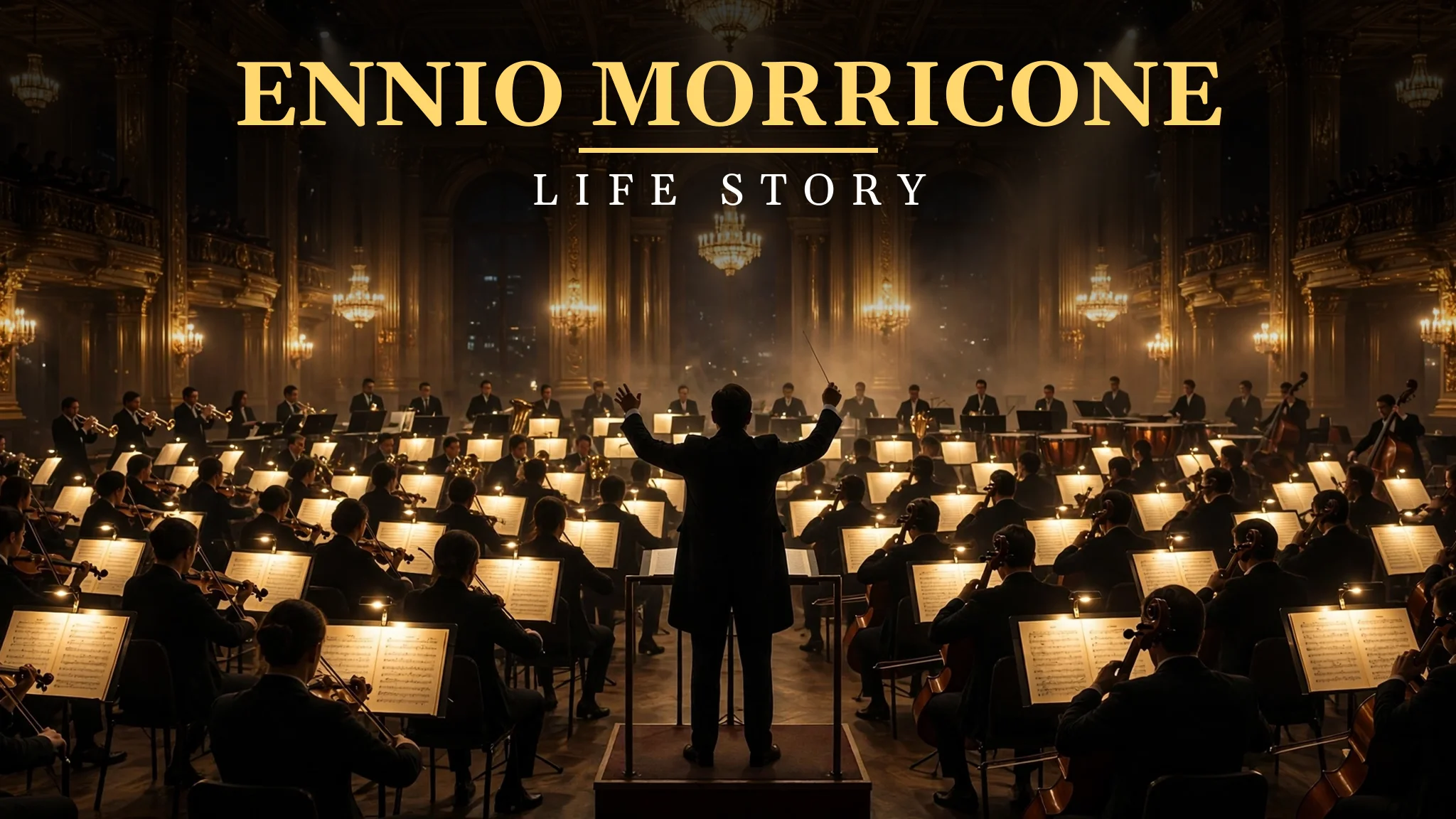
In his final years, Morricone continued to conduct concerts all over the world, standing in front of great orchestras and leading them through his most famous scores. Audiences in Rome, in London, in New York, and in many other cities stood and cheered for him, because they loved his music, and because they knew they were listening to a living legend. He was a quiet man on the podium, and the roar of a crowd made him uneasy, but the chance to hear a hundred musicians play the notes he had written, in a hall full of people who had come to listen, made every evening worthwhile.
He died on 6 July 2020 in Rome, at the age of ninety-one, after falling and breaking his leg. His death was mourned all over the world, and tributes came from directors, from musicians, and from millions of people who had grown up with his music. He was buried in Rome, the city where he was born, where he lived, and where he wrote the music that changed the world.
The Sound of a Hundred Films: How Morricone Worked
Ennio Morricone’s way of working was as remarkable as his music. He wrote with a pen on paper, sitting at a desk in his home in Rome, and he did not use a computer. He believed that music should be written by hand, slowly and carefully, and that a composer must think about every note, every instrument, and every silence. He woke early, he worked every day, and he treated music as a craft, as a job that must be done with discipline, not as a gift that comes and goes.
He was famous for his use of unusual sounds. In the Westerns, he used a whistle, a gunshot, a bell, an electric guitar, and a choir singing strange sounds, instruments that no one had ever used in a Western before. In other films, he used a harmonica, a Jew’s harp, a human voice humming, and even the sound of a typewriter. He believed that any sound could be music, if it was used with care, and that a film score should surprise the audience, not just comfort them.
He wrote quickly, but he wrote carefully. He could write a score in a few weeks, and he often worked on several films at the same time, but he never rushed, and he never gave a director a score that he did not believe in. He listened to the director, he watched the film, and he thought about what the music should say, and then he wrote it, note by note, until it felt right. That discipline is one of the reasons he wrote more than four hundred scores, a number that is almost impossible to believe, and that each one feels complete.
He also conducted concerts all over the world, standing in front of great orchestras and leading them through his most famous scores. Audiences in Rome, in London, in New York, and in many other cities stood and cheered for him, because they loved his music, and because they knew they were listening to a living legend. He was a shy man, and he did not enjoy the applause, but he enjoyed the music, and he enjoyed sharing it with the people who loved it.
Morricone was also a serious composer, a man who wrote music for the concert hall, music that was experimental and difficult, and that showed his love of the great composers of the twentieth century. He never forgot that training, and it stayed in his film music, in the strange harmonies, in the unusual instruments, and in the way he could write a simple melody and a complex piece of music at the same time. He believed that film music was not a lesser art. It was a great art, and it deserved the same care as a symphony, or an opera, or a string quartet.
In his final years, he continued to work, to write, and to conduct, even when he was old, even when he was ill, and even when he had won every honour there was to win. He did not stop, because music was his life, and because he believed that a composer must keep working, as long as he can, as long as there is a melody in his head, and as long as there is a film that needs it. That is a rare and inspiring way to live, and it is why his music will live long after him.
Morricone’s music also lives on in the concert hall, where orchestras all over the world still play his scores, not as film music, but as music in its own right. Gabriel’s Oboe is played at weddings and at funerals, the theme from Cinema Paradiso is played in concerts and on the radio, and the whistle from The Good, the Bad and the Ugly is known by people who have never seen a Western. That is a rare thing, for film music to outlive the films it was written for, and to become a part of the world’s music, and it shows that Morricone was not just a film composer. He was a composer, in the fullest sense, a man whose melodies belong to everyone, and who will be played for as long as people listen to music.
My Take:
When I think about Ennio Morricone, I think about a man who wrote the soundtrack of my life, and of the lives of millions of people, without most of them knowing his name. That is a strange and wonderful thing. You can hum the theme from The Good, the Bad and the Ugly, you can cry at the oboe from The Mission, and you can remember Cinema Paradiso from a few notes, and you may not know that all of those melodies were written by the same quiet man from Rome. I think that is the mark of a great artist: his work lives in the world, even when his name does not, and it becomes a part of people’s lives.
I think his music is great because it is simple. A few notes, a whistle, a trumpet, an oboe, and suddenly you are in the desert, or in a jungle, or in a small cinema in Sicily. He did not need a hundred instruments to make you feel something. He needed the right notes, played at the right time, with the right feeling. That is the hardest thing in music, to be simple and true, and Morricone did it again and again, in film after film, for almost sixty years. I admire that more than I can say, because simplicity is easy to talk about and hard to achieve.
What I love most about his partnership with Sergio Leone is that they made something new together. Before them, Western music was about violins and trumpets playing a heroic tune. Morricone gave Leone a whistle, a gunshot, a bell, and a choir singing strange sounds, and it worked, because it captured the strangeness of the West, a place that was both beautiful and brutal. They planned the music together, they talked about it, and they made films where the music and the images were one thing. That is a lesson for anyone who works in art: find a partner you trust, and work together as equals, and you will make something neither of you could make alone.
I also think about The Mission, and about Gabriel’s Oboe, because it is one of the most beautiful pieces of music I have ever heard. It is a simple melody, played on an oboe, and it says everything about the film: about faith, about loss, about a man who tries to bring peace to a violent world, and who fails. When I hear it, I feel sad, and I feel hopeful at the same time, and I think that is what great music does. It does not tell you what to feel. It lets you feel, and it gives you room to feel more than one thing at once.
There is something I find moving about his Oscar win for The Hateful Eight, because he was eighty-seven years old, and he had been nominated five times before and had never won. Many people would have given up, or would have become bitter. Morricone did not. He kept working, he kept writing, and when the Oscar finally came, he accepted it with grace, and he thanked his wife, his family, and the directors he had worked with. That is a lesson in patience, and in dignity. Good work is not always rewarded at once, and sometimes it takes a lifetime, but if you keep working, and if you keep believing in what you do, the reward will come, even if it comes late.
I also think about his discipline, because it is something I admire and something I struggle with myself. He woke early, he worked every day, he wrote with a pen on paper, and he did not stop, even when he was old and famous. He treated music as a craft, as a job that must be done every day, not as a gift that comes and goes. That is a wise way to live, and it is why he wrote more than four hundred scores. He did not wait for inspiration. He worked, and the inspiration came through the work. I think that is true for every kind of art, and for every kind of work. You do not wait. You begin, and you keep going.
One thing I notice about Morricone is his humility. He was one of the greatest composers in the world, and he did not act like a star. He was a quiet man, a family man, a man who went home after work and who wrote his music in his own house. He did not seek fame, and he did not enjoy the applause. He enjoyed the music, and that was enough. I think that is a good way to live, because fame is a fragile thing, and it can be taken away, but the work remains, and the work is what matters.
I also think about his love for his wife Maria, because they were married for more than sixty years, and he thanked her when he won his Oscar. That is a long marriage, and a rare one, and it tells me something about the man. He was not just a great composer. He was a faithful husband, a father, and a man who built a life around his family and his work. That is a full life, and it is a life worth admiring, not just for the music, but for the way he lived it.
In the end, I think Ennio Morricone’s story teaches us that music is not a decoration. It is not something you add to a film to make it prettier. It is a part of the story, a part of the feeling, and a part of the truth. Morricone understood that, and he wrote music that told the story, that carried the emotion, and that stayed with the audience long after the film ended. His melodies are still with us, in our heads, in our hearts, and in the films we love, and they will be with us for as long as people watch films and listen to music. That is a legacy that few artists ever achieve, and I am grateful that he shared his music with the world.
There is one more thing I want to say about Morricone, and it is about his trumpet. He learned to play the trumpet as a boy, in his father’s orchestra, and the sound of the trumpet stayed with him for his whole life. It is the lonely sound that plays over the desert in his Westerns, the sound that says more than words ever could, and it is the sound of a boy from Rome who learned music from his father, and who never forgot it. When I hear that trumpet, I think about fathers and sons, about the music that passes from one generation to the next, and about the love that lives in a melody. That is a beautiful thing, and it is why his music feels so personal, even when it is written for a film about strangers in a desert.
I also think about the five times he was nominated for an Oscar and did not win, and about how he must have felt, sitting in the audience, hearing another name called, again and again. Many people would have become bitter. Morricone did not. He kept working, he kept writing, and when the Oscar finally came, for The Hateful Eight, when he was eighty-seven, he accepted it with grace, and he thanked his wife, his family, and the directors he had worked with. That is a lesson in patience, and in dignity, and it is a lesson I want to remember: good work is not always rewarded at once, and sometimes it takes a lifetime, but if you keep working, the reward will come, even if it comes late.
If I could ask him one question, I would ask him which melody he loved most, which one he would want to be remembered by. I think he might say Gabriel’s Oboe, because it is so beautiful, and so sad, and because it is played in concert halls all over the world. Or he might say the theme from Cinema Paradiso, because it is the music of memory, and of a childhood that is gone. Or he might say the theme from The Good, the Bad and the Ugly, because it is the music that everyone knows, even people who have never seen the film. I do not know which one he would choose, and perhaps he would not choose at all, because a composer loves all his children, even the ones the world forgets.
I also think about his concerts, and about the audiences who stood and cheered for him, in Rome, in London, and in New York. He was a shy man, and the cheering of a crowd made him uneasy, yet he loved the music itself, and he loved hearing it played for people who had come to listen. I think about what it must have felt like to stand in front of a great orchestra, to raise your arms, and to hear a hundred musicians play the music you wrote, in a hall full of people who came to listen. That is a wonderful feeling, and I am glad he lived to feel it, again and again, in his final years.
Another thought that stays with me is about his wife Maria, and about their marriage of more than sixty years. He thanked her when he won his Oscar, and that thank you said everything about the man. He was not just a great composer. He was a faithful husband, a father, and a man who built a life around his family and his work. That is a full life, and it is a life worth admiring, not just for the music, but for the way he lived it, quietly, faithfully, and with love.
I also want to say something about his discipline, because it is something I admire and something I struggle with myself. He woke early, he worked every day, he wrote with a pen on paper, and he did not stop, even when he was old and famous. He treated music as a craft, as a job that must be done every day, not as a gift that comes and goes. That is a wise way to live, and it is why he wrote more than four hundred scores. He did not wait for inspiration. He worked, and the inspiration came through the work. I think that is true for every kind of art, and for every kind of work, and I try to remember it when I am waiting for the right moment to begin.
Finally, I want to say why I will keep listening to his music. It is not because he is famous, or because he won an Oscar, or because the critics call him a genius, although all of those things are true. It is because his melodies live in my head, in my heart, and in the films I love, and because they remind me that music is not a decoration. It is a part of the story, a part of the feeling, and a part of the truth. Morricone understood that, and he wrote music that told the story, that carried the emotion, and that stayed with the audience long after the film ended. His melodies are still with us, and they will be with us for as long as people watch films and listen to music, and that is a legacy that few artists ever achieve.
One more melody stays with me, and it is the theme from Cinema Paradiso, a tune so simple and so sad that it makes me think of my own childhood, of the places I loved, and of the people who taught me. When I hear it, I do not just think of a film. I think of my own memories, of the cinemas I sat in, of the friends I watched films with, and of the time that has passed since then. That is the power of Morricone’s music: it does not just belong to the film. It belongs to the listener, to their memories, and to their life, and that is why it will live forever, in concert halls, on the radio, and in the hearts of everyone who has ever heard it.
Frequently Asked Questions
When was Ennio Morricone born and when did he die?
Ennio Morricone was born on 10 November 1928 in Rome, Italy, and he died on 6 July 2020 in Rome at the age of ninety-one, after a fall in which he broke his leg.
How many film scores did Ennio Morricone write?
He wrote more than four hundred film scores in a career that lasted almost sixty years, working with directors in Italy, France, America, and all over the world.
Which films did Ennio Morricone work on with Sergio Leone?
He wrote the music for all of Leone’s films from A Fistful of Dollars onwards, including For a Few Dollars More, The Good, the Bad and the Ugly, Once Upon a Time in the West, and Once Upon a Time in America.
What is Gabriel’s Oboe?
Gabriel’s Oboe is the famous melody from The Mission, the 1986 film about Jesuit missionaries in South America. It is one of Morricone’s most loved pieces and is now played in concert halls around the world.
When did Ennio Morricone win his Oscar?
He won the Academy Award for Best Original Score for The Hateful Eight in 2016, when he was eighty-seven, becoming the oldest person ever to win a competitive Oscar. He had also received an honorary Oscar in 2007.
Did Ennio Morricone write the music for Cinema Paradiso?
Yes, he wrote the music for Cinema Paradiso and for almost all of Giuseppe Tornatore’s films, including The Legend of 1900, Malèna, and The Best Offer.


