Erykah Badu: The Life Story Behind Neo-Soul's Queen
In this post
Erykah Badu does not sound like anyone else, and she does not try to. When her first album arrived in 1997, it felt like a voice from another time had walked into the present day. Her singing was loose and jazzy, her words were wise and funny and strange, and her style was entirely her own. She wore tall head wraps, long flowing clothes, and jewellery that looked like it came from a market in another country. She was called the Queen of Neo-Soul, and the title fit, but it never quite captured her. She was not only a singer. She was a poet, a thinker, a mother, and a woman who refused to let the music business tell her who to be.
She was born Erica Abi Wright in Dallas, Texas, and she grew up in a home where art, music, and strong women mattered. Her mother raised her and her siblings largely on her own, and the family was close. As a girl, Erykah danced, acted, and sang, and she was drawn to the stage from an early age. She studied at a performing arts school in Dallas, and she began to write poetry and songs. She loved jazz, especially the work of Billie Holiday, and she loved hip hop, soul, and the sounds of her own neighbourhood. She took all of those loves and made something new from them.
Her career has lasted for nearly three decades, and it has never followed a simple path. She made a classic first album, a deeper second album, and then a series of records that explored politics, love, motherhood, and the world around her. She has acted in films, she has worked as a doula helping mothers give birth, and she has remained a powerful live performer. She has also been a mother to three children, and she has spoken openly about the joy and the difficulty of raising them while keeping a career. This is the story of a woman who built a life on her own terms, and whose voice still sounds like no one else.
A Dallas Girl Raised by Strong Women
Erica Abi Wright was born on 26 February 1971 in Dallas, Texas. Her mother, Kolleen Wright, raised Erica and her brother and sister, and the family lived a modest life. Her mother worked hard to give her children a stable home, and she encouraged them to be creative. Erica’s grandmother was also an important figure in her life, and the women of the family taught her to be independent, to speak her mind, and to value her own voice. Those lessons stayed with her, and they shaped both her music and her public life.
As a child, Erica was drawn to the arts. She danced, she sang in the choir, and she performed in school plays. She was a bright and curious girl, and she loved to read and to write. She attended the Booker T. Washington High School for the Performing and Visual Arts in Dallas, a school known for training young artists. There she studied dance and theatre, and she began to think seriously about a life in the arts. Her teachers saw a young woman with a strong sense of self, and they encouraged her to keep developing her own style.
After school, she studied at Grambling State University in Louisiana, where she majored in theatre. She left before finishing her degree, because she wanted to focus on music and performance. She returned to Dallas and began to work as a teacher and a performer, singing in local clubs and writing songs. She took the name Erykah Badu, with Erykah a variation of her own name and Badu a word she loved for its sound and its meaning in African culture. The name marked a new beginning, and it gave her a stage identity that felt true to who she was.
In Dallas, she built a small but loyal following. She performed at open mic nights, she worked with local musicians, and she recorded demos. Her voice was unusual, with a jazz-like phrasing that made even simple songs sound deep. She was also a striking presence on stage, with her tall head wraps and her flowing clothes. People who saw her perform remembered her, and word began to spread. She was not trying to sound like the pop singers of the time. She was trying to sound like herself, and that honesty was what made her stand out.
Baduizm and a Star Is Born
Erykah Badu’s first album, Baduizm, was released in 1997, and it changed her life at once. The album was warm, jazzy, and deeply soulful, and it featured the hit single On and On, which became one of the most loved songs of the year. The record reached the top of the American rhythm and blues chart, and it won the Grammy Award for Best R and B Album. Badu also won the Grammy for Best Female R and B Vocal Performance. She was twenty-six years old, and she had made one of the most important debut albums of the decade.
Baduizm mattered because it sounded like nothing else on the radio. The music was built on live instruments, with a loose, jazzy feel that owed a debt to Billie Holiday, to jazz, and to the soul music of the 1970s. Her lyrics were wise and playful, talking about love, about life, about staying true to yourself. Songs like On and On, Next Lifetime, and Otherside of the Game showed a singer who could be tender, funny, and serious in the same breath. Critics praised the album, and it sold millions of copies. It also helped to define neo-soul, alongside the work of D’Angelo and Maxwell.
The success of Baduizm brought her fame, touring, and attention from around the world. She performed on television, she appeared on magazine covers, and she became known for her style as much as for her music. Her head wraps became a signature, and her fashion sense was widely copied. She was not a pop star in the usual sense. She was an artist who looked and sounded like herself, and that was what people loved. She toured widely, and her live shows were warm, funny, and unpredictable, with long jams and moments of pure improvisation.
During this period, she also began a relationship with the rapper and singer Andre 3000, of the group Outkast. They had a son together, Seven Sirius Benjamin, born in 1997. The relationship ended, but they remained connected through their child. Badu has always been open about motherhood, and she has spoken about the joy and the challenge of raising children while keeping a career. She was a young mother and a new star at the same time, and she handled both roles with a strength that many people admired.
Mama’s Gun and Going Deeper
Badu’s second album, Mama’s Gun, was released in 2000, and it was deeper and more personal than her first. It was recorded with the Soulquarians, the circle of musicians that included Questlove, J Dilla, and James Poyser, and it had a richer, more live sound. The single Bag Lady became a hit, and the album was praised for its honesty and its musical depth. Songs like Didn’t Cha Know and Green Eyes showed a singer who was willing to talk about pain, about love that hurts, and about the work of healing. The album was a success, and it confirmed that Badu was not a one-album wonder.
Mama’s Gun was important because it showed her growth. She was no longer a newcomer. She was a woman who had lived through love, through motherhood, and through fame, and her songs reflected that experience. The record was longer and more complex than Baduizm, and it asked more of the listener. It was not a collection of easy hits. It was a full album, meant to be heard from start to finish, and it rewarded people who gave it time. Critics called it one of the best albums of the year, and it remains one of her most loved records.
After Mama’s Gun, Badu continued to work, but she took her time. She released Worldwide Underground in 2003, a looser and more experimental record, and she toured widely. She also began to act, appearing in films such as The Cider House Rules in 1999, for which she won praise, and Blues Brothers 2000. Her acting was natural and warm, and it showed another side of her talent. She was not trying to be a movie star. She was a performer who could step into a role and make it her own, just as she did with a song.
During these years, she had two more children, a son named Puma with the rapper The D.O.C., born in 2004, and a daughter named Mars with the rapper Jay Electronica, born in 2009. She has spoken openly about being a mother of three children by three different fathers, and she has done so without shame or apology. She has said that motherhood is central to her life, and that her children are her greatest work. That honesty has made her a role model for many women who are trying to balance family and career.
New Amerykah and the Political Voice
In 2008, Badu released New Amerykah Part One, an album that was more political than anything she had made before. It spoke about race, about poverty, about war, and about the state of America, and it did so with a sound that mixed soul, funk, hip hop, and jazz. The album was praised by critics, and it showed that Badu was not afraid to use her voice for more than love songs. She had always been a thinker, and now she was putting her thoughts into her music in a direct way.
The second part, New Amerykah Part Two, was released in 2010, and it was more personal and romantic. It featured the song Window Seat, which became famous for its music video. In the video, Badu walked through Dallas, slowly removing her clothes, until she was naked in the street. The video was a statement about freedom, about the body, and about the assassination of President John F. Kennedy in Dallas. It caused a great deal of discussion, and Badu was fined for the public display. She stood by the work, and she said that it was art, not a stunt. The video remains one of the most talked about of her career.
The New Amerykah albums showed a woman who was not afraid to grow and to change. She was in her late thirties, a mother of three, and a veteran of the music business, and she was still taking risks. She toured behind the albums, and her shows were powerful. She sang the old songs, she sang the new ones, and she spoke to the audience about the world around them. She was not a singer who stayed in the past. She was an artist who kept moving forward, even when the path was not easy.
In the years since, she has released music more slowly. She released the mixtape But You Caint Use My Phone in 2015, a playful record built around the theme of the telephone. She has performed at festivals, she has collaborated with younger artists, and she has remained a beloved live performer. She has also worked as a doula, helping women through childbirth, and she has spoken about the importance of that work. She is a woman of many talents, and she has used them all.
A Life Lived on Her Own Terms
Erykah Badu’s legacy is not only her music. It is the way she has lived her life. She has refused to be told how to dress, how to sing, how to raise her children, or how to speak. She has been honest about her choices, and she has stood by them even when they were unpopular. She has been a feminist voice, a Black voice, and a mother’s voice, all at once, and she has done it without apology. That independence is rare in the music business, and it is one of the reasons she is so admired.
Her influence can be heard in the work of many younger singers who value honesty, jazz phrasing, and a strong sense of self. Artists who mix soul, hip hop, and jazz, who write about real life, and who refuse to fit into a single box owe something to her example. She showed that a woman could be sexy and wise, funny and serious, a mother and an artist, all at the same time. She showed that a singer could be a thinker, and that a thinker could be a singer. Her work has lasted because it is true, and because it comes from a real person.
She remains active, performing, recording, and speaking her mind. Her concerts are still warm, funny, and unpredictable, and her audience spans generations. Young people who were not born when Baduizm was released now discover her music and love it. Older fans who have followed her since the beginning still come to her shows. She is a bridge between generations, between jazz and hip hop, between the past and the present, and that is a rare and valuable place to be.
Style, Image, and the Head Wrap
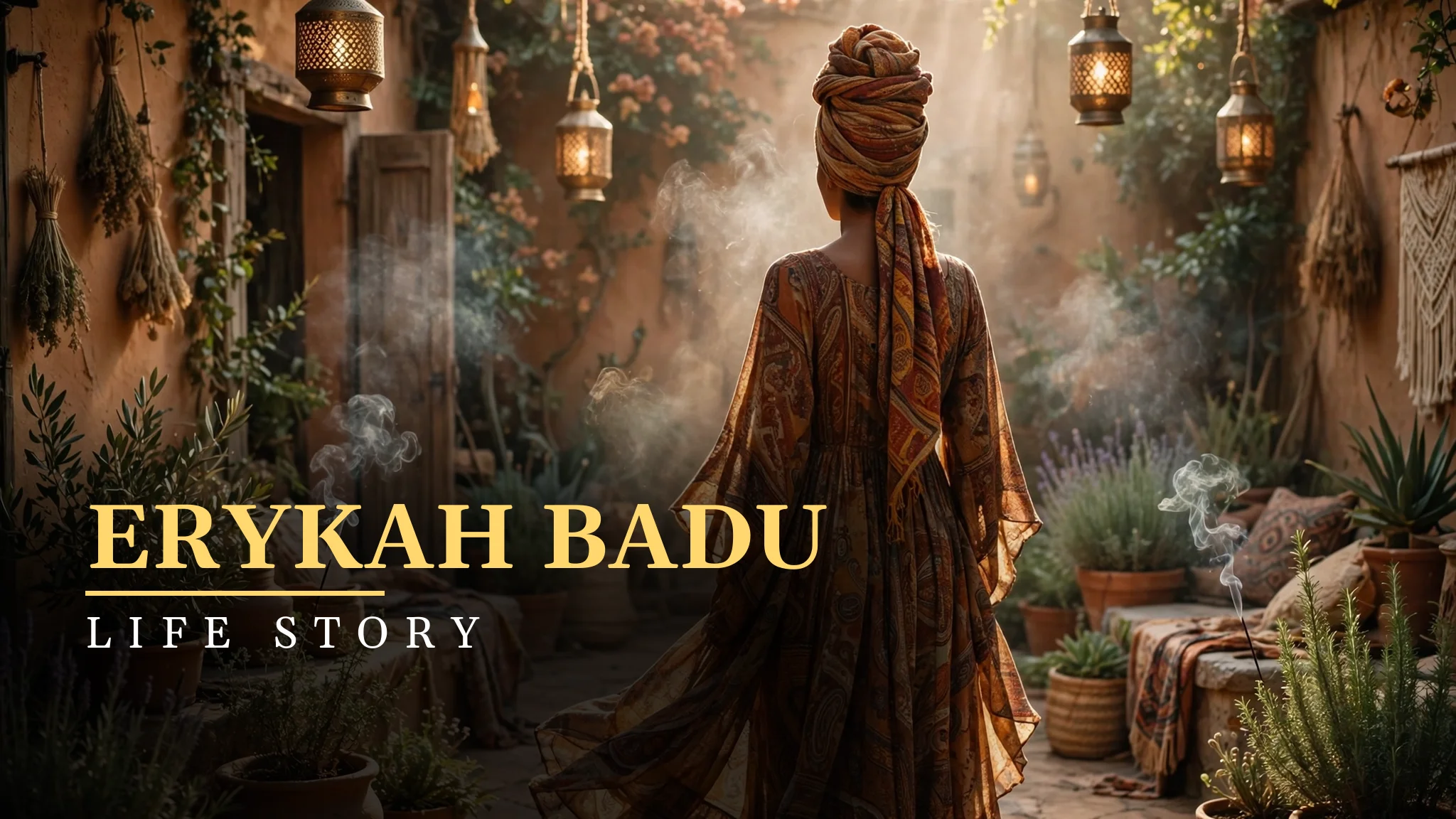
Erykah Badu’s style is as famous as her music, and it is not an accident. She wears tall head wraps, long flowing dresses, large jewellery, and clothes that mix African, bohemian, and vintage influences. The look is entirely her own, and it tells a story before she sings a single note. It says that she is proud of her heritage, that she values beauty that is not bought from a fashion magazine, and that she dresses for herself rather than for the camera. Young women who saw her on television in 1997 recognised something new. Here was a star who looked like she had come from a different world, a world where Black beauty was celebrated in its full richness.
The head wrap became her signature, and it has been copied by many people, but it was never only a fashion choice. It was a statement about identity, about history, and about the right to be seen on your own terms. Badu has said that her style comes from her mother, her grandmother, and the women she grew up around, and that it is a way of honouring them. She does not follow trends. She sets her own course, and the fashion world has followed her. That independence is part of what makes her a cultural figure, not only a singer.
Her style has changed over the years, as any living artist’s style should, but it has always remained personal. Sometimes she wears a simple dress, sometimes she wears something bold and strange, and always she looks like herself. She has been photographed in many different looks, and each one feels true. That is because her style is not a costume. It is an expression of who she is, and it grows with her. She has shown that a woman can be beautiful without fitting into a narrow idea of beauty, and that lesson has mattered to many people.
The Doula and the Healer
One of the least known parts of Erykah Badu’s life is her work as a doula, a person who helps women through pregnancy and childbirth. She trained as a doula, and she has helped many women give birth, offering comfort, advice, and support during one of the most important moments of their lives. She has spoken about this work with great seriousness, and she has said that it is one of the most meaningful things she does. It is not a hobby. It is a calling, and it comes from the same place as her music: a love of life, a respect for women, and a belief that birth is sacred.
Her work as a doula connects to her music in a deep way. Both are about helping people through moments of vulnerability, about being present, about listening, and about offering comfort. A song can comfort a person who is sad. A doula can comfort a woman who is giving birth. Both require patience, kindness, and the ability to be still and to listen. Badu has both of those skills, and she uses them in both parts of her life. That is a rare and beautiful thing, and it tells us something important about who she is.
She has also spoken about health, about natural living, and about the importance of taking care of the body. She is known for her interest in herbs, in natural remedies, and in a way of life that is close to the earth. Some people find those interests unusual, but they are consistent with her overall approach to life. She values what is natural, what is true, and what is rooted in tradition. She does not trust every new thing simply because it is new. She asks whether it is good, whether it is honest, and whether it helps people. That is a wise way to live, and it is a way of life that she has modelled for her audience.
Collaborations and a Wider Circle
Erykah Badu has always worked well with other artists, and her collaborations have added rich chapters to her story. She has sung with the Roots, with Outkast, with Common, and with many younger singers who sought her wisdom and her voice. These collaborations were not about chasing a hit. They were about musical friendship, about sharing ideas, and about learning from each other. When Badu sings with another artist, she does not try to dominate the song. She listens, she responds, and she adds her own colour to the music. That generosity is part of what makes her loved by other musicians, and it is why so many of them have wanted to work with her.
She has also appeared on records by artists from very different worlds, from hip hop to jazz to electronic music, and she has brought her own sound to each one. That range shows how flexible her voice is, and how deep her musical knowledge runs. She can sing over a hip hop beat, over a jazz piano, or over a simple guitar, and she always sounds like herself. That is the mark of a true artist. The setting changes, but the voice remains true, and the listener always knows who is singing.
My Take:
When I listen to Erykah Badu, I feel like I am listening to a woman who knows exactly who she is. I think about On and On, and I remember how strange and beautiful it sounded the first time I heard it. The music was slow, the words were wise, and her voice moved like smoke. She sang about life, about love, about staying true to yourself, and she did it in a way that felt like a conversation with a friend who had seen more of the world than I had. I have heard many singers who try to sound wise, and most of them fail. Badu does not try. She simply is wise, and her music shows it.
I admire her most for her independence. She has never let anyone tell her how to be. She wears what she wants to wear, she sings what she wants to sing, and she says what she wants to say. I think about how hard that must be in the music business, where everyone wants you to fit into a box. The label wants a hit. The radio wants a simple song. The magazines want a simple image. Badu refused all of that. She wore a tall head wrap when other singers wore short dresses. She sang long, jazzy songs when other singers sang short pop songs. She talked about politics when other singers talked only about love. I think that takes real courage, and I respect it deeply.
I also think about her as a mother, and I feel a deep admiration for her. She has three children, and she has raised them while keeping a career that has lasted for nearly thirty years. I know how hard it is to be a parent, and I know how hard it is to be an artist. To do both, and to do both well, is a remarkable thing. She has spoken openly about her children, about their fathers, and about the choices she has made, and she has done so without shame. I think that honesty helps other mothers, because it tells them that they do not have to be perfect. They only have to be honest, loving, and true to themselves.
Mama’s Gun is the record that moves me most. I think about Bag Lady, and I hear a song about carrying too much pain from the past. I think about Green Eyes, and I hear a song about jealousy and love and the difficulty of trusting another person. These are not easy songs. They are songs about real feelings, the kind that are hard to talk about. Badu sings them with a tenderness that makes me feel less alone. I think many people have felt like a bag lady, carrying old hurts that they cannot put down. Badu gave that feeling a voice, and she did it with kindness. That is a gift, and I am grateful for it.
The Window Seat video is something I think about often, because it shows how brave she is. I know that many people were shocked by it, and I understand why. A woman walking naked through a public street is a powerful image, and it is not one that everyone will accept. But I think Badu was making a serious point about freedom, about the body, and about the history of Dallas. She was not doing it for attention. She was doing it because she believed in the work. I admire that she stood by it, even when she was fined and criticised. It is easy to be brave when everyone agrees with you. It is much harder to be brave when people are angry, and Badu was brave.
I also love her sense of humour. She is funny, and her music is often funny in a gentle way. She can sing a serious song, and then she can make a joke that makes the whole room laugh. I think that humour is part of her wisdom. She knows that life is hard, and she knows that laughter helps. Her live shows are famous for their warmth and their unpredictability, and I think that is because she is a real person on stage, not a polished act. She talks to the audience, she tells stories, she laughs, and she sings. That is the kind of performance I love, because it feels human.
What I learn from her life is that a woman does not have to choose between being a mother and being an artist, between being sexy and being wise, between being funny and being serious. Badu has been all of those things at once, and she has done it without apology. I think that is a powerful lesson for young women, and for young men too. It tells us that we do not have to fit into one box. We can be many things, and we can be true to all of them. That is a kind of freedom, and Badu has lived it.
I also think about her work as a doula, and I find it deeply moving. She helps women give birth, and she does it with the same care and wisdom that she brings to her music. I think that work tells me something important about who she is. She is not only a singer. She is a helper, a healer, and a witness to one of the most important moments in a woman’s life. That is a beautiful thing, and it makes me respect her even more. She uses her gifts to help others, not only to entertain them.
In the end, I think Erykah Badu teaches me that the most important thing an artist can do is to be herself. She has been herself for nearly thirty years, through fame, through motherhood, through criticism, and through change. She has not chased trends, she has not copied others, and she has not let anyone tell her who to be. Her music is the sound of a woman who knows her own mind, and that is a rare and beautiful sound. I will keep listening to her, and I will keep learning from her, because her voice still has much to teach me.
I also want to say that Baduizm still sounds fresh to me. I can play it today, and it does not sound like a record from 1997. It sounds like a record from a timeless place, where jazz and soul and hip hop meet. That is the test of great music. It does not belong to one year. It belongs to every year, because the feelings in it are true. Erykah Badu made a record that will last, and she has spent the years since proving that she is more than one record. She is a whole life, lived on her own terms, and I admire that life deeply.
I think about her childhood in Dallas, too, and how the strong women around her shaped her. Her mother raised her, her grandmother guided her, and the women of her family taught her to speak her mind. I think that is why she is so fearless now. She learned early that a woman’s voice matters, and she has never forgotten that lesson. I admire the women who raised her, and I admire her for honouring them in her music, her style, and her life.
I also think about the way she sings about love, and how different it is from most love songs. She does not sing about love as if it were a fairy tale. She sings about love as it really is, complicated, painful, joyful, and sometimes disappointing. When I hear her sing about a lover who has hurt her, I feel the pain, but I also feel the strength. She does not beg. She does not pretend. She tells the truth, and she moves on. I think that is a powerful message, especially for young women who are learning about love for the first time.
There is a part of her story that makes me sad, and it is the way she has sometimes been misunderstood. People have called her strange, difficult, or eccentric, when what she really is, is honest. She does not fit into a simple box, and that makes some people uncomfortable. I think that is unfair, and I think it shows how hard it is for a woman who thinks for herself to be accepted. Badu has faced that misunderstanding with grace, and she has kept being herself. I respect that, and I think it is a lesson for all of us. Being misunderstood is not a reason to change. It is a reason to stay true.
In the end, I think Erykah Badu teaches me that art and life are the same thing. Her music is her life, her style is her life, her work as a doula is her life, and her motherhood is her life. She does not separate them. She lives them all at once, with honesty and courage. I will keep listening to her, and I will keep learning from her, because she is a woman who has lived on her own terms, and that is the most inspiring thing of all.
I think about her influence on younger artists, too, and how large it is. Many young singers today mix soul, jazz, and hip hop, write about real life, and refuse to fit into a single box. They learned that from Badu. She showed them that it was possible to be a thinking singer, a singer who reads, who writes, who speaks about the world, and who still makes beautiful music. I think that influence will last for a long time, because it is not about a single song. It is about a way of being an artist, and that way of being is powerful.
I also think about the way she has aged as an artist, and how gracefully she has done it. She was twenty-six when Baduizm was released, and now she is in her fifties, a mother of three, and a veteran of the music business. She has not tried to stay young. She has grown older with dignity, and her music has grown with her. The early songs were about young love. The later songs are about mature love, about politics, about motherhood, and about the world. That growth is beautiful, and it shows that an artist can get better with age.
When I compare Badu with other singers of her time, what stands out is her courage. Other singers played it safe, made simple records, and avoided controversy. Badu took risks, spoke her mind, and made art that challenged people. That courage has cost her at times, but it has also made her one of the most respected artists of her generation. I admire that courage, and I think it is a lesson for anyone who creates something. Safety is comfortable, but courage is what makes art last.
I will end by saying that I am grateful for Erykah Badu, for her music, for her honesty, and for her example. She has shown me that a woman can be many things at once, and that she can be true to all of them. I will keep listening to her records, and I will keep learning from her, because her voice still has much to teach me about love, about life, and about the courage to be yourself.
I also think about the joy in her music, and how important that joy is. She is a serious artist, but she is also a joyful one. Her songs make me smile, her live shows make me laugh, and her interviews make me think. That combination of joy and seriousness is rare, and it is why her work has lasted through so many years and changes, and why it will last for many more. She does not only make me think. She makes me feel alive, and that is a gift that I treasure.
Frequently Asked Questions
What is Erykah Badu’s real name and where was she born?
Her real name is Erica Abi Wright, and she was born on 26 February 1971 in Dallas, Texas. She was raised by her mother and studied at a performing arts high school in Dallas before turning to music full time.
What made Baduizm such an important debut?
Baduizm, released in 1997, mixed soul, jazz, and hip hop in a warm and original way, with the hit On and On. It won the Grammy for Best R and B Album and helped to define neo-soul alongside the work of D’Angelo and Maxwell.
How many children does Erykah Badu have?
She has three children: a son, Seven, with Andre 3000; a son, Puma, with The D.O.C.; and a daughter, Mars, with Jay Electronica. She has spoken openly about motherhood and about balancing family life with her career.
What was the Window Seat video about?
The video for Window Seat in 2010 showed Badu walking through Dallas and slowly removing her clothes, as a statement about freedom, the body, and the history of the city, including the assassination of President Kennedy there. It caused wide discussion and she was fined for the public display.
Has Erykah Badu acted in films?
Yes, she appeared in The Cider House Rules in 1999 and in Blues Brothers 2000, among other roles. Her acting was praised for its natural warmth, and she has also worked as a doula helping mothers through childbirth.
What are the New Amerykah albums?
New Amerykah Part One, released in 2008, and Part Two, released in 2010, were more political and personal records. The first spoke about race, poverty, and America, while the second was more romantic and included Window Seat.


