Esther Rolle: The Life Story Behind the Good Times Star
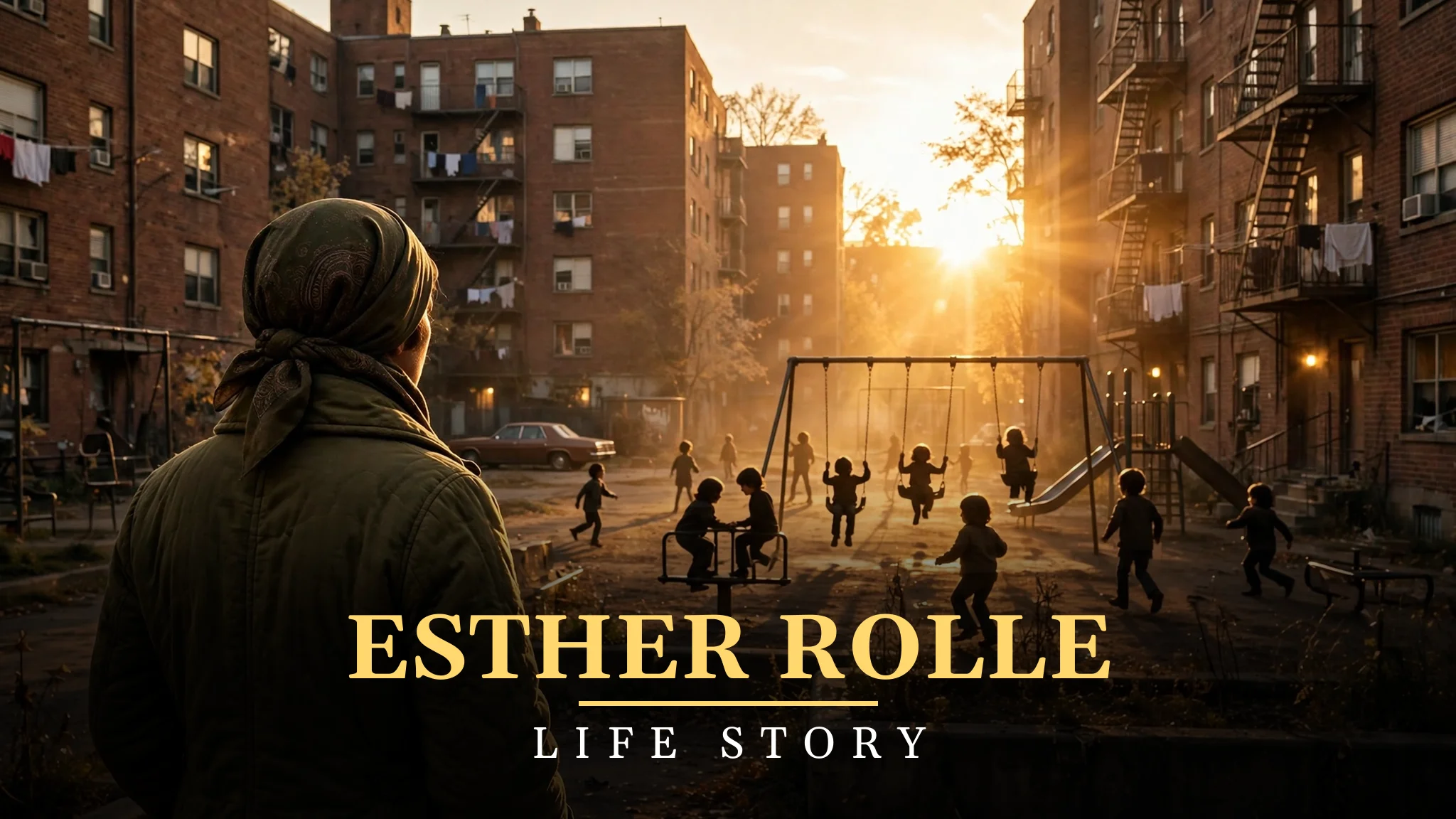
In this post
Esther Rolle played a mother who held a family together in a housing project in Chicago, and she did it with a strength that made millions of viewers believe in her. As Florida Evans on Good Times, she was a wife, a mother, and a woman of faith who faced poverty, unemployment, and the daily struggles of Black life in America with dignity and with love. She was not a perfect character, and she was not a simple one. She was a real woman, and Rolle gave her a heart that made the show more than a comedy. She made it a story about a family that refused to give up.
Her own life was shaped by a large family, by hard work, and by a long wait for recognition. She was born in Florida in 1920, the eighteenth child in a family of Bahamian parents, and she grew up in a world where Black women were expected to work hard and to ask for little. She moved to New York, she studied acting, she worked in theatre for many years, and she did not become a television star until she was in her fifties. She won an Emmy, she fought for the dignity of her character, and she left a legacy that still matters today.
What makes her story worth telling is the fight in it. She loved Good Times, but she was not afraid to leave it when she felt that the show was not treating Black families with respect. She came back when she felt that she could make a difference, and she used her fame to speak for the people she played. This is the story of a woman who knew her worth, and who refused to let anyone take it away from her.
The Eighteenth Child in Pompano Beach
Esther Rolle was born on 8 November 1920 in Pompano Beach, Florida. She was the eighteenth child of Jonathan and Elizabeth Rolle, who had come from the Bahamas to work in Florida. Her parents were farmers and labourers, and they raised a large family in a small home where everyone worked and everyone helped each other. Growing up as the eighteenth child meant that Esther learned early how to share, how to listen, and how to find her own voice in a crowded house. It also meant that she learned the value of family, a value that would later shape her most famous role.
Pompano Beach in the 1920s and 1930s was a small town in the segregated South, where Black families lived apart from white families and where opportunities were limited. Esther went to school in a segregated system, and she learned to read and to write in classrooms that had fewer books and fewer resources than the white schools. She did not let that stop her. She was a bright and curious child, and she loved to sing, to act, and to tell stories. Her family encouraged her, and they saw that she had a talent that was special.
As a young woman, she moved to New York City, where she hoped to find work and to study acting. New York was a long way from Pompano Beach, and it was a different world, full of theatres, schools, and people from every part of America. She took jobs to support herself, and she studied at night. She joined the theatre community in Harlem, and she began to learn her craft. She was in her twenties, and she knew that acting would be a hard life, but she believed that it was the life she was meant to live.
The years in Florida shaped her in a lasting way. She carried the values of her Bahamian parents with her for the rest of her life: hard work, faith, family, and dignity. She also carried the memory of a large family where everyone looked after each other. When she later played Florida Evans, a mother of three children in a Chicago housing project, she did not have to imagine that life. She had lived in a crowded home, she had known poverty, and she had known the love that holds a family together when money is short. That knowledge made her performance feel true.
New York, Theatre, and a Long Apprenticeship
In New York, Esther Rolle worked in the theatre for many years before television found her. She was a member of the theatre company at the New York Shakespeare Festival, and she appeared in plays by William Shakespeare and by other writers. She learned to act on a large stage, to project her voice, and to make a character feel real to an audience that was far away. Theatre taught her discipline, and it taught her to respect the work of other actors. She was known as a reliable and talented performer, and directors gave her more work as her reputation grew.
She also worked with the Negro Ensemble Company, a theatre group that gave Black actors a place to perform serious plays. The company was important because it showed Black life in a way that was honest and complex, not based on stereotypes. Rolle appeared in plays that dealt with family, with race, and with the struggles of Black people in America. She played mothers, wives, and strong women, and she brought her own experience to each role. The work was not always well paid, but it was meaningful, and it gave her a sense of purpose.
During these years, she also began to appear in films and on television in small roles. She was in the film Nothing But a Man in 1964, a film about a Black man in the South who tries to live with dignity in a racist world. She played a small part, but the film was important, and it showed that she could act for a camera as well as for a stage. She also appeared in other films and in guest roles on television, always playing women who were strong and real. She was in her forties, and she was still waiting for a leading role, but she did not give up.
She married Oscar Robinson in 1955, and the marriage lasted until 1975, when the couple divorced. She did not have children, and she spoke in interviews about the choices she had made. She had given her life to her work, and to her family in Florida, and she was at peace with that. She kept close ties with her brothers and sisters, and she helped them when she could. Her family was large, and it was spread across America, but it remained close, and Rolle was proud of her roots.
Maude and the Birth of Florida Evans
In the early 1970s, Esther Rolle was cast as Florida Evans on Maude, the comedy created by Norman Lear and starring Bea Arthur. Florida was the maid who worked for Maude, a liberal white woman in New York, and she was a character who was funny, wise, and not afraid to speak her mind. Rolle played her with a warmth and a dignity that made audiences love her, even though the role was a supporting one. She was supposed to appear in only a few episodes, but she became so popular that the producers gave her more work.
Florida Evans was a Black woman who worked in a white woman’s home, and Rolle was careful about how she played her. She did not want Florida to be a stereotype, a maid who was grateful and silent. She played her as a woman with her own life, her own family, and her own opinions. She made jokes, she gave advice, and she told Maude when she was wrong. The audience responded to that honesty, and they wanted to see more of Florida. Rolle had taken a small role and made it into something important, just as she had done in the theatre for many years.
In 1974, Norman Lear gave Florida her own show, Good Times, which followed Florida and her husband James Evans, played by John Amos, as they raised three children in a housing project in Chicago. The show was the first comedy on American television to focus on a Black family living in a housing project, and it was a groundbreaking show. Rolle was in her fifties, and she was finally a leading actress on television. She had waited a long time for this moment, and she was determined to make the most of it.
Good Times became a success, and Rolle became a star. She played Florida as a mother who loved her children, who worked hard, and who kept her faith even when life was hard. She was the moral centre of the show, the person who held the family together when James lost his job, when money was short, and when the children faced trouble. Audiences loved her, and they saw in her a mother they knew, a woman who had faced the same struggles in their own lives.
Good Times and a Family in the Projects
Good Times ran from 1974 to 1979, and Esther Rolle was at its centre for most of that time. The show was set in the Cabrini-Green housing project in Chicago, and it showed a Black family living in poverty, but with love, humour, and hope. Florida was a devout Christian, a woman who prayed, who cooked, and who taught her children to be honest and to work hard. Rolle played her with a deep sense of faith, and she made Florida’s religion feel real, not like a joke. She prayed in the show, and she spoke about God with a sincerity that came from her own life.
She worked with John Amos, who played her husband James, and with Jimmie Walker, who played their son J.J. The cast became like a family, and they shared jokes, meals, and the pressure of making a show that millions of people watched every week. Amos and Rolle had a strong chemistry on screen, and their marriage felt real to audiences. They argued, they laughed, and they loved each other, even when life was hard. Walker, who played J.J., became famous for his catchphrase Dyn-o-mite, and his comedy brought a different energy to the show.
As the show went on, Rolle became unhappy with the direction it was taking. She felt that J.J. was being shown as a buffoon, a young Black man who was funny but not serious, and she felt that the show was not giving enough attention to the parents and to the family’s struggles. She also felt that James, played by John Amos, was being written as a man who was always angry and who did not have enough dignity. She spoke to the producers about her concerns, and she asked them to change the show. When they did not, she made a difficult decision, and she left the show after the fourth season.
Her departure was a brave act, because she was giving up a steady job and a famous role to stand up for what she believed. She was in her fifties, and she knew that leaving a hit show could end her career. She did it anyway, because she believed that Black families deserved to be shown with respect on television. That belief was more important to her than fame or money, and it is one of the most important parts of her story.
The show also mattered because it showed poverty without making the family look hopeless, and Rolle was the reason for that balance. Florida worked, she prayed, and she taught her children that their lives had value even when they had little money. She did not pretend that poverty was easy, and she did not hide the pain of losing a job or of facing an empty cupboard. She showed that a family can be poor and still be proud, still be loving, and still be full of hope. That message reached millions of viewers, many of whom lived in similar housing projects, and it told them that their lives mattered. Rolle understood that message, because she had lived it, and she carried it with her in every scene she played as Florida Evans.
Leaving, Returning, and an Emmy
After Esther Rolle left Good Times, the show continued without her, and it changed. James was killed off, and Florida was written out as having left Chicago. The show lost some of its heart, and audiences noticed. Rolle, meanwhile, worked in other roles, and she waited to see if the show would change. She was not bitter, and she did not speak badly about her fellow actors. She simply believed that the show needed Florida, and that Florida needed to be shown as a strong and dignified mother.
In 1978, she returned to Good Times for its final season, after the producers agreed to make changes. She came back as Florida, now a widow, raising her children alone and working to keep the family together. Her return gave the show back its heart, and audiences were happy to see her again. She played Florida with the same warmth and strength as before, and she showed a woman who had lost her husband and who still kept going. That final season was a tribute to her talent and to her courage.
In 1979, Rolle won the Emmy Award for Outstanding Supporting Actress in a Limited Series for her work in Summer of My German Soldier, a television film about a young Jewish girl in the South during the Second World War. Rolle played a maid in the film, but she gave the role a depth and a dignity that made it memorable. The Emmy was a recognition of her long career in theatre and in television, and it was a moment of pride for her and for her family. She accepted the award with grace, and she thanked the people who had helped her along the way.
The Emmy win showed that Rolle was more than a television mother. She was a serious actress who could play many kinds of roles, and who could bring truth to any character she played. She had waited a long time for recognition, and she had earned it through years of hard work on stage and on screen. The award was a fitting tribute to a woman who had given her life to acting, and who had done it with dignity and with love.
Later Work and a Life of Faith
After Good Times ended in 1979, Esther Rolle continued to work in television and in films. She appeared in guest roles on shows such as The Love Boat and in films such as Driving Miss Daisy, where she played a small but memorable role. She also returned to the theatre, where she had started, and she appeared in plays that gave her a chance to show her range as an actress. She was in her sixties and seventies, and she was still working, still learning, and still making audiences believe in her characters.
She was known for her faith, and she spoke about it openly in interviews. She was a devout Christian, and she believed that her work was a way to serve God and to help others. She prayed every day, and she tried to live her life by the values she had learned from her parents in Florida. She was generous with her time and with her money, and she helped her family and her friends when they needed her. She was a woman who lived her faith, not just in church, but in her daily life.
She also became a respected elder in the acting community, and younger Black actresses looked up to her. She told them to be patient, to study their craft, and to refuse roles that demeaned them. She had fought for Florida Evans, and she wanted the next generation to fight for themselves as well. She spoke at events, she appeared at award ceremonies, and she was honoured by organisations that recognised her contribution to television. She was proud of her work, and she was proud of the doors she had helped to open.
In her later years, she lived in Los Angeles, close to her family and her friends. She was a grandmother figure to many young actors, and she was loved for her warmth, her humour, and her wisdom. She cooked, she told stories about Florida and about her large family, and she kept her faith strong. She was a woman who had lived a full life, and she was grateful for it, even when it had been hard.
A Quiet Goodbye
Esther Rolle died on 17 November 1998 in Culver City, California, at the age of 78. She had been ill with diabetes, and her death was mourned by fans, by her fellow actors, and by the television industry. Tributes came from across America, and many people spoke about what Florida Evans had meant to them. John Amos, Jimmie Walker, and other members of the Good Times cast spoke about her with warmth and sadness. They said that she had been like a mother to them, and that working with her had changed their lives.
Her death marked the end of an era for Good Times, but her legacy lived on. She was remembered as a talented actress, a woman of faith, and a pioneer who had fought for the dignity of Black families on television. Her work is still watched today, and new generations discover Florida Evans and fall in love with her strength and her love. That is a rare gift, and it is one that Rolle earned through a lifetime of hard work and of courage.
She is also remembered as a woman who came from a large family in Florida, who moved to New York with a dream, and who became a star in her fifties. She proved that success can come late, and that it is worth waiting for. She proved that a woman who stands up for what she believes can change a television show, and can change the way a whole country sees a family. She did it without shouting, and without losing her kindness. She did it by being herself, by being strong, and by being true to her faith. That is a life worth remembering, and a story worth telling.
My Take:
When I think about Esther Rolle, I think first about the word dignity, and I think about how she carried it with her from Pompano Beach to New York to Hollywood, through every job and every role. She was the eighteenth child in a large Bahamian family, she grew up in the segregated South, and she learned early that the world would not always treat her with respect. She decided, quietly and firmly, that she would treat herself with respect, and that she would not accept roles that took that respect away. I admire that decision, because it cost her work, it cost her money, and it cost her years of waiting. She could have taken any role that was offered to her, and she could have become famous sooner, but she chose to wait for roles that honoured her. That choice is a form of courage, and it is one that I find deeply moving.
I also think about Florida Evans, and about the way Rolle played a mother in a housing project with such love and such truth. I have seen many television mothers who feel like cartoons, women who are either perfect or foolish, and Florida was neither. She was a woman who prayed, who cooked, who worried about money, and who loved her children with a fierceness that made the audience believe in her. Rolle gave Florida that fierceness, and she gave her a faith that felt real, not like a performance. I think that faith came from Rolle’s own life, from her Bahamian parents, and from the church she grew up in. She did not have to imagine what it felt like to pray when money was short. She knew, and that knowledge made her performance feel true in a way that few television performances ever do.
What moves me most is the decision to leave Good Times, because it is easy to say that you will stand up for what you believe, and it is hard to do it when your job is on the line. Rolle was in her fifties, she was a star on a hit show, and she was making good money. She gave it up because she felt that the show was making J.J. into a buffoon, and because she felt that Black families deserved better. I think about how frightening that must have been, to walk away from a show that millions of people watched, and to wonder if you would ever work again. She did it anyway, and she did it with grace. She did not shout, she did not make a scandal, and she did not blame her fellow actors. She simply said, this is not right, and I will not be part of it. That quiet stand is one of the bravest things I have read about in the life of any actor.
I feel sad when I think about the years she spent waiting, because she was a talented actress in her twenties and thirties, and she was given almost no chances to show it on television. She worked in theatre, she played small roles in films, and she waited for a leading role that did not come until she was in her fifties. I think about the talent that was wasted in those years, and about the roles she could have played if the industry had been fairer. I do not want to be angry on her behalf, because she herself did not seem bitter, but I do feel a sadness that a woman with her gift had to wait so long. That sadness makes her success even sweeter, because when it finally came, she was ready, and she made the most of every moment.
I also think about her faith, and about the way it shaped her work and her life. She was a devout Christian, and she prayed every day, and she tried to live by the values she had learned from her parents. I am moved by the way she carried that faith onto the screen, not as a sermon, but as a quiet part of Florida’s life. Florida prayed when she was worried, she thanked God when things went well, and she taught her children to do the same. That portrayal of faith was rare on television, and it was honest. It showed a Black woman whose religion was not a joke, but a source of strength. I think Rolle’s faith gave her the strength to leave Good Times, to return when she felt she could make a difference, and to keep working into her seventies. It was the foundation of her life, and it showed in her work.
If I have a criticism, it is not of Rolle. It is of the television industry that made her fight so hard for dignity. She should not have had to leave a hit show to be heard. The producers should have listened to her sooner, and they should have respected her knowledge of Black life. She knew what a Black mother in Chicago would say, how she would pray, and how she would raise her children, because she had lived that life in Florida and in New York. The industry did not always listen to that knowledge, and that is a loss for everyone who watched the show. I wish the show had been better because it had listened to her from the start, and I wish she had not had to sacrifice her job to make her point.
What I learn from her story is that dignity is not negotiable, and that a person who knows their worth should not give it up for fame or for money. Rolle knew her worth, and she protected it, even when it cost her. I learn that patience is a form of strength, and that waiting for the right role is better than taking the wrong one. I learn that faith can be a source of courage, and that a quiet person can change a television show by simply saying no. I hope that young actresses today will look at Rolle and see that they do not have to accept roles that demean them, and that they can fight for better stories with grace and with strength.
I also think about her large family, and about what it meant to be the eighteenth child in a house full of brothers and sisters. I think that growing up in a crowded home taught her how to listen, how to share, and how to find her own voice without shouting over others. Those skills made her a great actress, because acting is about listening as much as it is about speaking. She listened to her fellow actors on Good Times, she listened to the audience, and she listened to her own heart when she decided to leave. That listening is a gift, and it is one that I want to practise in my own life. I want to listen more, to speak less, and to know when to stand up and when to be patient.
Finally, I think about her death in 1998, and about the tributes that came from her fellow actors. They spoke about her as a mother, as a friend, and as a woman who had changed their lives. I think that is the best tribute any person can receive, to be remembered not only for their work, but for their kindness. Rolle was kind, she was strong, and she was true to her faith. She played a mother on television, and she was a mother figure to many people in real life. That is a legacy that no award can measure, and it is one that will live on as long as people watch Good Times and remember Florida Evans. I will remember her with love, with respect, and with gratitude for the dignity she brought to our screens.
I also think about the young Black girls who watched Good Times and saw Florida Evans as a mother who looked like them, who prayed like them, and who loved her children like their own mothers did. I think about how important that image was, in a time when Black women on television were often shown as maids or as jokes. Florida was a mother, a wife, and a person, and she was shown with respect. That image mattered, and it still matters today. Rolle gave those girls a hero, and she gave them a reason to believe that their own mothers were heroes too. That is a gift that cannot be measured in awards or in ratings, and it is the reason her story will be told for many years to come.
I will keep her example in my mind whenever I face a choice between what is easy and what is right, because she chose what was right, even when it was hard, and she did it with grace. She left a show she loved, she came back when she could help, and she kept her dignity through it all. That is a life well lived, and it is a life that teaches us all to stand up, to speak quietly, and to never give up on the belief that we deserve respect.
I think about the way Rolle used her faith as a source of strength, and I wonder how many people in her position would have done the same. She prayed every day, she went to church, and she tried to live by the values she had learned as a child in Florida. That faith did not make her passive. It made her brave, because she believed that God wanted her to stand up for what was right, even when it cost her a job. I admire that kind of faith, because it is not about words. It is about action, about leaving a show you love because you believe it is not treating people with respect, and about returning when you believe you can help. That is a faith that moves, and it is a faith that I want to understand better in my own life.
I also think about her work in Driving Miss Daisy and in other films, and about how she brought dignity to every small role she played. She did not need a leading role to be excellent. She could take a few scenes and make them memorable, because she brought a lifetime of experience to them. I think that is a lesson for anyone who feels that their work is too small to matter. Rolle shows that no work is too small, if you do it with care, with truth, and with love. She played maids, mothers, and grandmothers, and she made each one feel like a whole person, not a stereotype. That is a gift, and it is one that I will remember whenever I am tempted to think that a small job is not worth doing well.
Finally, I think about the eighteenth child in a crowded house in Pompano Beach, and about how that girl grew up to be a star who changed American television. She did not have money, she did not have connections, and she did not have an easy road. She had a large family who loved her, a faith that sustained her, and a talent that she refused to give up on. She waited, she worked, she fought for dignity, and she won an Emmy. That journey, from a small town in Florida to a stage in Hollywood, is one of the most inspiring stories I know, and it reminds me that where you start does not decide where you finish. What matters is how you live, how you love, and whether you are willing to stand up for what you believe, even when it is hard.
I will remember Esther Rolle as Florida Evans, as a woman of faith, and as a pioneer who refused to let a television show take away her dignity, and I will carry her quiet courage with me whenever I need to stand up for what is right.
Frequently Asked Questions
Who did Esther Rolle play on Good Times?
Esther Rolle played Florida Evans, the mother of the Evans family, on Good Times, which ran from 1974 to 1979. Florida was a devout Christian wife and mother who raised three children with her husband James in a housing project in Chicago. Rolle played the role with warmth, faith, and dignity, and she became one of the most loved television mothers in America.
Where was Esther Rolle born?
Esther Rolle was born on 8 November 1920 in Pompano Beach, Florida, and she was the eighteenth child of Bahamian parents Jonathan and Elizabeth Rolle. She grew up in a large family in the segregated South, and she later moved to New York City to study acting and to work in the theatre. Her family background shaped her performance as Florida Evans.
Why did Esther Rolle leave Good Times?
Esther Rolle left Good Times after the fourth season because she felt that the show was making her son J.J., played by Jimmie Walker, into a buffoon, and that it was not giving enough dignity to the parents and to Black family life. She spoke to the producers about her concerns, and when they did not change the show, she left. She returned for the final season in 1978 after changes were made.
Did Esther Rolle win an Emmy Award?
Yes, Esther Rolle won an Emmy Award in 1979 for Outstanding Supporting Actress in a Limited Series for her work in the television film Summer of My German Soldier. She played a maid in the film, but she gave the role a depth and dignity that made it memorable. The Emmy recognised her long career in theatre and television, and it was a proud moment for her family.
What was Esther Rolle’s first television role as Florida Evans?
Esther Rolle first played Florida Evans on the comedy Maude, starring Bea Arthur, in the early 1970s, where Florida was the maid in Maude’s home. The character was so popular that she was given her own show, Good Times, in 1974, with John Amos as her husband James. She played Florida on both shows for many years.
When did Esther Rolle die?
Esther Rolle died on 17 November 1998 in Culver City, California, at the age of 78, after an illness with diabetes. She had continued to work in television, film, and theatre into her seventies, and her death was mourned by fans and by her fellow actors. She was remembered as a talented actress, a woman of faith, and a pioneer for Black families on television.


