William Shakespeare: The Life Story Behind the Greatest Playwright
In this post
- A Glove-Maker’s Son in Stratford
- Marriage to Anne Hathaway and the Lost Years
- London, the Theatre, and the Lord Chamberlain’s Men
- Hamlet, Macbeth, and the Great Tragedies
- The Globe, the Sonnets, and the Later Plays
- The First Folio and How His Plays Survived
- Words He Invented and the Language We Still Use
- My Take:
William Shakespeare is the most famous writer in the English language, and his words are still spoken, quoted, and performed more than four hundred years after his death. People who have never read a play know his lines: to be or not to be, all the world’s a stage, Romeo, Romeo, wherefore art thou Romeo, and a rose by any other name would smell as sweet. His plays are performed in every country in the world, his sonnets are read at weddings, and his characters, Hamlet, Macbeth, Othello, King Lear, and Falstaff, are as alive today as they were when they first walked onto a London stage. He is not only a writer. He is a part of the language itself.
He was baptised on 26 April 1564 in Stratford-upon-Avon, a small market town in England, the son of John Shakespeare, a glove-maker and a local official, and Mary Arden, the daughter of a farmer. He was the third child and the eldest son, and he grew up in a house on Henley Street, in a town where life was shaped by the church, the market, and the seasons. He went to the local grammar school, where he learned Latin, and he left school as a teenager, probably to work, although no one knows exactly what he did in those years. At eighteen, he married Anne Hathaway, a woman eight years older than him, and they had three children.
Then, for about seven years, he disappears from the records, and no one knows where he was or what he was doing. When he reappears, he is in London, writing plays and acting in them, and within a few years he is the most successful playwright in England. He wrote at least thirty-seven plays, and more than a hundred and fifty sonnets, and he became a wealthy man, a shareholder in his own theatre company, and a landowner in Stratford, where he died on 23 April 1616, at the age of fifty-two. It is a life full of gaps, and full of mysteries, and that is part of why people are still fascinated by him.
A Glove-Maker’s Son in Stratford
William Shakespeare was baptised on 26 April 1564 in the church of the Holy Trinity in Stratford-upon-Avon, a market town on the River Avon in Warwickshire, England. His father, John Shakespeare, was a glove-maker, a maker of leather gloves, and a respected man in the town, who served as an alderman and later as the bailiff, the mayor, of Stratford. His mother, Mary Arden, came from a farming family, and the family lived in a house on Henley Street, a house that still stands today and that visitors can walk through. William was the third of eight children, and the eldest son who survived childhood, and he grew up in a household that was comfortable, but not rich, and that valued hard work and respectability.
Stratford in the 1560s was a small town, with a market, a church, and a school, and life there was shaped by the seasons, by the harvest, and by the church calendar. William would have played in the streets, swum in the river, and watched the travelling players who came to the town to perform in the guildhall. Those travelling players were important, because they brought stories from London, from the court, and from the wider world, and they showed a boy from a small town that there was a life beyond Stratford, a life of words, of acting, and of applause. He would have watched them with wide eyes, and he would have remembered their voices, their costumes, and their stories.
He went to the King’s New School in Stratford, the local grammar school, where he would have learned Latin, the language of the church and of learning, and where he would have read the Roman writers, including Ovid, whose stories of love, transformation, and tragedy stayed with him for the rest of his life. He did not go to university, and that fact has puzzled people for centuries, because his plays show a knowledge of history, of law, of nature, and of the classics that seems too wide for a man who never went to Oxford or Cambridge. He learned, it seems, by reading, by watching, and by listening, and he learned more from life than from a lecture hall.
His father’s fortunes declined when William was a teenager, and the family fell into debt, and William probably left school early to help his father, or to find work of his own. No record survives of what he did in those years, and that silence has led to many theories, some sensible and some wild, about where he went and what he did. He may have worked as a schoolteacher, he may have travelled, or he may have joined a company of players. What is certain is that he did not stay in Stratford, and that when he next appears in the records, he is in London, and he is a playwright.
Marriage to Anne Hathaway and the Lost Years
On 28 November 1582, when William was eighteen, he married Anne Hathaway, who was twenty-six, the daughter of a farmer from the nearby village of Shottery. The marriage was hurried, because Anne was already pregnant, and their first child, Susanna, was born six months later, in May 1583. They went on to have twins, Hamnet and Judith, born in 1585. Hamnet died at the age of eleven, in 1596, a loss that must have been devastating for William, and that many scholars believe shaped his later plays, especially Hamlet, which is a play about a son, a father, and grief.
The years between 1585 and 1592 are known as the lost years, because there is no record of where Shakespeare was or what he was doing. It is a gap of seven years in the life of the most famous writer in English, and it has fascinated biographers for centuries. He may have left Stratford to find work, he may have joined a theatre company, or he may have been working as a tutor in a great house. No one knows, and the lack of evidence has led to many stories, some of them invented, about his life in those years. What matters is that, by 1592, he was in London, and he was already known as a playwright, because a fellow writer, Robert Greene, attacked him in print as an upstart crow, a young man from the country who thought he could write plays as well as university-educated writers.
That attack tells us two things: that Shakespeare was already successful enough to be envied, and that he was seen as an outsider, a man without a university degree who had dared to enter a world that belonged to educated men. He did not apologise for being an outsider. He wrote, and he kept writing, and within a few years he was the most popular playwright in London, and the attack was forgotten, while his plays were remembered. It is a reminder that talent does not need a degree, and that a man from a small town can change the language of a nation.
His marriage to Anne lasted for the rest of his life, although he spent most of his working years in London, while Anne stayed in Stratford with the children. It was not a modern marriage, and it was not a marriage of equals in the way we understand it today, but it lasted, and Anne survived him, dying in 1623, seven years after William. In his will, he left her his second-best bed, a detail that has puzzled and amused readers for centuries, and that probably meant more in his time than it does in ours, because a good bed was one of the most valuable things in a house.
London, the Theatre, and the Lord Chamberlain’s Men
London in the 1590s was a city of about two hundred thousand people, a busy, dirty, exciting place, with theatres, taverns, and markets, and with a queen, Elizabeth I, who loved plays and who supported the theatre. Shakespeare arrived in a city where the theatre was booming, and where companies of actors performed in open-air playhouses, in front of audiences that included everyone from the poorest labourers, who stood in the yard, to the richest lords, who sat in the galleries. It was a democratic art, and it was a popular art, and Shakespeare understood it perfectly.
He joined the Lord Chamberlain’s Men, a company of actors that was later renamed the King’s Men when James I became king in 1603, and he became not only a playwright for the company, but also an actor and a shareholder, a part-owner of the company and of its theatres. That made him a wealthy man, because the company was successful, and because he received a share of the profits, as well as payment for his plays. He was not a poor writer selling his work to others. He was a businessman, a partner, and a man who understood the value of his own words.
He wrote quickly, and he wrote a great deal, producing about two plays a year for twenty years, as well as poems and sonnets. His early plays were histories, about the kings of England, and comedies, about love, mistaken identity, and happy endings, and they were popular with audiences. He wrote The Comedy of Errors, The Taming of the Shrew, and A Midsummer Night’s Dream, a play about fairies, lovers, and a donkey-headed man, which is still one of the most performed plays in the world. He also wrote Romeo and Juliet, a tragedy about two young lovers from feuding families, which is one of the most famous love stories ever written.
The theatre was a collaborative art, and Shakespeare worked with actors, with other writers, and with the audience itself, learning what made them laugh, what made them cry, and what made them think. He was not a solitary genius writing in a tower. He was a working playwright, in a busy theatre, writing for a living, and his plays show it: they are full of life, full of jokes, full of crowd scenes, and full of characters who speak like real people, even when they are kings and queens.
Hamlet, Macbeth, and the Great Tragedies
In the early 1600s, Shakespeare’s writing changed, and he began to write the great tragedies that are now considered his masterpieces. Hamlet, written around 1600, is a play about a prince of Denmark whose father has been murdered, and who must decide whether to take revenge. It is a play about doubt, about death, about madness, and about the difficulty of acting in a world that is corrupt, and it contains the most famous speech in English literature, the to be or not to be soliloquy, in which Hamlet wonders whether it is better to live or to die. The play has been performed thousands of times, and it is still studied in schools, because it asks questions that have no easy answers.
Othello, written around 1603, is a play about jealousy, about a Moorish general who is tricked by his ensign Iago into believing that his wife Desdemona has been unfaithful, and who kills her, and then kills himself. It is a play about trust, about race, and about the power of a lie, and it is still shocking today, because it shows how easily a good man can be destroyed by suspicion. King Lear, written around 1605, is a play about an old king who divides his kingdom between his daughters, and who learns, too late, that flattery is not love, and that power is not happiness. It is a bleak, powerful play, and it is often called Shakespeare’s greatest tragedy.
Macbeth, written around 1606, is a play about ambition, about a Scottish general who murders a king to take his throne, and who is then destroyed by guilt, by fear, and by the witches who first told him that he would be king. It is a short, intense play, full of blood, of darkness, and of famous lines, including the witches’ chant, double, double toil and trouble, and Macbeth’s speech about life being a tale told by an idiot, full of sound and fury, signifying nothing. The play is still performed, and it is still feared by actors, who call it the Scottish play, because they believe it is unlucky to say its name in a theatre.
These tragedies are different from his earlier comedies, because they are darker, more serious, and more philosophical, and they show a writer who had grown, who had suffered, and who had seen the darker side of human nature. They were written after the death of his son Hamnet, after the death of Queen Elizabeth, and after the accession of a new king, James I, and they reflect a world that was changing, and a writer who was changing with it. They are the reason Shakespeare is not only a popular playwright, but a great one, and why his plays are still read, studied, and performed today.
The Globe, the Sonnets, and the Later Plays
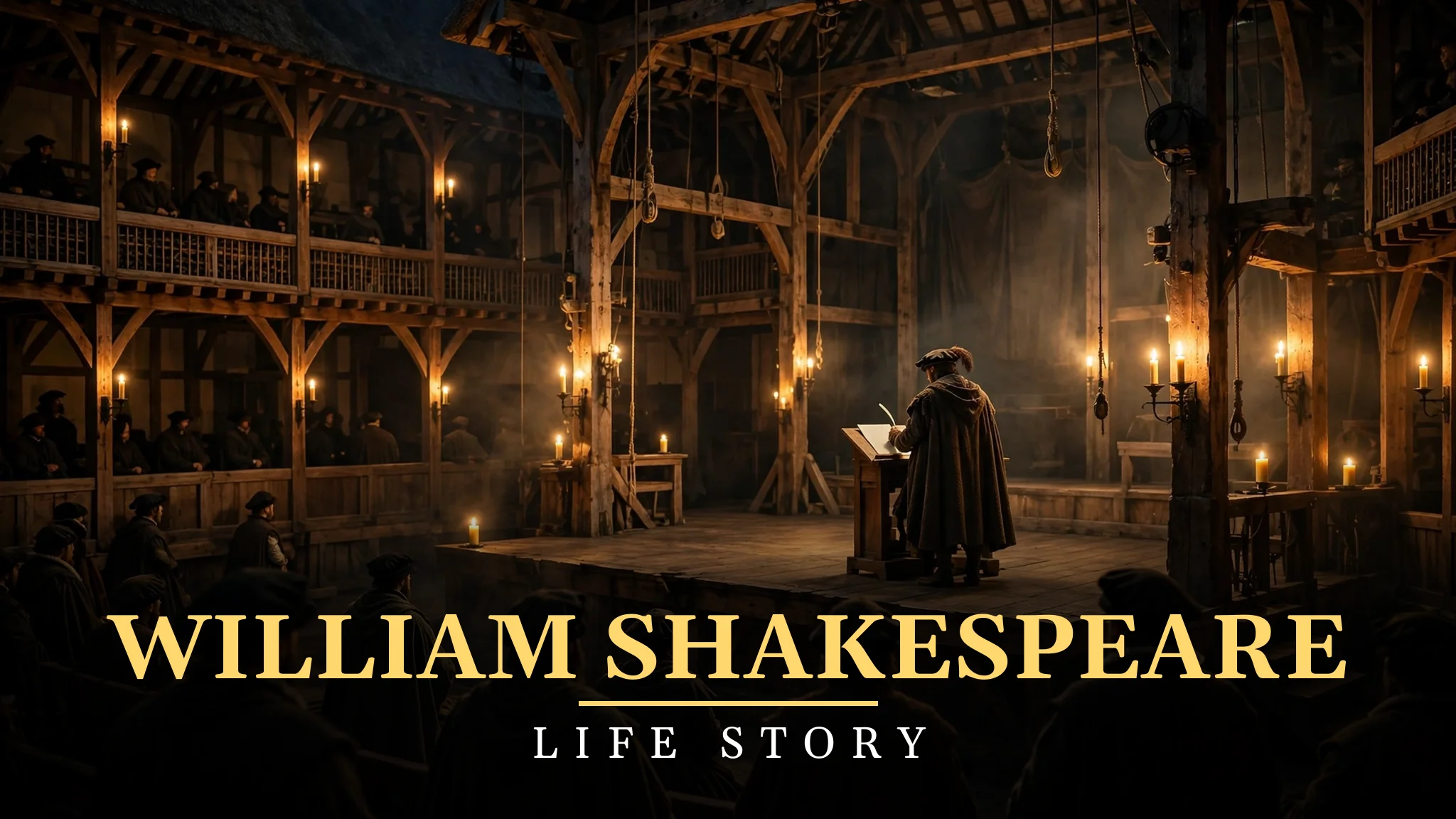
In 1599, Shakespeare and his company built the Globe Theatre, a large open-air playhouse on the south bank of the River Thames in London, where his plays were performed for audiences of thousands. The Globe was a round wooden building, with a stage in the middle, and with galleries for the rich and a yard for the poor, who stood and watched, and who reacted loudly to the plays. It was a noisy, lively place, and Shakespeare wrote for it, with crowd scenes, with music, with sword fights, and with speeches that could be heard by the people at the back. The Globe burned down in 1613, during a performance of Henry VIII, when a cannon fired on stage set the thatch roof alight, and it was rebuilt, and it stood until 1642, when the theatres were closed by the Puritans.
Shakespeare also wrote sonnets, one hundred and fifty-four short poems of fourteen lines each, about love, beauty, time, and death, and they are among the most beautiful poems in English. They were published in 1609, although they had been written over many years, and they are addressed to a young man, and to a dark lady, whose identities have never been certainly known, and that mystery has fascinated readers for centuries. The sonnets are personal, passionate, and honest, and they show a different side of Shakespeare from the plays: a man who loved, who was jealous, who was afraid of growing old, and who believed that poetry could defeat time.
In his later years, Shakespeare wrote romances, plays that are neither comedies nor tragedies, but that mix the two, including The Winter’s Tale, Cymbeline, and The Tempest, his last great play, written around 1611, about a magician, Prospero, who lives on an island with his daughter Miranda, and who gives up his magic at the end of the play, in a speech that many readers see as Shakespeare’s farewell to the theatre. Prospero says that he will break his staff and drown his book, and that he will return to Milan, and the words feel like a writer saying goodbye to his art, and to his audience.
He retired to Stratford around 1613, and he lived there for the last three years of his life, in a large house called New Place, which he had bought in 1597, and where he lived as a wealthy gentleman, a landowner, and a respected citizen of the town. He died on 23 April 1616, at the age of fifty-two, on or near his birthday, and he was buried in the church of the Holy Trinity in Stratford, where his grave is still visited by thousands of people every year. His plays were not published in a single book during his lifetime, but in 1623, seven years after his death, his friends and fellow actors published the First Folio, a collection of thirty-six of his plays, which preserved them for the future, and which is now one of the most valuable books in the world.
The First Folio and How His Plays Survived
Shakespeare never published his plays in a single book during his lifetime, and many of them were only printed as cheap, single-play editions, called quartos, which were often inaccurate, and which were sold to the public for a few pennies. If his friends had not acted, many of his plays might have been lost forever, or might have survived only in bad copies. In 1623, seven years after his death, two of his fellow actors, John Heminges and Henry Condell, collected thirty-six of his plays, including eighteen that had never been printed before, and published them in a large book called the First Folio, with a portrait of Shakespeare on the front, and with a dedication to his patrons. The First Folio is now one of the most valuable books in the world, and it is the reason we have Hamlet, Macbeth, King Lear, and many other plays in the form we know them today. Without Heminges and Condell, Shakespeare might be a name, not a library, and the world would be poorer for it.
The First Folio also tells us something about how Shakespeare was seen by his friends: not as a solitary genius, but as a working actor and playwright, a colleague, and a friend, whose work was worth preserving, and whose plays were worth reading, not only performing. Heminges and Condell wrote in the preface that they had collected the plays to keep them from being lost, and that they hoped readers would enjoy them, and their hope was fulfilled, because the First Folio was a success, and it was followed by other editions, and by centuries of reading, performing, and studying. It is a reminder that great art often survives because of the love and the work of friends, not only because of the genius of the artist.
Words He Invented and the Language We Still Use
Shakespeare did not only write plays. He also changed the English language itself, inventing words and phrases that we still use every day, often without knowing that they came from him. He is credited with inventing, or first recording, words like eyeball, bedroom, fashionable, and lonely, and phrases like break the ice, wild goose chase, in a pickle, and all the world’s a stage, and there are hundreds more, in his plays and in his sonnets, that have become part of everyday English. He did it not by sitting down to invent words, but by writing quickly, by needing a word that did not exist, and by making one up, and by using it so well that other writers copied him, and the word entered the language.
That gift for language is one of the reasons his plays are still performed, and still read, in every country in the world, and in translation into dozens of languages. His words are not only beautiful, they are also useful, because they describe feelings, and situations, that we all recognise, and that we still need words for. When we say that someone has a green-eyed monster, meaning jealousy, we are quoting Othello. When we say that something is a foregone conclusion, we are quoting Othello again. When we say that love is blind, we are quoting The Merchant of Venice. His language is our language, and it is a gift that he gave to the English-speaking world, and that the world has never returned.
My Take:
I think William Shakespeare is the greatest writer in the English language, and I do not say that because everyone says it, but because his words are still alive, still spoken, and still true, four hundred years after he died. I have read his plays, I have seen them performed, and I have heard his lines quoted by people who do not know they are quoting Shakespeare, and I am always struck by how modern he feels. He wrote about love, jealousy, ambition, grief, and power, and those things have not changed, and his words about them have not changed either. That is the mark of a great writer: he wrote about the things that never change, and he wrote about them so well that we still use his words to describe them.
What amazes me most about Shakespeare is how little we know about him, and how much he wrote. We know when he was baptised, when he married, when his children were born, and when he died, but we do not know where he was for seven years, we do not know how he learned what he knew, and we do not know what he thought about his own work. And yet he wrote thirty-seven plays, and a hundred and fifty-four sonnets, and he invented words, and phrases, and characters that are still with us. I find that mystery beautiful, because it tells me that a writer does not need to be famous in his own lifetime, or to leave a diary, or to explain himself. The work is enough, and the work speaks for itself, across four centuries, to people who have never been to Stratford and who have never seen a play in the Globe.
I love Hamlet most of all his plays, because Hamlet is the character I recognise in myself, and in the people I know. He is a young man who is asked to do a terrible thing, to avenge his father’s murder, and he cannot do it, not because he is weak, but because he thinks too much, because he sees the complexity of the world, and because he is afraid of being wrong. He talks to himself, he talks to the audience, and he asks the questions that we all ask: is it better to live or to die, is it better to act or to wait, and how do we know what is right? I think everyone who has ever felt stuck, or afraid, or unsure, has been Hamlet, and that is why the play has lasted. It is not a play about a prince in Denmark. It is a play about being human.
I also love his comedies, especially A Midsummer Night’s Dream, because they show a different side of him, a playful, funny, magical side that is easy to forget when we talk about the tragedies. The Dream is a play about lovers who get lost in a wood, about fairies who play tricks, and about a man with a donkey’s head who falls in love with a fairy queen, and it is funny, and it is beautiful, and it is full of poetry. It shows that Shakespeare could be light as well as dark, and that he understood that life is not only tragedy, but also comedy, and that the two live side by side, in the same play, and in the same life. I think that balance is one of his greatest gifts.
I think about his sonnets, and how personal they are, because they show a man who was not a distant genius, but a person who loved, who was jealous, who was afraid of time, and who believed that poetry could save love from death. He wrote to a young man, and to a dark lady, and he wrote about beauty fading, about time passing, and about the power of words to preserve what time would destroy. Those are the thoughts of a man who knew that he would die, and who wanted his words to live, and his words have lived, for four hundred years, and they will live for four hundred more. That is a kind of immortality, and it is the only kind that matters.
I want to be honest about the mysteries, because they are part of his story, and because they have led some people to doubt that Shakespeare wrote his own plays. Some people have said that a man from Stratford, without a university education, could not have written plays that show such knowledge of law, of history, and of the classics, and they have suggested other writers, including Francis Bacon, or Christopher Marlowe, or the Earl of Oxford. I do not believe those theories, because there is no evidence for them, and because the evidence for Shakespeare is strong: his name is on the plays, his friends published them after his death, and his contemporaries praised him. I think the theories say more about our own snobbery than about Shakespeare, because they assume that a man without a degree cannot be a genius. Shakespeare proves that he can, and that is one of the most important lessons of his life.
I think about the Globe Theatre, and about the audiences who stood in the yard, in the rain, watching his plays, and I love the idea that his work was popular, not only for the rich, but for everyone. He wrote for the groundlings, the poor people who stood, and for the lords in the galleries, and he wrote for both at the same time, with jokes for the groundlings and poetry for the lords, and with stories that everyone could understand. That is a democratic art, and it is a reminder that great art does not belong to the educated few. It belongs to everyone, and Shakespeare knew that, and he wrote for everyone, and that is why his plays are still performed in every country in the world.
His retirement to Stratford is the part of his story that I find most human. He was a wealthy man, he had a large house, and he went home, to the town where he was born, to live quietly for the last three years of his life. He did not stay in London, chasing fame, and he did not write until the day he died. He went home, and he lived as a gentleman, and he died there, at fifty-two, a relatively young man by today’s standards, but an old man by the standards of his time. I find that ending fitting, because it shows that he was not only a writer, but a man who loved his home, and who wanted to return to it, and who did.
If I have a criticism, it is only that his plays are sometimes difficult to read, and that the language, beautiful as it is, can be a barrier for modern readers, especially for young people who are meeting Shakespeare for the first time in school. I think that is a shame, because his stories are wonderful, and they should be enjoyed, not endured. I would tell a young reader to see a play first, to watch it, to hear the words spoken, and to let the story carry them, before they try to read it on the page. Shakespeare wrote for the stage, not for the classroom, and his plays come alive when they are performed, not when they are studied. That is a lesson for teachers, and for readers, and it is one I wish I had learned earlier.
I also think about the First Folio, and about the friends who saved his plays, because it is a reminder that art survives because people care enough to preserve it. Heminges and Condell were not famous writers. They were actors, colleagues, and friends, and they spent seven years after Shakespeare’s death collecting his plays, many of which had never been printed, and publishing them in a book that is now one of the most valuable in the world. Without them, we would not have Hamlet, or Macbeth, or King Lear, or eighteen other plays, and the world would be a poorer place. I think about that when I think about the importance of friendship, and of the quiet work of preserving what matters, because genius is not enough. Genius also needs friends who will keep it alive.
I think about the words he invented, and how they are still in our mouths, every day, without us knowing it. When I say that something is a wild goose chase, or that I am in a pickle, or that love is blind, I am quoting Shakespeare, and so is everyone else who speaks English. That is an extraordinary thing, because it means that a man who died four hundred years ago is still speaking through us, in our everyday conversations, in our jokes, and in our arguments. His language is not dead. It is alive, in the mouths of millions of people, and it will stay alive for as long as people speak English. That is a kind of immortality that no other writer has achieved, and it is why I think he is the greatest writer in our language.
Another thought that stays with me is about the Globe, and about the groundlings, the poor people who stood in the yard, in the rain, watching his plays, and shouting, and laughing, and crying. Shakespeare wrote for them, as well as for the lords in the galleries, and he wrote jokes for them, and poetry for the lords, and stories for everyone, and that is why his plays are democratic, in the best sense. They belong to everyone, not only to the educated, and not only to the rich. I think that is a lesson for writers today: write for everyone, not only for the few, and trust your audience to understand, to laugh, and to think. Shakespeare trusted his audience, and his audience trusted him, and that trust is still alive, in every theatre where his plays are performed.
Finally, I want to say something about the mystery of his life, and about why it does not bother me. We do not know where he was for seven years, we do not know how he learned what he knew, and we do not know what he thought about his own work, and yet we have his plays, and his sonnets, and they are enough. I do not need a diary, or a biography, or a confession, to know that he was a genius, because the work is the proof, and the work is still here, still being performed, still being read, and still being loved. That is enough for me, and I think it should be enough for anyone who loves his work. The man is gone, but the words remain, and the words are what matter.
In the end, I think Shakespeare’s life teaches a simple lesson: that words matter, and that a man from a small town, with no university degree, with a wife and three children, with a job in a theatre, can change the language of a nation, and the literature of the world, simply by writing well, by observing people, and by telling the truth about what it means to be human. He did that, and his words are still with us, in our everyday speech, in our theatres, and in our hearts. That is why I admire him, and why I think his story will be told for as long as people speak English, and for as long as people love a good story. I also think about the way his plays are taught in schools, and about how many young people meet Shakespeare for the first time in a classroom, with a difficult text, and a teacher who tells them it is important, and they find it boring, and they decide that Shakespeare is not for them. I think that is a tragedy, because his plays are not boring, they are exciting, funny, and moving, and they were written to be performed, not to be studied. I would tell a young person to go and see a play, to watch the actors, to hear the words spoken, and to let the story carry them, before they try to read it. That is how Shakespeare was meant to be met, in a theatre, with an audience, and with the noise and the life of a crowd.
Frequently Asked Questions
When was William Shakespeare born?
William Shakespeare was baptised on 26 April 1564 in Stratford-upon-Avon, England, and his birthday is traditionally celebrated on 23 April. He was the son of John Shakespeare, a glove-maker, and Mary Arden, and he grew up in a house on Henley Street in Stratford.
Who did Shakespeare marry and how many children did he have?
Shakespeare married Anne Hathaway on 28 November 1582, when he was eighteen and she was twenty-six. They had three children: Susanna, born in 1583, and twins Hamnet and Judith, born in 1585. Hamnet died at the age of eleven in 1596.
What are the lost years in Shakespeare’s life?
The lost years are the period from about 1585 to 1592, when there is no record of where Shakespeare was or what he was doing. By 1592 he was in London and known as a playwright, but how he got there and what he did in those seven years is not known.
What is the Globe Theatre?
The Globe was an open-air playhouse built in 1599 on the south bank of the River Thames in London, where Shakespeare’s company performed his plays. It burned down in 1613 during a performance of Henry VIII and was rebuilt, and it was closed in 1642 when the theatres were shut by the Puritans.
What are Shakespeare’s most famous plays?
His most famous plays include Hamlet, Macbeth, Othello, King Lear, Romeo and Juliet, A Midsummer Night’s Dream, and The Tempest. He wrote at least thirty-seven plays, as well as one hundred and fifty-four sonnets, and his works are performed in every country in the world.
When did William Shakespeare die?
Shakespeare died on 23 April 1616 in Stratford-upon-Avon, at the age of fifty-two, and he was buried in the church of the Holy Trinity in Stratford. His plays were collected and published in the First Folio in 1623, seven years after his death, by his friends and fellow actors.


