What Happened to Evergrande Homes and Buyers in 2026?
In this post
- The Buyer Who Paid First and Waited Longest
- What Evergrande Actually Sold, and Why Buyers Paid Early
- The Scale of the Unfinished Problem
- Mortgages on Homes That Did Not Exist Yet
- Liquidation: What It Means for a Homebuyer
- The Founder’s Sentence Changed the Mood, Not the Math
- Why Some Projects Finished and Others Did Not
- The Wider Market in 2026: Still Falling, Still Waiting
- What Buyers Can Actually Check in 2026
- Lessons for Anyone Buying Off-Plan Anywhere
- The Questions That Are Still Unanswered
- My Take: The Buyers Were Never the Footnote, and the System Still Owes Them a Straight Answer
The Buyer Who Paid First and Waited Longest
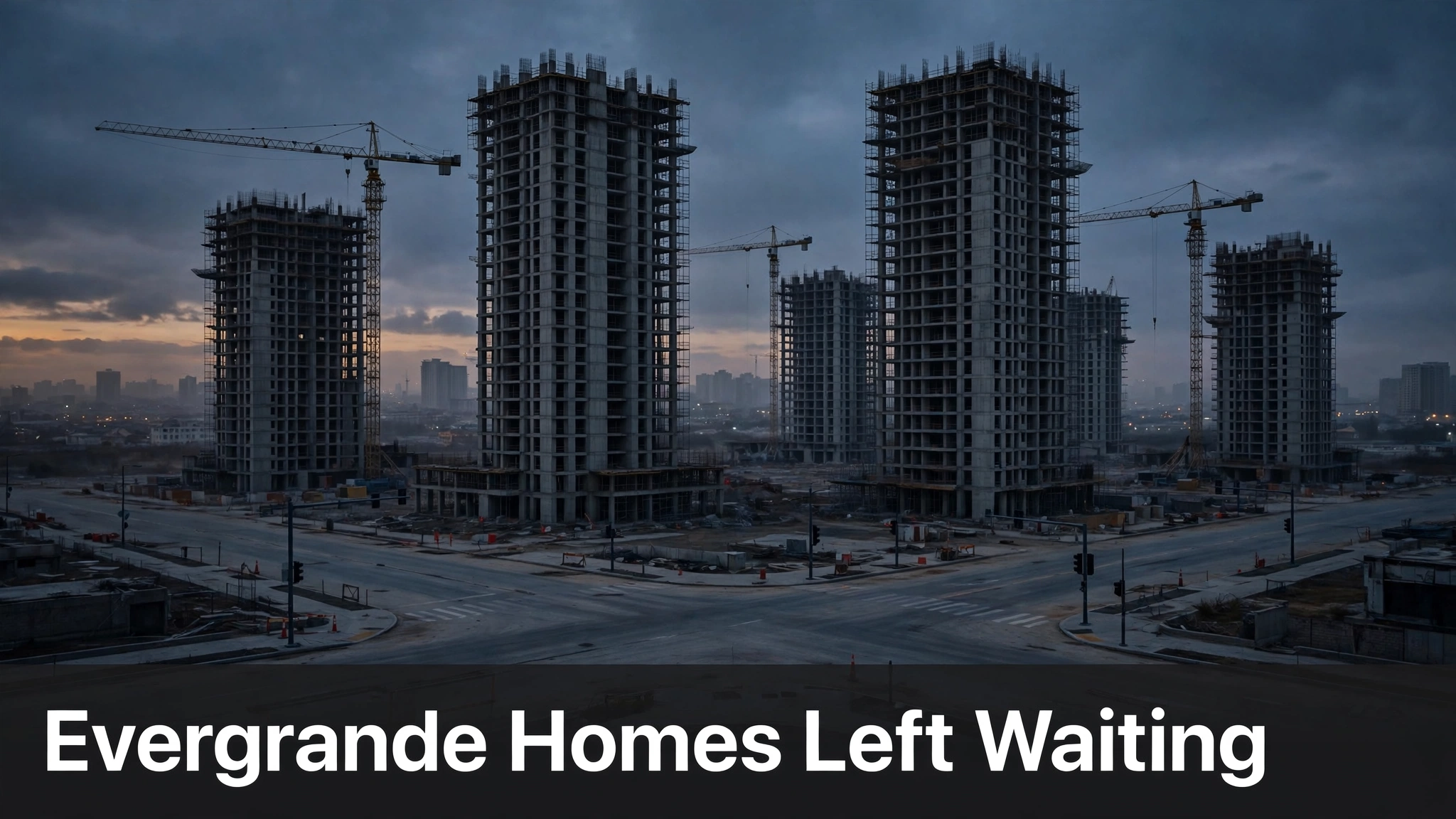
Imagine paying for a home before a single brick of your own flat is finished, watching the building rise floor by floor, and then one day the cranes stop. The workers leave. The concrete shell stays. The loan payments, however, do not stop. That is the position in which many Evergrande buyers found themselves, and in 2026 it is still the sharpest way to understand this story. This is not mainly a story about share prices or bondholders in distant offices. It is a story about ordinary families who paid in advance for a place to live, trusting a system that sold homes before they were built. When China Evergrande Group ran into a debt crisis in late 2021, that trust broke in a very practical way. Homes were delayed, projects stalled, and buyers were left with a mortgage on a home they could not move into. Five years later, the company is in liquidation, its founder has been sentenced, and parts of the wider property market are still falling. Yet the buyer question has never had one clean answer, because buyers in different cities, in different projects, and at different stages of construction have had very different outcomes. Some projects were finished by new arrangements. Some were taken over in part. Others remain stalled, and that uneven picture is exactly what a buyer, an investor, or a curious reader needs to understand in 2026.
What Evergrande Actually Sold, and Why Buyers Paid Early
To understand the buyers, you first have to understand the pre-sale model. In China, as in several other countries, developers commonly sold apartments before completion. Buyers paid a deposit and then staged payments, often supported by a mortgage, while construction was still under way. For a growing middle class, this was the normal route to home ownership. A home was also more than shelter. It was savings, security, a place to raise children, and often the largest purchase a family would ever make. Evergrande, founded by Hui Ka Yan in 1996, grew fast on heavy borrowing and became, for a time, the country’s largest developer by contracted sales. At its peak in 2017, the company was worth more than 50 billion dollars, according to reporting on its history. That scale made its pre-sales feel safe. If the biggest builder in the country was selling your flat, why would you doubt delivery? The problem was that money paid for one project was not always ring-fenced for that project alone. Reporting on the prosecution of Hui describes a systematic diversion of homebuyer pre-sale funds toward new projects rather than the homes those buyers had already paid for. That claim matters because it turns a construction delay into something more serious: buyers were not simply waiting behind a slow builder. In the prosecution account, their money had helped fuel expansion elsewhere. When borrowing tightened after Beijing moved in 2020 to rein in excessive developer borrowing, the chain could no longer keep moving. Evergrande defaulted in late 2021 while carrying more than 300 billion dollars in liabilities, and the pre-sale machine stopped in many places at once.
The Scale of the Unfinished Problem
Numbers about unfinished Evergrande homes vary, and readers should treat any single national total with care, because there has been no simple, transparent, final count that covers every project in the same way. One widely repeated figure in 2026 reporting is roughly 1,300 unfinished projects across 280 Chinese cities left in limbo after the crisis. That figure gives a sense of spread, not a precise flat-by-flat census, and it helps explain why no single rescue could fix everything at once. A project in one city might be nearly complete and easy to finish with a modest injection of money. A project in another city might be barely started, on land with complicated debts, or tied to a wider tourism or commercial scheme that no longer makes sense. The Guiyang Evergrande Cultural Tourism City is a vivid example of the second kind. Construction began in 2018, the site spans more than 8,000 mu, about 533 hectares, with planned investment of more than 100 billion yuan, and it was supposed to hold hotels, a sports centre, a convention centre, a shopping mall and a theme park projected to receive nearly 10 million visitors a year. In August 2026, reporters found pastel castle-like buildings, weeds on the steps, broken glass, faded posters, and graffiti. Yet even there, the picture was not uniformly dead: in June 2026, Plot 51 of that development received approval for the sale of 615 completed homes and 17 commercial units, according to local media cited in that report. That contrast, abandonment beside a partial salvage, is the pattern of 2026. It is not one ghost city. It is a patchwork.
Mortgages on Homes That Did Not Exist Yet
The most painful part for buyers was not only delay. It was paying a mortgage on an unfinished home. A mortgage is a loan secured against a property, and when the property is not delivered, the borrower still owes the bank in ordinary circumstances. Families therefore faced rent for where they actually lived, plus loan repayments for where they were supposed to live, plus uncertainty about whether the home would ever arrive. In 2022, buyers at stalled projects across China threatened or began mortgage boycotts, turning a corporate liquidity crisis into a challenge to social stability. That detail is important because it explains why the authorities treated home completion as a political priority, not only a business problem. A boycott is not a normal consumer complaint. It is a refusal to keep paying into a system that has not delivered, and if many buyers do it at once, banks, developers and local governments all feel the pressure. The response, as described in 2026 reporting, was focused on ensuring pre-sold homes were delivered by directing financing towards projects deemed viable through a white-list mechanism. In simple words, a white list is a list of approved projects that banks are encouraged to lend to, so that viable construction can restart. That helped some projects. It did not automatically help every buyer, because a project that is not deemed viable, or whose debts are too tangled, may stay off the list or may still move slowly even with support.
Liquidation: What It Means for a Homebuyer
On 29 January 2024, Hong Kong’s High Court ordered China Evergrande Group to be wound up after it failed to present a workable restructuring plan. Its shares were suspended the same day, and the company was later delisted from the Hong Kong Stock Exchange in August 2025, with its shares effectively worthless. For a reader who is not a lawyer, liquidation can sound like the end of the story. It is not. Liquidation means that independent liquidators take control of the company in order to sell assets and pay creditors in a legal order of priority. Homebuyers are not in the same position as bondholders, and bondholders are not in the same position as banks or contractors. The order matters, and so does the location of the assets, because Evergrande’s main business was on the mainland while the liquidation order came from Hong Kong. In practice, that has meant long legal work, disputes, and slow asset sales, while buyers on the ground depend far more on local government action, new financing, and replacement builders than on the Hong Kong court process alone. Liquidators were still pursuing assets in 2026, while creditors faced the prospect of recovering only pennies on the dollar, according to August 2026 reporting. That phrase, pennies on the dollar, is a warning for anyone who expects a full refund from liquidation. It describes unsecured creditors in general, and it does not by itself tell an individual buyer whether their particular flat will be finished, because flat delivery and creditor repayment are two different tracks. A buyer might get a finished home through a local completion plan even while the company’s creditors recover very little, or a buyer might wait years while legal cases continue.
The Founder’s Sentence Changed the Mood, Not the Math
In April 2026, Hui Ka Yan pleaded guilty in a Shenzhen court to charges including fundraising fraud, illegal absorption of public deposits, embezzlement of corporate assets and corporate bribery, according to the court’s own account as reported in August 2026. He was sentenced on 20 August 2026 to life in prison, stripped of his political rights for life, and had all his personal assets confiscated. Evergrande Group was fined 8.82 billion yuan, with a separate 7 billion yuan fine on its onshore unit. On Chinese social media, some people saw the sentence as justice, while others said even life imprisonment was insufficient while homebuyers still faced unfinished homes and lost savings. Both reactions make sense, because punishment and delivery solve different problems. A sentence can close a criminal case. It cannot pour concrete, rehire workers, or untangle a project’s debts. It also does not, by itself, put money back into a buyer’s pocket. Confiscated assets go through legal processes, and buyers should not assume that a confiscation order equals a refund cheque. The sentence matters most as a signal: the authorities were willing to treat the diversion of buyer money as a serious crime, not only a business failure. For future buyers, that signal is part of the lesson. For existing buyers, the practical question remains the same as before the sentence: is my project on a completion path, who is funding it, and what is the timetable in writing?
Why Some Projects Finished and Others Did Not
The patchwork outcome has several clear causes. First, completion depends on how far construction had already gone. A tower that needed only fittings, lifts and inspections is far cheaper to finish than a site that needed foundations, structure and infrastructure. Second, it depends on local money and local will. Local governments, banks and developers have had to grapple with how to deal with stalled sites, and different cities have had different resources and different pressures. Third, it depends on whether a new developer or state-linked body is willing to take over. A project in a city where homes are still in demand is more attractive to a rescuer than a project in a place where prices are falling and buyers are waiting for the bottom. Fourth, it depends on legal clarity about who owns what. If land, loans and contractor claims are disputed, no builder wants to step into the middle of the argument. That is why two buyers who bought from the same company can have opposite experiences. One moves into a finished flat, perhaps late but complete. The other still visits a fenced site. Any article that claims all Evergrande buyers were ruined, or all were saved, is therefore misleading. The honest 2026 picture is mixed, slow, and local, and anyone advising buyers should start by asking for the project name, the city, and the construction stage, not by quoting a national slogan.
The Wider Market in 2026: Still Falling, Still Waiting
Evergrande did not cause China’s whole property downturn alone, and its collapse did not end that downturn. In 2026, home prices were still falling as of July, and potential buyers were holding back in the hope that prices would fall further. Property investment fell 20.6 percent in January to September 2026, and new-home prices fell 2.8 percent year on year in September, according to a timeline of official data published in October 2026. New home sales had already fallen 11.2 percent by value in the first eleven months of 2025, and property investment dropped nearly 16 percent over the same period, according to 2026 reporting. Those figures describe the market, not one company, and they matter to Evergrande buyers for a practical reason: a falling market makes rescue harder. If finished homes lose value, a rescuer earns less from finishing them. If buyers expect lower prices tomorrow, they delay buying today. If local governments earn less from land sales, they have less money to support completion. The crisis has also spread beyond Evergrande. Country Garden, whose 2023 near-default rivalled Evergrande in scale, remained unresolved in June 2026, with distressed-debt investors still competing over its restructuring plan more than two and a half years after its liquidity crisis became public. China Vanke, once cited as proof the crisis was contained, narrowly avoided a bond default in December, needed a state-led bailout that began in early 2025, and by July 2026 had handed every non-independent director seat to state-owned sector candidates. When even a state-backed, disciplined builder needs that kind of intervention, it tells buyers that the problem is structural, not only about one reckless company.
What Buyers Can Actually Check in 2026
A buyer who is still waiting should focus on documents and local facts, not on headlines about the parent company. The first check is the project itself: is construction visibly active, is there a named contractor on site, and has the local housing authority published any completion or sales approval for that plot, as happened with Plot 51 in Guiyang? The second check is the contract: what does it say about delivery dates, delay compensation, and the buyer’s rights if delivery fails, and has any new agreement replaced the original terms? The third check is the loan: what has the bank said in writing about repayment, any pause, or any restructuring, and is there a record of every payment made? The fourth check is the funding route: is the project on a local white list or completion plan, and who is the funder? The fifth check is the legal route: has the buyer joined any group claim, local registration, or official buyer list, and what deadlines apply? None of these checks guarantees a home, and this article does not offer legal advice. A buyer with a large sum at stake should seek a qualified local lawyer before signing any new agreement, accepting a swap to a different flat, or agreeing to a refund on terms that waive further claims. The point of the checklist is narrower: it stops a buyer from judging their case by the fate of Evergrande’s shares, which are already delisted and worthless, when their real fate will be decided by the project file in their city.
Lessons for Anyone Buying Off-Plan Anywhere
The Evergrande buyer story carries lessons far beyond China, and they are worth stating plainly. First, a famous developer is not a guarantee. Size can hide debt, and a strong sales record can be built on borrowing rather than on finished homes. Second, pre-sale money should be protected. Buyers should ask, in writing, where their payments are held, whether the account is escrowed for their project, and who audits it. If the answer is vague, that vagueness is itself information. Third, the contract matters more than the brochure. A glossy show flat, a theme park promise, and a castle-shaped facade do not deliver a home. Delivery dates, penalty clauses, and exit rights do. Fourth, debt matters. A developer with very high borrowing relative to sales is riskier, even if its projects look impressive. Fifth, local law matters more than global headlines. Property rights, mortgage rules, and buyer protections differ by country and by city, and a buyer should understand the local rules before paying. Finally, never put all savings into a single unfinished promise without a fallback. A family that can survive a delay, because it has savings, a rental option, or a smaller loan, is in a stronger position than a family that has stretched to the limit for a home that does not yet exist. None of this blames the buyers. They bought in a system that presented pre-sales as normal. The lesson is for the system, and for the next buyer who is offered the same model.
The Questions That Are Still Unanswered
Several important facts about Evergrande buyers in 2026 remain unverified or disputed, and honest reporting should say so. There is no single verified national figure, in this article’s sources, for how many Evergrande buyers have now received finished homes, how many have received refunds, and how many are still waiting, broken down project by project. The figure of roughly 1,300 unfinished projects is a widely reported scale indicator, not a confirmed delivery census. Likewise, any claim about a total amount that buyers will eventually recover through liquidation should be treated as disputed and not confirmed, because creditor recoveries depend on asset sales that are still under way and on legal priorities that differ by claim type. The 2026 reports used here also describe a patchwork of local completion efforts, not a national completion date, so this article does not give one. Readers who see a social media post claiming that all Evergrande homes are finished, or that all buyers have been repaid, should ask for the project list and the source, because neither claim matches the patchwork evidence from Guiyang, the continuing liquidation disputes, and the wider market data for 2026. Uncertainty is frustrating, but false certainty is worse, especially for families making decisions about rent, loans, and legal action.
My Take: The Buyers Were Never the Footnote, and the System Still Owes Them a Straight Answer
The first thing I want to say plainly is that the Evergrande story was reported backwards for too long. It was told as a story about a tycoon, a debt pile, a share price, and a property sector, and the buyers appeared near the end, as victims in a paragraph, as if they were a side effect of a financial event. That order is wrong, and I believe it shaped the response in a bad way. A home is not a side effect. When a family pays for a flat before it is built, that family is not a speculator in the abstract sense. That family is trusting the state, the bank, the developer, and the whole pre-sale system with its savings and its future address. If that system then uses the money to start the next project instead of finishing the one that was paid for, the failure is not only financial. It is a breach of a very simple promise: your money builds your home. I do not think a life sentence, however justified on the criminal facts, repairs that breach by itself. Punishment answers the question of who is to blame. It does not answer the question the buyer asks every month when the mortgage payment leaves the account: when do I get my keys, or when do I get my money back? Until that second question has a project-by-project answer, in writing, with a date and a funder, the story is not closed, no matter how many court cases are finished. I also believe the pre-sale model itself needs a harder look than it has received. Defenders of pre-sales will say the model built modern China, funded huge housing supply, and let millions of families buy homes they could not otherwise afford. There is truth in that, and I do not dismiss it lightly. Without pre-sales, construction would have been slower and homes might have cost more upfront. But a model that depends on new buyers funding old promises is only as safe as its weakest control, and Evergrande showed what happens when that control fails. The money was not, on the prosecution account, safely locked to each project. It moved. The borrowing kept growing. The regulators, auditors, banks and buyers all had reasons to look away while prices rose, and that shared looking away is part of the scandal too. I am not saying every actor is equally guilty. I am saying a system that only works while everyone keeps believing is not a safe system for a family’s life savings. It is a confidence trick with good architecture. My judgement is that pre-sale money should be treated like client money, not company money. It should sit in a separate, audited account for that project, it should only be released against verified construction progress, and any diversion should be a serious offence with real, fast consequences, not a footnote discovered years later. If a developer cannot build under those rules, then that developer should build fewer projects, more slowly, with more of its own capital at risk. Slower building is a price worth paying if it means fewer families are left paying for concrete shells. I also think banks carry a share of responsibility that is too often softened in coverage. A bank that lends a mortgage on an unfinished home is not a bystander. It profits from the loan, it has the power to check construction progress, and it has the information to warn a borrower when a project stalls. When buyers stopped paying in 2022, banks and authorities faced a real dilemma, because mass non-payment threatens the financial system. But the dilemma does not erase the earlier choice. If lenders had tied drawdowns more tightly to verified progress, and if they had refused to keep lending into projects that were already in trouble, fewer buyers would be in this position today. That is not a call for banks to abandon mortgage lending. It is a call for mortgage lending to be honest about what it is funding: a home that does not yet exist, whose completion depends on a developer who may not survive. The next buyer deserves that honesty in plain language, before signing, not in a court filing years later. Local governments, too, deserve a frank assessment rather than praise or blame in general terms. In some places, local action clearly helped: projects were listed, funding was arranged, and flats were finished or approved for sale. In other places, action was slow, opaque, or insufficient, and buyers were left to protest, petition, and wait. That unevenness is the most important fact for policy, because it shows that completion is possible when there is will, money, and a clear project file, and that failure is often a choice about priorities, not an act of nature. I believe every stalled project should have a public status page: construction stage, funder, timetable, and a named contact. That sounds basic, and it is basic, which is exactly why its absence is so telling. A family should not have to rely on rumours, site visits, and social media to learn whether their home is being built. Transparency of that kind would not finish a single tower by itself, but it would end the cruelest part of waiting, which is not knowing. It would also let journalists, lawyers, and buyers check claims instead of repeating them. On the wider market, my view is that Evergrande’s founder going to prison should not be mistaken for the market finding its bottom. Prices were still falling in mid-2026, investment was still down sharply, and even Vanke, the supposedly safe builder, needed state intervention. That tells me the adjustment is structural and will take years, not quarters. Anyone who tells buyers that the market has turned, or that a recovery will automatically finish their project, is selling hope, not evidence. A recovery in prices might help rescuers, but it does not by itself untangle a project’s debts or restart a stalled site. Conversely, a falling market does not mean every project is doomed. Some projects will be finished because they are viable, well-located, and properly funded, even in a weak market. The difference will be made project by project, and that is why I keep returning to the project file. Finally, I want to speak directly to the idea that buyers should simply have known better. That argument is easy to make from a distance and cruel up close. These buyers bought in a market where pre-sales were normal, where the developer was the largest in the country, where banks approved the mortgages, and where the state presented home ownership as a safe store of wealth. To blame them for trusting that system is to excuse the system for betraying that trust. The fair standard is different: the people and institutions who designed, sold, financed, and regulated pre-sales should carry the burden of fixing them, and the buyers should get clear answers first. If China, or any other country that uses off-plan sales, wants buyers to trust the model again, it will have to earn that trust with escrow, audits, public project status, and delivery before new sales. Until then, the most honest advice to a future buyer is also the simplest: do not pay in full for a promise. Pay for progress you can see, keep your documents, and never let a brochure do the work of a contract.
Frequently Asked Questions
What happened to Evergrande homes and buyers in 2026? In 2026, Evergrande was in liquidation, its shares had been delisted in August 2025, and its founder had been sentenced to life in prison in August 2026, but buyers faced a mixed picture. Some projects were finished or partly salvaged through local plans, while others remained stalled, and there was no single national completion date in the sources used for this article.
Did Evergrande buyers get their homes or their money back? Some buyers did receive finished homes through local completion efforts, and the Guiyang example shows completed homes approved for sale on one plot in June 2026, but this article found no verified national figure for how many buyers received homes, refunds, or are still waiting. Any claim of a complete national refund or delivery should be treated as unconfirmed unless it names specific projects and sources.
What does Evergrande liquidation mean for homebuyers? Liquidation means independent liquidators sell the company’s assets and pay creditors in a legal order of priority. It does not automatically deliver a flat or refund a buyer, because flat delivery often depends more on local government completion plans, new funding, and the state of the individual project than on the Hong Kong liquidation process alone.
Why did Evergrande buyers stop paying their mortgages in 2022? Buyers at stalled projects threatened or began mortgage boycotts in 2022 because they were paying loans on homes that had not been delivered, while also paying rent elsewhere. The boycotts turned a developer liquidity crisis into a wider social and financial issue, and authorities responded by prioritising home completion through measures such as project white lists.
Can I still buy an Evergrande home in 2026? Some completed units on salvaged plots, such as Plot 51 in Guiyang, received sale approval in June 2026, according to local media cited in August 2026 reporting, but that does not mean every Evergrande project is for sale or safe to buy. A buyer should check the specific project, its construction stage, its funding, and its legal status with a qualified local adviser before paying anything.
What should an Evergrande buyer check first about their own project? Start with the project name and city, visible construction activity, any local housing authority approval, the original contract and any replacement agreement, written bank statements about the loan, and whether the project is on a local completion or white-list plan. Keep every document, and seek qualified local legal advice before signing a swap, a refund, or any agreement that waives further claims.