Inflation Explained In Simple Words
In this post
- What Inflation Means In Simple Words
- How Inflation Is Measured With Price Indexes
- Other Measures The Federal Reserve Watches
- Why A Little Inflation Is Treated As Normal
- Why Prices Rise Across The Whole Economy
- What Inflation Does To Savings
- What Inflation Does To Borrowers
- What Inflation Does To Wages And Plans
- How Ordinary People Feel Inflation First
- Can Inflation Be Stopped Completely
- You may also like
Imagine you go to the market with the same amount of money you took last year, and you buy the same basket of food, soap, and bus tickets. This year, the basket costs more. Nothing in the basket changed. The shop did not add anything extra. Your money simply buys less than it did before. That slow shrinking of what money can buy has a name, and almost every adult feels it: inflation.
Inflation is not one shop charging too much, and it is not one bad month. It is a general rise in prices across the whole economy, over time. The United States Federal Reserve defines it in plain language: inflation is the increase in the prices of goods and services over time, and it cannot be measured by an increase in the cost of one product or service, or even several products or services. It is a general increase in the overall price level of the goods and services in the economy. In this post, you will learn what inflation means in simple words, how it is measured, why it happens, why a little of it is treated as normal, and what it quietly does to money kept aside for later.
What Inflation Means In Simple Words
Think of money as a measuring cup. Last year, one cup bought a full basket of everyday things. This year, the same cup buys a basket that is a little less full. Next year, a little less again. The cup did not change. The things did not change. What changed is the price level: the average of what things cost, taken together.
A single price going up is not inflation. If the price of onions jumps because rain ruined a crop, that is an onion problem. If the price of petrol jumps because of trouble in one oil-producing region, that is a petrol problem. Inflation is when the general level moves up: food, clothes, rent, transport, and services, all drifting higher together over months and years. That is why the Federal Reserve is careful to say that inflation cannot be measured from one product alone. One price tells you about one market. Inflation is about the whole economy.
Here is a small example to make the arithmetic clear. Suppose a family spends 10,000 rupees a month on everyday needs. If prices in general rise by 5 percent over a year, the same needs cost 10,500 rupees the next year. The family did not eat more or live more richly. It simply needs 500 rupees more to stand still. If the family’s income also rises by 5 percent, it can keep up. If its income stays the same, it falls behind by 500 rupees a month, even though nobody in the family did anything wrong. That gap, between what money used to buy and what it buys now, is inflation in daily life.
How Inflation Is Measured With Price Indexes
Nobody can watch every price in a country at once, so economists watch a basket. A price index measures changes in the price of a group of goods and services. People collect the prices of many everyday items, combine them into one number, and watch how that number moves. If the number rises, prices in general are rising. If it rises fast, inflation is high. If it barely moves, inflation is low.
The Federal Reserve explains that its policymakers watch several different price indexes, because different indexes track different products and services and are calculated differently, so they can send different signals. The main one the Federal Reserve’s rate-setting committee, the Federal Open Market Committee, uses is the price index for personal consumption expenditures, known as PCE, produced by the Department of Commerce. The committee has said that an annual increase of 2 percent in that index is most consistent, over the longer run, with its mandate for maximum employment and price stability. In simple words: the target is not zero. It is 2 percent a year, steady and predictable.
Other Measures The Federal Reserve Watches
The Federal Reserve also watches other measures closely, including the consumer price indexes and producer price indexes issued by the Department of Labor. Consumer prices are what households pay. Producer prices are what businesses receive for what they make, and they can warn of consumer price rises coming later. Because inflation numbers can vary erratically from month to month, policymakers generally consider average inflation over longer periods, ranging from a few months to a year or longer, rather than reacting to a single month’s number.
Why A Little Inflation Is Treated As Normal
Two percent a year sounds small, and that is the point. When households and businesses can reasonably expect inflation to remain low and stable, the Federal Reserve says, they are able to make sound decisions about saving, borrowing, and investment, which contribute to a well-functioning economy and the well-being of all Americans. A shopkeeper can plan prices. A family can plan a loan. A worker can judge whether a pay rise is a real rise or just keeping up.
Zero inflation, or falling prices, sounds better at first, and it is not always better. If prices keep falling, people may delay buying, waiting for things to get cheaper, and businesses may delay investing, waiting for costs to fall. That waiting can slow the whole economy down. A small, steady rise avoids that trap while keeping money’s value predictable enough to plan around. The danger is not the 2 percent. The danger is when inflation runs far above the target for a long time, or when it jumps around so much that nobody can plan at all.
Think of it like a slow walk uphill. A gentle slope is fine: you adjust your pace and keep walking. A steep, uneven hill, where the ground rises fast in one month and barely at all in the next, makes every step uncertain. Policymakers aim for the gentle slope, and they watch the indexes to judge whether the slope is staying gentle.
Why Prices Rise Across The Whole Economy
There is no single cause of inflation, and honest explanations say so. Prices can rise when demand grows faster than supply: more people wanting the same goods and services, with no extra goods to meet them, pushes prices up. Prices can also rise when costs rise: if transport, energy, or wages cost more, businesses pass some of that cost on in higher prices. Sometimes a shock does it, such as a bad harvest, a war, or a sudden shortage, which pushes up the prices of the things that shock touches, and then spreads through the economy as other businesses face higher costs too.
The Federal Reserve’s approach to reading inflation reflects this messiness. Policymakers routinely examine the subcategories that make up a broad price index, to help determine whether a rise in inflation can be attributed to price changes that are likely to be temporary or unique events. Since the Federal Reserve’s policy works with a lag, meaning its actions take time to affect the economy, it must make policy based on its best forecast of inflation, and try to determine whether an inflation development is likely to persist or not. A one-month jump caused by a single event is different from a steady climb that lasts a year, and treating them the same way would be a mistake.
There is one more distinction worth knowing. Some prices jump up and down dramatically or often, especially food and energy. The Federal Reserve therefore also examines core inflation measures, which exclude items that tend to go up and down in price dramatically or often, like food and energy items. For those items, a large price change in one period does not necessarily tend to be followed by another large change in the same direction in the following period. Core measures are not used because food and energy do not matter: they matter enormously to every household budget, and policymakers ultimately seek to stabilize overall consumer prices. Core measures are used because leaving out the most jumpy prices can help in assessing inflation trends underneath the noise.
What Inflation Does To Savings
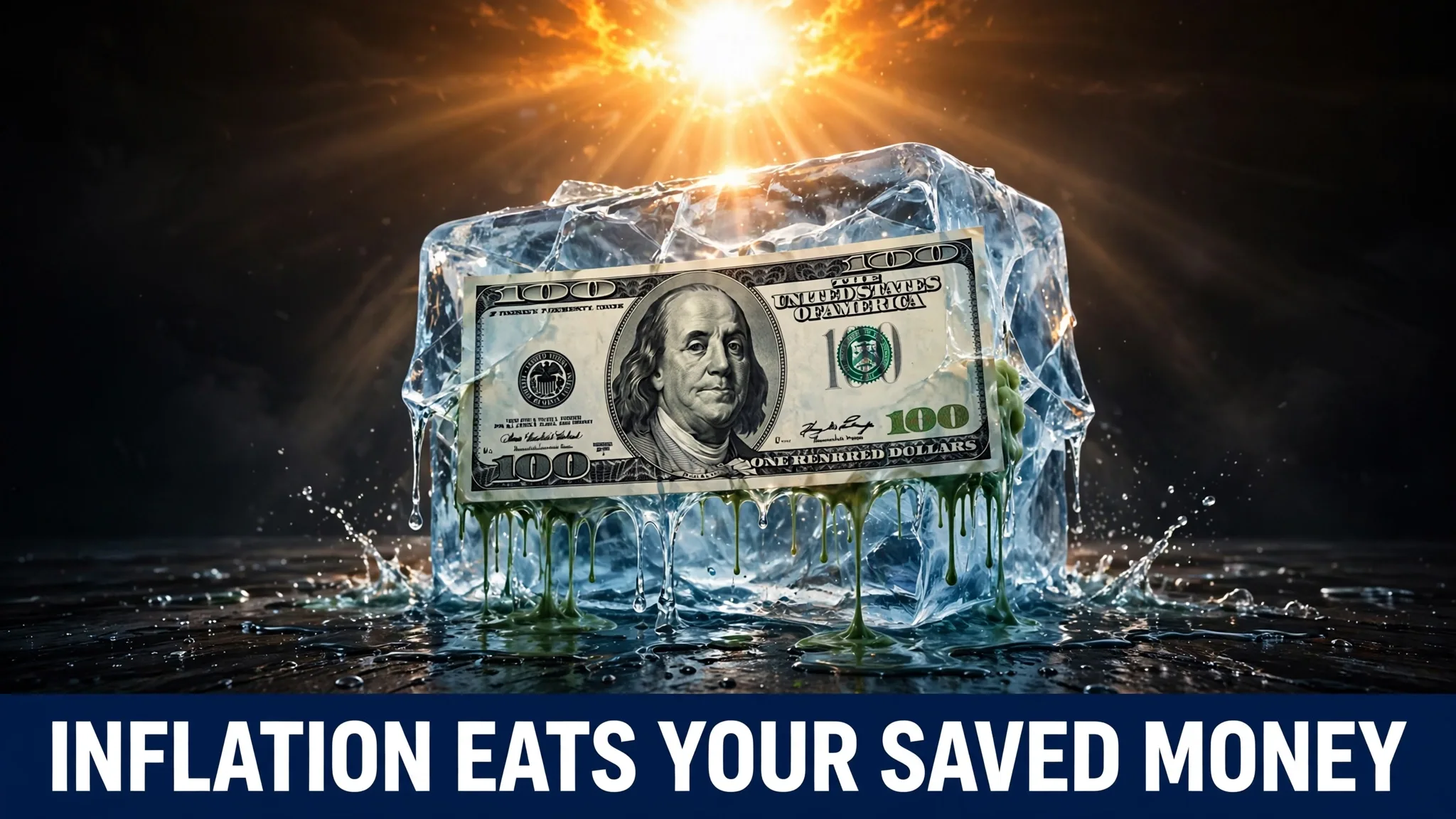
Inflation is quietest, and cruelest, with money that sits still. Imagine you keep 100,000 rupees in a drawer for ten years, and prices in general rise by 5 percent a year. After ten years, that 100,000 rupees still looks like 100,000 rupees. It will still be accepted in any shop. But it will buy far less than it bought when you put it away, because the prices of the things you need have risen year after year while the money in the drawer did not grow at all. The picture on this page says it in one line: inflation eats saved money, like sun melting ice around a banknote.
That is why saving alone is not the whole story. Money kept for a short goal, such as next month’s rent, needs to be safe and easy to reach, and a small loss to inflation over a few months matters little. Money kept for years needs to grow at least as fast as prices rise, or it slowly shrinks in real terms, even while the number on it stays the same. This is not advice to take risks with money you cannot afford to lose. It is the reason financial planning always asks two questions together: how safe is this money, and how fast is it growing compared with prices?
What Inflation Does To Borrowers
The same logic works in reverse for borrowing. If you borrow money and repay it later, in money that buys less than it did when you borrowed it, the real burden of the debt falls a little. That is one reason inflation can help borrowers and hurt lenders, and why people who lend money for long periods ask for interest: interest is, in part, compensation for the fact that the money returned later will buy less than the money lent today.
What Inflation Does To Wages And Plans
A pay rise is not always a rise. If your pay goes up by 4 percent in a year when prices rise by 6 percent, your pay has fallen in real terms: you can buy less than before, even though the number on your salary is bigger. If your pay goes up by 8 percent while prices rise by 6 percent, you are genuinely better off by about 2 percent. That comparison, pay growth minus price growth, is how workers, unions, and employers judge whether a deal is fair, and it is why inflation numbers matter far beyond economics classrooms.
Businesses feel the same squeeze from the other side. A shop that sells bread must pay more for flour, fuel, and wages, and must decide how much of that cost to pass on in the price of a loaf, and how much to absorb by earning less. Pass on too much, and customers buy less. Absorb too much, and the shop cannot survive. When many businesses face the same choice at the same time, prices across the economy move together, and that is inflation happening in real time, one loaf, one ticket, and one bill at a time.
Governments and central banks watch all of this because inflation changes behaviour. When people expect prices to keep rising fast, they may rush to buy now rather than later, which adds to demand and can push prices up further. When people expect prices to stay stable, they can plan, save, and invest calmly. Expectations matter so much that central banks spend a great deal of effort explaining what they aim for and what they will do, because a believable promise of low, stable inflation helps keep inflation low and stable.
How Ordinary People Feel Inflation First
Inflation is usually felt in the kitchen before it is felt in any report. The weekly shop costs more, but nothing extra comes home. The bus fare creeps up. The rent renewal letter asks for more. The electricity bill rises even though the family used the same lights. Each rise is small on its own, and each can be explained away: a bad season, a distant war, a new tax. It is only when the family looks back over a year that the pattern becomes clear: the same life costs more money.
The second place inflation is felt is in plans that stretch over years. A parent saving for a child’s education finds the target moving away. A worker saving for retirement finds the same monthly saving buys less future comfort than expected. A small business finds its cash, held for a new machine, buys a smaller machine than planned. None of these are dramatic events. They are slow leaks, and slow leaks are dangerous precisely because they do not demand attention until the damage is done.
The third place is in arguments about fairness. When prices rise faster than wages, workers feel cheated. When wages rise faster than prices, business owners feel squeezed. When savings lose value, older people who saved carefully feel punished for doing the right thing. Inflation does not only move numbers. It moves the feeling of whether the rules of economic life are fair, and that is why it is argued about so fiercely in every country.
Can Inflation Be Stopped Completely
In practice, no country aims to stop inflation completely, and the Federal Reserve’s 2 percent target shows why. The aim is to keep it low, stable, and predictable. Central banks use interest rates as their main tool: raising rates makes borrowing more expensive and saving more rewarding, which cools spending and, over time, cools price rises. Lowering rates does the opposite. Because policy works with a lag, central banks must act on forecasts, not on today’s number alone, and they must judge whether a rise in prices is likely to persist.
Governments have their own tools, such as taxes and spending, but those work slowly and carry their own side effects. What ordinary people can do is more direct: keep an eye on the difference between income growth and price growth, avoid letting long-term savings sit still without a plan, and remember that a bargain today is only a bargain if the price, compared with what things cost in general, is genuinely low. Inflation cannot be wished away, but it can be understood, and understanding it is the difference between being surprised by it every year and planning for it.
Inflation, in the end, is a simple idea with large consequences. Prices in general rise over time. Money buys less than it did. Measuring that rise honestly, through price indexes watched over months and years, lets families, businesses, and policymakers tell the difference between a passing jump and a lasting climb. And once you can see that difference, you can stop asking why everything feels more expensive, and start asking the better question: is my income, my saving, and my planning keeping up?
You may also like
Frequently Asked Questions
What is inflation in simple words? Inflation is a general increase in the prices of goods and services over time, across the whole economy. It cannot be measured by an increase in the cost of one product or service, or even several products or services: it is a general increase in the overall price level. In daily life it means the same amount of money buys less than it did before, because the prices of everyday things have drifted higher together over months and years.
How is inflation measured? Inflation is measured with price indexes, which track changes in the price of a group of goods and services. The Federal Reserve watches several different indexes because they track different products and are calculated differently, so they can send different signals. Its rate-setting committee uses the price index for personal consumption expenditures, produced by the Department of Commerce, and it also closely tracks the consumer price indexes and producer price indexes issued by the Department of Labor.
Why is 2 percent inflation the target? The Federal Open Market Committee has affirmed that an annual increase in inflation of 2 percent in the price index for personal consumption expenditures is most consistent over the longer run with its mandate for maximum employment and price stability. When households and businesses can reasonably expect inflation to remain low and stable, they are able to make sound decisions about saving, borrowing, and investment, which contribute to a well-functioning economy. The target is steady and predictable, not zero, because a small, steady rise lets people plan while avoiding the problems that falling prices can cause.
What is core inflation? Core inflation measures exclude items that tend to go up and down in price dramatically or often, like food and energy items. For those items, a large price change in one period does not necessarily tend to be followed by another large change in the same direction in the following period. Core measures are useful in assessing inflation trends underneath the noise, but they do not mean food and energy are unimportant: they make up an important part of the budget for most households, and policymakers ultimately seek to stabilize overall consumer prices.
Does inflation make savings worthless? Not worthless, but worth less. Money kept still does not grow, while the prices of the things it must buy rise year after year, so the same sum buys less over time. That is why money kept for years needs to grow at least as fast as prices rise, or it slowly shrinks in real terms even while the number on it stays the same. Money kept for a short goal needs to be safe and easy to reach, and a small loss to inflation over a few months matters little, but long-term savings need a plan that takes rising prices into account.
Sources
- U.S. Federal Reserve, “What is inflation, and how does the Federal Reserve evaluate changes in the rate of inflation?”: https://www.federalreserve.gov/faqs/economy_14419.htm