First YouTube Video Ever Uploaded
In this post
It lasts nineteen seconds. The picture is grainy, the sound is rough, and nothing much happens. A young man stands in front of some elephants, says a few ordinary sentences, and the video ends. By every normal rule of entertainment, this clip should have been forgotten within a week.
Instead, it became the most important home video ever made. It was the very first video uploaded to YouTube — the small, quiet test that opened the door to the video age we all live in now. This is the story of “Me at the zoo”, and of the three friends who built the stage it appeared on.
Three Friends From PayPal With A Simple Idea
YouTube began with three young men who had worked together at the online payments company PayPal: Steve Chen, Chad Hurley and Jawed Karim. Like many people in the early 2000s, they had felt a small, annoying problem for themselves. Ordinary people were starting to record little videos on cameras and early phones — but putting a video online, and sharing it with friends, was painfully difficult. The founders’ idea was the opposite of difficult: let normal people share their home videos easily.
On 14 February 2005 — Valentine’s Day — they registered the name YouTube. At first, working out of a garage in California, they even tried shaping it into a video dating website. That version went nowhere. Within about two months, they dropped the dating idea and rebuilt YouTube as a home for every kind of video. What the new platform needed first was a test: someone had to upload video number one.
Nineteen Seconds In Front Of The Elephants
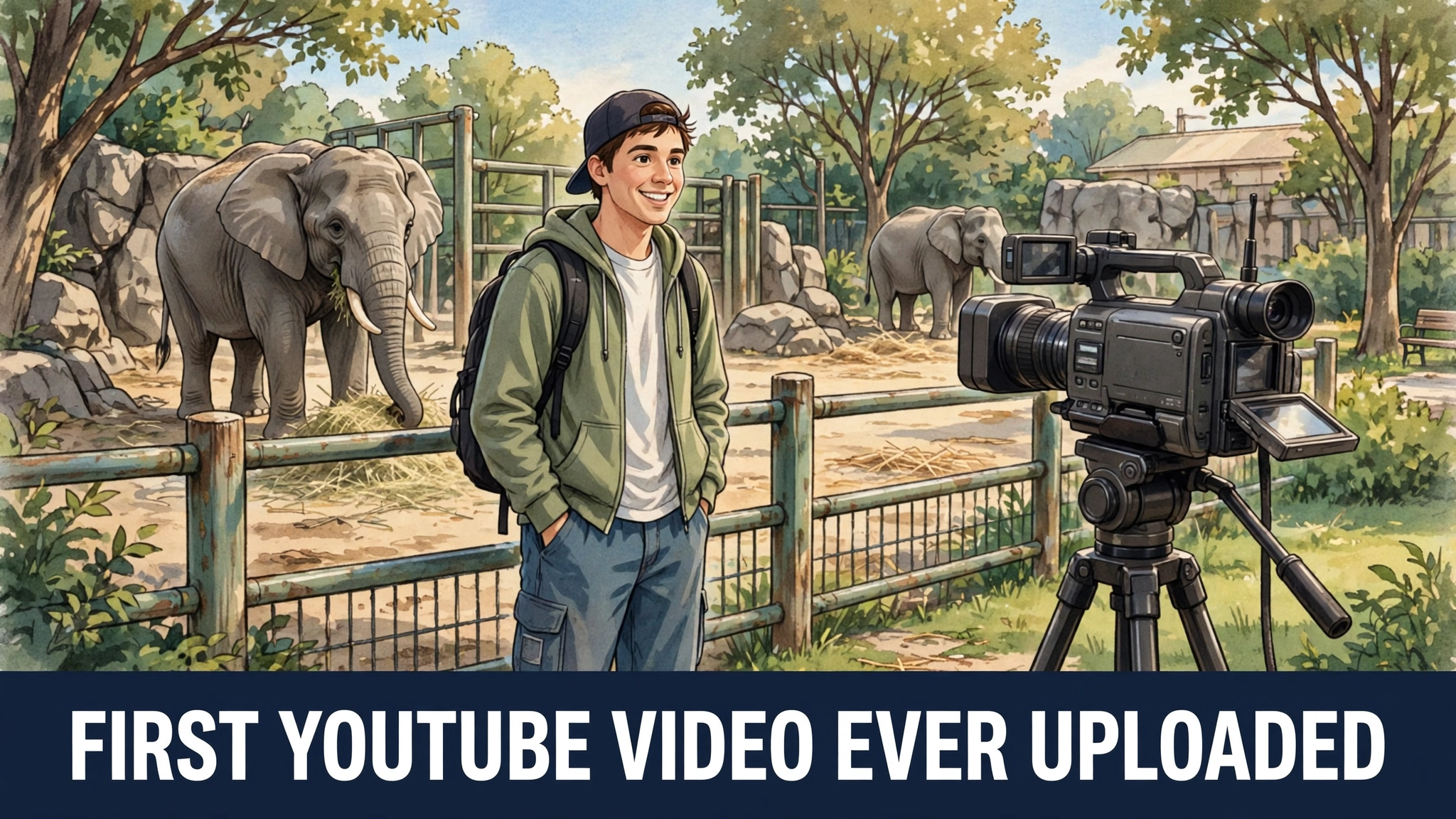
On 23 April 2005, Jawed Karim did the honours. His account, named simply “jawed”, was the very first account on the site — and the video he uploaded that day, as a test run of the new system, was a 19-second clip filmed at the San Diego Zoo.
Karim, then 25, stands in front of the elephant enclosure and speaks to the camera like a man showing a holiday video to a friend. His big observation, delivered with total seriousness, is that the truly cool thing about elephants is the astonishing length of their trunks — and then, with a small shrug, he admits that this is pretty much everything there is to say. That is the whole video. No music, no editing, no effects.
It is easy to laugh at how small it is. But look again: everything YouTube would become is already hiding in those nineteen seconds. An ordinary person, an ordinary camera, an ordinary moment — uploaded for the whole world to watch. Before this, video on the internet mostly meant big companies broadcasting at you. This clip pointed the camera the other way.
The Test Clip That Refused To Stay A Test
Within weeks, the experiment escaped the garage. YouTube opened to the public on a limited basis in May 2005 and was soon drawing some 30,000 visitors a day. When the site officially launched on 15 December 2005, it was already serving more than two million video views every day. By the following summer it was serving more than 100 million videos a day, with thousands of new clips pouring in.
The growth was so fast that in November 2006 — less than two years after that zoo trip — Google bought YouTube for 1.65 billion dollars in stock, its biggest purchase up to that time. Karim, the quietest of the three founders, had stepped back from daily work to continue his studies, but his nineteen seconds remained at the head of the line: the first item in a library that has since grown beyond all imagining. By 2025, more than 20 billion videos had been uploaded to YouTube. Every single one of them stands in a queue that starts at the San Diego Zoo.
And the little test clip itself never stopped being watched. People return to it the way tourists visit a birthplace. It has now been viewed hundreds of millions of times — the V&A museum puts the figure at nearly 380 million — making one of the shortest, simplest videos on the site also one of its most visited antiques.
Why This Tiny Video Changed The World
It is worth pausing on what “Me at the zoo” really proved. It proved that a video did not need a studio, a budget or permission. If a 19-second zoo clip could be published to the entire planet in moments, then anyone’s video could: a baby’s first steps, a song sung in a bedroom, a lesson, a joke, a storm, a revolution. The three founders had guessed that ordinary people would love sharing their home videos. They were more right than they knew.
Careers, industries and whole new art forms grew from that guess. But all of it traces back to a test upload that was never meant to be famous — a founder checking that his own website worked.
From Nineteen Seconds To A Billion Hours A Day
Measure how far the test clip’s children have travelled. In the summer of 2006, a little over a year after the zoo video, YouTube was already serving more than 100 million videos a day. In 2007 the platform squeezed itself onto the small screens of the first iPhone. In December 2012, the music video “Gangnam Style” became the first upload in history to pass one billion views — a number that would have sounded like a printing error to the three founders in their garage.
Today the scale is almost comedy. More than 20 million new videos are uploaded every single day, joining a library of more than 20 billion. Viewers watch over a billion hours of YouTube on television screens alone each day, and its short clips rack up hundreds of billions of views daily. Against numbers like those, video number one is a rounding error — nineteen seconds in an ocean. Yet every statistic in that ocean exists because a young engineer first proved, in front of the elephants at San Diego Zoo, that uploading a video could be easy.
The Video Goes To A Museum
The final honour arrived in February 2026, when the Victoria and Albert Museum in London — the V&A, one of the world’s great museums of art and design — officially acquired an early YouTube watch page together with its first-ever video.
Collecting a web page turned out to be detective work. YouTube had never archived its own early design, so the museum’s curators and digital conservators, working with YouTube’s own user experience team and a design studio called oio, spent 18 months rebuilding the watch page exactly as it looked on 8 December 2006, the oldest snapshot of it saved by the Internet Archive. The old video player had been built on Adobe Flash, a technology modern browsers no longer support, so the team revived it using an emulator, carefully documenting every change so future conservators can undo or update their work. The rebuilt page — video, player, adverts and all — is now on display in the museum’s Design 1900–Now gallery at V&A South Kensington.
Think about that journey for a moment. A grainy test clip, made by a 25-year-old checking his homework of a website, now sits in a national museum as a founding artefact of the internet age — preserved with the same care museums give to centuries-old paintings.
Frequently Asked Questions
What was the first video ever uploaded to YouTube? “Me at the zoo” — a 19-second clip showing co-founder Jawed Karim in front of the elephants at the San Diego Zoo, uploaded on 23 April 2005.
Who were the three founders of YouTube? Steve Chen, Chad Hurley and Jawed Karim. All three had worked at PayPal, and they registered YouTube on 14 February 2005.
What does Jawed Karim actually say in the video? Almost nothing — that is its charm. He points out that the cool thing about elephants is how very long their trunks are, and then admits that is basically all there is to say.
How many views does the first YouTube video have? Hundreds of millions. The Victoria and Albert Museum puts the total at nearly 380 million views, and the count keeps growing as people visit the famous first upload.
Can I still watch “Me at the zoo” today? Yes. It is still on YouTube under Karim’s original “jawed” account — and a reconstructed 2006 version of its watch page is also on display at the V&A Museum in London.
Sources
- Encyclopaedia Britannica, “YouTube”: https://www.britannica.com/topic/YouTube
- Victoria and Albert Museum, “Acquiring an early YouTube watch page and its first-ever video”: https://www.vam.ac.uk/articles/acquiring-an-early-youtube-watch-page-and-its-first-ever-video/
- Victoria and Albert Museum newsroom, “YouTube enters V&A collection”: https://vam-newsroom.prgloo.com/news/youtube-enters-va-collection
- The picture on this page is an original illustration made for Talha M Blog.