Fito Páez: The Life Story Behind Argentina's Piano Rock Star
In this post
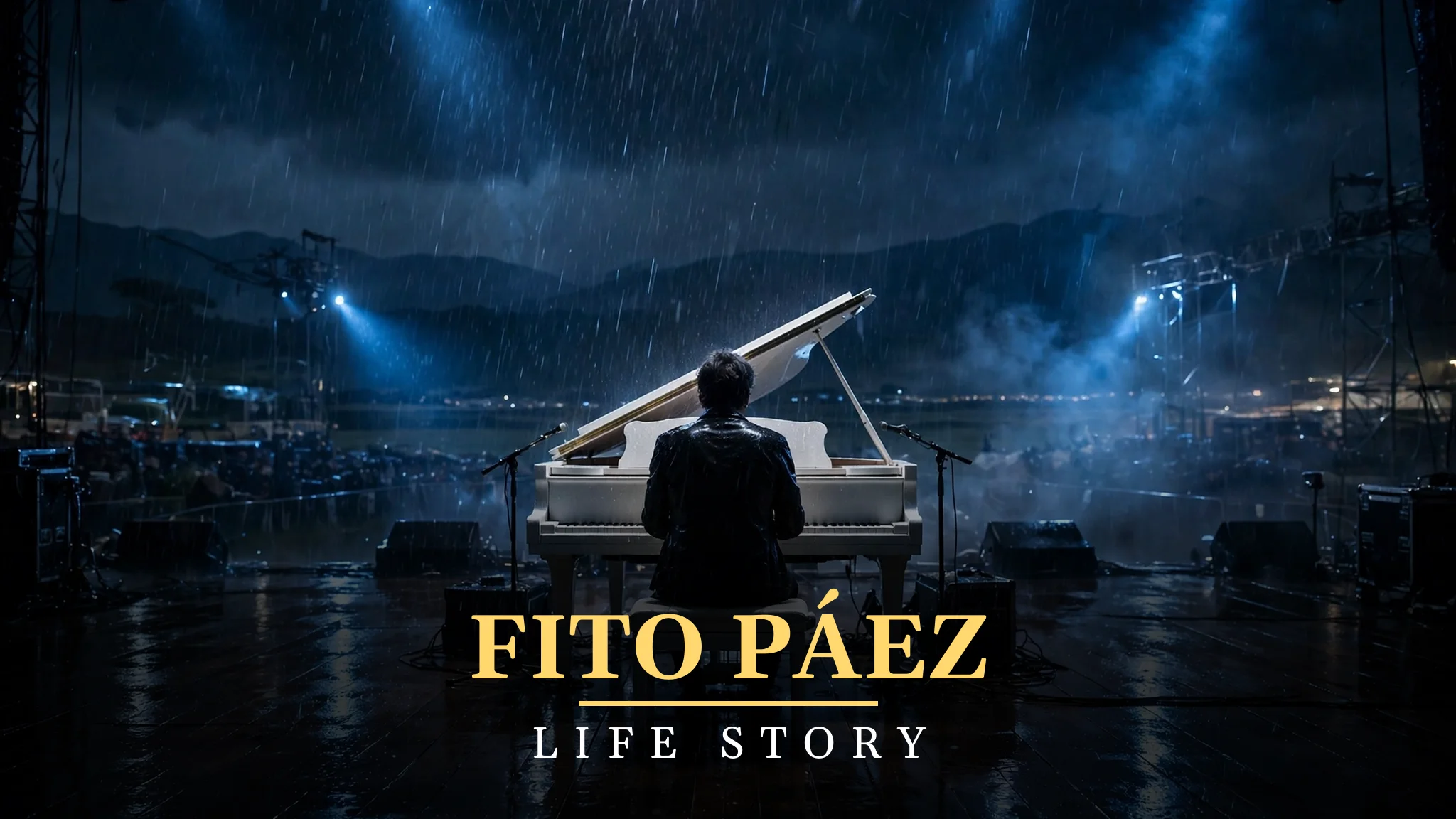
Fito Páez is the piano man of Argentine rock, a singer and songwriter from the city of Rosario whose songs have become part of the everyday life of Argentina. He is a pianist first and a rock star second, and his music is built on the piano, on melody, and on words that speak directly to the heart. His album El amor después del amor, released in 1992, is the best-selling rock album in the history of Argentina, and its songs are sung by people of all ages, from teenagers to grandparents. He is a musician who has never stopped growing, and his career has lasted for more than forty years.
His life is a story of talent, of hard work, and of a city that shaped him. He was born in Rosario, a port city on the Paraná River, and he grew up listening to the Beatles, to Argentine folk music, and to the rock that was coming from Buenos Aires. He learned the piano, he wrote songs, and he moved to Buenos Aires to make his life in music. He played with the great Charly García, he made his own albums, and he became one of the most loved musicians in Latin America.
His songs are about love, about the city, about friendship, and about the pain of losing people you love, and they are written with a warmth and an honesty that make them feel true. This is the story of how a boy from Rosario became the piano rock star of Argentina, and why his songs still matter today.
A Boy From Rosario
Fito Páez was born Rodolfo Páez on 13 March 1963 in Rosario, a large city in the province of Santa Fe, on the banks of the Paraná River. His family was musical, and his father, Rodolfo Páez, was a musician who played the piano, so the young Fito grew up in a house full of music. He learned to play the piano as a boy, and he showed a natural talent for it. He was not only a player. He was a writer, and he began to compose songs when he was still young.
Rosario was a city with a strong musical life, and the young Fito heard many kinds of music there. He heard the Beatles, he heard Argentine rock, and he heard the folk music of the countryside, and all of those sounds went into his songs. He was a sensitive boy, and he felt the city around him deeply. He wrote about its streets, its river, and its people, and his songs carried the feeling of Rosario with them, even after he moved away.
As a teenager he began to play in bands, and he became known in Rosario as a talented pianist and songwriter. He was not a loud rock star. He was a quiet, thoughtful young man who loved the piano, and who wanted to write songs that were beautiful and true. His friends saw his talent, and they encouraged him to go to Buenos Aires, where the music industry was centred, and to make his career there.
Buenos Aires and Charly García
In the early 1980s, Fito moved to Buenos Aires, and he soon found work as a keyboard player for some of the great musicians of Argentine rock. He played with Juan Carlos Baglietto, a singer from Rosario who had become famous in Buenos Aires, and then he was invited to play with Charly García, the most important figure in Argentine rock. Playing with Charly was a great honour, and it was also a great education. Fito learned how to write, how to arrange, and how to perform from a master, and he became a better musician for it.
He also began to make his own records. His first solo album, Del 63, was released in 1984, and it showed a young songwriter with a gift for melody and for words. He followed it with Giros in 1985, and with Ciudad de pobres corazones in 1987, an album that was darker and more personal, and that showed his music growing in depth. His songs were about love, about the city, and about the pain of life, and they were sung with a voice that was warm and honest.
His early albums made him a star in Argentina, but they were only the beginning. He was a young man with a piano and a gift for songs, and he was just starting to find his voice. The best was yet to come, and it would come in the early 1990s, when he made the album that would change his life.
El Amor Después del Amor
In 1992, Fito Páez released the album El amor después del amor, which means Love After Love, and it became the best-selling rock album in the history of Argentina. The album included the title song, a joyful, romantic song about love that comes after pain, and the songs Tumbas de la gloria, 11 y 6, and Un vestido y un amor, all of which became classics. The album was a celebration of love, of music, and of life, and it was played everywhere in Argentina.
The success of the album was enormous. It sold hundreds of thousands of copies, and its songs were sung by people of all ages. Fito became a superstar, and his concerts were huge events. He was no longer only a musician from Rosario. He was the piano rock star of Argentina, and his songs were the soundtrack of a generation. The album’s success was not only commercial. It was artistic, and it showed a songwriter at the peak of his powers.
The album also marked a personal moment in Fito’s life. He was in love, he was happy, and his music reflected that happiness. The songs were warm, romantic, and full of hope, and they spoke to people who had known pain and who were looking for love again. El amor después del amor is not only an album. It is a statement about the power of love to heal, and it is one of the great works of Argentine music.
Circo Beat and the Years After
After the huge success of El amor después del amor, Fito released the album Circo Beat in 1994, which included the songs Mariposa tecknicolor and Yo vengo a ofrecer mi corazón. Mariposa tecknicolor is a joyful, colourful song about a butterfly, and it became a hit. Yo vengo a ofrecer mi corazón is a tender, beautiful song about offering your heart to someone, and it has become one of his most loved works. The album showed that Fito could follow a great success with another great record, and that his gift had not faded.
In the years that followed, he continued to record and to perform, and he released albums that showed his music growing and changing. He made the album Abre in 1999 and Rey Sol in 2000, and he worked with other artists, including the Brazilian singer Caetano Veloso and the Argentine singer Mercedes Sosa. He was a generous musician, and he loved to collaborate with others, and his collaborations showed the breadth of his talent.
He also became a film director, making the film Vidas privadas in 2001, a work that showed his interest in stories and in images. He was not only a musician. He was an artist who wanted to tell stories in many forms, and his film work was part of that vision. His career was long and varied, and it showed a man who was always learning and always growing.
Loss, Love, and the Piano
Fito’s life has not been without pain. He has known loss, he has known the end of love, and he has written about those experiences in his songs. His music is honest about pain, and it is also honest about hope, and that honesty is part of why people love him. He does not pretend that life is easy. He sings about its difficulties, and he sings about the love that can help us through them.
He has been married and divorced, and he has a son, and his family life has been part of his story. He has also been a friend to many musicians, and he has been a mentor to younger artists. He is known as a kind, generous man, a musician who loves his craft and who loves the people who listen to his music. His piano is still the centre of his work, and his concerts are still built around it.
In recent years, he has continued to record and to perform, and his album La conquista del espacio, released in 2020, won a Latin Grammy Award, a sign that his music is still vital and still loved. He has also celebrated the thirtieth anniversary of El amor después del amor with concerts that brought together fans of all ages. His career has lasted for more than forty years, and it is still going strong.
The Piano Star of Argentina
Today, Fito Páez is remembered as one of the great songwriters of Argentina, a musician whose songs have become part of the national story. His album El amor después del amor is a classic, and his songs are sung by people of all ages. He showed that a piano and a voice could be the heart of rock music, and that a songwriter from Rosario could speak to the whole of Latin America.
His legacy is the songs themselves, a body of work that is warm, honest, and full of melody. He is a musician who has never stopped writing, and whose music has grown with him through love, through loss, and through the years. His piano still sings, and his songs still speak to the heart.
The Rosario Sound and the Piano
Fito Páez’s piano is the heart of his music, and his way of playing it is warm, melodic, and full of feeling. He learned the piano as a boy in Rosario, and he grew up listening to the Beatles, to Argentine folk music, and to the rock that was coming from Buenos Aires, and all of those sounds went into his playing. His piano is not a classical piano, and it is not a jazz piano. It is a rock piano, a piano that can carry a melody, drive a rhythm, and hold a song together, all at the same time. His playing is the foundation of his songs, and it is what makes them sound like him.
His sound is also the sound of Rosario, a port city on the Paraná River, with a musical life of its own. Rosario has produced many great musicians, and Fito is the most famous of them, and his songs carry the feeling of his city with them. He writes about its streets, its river, and its people, and his piano carries the warmth of a city that is proud of its music. He did not forget Rosario when he moved to Buenos Aires. He carried it with him, and his songs are better for it.
His piano playing has influenced many Argentine musicians, and his style is still studied by young pianists who want to learn how to play rock with melody and with taste. He showed that a piano could be the centre of a rock band, and that a songwriter could build a whole career on the piano, without needing to be a guitar hero. His piano is his voice, and it speaks as clearly as his singing does.
His songs are built around the piano, with melodies that fit the instrument perfectly, and his concerts are built around it too. He sits at the piano, he sings, and he lets the music do the work, and his audience loves him for it. That is a rare kind of performance, and it takes a great deal of confidence to do it. He does not hide behind a big band or a loud sound. He trusts his piano, and he trusts his songs, and that trust is audible in every note.
His piano also gives his music a warmth that is different from the sound of guitar rock. It is a softer, more romantic sound, and it suits the songs he writes about love, about the city, and about the pain of life. His music is not angry. It is warm, and it is honest, and it is full of melody, and that is why it is loved by people of all ages.
The piano has been with him for more than forty years, and it is still the centre of his work. He has played other instruments, he has worked with other musicians, and he has tried new sounds, but he always comes back to the piano. It is his home, and it is the place where his songs begin. That is a beautiful thing, and it is a sign of a musician who knows who he is.
Today, his piano playing is a model for young musicians, and his songs are a model for young songwriters. He showed that a piano and a voice could be enough, and that a songwriter from Rosario could speak to the whole of Latin America. His piano still sings, and his songs still speak to the heart.
Fito as a Filmmaker and Writer
Fito Páez is not only a musician. He is also a filmmaker and a writer, and his work in those fields shows a man who loves stories in many forms. He directed the film Vidas privadas in 2001, a work that showed his interest in drama, in characters, and in the life of Buenos Aires. The film was not a simple side project. It was a serious work, made with care, and it showed that Fito was an artist who wanted to tell stories not only in songs, but in images as well.
His interest in film grew out of his love of stories. His songs are themselves small stories, about love, about the city, and about the people he has known, and his film work was a natural extension of that. He wanted to tell longer stories, with characters and with dialogue, and he used the cinema to do it. His film was a sign of his ambition, and of his belief that an artist should not be limited to one form.
He has also written prose, and his writing shows the same warmth and honesty as his songs. He writes about his life, about his city, and about the music he loves, and he does it with a directness that makes his words feel true. His writing is not separate from his music. It is part of the same vision, a vision of a man who loves stories and who wants to share them.
His work as a filmmaker and a writer has earned him respect, and it has shown that he is an artist of many talents. He is not a musician who dabbles in film. He is a storyteller, and he tells stories in songs, in films, and in words, and each form shows a different side of his gift. That is a rare achievement, and it is one that deserves admiration.
His film work also brought him into contact with actors, with directors, and with the world of Argentine cinema, and those meetings enriched his music. He learned about drama, about character, and about the power of an image, and he brought those lessons back to his songs. His music became more cinematic, more visual, and more dramatic, and that growth is part of why his later work is so rich.
Today, his work in film and in writing is part of his legacy, and it shows a man who was never content to do only one thing. He was a musician, a filmmaker, and a writer, and he did all three with love and with care. That is a great legacy, and it is one that will last as long as people keep listening to his songs and watching his films.
Fito and the City of Rosario Today
Rosario is proud of Fito Páez, and the city celebrates him as its most famous musician. There are streets, there are murals, and there are places in the city that are associated with his songs, and young people in Rosario still hear his story and dream of following him. He is a symbol of what a person from Rosario can achieve, and his success has given the city a sense of pride. He did not forget Rosario when he became famous. He carried it with him, and he still speaks about it with love.
The city has honoured him in many ways, with concerts, with tributes, and with events that celebrate his music. His songs about Rosario are sung by people who know the streets he sang about, and they feel a personal connection to them. When he sings about the Paraná River, about the city, and about its people, his audience in Rosario hears their own lives in his songs, and that is a powerful thing. A songwriter who sings about his home gives his home a voice, and Fito gave Rosario a voice that the whole country can hear.
Young musicians in Rosario still look to him as a model, and they learn his songs, they study his piano playing, and they dream of making music like his. He has become a teacher, not in a classroom, but by example, and his example says that a musician from Rosario can speak to the whole of Latin America. That is a hopeful message, and it is one that young people in the city need to hear.
He also returns to Rosario to perform, and his concerts there are special events, full of fans who have followed him since the beginning. He plays his greatest songs, and the audience sings along, and the night feels like a homecoming. Those concerts are a reminder that fame does not have to mean leaving home behind. It can mean carrying home with you, and coming back to share what you have made.
Rosario’s musical life is richer because of him, and his influence can be heard in the work of many musicians from the city. He showed that Rosario could produce a great songwriter, and he opened a door for others to follow. His legacy in the city is not only his songs. It is the hope he gave to young musicians, and the pride he gave to a city that loves music.
Today, Rosario is known in Argentina as the city of Fito Páez, and that is a wonderful honour. A city and a musician, bound together by songs, and by love, and by a river that runs through both. His story is Rosario’s story, and Rosario’s story is his, and they will be told together for a long time.
His connection to Rosario is also a lesson for any artist who comes from a smaller place. You do not need to be from the capital to be great. Greatness does not belong only to the capital city. You can be from Rosario, or from any town, and you can make music that speaks to the whole world, as long as you are honest about where you come from. Fito was honest about Rosario, and his honesty made his music stronger, not weaker.
My Take:
I think Fito Páez is a wonderful musician because he built his whole career on the piano, and he proved that rock music does not need to be loud to be powerful. So many rock stars hide behind electric guitars and big sounds, but Fito sits at a piano, and he sings, and he lets the melody and the words do the work. That takes confidence, and it takes talent, and I admire him for it. His songs are beautiful because they are simple, and they are simple because he trusts the melody and he trusts the listener.
What I love most about him is El amor después del amor, and what that album means. It is a record about love after pain, about finding happiness again after you thought it was gone. I think that is one of the most hopeful messages in all of music, and it is a message that people need to hear. Life hurts us, love ends, and we think we will never be happy again, and then, slowly, love comes back, in a new form, and life begins again. Fito sang about that with joy and with warmth, and his album became the best-selling rock record in Argentine history because people recognised their own lives in it. I think that is the highest praise a songwriter can receive.
I also think about his home city of Rosario, and about how it shaped him. He was not from Buenos Aires, and he did not pretend to be. He was from a port city on a great river, and his songs carry the feeling of that city with them. I think that is a lesson for anyone who comes from a smaller place, and a reminder that a great artist can come from any town, not only from a capital city.
His time with Charly García moves me, because it shows how a young musician can learn from a master. Fito played keyboards for Charly, and he watched a genius at work, and he became a better musician for it. I think that is a beautiful part of his story. He did not start as a star. He started as a sideman, playing for someone else, learning, listening, and growing. Then, when he was ready, he made his own music, and he became a star in his own right. That is a lesson about patience and about humility. Learn from the best, work hard, and when the time is right, step forward with your own voice.
I also admire the way he has kept going for more than forty years. He has had great success, he has had pain, he has had love and loss, and he has kept writing and kept performing. His album La conquista del espacio won a Latin Grammy in 2020, almost thirty years after his greatest success, and that tells me that his gift has not faded. He is still a vital artist, still writing, still singing, and still loved. I think that is a rare achievement, and it is one that deserves respect. Many musicians have one great moment and then fade. Fito has had many moments, and he is still having them.
When I think about Yo vengo a ofrecer mi corazón, I feel the tenderness of it very deeply. It is a song about offering your heart to someone, without conditions, without demands, just as a gift. I think that is a beautiful idea, and it is one that Fito sings with a sincerity that is hard to fake. His songs are not clever tricks. They are honest offerings, and that is why people love them. He offers his heart in his music, and his audience offers theirs back, and that exchange is the heart of what music is for.
If I had to take one lesson from his life, it would be this: trust the piano, trust the melody, and trust love to return after pain. Fito trusted his piano, he trusted his songs, and he trusted that love could come again, and he was right. His music is a reminder that life can be hard, and that love can be lost, but that love can also come back, and that a good song can help us believe in that. I think that is a message worth carrying, and it is the reason Fito Páez will always be loved in Argentina.
I also think about his piano, and about how it has been the centre of his music for more than forty years. He sits at the piano, he finds a melody, and he writes a song about love, about the city, and about life, and he does it with a warmth that is rare. I think many rock musicians hide behind electric guitars and loud sounds, but Fito trusts his piano, and he trusts his voice, and he lets the melody do the work. That takes confidence, and it takes talent, and I admire him for it.
I think about Rosario, and about how it shaped him. He was not from Buenos Aires, and he did not pretend to be. He was from a port city on a great river, and his songs carry the feeling of that city with them. I think that is a lesson for anyone who comes from a smaller place. A great artist can come from any town, not only from Buenos Aires. You can be from Rosario, or from any town, and you can make music that speaks to the whole world, as long as you are honest about where you come from.
I also think about his work as a filmmaker, and about the courage it took to direct a film. He was already a famous musician, and he could have stayed comfortable, making records and touring. Instead, he tried something new, and he told a story in images, and he did it with care. I think that is a brave thing to do, and it is a lesson for anyone who is afraid to try a new form. Do not be afraid to tell your story in a new way. The story is what matters, and the form is only a way to tell it.
I think about El amor después del amor, and about what that album means. It is a record about love after pain, about finding happiness again after you thought it was gone, and it became the best-selling rock album in Argentine history because people recognised their own lives in it. I think that is the highest praise a songwriter can receive. His songs were not only his. They were everyone’s, and they spoke to people who had known pain and who were looking for love again.
I also think about his time with Charly García, and about how he learned from a master. He played keyboards for Charly, he watched a genius at work, and he became a better musician for it. I think that is a beautiful part of his story. He did not start as a star. He started as a sideman, playing for someone else, learning, listening, and growing, and then, when he was ready, he made his own music. That is a lesson about patience and about humility.
I think about Yo vengo a ofrecer mi corazón, and about the tenderness of it. It is a song about offering your heart to someone, without conditions, just as a gift, and Fito sings it with a sincerity that is hard to fake. His songs are not clever tricks. They are honest offerings, and that is why people love them. He offers his heart in his music, and his audience offers theirs back, and that exchange is the heart of what music is for.
I also think about the steadiness of his career, and about how he has kept going for more than forty years. He has had great success, he has had pain, he has had love and loss, and he has kept writing and kept performing, and his album La conquista del espacio won a Latin Grammy in 2020, almost thirty years after his greatest success. That tells me that his gift has not faded, and that he is still a vital artist. I think that is a rare achievement, and it deserves respect.
I think about his generosity as a collaborator, and about the way he has worked with other artists, including Mercedes Sosa and Caetano Veloso. He loves to share his music, and he loves to learn from others, and that openness has made his own music richer. I think that is a lesson for anyone who wants to do creative work. Do not work alone. Work with others, learn from them, and let their gifts make your work better.
I also think about the song Mariposa tecknicolor, and about its joy. It is a colourful, happy song about a butterfly, and it shows a different side of Fito, a playful side, a side that loves life and that finds beauty in small things. I think that is important, because a songwriter should not only write about pain. He should also write about joy, and Fito does both, and he does both well.
I think about his son, and about his family life, and about how his songs have grown with him. He has been a husband, a father, and a friend, and his music reflects those roles. His songs are not only about romance. They are about family, about friendship, and about the life of a man who has lived fully, and that is why they feel true. They are the songs of a life, not only of a moment.
I finish by thinking about the simplest lesson of his life, which is to trust the piano, trust the melody, and trust love to return after pain. Fito trusted his piano, he trusted his songs, and he trusted that love could come again, and he was right. His music is a reminder that life can be hard, and that love can be lost, but that love can also come back, and that a good song can help us believe in that. I think that is a message worth carrying, and it is the reason Fito Páez will always be loved in Argentina.
I also think about Rosario, and about how proud the city is of him. There are murals, there are tributes, and there are young musicians who learn his songs and dream of following him, and that is a wonderful thing. A city that celebrates its musician is a city that understands what art is for, and Rosario understands it. Fito gave the city a voice, and the city has never stopped thanking him for it.
I think about his homecoming concerts, and about how special they must feel. He returns to Rosario, he plays his greatest songs, and the audience sings along, and the night feels like a family gathering. I think that is a beautiful image, and it is a reminder that fame does not have to mean leaving home behind. It can mean carrying home with you, and coming back to share what you have made, and Fito does that.
I also think about the young musicians of Rosario, and about the hope he gives them. He is proof that a person from their city can speak to the whole of Latin America, and that is a powerful message. I think we all need such proof, that someone from a place like ours can do great things, and Fito is that proof for the young people of Rosario.
I finish by thinking about the river, the Paraná, and about how it runs through his songs and through his city. A river is a symbol of a journey, of moving forward, and of carrying things with you, and Fito’s music is like that river. It flows from Rosario to Buenos Aires and to the whole of Latin America, and it carries his home with it. That is a beautiful image, and it is a fitting end to his story.
Frequently Asked Questions
Who is Fito Páez?
Fito Páez is an Argentine singer, songwriter, and pianist, born in 1963 in Rosario. He is famous for his album El amor después del amor, the best-selling rock album in Argentine history, and for songs like Mariposa tecknicolor.
What is Fito Páez’s most famous album?
His most famous album is El amor después del amor, released in 1992. It includes the title song, Tumbas de la gloria, 11 y 6, and Un vestido y un amor, and it became the best-selling rock album in Argentina.
Where is Fito Páez from?
Fito Páez is from Rosario, a city in the province of Santa Fe, on the Paraná River. He moved to Buenos Aires in the early 1980s to make his career in music.
Did Fito Páez play with Charly García?
Yes, Fito Páez played keyboards for Charly García in the early 1980s, and he learned a great deal from working with one of the masters of Argentine rock.
What are Fito Páez’s most famous songs?
His most famous songs include El amor después del amor, Mariposa tecknicolor, Yo vengo a ofrecer mi corazón, 11 y 6, and Tumbas de la gloria. These songs are still widely sung in Argentina today.
Is Fito Páez still making music?
Yes, Fito Páez is still recording and performing. His album La conquista del espacio won a Latin Grammy Award in 2020, and he continues to tour and to celebrate his music.


