Gene Kelly: The Life Story Behind Hollywood's Dancing Star
In this post
- A Pittsburgh Boy Who Learned to Move
- Broadway Lights and the Road to Hollywood
- Anchors Aweigh and the Dancing Sailor
- Singin’ in the Rain and the Dance in the Rain
- An American in Paris and the Artist at His Peak
- Hard Years and a Changing Hollywood
- The Last Dance and a Lasting Legacy
- The Teacher Behind the Dancer
- My Take:
Gene Kelly changed the way dancing looked on film. Before him, movie dancing often looked neat and polite, like a stage show filmed from far away. Kelly made it look strong, free, and full of life. He danced in the rain, on rooftops, through city streets, and beside cartoon characters. He moved like an athlete and smiled like a man who loved every step. For many people, his name still means the happiest kind of Hollywood magic.
He was born in Pittsburgh, Pennsylvania, and he grew up in a family that ran a dance studio. Dancing was not a hobby in his house. It was work, and it was daily life. He learned to teach, to practise, and to keep going when his body was tired. Those early years gave him a rare mix of skill and toughness. He could do the graceful steps of ballet, and he could also move with the power of a sportsman. That mix became his gift to the world.
His greatest films came in the late 1940s and early 1950s, when Hollywood musicals were at their peak. An American in Paris won the Academy Award for Best Picture, and Singin’ in the Rain became one of the most loved films ever made. Kelly did not only star in these films. He directed them, he planned the dances, and he pushed the camera to move with the dancers instead of standing still. He turned the film musical into something new, and the work he did in those years is still studied by dancers and directors today.
A Pittsburgh Boy Who Learned to Move
Eugene Curran Kelly was born on 23 August 1912 in Pittsburgh, Pennsylvania. His father worked as a salesman, and his mother ran the family dance studio. The studio was the centre of the family’s life. Gene and his brothers and sisters learned to dance there, and they also learned to teach the children who came for lessons. The work was hard, and the hours were long. But it gave Gene a deep knowledge of dance that few young performers ever had.
As a boy, Gene was strong and active. He played sports, and he loved the feeling of his body in motion. Dancing was not seen as a manly thing in his neighbourhood, and some boys teased him for it. He did not give it up. He kept dancing, and he kept playing sports too. The two things came together in his style. He moved with the grace of a dancer and the strength of an athlete, and that was new. Most dancers of his time moved lightly. Kelly moved with weight and power, and audiences could feel the difference.
He went to the University of Pittsburgh, where he studied economics and took part in student shows. He also taught dancing to earn money, and he ran classes for children and adults. Teaching taught him how to break a dance down into small steps, and how to help a person who was struggling. It also taught him patience. He learned that a great dancer is not only a performer. A great dancer is also a teacher who can help others find the rhythm in their own bodies.
By the time he left Pittsburgh, he knew that dance would be his life. He had the training, the strength, and the drive. What he did not have yet was a stage big enough for what he wanted to do. He went to New York, where the theatre world was waiting, and where a young man with talent and energy could find his chance if he worked hard enough and refused to give up.
Broadway Lights and the Road to Hollywood
New York in the late 1930s was full of dancers, actors, and singers all hoping for a break. Kelly worked in Broadway shows, and he learned how a big stage production was put together. He danced in shows, he watched the directors, and he thought about how dance could tell a story instead of only filling time between songs. He wanted dance to be part of the plot, not a pretty extra on the side. That idea stayed with him for the rest of his career.
His big break on Broadway came with Pal Joey in 1940. He played the lead role, a charming but selfish nightclub owner, and the show was a success. People in the theatre noticed that he was different. He was not only a dancer. He was an actor who could dance, and he could carry a whole show on his shoulders. Hollywood noticed too. The film studios were looking for new stars, and a man who could act, sing, and dance was rare. Kelly was soon on his way to California.
His first Hollywood films came in the early 1940s. For Me and My Gal, released in 1942, gave him a chance to work with Judy Garland, and it showed that he could hold his own on screen. The film world was different from the stage. The camera could move, the scene could be cut, and a dance could be built piece by piece. Kelly began to think about all the new things film could do for dance. He did not want to simply film a stage dance. He wanted to make a dance that could only exist on film.
In those early years, he worked hard and learned fast. He watched how directors used the camera, and he began to form his own ideas. He believed that the camera should follow the dancer, not the other way round. He believed that a dance could happen anywhere, on a street, in a room, or on a rooftop, and that real places made dancing feel more alive. These ideas were still new, and not everyone in Hollywood agreed with them. But Kelly kept working on them, and the films that followed would prove him right.
Anchors Aweigh and the Dancing Sailor
Cover Girl, released in 1944, was an important step for Kelly. In that film, he danced with his own reflection, a trick that used film effects to show two Gene Kellys moving together. It was playful, clever, and full of joy. Audiences loved it, and it showed that Kelly was thinking about film in a way that few dancers were. He was not afraid of new tools. He used them to make dance more fun and more surprising.
The next year, Anchors Aweigh gave him one of his most famous moments. In the film, he danced with Jerry, the cartoon mouse from Tom and Jerry. The scene mixed live action with animation, and it was done with great care. Kelly had to dance with a partner who was not really there, and every step had to match the drawing that would be added later. The result was charming and warm. It showed a sailor on leave, dancing with a small mouse in a palace, and it made audiences of all ages smile. The scene is still remembered today as a landmark in film.
The film also showed Kelly as a sailor, a cheerful American serviceman full of energy. The war was still fresh in people’s minds, and a film about two sailors on leave in Hollywood felt light and hopeful. Kelly’s dancing gave the film its heart. He moved through the streets and the dance halls with ease, and he made the whole film feel like a celebration of youth and freedom. He was becoming a star, and his name was now known across America.
Behind the scenes, Kelly was learning more about directing. He watched the directors he worked with, and he asked questions about the camera, the lights, and the editing. He was building the skills he would need for the great films of the next few years. He was not content to be only a performer. He wanted to shape the whole film, from the first step of a dance to the last cut. That hunger to create would soon give Hollywood some of its finest musicals.
Singin’ in the Rain and the Dance in the Rain
In 1952, Kelly co-directed Singin’ in the Rain with Stanley Donen, and he starred in it as Don Lockwood, a silent film star learning to live in the age of talking pictures. The film is a comedy about Hollywood itself, full of jokes about the early days of sound, and full of wonderful songs and dances. It is now seen as one of the greatest musicals ever made, and its most famous scene is known all over the world.
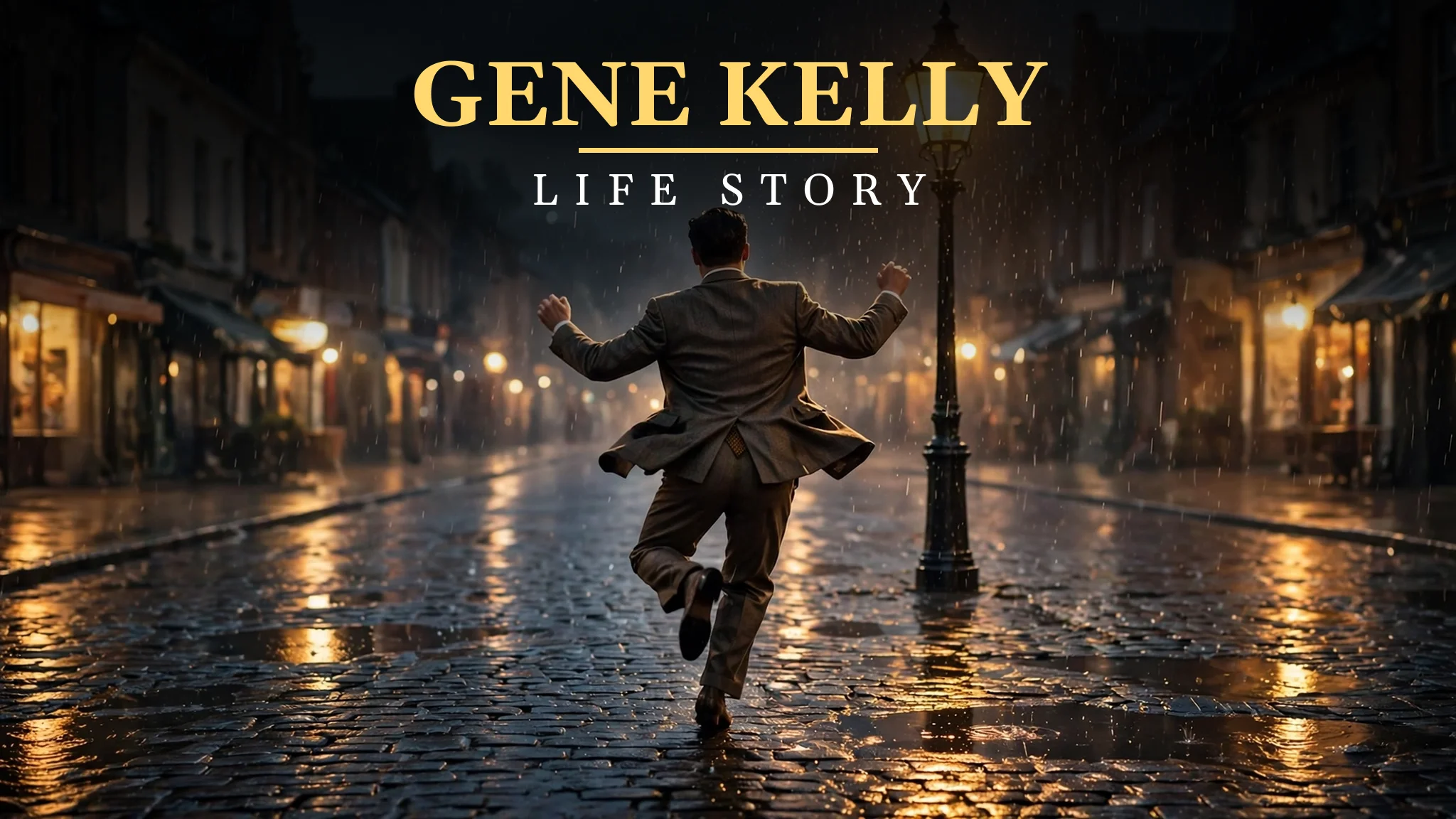
That scene shows Kelly walking home in the rain, holding an umbrella, and then giving in to joy. He throws the umbrella away, he dances on the wet street, he splashes through puddles, and he swings around a lamp post. The dance looks free and happy, as if it happened by chance. In truth, it was planned with great care, and Kelly filmed it while he was ill with a high fever. He kept going because he wanted the scene to feel right. The rain, the street, and the lamp post all became part of the dance, and the result feels like pure happiness.
The rest of the film is just as strong. The dance with Donald O’Connor, the long ballet dream, and the songs all fit together into a story about people who love making movies. Kelly played a man who is charming and proud, and who slowly learns to be honest about his feelings. The film was a success, but its true fame grew over the years. New generations found it, loved it, and passed it on. Today, the image of a man dancing in the rain is one of the most famous images in all of cinema, and it belongs to Gene Kelly.
An American in Paris and the Artist at His Peak
One year before Singin’ in the Rain, Kelly had made An American in Paris, released in 1951. In that film, he played Jerry Mulligan, an American painter living in Paris after the war. The film is full of colour, music, and dance, and it ends with a long ballet that takes the audience through the world of French painters. Kelly planned that ballet with great care, and it is one of the boldest dance scenes ever put on film. The sets, the costumes, and the music all came together to make something that felt like a painting coming to life.
The film won the Academy Award for Best Picture, and Kelly received an honorary Oscar for his work in film. It was a moment of real honour. He had shown that a musical could also be a work of art, and that dance could carry deep feeling. He had also shown that an American dancer could take the ideas of European art and make them his own. The film’s success gave him more freedom in Hollywood, and he used it to try new things.
In the years that followed, he made Brigadoon in 1954, a musical about a Scottish village that appears only once every hundred years. The film had beautiful dancing and a gentle, dreamlike feeling. He also made It’s Always Fair Weather in 1955, a film about three soldiers meeting again after the war, with dances that used the streets and rooftops of New York. Each film showed a different side of his talent. He could be joyful, he could be thoughtful, and he could use dance to tell a story about friendship, love, or loss.
By the mid-1950s, Kelly was at the peak of his powers. He was a star, a director, and a choreographer, all at once. Other dancers looked up to him, and young performers wanted to work with him. He had changed the film musical, and he had done it by trusting his own ideas. He believed that dance belonged everywhere, not only on a stage, and he had proved it again and again on screen.
Hard Years and a Changing Hollywood
The late 1950s brought change to Hollywood. The big musicals became less common, and television was taking audiences away from the cinema. Kelly made Invitation to the Dance in 1956, a film made only of dance, with no spoken words. It was a brave and artistic work, but it did not find a large audience. He also tried directing films without dancing, and he worked on television. The world was moving on, and the golden age of the Hollywood musical was coming to an end.
His personal life also had hard times. His first marriage, to the actress Betsy Blair, ended in divorce in 1957. He later married Jeanne Coyne, a dancer and choreographer who had worked with him for many years. They had two children, and their marriage lasted until her death in 1973. Loss and change were part of his life, as they are part of every life, and Kelly kept working through them. He did not stop creating, even when the big film roles became fewer.
He directed films such as Hello, Dolly! in 1969, a big musical that did not succeed as hoped. The film business was changing fast, and the old style of musical was out of fashion. Kelly also worked in television, and he appeared as an actor in films and shows. He played a role in the television series The Funny Side, and he took character parts in films. He was still loved by audiences, but the days when he could make a grand musical every year were gone.
Even so, he never lost his place in the hearts of film lovers. Young dancers still watched his old films, and directors still talked about his work. He gave talks, he appeared at festivals, and he shared what he had learned. He was patient with young people who wanted to learn, and he was honest about how hard the work was. He knew that fame fades, but good work lasts, and his work had already lasted longer than most.
The Last Dance and a Lasting Legacy
In his later years, Kelly lived in Beverly Hills, and he stayed close to his family. He married Patricia Ward in 1990, and she was with him in his final years. He received honours for his work, including the Kennedy Center Honors and the National Medal of Arts. He was praised not only as a dancer, but as a man who had changed American film. People who had grown up watching his movies now brought their children to see them, and the joy passed from one generation to the next.
He died on 2 February 1996, at the age of 83, at his home in Beverly Hills. The news was met with sadness around the world. Tributes came from dancers, actors, and directors who said that Kelly had shown them what film dance could be. He was remembered as a man who worked hard, who loved his craft, and who never stopped trying to make something better. His films were shown again on television and in cinemas, and new audiences discovered the man dancing in the rain.
His legacy is easy to see. Every time a dancer moves through a real street on film, every time a camera follows a dancer instead of standing still, and every time a musical uses dance to tell a story, Gene Kelly’s influence is there. He made dance feel strong and joyful, and he made it belong to everyone, not only to ballet lovers. He proved that a boy from Pittsburgh who learned to dance in his mother’s studio could change the way the whole world saw movement on screen. That is a rare and wonderful thing, and it is why his name is still loved today.
The Teacher Behind the Dancer
Gene Kelly was not only a performer. He was a teacher, and teaching was at the heart of everything he did. He had taught children in his mother’s dance studio in Pittsburgh, and he never forgot what that work had taught him. A teacher must be patient, must break a hard step into small parts, and must believe that a student can learn what seems impossible at first. Kelly brought that patience to his film sets, and the dancers who worked with him remembered it. He rehearsed for long hours, he showed each step himself, and he stayed until the dance was right. He did not shout at people to make them better. He showed them, again and again, until their bodies understood what their minds had not yet learned.
His rehearsals were famous for their discipline. He believed that a dance should look easy, and that ease could only come from hard work. He would practise a single step many times, changing a small detail each time, until the movement felt natural. He worked with the camera crew as well, because he knew that a dance on film is not only about the dancer. It is about where the camera stands, how it moves, and when the scene is cut. He planned all of it, and he expected everyone around him to work as hard as he did. That discipline could be demanding, but it produced work that still looks fresh many years later.
He also worked with some of the finest dancers of his time, and he helped them shine. He danced with Cyd Charisse, with Leslie Caron, and with Donald O’Connor, and each partnership was different. With Charisse, he danced with grace and power. With Caron, he danced with lightness and romance. With O’Connor, he danced with humour and joy, as in the famous number in Singin’ in the Rain where O’Connor runs through the studio making jokes with his body. Kelly was generous in these partnerships. He did not try to be the only star on screen. He shared the dance, and the dance was better for it.
In the 1960s, when the great Hollywood musicals were fading, Kelly found new work on television. He made television specials, he appeared in shows, and he directed films such as Gigot, a gentle story about a lonely man in Paris, and A Guide for the Married Man, a comedy. These works were not as famous as his great musicals, but they showed that he was still curious, still willing to try new things, and still in love with the work of making films. He also appeared in a television version of Jack and the Beanstalk, which brought his dancing to a new generation of children who had never seen his films in a cinema.
His influence on later dancers is easy to see, and it is still growing. Dancers who came after him learned from his films, from his use of real places, and from his belief that the camera should dance with the performer. Choreographers in film, in theatre, and on television have all studied his work, and many have said that he showed them what was possible. He proved that dance could be strong, that it could be joyful, and that it could belong to everyone, not only to a small group of experts. That lesson is still being taught today, in dance schools around the world, and it began with a boy from Pittsburgh who learned to dance in his mother’s studio.
My Take:
When I think about Gene Kelly, I think first about joy. Not the loud, forced kind of joy, but the real kind that comes when a person is doing exactly what they were made to do. When Kelly dances in the rain, he is not showing off. He is not trying to prove that he is the best dancer in the world. He is a man who has just fallen in love, and his body cannot hold the feeling inside. He has to move. He has to splash through the water and spin around a lamp post, because that is what happiness feels like when it is too big for words. I think that is why the scene has lasted for so many years. We have all felt that kind of happiness, even if we have never danced in the rain, and Kelly shows it to us in a way that feels true.
I admire Kelly because he worked so hard for that feeling. The rain dance looks easy, but it was not easy at all. He was ill, the water was cold, and the steps had to be exact. He kept going until it was right. That is the part of his story that stays with me. Talent is a gift, but Kelly turned his gift into something lasting by working at it every day. He practised in his mother’s studio, he taught children who were just learning, he rehearsed until his feet hurt, and he never settled for a dance that was only good enough. I think that is a lesson for anyone who wants to do good work. The joy on screen came from years of hard work off screen, and we should not forget the hard part when we enjoy the happy part.
I also admire the way Kelly mixed strength with grace. In his time, many people thought a male dancer had to be light and delicate. Kelly was not delicate. He was strong, he was athletic, and he moved like a man who loved sport. He played American football, he loved the feeling of his muscles working, and he brought that power into his dancing. He showed that a man could be graceful without being soft, and that strength could be beautiful. I think that changed dance for many young men who loved to move but felt that dance was not for them. Kelly gave them permission to dance in their own way, with power and with joy.
There is something else I respect about Kelly, and that is his mind. He was not only a dancer. He was a thinker about film. He asked how the camera should move, how a dance could happen in a real place, and how a story could be told through movement. He worked with directors, he learned about editing, and he planned his dances like a builder plans a house. Many performers are happy to do what they are told. Kelly wanted to understand the whole film, and he wanted to make it better. That curiosity made him a director, and it made his films richer than they would have been if he had only danced in them.
I feel sad when I think about the later years of his career, because Hollywood changed and left him behind. The big musicals became rare, and the new films wanted a different kind of star. Kelly tried new things, and some of them did not work. Hello, Dolly! was a big film that did not succeed, and Invitation to the Dance was too unusual for many audiences. I think it must have been hard for a man who had been at the top to find that the world had moved on. But I also think he handled it with grace. He did not become bitter, and he did not blame other people. He kept working, he taught young dancers, and he stayed proud of what he had made. That is a quiet kind of courage, and I admire it.
His personal life also had pain. His first marriage ended, and his second wife died. These are the kinds of losses that can break a person, and Kelly lived through them while the whole world watched him smile on screen. I do not want to pretend that I know how he felt in private, because I do not. But I think it is worth remembering that the man who danced so happily on screen also knew sadness in his own life. The joy in his films was real, but it was not the whole story. He was a real man, with a real life, and that makes his work feel more honest to me, not less.
One of the things I love most about Kelly is that he made dance for everyone. He did not dance only for people who knew ballet. He danced on streets, in rain, and beside a cartoon mouse. He danced in a way that a child could enjoy and a grown person could admire. He believed that dance was not a closed world for a few experts. It was a way for any person to feel more alive. I think that belief is still needed today. Too many art forms feel closed and hard to enter, and Kelly’s work is a reminder that great art can be open, warm, and welcoming to everyone who watches it.
I also think about the dancers who came after him. So many of them learned from his films. They watched how he used the camera, how he danced with the world around him, and how he made a dance tell a story. Directors learned from him too. The idea that a musical number can move through a real place, and that the camera can dance with the performer, is now common in film. But it was not common before Kelly. He had to fight for it, and he had to prove that it worked. I think we owe him a debt for that, even if we do not always know his name when we watch a modern film.
If I have a criticism, it is small, and it is about how Hollywood treated him. I think he deserved more recognition as a director while he was alive. People praised his dancing, and that was right, but they did not always see how much thought went into his films. Singin’ in the Rain is now seen as a masterpiece, but it was not seen that way at first. It grew in fame slowly, over many years. I think that is a shame, because Kelly was alive and working, and he should have known how much his best work would mean to the world. Still, he did live long enough to see his films loved by new generations, and that must have brought him some comfort.
What I take from his story is simple. Work hard at what you love, and do not be afraid to be different. Kelly was different from the dancers of his time, and that difference was his strength. He was strong where others were light, he was joyful where others were formal, and he was curious where others were content. He trusted his own ideas, and he kept working on them until the world caught up. I think that is a good way to live, whether you are a dancer or a teacher or a person learning a new skill late in life. Do the work, trust your own sense of what is right, and let the joy show.
I also think about the rain. In real life, rain is cold and wet, and most of us run for cover when it starts. Kelly ran into it and danced. That is a small image, but it holds a big idea. Life will give us hard days, and we can hide from them, or we can find a way to move through them with joy. Kelly’s dance does not say that life is easy. It says that joy is possible even on a wet night, and that a person can choose to dance instead of only waiting for the storm to pass. I like that idea very much, and I think it is the best gift his films give us.
When I watch his films now, I do not only see a great dancer. I see a man who believed in hard work, in joy, and in the power of movement to tell the truth. I see a boy from Pittsburgh who was teased for dancing and kept dancing anyway. I see a teacher who helped children find their rhythm. I see a director who wanted the camera to move with the dancer, and a star who wanted his films to be open to everyone. That is a full life, and a good one. I am glad his films still exist, and I am glad that new people keep finding them. Gene Kelly danced in the rain, and the world is still watching, and still smiling.
I also think about his discipline, because it is the part of his story that is easiest to miss. When we watch him dance, we see joy, and we forget the hours of practice that made the joy possible. He rehearsed until his feet hurt, he planned every step, and he worked with the camera crew until the shot was right. That is not glamorous work, and it is not fun to watch. But it is the work that makes great art possible, and I think we should honour it. Talent is a gift, but discipline is a choice, and Kelly chose it every day of his working life. I think that is a lesson for anyone who wants to do good work: the joy on the surface is built on hard work underneath, and there is no shortcut around it.
I think about his generosity as a teacher, too. He shared the screen with other dancers, he taught children in his mother’s studio, and he helped young performers find their way. He did not keep his knowledge to himself. He shared it, and the dance world is better because of it. A man who teaches is a man who gives, and Kelly gave a great deal. He gave his time, his patience, and his skill, and he asked only that his students work hard. That is a fair trade, and it is one that builds a better world, one dancer at a time.
I also think about how his films are studied today, in dance schools and in film classes, and I am glad they are. A young dancer can watch Singin’ in the Rain and learn more in two hours than from a whole book about dance on film. She can see how the camera moves, how the street becomes a stage, and how a dance can tell a story without a single word of dialogue. That is a rare kind of teaching, the kind that lives in the work itself, and it will keep teaching long after the man is gone. Kelly’s films are his classroom, and the doors are still open.
Finally, I think about what his life means for a person who is different. Kelly was different from the dancers of his time, and the world told him so. He was too strong, too athletic, too joyful for the old idea of what a dancer should be. He did not change himself to fit the old idea. He changed the idea to fit himself, and the world followed him. I think that is a brave and hopeful message. If you are different, do not hide it. Work hard, trust your own sense of what is right, and let the world catch up. Gene Kelly did that, and the world is still catching up, still watching, and still smiling.
I also think about the dancers who watched him and learned, because that is how art survives. A young dancer in a small town, watching Singin’ in the Rain on a television set, can see what is possible: a dance that is strong, joyful, and free, a camera that moves with the dancer, and a street that becomes a stage. That young dancer does not need a grand theatre or a rich family. She needs only the film, and the will to practise. Kelly’s work gives her both the dream and the lesson, and that is a gift that keeps giving, generation after generation, long after the man himself is gone.
And I think about the simple fact that he never stopped loving the work. He was teased as a boy, he was ill during his most famous scene, he lost his wife, and Hollywood moved on from his kind of film, and still he kept dancing, teaching, and creating. That stubborn love is the part of his story I want to carry with me. When the work is hard, when people doubt you, and when the world changes around you, keep going, keep practising, and keep finding joy in the thing you love. Gene Kelly did that for eighty-three years, and his dancing still makes the world smile.
Frequently Asked Questions
What made Gene Kelly different from other dancers of his time?
Gene Kelly danced with the strength and energy of an athlete, while many dancers of his time moved in a lighter and more delicate way. He mixed ballet training with sports, and he used real places like streets and rooftops as part of his dances. He also worked with the camera, so the film itself became part of the dance, which made his work feel fresh and modern.
When was Gene Kelly born and where did he grow up?
Gene Kelly was born on 23 August 1912 in Pittsburgh, Pennsylvania. He grew up in a family that ran a dance studio, so dancing was part of his daily life from a young age. He later studied at the University of Pittsburgh and taught dance classes to earn money before moving to New York to work on Broadway.
Why is the rain dance in Singin’ in the Rain so famous?
The rain dance is famous because it looks like pure joy, with Kelly splashing through puddles and spinning around a lamp post on a wet street. It was planned with great care, and Kelly filmed it while he was ill with a fever. The scene has become one of the most loved images in film history because it shows happiness in a simple and honest way.
Did Gene Kelly win an Academy Award?
Gene Kelly received an honorary Oscar in 1952 for his work in film, and An American in Paris won the Academy Award for Best Picture. He was not given a competitive acting Oscar, but his work as a dancer, choreographer, and director earned him great respect. He later received honours such as the Kennedy Center Honors and the National Medal of Arts.
What is Gene Kelly best known for today?
Gene Kelly is best known for Singin’ in the Rain and An American in Paris, and for changing the way dance was filmed in Hollywood. He is also remembered for Anchors Aweigh, where he danced with the cartoon mouse Jerry. His strong, joyful, and athletic style of dance still influences dancers and directors today.
How did Gene Kelly die?
Gene Kelly died on 2 February 1996 at his home in Beverly Hills, at the age of 83. He had lived a long life in film, and he was mourned by dancers and actors around the world. His films are still shown and loved, and new audiences continue to discover his work.


