George Strait: The Life Story Behind the King of Country
In this post
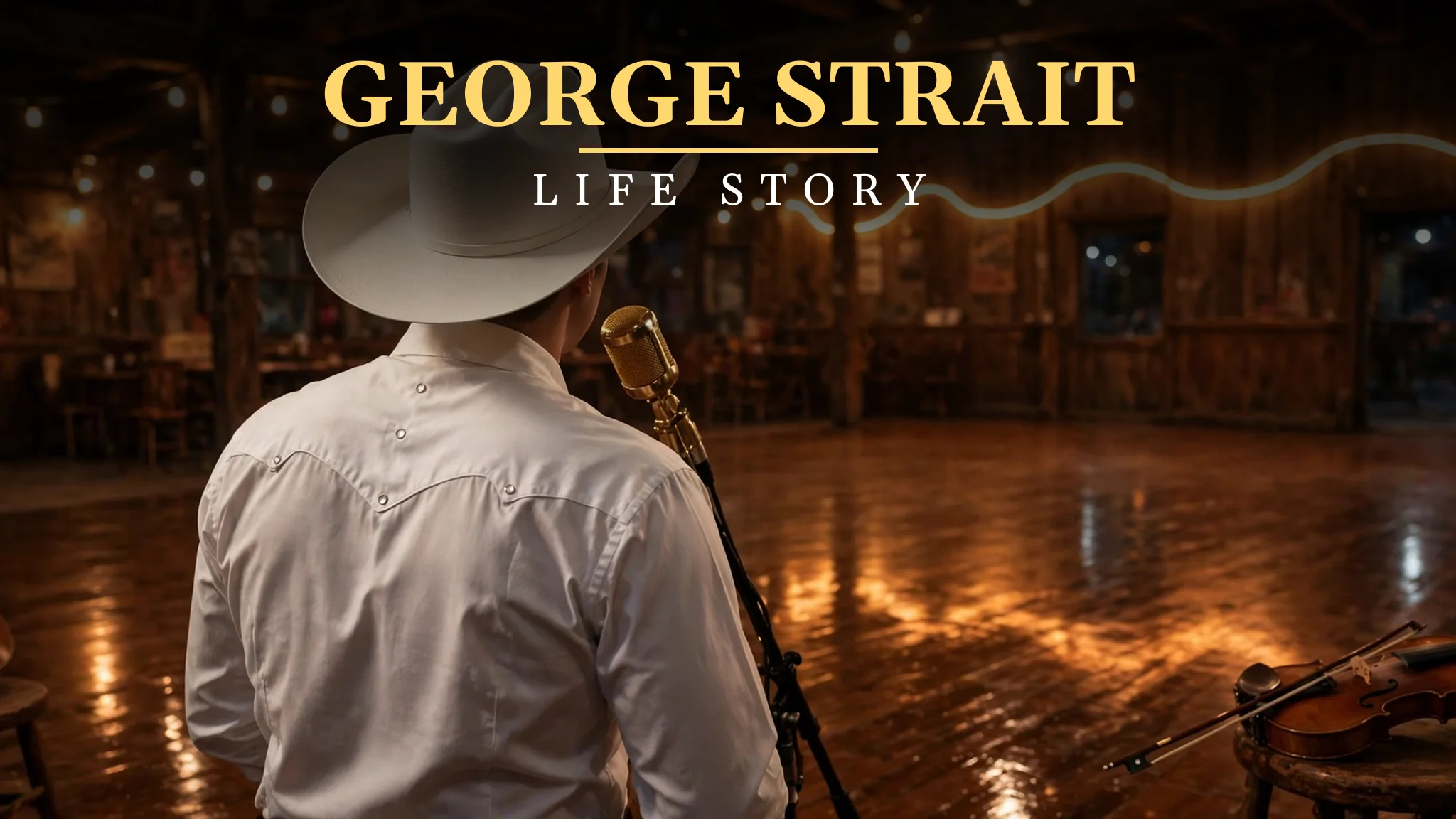
George Strait is called the King of Country, and the title fits him, not because he is loud or flashy, but because he has been the most steady, most trusted voice in country music for more than forty years. He has had more number one hits than any other artist in any kind of music, and he did it by singing simple, honest songs about love, loss, and the life of Texas, in a plain voice that never tried to be anything it was not. He wears a white cowboy hat, he stands still on stage, and he lets the songs do the talking.
What makes his story special is how quiet it is. He did not chase fame, he did not change his sound to follow fashion, and he did not live his life in the magazines. He grew up on a ranch in Texas, he served in the Army, he played in dance halls with a small band, and he became a star by being himself, year after year, album after album. He lost a daughter in a terrible accident, and he carried that grief with dignity, and he kept singing, because singing was what he knew how to do.
This is the story of a Texas ranch boy who became the King of Country, not by shouting, but by standing still and singing the truth. It is a story about patience, about loyalty to a sound, and about a man who let his music speak for him, even when the world around him kept changing.
A Ranch Boy From Poteet, Texas
George Harvey Strait was born on 18 May 1952 in Poteet, Texas, a small town south of San Antonio, and he grew up on a ranch near Pearsall, where his father, John, raised cattle and worked the land. Life on the ranch was hard and honest, with long days, hot sun, and work that had to be done whether you felt like it or not. George learned to ride, to work with cattle, and to understand the land, and those lessons stayed with him for the rest of his life, even after he became famous.
His parents separated when he was young, and he and his brother lived with their father on the ranch, while their sister lived with their mother. It was not an easy childhood, but it was a grounded one, and George learned to be steady, to be quiet, and to do his work without complaining. He went to school in Pearsall, he played in the school band, and he listened to the country music that was always on the radio in Texas, from Bob Wills to Hank Williams to Merle Haggard.
Music was part of ranch life, but it was not the centre of it. George played in a rock band in high school, and he liked to sing, but he did not dream of being a star. He was a country boy, and his life was the ranch, the cattle, and the wide Texas sky. He finished school, and he looked for a way forward, and like many young men of his time, he found it in the Army, which gave him a chance to see the world beyond Texas.
The ranch years mattered because they gave him his voice, his values, and his sound. He did not learn country music from a textbook. He learned it from life, from the radio, from the dance halls, and from the people around him. When he finally became a singer, he sang like a man who had lived the life he was singing about, and audiences could hear the difference. That is why they trusted him, and why they still do.
His father, John Byron Strait, was a rancher and a schoolteacher, and he taught George the value of hard work, of honesty, and of taking care of the land. The ranch was not a hobby. It was a way of life, with cattle to feed, fences to mend, and work that had to be done in all weathers. George learned to ride a horse before he learned to drive a car, and he learned that a man’s word matters, and that a job worth doing is worth doing well. Those lessons stayed with him, long after he left the ranch for the stage.
The Army, Hawaii, and the Ace in the Hole Band
In 1971 George joined the United States Army, and he was sent to Hawaii, where he served for four years. Hawaii was a long way from Texas, and it was a different world, with different music, different people, and a different pace of life. George liked it, and he began to play music more seriously, singing with a band on the base and learning how to perform for an audience. The Army gave him discipline, it gave him time to think, and it gave him a chance to grow up away from home.
While he was in Hawaii, he met Norma, the woman who would become his wife. They married in 1971, and their marriage has lasted for more than fifty years, one of the longest in country music. Norma was not a star, and she did not want to be one. She was a steady, private person, and she gave George a home and a family to come back to, no matter how far the music took him. Their partnership has been the quiet centre of his life, and he has always said that she is the reason he could keep going.
After the Army, George went back to Texas and studied agriculture at Southwest Texas State University in San Marcos, because he still thought he might go back to ranching. But music kept pulling him back, and he joined a band called the Ace in the Hole Band, a group of young musicians who played in dance halls and honky-tonks across Texas. The band was tight, it was traditional, and it played the kind of country music that George loved, with fiddles, steel guitars, and songs that people could dance to.
The Ace in the Hole Band became his band for the rest of his career, and the dance halls of Texas became his school. He learned how to sing for people who were dancing, drinking, and talking, and how to hold their attention with a song. He recorded a few singles that did not sell, and he was turned down by record companies in Nashville, who said his music was too traditional, too old-fashioned, and too Texas. George did not change. He waited, and he kept playing, and in 1981, MCA Records finally signed him, and his life changed forever.
While he was in Hawaii with the Army, George played in a band on the base, and he began to take music more seriously. He sang country songs for soldiers who were far from home, and he learned how music can comfort people, and remind them of the places they love. Hawaii was a long way from Texas, but the songs made it feel closer, and George discovered that his voice could make people feel at home, even when they were thousands of miles away from it.
Unwound, Amarillo by Morning, and the First Hits
George Strait’s first single for MCA was Unwound, released in 1981, and it became a hit, reaching the top ten on the country charts. It was a simple, traditional country song, with a fiddle, a steel guitar, and George’s plain, honest voice, and it proved that there was still an audience for real country music, even in a time when Nashville was moving toward a smoother, more pop sound. The fans heard it, and they liked it, and they wanted more.
His first album, Strait Country, came out the same year, and it was followed by more albums and more hits. In 1982 he recorded Amarillo by Morning, a song about a rodeo cowboy driving through the night to the next town, with a fiddle that sounds like the wind on the plains. The song became one of his most famous recordings, and it is still one of the songs that country fans name when they talk about George Strait. It is a song about the road, about loneliness, and about a man who keeps going because that is what he does.
Through the 1980s, George released album after album, and hit after hit, and he became one of the biggest stars in country music. He had songs like The Chair, All My Ex’s Live in Texas, and Ocean Front Property, and each one was a small story, told simply, with humour and with heart. He did not make big speeches, and he did not put on a wild show. He stood on stage in his white hat, he sang the song, and he let the music speak for itself.
By the end of the decade, he was known as the King of Country, a title that had once belonged to others, but which now belonged to him. He had not chased the title, and he had not changed his sound to earn it. He had simply kept making the kind of music he believed in, year after year, and the fans had followed him, because they knew that a George Strait record would always be honest, always be well made, and always be worth listening to.
In 1984 he recorded Does Fort Worth Ever Cross Your Mind, a song about a man who wonders if the woman he loved still thinks of him, and it became a number one hit, and one of his most loved recordings. The song was simple, direct, and full of feeling, and it showed that George could sing about heartbreak without ever raising his voice, or making a big show of his pain. He sang it quietly, and honestly, and the fans heard the truth in it, and they loved him for it.
Sixty Number Ones and a Steady Throne
In the 1990s and 2000s, George Strait kept doing what he had always done, and the hits kept coming. He recorded songs like Check Yes or No, a sweet song about young love, Carrying Your Love With Me, and I Cross My Heart, a song he sang at his own wedding anniversary, and each one went to number one on the country charts. Over time, he collected more number one hits than any other artist in any genre of music, a record that still stands, and a sign of how steady and how loved his career has been.
He also made films, including Pure Country in 1992, in which he played a country star who walks away from fame to find himself again. The film was a success, and its soundtrack became one of his best-selling albums. He was not a trained actor, but he played the role with the same quiet honesty that he brought to his songs, and audiences liked seeing him on screen, playing a man who was not so different from himself.
He toured constantly, but his shows were different from the big stadium shows of other stars. He did not run around the stage, he did not smash guitars, and he did not shout at the crowd. He stood still, he sang, and he let the band play, and the fans, who had come to hear the songs, were happy. His concerts were like a good dance hall, warm, honest, and full of music that people knew by heart.
Through all of this, he stayed the same man. He did not change his hat, he did not change his sound, and he did not change his life. He lived on a ranch in Texas, he raised his family, and he went to work like any other man, except that his work was singing songs for millions of people. That steadiness is rare in the music business, and it is the reason his fans trust him more than almost any other star.
His son Bubba, who was born after Jenifer’s death, grew up on the ranch, and he became a rodeo rider, following in the footsteps of his father and grandfather. George has spoken with pride about Bubba, and about the way he has carried on the ranch tradition, and about the joy of watching his son ride, and compete, and live the life that George himself once lived. It is a circle, from father to son, and it is a beautiful thing to see.
Loss, Grief, and Carrying On
In 1986 George and Norma suffered a loss that no parent should ever have to face. Their thirteen-year-old daughter, Jenifer, was killed in a car accident in Texas. The news was devastating, and George, who was already a private man, became even more private. He did not talk about the loss in public, and he did not use it to sell records. He grieved with his family, in private, and he kept going, because that was the only thing he knew how to do.
The loss changed him, as it changes any parent who goes through it. He became more careful with his time, more protective of his family, and more aware of how short life can be. He and Norma had a son, Bubba, who was younger than Jenifer, and they raised him with love and with care, and they kept Jenifer’s memory alive in their home. George has rarely spoken about her death, and when he has, he has done so with a quiet dignity that says more than any long speech could.
He also started a foundation in Jenifer’s name, to help children and families in need, and he has supported it quietly for many years. He does not talk about the foundation much, and he does not make a show of his charity. He gives because he believes it is right, and because he knows what it is like to lose a child, and he wants to help other families who are going through hard times.
His music after the loss did not change in an obvious way, but listeners who know his story can hear a deeper sadness in some of his songs, a sense that he understands loss in a way that only a person who has lived through it can. He did not stop singing, and he did not stop touring, but he sang with a heart that had been broken and had kept beating, and that is a kind of strength that is hard to describe, and easy to feel.
In 2008 he released the album Troubadour, which won a Grammy Award for Best Country Album, and which had songs about growing older, about looking back, and about the road that a singer travels, year after year. The title song was about a troubadour, a travelling singer, and it was a fitting song for a man who had spent his whole life on the road, singing for people who loved his music. It was a reminder that George Strait is not just a star. He is a troubadour, in the oldest sense of the word.
The Cowboy Rides Away and the Years After
In 2012 George announced that he would stop touring, and his final tour, called The Cowboy Rides Away, ran through 2013 and 2014, with shows across America that sold out in minutes. The final show was held in Arlington, Texas, in front of more than one hundred thousand fans, one of the largest crowds for a single concert in American history. It was a farewell, but it was not a goodbye to music. George said he would keep recording, and he has, releasing new albums in the years since, even though he no longer tours in the same way.
The farewell tour was emotional for his fans, because they had grown up with his songs, and they knew that they were watching the end of an era. George, true to himself, did not make a big speech, and he did not cry on stage. He sang the songs, he thanked the crowd, and he tipped his hat, and that was enough. He had always let the music speak for him, and he did it one last time, in front of the biggest crowd of his life.
In the years since, he has played a few special shows, including a long run of concerts in Las Vegas, and he has continued to record new music. He has also been honoured with awards, including induction into the Country Music Hall of Fame in 2006, and he has been named the Artist of the Decade and the Entertainer of the Year by the country music industry. He accepts these honours with the same quiet grace that has marked his whole career.
He still lives in Texas, on a ranch, with Norma, and he still wears the white hat, and he still sings like a man who has lived the life he sings about. He is not a star who chases the spotlight. He is a man who found his place, and stayed there, and let the world come to him. That is a rare kind of success, and it is why his story still matters.
The Legacy of the King
George Strait’s legacy is in the numbers, and the numbers are remarkable: more number one hits than any other artist, more albums, more awards, and a career that has lasted for more than forty years. But his real legacy is not in the numbers. It is in the songs, and in the way he sang them, and in the trust that his fans have placed in him. When you buy a George Strait record, you know what you are getting, and that trust is worth more than any award.
His legacy is also in the sound he protected. When Nashville moved toward pop, George stayed with traditional country music, with fiddles, steel guitars, and songs about real life. He proved that traditional country could still sell, still fill arenas, and still matter, and he gave courage to younger singers who wanted to make the same kind of music. He did not just sing country songs. He kept country music alive, at a time when it could easily have lost its way.
He will be remembered as the King of Country, not because he wore a crown, but because he earned the title, year after year, song after song, with honesty and with hard work. He is a man from a Texas ranch who became a legend by being himself, and by never forgetting where he came from. That is a legacy that will last, and it is why his name will be spoken with respect for as long as country music is sung.
George Strait started as a ranch boy in Poteet, Texas, and he became the most successful country singer in history, not by shouting, but by singing the truth, quietly, and well. He lost a daughter, he kept his marriage, he kept his band, and he kept his sound, and he did it all with a white hat and a steady heart. That is a full life, and it is a life worth remembering.
My Take:
When I think about George Strait, the first thing I feel is calm, because his music has a steadiness that is rare in a loud and fast world. He does not shout, he does not show off, and he does not try to be something he is not. He stands on stage in a white hat, he sings a song about love or loss, and he lets the song do the work. I have listened to many singers who try too hard, and they tire me out. George never tires me out, because he is honest, and honesty is restful. It is a gift to be able to sing that way, and he has done it for more than forty years.
I admire him most for the way he never changed his sound to follow fashion. Nashville has gone through many changes, from pop country to rock country to bro country, and George stayed with the traditional sound he loved, with fiddles and steel guitars and songs about real life. That takes courage, because the music business rewards the new thing, and it punishes the old thing, and George could have changed his sound and made more money. He did not. He trusted his fans, and he trusted his own taste, and he was right. His fans stayed with him, because they knew that a George Strait record would always be honest.
What moves me most is the way he carried the loss of his daughter Jenifer. He did not talk about it in public, and he did not use it to sell records, and he did not make a show of his grief. He grieved in private, with his family, and he kept singing, and he kept going. I think that is a kind of strength that is hard to describe, because it is quiet, and it does not ask for applause. It is the strength of a man who has been broken and who has kept living, and who has kept loving the people who are still with him. I respect that more than I can say.
I also think about his marriage to Norma, because it has lasted for more than fifty years, and that is a long time in any life, and a very long time in the music business. They met when he was in the Army, they married young, and they built a life together on a ranch in Texas, away from the spotlight. She did not want to be famous, and he did not ask her to be. They raised two children, they lost one, and they stayed together through it all. I think that is a beautiful thing, and it is a reminder that a good marriage is not about being perfect. It is about staying, and about loving each other through the hard times as well as the good ones.
There is something I find sad in his story too, and it is the way the world sometimes overlooks quiet people. George Strait is the most successful country singer in history, and yet many people outside country music do not know his name, because he does not make headlines, he does not cause trouble, and he does not shout for attention. He just sings, and he goes home. I think that is unfair, because his work deserves to be known by everyone, not just by country fans. But I also think that George does not mind, because he never sang for the headlines. He sang for the people who love country music, and they know who he is, and that is enough for him.
I keep coming back to Amarillo by Morning, because it is one of my favourite songs, and it tells the whole story of George Strait in a few minutes. It is a song about a rodeo cowboy driving through the night, with no money, no home, and no one waiting for him, and yet he keeps going, because that is what he does. The fiddle sounds like the wind, the voice sounds like a man who has seen hard times, and the song ends without a happy ending, just a man on the road, going to the next town. That is George. He is not a man who needs a happy ending. He is a man who keeps going, and who sings the truth, even when the truth is sad.
If I have a criticism, it is a small one, and it is that his shows, for all their beauty, can feel a little too calm for some people. He does not run around the stage, he does not talk much to the crowd, and he does not put on a big show. I understand why he does it, because the songs are the show, and he does not need to add anything to them, but I sometimes wish he would say a little more, and let the audience see a little more of the man behind the hat. That is a small wish, though, and it does not take away from the music, which is what matters most.
Another thing I notice is how loyal he has been to his band, the Ace in the Hole Band, who have played with him since the early days. In a business where musicians are often hired and fired without a second thought, George kept his band together for decades, and he treated them like family. I think that says a lot about him. He is not a star who uses people and throws them away. He is a man who values loyalty, and who understands that a good band is not just a group of musicians. It is a family, and a family stays together.
For a young reader, I think the lesson of George Strait’s life is that you do not have to be loud to be heard. You do not have to shout, or show off, or change yourself to fit the fashion of the moment. You have to be good, you have to be honest, and you have to be patient. George waited years for his first hit, and when it came, he was ready, because he had spent those years playing in dance halls and learning his craft. That patience is a lesson that is hard to learn in a world that wants everything now, and it is worth learning.
I also think his story teaches us about the value of staying true to your roots. George grew up on a ranch in Texas, and he never left Texas, not really. He lives there, he works there, and he sings about it, and his music sounds like Texas because he is Texas. He did not move to Los Angeles, he did not change his accent, and he did not pretend to be something else. He stayed himself, and the world came to him. I think that is a powerful lesson for anyone who feels pressure to change in order to succeed.
One more thing stays with me, and it is the way he handled his farewell tour. He did not make a big drama out of it, and he did not cry on stage, and he did not ask for sympathy. He sang the songs, he thanked the crowd, and he tipped his hat, and he went home. That is a dignified way to say goodbye, and it is a reminder that a career does not have to end with a bang. It can end with a quiet thank you, and a hat tip, and a walk off the stage, and that can be just as moving as any big finale.
In the end, I believe George Strait teaches us that a great life is not always a loud life. It can be a quiet life, lived with honesty, with loyalty, and with love, and it can still be a great life. He sang songs, he loved his family, he kept his band, he kept his sound, and he kept his word. When I hear his music today, I do not just hear a country singer. I hear a man who knows who he is, who knows where he came from, and who has never forgotten it, and I think that is why people will keep listening to him for a long time to come.
I think about the ranch sometimes, and about the boy who grew up there, working with cattle, listening to the radio, and dreaming of nothing more than a good song and a good day. That boy became the King of Country, not by dreaming of fame, but by working hard, by being patient, and by singing the truth. I think that is a hopeful story, because it means that a quiet boy from a small town can become a legend, if he is willing to work, and to wait, and to stay true to himself.
I also want to say that his music has a place in my life that is steady and warm. I listen to George Strait when I want to feel calm, when I want to remember that life is long, and that hard times pass, and that a good song can make a hard day feel a little easier. His voice is like a friend sitting next to you, telling you that it will be all right. That is a rare gift, and I am glad he shared it with the world.
Finally, I want to say that George Strait’s story is a reminder that success does not have to change you. He became the most successful country singer in history, and he stayed the same man, living on a ranch in Texas, married to the same woman, playing with the same band, and singing the same kind of songs. That is a rare thing, and it is a beautiful thing, and it is why I admire him so much. He did not let fame change him. He let fame serve him, and he used it to do the work he loved, and that is the best way to be famous.
When I look at the whole of his life, from Poteet to the Hall of Fame, from Unwound to Amarillo by Morning, from the Army to the Cowboy Rides Away tour, I see a man who lived a full and honest life, with love and with loss, with triumph and with grief, and who never stopped being himself. I think the world is better because George Strait sang, and I think his songs will keep playing, in dance halls and in cars and in kitchens, for many years to come.
One last thought stays with me, and it is about the white hat. The hat is not a costume. It is a part of who he is, a symbol of Texas, of the ranch, and of a man who knows where he belongs. When he tips his hat at the end of a show, he is not just saying goodbye. He is saying thank you, and he is saying that he is proud to be a country singer, and proud to be from Texas, and proud to have shared his music with the people who came to listen. That is a good way to end a show, and a good way to live a life.
I also think about his quiet dignity, and the way he has never chased attention, or made a show of his life. He does not give long interviews, he does not talk about his feelings in public, and he does not ask for sympathy. He just sings, and he goes home, and he lives his life. I think that is a rare and valuable quality, in a world where many famous people share everything, and demand attention for it. George does not demand attention. He earns it, with his music, and with his character, and that is a better way to live.
One more song stays with me, and it is I Cross My Heart, a song he recorded in 1992, and one that many couples have chosen as their wedding song. It is a promise, sung simply, and honestly, about loving someone, and staying with them, through good times and bad. George sang it at his own wedding anniversary, and he meant every word, because he has lived it, with Norma, for more than fifty years. That is a beautiful thing, and it is a reminder that a song can be a promise, and a promise can be a life.
Frequently Asked Questions
Where was George Strait born and where did he grow up?
George was born on 18 May 1952 in Poteet, Texas, and he grew up on a ranch near Pearsall, where his father raised cattle. He learned to ride and work the land as a boy, and the ranch life shaped the voice, values, and sound that made him famous.
How did George Strait get his start in music?
After serving in the Army in Hawaii, George returned to Texas and joined the Ace in the Hole Band, playing in dance halls and honky-tonks across the state. He was turned down by Nashville record companies who said his sound was too traditional, but MCA Records signed him in 1981, and his first single, Unwound, became a hit.
What is Amarillo by Morning about?
Amarillo by Morning, recorded in 1982, is a song about a rodeo cowboy driving through the night to the next town, with little money and no one waiting for him. Its fiddle and plain, honest words made it one of George Strait’s most famous songs, and a classic of country music.
How many number one hits does George Strait have?
George Strait has had more number one hits than any other artist in any genre of music, with sixty number one songs on the country charts. The record reflects a career of more than forty years, with album after album of hit songs that fans still know by heart.
What happened to George Strait’s daughter Jenifer?
George and Norma Strait’s thirteen-year-old daughter, Jenifer, was killed in a car accident in Texas in 1986. George has rarely spoken about the loss in public, and the family started a foundation in her name to help children and families in need.
Why did George Strait stop touring?
George announced in 2012 that he would stop touring, and his final tour, called The Cowboy Rides Away, ended in 2014 with a huge show in Arlington, Texas. He said he would keep recording new music, and he has, while playing only a few special shows, including concerts in Las Vegas.


