Gianni Versace: The Life Story Behind the Bold Designer
In this post
- Reggio Calabria, a Dressmaker’s Shop, and a Boy Who Sewed
- Milan, Freelance Work, and the House on Via Spiga
- Supermodels, Safety Pins, and the Most Famous Dresses
- Miami, Casa Casuarina, and a Life in the Sun
- The Atelier, the Family, and the Business Behind the Glamour
- Versace Home, Perfume, and a Brand Beyond Clothes
- My Take:
Gianni Versace did not believe in quiet. He believed in colour, in gold, in prints that could be seen from across a room, and in dresses that made a woman feel like a star the moment she put them on. While other designers were talking about simplicity, Versace was talking about glamour, about the joy of being noticed, and about the power of a dress to change how a woman felt about herself. He was a designer who loved excess, who loved beauty, and who loved the theatre of fashion, and in less than twenty years, he built a house that became a symbol of luxury, of sensuality, and of Italian style at its most joyful.
Giovanni Maria Versace was born on 2 December 1946 in Reggio Calabria, a city in the south of Italy, on the toe of the boot, looking across the sea to Sicily, and he grew up in a family where clothes were not a luxury, but a living. His mother, Francesca, was a dressmaker, and she ran a small shop where she made clothes for the women of the town, and his father, Antonio, was a salesman who sold coal and other goods. Gianni had an older brother, Santo, a younger sister, Donatella, and another sister, Tina, who died young, and he grew up in a house where fabric, scissors, and needles were part of daily life, and where a boy could learn to sew by watching his mother work.
What makes Versace’s story so vivid is that it is a story of a boy from the south of Italy, a place that was poor, traditional, and far from the fashion capitals of Milan and Paris, who became one of the most famous designers in the world, by trusting his own taste, which was bold, colourful, and unashamedly glamorous. He did not try to be quiet, or to be minimal, or to be safe. He was loud, he was bright, and he was proud of it, and the world loved him for it, because his clothes made people feel alive.
Reggio Calabria, a Dressmaker’s Shop, and a Boy Who Sewed
Gianni Versace grew up in Reggio Calabria, a city in the south of Italy that was, in the 1940s and 1950s, a place of poverty, of tradition, and of strong family ties, where life moved slowly, and where a boy’s future was often decided by his family, not by his dreams. His mother’s dressmaking shop was a small, busy place, where women came to have their dresses made, and where Gianni, as a child, watched his mother work, learning how a piece of fabric could become a dress, how a dress could fit a woman’s body, and how a woman’s face changed when she saw herself in a beautiful garment. He learned to sew, to cut, and to design, not in a school, but in his mother’s shop, by watching, by helping, and by trying things himself.
He was a bright, curious boy, who loved art, who loved the ancient Greek and Roman ruins that were part of the landscape of southern Italy, and who was fascinated by the myths, the gods, and the monsters of the classical world. The Medusa, a figure from Greek myth with snakes for hair, who could turn a person to stone with a look, became a symbol that would later define his fashion house, because Gianni saw in her a power, a beauty, and a danger that he wanted his clothes to have. He also loved the colours of the south, the bright blue of the sea, the gold of the sun, and the pink of the bougainvillea that grew on the walls of houses, and those colours stayed in his mind, and became the palette of his later work.
At school, Gianni was not a star student, but he was a talented artist, and he dreamed of a life beyond Reggio Calabria, a life in Milan, where fashion was made, and where a young designer could become famous. He studied architecture for a short time, but he soon realised that his real talent was for fashion, and he began to work with his mother, designing clothes for her shop, and learning the business of dressmaking from the ground up. He was a young man with a clear vision, and he was determined to leave the south and to make his name in the north, in Milan, the capital of Italian fashion.
In 1972, when he was twenty-six, Gianni moved to Milan, a city that was fast, modern, and full of opportunity, and he began to work as a freelance designer, designing clothes for other fashion houses, including Callaghan, Genny, and Complice, and building a reputation as a designer who was bold, original, and unafraid to use colour and print. He worked hard, he learned the business, and he saved money, because he knew that one day he wanted to start a house of his own, a house that would bear his name, and that would reflect his taste, his southern Italian roots, and his love of glamour.
Milan, Freelance Work, and the House on Via Spiga
Milan in the 1970s was a city of great energy, where Italian fashion was becoming famous around the world, and where young designers could find work if they were talented and hard-working. Gianni Versace was both, and he quickly became known as a designer who could create a collection that was both commercial and artistic, a collection that sold in shops and that was praised by the press. He designed for Genny, a house known for its knitwear, and for Complice, a house known for its leather, and he learned how to design for different kinds of women, with different tastes, and with different budgets, a skill that would serve him well when he started his own house.
In 1978, with the help of his brother Santo, who handled the business, and his sister Donatella, who worked with him on design, Gianni founded the house of Gianni Versace, opening a boutique in Milan on the Via della Spiga, one of the most elegant streets in the city. His first collection, shown in 1978, was a success, and it established his style, bold prints, bright colours, luxurious fabrics, and a sensual, glamorous feeling that was very different from the quiet, minimal style of other Italian designers, like Giorgio Armani. Where Armani was quiet, Versace was loud, and where Armani used greige, Versace used gold, and that contrast made him stand out, and made his house famous.
The Medusa became the logo of the house, a golden head with snakes for hair, chosen because Gianni loved Greek myth, and because he believed that Medusa, who could turn people to stone with her beauty, was a perfect symbol for his clothes, which were meant to be so beautiful that they stopped people in their tracks. The logo appeared on clothes, on bags, on belts, and on every product the house made, and it became one of the most recognisable symbols in fashion, a sign of luxury, of glamour, and of Italian style. Gianni also used baroque prints, inspired by the art and architecture of Italy, with gold, with scrolls, and with classical motifs, and those prints became a signature of his work, instantly recognisable, and endlessly copied.
His house grew rapidly in the 1980s, with shops in Milan, in Paris, in New York, and in other cities, and with a ready-to-wear line, a couture line, and a range of accessories, perfumes, and home goods. He dressed the most famous women in the world, from princesses to pop stars, and he became known as a designer who understood women, who knew how to make them feel beautiful, and who was not afraid to design clothes that were sexy, bold, and joyful. His shows were spectacles, with music, with lights, and with the most famous models in the world, walking down the runway in his clothes, to the applause of an audience that had come to be entertained as much as to see fashion. The growth was fast, but it was managed carefully by Santo, who made sure that each new shop, each new line, and each new product carried the same quality, the same Medusa, and the same sense of glamour, so that a customer in New York felt the same excitement as a customer in Milan, when they walked into a Versace boutique and saw the gold, the prints, and the light.
Supermodels, Safety Pins, and the Most Famous Dresses
In the late 1980s and early 1990s, Versace became famous for his work with supermodels, the group of women who became stars in their own right, including Linda Evangelista, Cindy Crawford, Naomi Campbell, and Christy Turlington, and who walked in his shows, appeared in his advertising campaigns, and became associated with his house. Versace understood that fashion was not just about clothes, but about the women who wore them, and he chose models who were strong, beautiful, and confident, and he designed clothes that showed off their beauty, rather than hiding it. His shows were events, with the supermodels walking together, arm in arm, to music, and with an audience that cheered, because they were watching not just a fashion show, but a performance.
One of his most famous designs was the safety pin dress, worn by the actress Elizabeth Hurley in 1994, to the premiere of the film Four Weddings and a Funeral, in London. The dress was a black, silk dress, held together by large gold safety pins, with cut-outs that showed Hurley’s body, and it became one of the most famous dresses in the history of fashion, photographed around the world, and talked about for years. The dress was bold, sexy, and daring, and it showed Versace’s gift for creating a moment, a dress that would be remembered, and that would make its wearer famous. Hurley, who was then little known, became a star overnight, because of that dress, and Versace became known as a designer who could make a moment happen.
He also designed for Princess Diana, who became a friend and a client, and who wore his clothes to public events, and who loved his elegant, glamorous style. He designed for Elton John, the musician, who was a close friend, and who wore Versace’s bold, colourful clothes on stage, and he designed for many other stars, from Madonna to Cher to Sting, all of whom loved his work because it was joyful, because it was luxurious, and because it made them feel like stars. His clothes were not for shy people. They were for people who wanted to be seen, who wanted to be admired, and who wanted to enjoy the attention that a beautiful dress could bring.
Versace’s prints became famous in their own right, with bold, baroque patterns, with gold, with leopard, with bright colours, and with a sense of excess that was both Italian and universal. He did not believe in less is more. He believed in more is more, and his clothes reflected that belief, with embroidery, with beading, with silk, and with a richness that was a celebration of beauty, of luxury, and of life itself. His house became a symbol of the 1980s and 1990s, decades when fashion was bold, when money was plentiful, and when glamour was a way of life, and Versace was at the centre of it all, a designer who embodied the spirit of his time.
Miami, Casa Casuarina, and a Life in the Sun
In the 1990s, Versace spent more time in Miami, Florida, where he bought a house on Ocean Drive, Casa Casuarina, a beautiful, ornate mansion that he restored and filled with art, with mosaics, and with the colours he loved, and that became his home in America, a place where he could relax, entertain friends, and enjoy the sun, the sea, and the vibrant life of Miami. The house was a reflection of his taste, bold, luxurious, and full of beauty, with a pool lined with gold tiles, with gardens, and with rooms that were decorated like a palace, and it became a famous landmark, visited by stars, by friends, and by the fashion world.
Miami suited Versace, because it was a city of colour, of music, and of glamour, a city where people dressed boldly, where the sun shone, and where life was lived outdoors, and Versace’s clothes, with their bright prints and their sensual cuts, felt at home there. He spent his mornings walking on the beach, his afternoons working in his studio, and his evenings entertaining friends, including Elton John, Princess Diana, and many others, who came to his house to enjoy his hospitality, his food, and his company. He was a generous host, a man who loved to share his success with his friends, and who believed that life should be enjoyed, with beauty, with good food, and with good company.
His work in the 1990s continued to be successful, with new collections, with new shops, and with a growing business that included menswear, womenswear, couture, perfumes, and home goods, all bearing the Medusa logo, and all reflecting his vision of glamour. He was at the height of his fame, and his house was one of the most valuable in fashion, and he was planning new projects, including a hotel, when his life was cut short, in a way that shocked the world, and that ended a career that had still so much more to give.
Gianni Versace died on 15 July 1997 in Miami Beach, at the age of fifty, and his death was reported around the world, with tributes from designers, from models, and from the stars who had worn his clothes. His funeral was held in Milan, and it was attended by thousands of people, including Princess Diana, Elton John, and many others, who came to pay their respects to a man who had changed fashion, and who had brought joy, colour, and glamour to the lives of millions of people. His sister Donatella took over the house after his death, and she has led it ever since, keeping his vision alive, and ensuring that the Medusa, the prints, and the glamour that Gianni created continue to be worn by women around the world.
The Atelier, the Family, and the Business Behind the Glamour
Behind the glamour of Versace’s shows stood a family business, and that family was the heart of the house. His brother Santo handled the money, the production, and the business side, with a careful, practical mind that complemented Gianni’s artistic vision, and his sister Donatella worked closely with Gianni on design, on accessories, and on the image of the house, bringing a younger, bolder eye to the collections. The three siblings worked together every day, in Milan, in meetings, in the atelier, and on the runway, and their partnership was one of the closest in fashion, a family that had grown up together in Reggio Calabria, that had moved to Milan together, and that had built an empire together, from nothing, with only their talent and their determination.
The atelier itself was a place of hard work, with seamstresses, cutters, and embroiderers who turned Gianni’s sketches into clothes, and who worked with fabrics that were among the most luxurious in the world, silk, velvet, leather, and beading, all handled with a skill that had been learned over decades. Gianni was a demanding designer, and he expected perfection, but he was also generous with his praise, and he knew the names of the people who worked for him, and he respected their craft, because he had learned to sew in his mother’s shop, and he knew how hard the work was. The atelier was not just a workplace. It was a family, and Gianni treated it as one, with warmth, with humour, and with a belief that everyone who worked there was part of the house.
His business grew quickly, and by the early 1990s, Versace was one of the largest fashion houses in Italy, with hundreds of shops, with a turnover of hundreds of millions of dollars, and with a name that was known in every country. Santo managed that growth with care, opening shops in the right places, controlling production, and making sure that the house did not grow too fast, or lose the quality that had made it famous. Donatella, meanwhile, became the face of the house’s younger, bolder side, designing accessories, working on advertising, and bringing a fresh energy to the collections. Together, the three siblings created a house that was both a business and a family, and that balance is part of why the house survived after Gianni’s death, because the family was still there, to carry it forward.
Versace Home, Perfume, and a Brand Beyond Clothes
Versace did not stop at clothes. He believed that glamour should extend to every part of life, and he created a range of products that carried the Medusa logo and his bold, baroque style into the home, into perfume, and into accessories. He launched perfumes, including Gianni Versace for women and men, scents that were rich, warm, and sensual, like his clothes, and that became popular around the world. He designed furniture, china, and home goods, with the same gold, the same prints, and the same sense of luxury that defined his fashion, and he showed that a fashion house could be a lifestyle, not just a label on a dress.
His home collection was a natural extension of his work, because Gianni loved interiors, he loved his house in Miami, and he loved the idea of living in a beautiful space, surrounded by art, by colour, and by objects that made life feel luxurious. He designed plates, glasses, and furniture with the Medusa, with baroque patterns, and with a sense of opulence that was both Italian and universal, and those objects became collectible, bought by people who loved his fashion and who wanted to bring a little of his glamour into their homes. The home line was a success, and it showed that Versace’s vision was not limited to clothes, but extended to a whole way of life, a way of living boldly, colourfully, and joyfully.
He also designed costumes for the theatre, for the ballet, and for the opera, working with companies in Milan and elsewhere, and creating clothes for the stage that were as dramatic and as beautiful as his fashion shows. Those costumes showed his love of theatre, a love that had begun in Reggio Calabria, where he had watched his mother make dresses, and where he had dreamed of a world of performance, and they allowed him to design on a grand scale, for characters, for stories, and for a stage that was larger than any runway. His work for the theatre is less well known than his fashion, but it is an important part of his legacy, because it shows that his talent was not limited to one medium, but could be applied to any form of beauty.
My Take:
I think Gianni Versace is the designer who reminded the world that fashion can be joyful, and that joy is not a small thing, it is a serious thing, and it matters. In a fashion world that often takes itself very seriously, with its talk of minimalism, of restraint, and of quiet elegance, Versace said, why not be bold, why not wear gold, why not wear a print that can be seen from across a room, and why not enjoy being noticed. That is a brave and generous idea, because it gives people permission to be happy, to be glamorous, and to celebrate themselves, rather than hiding in beige. I admire that enormously, because joy is a gift, and Versace gave it to millions of people through his clothes.
What I admire most is his colour. He loved gold, he loved bright blue, he loved pink, and he used those colours without apology, in prints that were baroque, bold, and beautiful. His clothes were not for people who wanted to blend in. They were for people who wanted to stand out, and that is a powerful idea, because it says that a person does not need to be quiet to be elegant, and that elegance can be loud, can be bright, and can be fun. I think about his prints, with their scrolls, their Medusa heads, and their gold, and I see a designer who loved Italy, who loved its art, its history, and its sun, and who wanted to share that love with the world. That is a generous vision, and it is one that still feels fresh today, because the world still needs colour, especially in difficult times.
I also admire his understanding of women. He designed clothes that made women feel beautiful, sexy, and confident, and he did it without apology, because he believed that a woman’s body was beautiful, and that a dress should celebrate it, not hide it. The safety pin dress is the perfect example, a dress that was bold, that showed skin, and that made Elizabeth Hurley famous overnight, because it was a dress that said, look at me, and that is a powerful statement for a woman to make. Versace understood that a dress is not just a piece of cloth, it is a way for a woman to say who she is, and he gave women dresses that allowed them to say it loudly, and proudly, and I think that is a gift.
His work with supermodels is another part of his story that I think about a great deal. He understood that fashion is not just about clothes, but about the women who wear them, and he chose models who were strong, beautiful, and confident, and he put them on the runway together, arm in arm, to music, in a way that made the audience cheer. Those shows were not just fashion shows. They were performances, celebrations of female beauty, and they made the models into stars, and they made Versace into a star as well. I think that was a clever and generous idea, because it shared the spotlight, and it showed that fashion is a team effort, between a designer and the women who bring his clothes to life.
If I am honest, I think Versace’s style, for all its beauty, can sometimes feel like too much, too much gold, too much print, too much glamour, for everyday life. His clothes were made for parties, for red carpets, and for moments when a person wants to be noticed, and they are not always practical for a quiet day at work, or for a walk in the park. I understand that, and I do not hold it against him, because his clothes were never meant to be quiet, and they were never meant to be practical in the usual sense. They were meant to be joyful, and joy is not always practical, but it is always necessary. A wardrobe made only of Versace would be exhausting, but a wardrobe with one Versace dress, worn on a special night, is a wonderful thing, and that is how his clothes should be understood, as moments of joy, not as everyday uniforms.
I think about his death, and how sudden it was, and how much it shocked the world. He was fifty years old, he was at the height of his fame, and he had so much more to give, and his death, on a summer morning in Miami, ended a career that was still growing, still changing, and still full of ideas. I do not want to dwell on the details of his death, because they are painful, and because they do not define his life, but I do want to say that his death was a loss, not just for fashion, but for the world, because the world lost a man who brought colour, joy, and glamour to millions of people, and who did it with a generosity and a warmth that are rare. His sister Donatella took over the house, and she has kept his vision alive, and that is a tribute to his work, and to the strength of the family he built around him.
I also think about his mother, Francesca, and her dressmaking shop in Reggio Calabria, because that shop is where his story began, and it is a reminder that great designers often come from small places, from a mother’s shop, from a town far from Milan, and from a childhood spent watching fabric become a dress. Gianni learned to sew by watching his mother, and he learned that a dress could change a woman’s face, and that lesson stayed with him for his whole life. I find that moving, because it shows that a mother’s work, done quietly in a small shop, can become the foundation of a global empire, and that the love of a craft, passed from a mother to a son, can change the world.
What I learn from Versace is that boldness is a kind of honesty. He did not hide his taste, he did not pretend to be minimal when he loved excess, and he did not apologise for loving gold, for loving prints, or for loving glamour. He was himself, loudly and proudly, and the world loved him for it, because people can tell when a designer is being honest, and when they are following a trend. Versace followed his own taste, and his taste was bold, and that boldness is a lesson for anyone who wants to create something, which is to trust your own eye, even when it is different from everyone else’s, and to have the courage to be loud, if loud is who you are.
I also think about the joy in his work, and how rare that joy is. Many designers make clothes that are serious, that are intellectual, and that are meant to be admired in a museum, but Versace made clothes that were meant to be worn to a party, to be danced in, and to be enjoyed, and that joy is a serious achievement, because it is easy to be serious, and it is hard to be joyful, and to make other people feel joyful too. His clothes did that, and they still do, every time a woman puts on a Versace dress and feels like a star, and that feeling, of joy, of confidence, and of celebration, is his greatest gift to the world, and it is one that will last as long as people love to dress up, to dance, and to be seen.
In the end, I think Gianni Versace will be remembered as the designer of glamour, a man who gave the world colour, gold, and joy, and who did it with a generosity and a warmth that made his clothes feel like a celebration. He was not quiet, he was not minimal, and he was not safe, but his work was beautiful, and his influence is everywhere, in every bold print, in every gold dress, and in every woman who puts on a dress and feels like a star. He died young, at fifty, but his house lives on, led by his sister Donatella, and his vision lives on, in the Medusa, in the prints, and in the joy that his clothes still bring to the people who wear them.
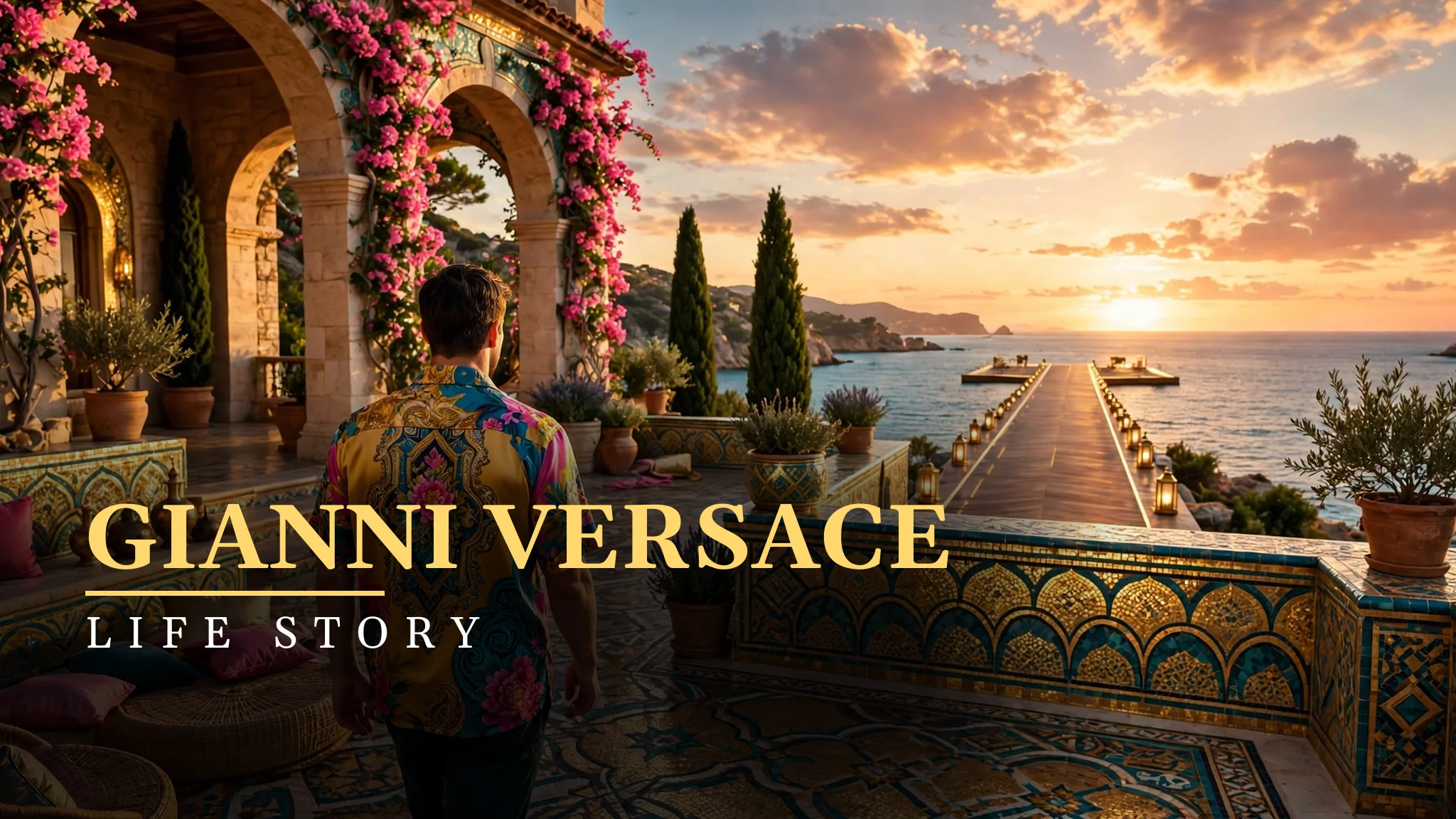
I will remember him as a boy in Reggio Calabria, watching his mother sew in her small shop, and as a man in Miami, standing on a terrace in a bright silk shirt, looking out over the sea at sunset, and I will remember that between those two images lies a life of extraordinary colour, extraordinary generosity, and extraordinary joy. That life is worth telling, and worth remembering, because it shows that a boy from the south of Italy, with a mother who made dresses, can become one of the most famous designers in the world, not by being quiet, but by being bold, and by trusting that the world wants colour, wants glamour, and wants joy, even when it pretends otherwise.
I also think about Donatella, and how she carried the house forward after his death. That is not an easy thing to do, to take over a house that was built by a brother you loved, and to lead it in a world that is always asking whether you can live up to his name. Donatella did it, and she has led Versace for nearly thirty years, keeping the Medusa, the prints, and the glamour alive, while also making the house her own. I admire that enormously, because it shows a strength and a loyalty that are rare, and it shows that a family business, built on love, can survive even the greatest loss. The house of Versace is still here, because Donatella kept it here, and that is a tribute to both of them, to Gianni who built it, and to Donatella who saved it.
His home in Miami, Casa Casuarina, is another part of his story that stays with me, because it shows how he lived, not just how he designed. The house was bold, luxurious, and full of beauty, with a pool lined with gold, with mosaics, and with gardens, and it was a place where he entertained friends, where he relaxed, and where he enjoyed the sun and the sea. I think a person’s home tells you a great deal about them, and Versace’s home tells me that he loved beauty in every part of life, not just in clothes, and that he believed that life should be lived joyfully, with good food, good friends, and beautiful surroundings. That is a philosophy I admire, because it says that beauty is not a luxury, it is a necessity, and that a life without beauty is a life that is missing something essential.
I also think about the supermodels, and how Versace helped to make them stars. He put Linda Evangelista, Naomi Campbell, Cindy Crawford, and Christy Turlington on the runway together, arm in arm, and he made them famous, not just as models, but as personalities, as women who were strong, confident, and beautiful. That was a generous act, because it shared the spotlight, and it showed that fashion is not just about the designer, but about the women who wear the clothes, and who bring them to life. I think that generosity is part of why his shows were so loved, because they were not just about clothes, they were about women, about friendship, and about joy, and the audience could feel that.
Finally, I think Versace teaches me that excess, done well, can be a form of honesty. He did not pretend to love minimalism when he loved gold, and he did not pretend to be quiet when he was loud, and that honesty is refreshing in a world where many people hide their true taste behind what is fashionable. He loved colour, he loved prints, and he loved glamour, and he said so, with every dress he made, and the world loved him for it, because people can tell when a designer is being true to themselves. That is a lesson for anyone who creates anything, which is to trust your own taste, even when it is different, and to have the courage to be bold, if bold is who you are.
Frequently Asked Questions
When was Gianni Versace born?
Gianni Versace was born Giovanni Maria Versace on 2 December 1946 in Reggio Calabria, in the south of Italy. His mother, Francesca, was a dressmaker, and he learned to sew by watching her work in her shop.
When did Gianni Versace found his fashion house?
He founded the house of Gianni Versace in 1978, opening a boutique in Milan on the Via della Spiga, with the help of his brother Santo and his sister Donatella. His first collection was a success and established his bold, colourful style.
What is the Medusa logo?
The Medusa is the logo of the Versace house, a golden head with snakes for hair, taken from Greek myth. Gianni chose it because he loved classical art, and because Medusa’s beauty, which could turn people to stone, was a perfect symbol for his glamorous clothes.
What was the safety pin dress?
The safety pin dress was a black silk dress worn by Elizabeth Hurley in 1994 to a film premiere in London. It was held together by large gold safety pins, with cut-outs that showed her body, and it became one of the most famous dresses in fashion history.
Who took over Versace after Gianni’s death?
After Gianni Versace died on 15 July 1997, his sister Donatella Versace took over the house as its creative director, and she has led it ever since, keeping his vision of bold prints, Medusa, and glamour alive.
What was Casa Casuarina?
Casa Casuarina was Versace’s house in Miami Beach, Florida, a beautiful mansion on Ocean Drive that he bought and restored, filling it with art and mosaics. It was his home in America, where he entertained friends including Elton John and Princess Diana.


