Glenn Ford: The Life Story Behind the Western Star
In this post
Glenn Ford was a quiet and steady star of Hollywood, a man who could play a cowboy, a teacher, a detective, or a soldier, and make each one feel real. He was not a loud star. He did not shout, he did not try to be the centre of attention, and he did not need a big gesture to make a scene work. He stood still, he spoke in a calm voice, and he let the character grow slowly, until the audience understood the man on the screen. That style made him one of the most reliable and most loved actors of his time.
He was born in Quebec City, in Canada, and he grew up in California. He began acting on stage, he worked in film, and he became a star in the 1940s, when he appeared in Gilda with Rita Hayworth. He went on to star in westerns, in dramas, and in crime films, and he built a career that lasted for more than fifty years. He was a working actor, a professional, and a man who loved his craft.
His story matters because it shows how a quiet and steady actor can build a long career, without being the loudest star in Hollywood. He played many different kinds of roles, he worked with many famous directors and actors, and he made films that are still watched today. He was a Canadian who became an American star, and he did it by being himself, by working hard, and by being patient.
A Boy From Quebec City Who Grew Up in California
Gwyllyn Samuel Newton Ford was born on 1 May 1916 in Quebec City, Quebec, Canada. His father, Newton Ford, worked for the Canadian Pacific Railway, and his mother, Hannah, was from Wales. The family moved to California when Glenn was young, and they settled in Santa Monica. He grew up in California, and he went to school there. He was a quiet boy, and he liked to read, to think, and to watch people.
As a boy, he became interested in acting, and he took part in school plays. He liked the feeling of being on a stage, of becoming a different person for a short time, and of making an audience believe in that person. He was not the loudest child in his class, but he was often the one with a clear and thoughtful comment. He learned to listen, to watch, and to use his voice with care. Those skills would later become central to his acting style.
He went to Santa Monica High School, and he began to work in theatre. He joined a local theatre group, and he learned how to act in front of a live audience. He also worked in different jobs, and he learned how to deal with people, how to be patient, and how to keep going even when things were hard. He was a young man with talent, but he was also a young man who was willing to work, to learn, and to grow.
His family background gave him a steady base. His parents supported his interest in acting, and they gave him room to try things and to fail. That support mattered, because a young actor needs time to learn, and time to make mistakes. Glenn used that time well. He performed in local theatres, he worked in radio, and he slowly built a reputation as a serious and talented young actor.
By the time he was a young man, he was ready to try a bigger stage. He moved to New York, and he began to work in theatre there, where he learned the craft of acting in a serious way. He was a handsome young man, with a calm voice and a clear manner, and directors noticed him. He was cast in roles that needed a strong and quiet presence, and he learned how to use that presence to make a character feel real.
Stage, Radio, and the First Steps in Film
In the 1930s, Glenn Ford worked on stage in New York and in California. He appeared in plays, and he learned how to act in front of a live audience. Theatre taught him discipline, it taught him how to remember his lines, and it taught him how to build a character over the course of a play. He was a serious actor, and he took his work seriously. He did not try to be a star. He tried to be good.
He also worked in radio, where he learned how to use only his voice to create a character. Radio was an important medium at the time, and it gave actors a chance to reach a wide audience without being seen. Glenn’s calm and clear voice was perfect for radio, and he became known as a reliable and talented voice actor. He learned to speak clearly, to use pauses, and to make a listener believe in a character with only sound.
He began to work in film in the late 1930s, and he appeared in small roles. He was a young actor, and he had to wait for the right role. He took what he could get, he learned from other actors, and he slowly built a reputation as a professional. He was not an overnight star. He was a working actor, learning his trade one role at a time.
During the Second World War, he joined the United States Marine Corps, and he served in the war. He was a young man, and the war was a formative experience for him, as it was for many men of his generation. He served in the Pacific, and he learned discipline, teamwork, and the value of hard work. He did not talk much about his service in later years, but it was a part of his youth that shaped him.
After the war, he returned to Hollywood, and he was ready for a bigger role. He had a strong base in theatre, radio, and film, and he had a clear idea of what he could do. He needed a film that would let him use his calm voice, his quiet strength, and his ability to play a man who was both tough and kind. That film came in 1946, when he was cast in Gilda, with Rita Hayworth.
Gilda and Becoming a Star
In 1946, Glenn Ford starred in Gilda, a film about a man who works in a casino in Buenos Aires, and who falls in love with a woman played by Rita Hayworth. The film was a huge success, and it made Glenn a star. He played Johnny Farrell, a calm and smart man who tries to stay in control, even when his life becomes complicated. His performance was quiet and strong, and it made audiences believe in his character.
Gilda was a film noir, a kind of film that was popular at the time, with dark lighting, complex characters, and a story about love and betrayal. Glenn’s calm style was perfect for the film, because it made Johnny feel like a real man, not only a character in a story. He did not shout, he did not try to be dramatic, and he let the character grow slowly. That style made him a star, and it gave him a new level of fame.
He followed Gilda with other successful films, including A Stolen Life, in 1946, and The Loves of Carmen, in 1948. He was now a leading man, and he was in demand for many different kinds of roles. He played in westerns, in dramas, and in crime films, and he built a reputation as a reliable and versatile actor. He was not a star who needed to be in every hit film. He was a working actor who chose roles that interested him, and who did them well.
His work in Gilda also gave him a lasting image. He was the quiet man in a dark suit, with a calm voice and a steady gaze, who could handle a difficult situation without losing his cool. That image stayed with him for the rest of his career, and it made him a favourite of audiences who liked a hero who was calm, smart, and strong. He was not a loud hero. He was a quiet hero, and that made him different from many other stars of his time.
By the late 1940s, he was one of the most popular actors in Hollywood, and he was ready for the next part of his career, which would take him to westerns, to crime films, and to some of the most famous films of the 1950s.
Westerns, Crime Films, and the 1950s Peak
In the 1950s, Glenn Ford became one of the most popular stars in Hollywood, and he appeared in many famous films. He starred in The Big Heat, in 1953, a crime film directed by Fritz Lang, in which he played a detective who fights corruption. He starred in Blackboard Jungle, in 1955, a film about a teacher in a tough school in New York, in which he played a man who tries to help his students. He starred in 3:10 to Yuma, in 1957, a western in which he played an outlaw, and he starred in many other westerns, including The Fastest Gun Alive, in 1956.
Each of these films showed a different side of his talent. In The Big Heat, he was a tough and angry detective. In Blackboard Jungle, he was a patient and kind teacher. In 3:10 to Yuma, he was a charming and dangerous outlaw. He could play many different kinds of men, and he made each one feel real. That versatility made him a valuable actor, and it gave him a long and successful career.
He was known for being professional, for being on time, and for knowing his lines. He worked with many famous directors, including Fritz Lang, and he worked with many famous actors, including Rita Hayworth, Gloria Grahame, and Van Heflin. He was a team player, and he helped other actors to do their best work. He did not try to be the star of every scene. He tried to make the film work, and he did whatever was needed to make it work.
The 1950s were the peak of his career, and he was one of the top box-office stars in America. His films were popular, his name was known, and he was respected by audiences and by other actors. He was a quiet star, but he was a star, and his work in the 1950s remains some of the best of his career. Films like The Big Heat and 3:10 to Yuma are still watched today, and they are still praised for their strong performances and their clear storytelling.
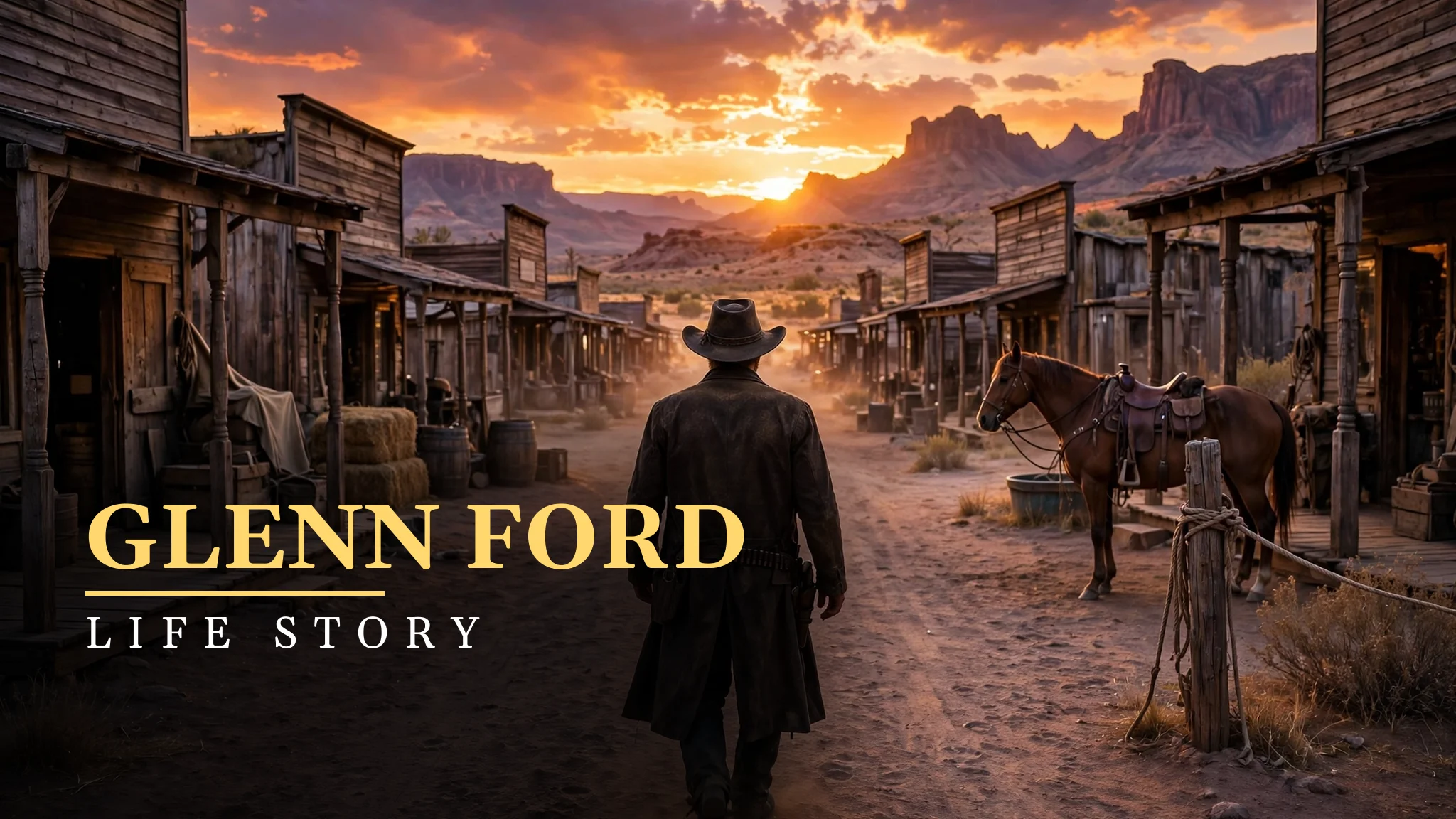
His work in westerns also gave him a lasting image as a cowboy, a man who could ride a horse, who could handle a gun, and who could stand up to a difficult situation with calm and courage. That image, seen in the cover for this story, is a key part of his legacy, and it is one that many people remember when they think of Glenn Ford.
Later Films, Television, and a Long Career
After the 1950s, Glenn Ford continued to work in film and television. He appeared in many films in the 1960s and 1970s, and he worked in television series, including Cade’s County, in the early 1970s, in which he played a sheriff in the modern West. He was a working actor, and he kept his career going for many years, even as Hollywood changed and new stars came and went.
He also appeared in Superman, in 1978, in which he played Jonathan Kent, the adoptive father of Clark Kent. The role was small, but it was important, because it gave him a chance to play a kind and wise father, and to be seen by a new generation of viewers. Children who saw Superman knew him as Jonathan Kent, and they loved him for his warmth and his kindness. That role showed a different side of his talent, and it gave him a new audience.
He continued to work into the 1980s and early 1990s, appearing in films and television shows. He was a busy performer, even in his seventies, and he showed no sign of slowing down. He loved to work, and he loved to act, and he kept doing it for as long as he could. He was a professional, and he took his work seriously, even when the roles were small.
He was married four times, and he had a son, Peter, from his first marriage. His family life was private, and he did not talk about it in public very often. He was known for being a kind and generous man, who loved to make people laugh, both on and off the set. He was also known for his love of the outdoors, and for his interest in nature and in the West.
He died on 30 August 2006 in Beverly Hills, California, at the age of ninety, after a long and full life. His death was mourned by fans around the world, and tributes came from actors, directors, and viewers who had loved his work. He was remembered as a quiet and steady star, a man who had made many wonderful films, and who had built a career that lasted for more than fifty years.
Why Glenn Ford Still Matters
Glenn Ford’s place in film history is secure, because he starred in Gilda, The Big Heat, Blackboard Jungle, and 3:10 to Yuma, four of the most famous films of the 1940s and 1950s. He showed that a quiet and steady actor could become a star, and that a career could last for many years if it was built on talent, professionalism, and hard work. That is a legacy that matters, and it is one that will be remembered for a long time.
His work also matters because it shows the value of versatility. He could play a cowboy, a teacher, a detective, and a father, and he made each one feel real. That range made him a valuable actor, and it gave him a career that touched many different kinds of films. He was not a star who played only one kind of role. He was an actor who played many kinds of men, and who did it well.
He remains a Canadian voice in American film, a man who was born in Quebec City and who became a star in Hollywood by being calm, smart, and persistent. His story is a story of slow work, of building a career one role at a time, and of finding success that lasted for more than fifty years. That is a story worth remembering, and it is one that will continue to inspire people for many years to come.
Blackboard Jungle, The Big Heat, and the Teacher Who Cared
In the 1950s, Glenn Ford made two films that showed very different sides of his talent. In The Big Heat, released in 1953 and directed by Fritz Lang, he played Dave Bannion, a detective who fights corruption after his wife is killed. The film was dark and violent, and Glenn played Bannion with a quiet anger that made the character feel real. He did not shout, he did not try to be a hero in a loud way, and he let the character’s pain show in a calm and steady manner. The film is still regarded as one of the best crime films of the 1950s.
In Blackboard Jungle, released in 1955, he played Richard Dadier, a teacher in a tough school in New York who tries to help his students. The film was about education, about young people who had been failed by the system, and about a teacher who refused to give up on them. Glenn played Dadier with patience and kindness, and he made the audience believe that a good teacher can change a life. The film was a success, and it showed that Glenn could play a gentle and hopeful man, as well as a tough detective or a cowboy.
These two films, made only two years apart, show his range as an actor. He could be angry and tough in one film, and patient and kind in the next, and he made both characters feel real. That versatility is a key part of his talent, and it is one of the reasons he had such a long and successful career. He did not play only one kind of man. He played many kinds of men, and he did it well.
His work in westerns also included films like The Fastest Gun Alive, in 1956, in which he played a gunfighter who tries to live a quiet life, and Cowboy, in 1958, in which he played a man who learns about life on the trail. Those films showed a different side of his talent, because they were about men who were trying to be good, even in a hard and violent world. Glenn played those men with a calm and steady voice, and he made audiences believe in them. He was not a loud cowboy. He was a quiet cowboy, who thought before he acted, and who tried to do the right thing, even when it was hard. That quiet heroism is a key part of his legacy, and it is one that many people remember when they think of Glenn Ford.
He also worked in television in the 1970s, in a series called Cade’s County, in which he played a sheriff in the modern West. The show was about a man who tried to keep the peace in a small town, and who had to deal with modern problems in an old-fashioned way. Glenn played the sheriff with the same calm and clear style that had made him a star in film, and he showed that he could carry a television series as well as a film. That versatility, from film to television, from westerns to dramas, is a key part of his career, and it is one of the reasons he worked for more than fifty years.
He also appeared in A Stolen Life in 1946, a drama in which he played a man who falls in love with a woman played by Bette Davis. The film was a success, and it showed that Glenn could play a romantic lead as well as a cowboy or a detective. He was a versatile actor, and he could play many different kinds of men, from a casino worker in Gilda to a teacher in Blackboard Jungle to a father in Superman. That versatility is a key part of his talent, and it is one of the reasons he had such a long and successful career.
He also appeared in a film called The Sheepman in 1958, a western comedy in which he played a man who brings sheep into cattle country and who has to deal with the anger of local ranchers. The film was funny and warm, and Glenn played his role with a calm and steady voice that made audiences laugh and care at the same time. He was a versatile actor, and he could play a western hero, a teacher, a detective, and a father, all in a short time, and he made each one feel real. That versatility is a key part of his talent, and it is one of the reasons he worked for more than fifty years.
My Take:
When I think about Glenn Ford, I think first about calmness, because that is what his acting gave me. He did not shout, he did not try to be dramatic, and he did not need a big gesture to make a scene work. He stood still, he spoke in a calm voice, and he let the character grow slowly. I admire that, because it is hard to be calm on screen. Most actors want to show that they are feeling something, and they do it by shouting or by moving a great deal. Glenn did the opposite. He trusted the audience to see what he was feeling, even when he did not show it in a loud way. I think that trust is the heart of his work.
I also think about his versatility, because he could play so many different kinds of men. He was a cowboy in 3:10 to Yuma, a teacher in Blackboard Jungle, a detective in The Big Heat, and a father in Superman. Each one was different, and each one felt real. I think that range shows a real talent, and a real love of acting. He did not want to play the same man again and again. He wanted to try new roles, to learn new things, and to grow as an actor. That is a sign of a person who loves his craft, not only his fame.
What I like most about Gilda is the way he played Johnny Farrell. Johnny is a calm and smart man, who tries to stay in control, even when his life becomes complicated. Glenn played him with a quiet strength, and he made the audience believe in him. He did not try to be a hero in a loud way. He was a hero in a quiet way, and that made him more believable. I think that is why Gilda is still watched today. It is not only a film about love and betrayal. It is a film about a man who tries to do the right thing, even when it is hard, and Glenn played that man perfectly.
I feel sad when I think about how quiet his fame was, because he was not the loudest star in Hollywood, and he did not always get the attention that other stars got. He was a steady and reliable actor, and he was loved by audiences, but he was not always talked about in the same way as some of his more flamboyant colleagues. I think that is a shame, because his work deserves to be remembered, and his films deserve to be watched. He was a star, even if he was a quiet one, and I think his quietness is a part of what made him special.
His work in Blackboard Jungle also makes me think about how a film can change the way people think about a problem. The film was about a teacher in a tough school, and it showed the difficulties that teachers face, and the hope that they can make a difference. Glenn played the teacher with patience and kindness, and he made the audience believe that a good teacher can change a life. I think that is a powerful message, and it is one that is still relevant today. A teacher who cares can make a difference, and Glenn showed that in a clear and honest way.
I admire the way he served in the Second World War, because it shows a different side of his life. He was a young actor, and he joined the Marine Corps, and he served in the Pacific. That is a brave choice, and it is one that many young men of his generation made. He did not talk much about his service in later years, but it was a part of his youth that shaped him. I think that service gave him a sense of discipline, of teamwork, and of the value of hard work, and those lessons stayed with him through his whole career.
When I compare Glenn with other stars of his time, I see a man who was patient, professional, and very talented. He did not chase fame in a loud way. He built a career by being reliable, by being versatile, and by being willing to work hard for many years. I think that is a good model for a career, because fame can be loud and short, but a steady career built on talent and hard work can last longer. Glenn built that kind of career, and his work is still loved today.
The lesson I take from his life is about being steady. Do not try to be the loudest person in the room. Be calm, be clear, and trust your work. Learn many different kinds of roles, and be willing to try something new. Glenn did that, and he built a career that lasted for more than fifty years. I hope young actors remember that lesson, because it is easy to think that you need to shout to be noticed. Glenn showed that you can be noticed by being quiet, by being clear, and by being good at what you do.
I hope people keep watching his films, because I think they will see a man who was calm, smart, and very talented, and who played characters that made audiences feel hope. I hope they watch Gilda, The Big Heat, Blackboard Jungle, and 3:10 to Yuma, and I hope they see a quiet hero who tried to do the right thing, even when it was hard. That is a legacy that will last for a long time, and it is one that I think will be remembered whenever people talk about the history of film.
I also think about his role as Jonathan Kent in Superman, because it shows a kind and wise father, who teaches his son to be good. That is a small role, but it is an important one, because it shows a different side of Glenn’s talent. He could play a cowboy, a detective, and a teacher, and he could also play a father who loves his son and who wants him to do the right thing. I think that is a beautiful part of his career, and it is one that I will remember whenever I think about him.
I also think about his work in The Big Heat, because it showed a different side of Glenn that many people forget. He played a detective who fights corruption after his wife is killed, and he played him with a quiet anger that made the character feel real. He did not shout, he did not try to be a hero in a loud way, and he let the character’s pain show in a calm and steady manner. I think that is a powerful way to act, because it shows confidence. A confident actor does not need to shout. He needs to be clear, and to trust that the audience will listen. Glenn trusted his audience, and his audience trusted him back.
Another thing that stays with me is his work in Blackboard Jungle, because it showed a teacher who cares, and who refuses to give up on his students. Glenn played Richard Dadier with patience and kindness, and he made the audience believe that a good teacher can change a life. I think that is a powerful message, and it is one that is still relevant today. A teacher who cares can make a difference, and Glenn showed that in a clear and honest way. I think that film is one of his best, because it is not only about a teacher. It is about hope, about young people, and about the belief that people can change.
I think about his role as Jonathan Kent a great deal, too, because it shows a kind and wise father, who teaches his son to be good. That is a small role, but it is an important one, because it shows a different side of Glenn’s talent. He could play a cowboy, a detective, and a teacher, and he could also play a father who loves his son and who wants him to do the right thing. I think that is a beautiful part of his career, and it is one that I will remember whenever I think about him.
When I look at his whole career, I see a man who was calm, steady, and very talented, and who built a career that lasted for more than fifty years. He did not chase fame in a loud way. He built a career by being reliable, by being versatile, and by being willing to work hard for many years. That is a powerful example, and it is one that I think will be remembered for a long time.
I think about his work in westerns a great deal, because those films show a quiet hero who thinks before he acts, and who tries to do the right thing, even when it is hard. Glenn played cowboys who were not loud or violent, but who were calm, smart, and strong. I think that is a powerful kind of hero, because it shows that strength does not need to shout. A quiet man who does the right thing can be just as strong as a loud man who shouts, and Glenn showed that in film after film. That quiet heroism is a key part of his legacy, and it is one that many people remember when they think of him.
I also think about his work in Cade’s County, because it showed that he could carry a television series as well as a film. He played a sheriff in the modern West, a man who tried to keep the peace in a small town, and he did it with the same calm and clear style that had made him a star in film. I think that versatility, from film to television, from westerns to dramas, is a key part of his career, and it is one of the reasons he worked for more than fifty years. A performer who can work in many different kinds of shows will always have work, and Glenn understood that early in his career.
I think about his work in A Stolen Life a great deal, because it showed that Glenn could play a romantic lead as well as a cowboy or a detective. He played a man who falls in love with a woman played by Bette Davis, and he did it with a calm and steady voice that made audiences believe in him. I think that versatility, from a casino worker in Gilda to a teacher in Blackboard Jungle to a father in Superman, is a key part of his talent. He was not a star who played only one kind of man. He was an actor who played many kinds of men, and who made each one feel real.
I also think about his long life, because he lived to ninety, and he saw the world of film change many times. He was born in 1916, when films were silent, and he died in 2006, when films were digital and long, and when people watched them on television and on the internet. He lived through all of those changes with dignity, and he remained a respected figure in Hollywood until the end of his life. I think that is a sign of a person who understands that a career is not the whole of a life, and that a long and quiet life after fame can be just as important as the fame itself.
I think about his work in The Fastest Gun Alive a great deal, because it showed a gunfighter who tries to live a quiet life, and who is drawn back into violence by his own reputation. Glenn played that man with a calm and steady voice, and he made audiences believe in him, because he showed a man who was tired of fighting, but who could not escape it. I think that is a sad and human story, and it is one that Glenn played perfectly. He was not a loud cowboy. He was a quiet cowboy, who thought before he acted, and who tried to do the right thing, even when it was hard. That quiet heroism is a key part of his legacy.
Frequently Asked Questions
Where was Glenn Ford born?
Glenn Ford was born on 1 May 1916 in Quebec City, Quebec, Canada. His family moved to California when he was young, and he grew up in Santa Monica, where he began acting on stage.
What was Glenn Ford’s breakthrough film?
His breakthrough film was Gilda, released in 1946, in which he starred with Rita Hayworth. He played Johnny Farrell, a calm and smart man in a casino in Buenos Aires, and the film made him a star.
What are Glenn Ford’s most famous films?
His most famous films include Gilda in 1946, The Big Heat in 1953, Blackboard Jungle in 1955, and 3:10 to Yuma in 1957. He also played Jonathan Kent in Superman in 1978, a role loved by a new generation.
Did Glenn Ford serve in the military?
Yes, he served in the United States Marine Corps during the Second World War, in the Pacific. After the war, he returned to Hollywood and became a star with Gilda.
What kind of actor was Glenn Ford?
He was a quiet and steady actor, known for a calm voice, a clear manner, and a versatile style. He could play a cowboy, a teacher, a detective, a soldier, and a father, and he made each character feel real.
When did Glenn Ford die?
He died on 30 August 2006 in Beverly Hills, California, at the age of ninety, after a long and full life. He had worked in film and television for more than fifty years.
Why is Glenn Ford important in film history?
He is important because he starred in some of the most famous films of the 1940s and 1950s, and because he showed that a quiet and steady actor could build a long career. His work in westerns, crime films, and dramas is still watched today.


