Glenn Frey: The Life Story Behind the Eagles' Smooth Star
In this post
Glenn Frey had a gift that many musicians never learn. He could make a song sound easy. His voice was smooth, his guitar playing was clean, and his songs felt like a warm evening in California, even when the words were about hard times. He was a founder of the Eagles, the singer of Take It Easy, Lyin’ Eyes, and Tequila Sunrise, and a solo star with The Heat Is On and You Belong to the City.
He was born in Detroit, Michigan, a city of cars, factories, and music. He grew up listening to rock and roll, learned the guitar, and played in local bands before he moved west to Los Angeles. There, he met Don Henley, and together they built one of the most successful bands in American history.
His life was full of success, but it was also full of hard work, arguments, and long nights on the road. He died in 2016, at the age of sixty-seven, and the music world mourned him as a songwriter, a singer, and a man who helped define the sound of the 1970s.
His guitar playing is often overlooked, because his voice and his songwriting get so much attention, but it deserves a closer look. Glenn Frey played rhythm guitar for the Eagles, and he played it with a clean, precise style that held the songs together. He was not a flashy soloist like Joe Walsh. He was a rhythm player, a man who understood that a good song needs a solid foundation, and he provided it. That is a humble job, and it is an important one, and Glenn did it well for decades.
His sense of humour was also a key part of who he was. Friends and bandmates have said that Glenn was funny, warm, and generous, a man who could make a room laugh and who could put people at ease. That humour helped the Eagles through hard times, and it helped Glenn through his own life. He did not take himself too seriously, even when he was famous, and that made him easy to like. I think humour is a gift, and Glenn had it in abundance.
He was also a family man, a father of three children, and a husband who tried to balance his life on the road with his life at home. That is not easy for a rock star, and Glenn worked at it. He lived in Los Angeles, he spent time with his children, and he tried to give them a normal life, even though their father was famous. That effort matters, and it tells me a lot about his character.
A Detroit Boy With a Guitar
Glenn Lewis Frey was born on 6 November 1948 in Detroit, Michigan. His father worked in the auto industry, and his mother kept the home. Detroit in the 1950s was a busy, loud city, full of cars, factories, and music. The radio played rock and roll, soul, and rhythm and blues, and young Glenn listened to it all. He liked the energy of the music, and he liked the way a good song could make a room feel alive.
He learned to play the guitar as a teenager, and he soon joined local bands. Detroit had a strong music scene, and a young guitarist could find work playing in clubs and at parties. Glenn played in a band called The Mushrooms, and later he played with Bob Seger, another Detroit musician who would become famous. Seger taught him a lot about songwriting, about how to write a plain, honest song that people could understand.
School was not his main interest. Music was. He spent his free time practising, listening to records, and thinking about songs. He was a good-looking young man with a confident manner, and he liked being on stage. He was not shy. He liked to sing, he liked to play, and he liked the feeling of a crowd listening to him.
By the late 1960s, Glenn knew that Detroit was not big enough for his dreams. He wanted to go where the music business was, and that meant California. He packed his bags, said goodbye to his family, and drove west to Los Angeles, a city that promised fame to anyone brave enough to try.
Los Angeles and the Road to the Eagles
Los Angeles in the late 1960s and early 1970s was full of young musicians. Glenn arrived with little money, but he had talent and confidence. He played in clubs, he met other musicians, and he tried to get work as a songwriter and a session player. He lived in a small apartment, and he spent his days writing songs and his nights playing them for anyone who would listen.
He met Jackson Browne, a young songwriter who lived in the same building, and the two became friends. Browne was working on a song called Take It Easy, and Glenn helped him finish it. The song would later become the Eagles’ first hit, and it showed Glenn’s gift for taking a simple idea and turning it into a song that felt like a road trip in the sun.
Glenn also played in Linda Ronstadt’s backing band, where he met Don Henley. The two men were different in many ways. Glenn was warm, funny, and outgoing. Don was serious, careful, and intense. But they shared a love of good songs, and they both wanted to start a band that mixed rock and country. They talked late into the night about the kind of band they wanted, and they began to make plans.
In 1971, they formed the Eagles with Bernie Leadon and Randy Meisner. Glenn played guitar and sang lead on many songs, and he became the band’s frontman in many ways. He had the look, the voice, and the charm to lead a band on stage, and he used it well. The band signed a record deal, and they began to record their first album.
Take It Easy and the First Hits
The Eagles’ first album came out in 1972, and Take It Easy was the first single. The song, sung by Glenn, was a perfect start. It talked about a man driving down the road, looking for a woman, and trying to take life easy. The song was light, catchy, and full of California sunshine, and it became a hit. It set the tone for the band: songs that were easy to enjoy, but written with care.
The album also included Witchy Woman and Peaceful Easy Feeling, and it sold well. The band toured constantly, playing small clubs and then larger halls. Glenn was at the centre of the shows, singing, playing guitar, and talking to the crowd. He had a natural way with an audience, and people liked him. He was not a distant star. He was a friendly man who seemed to enjoy being on stage.
Their second album, Desperado, came out in 1973. It was a more serious album, about outlaws in the Old West, and it included the song Tequila Sunrise, sung by Glenn. The song was about a man who drinks too much and wakes up alone, and it showed that Glenn could sing a sad song with real feeling. The album did not sell as well as the first, but it showed that the band wanted to grow.
In 1974, the band released On the Border, and in 1975 they released One of These Nights. The band’s sound grew stronger, and Glenn wrote and sang some of their best songs. Lyin’ Eyes, from One of These Nights, was a song about a woman who marries for money and lives a lie. Glenn sang it with a smooth, sad voice, and the song won a Grammy Award. It was one of the band’s biggest hits, and it showed Glenn at his best as a songwriter.
Hotel California and the Biggest Years
By 1976, the Eagles were one of the biggest bands in the world. They released Hotel California, an album that would become a classic. Glenn sang lead on several songs, and he co-wrote many of the album’s tracks. The title song, sung by Don Henley, became the band’s most famous song, but Glenn’s work on the album was just as important. He helped shape the sound, the harmonies, and the feel of the record.
The band toured the world, played to huge crowds, and sold millions of records. They were rich, famous, and tired. Life on the road was hard, and the band members began to argue. Glenn and Don were the leaders of the band, and they often disagreed about the music, the money, and the direction of the group. They were like brothers, close and competitive, and their arguments could be loud.
The band released The Long Run in 1979, and it was another success. It included the song Heartache Tonight, sung by Glenn, which became a number one hit. But the band was falling apart. The tours were long, the members were exhausted, and the fun had gone out of the music. In 1980, after a difficult tour, the Eagles broke up. Glenn was in his early thirties, and he had to decide what to do next.
He decided to go solo. He had songs to write, and he had a voice that people knew. He did not want to stop making music just because the band had ended. He began to work on a solo career, and he found that he could make hits on his own.
The Heat Is On and Solo Success
Glenn’s first solo album, No Fun Aloud, came out in 1982. It included the hit The One You Love, a smooth, romantic song that showed his voice at its best. The album was a success, and it proved that Glenn could stand on his own. He followed it with The Allnighter in 1984, which included Sexy Girl and Smuggler’s Blues, a song that was used in the television show Miami Vice.
His biggest solo hit came in 1985, when he recorded The Heat Is On for the film Beverly Hills Cop. The song was fast, exciting, and full of energy, and it became a number one hit. It was very different from the Eagles’ music, but it showed that Glenn could adapt to a new sound. He also recorded You Belong to the City for Miami Vice, another hit that became closely linked to the show’s stylish, neon-lit world.
Glenn also tried acting. He appeared in Miami Vice as a guest star, and he acted in films and television shows. He liked the work, but music was still his first love. He kept recording solo albums, and he kept touring, playing his Eagles songs and his solo hits for audiences who loved them.
His solo career was not as big as the Eagles, but it was real, and it gave him a life of his own. He was no longer just one member of a famous band. He was Glenn Frey, a singer and songwriter in his own right. He enjoyed the freedom, and he enjoyed being able to make his own choices about his music.
Reunion, Family, and the Final Years
In 1994, the Eagles reunited for a tour and a live album called Hell Freezes Over. Glenn and Don put their old arguments aside, and the band came back together. The tour was a huge success, and the band found a new audience. Glenn was happy to be back with his old friends, and he sang the songs that had made them famous with the same warmth as before.
The band kept touring in the years that followed, and they released a new album, Long Road Out of Eden, in 2007. Glenn sang lead on several songs, and he was a key part of the band’s sound. He also worked on other projects, including a solo album called After Hours in 2012, which was a collection of love songs from the 1940s and 1950s. The album showed a softer side of Glenn, a man who loved the old songs his parents had listened to.
Glenn married Cindy Millican in 1990, and they had three children together. He was a devoted father, and he tried to balance his life on the road with his life at home. He lived in Los Angeles, and he enjoyed a quieter life when he was not touring. He was known for being funny, generous, and loyal to his friends.
In late 2015, Glenn became seriously ill. He had been dealing with health problems for some time, including rheumatoid arthritis and other issues, and he needed surgery. He died on 18 January 2016 in New York City, at the age of sixty-seven. The news shocked the music world, and tributes came from across the globe. Don Henley said that Glenn was like a brother to him, and that the band had lost its founder and its heart.
The Rhythm Guitar, the Humour, and the Man Behind the Songs
Glenn Frey was the Eagles’ frontman in many ways, but he was also the band’s rhythm guitarist, and that role deserves more attention than it usually gets. Rhythm guitar is not glamorous. It does not get the solos, and it does not get the applause. But it is the backbone of a song, the part that keeps the beat, that fills in the chords, and that makes the music feel full. Glenn played rhythm guitar with a clean, steady touch, and he did it for decades, on stage and in the studio. He understood that a band is a team, and that every player has a job to do.
His songwriting partnership with Don Henley was one of the great partnerships in rock. They wrote together, they argued together, and they made great music together. Glenn brought melody, warmth, and a sense of humour to the partnership, while Don brought seriousness, precision, and a sharp eye for detail. Together, they were better than either of them was alone. That is what a good partnership does. It brings out the best in both people, even when it is hard.
Glenn also had a successful solo career, and his solo hits, The Heat Is On and You Belong to the City, showed a different side of him. They were songs for films and television, songs that were fast, exciting, and full of energy, and they became hits in their own right. He also acted in Miami Vice and in films, and he enjoyed the work. He was not afraid to try new things, and he was not afraid to fail. That willingness to try is a sign of a confident artist.
He was also a generous man, a friend who helped other musicians, and a father who cared about his children. He married Cindy Millican in 1990, and they had three children together, Taylor, Deacon, and Otis. Deacon Frey later joined the Eagles, singing his father’s songs, and it was a moving tribute. Glenn would have been proud to see his son on stage with the band he founded, singing the songs he wrote. That is a legacy that goes beyond music. It is a family legacy.
Over the years, Glenn received many honours for his music, including six Grammy Awards with the Eagles and his induction into the Rock and Roll Hall of Fame in 1998. He was also honoured for his solo work, and for his contributions to American music. These honours matter, but they are not the whole story. The whole story is a man from Detroit who drove to California with a guitar, who helped to create one of the greatest bands in history, who made solo hits, who raised a family, and who left behind songs that people will sing for a long time.
Today, his songs are still played on the radio, in films, and at concerts, and new listeners discover them every day. A young person hears Take It Easy and feels the freedom of the open road. An older person hears Lyin’ Eyes and thinks about love and lies. That is the power of Glenn’s writing. It speaks across generations, because it speaks about feelings that do not change.
Glenn Frey’s early work with Bob Seger in Detroit is a part of his story that deserves more attention. Seger was a few years older, and he was already a successful songwriter in Michigan. Glenn played guitar for Seger, sang backing vocals, and learned how to write a plain, honest song that people could understand. Seger taught him that a song does not need to be complicated to be good, and that the best songs are often the simplest ones. Glenn carried that lesson with him to Los Angeles, and it shaped his work with the Eagles.
His work on the Eagles’ album On the Border in 1974 showed his growing skill as a songwriter. The album included Already Gone, a song about leaving a bad situation, and James Dean, a song about the famous actor. Glenn sang lead on several tracks, and his voice was becoming one of the band’s trademarks. He was learning how to write songs that were both commercial and personal, and he was becoming a confident frontman. The band was growing, and Glenn was growing with it.
Glenn also loved the music of the 1940s and 1950s, the songs his parents had listened to, and that love showed in his solo album After Hours in 2012. The album included songs like The Look of Love, Route 66, and I Wanna Be Around, standards that Glenn sang with warmth and respect. It was a labour of love, an album he made because he loved the songs, not because he needed a hit. That kind of album tells you a lot about a musician. It tells you what they love, what shaped them, and who they are when no one is watching.
His legacy in Detroit is also worth remembering. He was a Detroit boy who became famous, but he never forgot where he came from. He spoke about Detroit with pride, he supported musicians from his hometown, and he was honoured by the city after his death. Detroit is a city of music, of Motown, of rock and roll, and of hard work, and Glenn Frey is a part of that story. He carried Detroit with him to California, and he carried it in his songs.
My Take:
When I think about Glenn Frey, I think about how hard it is to make something difficult look easy. His songs sound simple. Take It Easy sounds like a man driving down a road on a sunny day. Lyin’ Eyes sounds like a smooth, sad story. But those songs were not easy to write. They took care, craft, and a deep understanding of how people live and love. I admire Glenn because he hid the hard work behind a smile, and he let the listener enjoy the song without seeing the effort.
I admire his voice. It is warm, clear, and friendly. When he sings, I feel like I am listening to a friend telling me a story. He does not shout, he does not show off, and he does not try to be someone he is not. That is a rare gift. Many singers try too hard. Glenn trusted his voice, and he trusted the song, and that trust made his music last.
There is a sadness in his story that I feel deeply. He and Don Henley were partners, and they fought like brothers. They made great music together, but they also hurt each other. I think about the years when the Eagles were broken up, and I wonder if Glenn missed the band, or if he was relieved to be free. I think it was both. He loved the band, and he loved his freedom. That is a human feeling, and I understand it. We can love something and still need time away from it.
I think about his solo career, and I respect the way he handled it. He did not try to copy the Eagles. He made songs for films, he made songs for television, and he made a solo album of old love songs that his parents would have known. That last album, After Hours, tells me a lot about him. He was not trying to be young forever. He was a man in his sixties who loved the music of an earlier time, and he wanted to sing it his way. That is a brave and honest choice.
His death at sixty-seven feels too early. He was still working, still touring, still singing. He had a family, he had a band, and he had plans for the future. When he died, the Eagles lost their founder, and the music world lost a songwriter who could make a sad story sound beautiful. I feel sad for his wife and children, who lost a husband and a father. I feel sad for Don Henley, who lost a brother. And I feel sad for the fans, who will never hear a new Glenn Frey song again.
If I have a criticism, it is not about Glenn. It is about the way the music business treats artists. Glenn and the Eagles worked so hard, toured so much, and gave so much, that they burned out. The band broke up because they were exhausted, not because they had run out of songs. I think the industry asks too much of its stars, and it does not give them enough rest. Glenn paid a price for that, and so did the band. I wish they had taken more time to rest, to be with their families, and to enjoy the success they had earned.
What I learn from Glenn Frey is the value of being a good partner. He was not the only star in the Eagles, but he was the one who kept the band together in many ways. He was the frontman, the man who talked to the crowd, the man who made the band feel like a band. He knew how to work with other people, how to share the stage, and how to let others shine. That is a skill, and it is a kind one. A lot of stars want to be alone in the spotlight. Glenn was happy to share it.
I also learn from him that a song does not have to be complicated to be good. Take It Easy has a simple melody, simple words, and a simple story. Yet it has lasted for more than fifty years. That tells me that simplicity is not a weakness. It is a strength, if the song is true. I want to remember that when I write or when I work. Do not make things harder than they need to be. Say it plainly, say it honestly, and let the truth do the work.
When I listen to Tequila Sunrise now, I hear a man who understands loneliness. The song is about a man who drinks, who wakes up alone, and who keeps doing the same thing again and again. Glenn sings it without judging the man. He just tells the story, and he lets the listener feel the sadness. That kindness, that refusal to judge, is what makes his songs human. I admire it, and I want to be more like that in my own life.
In the end, I think Glenn Frey teaches me to enjoy the work, to be kind to the people I work with, and to sing the songs I love, even if they are old. He was a Detroit boy who drove to California with a guitar and a dream, and he became a star by making music that sounded easy and felt true. He left behind songs that people will sing for a long time, and a band that still plays his music today. That is a good life, and a good legacy, and I am glad I got to learn about it.
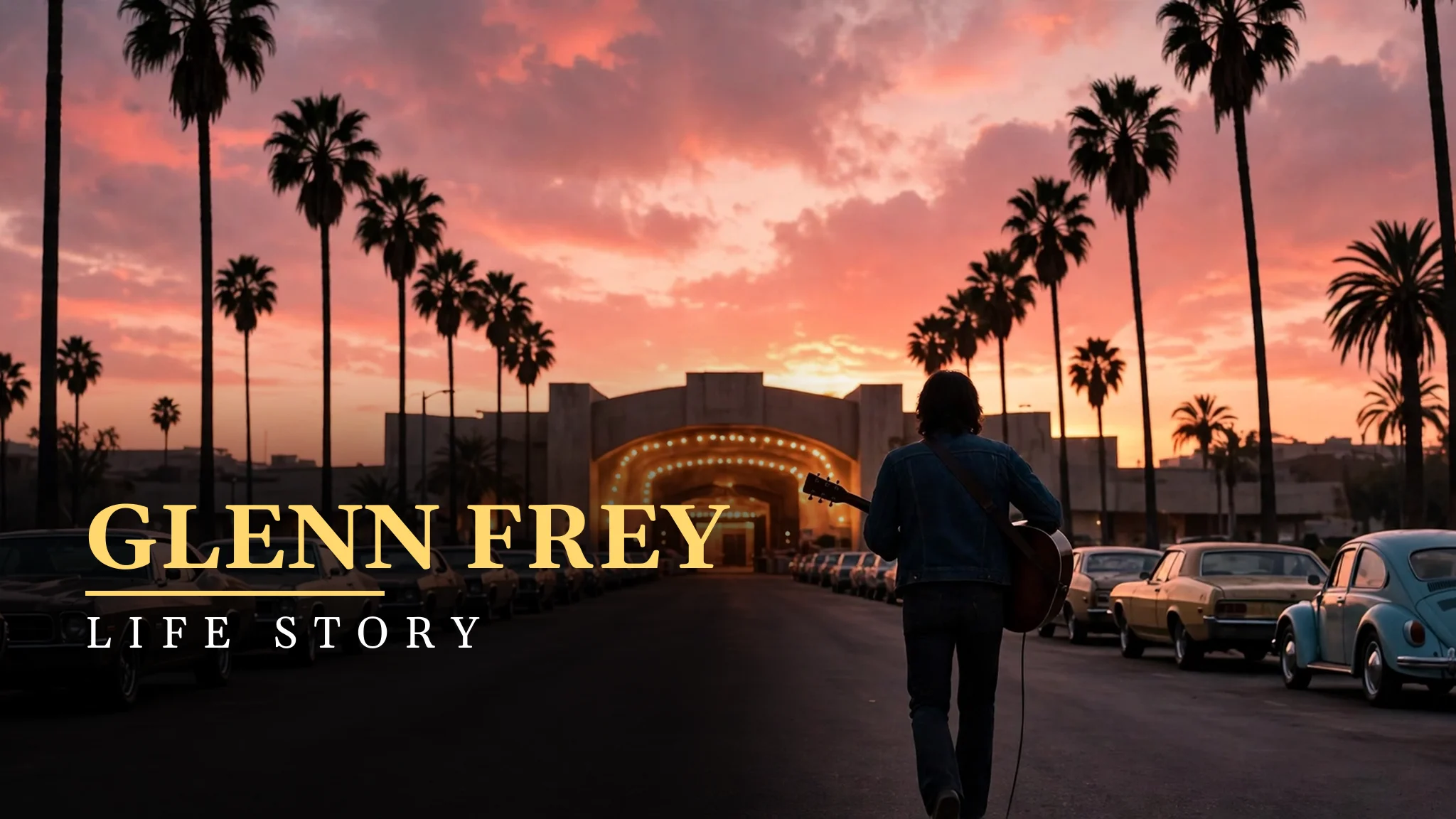
I keep thinking about the image of Glenn walking toward a concert hall at sunset, with palm trees and old cars around him. It feels right for him. He was a man who loved the road, loved the stage, and loved the feeling of a warm evening when the music was about to start. I hope that feeling stays with his fans, and with his family, for a long time. He earned it, and he deserved it.
I think about Glenn Frey’s guitar playing, and I realise how much I have overlooked it. He was a rhythm guitarist, not a soloist, and rhythm guitar does not get much attention. But without it, the Eagles would not have sounded the same. Glenn kept the beat, he filled in the chords, and he made the songs feel full. That is a humble job, and it is an important one. I respect a musician who is willing to do the humble job well, without needing the spotlight.
I also think about his humour, and I like it. Friends have said Glenn was funny, warm, and generous, a man who could make a room laugh. That humour must have helped the Eagles through hard times, when they were tired, when they were arguing, and when they wanted to quit. A joke at the right time can save a band, and Glenn knew how to tell one. I think humour is a gift, and I am glad he had it.
When I listen to Lyin’ Eyes, I hear a song that is both beautiful and sad. It is about a woman who marries for money, who lives a lie, and who is unhappy. Glenn sings it without judging her. He just tells her story, and he lets the listener feel the sadness. That kindness, that refusal to judge, is what makes his songs human. I admire it, and I want to be more like that in my own life.
I think about his son Deacon joining the Eagles, and I feel moved. Deacon was a young man when his father died, and he stepped onto the stage to sing his father’s songs. That takes courage, and it takes love. It is a tribute, and it is a way to keep Glenn’s memory alive. I think Glenn would have been proud, and I think Deacon is brave to do it. It is not easy to sing your father’s songs in front of thousands of people, but Deacon does it well.
I also think about Glenn’s solo album After Hours, from 2012, and I like it a lot. It is a collection of love songs from the 1940s and 1950s, songs that his parents would have known. He sang them with warmth and with respect, and he showed a softer side of himself. It was not a rock album. It was a love letter to an earlier time, and it showed that Glenn was a man who loved music in all its forms. I respect that.
I wonder what Glenn would say to a young musician today. I think he would say, learn your craft, write good songs, and do not be afraid to be yourself. He learned from Bob Seger, he learned from Jackson Browne, and he learned from his own mistakes. He was a student of music, and he kept learning all his life. That is good advice for anyone. Keep learning, keep listening, and keep trying.
I think about his death at sixty-seven, and I feel sad. He was still working, still touring, still singing, and he had plans for the future. When he died, the music world lost a songwriter, a singer, and a friend. I feel sad for his wife and children, who lost a husband and a father. I feel sad for Don Henley, who lost a brother. And I feel sad for the fans, who will never hear a new Glenn Frey song. It is a loss that still hurts.
When I hear Tequila Sunrise now, I hear a song about loneliness, about a man who drinks too much and wakes up alone. Glenn sings it with a soft, sad voice, and he does not judge the man. He just tells the story. That is what makes his songs special. They are not preachy, and they are not cruel. They are honest, and they are kind. I want to remember that when I write or when I talk about other people.
I keep coming back to the idea that Glenn Frey was a team player. He was the frontman, but he shared the stage, he shared the songwriting, and he shared the credit. He knew that a band is a team, and that no one person makes it work alone. That is a lesson for any group, not just a band. A good team shares the work, shares the credit, and supports each other. Glenn did that, and I admire it.
In the end, I want to remember Glenn Frey as a Detroit boy who drove to California, who helped to create the Eagles, who made solo hits, who raised a family, and who left behind songs that people will sing for a long time. He was a singer, a guitarist, a songwriter, and a friend, and his music will outlive him. I am glad I learned about him, and I will keep listening to his songs.
I think about Glenn Frey’s time with Bob Seger, and I respect it. Seger was a mentor, a man who taught Glenn how to write a simple, honest song. Every young musician needs a mentor, someone who has been there before and who can show them the way. Glenn found one in Seger, and he was grateful for it. I think that is a good lesson: find someone to learn from, listen to them, and then find your own voice. Glenn did that, and it made him a better songwriter.
When I listen to Already Gone, I hear a song about leaving, about walking away from something that is not working. It is a hopeful song, with a driving beat and a strong vocal, and it makes me feel like I can leave a bad situation, too. Glenn sings it with confidence, and that confidence is contagious. I like songs that give you courage, and Already Gone is one of those songs. It is a reminder that sometimes the best thing to do is to go.
Finally, I want to remember Glenn Frey as a man who loved music in all its forms. He loved rock, he loved the standards of the 1940s, he loved country, and he loved soul. He was not a snob about music. He liked what he liked, and he sang it with love. That openness is a gift, and it made his music richer. I am glad I learned about him, and I will keep listening to his songs, from Take It Easy to After Hours, for a long time.
Frequently Asked Questions
Where was Glenn Frey born?
Glenn Frey was born on 6 November 1948 in Detroit, Michigan. He grew up in the city, learned guitar as a teenager, played in local bands, and worked with Bob Seger before he moved to Los Angeles.
How did Glenn Frey help write Take It Easy?
Frey lived in the same building as Jackson Browne in Los Angeles, and Browne was working on Take It Easy. Frey helped him finish the song, and it became the Eagles’ first hit in 1972, with Frey singing lead.
Which Eagles songs did Glenn Frey sing?
Frey sang lead on Take It Easy, Tequila Sunrise, Lyin’ Eyes, Heartache Tonight, and many other Eagles songs. He also co-wrote much of the band’s music with Don Henley and played guitar for the group.
What were Glenn Frey’s biggest solo hits?
His biggest solo hits were The Heat Is On, from the film Beverly Hills Cop, and You Belong to the City, from Miami Vice. He also had success with The One You Love, Smuggler’s Blues, and Sexy Girl.
When did Glenn Frey die and how old was he?
Glenn Frey died on 18 January 2016 in New York City, at the age of sixty-seven. He had been dealing with serious health problems, and his death was mourned by fans and fellow musicians around the world.
Was Glenn Frey married?
Yes, he married Cindy Millican in 1990, and they had three children together. He was a devoted father, and he tried to balance his touring life with his family life in Los Angeles.
Did the Eagles continue after Glenn Frey’s death?
Yes, the Eagles continued with Glenn’s son Deacon Frey and Vince Gill joining the band. They kept touring and playing the songs Frey had helped write, as a way to honour his memory and his music.


