Jackson Browne: The Life Story Behind Rock's Running on Empty Star
In this post
- Born in Germany, Raised in California
- Folk Clubs, the Nitty Gritty Dirt Band, and Early Songs
- Doctor My Eyes and a Debut That Mattered
- The Pretender, Loss, and Running on Empty
- Lawyers in Love, Activism, and a Public Voice
- Later Albums, Touring, and a Lifetime of Songs
- Still on the Road, Still Writing
- The Collaborator, the Live Performer, and the Father
- My Take:
Jackson Browne writes songs the way a good friend talks to you late at night, quietly, honestly, and without trying to impress you. His voice is soft, his melodies are gentle, and his words are about the things that matter most: love, loss, growing older, and trying to live a decent life in a world that keeps changing. When he sang Running on Empty in 1977, he gave a name to a feeling that millions of people knew well, the feeling of driving too fast, working too hard, and wondering where the road was taking them.
He was born in Germany, the son of an American serviceman, and raised in Los Angeles, where he grew up surrounded by music, books, and the bright, strange world of California in the 1960s. He started writing songs as a teenager, played in folk clubs, and became one of the most respected songwriters of his generation before he was thirty years old. Other singers recorded his songs, and his own albums became classics.
His story is also the story of a man who cares deeply about the world around him. He has spent decades speaking out for peace, for the environment, and for ordinary people, and he has used his concerts to raise money for causes he believes in. He has known great sadness, including the loss of his first wife, and he has turned that sadness into songs that help other people feel less alone.
His work with other songwriters is a key part of his story, because Jackson Browne has always been a generous collaborator. He helped Glenn Frey finish Take It Easy, he wrote songs with other artists, and he sang harmonies on their records. He was not jealous of other people’s success. He was happy to help, and he believed that good songs deserve to be heard, no matter who sings them. That generosity is rare in the music business, where many artists are competitive and secretive. Jackson was open, and that openness made his music better.
His live shows are also worth thinking about. He plays in theatres and concert halls, with a small band, and he focuses on the songs and the words. He does not use big lights, big effects, or big spectacles. He just plays, and he sings, and he lets the songs speak for themselves. That is a brave choice in a world where many concerts are more about the show than the music. Jackson trusts his songs, and his audiences trust him. It is a quiet, respectful relationship, and it has lasted for decades.
He has also been a father, a role that has shaped his music in important ways. He raised his son Ethan after his first wife died, and he later became a father again. His songs about family, about love, and about responsibility come from real experience, not from imagination. He knows what it is like to be a parent, to worry about a child, and to try to do the right thing. That experience makes his songs more honest, and more moving.
Born in Germany, Raised in California
Clyde Jackson Browne was born on 9 October 1948 in Heidelberg, Germany, where his father was serving in the United States Army. His family moved back to America when he was three years old, and they settled in Los Angeles, California, in the Highland Park area. His father worked as a printer and a writer, and his mother was a homemaker who loved music and books. The house was full of records, and young Jackson listened to folk music, classical music, and the early sounds of rock and roll, learning to love songs that told a story.
As a boy, Jackson was quiet, thoughtful, and a good student. He liked to read, he liked to write, and he liked to spend time alone thinking about the world. He was not the loudest child in the room, and he was not the one who wanted to be the centre of attention. He was the one who watched, listened, and remembered, and those habits would later make him a great songwriter. He learned to play the piano and the guitar, and he began to write his own songs while he was still in his teens, filling notebooks with words and melodies that felt personal and true.
Los Angeles in the 1960s was a wonderful place for a young musician. The city was full of folk clubs, coffee houses, and small venues where a young singer could play for a few dollars and a cup of coffee. Jackson started playing in these clubs when he was sixteen years old, and he met other young musicians who were also trying to find their voice. He was shy on stage, but his songs were strong, and people noticed. He wrote with a maturity that seemed far beyond his years, and his words about love and loss sounded like they came from a man much older than he was.
He went to college for a short time, but music was already his real education. He left school to focus on songwriting, and he began to travel, playing in clubs across America and learning from the musicians he met. He was a young man with a guitar, a notebook, and a head full of songs, and he was determined to make a life out of music, even if it meant living simply and working hard for very little money at first.
Folk Clubs, the Nitty Gritty Dirt Band, and Early Songs
In the late 1960s, Jackson Browne became part of the folk music scene in Los Angeles and New York. He played in clubs like the Troubadour in Los Angeles, a famous venue where many young songwriters got their start, and he met artists like Joni Mitchell, James Taylor, and the members of the Eagles. He was respected by other musicians for his songwriting, even though he had not yet released his own album. His songs were being recorded by other artists, and that was a sign that his work was good.
One of his early songs, These Days, was recorded by the Nitty Gritty Dirt Band and by other artists, and it became a favourite among folk fans. The song was sad, beautiful, and honest, about a person looking back on a relationship and wondering what went wrong. It showed Jackson’s gift for writing about feelings in a plain, direct way, without hiding behind fancy words. He also wrote songs for other singers, and he played guitar on other people’s records, learning the craft of recording and performing from the inside.
He spent time in New York as well, playing in folk clubs in Greenwich Village, the heart of the American folk revival. The Village was full of young singers, poets, and activists, and Jackson fit in well. He was a quiet, serious young man who cared about the world, and he wrote songs that reflected that care. He was not interested in becoming a pop star. He wanted to be a songwriter, a person who could put real feelings into words and music, and who could help other people understand their own lives a little better.
By the early 1970s, Jackson had built a strong reputation as a songwriter, but he had not yet made his own album. He was known as a writer’s writer, a man other musicians admired, and he was ready to step out on his own. He signed a record deal, and he began to work on his first album, a record that would introduce his voice to the world and start a career that would last for more than fifty years.
Doctor My Eyes and a Debut That Mattered
Jackson Browne’s first album, called Jackson Browne, came out in 1972, and it was a quiet success that grew over time. The album included Doctor My Eyes, a song that became a hit on the radio, and Rock Me on the Water, a gentle, thoughtful song about faith and hope. The album was produced with care, and it showed a young songwriter who was already wise beyond his years. His voice was soft and clear, and his songs were full of images of California, of highways, of love, and of loss.
The album did not make him a huge star overnight, but it made him a respected artist, and it gave him a loyal audience. People who heard Doctor My Eyes liked the way the song mixed a catchy melody with serious words about a man who has seen too much and wants to find a way to see clearly again. It was a song about the cost of living hard and looking for meaning, and it resonated with listeners who were also trying to make sense of their own lives.
His second album, For Everyman, came out in 1973, and it included the song Take It Easy, which he had co-written with Glenn Frey, and which the Eagles had already made famous. Jackson’s own version was slower and more thoughtful, and it showed his gift for writing a song that could work in more than one way. The album also included Redneck Friend and These Days, and it confirmed that Jackson was a songwriter of rare talent, a man who could write about ordinary life with extraordinary care.
In 1974, he released Late for the Sky, an album that many critics now call one of the best albums of the 1970s. The album included the title track, a long, sad song about a relationship falling apart, and Fountain of Sorrow, a song about love and memory. The album was not a huge commercial hit at first, but it has grown in reputation over the years, and it is now seen as a classic. It showed Jackson at his best: a writer who could take a simple moment, a drive in a car, a look in a mirror, and turn it into a song that felt universal.
The Pretender, Loss, and Running on Empty
The mid-1970s brought both success and sadness for Jackson Browne. In 1976, he released The Pretender, an album that included the title song, a powerful look at a man who works hard, earns money, and wonders if he has lost himself in the process. The Pretender became one of his most famous songs, and the album was a commercial success. But behind the success, his personal life was falling apart. His first wife, Phyllis Major, died in 1976, and the loss devastated him. He was left to raise their young son, Ethan, on his own, and he had to find a way to keep going through grief.
He channelled that grief into his music, but he did not make a sad, self-pitying album. Instead, he made Running on Empty, released in 1977, an album recorded live on the road, in hotel rooms, on tour buses, and on stage. The album captured the feeling of life on tour, the long drives, the late nights, the crowds, and the loneliness that comes with it. The title song, Running on Empty, became a huge hit, and it gave a name to the feeling of being tired, running on fumes, and still trying to keep going.
Running on Empty was a brilliant idea, and it worked beautifully. The album sounded like a road trip, with songs recorded in different places, and it gave listeners a sense of what a musician’s life really felt like. It included The Load-Out and Stay, songs that became favourites at concerts, and it sold millions of copies. Jackson had turned a difficult time in his life into a great work of art, and he had done it without hiding his pain.
In the years that followed, he continued to write and record, and he became known as a voice for a generation that was growing older and asking hard questions. His songs were not about teenage love anymore. They were about adult life, about work, about family, about loss, and about trying to hold on to hope. He was a songwriter who grew up with his audience, and his audience grew up with him.
Lawyers in Love, Activism, and a Public Voice
In the 1980s, Jackson Browne became more active in politics and in social causes. He had always cared about the world, but now he used his fame to speak out. He performed at concerts for peace, for the environment, and for human rights, and he helped raise money for organisations that worked to stop nuclear power and to protect the planet. He was a regular at benefit concerts, and he was known as a musician who put his beliefs into action, not just into songs.
His album Lawyers in Love, released in 1983, included the title song, a satirical look at the world of wealth and power in the 1980s, and Tender Is the Night, a song about love and vulnerability. The album was a success, and it showed that Jackson could write about the modern world with humour and anger. He followed it with Lives in the Balance in 1986, an album that dealt with war, with Central America, and with the responsibility of a rich country to the rest of the world. The album was serious and political, and it showed that Jackson was not afraid to take a stand.
He also worked with other musicians, writing songs and performing with artists like Bonnie Raitt, Bruce Springsteen, and many others. He was a generous collaborator, a man who liked to help other artists and to share the stage. He was inducted into the Rock and Roll Hall of Fame in 2004, a recognition of a career that had lasted more than thirty years and had produced some of the most loved songs in American music.
His personal life in these years was quieter. He had a long relationship with the actress Daryl Hannah, and he raised his son Ethan. He lived in Los Angeles, and he continued to write, record, and tour. He was not a tabloid star. He was a private man who let his music speak for him, and his fans respected that privacy.
Later Albums, Touring, and a Lifetime of Songs
In the 1990s and 2000s, Jackson Browne continued to record and tour, even as the music business changed around him. He released albums like I’m Alive in 1993, a record about love and starting over, Looking East in 1996, and The Naked Ride Home in 2002. His songs grew more reflective, more concerned with aging, with the passage of time, and with the state of the world. He was an older man now, and his music sounded like it: wiser, sadder, and more patient.
He also became a father again, and he spent time with his family, balancing his life on the road with his life at home. He toured with other artists, including a tour with Bonnie Raitt and a series of concerts with his old friends from the Los Angeles folk scene. He was a beloved figure in American music, a man who had been writing great songs for decades and who still had something to say.
In 2008, he released Time the Conqueror, an album that dealt with war, with loss, and with the passage of time, and in 2014 he released Standing in the Breach, an album that was praised by critics for its honesty and its craft. He continued to tour, playing theatres and concert halls, and his audiences included both old fans who had followed him since the 1970s and young listeners who were discovering his songs for the first time.
He has also been honoured for his activism, receiving awards for his work on behalf of the environment and for peace. He has used his concerts to raise money for a wide range of causes, and he has spoken out on issues ranging from nuclear power to the rights of indigenous people. He is a musician who believes that art and action go together, and he has lived that belief for his whole career.
Still on the Road, Still Writing
Today, Jackson Browne is still touring, still recording, and still writing songs. He released Downhill from Everywhere in 2021, an album that deals with the world as it is now, with its problems, its beauty, and its hope. The album showed that, even in his seventies, he is still a songwriter who cares about the truth, and who can write a song that makes you stop and think.
He lives in Los Angeles, near the place where he grew up, and he continues to play concerts across America and around the world. His shows are quiet, thoughtful affairs, with a focus on the songs and the words, and his audiences listen with respect. He is not a loud, flashy performer. He is a man with a guitar and a piano, telling stories that matter, and that is enough.
His legacy is clear. He is one of the great American songwriters, a man who wrote Running on Empty, The Pretender, Doctor My Eyes, and Late for the Sky, songs that will be sung for generations. He is also a man who used his voice to speak for others, to protect the planet, and to stand up for what he believed in. He is a quiet star, but a lasting one, and his songs will outlive him.
Jackson Browne’s story is the story of a boy who grew up in Los Angeles, who learned to write songs that told the truth, who lost his wife young, who raised a son, who kept touring, who kept caring, and who never stopped believing that a song could change a person’s mind and heart. It is a story of a life lived with honesty, with sadness, and with hope, and it is a story that still matters today.
The Collaborator, the Live Performer, and the Father
Jackson Browne has always been a collaborator, a man who likes to work with other musicians and to help them make better music. He helped Glenn Frey finish Take It Easy, a song that became the Eagles’ first hit, and he has written songs with many other artists, including Bonnie Raitt, Bruce Springsteen, and Warren Zevon. He was a friend to Zevon, and he helped him to record his final album, The Wind, when Zevon was dying of cancer. That is a generous, loyal thing to do, and it shows Jackson’s character. He was there for his friend when it mattered most.
His live performances are quiet, thoughtful affairs, and they are a key part of his appeal. He does not play in stadiums with big lights and big effects. He plays in theatres, with a small band, and he focuses on the songs. He talks to the audience between songs, telling stories about how the songs were written, and he creates a feeling of intimacy, as if he is singing to each person in the room. That is a rare skill, and it is one that has kept his audiences loyal for decades.
He has also been a dedicated father. After his first wife, Phyllis Major, died in 1976, Jackson raised their son Ethan on his own, while also touring and recording. It was a hard time, but he did it, and he has spoken about how much his son means to him. He later became a father again, and he has tried to balance his career with his family life. His songs about family, about love, and about responsibility come from that experience, and they are more honest because of it.
Over the years, Jackson has received many honours, including his induction into the Rock and Roll Hall of Fame in 2004, and his induction into the Songwriters Hall of Fame in 2007. These honours recognise a career of more than fifty years, and a body of work that includes some of the most loved songs in American music. They also recognise his work as an activist, and his commitment to using his music to make the world a better place. He is a man who has used his talent for good, and that matters.
Today, his songs are still played on the radio, in films, and at concerts, and new listeners discover them every day. A young person hears Running on Empty and feels the tiredness of life on the road, even if they have never been on tour. An older person hears The Pretender and thinks about work, about money, and about what matters. That is the power of Jackson’s writing. It speaks across generations, because it speaks about feelings that do not change.
My Take:
When I listen to Jackson Browne, I feel like I am sitting with a friend who is not trying to impress me. He is just telling me what he has learned, and he is doing it in a quiet, honest voice. That is rare in music, where so many singers shout, show off, and try to be the loudest person in the room. Jackson does the opposite. He whispers, and you lean in to listen. I admire that kind of confidence, the confidence to be quiet and to trust that the song is strong enough to hold you.
I admire his songwriting most of all. Running on Empty is a perfect song, not because it is complicated, but because it is true. It is about a feeling that everyone knows: being tired, running low, and still having to keep going. He wrote that song while he was on tour, living that life, and you can hear it in every line. The Pretender is another perfect song, about a man who works hard, earns money, and wonders if he has lost himself. That is a question that many adults ask themselves, and Jackson asks it without judging the man. He just tells the story, and he lets you feel the sadness.
There is a deep sadness in his story, and I think about it a lot. His first wife, Phyllis Major, died in 1976, when they were both young, and he was left to raise their son alone. I cannot imagine that loss, and I do not want to pretend that I can. What I do know is that he did not let the loss destroy him. He kept going, he raised his son, and he turned his grief into music that helps other people. That is a brave thing to do. It is easy to hide from pain. It is hard to face it, to write about it, and to share it with the world.
I think about his activism, and I respect it deeply. Jackson Browne has spent decades speaking out for peace, for the environment, and for people who have no voice. He did not do it for publicity. He did it because he believes it is right. He has played at benefit concerts, he has raised money, and he has used his fame to help others. In a world where many famous people only care about themselves, Jackson cares about the world, and that makes him different. I wish more artists were like him.
I also think about his friendship with other musicians, and I like what I see. He helped Glenn Frey finish Take It Easy, he wrote songs for other singers, and he shared the stage with Bonnie Raitt, Bruce Springsteen, and many others. He was not jealous. He was generous. He wanted other people to succeed, and he was happy to help them. That generosity is a sign of a good person, and it is a sign of a confident artist. A weak artist is afraid of other people’s talent. A strong artist welcomes it.
If I have a criticism, it is that some of his albums are hard to listen to if you are not in the right mood. His songs are slow, thoughtful, and sad, and they ask you to pay attention. If you want a loud, fun party song, Jackson Browne is not the right choice. I understand that. Sometimes I want a song that makes me dance, not a song that makes me think. But I also think that is not a fair criticism. Jackson is not trying to be a party singer. He is trying to be honest, and honesty is sometimes slow and sad. I have learned to respect that, even when I am in the mood for something lighter.
I learn from Jackson Browne that a song can be a way to think about your life. When I hear Late for the Sky, I think about the relationships in my own life, about the times I was late, about the times I did not say the right thing. When I hear The Pretender, I think about work, about money, and about what I want my life to mean. That is a powerful thing for a song to do. It is not just entertainment. It is a mirror, and it helps you see yourself more clearly.
I also learn from him that it is okay to grow older and to write about it. Jackson did not try to stay young forever. He wrote about aging, about loss, about the world changing, and about trying to hold on to hope. His later albums are quieter and sadder, but they are also wiser. I think that is a good way to grow old. To be honest about what you have lost, and to be grateful for what you still have. I hope I can do the same.
When I think about his life, I think about the road. He has spent his whole life on the road, driving from town to town, playing songs for people who need them. Running on Empty is a song about that life, but it is also a song about all of our lives. We are all running on empty sometimes, we are all tired, and we are all trying to get somewhere. Jackson Browne gave that feeling a name, and he gave it a melody, and for that I am grateful.
In the end, I think Jackson Browne teaches me to be honest, to be kind, and to care about the world. He is not a loud star, and he is not a rich star in the way some singers are. He is a quiet man with a guitar, a notebook, and a conscience, and he has used those tools to make the world a little better. That is a life worth admiring, and a life worth learning from. I will keep listening to his songs, and I will keep thinking about what they mean, because they help me understand my own life a little better.
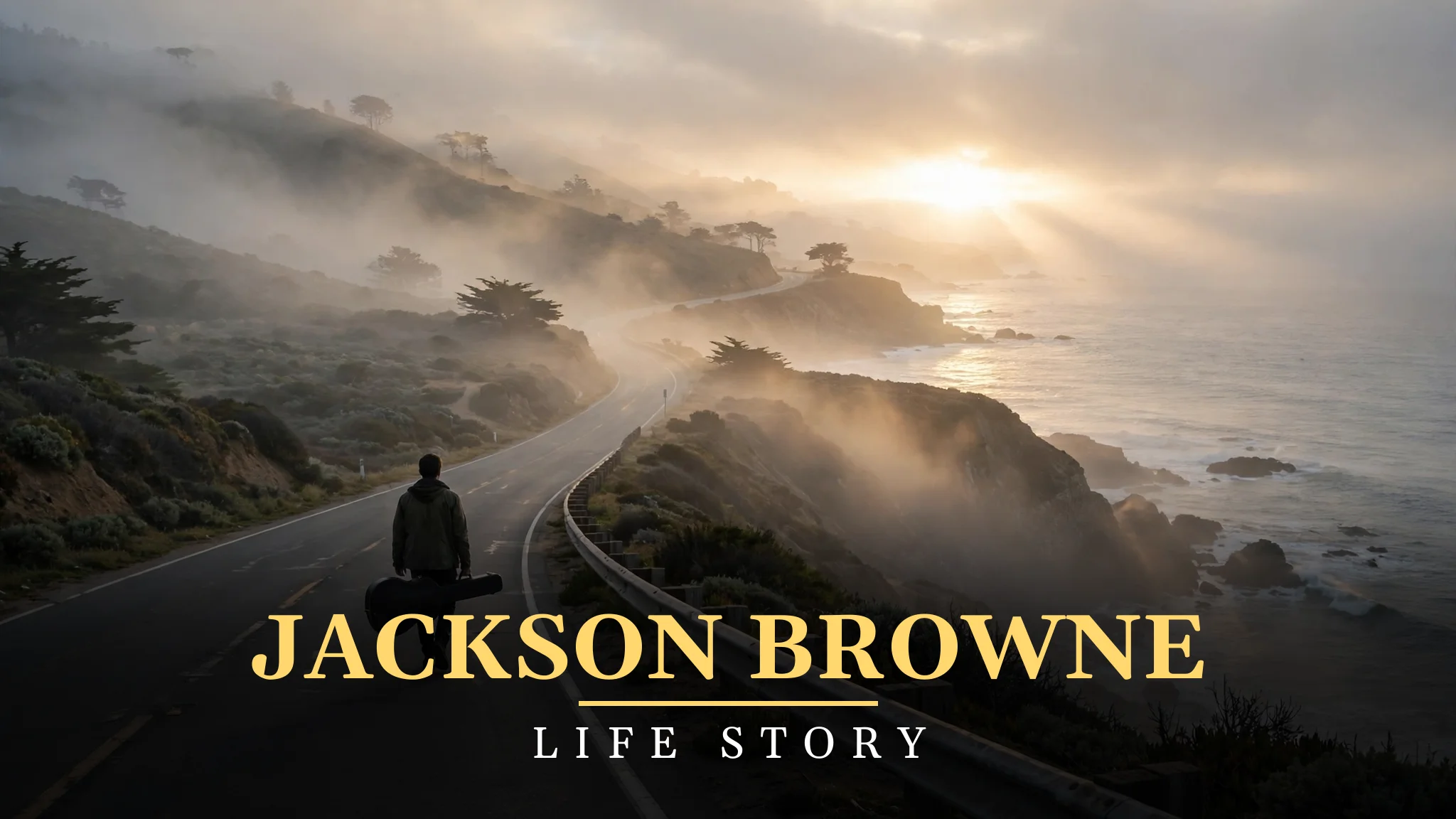
I keep returning to the image of a man walking along a coastal road with a guitar case, the fog lifting, the sun coming up over the sea. That feels like Jackson Browne to me. He is a traveller, a thinker, and a singer, walking a long road and writing songs about what he sees. I hope he keeps walking, and I hope he keeps writing, because the world needs his songs, now more than ever.
I think about Jackson Browne’s friendship with Warren Zevon, and I feel moved. Zevon was dying of cancer, and Jackson helped him to record his final album, The Wind. That is a loyal, generous thing to do. It takes a good friend to sit with someone who is dying, and to help them make music. Jackson did that, and I respect him for it. It shows that he values friendship more than fame, and that he is a man who shows up when it matters.
I also think about his live shows, and I like them. He does not use big effects, he does not shout, and he does not try to be a rock star. He just plays his songs, tells stories, and lets the music speak. That is a brave choice in a world where concerts are often more about spectacle than about songs. Jackson trusts his songs, and I trust him, too. I would rather listen to a quiet, honest show than a loud, empty one.
When I listen to Fountain of Sorrow, I hear a song about love and memory, about a person who has lost someone and who is trying to remember them. It is a beautiful, sad song, and it makes me think about the people I have lost. Jackson writes about loss with a gentleness that is rare. He does not shout about it. He whispers, and the whisper is more powerful than a shout. I admire that.
I think about his activism, and I respect it more the more I learn about it. He has spoken out against nuclear power, against war, and for the environment, for decades. He has performed at benefit concerts, he has raised money, and he has used his fame to help others. He does not do it for publicity. He does it because he believes it is right. That is a good use of fame, and I wish more artists did the same.
I also think about his son Ethan, and about what it must have been like to raise a child alone after losing a wife. Jackson was a young man, in his twenties, with a career, and suddenly he was a single father. He did it, and he did it well, and his son grew up to be a successful person. That is a remarkable achievement, and it tells me a lot about Jackson’s character. He is a responsible, loving father, and he put his family first.
I wonder what Jackson would say to a young songwriter today. I think he would say, write about what you feel, be honest, and do not rush. He takes his time with his songs, and he does not release an album until it is ready. That is good advice in a world that wants everything fast. A good song takes time, and it is worth waiting for. I want to remember that.
I think about his song These Days, and I feel sad and hopeful at the same time. It is a song about looking back on a relationship, about wondering what went wrong, and about hoping for a better future. It is a song that many people have covered, because it is so honest and so beautiful. I like that Jackson wrote it when he was young, and that it still matters today. Good songs do not age. They grow with us.
When I hear Late for the Sky now, I hear a song about a relationship falling apart, about a drive in a car, and about the silence between two people. It is a long song, and it takes its time, but it is worth listening to. It shows Jackson at his best: a writer who can take a simple moment and turn it into a universal story. I admire that skill, and I want to learn from it.
I keep coming back to the idea that Jackson Browne is a quiet star. He is not loud, he is not flashy, and he does not chase attention. He is a man with a guitar, a piano, and a notebook, and he has used those tools to make the world a little better. That is a life worth admiring, and a life worth learning from. I am glad I learned about him.
In the end, I want to remember Jackson Browne as a songwriter, a father, a friend, and an activist. He is a man who wrote great songs, who raised a son, who helped his friends, and who spoke up for what he believed in. His music will be played for a long time, and his example will be followed by younger artists who want to make music that matters. I will keep listening to his songs, and I will keep thinking about what they mean.
I think about Jackson Browne’s song The Load-Out, from Running on Empty, and I like it a lot. It is a song about the end of a concert, about the road crew packing up, and about the fans going home. It is a behind-the-scenes song, a song about the work that goes into a show, and it is beautiful. It shows Jackson’s gift for finding poetry in ordinary moments, in the loading of a truck, in the lights going out, in the road stretching ahead. I admire that gift, and I wish more songwriters had it.
When I hear Rock Me on the Water, I hear a gentle, hopeful song about faith, about a person asking to be carried through hard times. It is a song that many people have turned to when they are struggling, and it is easy to understand why. It is kind, it is calm, and it offers comfort without preaching. Jackson writes about faith in a way that is personal, not dogmatic, and that makes his songs accessible to people of all beliefs. I respect that, and I am grateful for it.
Frequently Asked Questions
Where was Jackson Browne born?
Jackson Browne was born on 9 October 1948 in Heidelberg, Germany, where his father was serving in the United States Army. His family moved back to America when he was three, and he grew up in Los Angeles, California.
How did Jackson Browne start his music career?
He started playing in folk clubs in Los Angeles and New York when he was a teenager, writing songs and performing at venues like the Troubadour. Other artists recorded his early songs, including These Days, before he released his own debut album in 1972.
What is Running on Empty about?
Running on Empty is an album and a song recorded live on the road in 1977, about the life of a touring musician and the feeling of being tired and running low. The title song became a huge hit, and the album is now seen as a classic of American rock.
Did Jackson Browne write Take It Easy?
He co-wrote Take It Easy with Glenn Frey. Browne had started the song, Frey helped him finish it, and the Eagles made it famous in 1972. Browne later recorded his own version on his album For Everyman.
Who was Jackson Browne’s first wife?
His first wife was Phyllis Major, who died in 1976. Browne was left to raise their young son, Ethan, on his own, and the loss deeply affected his life and his music in the years that followed.
What causes has Jackson Browne supported?
Browne has supported peace, environmental protection, and human rights for decades. He has performed at benefit concerts, helped raise money to stop nuclear power, and spoken out on issues ranging from war to the rights of indigenous people.
Is Jackson Browne in the Rock and Roll Hall of Fame?
Yes, Jackson Browne was inducted into the Rock and Roll Hall of Fame in 2004. The honour recognised a career of more than thirty years, from his early folk songs to his later albums and his work as an activist.


