Goran Bregović: The Life Story Behind the Balkan Music Master
In this post
- Sarajevo, a Mixed Family, and a Boy With a Guitar
- Bijelo Dugme and the Biggest Rock Band in Yugoslavia
- The End of the Band and a Turn to Film Music
- Time of the Gypsies, Underground, and Music the World Hummed
- The Wedding and Funeral Orchestra and the World Stage
- Family, Sarajevo, and a Life Between Worlds
- A Sound That Travelled the World
- Collaborations, Concerts, and Music Without Borders
- My Take:
Goran Bregović is the man who gave the Balkans its sound, a composer and musician whose melodies have been heard in films, at weddings, and at concerts around the world, and whose music makes people dance even when they do not understand a word of the language. He started as a rock star, leading the biggest band in Yugoslavia, and he ended up as a film composer, a bandleader, and a musical ambassador for a whole region.
He was born in Sarajevo, to a Croat father and a Serb mother, and he grew up in a city where many cultures lived together, and where music was everywhere, in cafes, in homes, and on the radio. He learned the guitar, he joined bands, and he became the leader of Bijelo Dugme, which means White Button, a band that sold millions of records and filled stadiums across Yugoslavia, becoming the biggest rock band the country had ever seen.
What makes his story worth telling is how he changed, again and again, from a rock star to a film composer, from a Yugoslav star to a world musician, and how he took the folk music of the Balkans, the brass bands, the gypsy songs, and the wedding music, and turned it into a sound that the whole world recognised. His music for the films of Emir Kusturica, especially Time of the Gypsies and Underground, became famous in its own right, and his Wedding and Funeral Orchestra has toured the world.
This is the story of a boy from Sarajevo who became a rock legend, a film composer, and a master of Balkan music, a man whose melodies have made millions of people dance, cry, and feel at home, wherever they are in the world.
Sarajevo, a Mixed Family, and a Boy With a Guitar
Goran Bregović was born on 22 March 1950 in Sarajevo, the capital of Bosnia and Herzegovina, which was then part of Yugoslavia, to a Croat father and a Serb mother. That mixed background was common in Sarajevo, a city where different peoples lived together, and it shaped him from the start, giving him a sense of belonging to many cultures at once, and a love for the music of all of them. He grew up in a home where music was part of everyday life, and where the radio played songs from many different traditions.
As a boy, he was drawn to music, and he learned to play the guitar, practising for hours, and listening to rock music from the West, to folk music from the Balkans, and to everything in between. He was a serious young musician, and he wanted to learn, to play, and to write songs, and he spent his teenage years in bands, playing in clubs and at school events, and building his skill one performance at a time. Music gave him a purpose, and a way to express himself.
He went to school in Sarajevo, and he studied, but music was always the centre of his life, and he knew from an early age that he wanted to make it his career. He was not a boy who wanted a safe job in an office. He wanted to play, to write, and to perform, and he was willing to work hard to make that happen. His family supported him, and they encouraged him to follow his talent.
The Sarajevo of his youth was a lively city, with a growing rock scene, with cafes where musicians met, and with a feeling that new music could be made there, music that was both Yugoslav and international. Bregović was part of that scene, and he learned from other musicians, from the records he heard, and from the folk music he grew up with, and he began to develop a style that was his own.
His mixed family background also taught him something important, which is that music does not belong to one people alone. A song can be Croat, Serb, Bosniak, or Romani, and it can still speak to everyone, and that idea became central to his work, as he mixed folk, rock, and classical music in a way that no one else had done before.
Bijelo Dugme and the Biggest Rock Band in Yugoslavia
In 1974, Bregović formed the band Bijelo Dugme, which means White Button, with friends from Sarajevo, and the band quickly became a sensation in Yugoslavia, with a sound that mixed hard rock with folk melodies, and with lyrics that spoke to young people. Bregović was the leader, the guitarist, and the main songwriter, and he shaped the band’s sound, its image, and its success, writing songs that became hits across the country.
The band released many albums, sold millions of records, and filled stadiums, becoming the biggest rock band Yugoslavia had ever seen, a band that was loved by young people in every part of the country, from Slovenia to Macedonia. Their concerts were huge events, with crowds singing every word, and their songs became anthems for a generation, songs about love, about youth, and about life in Yugoslavia in the 1970s and 1980s.
Bregović was a rock star, with fame, with money, and with a life that many young musicians dreamed of, but he was also a serious musician, who studied, who listened, and who kept learning. He was not content to play the same songs again and again. He wanted to grow, to try new sounds, and to push the band in new directions, and he did, adding folk instruments, adding new singers, and changing the band’s style over the years.
The band went through changes, with different singers, including Željko Bebek, Mladen Vojičić Tifa, and Alen Islamović, and each one brought something new, but Bregović remained the centre, the songwriter, the leader, and the person who held the band together. He was a demanding leader, and he expected hard work, but he also gave the band its sound, and its success.
By the late 1980s, Bijelo Dugme was a legend, a band that had defined Yugoslav rock, and Bregović was one of the most famous musicians in the country. But Yugoslavia was about to break apart, and the band, like the country, would not survive the changes that were coming. Bregović was about to face a new chapter in his life, one that would take him in a very different direction.
The End of the Band and a Turn to Film Music
In 1989, Bijelo Dugme broke up, after fifteen years at the top, and Bregović found himself at a crossroads, a famous rock star without a band, in a country that was falling apart. He could have tried to start a new rock band, or he could have retired, but he chose a different path, and he turned to film music, composing scores for films, and working with directors who wanted a new sound for their stories.
His most important partnership was with Emir Kusturica, the director from Sarajevo, for whom he composed the music for Time of the Gypsies in 1988, Arizona Dream in 1993, and Underground in 1995. The music for those films became famous in its own right, with brass bands, with folk melodies, and with a sound that was both Balkan and universal, and it introduced Bregović to audiences around the world who had never heard of Bijelo Dugme.
The film scores showed a new side of him, not just as a rock musician, but as a composer who could write for an orchestra, for a brass band, and for a singer, and who could make music that carried a film’s emotion. He learned to work with directors, to write music that fitted a scene, and to create a sound that was both local and global, and that skill made him one of the most sought-after film composers in Europe.
He also composed music for other films, including Queen Margot, a French historical film, and for many other directors, and he became known as a composer who could bring a Balkan flavour to any story, without making it sound like a cliché. His music was not background. It was a character in the film, and it stayed in the audience’s mind long after the film ended.
The turn to film music was a brave choice, because it meant leaving the world of rock stardom, where he was a king, and entering a new world, where he had to prove himself again. He did, and he proved that a great musician can change, can learn, and can succeed in a new field, if he is willing to work hard and to take a risk.
Time of the Gypsies, Underground, and Music the World Hummed
The music Bregović wrote for Time of the Gypsies is one of the most loved film scores of the twentieth century, with its brass bands, its Romani melodies, and its feeling of a world that is both joyful and sad. The song Ederlezi, a traditional Romani song about spring, became famous through the film, and it is still sung today, in many countries, by people who first heard it in Kusturica’s film. Bregović did not invent that song, but he gave it a new life, and he made it known to the world.
For Underground, he wrote music that was even bigger, with large brass bands, with choirs, and with a sound that matched the film’s wild, crowded, and chaotic style. The music for Underground became a hit on its own, with concerts, with albums, and with a life beyond the film, and it showed that Bregović could write music that was both serious and fun, both local and universal, at the same time.
His film music was not only for Kusturica. He wrote for many directors, in many countries, and he brought a Balkan sound to stories that had nothing to do with the Balkans, proving that a melody can travel, and that a good tune can speak to anyone, anywhere. He became a world musician, not just a Yugoslav one, and his name was known in Paris, in New York, and in Tokyo.
The success of his film music also changed the way people thought about Balkan music, because before him, many people outside the region thought of it as folk music for weddings, not as art. Bregović showed that it could be art, that it could be complex, beautiful, and powerful, and that it deserved to be heard in concert halls and in cinemas, not only at parties. He gave Balkan music a new dignity, and a new audience.
Today, when people hear a Balkan brass band, they often think of Bregović, and that is a sign of how deeply his music has entered the world’s imagination. He did not just write film scores. He created a sound, a sound that is now associated with a whole region, and with a whole way of life, and that is a remarkable achievement for any composer.
The Wedding and Funeral Orchestra and the World Stage
In the 1990s, Bregović formed the Wedding and Funeral Orchestra, a large band that mixed brass, strings, folk singers, and rock musicians, and that performed his music in concerts around the world. The name was a joke, and a truth, because in the Balkans, the same band plays at weddings and at funerals, for joy and for sorrow, and Bregović’s music, like life, contains both. The orchestra became famous, and it toured in Europe, America, Asia, and Australia, playing to large and enthusiastic crowds.
The concerts were joyful, loud, and full of energy, with musicians in traditional dress, with dancers, and with a feeling that the audience was part of a celebration, not just watching a show. People who had never heard Balkan music before found themselves dancing, clapping, and singing along, and they left the concert with a new love for a sound they had not known. Bregović was not just a composer. He was a bandleader, a showman, and an ambassador for his music.
He also worked with many singers, including the famous Greek singer, and with musicians from many countries, and he showed that his music could work with many different voices and styles. He was not afraid to collaborate, and he was not afraid to try new things, and that openness kept his music fresh, even as he got older. He was a musician who loved to learn, and who loved to share what he had learned.
The orchestra’s tours took him to the biggest concert halls in the world, and to festivals where he played alongside rock stars, classical musicians, and folk artists, and he was respected by all of them, because they recognised a master. He had gone from a rock star in Yugoslavia to a world musician, and he had done it by staying true to his sound, and by sharing it with generosity.
In recent years, he has continued to tour, to record, and to compose, and he remains one of the most loved musicians from the Balkans, a man whose concerts are a celebration, and whose music brings people together, across borders, across languages, and across cultures.
Family, Sarajevo, and a Life Between Worlds
Bregović is married to Dženana Sudžuka, and they have children, including daughters, and he has kept his family life largely private, living between Sarajevo, Paris, and the wider world. He is a man who belongs to many places, and who has homes in different countries, but Sarajevo remains his home in his heart, the city where he was born, where he formed his first band, and where he learned the music that shaped his life.
He has spoken about his mixed background, about being the son of a Croat father and a Serb mother, and about growing up in a city where many peoples lived together, and he has said that this background gave him a sense of belonging to the whole region, not to one group alone. That is a brave thing to say in a region where many people are defined by their ethnic group, and it is a part of his story that deserves to be remembered.
He has also faced criticism, as many artists from the former Yugoslavia have, for his views, for his choices, and for the way he has talked about the wars, and he has been attacked in the press in different countries. He has not always responded, and he has kept working, letting his music speak for him, which is a choice that many artists make when words become too dangerous.
Off stage, he is a quiet man, a husband, a father, and a musician who practises, who writes, and who thinks about music, and he is not a celebrity who seeks attention. He works, he tours, and he goes home, and that balance has kept him going for more than fifty years, through rock stardom, through film music, and through world tours.
For people in the Balkans, he is a source of pride, a man from Sarajevo who became a world star, and who never forgot where he came from. For people elsewhere, he is the composer of the music they danced to at a wedding, or the music they heard in a film, and that is a legacy that touches many lives.
A Sound That Travelled the World
Looking back, Goran Bregović’s career is a story of a musician who changed again and again, from a rock star to a film composer to a world bandleader, and who succeeded in each new role, because he was willing to learn, to take risks, and to stay true to his sound. He did not become famous once. He became famous three times, in three different worlds, and that is a rare achievement.
His legacy is clear. He gave the world the sound of the Balkans, he wrote film music that is still loved, he led a band that made people dance in many countries, and he showed that a musician from a small country could become a world star, without losing his identity. His melodies are now part of the world’s music, and they will be played long after he stops performing.
Young musicians in the Balkans look up to him, not only because he is famous, but because he is a composer, a bandleader, and a musician who never stopped learning. He did not become a rock star and then stop. He kept going, and he kept growing, and that is a lesson that lasts longer than any single hit.
He remains, in the end, a man from Sarajevo, a boy with a guitar, who became a master of Balkan music, and who never forgot where he came from. His story is a reminder that music can cross borders, can bring people together, and can make a small place feel like the centre of the world, and that is a story worth telling.
Today, when a brass band plays at a wedding, when a film score makes an audience cry, when a concert hall fills with people dancing to Balkan music, Goran Bregović’s influence is there, in the sound, in the rhythm, and in the joy. That is the best tribute a musician can receive, that his music has become part of people’s lives, and that it will go on being part of their lives for a long time to come.
Collaborations, Concerts, and Music Without Borders
Bregović has collaborated with singers and musicians from many countries, including Greece, Bulgaria, Romania, and beyond, and he has shown that his music can work with many different voices, and many different styles, because a good melody is universal, and it can be sung in any language, by any voice, and still touch the listener, and those collaborations have made his music richer, and have introduced it to new audiences, who might never have heard Balkan music before.
He has also worked with classical orchestras, with rock bands, and with folk ensembles, mixing sounds that are not usually mixed, and creating a music that is both traditional and modern, both local and global, and that mixing is a sign of a musician who is not afraid to try new things, and who believes that music should not be kept in a box, but should be shared, and should grow, through contact with other traditions.
His concerts with the Wedding and Funeral Orchestra have become legendary, with large stages, with many musicians, with dancers, and with a feeling of celebration, that makes the audience feel like guests at a wedding, not spectators at a concert, and people who have been to his shows talk about them for years, remembering the brass, the voices, the dancing, and the joy, and that memory, shared by thousands, is a part of his legacy.
He has performed at major festivals around the world, including in France, in Germany, in America, and in Asia, and he has been welcomed as a world musician, not only as a Balkan musician, and his name on a festival programme draws crowds, because audiences know that a Bregović concert will be joyful, loud, and unforgettable, and that is a reputation earned over decades, through hard work, and through great music.
He has also composed for theatre, for dance, and for special events, bringing his sound to new places, and showing that Balkan music can work in many contexts, not only in a film, or at a wedding, but on a stage, in a concert hall, and in a theatre, and that versatility is a sign of a composer who understands music deeply, and who can adapt it, without losing its soul.
He has received honours in many countries, for his music, and for his contribution to culture, and he is regarded as one of the most important composers from the Balkans, a man whose melodies are now part of the world’s music, and whose influence can be heard in the work of younger musicians, who mix folk and rock, and who look to him as an example, and as a pioneer.
Today, he continues to tour, to record, and to compose, and he remains a living legend, a musician who is still creating, still performing, and still bringing people together, with a brass band, with a song, and with a joy that crosses borders, and that is a fitting end to a long career, and a beginning, for the years to come, because his music will go on, long after he stops performing, in the hands of others, who will play it, and sing it, and dance to it.
My Take:
I think the first thing I feel about Goran Bregović is joy, because his music makes me want to dance, even when I do not understand the words, and that is a rare and wonderful thing. A melody that can make a person in Paris, in New York, or in Tokyo dance to a Balkan brass band is a melody that has crossed every border, and Bregović has written many of them. I admire that power, because it shows that music does not need a common language. It needs a good tune, and an honest heart.
I admire his ability to change most of all, because he was a rock star, and then he became a film composer, and then he became a world bandleader, and he succeeded in each new role. Many musicians are afraid to change, because they worry they will lose their audience. Bregović changed, and his audience grew, because he brought his sound with him, and he let it grow. That takes courage, and it takes a willingness to be a beginner again, and I respect that deeply.
What moves me about his story is the way he took the folk music of the Balkans, music that many people thought was only for weddings and parties, and turned it into art that was heard in cinemas and concert halls around the world. He did not hide where his music came from. He celebrated it, and he made the world celebrate it too. That is a generous act, and it is a proud one, and it gave Balkan music a dignity it had not had before.
I also think about Bijelo Dugme, and about what it meant to be the biggest rock band in Yugoslavia, with millions of records sold, with stadiums full of young people singing every word. That is a kind of fame that few musicians ever know, and Bregović lived it, and then he walked away from it, to write film music. I find that brave, because it would have been easy to keep playing the same songs for the rest of his life. He chose to learn something new, and that choice made his career longer and richer.
His partnership with Kusturica also stays with me, because the music for Time of the Gypsies and Underground is some of the most loved film music I have ever heard, and it is music that I hum even when I am not watching the film. The song Ederlezi, the brass bands, the feeling of a wedding and a funeral in the same tune, these are things that stay in the mind, and they are things that Bregović created. I think that is a gift, to write a melody that people carry with them for years.
There is a sadness in his story too, and it is the sadness of Yugoslavia breaking apart, of a country that was once one, and that became many, and of a band that could not survive that break. Bregović was the leader of a band that belonged to the whole country, and when the country broke, the band broke too. I think that loss stayed with him, and I think it gave his later music a depth, a feeling of both joy and sorrow, that makes it so powerful. A wedding and a funeral, joy and loss, in the same concert, that is life in the Balkans, and he understood it.
For a young musician, I think the lesson is to learn your own music first, the music of your home, your family, and your people, because Bregović learned Balkan folk music, and then he mixed it with rock, and then with film music, and the world listened. He did not try to copy American rock stars. He took what he knew, and he made it new, and that is a better path than copying someone else. Your own music is your strength.
I also learn from him that a musician should not be afraid to collaborate, because he worked with Kusturica, with singers from many countries, and with musicians from many traditions, and each collaboration made his music richer. He did not try to do everything alone. He listened, he learned, and he shared, and that openness is a quality I admire in any artist. A closed mind makes small music. An open mind makes music that travels.
His Wedding and Funeral Orchestra matters to me too, because the name itself tells a truth about life, that the same band plays at a wedding and at a funeral, and that joy and sorrow are close together. I like that honesty, and I like the way his concerts feel like a celebration, with people dancing, clapping, and singing, even if they do not know the words. That is what music should do, in my view. It should bring people together, and it should make them feel alive.
I also respect the way he has kept his private life private, and the way he has lived between Sarajevo, Paris, and the world, without becoming a noisy celebrity. He works, he tours, he goes home, and he lets his music speak. In a world where many musicians live their lives online, that quiet approach is unusual, and it has helped him keep a long career without burning out.
Another thing I notice is how generous he is as a musician, sharing his sound, teaching young musicians, and bringing Balkan music to new audiences, without keeping it for himself. He could have kept his melodies private, or he could have retired after Bijelo Dugme. Instead, he kept sharing, kept touring, and kept writing, and that generosity is why his music is known in so many countries today.
I think about his mixed background, the son of a Croat father and a Serb mother, growing up in Sarajevo, and I believe that background gave him a gift, the ability to belong to many cultures at once, and to make music that belongs to everyone. In a region where people are often divided by ethnic group, his music says something different, that a song can be for everyone, and that is a message I find hopeful, and important.
For a reader who has never heard his music, I would say to start with the film scores, with Time of the Gypsies and Underground, and to listen to the brass, to the voices, and to the feeling, because that feeling is the heart of his work. You do not need to know the language. You can hear the joy, the sorrow, and the celebration, and you will understand why people around the world love his music.
In the end, I think Goran Bregović teaches us that music can travel further than any person, and that a good melody can cross borders that politics cannot. He took the music of Sarajevo, of the Balkans, and he gave it to the world, and the world danced to it. That is a legacy I would be proud of, and I think he should be proud of it too.
One more thought stays with me, and it is about the name of his orchestra, Wedding and Funeral, because it reminds me that life is both, joy and loss, celebration and mourning, and that music is there for both. Bregović understood that, and he made music for both, and that is why his music feels so true. It does not pretend that life is only happy. It says that life is happy and sad, and that music can hold both at once.
I also think about what his story means for young people from small countries, who dream of making music that the world will hear, and I believe his story says that it is possible, if you learn your own music, if you work hard, and if you are willing to change. He did it, from Sarajevo, with a guitar, with a band, and with a brass orchestra, and he is still doing it, and I hope he keeps doing it for many years to come.
Finally, I think Bregović reminds us that a musician’s job is not only to entertain, but to bring people together, to make them dance, to make them cry, and to make them feel that they belong. His concerts do that, his film scores do that, and his songs do that, and that is a gift that lasts longer than any award. He is a master of Balkan music, and he is a musician the world should be grateful for.
I keep thinking about his collaborations, and about what it means for a musician from Sarajevo to work with singers from Greece, from Bulgaria, from Romania, and from many other countries, and to make music that belongs to all of them, and I realise that this is a hopeful message, in a region where people are often divided, that music can bring them together, and that a song can be for everyone, regardless of language, or background, and Bregović proves that, with every collaboration, and with every concert.
I also think about his concerts, and about the joy in them, because a Bregović concert is not a quiet, serious event, but a celebration, with brass, with dancing, and with an audience that feels like guests at a wedding, and that joy is a gift, in a world that is often sad, and serious, and I admire a musician who can make people dance, and who can make them forget their worries, even for a few hours, because that is a kind of healing, and it is a kind of hope.
His work with classical orchestras also matters to me, because it shows that Balkan folk music, which many people thought was only for weddings, can be art, can be complex, and can be played in a concert hall, with an orchestra, and that is a dignity he gave to his music, and to his region, and it is a dignity that deserves to be remembered, because it changed the way the world thought about Balkan music, from folk, to art, and from local, to global.
I think about Bijelo Dugme again, and about what it meant to be the biggest rock band in Yugoslavia, with millions of records, and with stadiums full of young people, and I realise that Bregović lived that fame, and then he walked away from it, to write film music, and then he walked away from that, to lead an orchestra, and each time he changed, he grew, and that willingness to change, to learn, and to start again, is a lesson I want to remember, because many people are afraid to change, and they stay in one place, even when it no longer fits them.
Another thought that stays with me is about the name Wedding and Funeral, and about the truth in it, that the same band plays at a wedding and at a funeral, and that joy and sorrow are close together, in life, and in music, and Bregović understood that, and he made music for both, and that honesty, about life being both happy and sad, is what makes his music feel so true, and so powerful, because it does not pretend that life is only one thing.
I also reflect on his mixed background, the son of a Croat father and a Serb mother, growing up in Sarajevo, and I believe that background gave him a gift, the ability to belong to many cultures at once, and to make music that belongs to everyone, and in a region where people are often divided by ethnic group, his music says something different, that a song can be for everyone, and that is a message I find hopeful, and important, and one that the world needs to hear.
There is a lesson here about learning your own music first, and it is a lesson I want to remember, because Bregović learned Balkan folk music, and then he mixed it with rock, and then with film music, and the world listened, and he did not try to copy American rock stars, but took what he knew, and made it new, and that is a better path than copying someone else, because your own music is your strength, and it is what makes you different, and what makes you last.
I think about the song Ederlezi, and about how a traditional Romani song, about spring, became famous around the world, through a film, and I realise that a composer can give a song a new life, by hearing it, by loving it, and by sharing it, and Bregović did that, and he gave the world a song that is now sung in many countries, by people who first heard it in Time of the Gypsies, and that is a gift he gave, to the Romani people, and to the world, and it is a gift that lasts.
His generosity as a collaborator also deserves more thought, because he works with many musicians, he listens, he learns, and he shares, and that openness is a quality I admire in any artist, because a closed mind makes small music, and an open mind makes music that travels, and Bregović’s music travels, because he is open, because he listens, and because he is willing to try new things, even in his seventies, and that is a lesson for any musician, young or old.
I also think about the future, and about young musicians in the Balkans, who look up to him, as a composer, as a bandleader, and as a pioneer, and who mix folk and rock, because he showed them it was possible, and I hope they learn from him, not only about music, but about courage, about change, and about the importance of staying true to your sound, even when the fashion changes, because a true sound lasts, and a fashion fades, and Bregović’s sound has lasted for fifty years.
In the end, I think the extra chapter of his life, the collaborations, the concerts, and the music without borders, makes his story richer, because it shows a musician whose work is not only for the Balkans, but for the world, and whose melodies have crossed every border, and have made people dance, in many countries, and that is a legacy that will last, long after the concerts end, in the hands of others, who will play his music, and sing his songs.
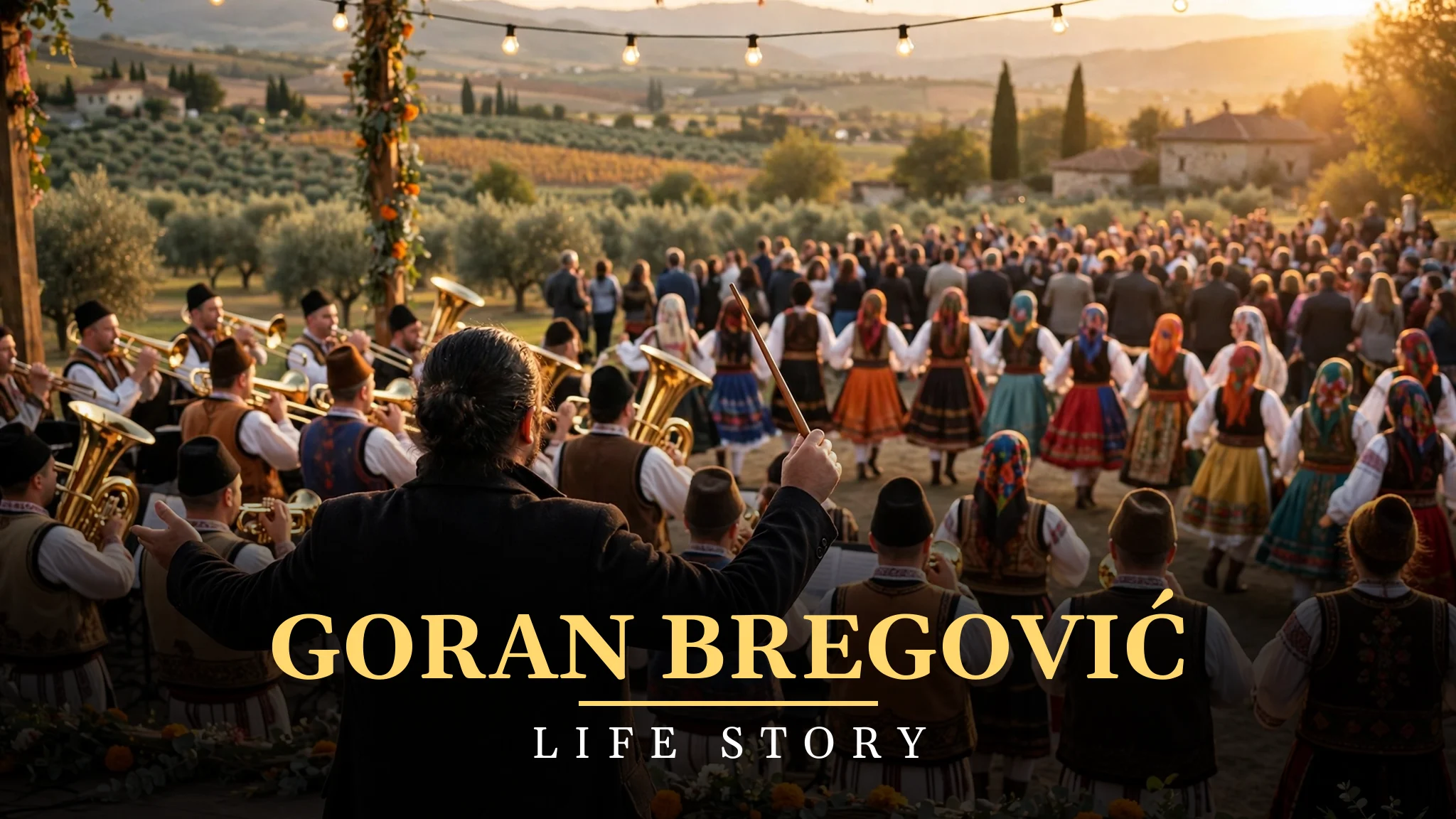
Finally, I return to the image of the conductor, with his baton raised, before a brass band and folk dancers, at sunset, because that image captures his story, a man leading music, with joy, with energy, and with a crowd, and I hope that image stays with readers, as a picture of a master of Balkan music, who gave the world a sound, and who never stopped sharing it, with generosity, and with love.
Frequently Asked Questions
When and where was Goran Bregović born?
Goran Bregović was born on 22 March 1950 in Sarajevo, Bosnia and Herzegovina, which was then part of Yugoslavia. His father was Croat and his mother was Serb, and he grew up in a city where many cultures lived together.
What was Bijelo Dugme?
Bijelo Dugme, which means White Button, was the rock band Bregović formed in Sarajevo in 1974, and it became the biggest rock band in Yugoslavia, selling millions of records and filling stadiums. Bregović was its leader, guitarist, and main songwriter.
What films did Goran Bregović write music for?
He wrote the music for Emir Kusturica’s films Time of the Gypsies, Arizona Dream, and Underground, as well as for Queen Margot and many other films. His scores became famous in their own right, especially the brass band music and the song Ederlezi.
What is the Wedding and Funeral Orchestra?
The Wedding and Funeral Orchestra is the large band Bregović formed in the 1990s, mixing brass, strings, folk singers, and rock musicians. The name reflects the Balkan tradition that the same band plays at weddings and at funerals, for joy and for sorrow.
What is Ederlezi?
Ederlezi is a traditional Romani song about spring that became famous around the world through the film Time of the Gypsies, for which Bregović wrote the music. It is still sung today in many countries by people who first heard it in the film.
Is Goran Bregović still performing today?
Yes, he continues to tour, record, and compose with his orchestra, performing in concert halls and at festivals around the world. He remains one of the most loved musicians from the Balkans, and his concerts are joyful celebrations.


