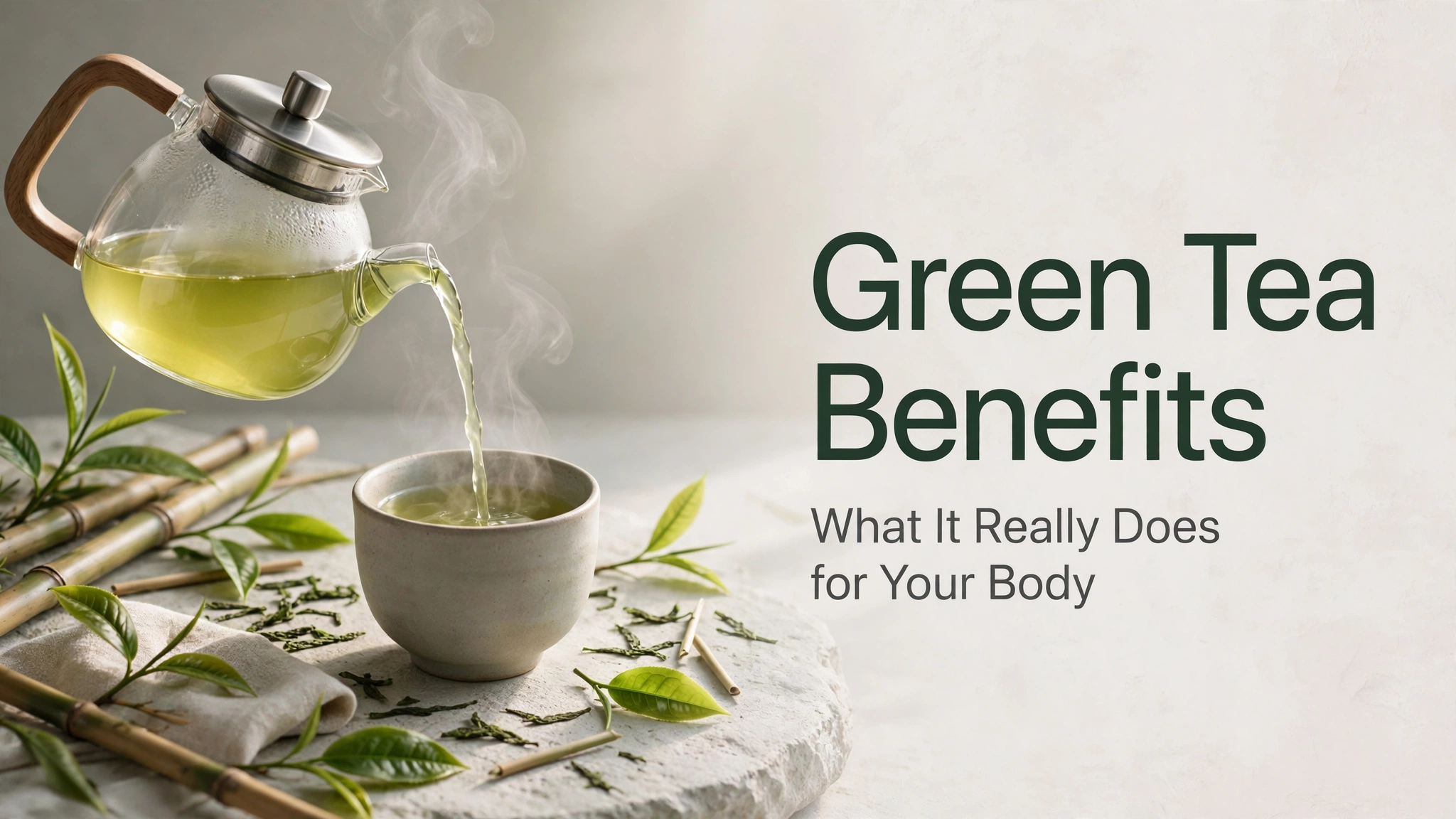
Green Tea Benefits Explained: What It Really Does for Your Body
In this post
Green tea is the most studied drink in the world after water, and it has been drunk for thousands of years, first in China and then across Asia and the world. It is made from the leaves of the Camellia sinensis plant, the same plant that produces black tea and oolong tea, but it is processed differently: the leaves are steamed or pan-fired soon after picking, which stops oxidation and preserves the compounds that give green tea its colour, its flavour and its reputation for health. Those compounds, especially a group called catechins, are the reason green tea is studied so much, and the reason it is sold as everything from a weight-loss aid to a brain booster.
The claims made for green tea are many, and they range from the sensible to the exaggerated. It is said to burn fat, protect the heart, improve memory, prevent cancer, strengthen bones and extend life. Some of these claims have evidence behind them, and some do not, and the difference is often a matter of dose, of form, and of whether the study was done in a laboratory, in animals, or in people drinking a normal cup of tea. A cup of green tea is not the same as a concentrated extract, and a study in mice is not the same as a study in humans.
This article explains what is actually in green tea, what the research shows for metabolism, heart, brain and other areas, how caffeine and L-theanine work together, how to brew it properly, what matcha is and whether it is better, and what the risks are. It is general information, not medical advice, and it is written to help you enjoy green tea for what it is, without believing promises it cannot keep.
This article is general information only. It is not individual medical advice. Talk to your doctor if you are pregnant, take medicine, or have a health condition, especially before taking high-dose green tea extracts.
What Is Actually in Green Tea
Green tea contains a mix of compounds that work together, and the most important are the catechins, a type of polyphenol with antioxidant properties. The most studied catechin is EGCG, epigallocatechin gallate, which makes up a large share of the catechins in green tea and which is responsible for many of the effects seen in research. EGCG is a powerful antioxidant in the laboratory, meaning it can neutralise free radicals, and it has been shown to affect many processes in cells, from inflammation to fat metabolism. But like curcumin, EGCG is not well absorbed, and the amount that reaches the bloodstream from a cup of tea is much smaller than the amount used in laboratory studies.
Green tea also contains caffeine, though less than coffee. A cup of green tea typically contains 30 to 50 milligrams of caffeine, compared with 90 to 100 milligrams in a cup of coffee, and the exact amount depends on the type of tea, the amount of leaves and the brewing time. It also contains L-theanine, an amino acid that is almost unique to tea, and which has a calming effect on the brain. The combination of caffeine and L-theanine is one of the most interesting things about green tea, because it produces a different kind of alertness from coffee: more focused and less jittery.
Green tea also contains small amounts of vitamins, minerals and other compounds, including fluoride, which is good for teeth, and theanine, which contributes to the savoury, umami flavour of good green tea. The exact composition varies by type, origin and preparation, and a high-quality loose-leaf green tea will contain more of these compounds than a cheap tea bag that has been sitting on a shelf for a year. Freshness matters, and so does brewing, which is why how you make green tea affects what you get from it.
Caffeine and L-Theanine: Calm Alertness Explained
The combination of caffeine and L-theanine is often described as the secret of green tea, and there is some truth to that. Caffeine is a stimulant that blocks adenosine, a chemical that makes you feel sleepy, and it increases alertness and concentration. L-theanine increases alpha brain waves, which are associated with a relaxed but alert state, and it may reduce the jittery, anxious feeling that caffeine can cause. Together, they produce a state that many people describe as calm focus: awake and alert, but not wired or nervous.
Studies have found that the combination of caffeine and L-theanine can improve attention, reaction time and memory more than caffeine alone, and that L-theanine can reduce the blood pressure increase that caffeine sometimes causes. The effects are modest, and they depend on the dose, but they are consistent enough that the combination is now sold as a supplement on its own. The point is not that green tea is a smart drug. It is that the natural combination of compounds in tea produces a different experience from coffee, and many people prefer it for that reason.
The practical implication is simple: if coffee makes you jittery or anxious, green tea may be a better choice, because it provides a gentler lift. If you need a strong jolt of energy, coffee is more effective, because it contains more caffeine. Green tea is a middle ground, and it is a good choice for people who want to be alert without feeling overstimulated. It is also a good choice for the afternoon, when coffee might interfere with sleep, because the lower caffeine content is less likely to keep you awake at night.
Green Tea and Metabolism: Does It Burn Fat
The most common claim for green tea is that it burns fat and helps with weight loss, and it is the claim that has sold the most supplements. The evidence is real but modest. Green tea contains caffeine and EGCG, both of which can increase metabolism slightly and increase fat burning during exercise. Studies have found that green tea extract can increase energy expenditure by a small amount, and that it can help with fat loss when combined with diet and exercise. But the effect is small, typically a few percent, and it is not enough to cause significant weight loss on its own.
The problem is that the studies showing the largest effects often use green tea extract, in doses far higher than what you get from drinking tea, and they are often short and small. A person who drinks two or three cups of green tea a day is getting a much lower dose of EGCG than a person who takes a concentrated extract, and the effect on weight is correspondingly smaller. Green tea can be a useful part of a weight-loss plan, because it is a calorie-free drink that can replace sugary drinks, and because it provides a small metabolic boost, but it is not a weight-loss treatment.
The honest summary is that green tea helps a little, and that little is worth having, but it is not a substitute for the things that actually cause weight loss: eating fewer calories, moving more, and doing it consistently over time. A person who drinks green tea and also eats well and exercises will do better than a person who does neither, but the tea is not the main reason. It is a supporting player, and it should be treated as one. The marketing that shows green tea melting away fat is misleading, and it should be ignored.
Heart Health and Blood Pressure
The evidence for green tea and heart health is more encouraging than the evidence for weight loss, and it is based on large population studies. People who drink green tea regularly, especially in East Asia where it is a daily habit, tend to have a lower risk of heart disease and stroke, and the effect appears to be dose-dependent: the more regularly they drink it, the lower the risk. These are observational studies, which cannot prove cause and effect, because tea drinkers may also have other healthy habits, but the association is consistent across many studies and many countries.
The mechanisms are plausible. Green tea can help lower LDL cholesterol, the type often called bad cholesterol, and it can improve the function of blood vessels, making them more flexible and better able to respond to changes in blood flow. It may also help lower blood pressure slightly, though the effect is small. These are modest benefits, but they add up over years of regular drinking, and they are one reason health authorities in many countries consider green tea a healthy drink.
It is important to keep the scale in mind. Green tea does not replace medicine for high cholesterol or high blood pressure, and it does not undo the effects of smoking, a poor diet or a lack of exercise. It is a small, positive factor in a larger pattern, and its benefit is greatest when it is part of an overall healthy lifestyle. A person who drinks green tea every day but also smokes and eats a poor diet is not protecting their heart. A person who drinks green tea as part of a healthy diet and an active life is doing something sensible, and the tea is one small part of it.
Brain Health, Memory and Mood
Green tea has been studied for brain health, and the results are promising, though not conclusive. The combination of caffeine and L-theanine can improve attention and alertness in the short term, and some studies have found that regular tea drinkers have a lower risk of cognitive decline and dementia. The evidence is observational, which means it shows an association rather than proof, but the association is consistent, and the compounds in green tea have plausible mechanisms for protecting the brain, including antioxidant and anti-inflammatory effects.
EGCG has been studied for its potential to protect brain cells and to reduce the buildup of proteins associated with Alzheimer’s disease, but most of this research is in laboratories and animals, not in people. Human studies are small and preliminary, and it would be wrong to say that green tea prevents dementia. What can be said is that drinking green tea regularly is associated with better brain health in older age, and that it is a sensible habit for anyone who wants to look after their brain, alongside the more important factors of exercise, sleep, social connection and not smoking.
The mood effects are also worth mentioning. L-theanine has a calming effect, and some people find that green tea helps them feel more relaxed and less stressed. The ritual of making and drinking tea can also be calming in itself, providing a pause in a busy day. These are real benefits, but they are subtle, and they are not a treatment for anxiety or depression. Anyone with a mental health condition should seek professional help, and green tea should be seen as a pleasant habit, not as a therapy.
How to Brew Green Tea Properly
How you brew green tea affects both its taste and its chemistry, and many people brew it badly without realising. The most common mistake is using water that is too hot. Green tea should be brewed with water at around 70 to 80 degrees Celsius, not boiling, because boiling water makes the tea bitter and destroys some of the delicate compounds. If you do not have a thermometer, let boiled water cool for a few minutes before pouring it over the leaves. The difference in taste is immediate and dramatic.
The second mistake is brewing for too long. Green tea should be steeped for two to three minutes, not five or ten, because a longer steep extracts more bitter tannins and makes the tea harsh. A shorter steep produces a smoother, sweeter tea, and the leaves can often be steeped two or three times, with each steep tasting slightly different. The amount of leaves matters too: about one teaspoon per cup is a good starting point, and loose-leaf tea generally tastes better than tea bags, though a good quality tea bag is fine for everyday drinking.
The type of green tea also matters. Sencha, the most common Japanese green tea, is grassy and fresh. Matcha, the powdered green tea used in Japanese tea ceremony, is richer and more intense, because you drink the whole leaf rather than an infusion. Dragon Well, a Chinese green tea, is smooth and slightly nutty. Each type has a different flavour and a slightly different composition, and trying different types is part of the pleasure of drinking green tea. The best green tea is the one you enjoy drinking, because the health benefit comes from drinking it regularly.
Matcha, Extracts and the Risks of Too Much
Matcha is green tea in powdered form, made from shade-grown leaves that are ground into a fine powder, and it has become very popular in recent years. Because you drink the whole leaf, matcha contains more caffeine and more EGCG than regular green tea, typically two to three times as much per serving. It also contains more L-theanine, which gives it a rich, savoury flavour. Matcha is a legitimate form of green tea, and it can be a good choice for people who want a stronger effect, but it is also more expensive, and it contains more caffeine, so it is not suitable for everyone.
Green tea extracts, sold as capsules and pills, are a different matter. They contain concentrated EGCG, often in doses far higher than what you get from drinking tea, and they have been linked to liver damage in rare cases. Health authorities in several countries have warned about high-dose green tea extracts, and they should not be taken without medical advice, especially by people with liver problems or by people who take other medicines. Drinking green tea is safe for almost everyone. Taking a concentrated extract is not the same thing, and it carries risks that a cup of tea does not.
The practical advice is to enjoy green tea as a drink, to try matcha if you like it, and to avoid high-dose extracts unless a doctor has recommended them. Two to three cups a day is a sensible amount for most people, and it provides the benefits without the risks. More than that is not necessarily better, and it can cause problems such as insomnia, anxiety and stomach upset, because of the caffeine. Green tea is a healthy drink, but it is still a drink that contains caffeine, and it should be treated with the same common sense as coffee.
My Take:
I think green tea is one of the healthiest drinks in the world, and I say that without the hype that usually surrounds it. It is not a miracle, it is not a weight-loss drug, and it is not a cure for anything. It is a drink made from leaves, with a modest amount of caffeine, a calming amino acid, and a group of plant compounds that have real, if modest, health benefits. That is enough. A drink does not need to be a miracle to be worth drinking, and green tea is worth drinking because it is pleasant, it is healthy, and it has been enjoyed for thousands of years for good reason.
What I like most about green tea is the combination of caffeine and L-theanine, because it is the thing that makes tea feel different from coffee. I have drunk both, and I know the difference: coffee wakes me up with a jolt, and green tea wakes me up gently, with a focus that lasts longer and a crash that is smaller. I think that is a valuable quality, especially for people who are sensitive to caffeine or who need to concentrate for a long time. It is not a dramatic effect, but it is a real one, and it is the reason I often choose tea over coffee in the afternoon.
I am also sceptical about the weight-loss claims, because they are the most exaggerated part of the green tea story. I have seen products that promise to melt fat with green tea extract, and I think those promises are dishonest. The evidence shows a small increase in metabolism, a small increase in fat burning, and a small effect on weight, and small is the honest word. A person who drinks green tea and expects to lose weight without changing their diet will be disappointed, and that disappointment is the fault of the marketing, not of the tea. Green tea can help, but it cannot do the work for you.
The heart health evidence is the part I find most convincing, because it is based on large studies of real people drinking real tea over many years. The association between regular green tea drinking and a lower risk of heart disease is consistent, and it makes sense given what we know about the compounds in tea. I do not think green tea alone prevents heart disease, and I do not think it replaces medicine or exercise, but I do think it is a sensible habit for anyone who wants to look after their heart. It is a small, positive choice, and small, positive choices add up over a lifetime.
I also think the brewing advice matters more than people realise, because a badly brewed cup of green tea tastes bitter and unpleasant, and a person who hates the taste will not drink it regularly. Using water that is too hot and steeping for too long are the two mistakes that ruin green tea, and they are easy to fix. Let the water cool, steep for two or three minutes, and the tea will taste smooth and sweet. That is not a health tip. It is a taste tip, but it matters for health, because the health benefit comes from drinking tea regularly, and you will only drink it regularly if you enjoy it.
My honest opinion is that matcha is worth trying, but it is not necessary, and that green tea extracts should be avoided unless a doctor recommends them. Matcha is a stronger, richer form of green tea, and it is a pleasant change, but it is also more expensive and it contains more caffeine. Extracts are a different matter entirely: they are concentrated, they carry a risk of liver damage, and they are not the same as drinking tea. I think the safest and most enjoyable way to get the benefits of green tea is to drink it as tea, two or three cups a day, brewed properly, and to leave the extracts on the shelf.
Turn green tea into a habit, not a project, and it will do more for you than any plan will. Buy a tea you like, learn to brew it properly, and drink it when you would otherwise reach for a sugary drink or a second coffee. That simple swap, repeated every day, is worth more than any supplement, because it is the kind of change that lasts, built on pleasure rather than willpower. Green tea will not transform your health overnight, but it will be a small, steady, positive part of your day, and that is exactly what a healthy habit should be: unremarkable, repeatable, and quietly good for you, one cup at a time.
I also think the ritual of tea matters, and it is the part of green tea that no study can measure properly. Making a cup of tea, waiting for the water to cool, watching the leaves unfurl, and sitting down for a few minutes without a phone is a small act of care, and it is a break that many people need. I think that ritual is part of why tea cultures have lasted for thousands of years, and it is part of why green tea is more than just a drink. It is a pause, and pauses are valuable in a life that is always rushing.
Drinking green tea and taking a concentrated extract are not the same thing, and the difference is the most important safety point in this whole topic. The tea is safe for almost everyone; the extract is not automatically safe, and the cases of liver damage linked to high-dose extracts are real. A person who buys an extract thinking it is the same as tea is taking a risk they do not understand, and the supplement industry should be clearer about that, because the confusion is profitable and the harm is preventable. The difference should be on the label in plain language, and until it is, the safest rule is the simplest one: drink the tea, and leave the concentrated extract alone unless a doctor has told you otherwise.
Brew it properly, drink it slowly, and enjoy it as a daily habit. Green tea will not change your life overnight, but it will make your days a little calmer and a little healthier, and that is enough to ask of a cup of tea.
Frequently Asked Questions
How much caffeine is in green tea?
A cup of green tea typically contains 30 to 50 milligrams of caffeine, compared with 90 to 100 milligrams in a cup of coffee. The exact amount depends on the type and brewing time.
Does green tea help with weight loss?
It can help slightly by increasing metabolism and fat burning, but the effect is small. It is not a weight-loss treatment on its own and works best combined with diet and exercise.
What is EGCG?
EGCG, epigallocatechin gallate, is the most studied catechin in green tea. It is a polyphenol with antioxidant properties and is responsible for many of green tea’s researched effects.
Is matcha better than green tea?
Matcha contains more caffeine and EGCG than regular green tea because you drink the whole leaf. It is stronger, but it is also more expensive and higher in caffeine.
How should I brew green tea?
Use water at 70 to 80 degrees Celsius, not boiling, and steep for two to three minutes. Boiling water and long steeping make the tea bitter.
Are green tea extract supplements safe?
High-dose green tea extracts have been linked to liver damage in rare cases and should not be taken without medical advice. Drinking green tea as a beverage is safe for most people.
Sources
- https://ods.od.nih.gov/factsheets/GreenTea-HealthProfessional/
- https://www.nhs.uk/live-well/eat-well/food-types/
- https://www.mayoclinic.org/healthy-lifestyle/nutrition-and-healthy-eating/expert-answers/green-tea/faq-20058010
- https://www.healthline.com/nutrition/green-tea-benefits
- https://medlineplus.gov/druginfo/natural/960.html