Guillaume Canet: The Life Story Behind France's Actor and Filmmaker
In this post
- A Horseman from Boulogne-Billancourt
- The Actor Finds His Place
- Tell No One: A Director Arrives
- Les Petits Mouchoirs and the Films of Friendship
- A Life with Marion Cotillard and the Sea
- Rock’n Roll: Laughing at Himself
- Astérix and the Big Adventure
- Lui and the Composer on an Island
- A Father, a Partner, and a Life by the Sea
- My Take:
Guillaume Canet is a man who has lived two lives. In his first life, he was a show jumper, a young man on horseback, dreaming of the Olympics. A bad fall ended that dream, and he had to start again. In his second life, he became an actor, and then a director, and he built a career that has made him one of the most respected film makers in France. He is a man who knows what it means to lose a dream, and to find a new one, and that knowledge is in every film he makes.
He is best known as an actor in films such as Joyeux Noël and Jeux d’enfants, and as a director of Ne le dis à personne, a thriller that won him the César for Best Director. He is also known for Les Petits Mouchoirs, a film about friendship that became a huge hit in France. He is a handsome leading man, a serious director, and a man who loves horses, the sea, and the cinema. His story is about falling, getting up, and finding a new path.
He has worked with the greatest actors in France, he has directed some of the most loved French films of the last twenty years, and he has done it all with a quiet, steady determination. He is not a loud star. He is a worker, a film maker, and a man who lets his films speak for him.
A Horseman from Boulogne-Billancourt
Guillaume Canet was born on 10 April 1973 in Boulogne-Billancourt, just outside Paris. He grew up in a family that loved horses, and he spent much of his childhood in the saddle. He was a talented young rider, and he dreamed of becoming a professional show jumper, of competing in the great competitions, and of one day going to the Olympic Games. He trained hard, he competed, and he was on his way to a career in sport. He was not thinking about films or acting. He was thinking about horses, about jumping, and about winning.
Then, as a young man, he had a bad fall from a horse, and his dream ended. The injury was serious, and he could no longer ride at the level he needed. For a young man who had given his life to horses, it was a terrible blow. He had to face the fact that the future he had imagined was gone, and that he would have to find a new one. He was still young, but he was lost, and he did not know what to do next.
It was at this low point that he turned to acting. He had always loved films, and he had a natural presence that people noticed. He began to take acting classes, and he discovered that he had a talent for it. He learned to use his body, his voice, and his face, and he found that the discipline he had learned from riding horses, the patience, the focus, and the hard work, helped him as an actor. He was starting again, from nothing, and he was doing it with the same determination he had shown on horseback.
His early years as an actor were hard. He took small roles, he worked in theatre, and he learned his craft. He was a handsome young man, and directors noticed him, but he wanted to be more than a pretty face. He wanted to be a serious actor, and he worked hard to become one. The fall from the horse had taken away one dream, but it had given him another, and he was determined to make the most of it.
The Actor Finds His Place
Canet’s first film roles came in the late 1990s, and he quickly became known as a promising young actor. He appeared in Barracuda in 1997, and in En plein coeur in 1998, and he showed that he could play complex, troubled men. He was not afraid of dark roles, and he was not afraid to show vulnerability. He had a quiet intensity on screen, a way of listening and watching that made audiences believe in him. He was building a reputation, film by film.
In 2003, he starred in Jeux d’enfants, known in English as Love Me If You Dare, alongside Marion Cotillard. The film told the story of two friends who play a dangerous game of dares from childhood into adulthood, and who cannot admit that they love each other. Canet played Julien, a man who is brave in the game, but afraid of love. The film was a success, and it made Canet and Cotillard a famous pair. They would work together again, and they would become partners in life as well as on screen.
In 2005, he starred in Joyeux Noël, a film about the Christmas truce of 1914, when soldiers from France, Germany, and Britain stopped fighting and celebrated Christmas together. Canet played a French lieutenant, a man caught between duty and humanity, and the film was a moving, powerful story about war and peace. It was nominated for the Academy Award for Best Foreign Language Film, and it showed Canet as a serious actor who could carry a major international film.
By the mid-2000s, Canet was one of the leading young actors in France. He had played lovers, soldiers, and troubled men, and he had shown that he could do it all. He was handsome, he was talented, and he was serious about his craft. But he was also thinking about something else: directing. He had watched directors on set, he had learned how films were made, and he had stories of his own to tell. He was ready to step behind the camera.
Tell No One: A Director Arrives
In 2006, Canet directed Ne le dis à personne, known in English as Tell No One, based on the novel by Harlan Coben. The film told the story of a man whose wife is murdered, and who receives a message years later that suggests she may still be alive. It was a thriller, full of twists, tension, and emotion, and Canet directed it with skill and with confidence. The film was a huge success in France, and it won the César Award for Best Director for Canet. He was no longer only an actor. He was a director, and a very good one.
Tell No One showed Canet’s talent for directing. He knew how to build suspense, how to work with actors, and how to tell a complex story without confusing the audience. He cast François Cluzet in the leading role, and Cluzet gave a powerful performance that won him the César for Best Actor. The film was a triumph for both men, and it proved that Canet had a real gift behind the camera. He had learned to direct by watching, by acting, and by studying films, and now he was doing it himself, at the highest level.
The success of Tell No One changed Canet’s career. He was now a director as well as an actor, and he could choose his projects with more freedom. He was respected by critics, loved by audiences, and sought after by producers. He had come from a fall off a horse to a César for Best Director, and it was a journey that few people could have predicted. He had proved that a lost dream can lead to a new one, and that hard work can turn a second chance into a triumph.
He continued to act as well, because he loved acting, and because he did not want to give it up. He was a man who could do both: he could stand in front of the camera, and he could stand behind it. That double talent is rare, and it is part of what makes him special. He understands acting because he is an actor, and he understands directing because he is a director, and each skill makes the other stronger.
Les Petits Mouchoirs and the Films of Friendship
In 2010, Canet directed Les Petits Mouchoirs, known in English as Little White Lies, a film about a group of friends who go on holiday together after one of them is badly hurt in an accident. The film starred many of the best actors in France, including François Cluzet, Marion Cotillard, and Benoît Magimel, and it was a huge success. It was a film about friendship, about the lies friends tell each other, and about the love that holds them together even when they hurt each other. Canet directed it with warmth, humour, and honesty, and audiences loved it.
Les Petits Mouchoirs was a personal film for Canet. It was about his own generation, about friends in their thirties, about the pressures of life, work, and love. He knew these people, he knew their jokes, their arguments, and their secrets, and he put all of that into the film. It was a film that felt real, because it was real, and audiences recognised themselves in it. The film became one of the biggest French hits of the year, and it confirmed Canet as a major director.
He continued to direct and to act, making films such as Rock’n Roll in 2017, a comedy in which he played himself, poking fun at his own image as an ageing actor, and Lui in 2021, a film about a composer on an island. He also directed Astérix et Obélix: L’Empire du Milieu in 2023, a big adventure film based on the beloved comic books. He was a director who could make thrillers, comedies, dramas, and adventures, and who could do them all well.
As an actor, he continued to take on strong roles, in films and on television, and he remained one of the most respected actors in France. He was a man who loved the cinema, who loved to act, and who loved to direct, and he did all three with the same quiet determination. He had built a career that was both popular and respected, and he had done it by working hard, by learning, and by never giving up.
A Life with Marion Cotillard and the Sea
Canet’s personal life has been closely linked to his work. He has been in a relationship with the actress Marion Cotillard since 2007, and they have two children together. They are one of the most famous couples in French cinema, and they have worked together in several films. They keep their private life mostly private, but they have spoken about their love of family, of the sea, and of a simple life away from Paris. Canet loves horses, he loves the coast, and he loves to be outdoors, and that love of nature is in his films.
He is known as a man who is serious about his work, who is demanding on set, and who expects the best from himself and from others. He is also known as a man who is loyal to his friends, who works with the same actors again and again, and who builds a team around him. He is not a star who lives for gossip. He is a film maker, a father, and a partner, and he has built a life that balances all of those things.
His story is still going. He continues to act, to direct, and to make films that matter to him. He is a man who fell off a horse and found a new life in the cinema, and who has never forgotten the lesson of that fall: that life can change in a moment, and that the only thing to do is to get up, and to find a new way forward. That is a lesson he carries with him, in every film he makes, and in every role he plays.
Rock’n Roll: Laughing at Himself
In 2017, Canet directed and starred in Rock’n Roll, a comedy in which he played himself, a famous actor who is told that he is no longer cool, no longer young, and no longer relevant. The film was a joke about fame, about ageing, and about the film industry, and Canet played it with a boldness that surprised audiences. He made fun of his own image, of his own career, and of his own fears, and he did it with humour and with honesty. He appeared alongside Marion Cotillard, who played herself, and the two of them laughed at the world they lived in. The film was funny, sharp, and full of self-awareness, and it showed that Canet was not afraid to look foolish.
Rock’n Roll was a brave film, because it asked the audience to laugh at a star who is afraid of getting old. Canet did not hide his age, and he did not pretend to be young. He played a man in his forties who wants to be cool again, who tries new things, and who fails in funny ways. The film was a success, and it showed that Canet could make a comedy about himself, and that he could do it with grace. He was a director who was willing to be the joke, and that willingness made the film work.
The film also showed his love of cinema, and his understanding of how fame works. He knows that stars are not always cool, that they get older, and that they have to learn to live with it. He made a film about that, and he made it funny, and that is a rare thing. Many stars would never make a film about their own fears. Canet did, and he did it well, and that is a sign of a confident artist, and of a man who is comfortable with who he is.
Astérix and the Big Adventure
In 2023, Canet directed Astérix et Obélix: L’Empire du Milieu, a big adventure film based on the beloved French comic books. The film took Astérix and Obélix to China, with a large cast, a big budget, and a story full of action, humour, and heart. Canet directed it with energy and with care, and he showed that he could handle a large production, with many actors, many locations, and many special effects. It was a different kind of film from Tell No One or Les Petits Mouchoirs, and it showed his range as a director.
The film was a success in France, and it was seen by audiences around the world. It showed that Canet could make a popular film for families, a film that was fun, exciting, and full of French humour. He did not lose his own voice in a big production. He kept his warmth, his humour, and his love of storytelling, and he brought them to a film about Gauls in China. That is a sign of a director who knows who he is, and who can bring that knowledge to any kind of film.
Canet’s work as a director has grown from a small thriller to a big adventure, from a film about friends to a film about a composer on an island. He has tried many kinds of films, and he has done them all well. He is a director who loves to learn, who loves to try new things, and who loves the cinema. He is still growing, still directing, and still surprising his audiences, and that is a happy thing for French cinema.
Lui and the Composer on an Island
In 2021, Canet directed Lui, a film about a famous composer who goes to a small island to find peace, and who is visited by the people from his past. The film was quiet, strange, and full of questions about fame, about love, and about the need to be alone. Canet directed it with a stillness that was different from his earlier films, and he showed that he was willing to try a slower, more thoughtful kind of cinema. The film was not a big hit, but it was praised by critics for its beauty and its honesty, and it showed that Canet was still growing as a director, still willing to take risks, and still interested in stories about the inner life.
Lui was a personal film for Canet, about a man who has everything, and who still feels empty, and who goes looking for something real. It was a film about the cost of fame, about the pressure of being known, and about the wish to disappear for a while. Canet understood that wish, because he is a famous man himself, and he knows what it feels like to be watched. He made a film about it, and he made it with care, with beautiful images of the sea and the island, and with a quiet, thoughtful tone. It was a film that asked the audience to slow down, to listen, and to think, and that is a brave thing for a director to ask.
The film showed a different side of Canet: not the thriller director, not the comedy director, but a director who is interested in silence, in nature, and in the inner life of a man. He is a film maker who keeps growing, who keeps trying new things, and who is not afraid to make a film that is quiet. That willingness to be quiet, in a loud world, is a sign of confidence, and it is one of the reasons his career is so respected.
A Father, a Partner, and a Life by the Sea
Canet has built a life that balances work and family. He has been in a relationship with Marion Cotillard since 2007, and they have two children together. They live a life that is mostly private, away from the noise of Paris, close to the sea and to nature. Canet loves horses, he loves the coast, and he loves to be outdoors, and he has passed that love on to his children. He is a father who takes his children to the beach, to the stables, and to the places he loved as a boy, and he teaches them to love the natural world. That is a simple, happy life, and it is one that he has protected from the press.
He is known as a man who is serious about his work, who is demanding on set, and who expects the best from himself and from others. He is also known as a man who is loyal to his friends, who works with the same actors again and again, and who builds a team around him. He is not a star who lives for gossip. He is a film maker, a father, and a partner, and he has built a life that balances all of those things. That balance is hard to achieve, and it is one that he has worked at, year after year, with the same determination he brought to riding horses and to making films.
My Take:
When I think about Guillaume Canet, I think about falling. Not falling in the sense of failing, but falling in the literal sense: a young man falls off a horse, and his dream of the Olympics ends. That is a hard moment, and it is a moment that could have broken him. He could have given up, he could have become bitter, and he could have spent his life regretting what he lost. He did not. He got up, he found a new dream, and he built a new life in the cinema. I admire that, because it is easy to talk about getting up after a fall, and it is hard to actually do it. Canet did it, and he did it with grace.
I admire his work as a director, especially Tell No One. It is a thriller, and thrillers are hard to direct well. You have to keep the audience guessing, you have to build tension, and you have to make the twists feel real. Canet does all of that, and he does it with a quiet confidence that comes from understanding actors. He is an actor himself, so he knows how to talk to actors, how to help them find their characters, and how to let them do their best work. I think about the directors who have never acted, and who do not understand what it feels like to stand in front of a camera. Canet understands, because he has stood there himself. That understanding makes his films better, and it makes him a director that actors love to work with.
What moves me most is Les Petits Mouchoirs, because it is a film about friendship, and friendship is one of the hardest things to show on screen. The film is about a group of friends who go on holiday, who lie to each other, who argue, and who love each other. It is funny, it is sad, and it is true. I think about my own friends, and about the lies we tell each other, the small lies that protect us, and the big lies that hurt us. Canet shows all of that without judging his characters. He loves them, even when they are wrong, and that love is what makes the film work. I think that is a lesson for all of us: our friends are not perfect, and neither are we, but love can hold us together anyway.
I think about his relationship with Marion Cotillard, and about the films they have made together. They are a couple in life and in art, and they have built a family together. I do not want to make their life sound like a fairy tale, because it is not. It is a real life, with work, with children, and with the pressures of fame. But I admire the way they have kept their private life private, and the way they have supported each other’s work. They are two stars who have chosen to build a life together, away from the noise, and that is a brave choice in a world that wants to know everything about famous people.
There is something I respect about the way Canet has handled his second career. He was an actor, and he became a director, and he did not give up acting. He does both, and he does both well. That is not easy, because each job takes time, energy, and focus. Canet has found a way to do both, and to do them with care. I think about the people who have more than one talent, and who are told to choose one. Canet shows that you do not have to choose. You can do both, if you are willing to work hard, and if you love both. That is a lesson for anyone who feels torn between two dreams: you can follow both, if you are patient and if you work.
I feel a quiet sadness when I think about the horse, and about the dream that ended. Canet loved riding, he was good at it, and he lost it in a moment. That loss is real, and it must still hurt, even after all these years. But I also feel hope, because the loss led to something new. If he had not fallen, he might never have become an actor, and he might never have become a director. We cannot know what would have happened, but we can see what did happen: a fall became a new beginning. That is a hopeful thought, and it is one I want to remember. When a door closes, another one can open, if we are willing to look for it.
For a young reader, I think the lesson of Canet’s life is about second chances. Do not think that your first dream is your only dream. If it ends, if it fails, if you fall, get up and look for a new one. Canet fell off a horse, and he found the cinema. He lost one life, and he built another, and the second life has been just as rich as the first. That is not luck. It is courage, it is hard work, and it is a willingness to start again. I think that is a lesson for all of us, because we will all fall, in one way or another, and we will all need to get up.
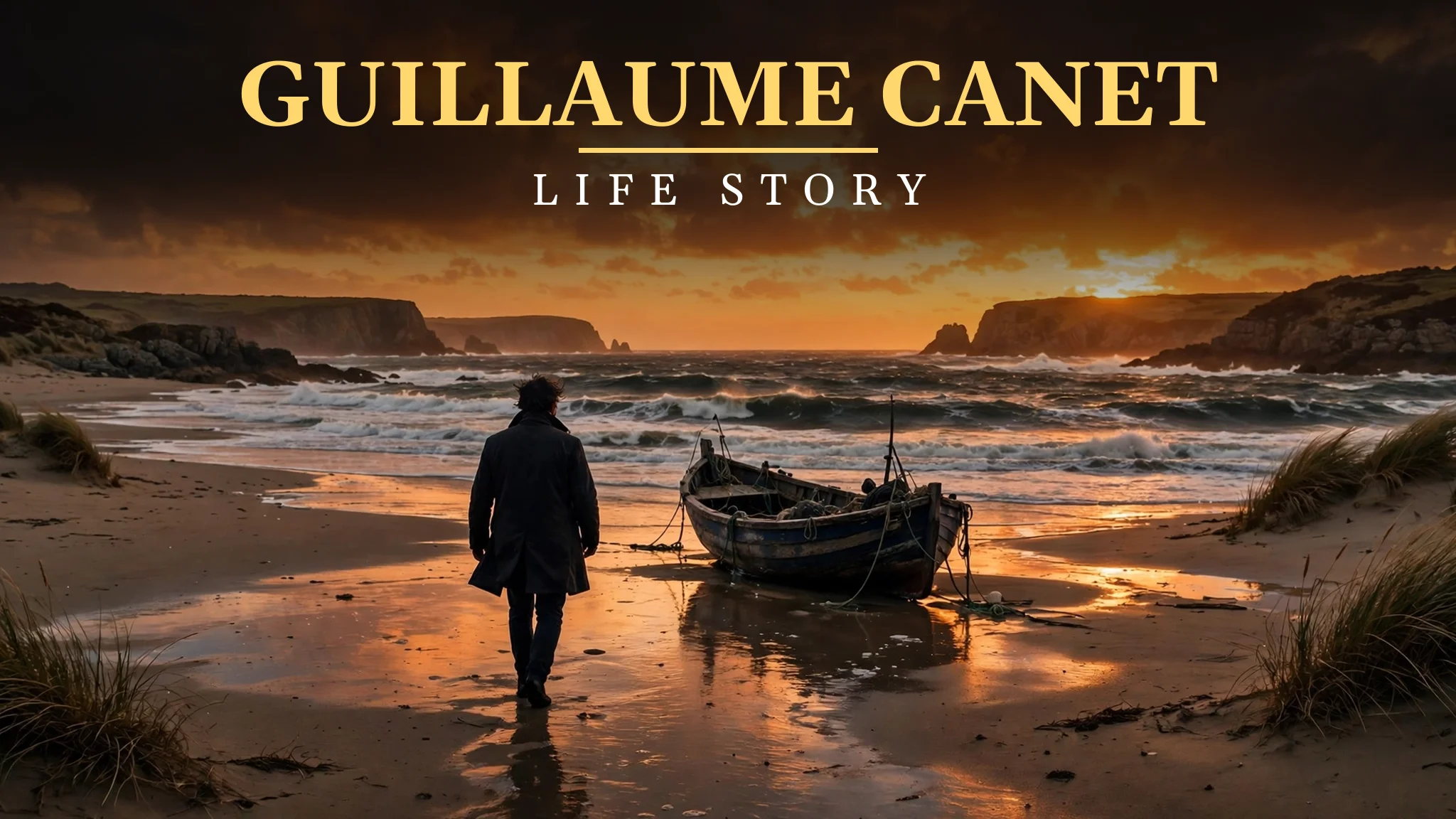
I keep thinking about the beach at sunset, the man in the dark coat walking toward the sea, the old boat on the sand, and the cliffs behind. It is a picture of a man walking alone, thinking, looking at the horizon. That is Canet for me: a man who walks, who thinks, and who looks at the horizon. He does not rush. He takes his time, and he makes films that take their time too. In the end, I think that is his gift: he shows us that life is not a race, and that a fall is not the end. It is only a turn in the road, and the road goes on.
I also think about his love of horses, and about how it has stayed with him. He was a show jumper as a young man, and he lost that dream in a fall. But he did not lose his love of horses, or of the outdoors, or of the sea. He still rides, he still loves the coast, and he still finds peace in nature. I think about the dreams we lose, and about how the love behind them does not die. Canet loved horses, and he still does, even if he cannot compete. That love is in his films, in the way he shows the sea, the land, and the open air. He is a man who carries his first love with him, even as he builds a second life, and that is a beautiful thing.
I think about Tell No One, and about the way Canet directs a thriller. He builds tension slowly, he lets the audience guess, and he gives them twists that feel real, not forced. That is hard to do, and it takes a director who understands story, who understands actors, and who understands the audience. Canet does all three, because he is an actor himself, and he knows what it feels like to stand in front of a camera. He knows how to talk to actors, how to help them find their characters, and how to let them do their best work. That understanding makes his films better, and it makes him a director that actors love to work with.
I also think about his relationship with Marion Cotillard, and about the films they have made together. They are a couple in life and in art, and they have built a family together. They keep their private life private, and they support each other’s work. I do not want to make their life sound like a fairy tale, because it is not. It is a real life, with work, with children, and with the pressures of fame. But I admire the way they have kept their life together, away from the noise, and the way they have chosen to build a home, not only a career. That is a brave choice in a world that wants to know everything about famous people, and it is a choice that takes strength.
There is something I respect about the way Canet does both acting and directing. He does not give up one for the other. He acts, he directs, and he does both well. That is not easy, because each job takes time, energy, and focus. Canet has found a way to do both, and to do them with care. I think about the people who have more than one talent, and who are told to choose one. Canet shows that you do not have to choose. You can do both, if you are willing to work hard, and if you love both. That is a lesson for anyone who feels torn between two dreams: you can follow both, if you are patient and if you work.
Finally, I think about the beach at sunset, the man in the dark coat walking toward the sea, the old boat on the sand, and the cliffs behind. He does not rush. He shows us that life is not a race, and that a fall is not the end. It is only a turn in the road, and the road goes on, toward the sea, toward the horizon, and toward a new beginning.
I also think about Lui, and about the composer who goes to an island to find peace. It is a quiet film, and it is a film about the cost of fame, about the pressure of being known, and about the wish to be alone. Canet understands that wish, because he is a famous man, and he knows what it feels like to be watched all the time. He made a film about it, and he made it with beautiful images of the sea, and with a thoughtful, slow pace. I think about the times when I have wanted to be alone, to escape the noise, and to find a quiet place. Canet shows that feeling in Lui, and he does it with honesty. It is a brave film, because it asks the audience to slow down, and to listen, and that is not easy in a loud world.
I think about his love of the sea, and about the beach at sunset in the image. Canet loves the coast, he loves horses, and he loves to be outdoors, and that love is in his films. He shows the sea, the land, and the open air with a care that comes from knowing them well. I think about the places I love, the sea, the hills, and the quiet roads, and I see them in his films. He is a director who films the world he loves, and that love shows in every frame. It is a simple thing, but it is a powerful one: film what you love, and the audience will love it too.
Finally, I think about the man walking toward the sea at sunset, the old boat on the sand, and the cliffs behind. He does not rush. He shows us that life is not a race, and that a fall is not the end. It is only a turn in the road, and the road goes on, toward the sea, and toward a new beginning.
I also think about his life by the sea, and about the balance he has built between work and family. He lives away from Paris, close to nature, with his partner and his children, and he protects that life from the press. I think about the famous people who live loud lives, who share everything, and who lose their privacy. Canet has chosen a different path: a quiet life, a life by the sea, and a life with the people he loves. That choice takes strength, and it shows that he knows what matters. Fame is loud, but family is quiet, and Canet has chosen the quiet thing, and he has kept it safe.
Frequently Asked Questions
When and where was Guillaume Canet born?
Guillaume Canet was born on 10 April 1973 in Boulogne-Billancourt, just outside Paris, France. He grew up in a family that loved horses, and he spent much of his childhood riding and dreaming of a career as a show jumper.
How did Guillaume Canet go from show jumping to acting?
He was a talented young show jumper, but a bad fall from a horse ended his riding career, and he turned to acting instead. He took acting classes, worked in theatre and small film roles, and built a career as an actor, using the discipline and focus he had learned from riding.
What are Guillaume Canet’s most famous films as an actor?
His most famous films as an actor include Jeux d’enfants, Joyeux Noël, and many others in which he played lovers, soldiers, and troubled men. Joyeux Noël, about the Christmas truce of 1914, was nominated for the Academy Award for Best Foreign Language Film.
What film won Guillaume Canet the César for Best Director?
He won the César Award for Best Director for Ne le dis à personne, known in English as Tell No One, released in 2006. The thriller, based on the novel by Harlan Coben, was a huge success in France and starred François Cluzet.
What is Les Petits Mouchoirs about?
Les Petits Mouchoirs, released in 2010 and directed by Canet, is a film about a group of friends who go on holiday together after one of them is badly hurt in an accident. It is a story about friendship, the lies friends tell each other, and the love that holds them together.
Who is Guillaume Canet’s partner?
He has been in a relationship with the actress Marion Cotillard since 2007, and they have two children together. The two have worked together in several films, including Jeux d’enfants, and they keep their private life mostly out of the public eye.


