Haruna Kawaguchi: The Life Story Behind Japan's Popular Star
In this post
- Childhood on the Goto Islands
- Modelling for Nicola and the First Steps in Tokyo
- Ouran High School Host Club and a First Lead
- A Busy Decade of Dramas, Films, and Adverts
- Silent and a Performance That Touched Millions
- The Weight of Being Always in Demand
- Where Haruna Kawaguchi Stands Now
- Adverts, Magazines, and Being a Household Face
- My Take:
Haruna Kawaguchi is the kind of star who seems to be everywhere in Japan without ever making a fuss about it. Turn on the television, open a magazine, walk past a poster in a train station, and there she is, smiling in a drama, in an advert, in a film. She has been famous since she was a teenager, and she has stayed famous by doing something that sounds easy and is very hard: she keeps showing up, keeps working, and keeps giving audiences a performance they can enjoy. She is not a star who depends on one big hit. She is a star who has built a long career out of many good jobs, done well, one after another.
She started in Nagasaki, far from Tokyo, as a young model, and she was still a schoolgirl when the entertainment world found her. From there she moved to Tokyo, to television, to film, and to a place among Japan’s most popular actresses. Her path was not a straight line to the top. It was a path full of school dramas, comedies, romances, and serious roles, and each one taught her something new. She learned to be funny, to be sad, to be strong, and to be quiet, and she learned it in front of millions of viewers.
This is the story of Haruna Kawaguchi, a girl from the Goto Islands who became one of Japan’s most familiar faces, and a look at how a long, steady career in Japanese television and film is really built, day by day, role by role.
Childhood on the Goto Islands
Haruna Kawaguchi was born on 10 February 1995 in Goto, a group of islands in Nagasaki Prefecture, Japan. The Goto Islands are far from the big cities, surrounded by sea, and life there moves at a slower pace than life in Tokyo or Osaka. A child growing up on a small island learns to know the sea, the wind, and the quiet of a place where everyone knows everyone else. Kawaguchi grew up in that world, and the calm of the islands stayed with her even after she moved to the busiest city in Japan.
She was the youngest in her family, and she grew up with older sisters who looked after her. A youngest child in a family often learns to be cheerful and to get attention by being bright and lively, and Kawaguchi has that quality in her work. She can light up a scene with a smile, and she can make a serious scene feel warm. That brightness is not an act she puts on for the camera. It seems to be part of who she is, and it comes from a childhood where family was close and life was simple.
As a schoolgirl in Nagasaki, she was not thinking of a career in Tokyo. She was living a normal island life, going to school, spending time with friends, and enjoying the sea and the hills around her home. But she had a face that stood out, and she had a natural way in front of a camera that other people noticed. In Japan, a young girl with that kind of presence can be spotted by a talent scout, and that is what happened to Kawaguchi. She was still young when she was noticed, and the notice changed the direction of her life.
The move from a small island to Tokyo is a big one for any teenager. It means leaving home, leaving friends, and living in a city where everything is faster, louder, and more crowded. Kawaguchi made that move, and she made it while she was still at school. She had to learn to live in Tokyo, to study, and to work, all at the same time. That is a hard life for a young person, but it taught her to be independent early, and it taught her to take her work seriously, because the work was the reason she had come to Tokyo in the first place.
Modelling for Nicola and the First Steps in Tokyo
Kawaguchi’s first work in the entertainment world was as a model for Nicola, a popular fashion magazine for teenage girls in Japan. Nicola is a magazine that many young stars pass through, and it is a good place to learn how to work with a camera. A model for Nicola must be fresh, cheerful, and natural, and she must appeal to girls her own age. Kawaguchi fitted that world well. She had a bright smile, a clear face, and a way of looking happy in photographs that made readers like her.
Modelling for Nicola gave her a base. It gave her regular work, it gave her a name among teenage readers, and it gave her experience on photo shoots. A photo shoot is a good school for a young performer. It teaches you to take direction, to change your mood quickly, to work with photographers and stylists, and to keep smiling even when you are tired. Kawaguchi learned those lessons, and she also learned something else: that being liked by an audience is a gift, and that it must be looked after with hard work.
She did not stay only a model. While she was modelling, she began to get small acting roles, and she began to learn how to act in front of a moving camera. Acting is different from modelling, and many models find the change hard. Kawaguchi took to it, and she began to appear in television dramas in small parts. Each part was a chance to learn, and she used those chances well. She watched older actors, she listened to directors, and she tried to make each small scene as good as she could.
The years as a Nicola model also gave her a fan base of young girls who grew up with her. When those girls grew older, they kept watching her work, and they followed her from magazines to television to film. That loyalty matters in Japan, where a star who grows up with her audience can stay popular for a long time. Kawaguchi grew up with her audience, and her audience stayed with her, from her teenage years into her adult career.
Ouran High School Host Club and a First Lead
In 2011, Kawaguchi got a role that made many more people notice her. She starred in Ouran High School Host Club, a television drama based on a popular manga, playing Haruhi Fujioka, a girl who ends up working in a host club at a rich school. The story is funny, romantic, and a little strange, and it was loved by young viewers. Kawaguchi played Haruhi as a plain, honest girl in a world of rich, flashy boys, and she made the character feel real and likeable.
The role was a lead, and it was a test. A lead in a drama based on a famous manga must please the fans of the manga, and those fans are quick to judge. Kawaguchi pleased them by playing Haruhi with a natural, down-to-earth manner, without trying to be too cute or too clever. She let the character’s honesty do the work, and the audience responded. The drama was a success, and it gave Kawaguchi a new level of fame. She was no longer only a model who acted. She was a television lead, and people began to see her as a star.
After Ouran, she appeared in other dramas, including GTO, a remake of the famous story about a former gang member who becomes a teacher. In GTO, she played a student, and the drama gave her a chance to work in a story that was tougher and more dramatic than a school romance. She also appeared in films, and her name began to appear more often in the news about Japanese entertainment. She was working hard, and the work was paying off.
Those years were busy, and they were also a time of learning. A young lead must carry a drama, must be on set for long hours, and must keep her energy up even when the work is hard. Kawaguchi learned to do that, and she learned to do it with a smile. Directors liked working with her, because she was professional and cheerful, and audiences liked watching her, because she was bright and natural. That combination is rare, and it is one of the reasons her career kept growing.
A Busy Decade of Dramas, Films, and Adverts
Through the 2010s, Kawaguchi worked in a steady stream of television dramas and films, and she became one of the most familiar faces on Japanese television. She appeared in dramas about school, work, love, and family, and she played each role with the same bright, natural style. She was not a star who only played one kind of character. She played students, office workers, young mothers, and women in trouble, and she made each one feel like a real person.
Her film work in those years included roles in films such as The Kirishima Thing, released in 2012, a film about high school life that was praised by critics, and other films that showed her range. She also appeared in the film version of Ouran High School Host Club, and in other movies that kept her close to young audiences. At the same time, she became a popular face in television adverts, and her smile appeared in commercials for many brands. In Japan, a star who is trusted in adverts is a star who is trusted by the public, and Kawaguchi was trusted.
The busy years were not easy. A popular actress in Japan can work on several dramas in a single year, and each drama means weeks of long days on set. Kawaguchi kept up that pace, and she did it without losing her cheerful manner. She was known on set as a hard worker, and she was known to audiences as a star who was always there, always reliable, and always good. That reliability is a kind of talent, and it is one that many stars do not have. It is easy to be brilliant once. It is hard to be good again and again, year after year.
She also began to take on more serious roles as she grew older. She played characters with deeper problems, with sadder stories, and with harder choices to make. Those roles showed that she was not only a bright, cheerful star. She could also be quiet, sad, and strong, and she could carry a drama that asked for more than a smile. That growth was important, because it meant that her career could last into her adult years, when the roles for teenage girls are gone and the roles for women begin.
Silent and a Performance That Touched Millions
In 2022, Kawaguchi starred in Silent, a television drama that became one of the most talked-about shows of the year in Japan. She played Tsumugi Aoba, a young woman who meets her first love again after many years, only to learn that he has lost most of his hearing. The drama was about love, loss, and the difficulty of talking to someone you care about when words are not enough. It was quiet, sad, and beautiful, and it was watched by millions of people.
Silent was a different kind of role for Kawaguchi. It asked her to be still, to listen, and to show feeling in small ways. There were scenes where she had to use sign language, and scenes where she had to show love and pain without speaking loudly. She played the part with a care that surprised people who had only seen her in bright, cheerful roles. The drama was a huge success, and it won praise from critics and from audiences. Many people said it was the best work of her career, and many people cried watching it.
The success of Silent changed how people saw Kawaguchi. She was no longer only a popular star. She was an actress who could carry a serious, emotional drama and make it feel true. The drama also showed that she had grown as an actress, and that she was ready for the kind of roles that ask for depth and patience. It was a peak in her career, and it came after more than a decade of steady work, which made it even more meaningful. She had not become a serious actress overnight. She had earned it, role by role, year by year.
Silent also brought her new fans, including people who had not watched her earlier work. The drama was talked about on social media, in newspapers, and in everyday talk, and Kawaguchi’s name was at the centre of that talk. For a star who had been famous for a long time, that kind of fresh attention is a gift. It shows that a career can have a second peak, and that a star who keeps working can find new success even after many years.
The Weight of Being Always in Demand
Being as busy as Kawaguchi has been brings its own problems. A star who is always in demand must always say yes, or risk being forgotten, and that pressure can be tiring. She has worked through long years of back-to-back dramas, films, and adverts, and that pace leaves little time for rest. She has spoken in interviews about the tiredness of long shoots, and about the need to keep her health and her energy up when the work never stops.
There is also the pressure of being watched. A popular actress in Japan is watched by the press, by fans, and by the public, and every choice she makes is noticed. Kawaguchi has kept her private life mostly private, and she has done it by staying quiet about her personal relationships and by focusing on her work. That privacy is a choice, and it is a wise one, because it lets people talk about her acting rather than about gossip.
She has also faced the challenge of growing up in public. She started as a teenage model, and she is now a woman in her thirties, and the roles she plays have had to change with her age. That change is not always easy. A star who is loved as a young girl must learn to be loved as a woman, and that means taking on different kinds of roles and letting go of the old image. Kawaguchi has done that with grace, moving from school dramas to adult dramas, from bright comedies to serious stories like Silent, and letting her audience grow up with her.
The hard times in her career have not been dramatic, and that is part of her story. She has not had a public fall or a big scandal. She has had the quiet hard times of a working actress: long days, tiredness, the pressure to stay popular, and the need to keep choosing good roles. She has handled those hard times by working steadily and by staying true to the cheerful, professional manner that has always been hers.
Where Haruna Kawaguchi Stands Now
Today, Haruna Kawaguchi is one of Japan’s most popular and most trusted actresses, and her career is a model of how to last in Japanese entertainment. She started on a small island, became a teenage model, moved to Tokyo, became a television lead, and then became a serious actress through a drama that touched millions. She did it without a single sudden explosion of fame, and without losing the bright, natural quality that made people like her in the first place.
Her legacy is still being written, because she is still working and still taking on new roles. But even now, her story has a clear lesson. It is a lesson about showing up, about doing good work again and again, and about letting a career grow slowly rather than trying to force it to grow fast. She did not become famous by being strange or shocking. She became famous by being likeable, by being reliable, and by being good at her job, and she has stayed famous by keeping those qualities.
For young people who want to act in Japan, she is a useful example. She shows that a start in a teenage magazine can lead to a long career, that a school drama can be a real beginning, and that a serious drama in your late twenties can be a second beginning. She shows that a star can be popular and serious at the same time, and that a cheerful manner on set can be a real professional skill. Haruna Kawaguchi’s career is a long, steady success, and long, steady successes are the ones that last.
She also stands for a kind of Japanese stardom that is close to everyday life. Her dramas are watched at home, her adverts are seen on trains, and her face is familiar to people who do not follow celebrity news. That closeness to everyday life is her strength. She is not a distant star. She is a star who feels near, and that nearness is why audiences have stayed with her for so many years.
Adverts, Magazines, and Being a Household Face
Kawaguchi has been a familiar face in Japanese advertising for many years, and that work is a bigger part of her career than many people realise. Her smile has appeared in commercials for food, for drinks, for beauty products, and for many other brands, and those commercials are seen by millions of people every day. In Japan, a star who is trusted in adverts is a star who is trusted by the public, because companies do not choose a face lightly. They choose a face that people like, that people trust, and that makes them feel good about a product. Kawaguchi’s face does all of those things, and that is why she has been chosen again and again.
Advertising work is not easy, even though it looks simple. A commercial lasts only thirty seconds, and in those thirty seconds an actress must make people smile, must make them remember a product, and must make them feel happy. Kawaguchi does that with a natural brightness that cannot be faked. She smiles, she speaks clearly, and she makes a short advert feel like a small, happy story. That skill is valuable, and it is one that many film actors do not have. It asks for a different kind of timing, a different kind of energy, and a different kind of connection with the camera.
Her work in magazines is also important. She has appeared on covers and in photo shoots for many years, from her early days as a Nicola model to her adult career as a fashion star. Those photographs keep her visible, keep her name alive, and give her a chance to show a different side of herself. In a magazine, she can be elegant, she can be funny, she can be serious, and she can be herself. That variety matters, because it means audiences see her in many ways, not only as a character in a drama. They see her as a person, and they like that person.
Being a household face also means being close to everyday life. Her dramas are watched at home, her adverts are seen on trains and on television, and her face is familiar to people who do not follow celebrity news. That closeness is her strength. She is not a distant star who lives in another world. She is a star who feels near, who feels like a neighbour, a friend, or a daughter, and that nearness is why audiences have stayed with her for so many years. It is a kind of fame that is built on trust, and trust is the hardest kind of fame to earn.
My Take:
I think Haruna Kawaguchi is a star who shows the value of simply doing the work, day after day, without making a drama out of it. When I look at her career, I do not see one moment that made her famous. I see many moments, many dramas, many films, many adverts, all adding up to a long career. That is a different kind of success from a sudden hit, and I think it is a harder kind. A sudden hit can happen by luck. A long career happens by work, by showing up, by being good again and again, and by not giving up when the work is tiring. I admire that kind of success, because it is honest.
I think about her childhood on the Goto Islands, and I think it gave her something that Tokyo cannot give. It gave her a sense of calm, a sense of what a quiet life feels like, and a sense of family. When I watch her act, I can feel that calm underneath the brightness. She can be cheerful, but she is not frantic. She can be funny, but she is not loud in a way that tires you. I think that calm comes from growing up on a small island, where life moves slowly and people know each other. It is a good base for an actress, because it means she does not need to shout to be heard. She can be still, and people will still watch her.
Her time as a model for Nicola is another part of her story that I think about. Nicola is a magazine for teenage girls, and it is a world that is bright, cheerful, and full of young energy. Kawaguchi fitted that world, and she learned how to work in it. But she did not stay there. She moved into acting, and she moved into it with a seriousness that I respect. Many models try acting and fail, because they think acting is just looking good on camera. Kawaguchi learned that acting is about listening, reacting, and telling a story, and she worked at it until she was good. That move, from model to actress, is one of the hardest moves in the entertainment world, and she made it look easy, which means she worked very hard at it.
Ouran High School Host Club is the role I remember most from her early years, because it was her first real lead, and because it was a role that could have gone wrong. The manga has many fans, and fans of a manga are quick to judge an actor. Kawaguchi played Haruhi as a plain, honest girl, and she did not try to make the character cute in a false way. She let the character be herself, and that honesty won the audience over. I think that is a lesson for any young actor: do not try to please the fans by being what you think they want. Be true to the character, and the fans will come to you. Kawaguchi did that, and it worked.
Silent is the part of her career that moves me most, because it is a drama about a man who loses his hearing and a woman who loves him and tries to reach him. I think about what it must have been like to play Tsumugi, to learn sign language, to show love without words, to be quiet in a world that is always noisy. Kawaguchi did that work with a care that I find very moving. She did not make the drama about herself. She made it about the two people, about the difficulty of talking to someone you love when the usual ways of talking are gone. I think that is a beautiful story, and I think her performance is the reason it touched so many people. It is not easy to be quiet on screen. Many actors fill every silence with words or with big faces. Kawaguchi let the silence speak, and that takes courage.
I also think about the tiredness of her career, and I feel sympathy for her. She has worked for more than a decade at a pace that would tire anyone. Dramas, films, adverts, photo shoots, interviews, all one after another, year after year. I wonder when she rests, and I wonder what it feels like to be always in demand. I think it must be both a joy and a weight. It is a joy to be wanted, and it is a weight to never be able to stop. I hope she finds time to rest, because a tired actress cannot give her best work, and Kawaguchi has always given her best work. I think the people who work with her should look after her, and I think she should look after herself too.
What I learn from her is that reliability is a talent. I think many people believe that talent means being brilliant once, or being the best in a single role. But Kawaguchi shows that talent can also mean being good again and again, being on time, being kind on set, being ready to work, and being trusted by directors and by audiences. That kind of talent does not get as much praise as a single brilliant performance, but it is what builds a career that lasts. I think young people who want to work in any field can learn from that. You do not need to be the brightest star in the sky for one night. You need to be a star who is there every night, shining steadily, and people will learn to trust your light.
I also learn from her that growing up in public is possible without losing yourself. She started as a teenager, and she is now a woman in her thirties, and she has let her roles grow with her. She did not try to stay a schoolgirl forever. She moved into adult roles, into serious dramas, into stories about love and loss, and she did it with grace. I think that is a brave choice, because many stars try to hold on to their first image, and they end up stuck. Kawaguchi did not get stuck. She moved forward, and her audience moved forward with her. That is a sign of a smart actress, and a sign of a person who knows who she is.
There is a part of me that wishes she would take a truly dark role, a villain, or a character who is not likeable, just to show that she can. I think she has the skill, and I think it would surprise people in a good way. But I also understand why she has not. Her strength is in warmth, in brightness, in being a person audiences like and trust. A dark role could break that trust, and she has built that trust over many years. I think she is wise to protect it, and I think she can still grow within the roles that fit her. Not every actor needs to play a villain to prove themselves. Some actors prove themselves by being good, kind, and true, again and again.
In the end, I think Haruna Kawaguchi matters because she is a star who feels close to everyday life. She is not distant or strange. She is a person you might meet, a person you might like, a person who works hard and does her job well. That closeness is her gift, and it is why audiences have stayed with her for so long. I will keep watching her work, and I will keep expecting her to be bright, honest, and good, because that is what she has always been. That is my take on her, and it is a take I feel with real respect and warmth.
I want to finish with a thought about her future, because I think it is bright. She has already had a second peak with Silent, and I think she can have a third. She is still young, still popular, and still learning. The roles she takes in the next few years will shape the second half of her career, and I hope she chooses roles that are deep, honest, and worthy of her skill. I hope she takes time to rest, I hope she keeps her private life private, and I hope she keeps the bright, calm quality that has always been hers. If she does those things, I think her career will last for many more years, and I think audiences will keep loving her. That is my hope for her, and it is a hope I feel with real warmth.
I also think about her work in adverts, and I think it deserves more respect than it usually gets. A commercial is only thirty seconds long, but it is seen by millions of people, and it asks an actress to make people smile in a very short time. Kawaguchi does that well, and she has done it for many years. I think that skill, of making people happy in thirty seconds, is a real talent, and it is one that many film actors do not have. It shows that she understands audiences, that she knows how to connect with them quickly, and that she can be bright without being false. I admire that, because it is easy to be bright in a long drama, and hard to be bright in a short advert.
There is something else I notice about her, and it is the way she handles being a household face. She is seen everywhere, in dramas, in adverts, in magazines, and yet she does not seem tired of being seen. She smiles, she works, and she keeps going, year after year. I think that takes a strong mind, because being seen everywhere can be tiring. People recognise you on the street, they talk about you, they judge you, and you must keep smiling through it all. Kawaguchi does that, and she does it with a grace that I respect. She does not complain, she does not make a fuss, and she does not let the pressure change her.
I also wonder what she will do when she is older, when the roles for young women are gone and the roles for older women begin. I hope she plays mothers, teachers, businesswomen, and many other kinds of people, and I hope she keeps the bright, honest style that has always been hers. I think she will, because she has always let her roles grow with her, and she has never tried to freeze herself at one age. That willingness to grow is a sign of a smart actress, and it is a sign of a person who knows who she is. I will be watching her next roles with interest, and I will be hoping for the best for her.
When I think about her future, I also think about the kind of dramas she might lead next. Silent showed that she can carry a quiet, emotional story, and I hope she takes on more dramas like it, stories about love, loss, and the difficulty of talking to someone you care about. A drama about a teacher, a drama about a nurse, a drama about a woman who runs a small shop in a town like Goto: those are the kinds of stories that fit her, because they are about real people, and she plays real people well. I think that is a gift she has, and I hope she uses it. She does not need to chase big, loud roles. She needs roles that feel true, and the audience will come to her if she keeps choosing them.
I also think about Tsumugi, the woman in Silent, and I wonder what that character would think of the woman Kawaguchi is now. Tsumugi was a young woman who met her first love again and learned he had lost his hearing, and she had to find a new way to talk to him. Kawaguchi played her with a stillness that surprised people who had only seen her in bright roles. Now Kawaguchi is a woman in her thirties, and she has proved she can be quiet as well as bright, serious as well as funny. I think that distance is a good thing. It shows that she was not trapped by one image. She used each role as a beginning, not as a cage, and she built a whole career after it. That is a brave way to work, and a wise way to continue.
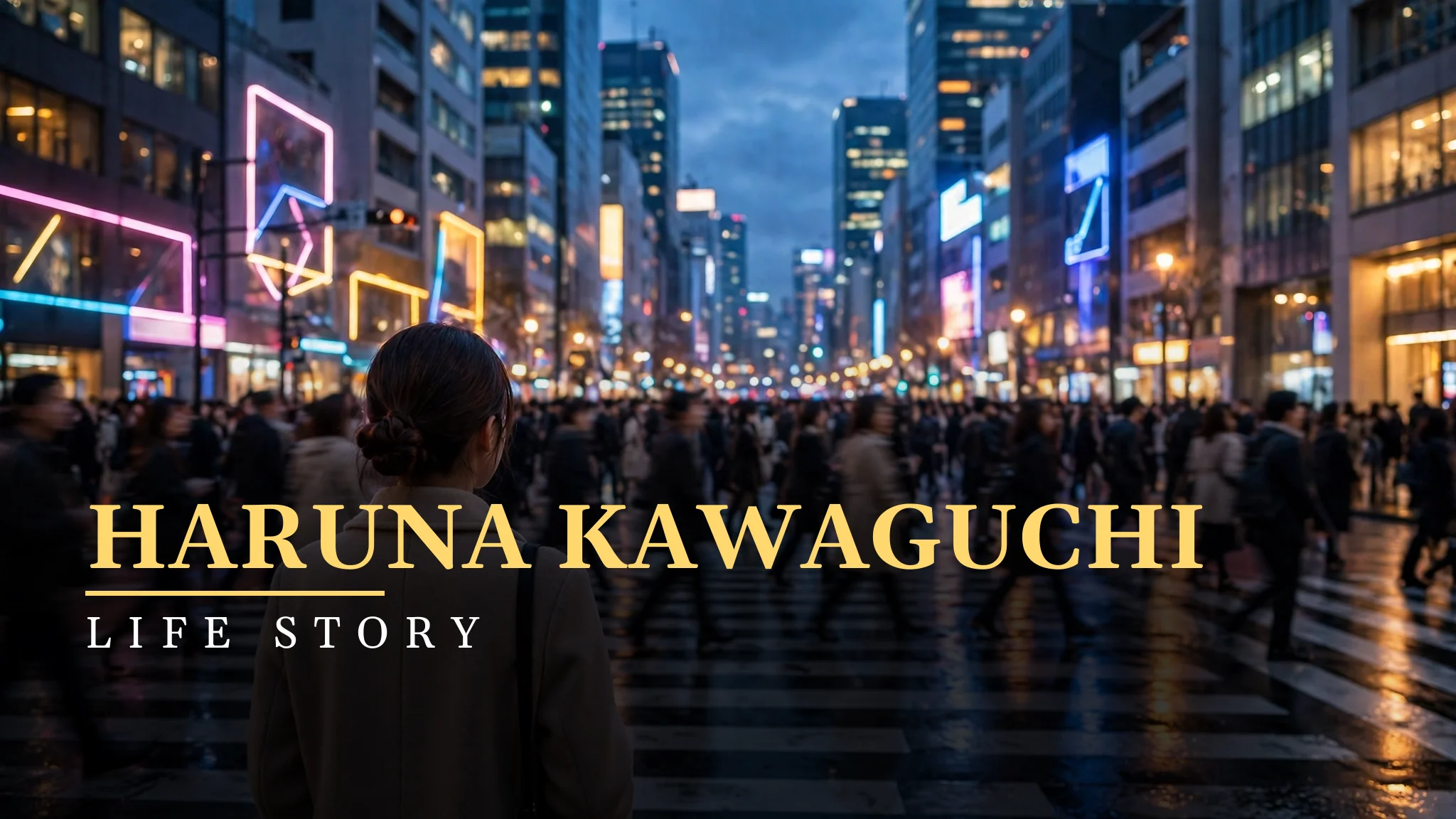
And I think about the neon crossing in her cover image, the woman in a beige coat standing at the edge of a busy Tokyo street at dusk, and I think it fits her. She is a person who stands calmly in the middle of a crowd, while the city rushes past her. She does not need to shout to be seen. She needs a good role, a good director, and a quiet day to do her work. I will keep watching for her next drama, and I will keep expecting it to be chosen with care, because that is what she has always done, from the Goto Islands to Tokyo to the world.
What surprises me most about Kawaguchi is how early she learned to be in front of a camera, and how calmly she carried that skill into acting. She modelled for Nicola as a young teenager, which means she learned to stand, to pose, and to face a lens when most girls her age were still learning to be comfortable in their own skin. That is not a small thing. A model must trust the photographer, must take direction, and must show feeling with only her face and her body, and Kawaguchi learned that before she ever spoke a line of dialogue. When I watch her in Silent, I see that training in the way she holds herself, in the way she lets the camera come close, and in the way she does not flinch from a long, quiet close-up. Modelling taught her to be seen, and acting taught her to be felt, and together they made her the star she is.
Frequently Asked Questions
Where was Haruna Kawaguchi born?
Haruna Kawaguchi was born on 10 February 1995 in Goto, Nagasaki Prefecture, Japan, on a group of islands far from Tokyo.
How did Haruna Kawaguchi start her career?
She started as a model for Nicola, a popular fashion magazine for teenage girls, before moving into television acting in small parts.
What was Haruna Kawaguchi’s first lead role?
Her first major lead was Haruhi Fujioka in Ouran High School Host Club in 2011, a television drama based on a popular manga.
What is Silent about?
Silent is a 2022 television drama in which Kawaguchi plays Tsumugi Aoba, a young woman who meets her first love again after learning he has lost most of his hearing.
Did Haruna Kawaguchi appear in GTO?
Yes, she appeared in the remake of GTO, the story about a former gang member who becomes a teacher, playing a student in the drama.
What kind of star is Haruna Kawaguchi known as?
She is known as a bright, natural, and reliable actress who has worked in many television dramas, films, and adverts across more than a decade.
Has Haruna Kawaguchi worked in films as well as television?
Yes, her film work includes The Kirishima Thing from 2012 and the film version of Ouran High School Host Club, alongside her many television dramas.


