Home Alone Filming Locations Today
In this post
- The House Everyone Recognises Is Real, but Private
- Why Most Interiors Were Filmed in a School Gym
- Winnetka Village: Streets, Parks, and the Santa Scene
- The Churches: Two Buildings for One Story
- Chicago, O’Hare, and the Paris Trick
- The Treehouse, the Airbnb Night, and What Changed
- How to Visit Today Without Disturbing Anyone
- What to Do Instead of Knocking on a Door
- My Take:
The House Everyone Recognises Is Real, but Private
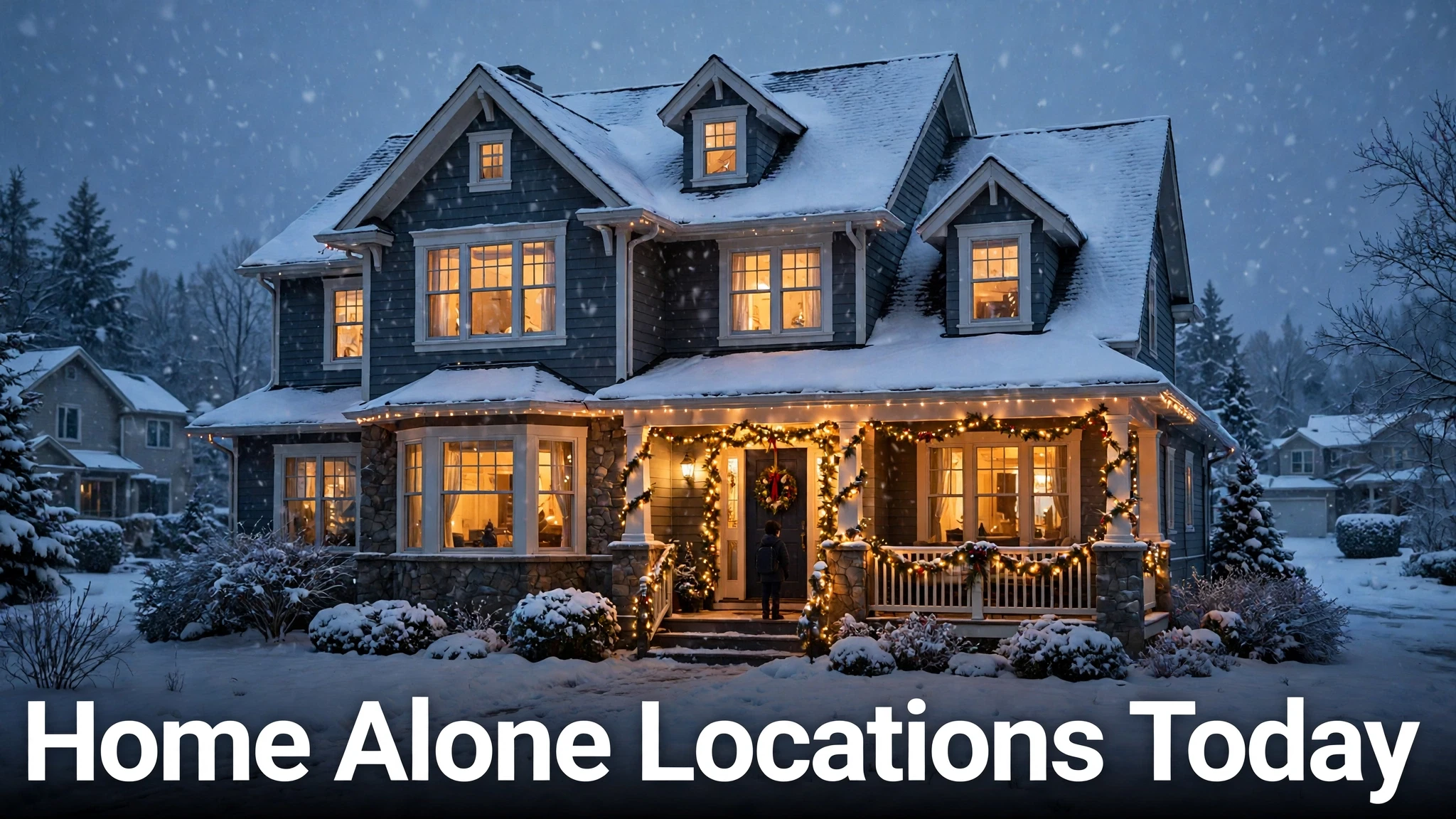
The McCallister house in Home Alone from 1990 is a real house, not a studio exterior built only for the film. Its exterior was filmed at 671 Lincoln Avenue in Winnetka, Illinois, a suburb north of Chicago. That address is widely reported in film-location guides, and the house itself is a red-brick Georgian-style home, built in the 1920s and later renovated. Fans recognise its front door, its driveway, and its overall shape instantly, because the film used the real exterior for key moments, including Kevin’s farewell wave, the burglars’ arrival, and the final family reunion. The house still stands today, and it still looks like the film house from the street, although renovation and landscaping have changed some details over time.
The most important fact for visitors is also the simplest: the house is a private family home, not a museum, not a tour stop, and not open to the public. Owners have lived there, sold the house, and lived there again since filming, and they are entitled to privacy. Film-location guides repeat this warning for a reason, because fans sometimes knock, enter driveways, or linger for long photographs. A respectful visit means viewing from the public street, taking a quick photograph if you wish, and moving on. Do not knock, do not enter the property, do not block the road, and do not treat the residents as part of the attraction. The film belongs to everyone; the house does not.
The house’s sale history also shows how fame changes a home without changing its address. Reports note that the house sold in 2012 for about 1.585 million dollars, after earlier ownership by the family who lived there during filming. Later renovation in 2018 expanded and updated the interior, while keeping recognisable exterior features. That renovation matters for fans who expect an exact replica of the film interior: the interior you imagine from the film was mostly not filmed inside this house, and the current interior reflects modern living, not a film set. The exterior is the film location; the interior is a private home that has moved on.
Why Most Interiors Were Filmed in a School Gym
One of the most surprising facts about Home Alone is that most of its interiors were not filmed inside the Winnetka house. The house was too small for a full film crew, cameras, lighting, and sound equipment, so director Chris Columbus and writer John Hughes built a two-storey set inside the gymnasium of New Trier Township High School in Winnetka. That set allowed the crew to control lighting, to move walls for camera angles, and to film traps safely, without damaging a real family home. The school’s west campus, which had been used for Hughes’s earlier films, provided the space and the practical base the production needed.
That decision explains several details fans notice on rewatching. The staircase, the kitchen, the living room, and Kevin’s bedroom feel larger and more open than a real house of that size, because they were built as a set, not found as rooms. The set also allowed repeated takes of slapstick scenes, such as paint cans, tar, and the famous iron, without destroying real furniture or endangering real residents. Filmmaking often uses this trick: a real exterior for recognition, and a built interior for control. Home Alone is a clear example, and it is why a visit to Winnetka cannot show you Kevin’s bedroom. That bedroom existed only as a temporary set, dismantled after filming.
Some interior shots were filmed in the real house, according to several location guides, including the main staircase and parts of the first-floor landing. Those exceptions are useful, because they show that the production mixed real and built spaces rather than choosing one or the other. The mix worked because audiences rarely notice the join. A front door from the real house, a staircase from a set, and a kitchen from a set can feel like one home when lighting, colour, and performance match. That seamless feeling is a filmmaking achievement, not a location trick to expose. It shows how carefully the production protected both the story and the real house.
Winnetka Village: Streets, Parks, and the Santa Scene
Winnetka itself is part of the film’s location story, not merely a backdrop for one house. The village, on Chicago’s North Shore, offers quiet streets, large trees, and a village centre that matched Hughes’s vision of a comfortable American suburb at Christmas. Kevin’s visit to Santa was filmed near the village centre, at Station Park in front of Winnetka Village Hall on Green Bay Road, according to location guides. That green, with its bandstand and village feel, gave the scene a public, festive quality that a studio set could not easily reproduce. A real village green, with real winter light, makes a child’s meeting with Santa feel ordinary and magical at once.
Hubbard Woods, one stop north of Winnetka, provided another key location: the green with the bandstand where Kevin shops for a toothbrush and encounters other village life. That location matters because it shows Kevin’s independence. He is not only trapped in a house; he moves through a real community, buys supplies, and learns to manage alone. Filming those scenes in real village locations, rather than on a backlot, gave Kevin’s journey a sense of scale. He walks real streets, crosses real spaces, and the audience believes his small adventure because the places look lived-in, not constructed for one scene.
Visitors who want to experience Winnetka should treat the village as a place, not as a film set. Walk the public streets, visit the village centre, and enjoy the architecture and lakefront character of the North Shore, but do not expect signs, plaques, or guided routes at every location. Winnetka is a residential community first, and its film fame is secondary. The best visit is a quiet walk, a photograph from a public street, and a meal or coffee in a local business, rather than a loud group tour that blocks pavements and driveways. Respect for residents is part of being a good film fan.
The Churches: Two Buildings for One Story
Home Alone uses two different churches for one story moment, a common filmmaking practice that surprises first-time location hunters. The exterior of the church Kevin visits was filmed at Trinity United Methodist Church in Wilmette, Illinois, at 1024 West Lake Avenue, according to location guides. The interior, with its choir, nativity scene, and emotional conversation between Kevin and his neighbour Marley, was filmed at Grace Episcopal Church in Oak Park, Illinois, at 924 Lake Street. Audiences see one church in the story, but filmmakers combined two real buildings to get the best exterior and the best interior for the scene.
That split matters for understanding film locations generally. A film location is often a collection of best parts, not a single perfect building. An exterior may offer the right shape, light, or street, while an interior may offer the right size, acoustics, or decoration. Editors join those parts so smoothly that viewers never notice. In Home Alone, the church scene works because both buildings share a traditional, warm character, and because Kevin’s emotional journey, from fear to forgiveness, carries the scene. The audience follows Kevin, not the architecture, and that focus hides the join.
Both churches are active places of worship, and visitors should treat them accordingly. Trinity in Wilmette and Grace in Oak Park are not film museums, and their primary purpose is worship and community life. If you visit, check service times, do not interrupt worship, and do not treat a service as a film tour. A quiet exterior photograph from a public street is usually acceptable, but entering during a service to recreate a film moment is not. The church scene’s message is about community and reconciliation; visiting respectfully honours that message better than any photograph.
Chicago, O’Hare, and the Paris Trick
Home Alone’s story involves a family flight to Paris, but most of the airport and travel scenes were filmed in Illinois, not in France. Chicago O’Hare International Airport provided the airport setting, and the production used Illinois locations to stand in for travel moments that the story places elsewhere. That choice was practical: filming a large family, a crew, and complex scenes at a real international airport in Chicago was easier and cheaper than moving the whole production to Paris for a few minutes of screen time. Audiences accept the trick because airport interiors look similar worldwide, and because the story’s focus is Kevin’s separation, not Parisian geography.
The sequel, Home Alone 2: Lost in New York, used New York locations more directly, including the Plaza Hotel, Central Park, and other Manhattan landmarks. That contrast helps explain why the first film feels suburban and the second feels urban. The first film’s locations are quiet, residential, and centred on one house. The second film’s locations are busy, public, and centred on a city. Fans who visit both sets of locations should expect different experiences: Winnetka offers a quiet residential walk, while New York offers busy public landmarks where photography is expected. Each film’s location strategy matches its story, and that matching is part of why both films work.
Other Illinois locations also appear in the first film, including nearby houses used for specific shots. Location guides note a neighbouring house at 656 Lincoln Avenue used for some exterior work, and other Chicago-area streets used for driving and neighbourhood scenes. Those details remind visitors that a film location is rarely one address. It is a network of streets, houses, schools, churches, and public spaces, chosen because together they create a believable world. A fan who only visits 671 Lincoln Avenue sees the most famous node in that network, but not the whole network. A fuller visit, by public streets and village centres, gives a better sense of how Hughes built his suburban world.
The Treehouse, the Airbnb Night, and What Changed
The backyard treehouse in Home Alone was a prop, built for the film and removed after production. Fans who visit the house today will not find Kevin’s treehouse, because it never existed as a permanent structure. That fact often disappoints visitors, but it also reveals a filmmaking truth: many beloved details are temporary constructions, designed to look permanent on screen. The treehouse looked real because it was built well, filmed carefully, and placed in a real backyard. Its removal after filming returned the garden to normal life, which is exactly what should happen after a film leaves a private home.
The house gained a second wave of fame in 2021, when it was offered for a one-night stay through Airbnb, as reported by several location and entertainment guides. That stay allowed a small number of fans to experience the house interior in a decorated, film-themed way, but it did not turn the house into a hotel or a public attraction. It was a limited promotion, tied to the film’s anniversary and to Airbnb’s marketing, and it ended. Visitors today should not expect to book the house, tour it, or stay there. The Airbnb night was an exception, not a new rule, and treating it as a permanent offer leads to disappointment and to unwanted enquiries to the owners.
Renovation also changed the house in ways that matter for photographs. The 2018 renovation expanded the home, updated its systems, and changed some interior and exterior details, while keeping the front facade recognisable. A photograph from the street today will still show the famous house, but it will not match every frame of the 1990 film exactly. Trees grow, paint changes, driveways are repaired, and neighbours build. A film freezes a place in one winter; real life continues. Fans who understand that difference enjoy the visit more, because they are seeing a living home that once hosted a film, not a museum frozen in 1990.
How to Visit Today Without Disturbing Anyone
The best way to visit Home Alone locations today starts with transport. Winnetka is reachable from downtown Chicago by Metra commuter train, with Winnetka station on the Union Pacific North line, followed by a short walk to Lincoln Avenue. That public-transport route is also the most respectful, because it avoids parking congestion on residential streets. If you drive, park legally, away from driveways, and do not block the road for photographs. A visit that creates traffic or noise for residents undermines the goodwill that allows fans to visit at all.
Timing also matters. Winter, especially December, brings the most visitors, because snow and Christmas lights match the film’s mood. That is also when residents most want privacy and quiet, because they are living their own Christmas. Visit in daylight, keep your group small, keep voices low, and limit your stay at the house itself to a few minutes. Spend more time in the village centre, in public parks, and in local businesses, where visitors are welcome, than outside a private home. A good film-location trip balances one famous photograph with a broader experience of the place.
Photography etiquette is simple: photograph from the public street, do not use drones over private property, do not enter gardens, and do not photograph residents, children, or car number plates. If a resident asks you to move on, do so politely. If you are visiting with children, use the moment to teach them about privacy: the house is someone’s home, and the film is a story, not permission to intrude. That lesson, taught at a famous house, lasts longer than any photograph, and it makes future film-location visits possible for everyone.
What to Do Instead of Knocking on a Door
If you cannot visit Winnetka, or if you want more than a street photograph, several alternatives give a fuller Home Alone experience. Watch the film with location notes, pausing at the house exterior, the church scene, and the village scenes, and noting which parts were real and which were sets. Read interviews with Chris Columbus about the school-gym set, which explain why the production chose that solution. Visit a local cinema screening in December, where the film’s community feeling is strongest. Those experiences respect the owners while still celebrating the film.
Chicago also offers broader film-location tours, including private tours that pass Lincoln Avenue and other Hughes locations, such as Ferris Bueller’s Day Off sites in nearby suburbs. A guided tour can be a better choice than an independent visit, because a guide manages timing, parking, and etiquette, and because the tour includes context about Hughes’s Chicago films as a group. Check the tour’s current itinerary before booking, because routes change, and confirm that the tour views the house from the street only. A responsible tour will state that rule clearly.
Finally, remember that Home Alone’s most important location is not an address, but a feeling: a child learning independence, a family learning togetherness, and a neighbourhood at Christmas. That feeling can be recreated at home, with a film night, a simple meal, and a conversation about what Kevin learns. A visit to Winnetka can deepen that feeling, but it cannot replace it. The film endures because its story works in any home, not because one house in Illinois is famous. Visit respectfully, if you visit at all, and let the story, not the address, be the main souvenir.
My Take:
My view is that the Winnetka house should be visited rarely, briefly, and quietly, or not at all. I understand the pull: standing where a beloved film was made feels like stepping into childhood. But a private home is not a theme park, and the owners did not agree to become a permanent attraction when they bought a house. If every fan who loved the film visited, knocked, and lingered, the house would become unlivable. Loving a film should include respecting the people who happen to live in its most famous location. That respect is part of being a fan, not an extra rule imposed on fans.
I also think the school-gym set is the most interesting part of this story, and it deserves more attention than the address. Building a two-storey house inside a gym, so that a crew could film traps, lighting, and camera moves safely, is a brilliant practical solution. It shows that filmmaking is problem-solving, not magic. Young viewers who learn about the gym set learn that films are made by people making choices under constraints, and that lesson is more valuable than memorising an address. I would rather a child remember the gym set than remember a house number.
My ranking of Home Alone locations to experience is: first, the village centre and public streets of Winnetka, because they are public and welcoming; second, the church exteriors viewed from the street, because they are beautiful and active community buildings; third, the house exterior from the street, briefly, because it is famous but private. That order reverses the usual fan priority, which puts the house first and everything else second. I reverse it deliberately, because public places deserve first attention, and private places deserve last, brief attention. A visit built that way still satisfies curiosity, but it does not centre intrusion.
I am also sceptical about the Airbnb night, even though I understand its appeal. A one-night promotion turns a private home into a product for a night, and it creates an expectation that the home is bookable. That expectation then falls on later owners, who never agreed to it. Promotions like that benefit a brand and a few lucky fans, but they burden residents for years, as fans keep asking whether the house is available. I would prefer film promotions that use public venues, such as a cinema, a museum, or a recreated set, rather than a real family’s home. A recreated set can be toured, photographed, and enjoyed without disturbing anyone.
I think the church split is also a useful lesson for film fans: do not assume one building equals one story location. Films combine best parts from many places, and that combination is a craft, not a deception. When fans learn that the church exterior and interior came from different towns, they stop hunting for a single perfect church and start appreciating editing, lighting, and performance. That appreciation makes rewatching richer. You notice the choir, the light, and Kevin’s face, rather than wondering whether the building matches a photograph. Story should lead location hunting, not the other way round.
Finally, I believe the best Home Alone pilgrimage is at home, not in Illinois. Watch the film with someone who has never seen it, explain the gym set during a pause, talk about Kevin’s loneliness as well as his cleverness, and notice how the film balances comedy and sadness. That shared viewing recreates the film’s core: family, independence, and return. A trip to Winnetka can add a photograph, but it cannot add that core. If you do travel, go quietly, stay briefly, spend money in local businesses, and leave the street as you found it. That is the fan behaviour the film itself would endorse: clever, kind, and aware of other people.
I would also warn against the growing habit of filming a visit for social media outside a private home. A short photograph for personal memory is one thing; a staged video, with music, narration, and a performance on someone else’s street, is another. The second turns a residential street into a set, and residents into unwilling background actors. If you must share a visit, share one still photograph, taken quickly, without naming the exact house number in a caption that encourages others to knock. Fame already brings visitors; social media should not add a louder, more intrusive layer to that fame.
Another practical point is winter safety in Winnetka. December streets can be icy, daylight is short, and a visitor focused on a phone can slip, step into traffic, or block a pavement. Wear proper shoes, keep to pavements, and do not cross private driveways to get a better angle. A film-location visit that ends with a fall or a confrontation is not a good memory, and it is easily avoided by treating the visit as a walk, not as a photoshoot. The film’s winter setting is charming on screen; real winter requires care, especially for children and older visitors.
I also think local businesses deserve more attention in film-location guides. Winnetka’s cafes, shops, and village centre are where visitors are genuinely welcome, and spending there supports the community that hosts the famous house. A visit that only photographs a house and leaves gives nothing back, while a visit that includes a meal, a bookshop, or a local market contributes to the place. Film tourism works best when it is also local tourism: visitors enjoy a town, not only a single address, and residents see visitors as customers and guests, not only as crowds outside a home.
Finally, I would suggest a simple test before any film-location trip: would you want this visit outside your own home? If a group of strangers photographed your house daily, knocked to ask about a film, and filmed videos on your street, would you welcome it? If the answer is no, then limit your own visit accordingly. That empathy test is more useful than any list of rules, because it applies to every famous house, not only Home Alone. Fans who pass that test become welcome visitors; fans who fail it become a reason for residents to fence, complain, or move. The film’s message is about family and home, and respecting real homes is the most direct way to honour it.
Frequently Asked Questions
Where is the Home Alone house located today?
The Home Alone house exterior was filmed at 671 Lincoln Avenue in Winnetka, Illinois, north of Chicago. The house still stands today, but it is a private family home, not open to tours or visitors, so any viewing should be brief and from the public street only.
Was Home Alone filmed inside the real Winnetka house?
Most interiors were not filmed inside the real house. The production built a two-storey set inside the gymnasium of New Trier Township High School in Winnetka, because the real house was too small for a full crew. Some shots, such as parts of the staircase and landing, were filmed in the real house.
Which churches were used for the Home Alone church scene?
The church exterior was filmed at Trinity United Methodist Church in Wilmette, Illinois, and the church interior was filmed at Grace Episcopal Church in Oak Park, Illinois. The film combines those two real buildings into one story church, so visitors should not expect a single church to match every shot.
Can you visit the Home Alone house in Winnetka in 2026?
You can view the house from the public street, but you cannot tour it, enter the property, or knock on the door, because it is a private home. The best respectful visit is a short street photograph, a walk in Winnetka village centre, and time in local businesses, rather than a long stay outside the house.
Is the Home Alone treehouse still in the backyard today?
No. The treehouse was a temporary prop built for filming and removed after production. Visitors today will not find it in the backyard, and they should not enter the garden to look for it.
How do you get to the Home Alone house from Chicago by public transport?
Take a Metra commuter train from downtown Chicago to Winnetka station, then walk a short distance to Lincoln Avenue. Public transport avoids parking congestion on residential streets and is the most respectful way to visit a quiet suburb.