How Ancient Egyptians Built the Pyramids
In this post
The Great Pyramid of Giza is the oldest of the Seven Wonders of the Ancient World and the only one still standing largely intact. It was built around 2560 BCE, during the reign of Pharaoh Khufu, from an estimated 2.3 million stone blocks, some weighing several tonnes, rising to an original height of about 147 metres. For centuries, people have asked how a Bronze Age society, without iron tools, wheels for heavy transport in the modern sense, or cranes, achieved such precision. The answer, built from archaeology, experiments, and ancient texts, is not aliens, lost technology, or slave armies in the Hollywood sense. It is skilled labour, organisation, river transport, ramps, levers, and a society that could mobilise thousands of seasonal workers over decades.
That answer is less sensational than alien theories, but more impressive. The Egyptians did not have a single secret trick. They had a system: quarries near the site, a harbour on the Nile, a workforce of farmers during the flood season, a bureaucracy that recorded food, tools, and teams, and engineers who understood levelling, alignment, and geometry with remarkable accuracy. The Great Pyramid is aligned to true north with an error of only a fraction of a degree, and its base is level to within a few centimetres across 230 metres. Those achievements came from careful measurement, not magic, and they can be explained, step by step, from evidence.
Who Built the Pyramids: Workers, Not Only Slaves
The popular image of slaves whipped while dragging stones comes largely from later Greek writers and from films, not from Egyptian evidence. Archaeology now paints a different picture. Excavations near Giza have found workers’ villages, bakeries, breweries, and cemeteries. The workers buried near the pyramids include people with healed injuries, medical care, and decent burials, which suggests they were valued labourers, not disposable slaves. Inscriptions show work gangs with names, such as “Friends of Khufu,” organised into teams, with overseers and records. Some workers were skilled craftsmen, stonemasons, carpenters, and engineers, employed year-round. Others were farmers, called up during the annual Nile flood, when fields were underwater and farm work paused, to work on state projects in return for food, housing, and status.
Slavery existed in ancient Egypt, but the pyramid workforce was not primarily enslaved foreigners. It was a mix of skilled workers, seasonal labourers, and conscripted Egyptians performing a form of state service, similar to corvee labour in other ancient societies. That distinction matters, because it changes the moral story. The pyramids were not built solely by cruelty, though ancient labour was hard and dangerous by modern standards, and workers certainly suffered injuries and deaths. They were built by a society that organised labour on a large scale, fed its workers, and treated the project as a national, religious undertaking: building a tomb that would ensure the pharaoh’s afterlife and, by extension, cosmic order.
Estimates of workforce size vary. Older popular accounts claimed 100,000 workers. Modern estimates, based on the workers’ village size and the construction rate, suggest a core workforce of perhaps 10,000 to 20,000, with seasonal peaks higher, over a period of about 20 to 30 years for the Great Pyramid. That is still a huge undertaking, but it is a manageable one for a state that controlled the Nile valley’s agriculture and could store and distribute grain. The key resource was not only muscle, but food logistics: bread, beer, fish, meat, and vegetables for thousands of workers, every day, for years. The bakeries and breweries found at Giza are therefore as important as the stones themselves; without them, no pyramid could rise.
Quarrying Stone: Local Limestone, Granite, and Transport
Most of the Great Pyramid’s core blocks are local limestone, quarried from the Giza plateau itself, close to the building site. That proximity saved enormous transport effort. Quarry marks show how workers cut blocks: they hammered wooden wedges into slots, wet them so the wood expanded and split the rock, or used copper chisels and stone pounders to cut channels. Copper is soft by modern standards, but with abrasives such as sand, and with patience, it can cut limestone. Harder stones, such as granite for the King’s Chamber, came from Aswan, about 800 kilometres up the Nile, and were transported by boat. That long-distance transport is one of the most impressive logistical feats of the project.
The outer casing stones, now mostly removed, were fine white limestone from Tura, across the Nile, which gave the pyramid a smooth, gleaming surface in sunlight. Some casing stones remain at the base, showing the precision of the joints. The pyramidion, the capstone, may have been gilded or made of polished stone, though the original is lost. The variety of stones, local core, Tura casing, Aswan granite, shows a supply chain with different quarries for different purposes, managed by a central administration that could coordinate boats, crews, and seasons.
Transport by water was essential. The Nile, during flood season, came much closer to Giza than it does today, and archaeologists have found evidence of a harbour and canals near the pyramid site. A papyrus diary, known as the Diary of Merer, written by an official involved in transporting limestone from Tura to Giza during Khufu’s reign, describes boats, crews, and schedules in detail. It is a direct, contemporary record, not a later legend, and it confirms that stone moved by boat, not only by land. Once at the harbour, blocks were hauled a short distance to the site on sledges, possibly over wet sand or prepared tracks, which reduces friction. Experiments have shown that wetting sand in front of a sledge can roughly halve the force needed to pull it, because water binds sand grains and creates a firmer surface.
Ramps, Levers, and Raising the Blocks
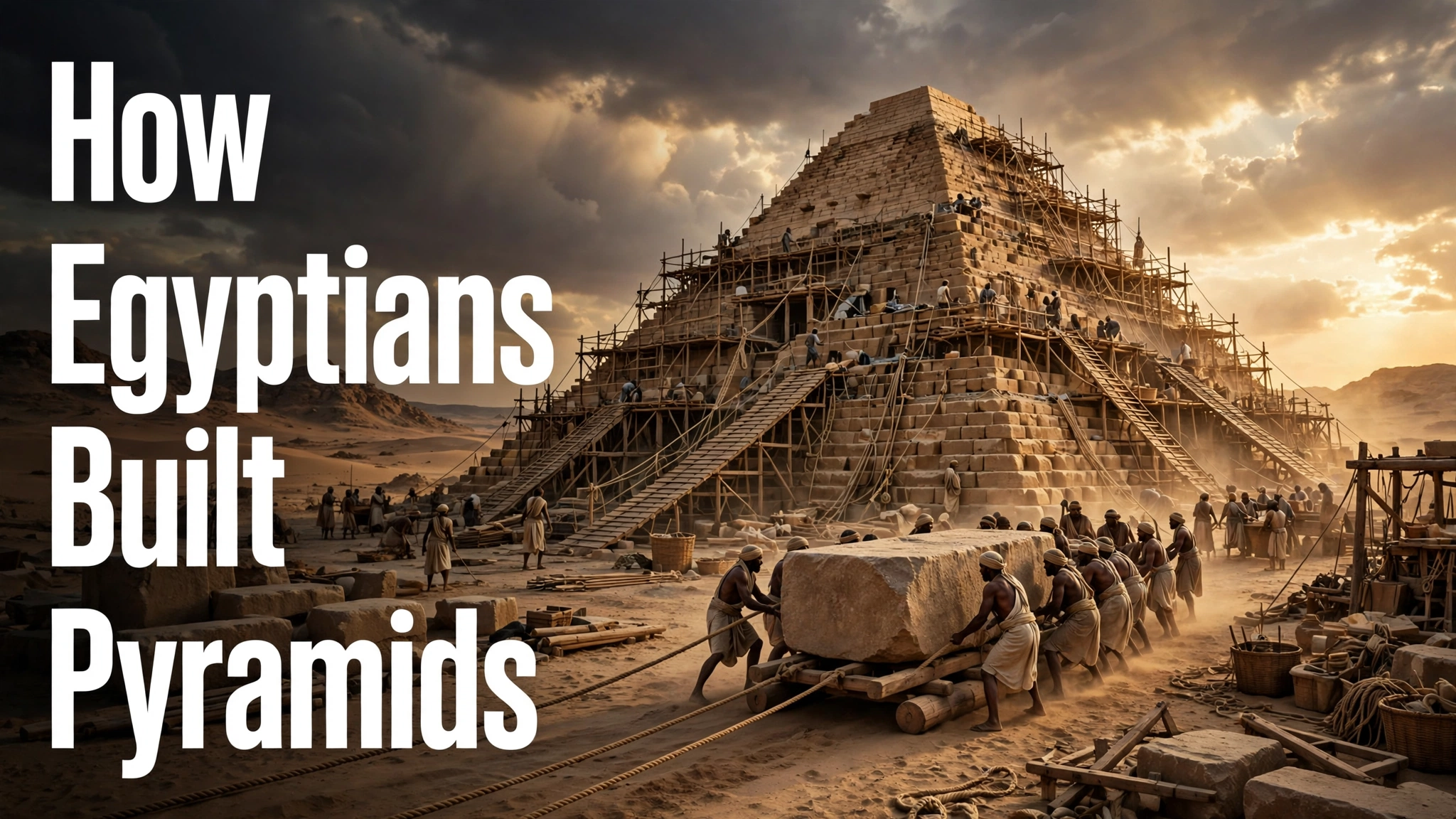
Raising millions of blocks to heights over 100 metres is the central engineering puzzle. No single ramp design is proven for the Great Pyramid, and several theories exist, each with strengths and weaknesses. The most widely discussed include a long straight ramp, a zigzag ramp wrapping around the pyramid, a spiral ramp hugging the sides, and internal ramps inside the pyramid itself. A straight ramp to the top would need to be enormously long and would require more material than the pyramid itself, which makes it unlikely in that simple form. A spiral or zigzag ramp uses less material but makes turning corners with heavy blocks difficult. An internal ramp, proposed by architect Jean-Pierre Houdin, suggests a ramp inside the pyramid’s structure, leaving no external trace, which explains the absence of ramp remains, but it is difficult to prove without invasive investigation.
The honest position is that Egyptians likely used a combination: external ramps for lower levels, levers and smaller ramps for upper levels, and possibly a ramp system that was dismantled as the pyramid rose, with its material reused in the structure. Evidence for ramps exists at other sites, including a ramp system discovered at Hatnub quarry, dating to a later period, with steps, postholes for ropes, and a steep incline, showing that Egyptians did use ramps with pulley-like rope systems. Levers, wooden beams, and manpower could lift a block a short distance at a time, resetting the lever repeatedly. That method is slow, but for a project lasting decades, slowness is acceptable. Precision came from levelling: workers used water-filled trenches or sighting tools to keep courses level, and they checked alignment against the stars, particularly the North Star of the time, Thuban, and against the sun’s shadow.
Another key technique was the use of the pyramid’s own stepped structure. The core was built in steps, like a staircase, which were then filled and cased to create smooth sides. That stepped core made it easier to work at each level, with a platform for workers and a place to stand while placing the next course. The casing was added from the top down, after the core was complete, so that the smooth surface was finished last and scaffolding could be removed progressively. That sequence, core first, casing top-down, is supported by remaining casing at the base and by the structure of other pyramids.
Inside the Pyramid: Chambers, Passages, and Precision
The interior of the Great Pyramid is as remarkable as its exterior. It contains the King’s Chamber, with granite beams weighing tens of tonnes, the Queen’s Chamber, the Grand Gallery, a tall, corbelled passage, and ascending and descending passages. The Grand Gallery, about 47 metres long and 8.6 metres high, with corbelled walls that step inward, is an engineering achievement in its own right, designed to distribute weight and to hold blocking stones that sealed the burial chamber. Above the King’s Chamber are five relieving chambers, small spaces with granite beams, designed to divert the weight of the pyramid above away from the chamber ceiling. That design shows an understanding of load, even without modern structural theory.
The precision of the interior is striking. The King’s Chamber is level, its walls are flat, and its granite blocks fit tightly. The passages are straight over long distances, with an accuracy that required careful surveying. How did Egyptians achieve this without lasers or modern theodolites? They used simple tools well: plumb bobs for vertical, water levels for horizontal, sighting rods for straight lines, and astronomy for orientation. They also used trial, error, and correction: earlier pyramids, such as the Step Pyramid of Djoser, the Bent Pyramid, and the Red Pyramid, show a learning curve, with mistakes, collapses, and design changes that taught engineers what worked. The Great Pyramid was not the first attempt; it was the culmination of a century of pyramid building, with each project refining the previous one.
The purpose of the interior was religious: to protect the pharaoh’s body and goods for the afterlife, and to provide a passage for his soul to ascend. Grave goods, though looted in antiquity, would have included furniture, food, and ritual objects. The pyramid was part of a larger complex, including a mortuary temple, a causeway, a valley temple, and smaller pyramids for queens, forming a ritual landscape, not an isolated tomb. Understanding that context helps explain the investment: the pyramid was not a vanity project alone, but the centre of a state religion that linked the pharaoh, the gods, and the fertility of the Nile.
Why Alien Theories Fail and What Evidence Shows
Alien and lost-technology theories about the pyramids fail on evidence, not only on plausibility. They claim Egyptians could not have cut granite, moved large blocks, or aligned the pyramid, yet archaeology shows they did all three at other sites, with tools and methods that are documented. Copper saws with sand abrasive can cut granite, slowly but effectively. Sledges on wet sand can move large blocks with a feasible number of workers, as experiments have demonstrated. Alignment to true north can be achieved by observing stars, as Egyptians did for temples and other structures. No alien artefact, no advanced metal, no unexplained material has been found in or around the pyramids. The tools found are stone, copper, wood, and rope, exactly what a Bronze Age society would use.
The appeal of alien theories often reflects a modern bias: because we cannot imagine doing this work without machines, we assume ancient people could not either. That underestimates human organisation, patience, and skill. A team of workers, given decades, food, and a clear plan, can achieve what seems impossible to an individual in a weekend. The pyramids are proof of that, not proof of outside help. Attributing them to aliens also erases Egyptian achievement, which is a form of disrespect, however unintended. The Egyptians left records, tools, villages, and a learning curve of earlier pyramids. Those records deserve more attention than speculation about visitors from space.
There are still open questions. The exact ramp system for the Great Pyramid is not proven. The full logistics of granite transport, the precise method for placing the largest beams, and the details of workforce organisation are still debated. Those gaps are normal in archaeology, where evidence is fragmentary, and they invite further research, not invention. New technologies, such as muon scanning, which detects voids by measuring cosmic rays, have revealed a large void above the Grand Gallery, known as the Big Void, whose purpose is still unknown. That discovery shows that the pyramid still holds secrets, but secrets that can be investigated with science, not secrets that require abandoning science.
Preservation, Tourism, and What Remains to Learn
The pyramids face modern threats that ancient builders never imagined: air pollution, groundwater, tourism pressure, and urban growth from nearby Cairo. Millions of visitors each year walk around, and sometimes climb, structures that were designed as tombs, not tourist attractions. Conservation work includes monitoring cracks, controlling humidity inside chambers, stabilising casing stones, and managing visitor numbers in the most fragile interior passages. The Giza plateau is a UNESCO World Heritage Site, and Egyptian authorities, together with international teams, balance access, research, and preservation, a balance that is never perfect and always contested. Visitors can help by following rules, not climbing, not touching carvings, and hiring licensed guides who explain context rather than only offering photographs.
Research continues to add detail. The Diary of Merer, discovered in the Red Sea port of Wadi al-Jarf and published in modern times, gave a contemporary voice to logistics that were previously inferred. Muon scanning, which uses cosmic rays to image dense structures, revealed the Big Void above the Grand Gallery, a large empty space whose function is still debated: it could be a construction feature, a relieving chamber, or an undiscovered passage. Further non-invasive scanning, sediment analysis, and study of workers’ settlements will likely refine, but not overturn, the human explanation. The pyramids still hold questions, but those questions are now sharper than they were a generation ago, because they are asked with better evidence, not with speculation. That progress, slow and cumulative, is how archaeology works, and it is why the human story of the pyramids grows more detailed every decade.
My Take:
My view is that the pyramids are more impressive when you accept the human explanation, not less. An alien theory makes the pyramid a product of someone else’s technology, which is ultimately boring: if advanced visitors built it, then it tells us nothing about humans except that we were helped. A human explanation makes it a product of organisation, patience, and learning over generations, which tells us everything about what humans can do when they coordinate. That is a far more hopeful story. It says that a society without iron, without cranes, without computers, could still achieve millimetre precision over 230 metres, feed thousands of workers, and sustain a project for decades. If they could do that, what could a modern society do if it coordinated as well, for a purpose as clear, and with as much patience? The pyramid is not only a tomb; it is a challenge to our own short attention spans.
I also think the worker villages change the moral story in a useful way. The old slave image made the pyramids easy to condemn and easy to dismiss: a cruel tyrant, whipped slaves, a monument to oppression. The newer picture is more complex: skilled workers, seasonal farmers, decent burials, medical care, and a religious project that many participants may have believed in. That does not make ancient Egypt a just society by modern standards; it was hierarchical, unequal, and hard. But it does make the pyramid builders human, not caricatures. They were people with names, gangs, bread, beer, injuries, and pride in their work. Remembering that complexity is important, because it prevents us from using history as a simple morality play. Real societies are mixed, and their achievements are mixed too.
There is a lesson here about expertise and time. Modern projects often fail because they are rushed, underfunded, or constantly redesigned. The pyramid project succeeded, in its own terms, because it had a stable design, a long timeline, and a state that could sustain logistics. That stability came at a cost: a society organised around a single, massive religious project may have neglected other needs, and later pyramids became smaller as resources and priorities changed. That decline is also instructive. No project, however grand, is sustainable forever, and the end of large pyramid building does not mean Egyptian civilisation collapsed; it adapted, built temples and tombs in other forms, and continued for millennia. The pyramid age was a phase, not the whole of Egypt, and recognising phases helps us avoid the trap of judging a civilisation by its most famous monument alone.
Finally, I think visiting or studying the pyramids should inspire humility, not only awe. Stand at the base, look up, and consider the labour: each block placed by hands, each course levelled by eye, each chamber designed to bear weight for millennia. That labour was not performed by a single genius, but by thousands of people whose names, except for gang names, are mostly lost. Their anonymity is part of the monument’s power. It reminds us that most great human achievements are collective, and that the people who build them are often forgotten while the ruler’s name survives. If we remember the workers, the bakers, the boatmen, and the surveyors, as well as Khufu, we honour the pyramid more fully. And if we carry that habit into the present, noticing the workers behind modern wonders, bridges, hospitals, and networks, we will live in a fairer story than the one that credits only kings, or only aliens, for what many hands built.
I also want to be clear about what remains unknown, because honesty about gaps is what separates history from myth. We do not know the exact ramp, we do not know every detail of granite placement, and we may never know them, because ramps were dismantled and records are incomplete. That uncertainty does not justify inventing a secret technology; it justifies more research, more experiments, and more patience. The Big Void, the Diary of Merer, and the workers’ villages were all discovered by patient work, not by speculation. The next discovery will likely come the same way. So the best attitude toward the pyramids is not “we will never know,” nor “aliens did it,” but “we know a great deal, we are learning more, and what we know already is extraordinary enough.”
There is also a point about scale and time that modern readers often miss. A project lasting twenty or thirty years means that many workers spent their entire working lives on a single pyramid, and some were born after it began and died before it finished. That generational timescale changes how we should imagine motivation. It was not a short burst of enthusiasm, but a sustained, institutional commitment, passed from one crew to the next, with knowledge transferred through apprenticeship. Modern projects rarely sustain that continuity, because funding, leadership, and priorities change. The Egyptians sustained it through religion, state organisation, and a stable agricultural surplus. Whether we admire or criticise that system, we should recognise what it required: not only engineering skill, but social continuity, record-keeping, and a shared belief that the work mattered beyond a single lifetime. That continuity is, in its own way, as impressive as the stones.
A final reflection concerns what we owe the workers whose names are lost. History remembers Khufu, but it largely forgets the quarrymen, boatmen, bakers, and surveyors who made his tomb possible, except through gang names and a few records. That forgetting is not unique to Egypt; it happens for almost every large project, ancient and modern, where credit concentrates at the top and labour disappears into the structure. Remembering the workers is not only fair, it is accurate, because without them there would be no pyramid to admire. When you next see a photograph of Giza, try to imagine not only the pharaoh, but the team that levelled the base, the crew that hauled the block, and the baker who fed them. That imagination does not diminish the monument; it completes it, by restoring the people to the stone they shaped, and by reminding us that every wonder we admire was built by hands like our own.
One more lesson is about learning from earlier attempts. The Great Pyramid did not emerge fully formed; it followed the Step Pyramid, the Bent Pyramid, which changed angle midway, possibly because of stability problems, and the Red Pyramid, which applied those lessons. That sequence, try, fail partly, adjust, succeed, is the normal path of engineering, and it is worth remembering whenever a modern project fails. Failure is not proof that a goal is impossible; it is often the step that teaches how to succeed. The Egyptians did not hide their Bent Pyramid or pretend it was perfect; they built on it, literally and figuratively. Modern teams that hide failures, or abandon a goal after one setback, could learn from that openness to iteration, which turned a bent pyramid into a masterpiece within a single century.
Frequently Asked Questions
How long did it take to build the Great Pyramid? Estimates suggest about 20 to 30 years, during Khufu’s reign around 2560 BCE, with a workforce of perhaps 10,000 to 20,000 core workers, plus seasonal labourers.
Who built the pyramids, slaves or workers? Mainly skilled workers and seasonal Egyptian labourers, organised in gangs and fed by the state, not primarily enslaved foreigners. Workers’ villages, bakeries, and cemeteries support this picture.
How were heavy stones moved? Most core stone was quarried nearby. Granite and casing stone were transported by boat on the Nile, then hauled on sledges, possibly over wet sand, and raised with ramps, levers, and manpower.
What ramp did Egyptians use for the Great Pyramid? No single ramp is proven. Theories include straight, zigzag, spiral, and internal ramps, and a combination is likely. Ramps found at other sites confirm Egyptians used ramp systems.
How did Egyptians align the pyramid so precisely? They used astronomy, observing stars and the sun, plus plumb bobs, water levels, and sighting tools. The Great Pyramid aligns to true north within a fraction of a degree.
Why were pyramids built? As tombs and ritual complexes for pharaohs, ensuring their afterlife and cosmic order, and as displays of state power, organisation, and religious belief.