How Do Caves Form in the Underground World
In this post
- The main recipe: water, limestone, and time
- Stalactites, stalagmites, and cave decorations
- Other kinds of caves: lava, ice, sea, and more
- Underground rivers, lakes, and sinkholes
- Life in the dark: troglobites and cave ecosystems
- Caves as archives: climate, history, and human past
- Visiting caves safely and protecting them
- My Take:
Beneath our feet, in darkness that sunlight never reaches, lies a world of chambers, rivers, and stone sculptures that took thousands or millions of years to form. Caves are not simply holes in the ground; they are landscapes in their own right, carved by water, fire, ice, and time, and they shelter some of the most specialised life on Earth. Some caves are vast enough to hold cathedrals, others are narrow passages that only a caver can squeeze through, and some have never been fully explored at all.
This guide explains how caves form in the underground world, why limestone caves are the most common and spectacular, how other types of caves form in lava, ice, and sea cliffs, what grows inside them, and what lives in their darkness. It also looks at how caves record past climates, why they must be protected, and how to visit them safely.
The main recipe: water, limestone, and time
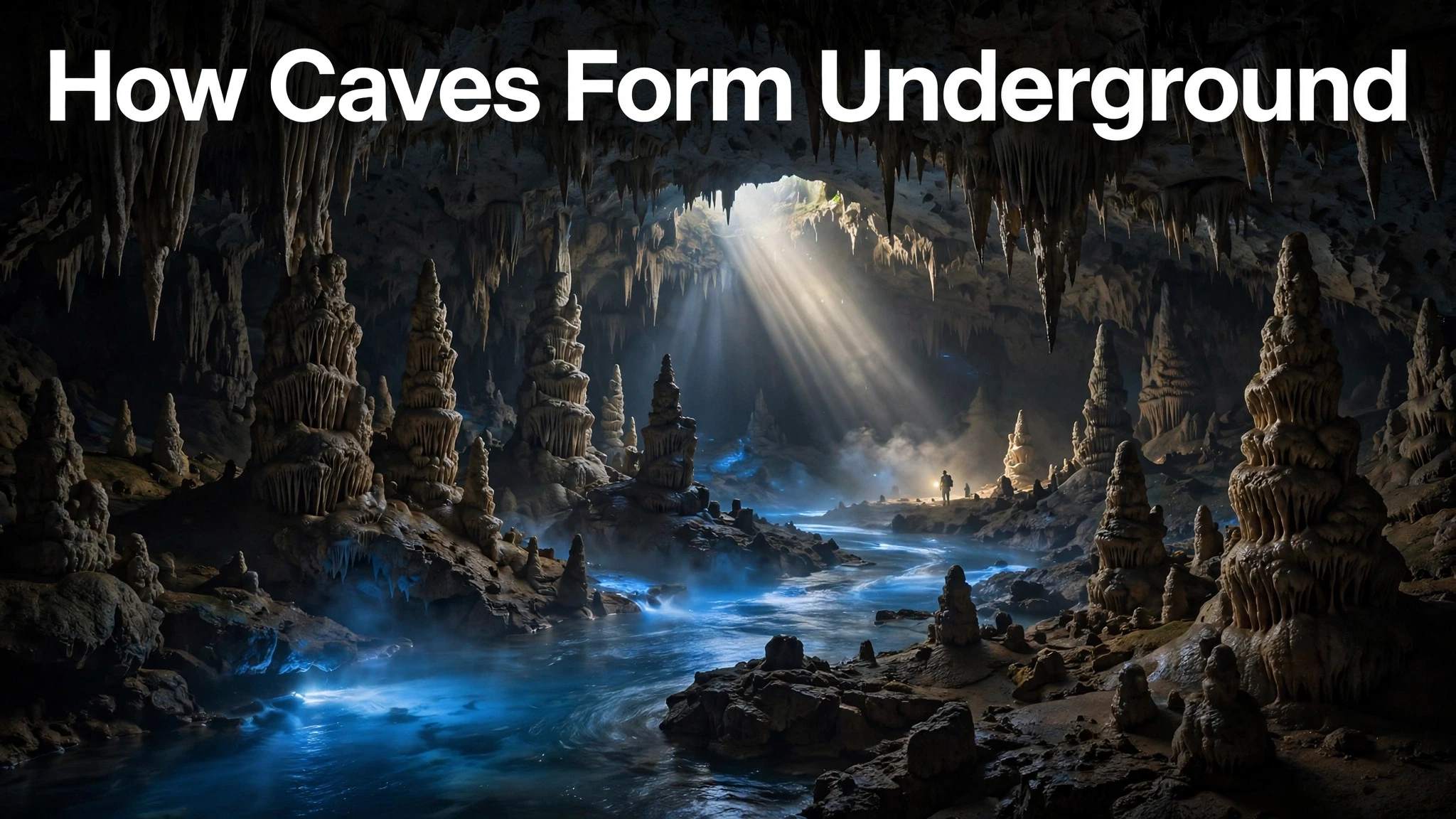
Most of the world’s largest and most decorated caves form in limestone, a rock made mainly of calcium carbonate, laid down in ancient seas from shells and coral. Rainwater absorbs carbon dioxide from the air and from soil as it falls and seeps downward, becoming a weak carbonic acid. That slightly acidic water is not strong enough to harm your skin, but over thousands of years it can dissolve limestone along cracks, joints, and bedding planes, widening them slowly into passages, chambers, and underground rivers.
The process is slow at first, because water must find a route through the rock, but once a passage opens, more water flows through it, dissolving more rock, and the passage grows faster, a positive feedback that can create extensive cave systems over hundreds of thousands of years. The water table, the level below which rock is saturated with water, plays a key role: caves often form at or near the water table, where water flows horizontally, and when the water table drops, perhaps because a river valley deepens, the upper passages drain and become air-filled caves that people can explore, while new passages form lower down.
Not all limestone is equally soluble, and not all water is equally acidic. Soil rich in organic matter produces more carbon dioxide, making seepage more acidic and dissolution faster. Fractured rock dissolves faster than massive, unfractured rock, because water has more surfaces to attack. And climate matters: wetter regions with abundant rainfall and vegetation tend to develop more extensive karst landscapes, the term for terrain shaped by dissolving rock, with sinkholes, disappearing streams, and caves, than dry regions, although caves can form in surprisingly arid places where water once flowed more abundantly.
Stalactites, stalagmites, and cave decorations
Once a cave passage drains and becomes air-filled, a second process begins: decoration. Water still seeps through the ceiling, carrying dissolved calcium carbonate, and when it reaches the cave air, it loses carbon dioxide and deposits tiny amounts of calcite. Drop by drop, over centuries, those deposits build stalactites, which hang down from the ceiling, and stalagmites, which grow up from the floor where drips land. When a stalactite and stalagmite meet, they form a column, and over still longer times, columns can merge into massive formations.
The old mnemonic helps: stalactites hold on tight to the ceiling, stalagmites might reach the ceiling one day. Growth rates vary enormously, from less than a millimetre per year in dry caves to several millimetres per year in wet, active caves, but even fast-growing formations are slow by human standards. A stalactite a metre long may have taken thousands of years to grow, and breaking one, as careless visitors sometimes do, destroys in seconds what nature built over millennia. That is why show caves protect formations with paths, barriers, and rules against touching.
Other decorations include flowstone, sheets of calcite deposited where water flows over walls or floors, draperies or curtains, thin, wavy sheets hanging from ceilings, and helictites, strange, twisting formations that seem to defy gravity, growing in odd directions because of capillary forces and air currents. Cave pearls, small, rounded calcite balls formed in shallow pools where dripping water coats a grain of sand, are another curiosity. Together, these speleothems, the scientific term for cave deposits, make limestone caves among the most beautiful natural environments on Earth, and they also record past climates in their growth layers, like tree rings in stone.
Other kinds of caves: lava, ice, sea, and more
Limestone solution caves are the most famous, but they are not the only kind. Lava tubes form when a river of molten lava flows and its outer surface cools and solidifies into a crust, while the hot lava inside continues to flow and eventually drains away, leaving a tunnel. Lava tubes can be kilometres long, with smooth walls, skylights where the roof has collapsed, and a distinctive ropy texture. They are found in volcanic regions such as Hawaii, Iceland, and the Canary Islands, and scientists study them as analogues for possible lava tube shelters on the Moon and Mars, where astronauts might one day shelter from radiation and temperature extremes.
Sea caves form where waves erode cliffs, exploiting cracks and weaker rock, and over time carving arches, stacks, and caves at the base of cliffs. They are usually shorter and less decorated than limestone caves, but they can be spectacular, with light reflecting off water onto their walls, and they provide nesting sites for seabirds and shelter for seals. Ice caves form in glaciers, where meltwater carves tunnels and chambers inside the ice, often with blue, translucent walls, but they are temporary, changing with each melt season and collapsing as the glacier moves.
Other cave types include sandstone caves, formed by erosion and weathering, talus caves, formed by gaps between fallen boulders, and tectonic caves, formed when rock masses shift and open fractures. Each type has its own formation process, timescale, and ecology, but all share one feature: they are environments where light, temperature, and humidity differ sharply from the surface, creating refuges for specialised life and archives of past conditions that surface environments rarely preserve.
Underground rivers, lakes, and sinkholes
Caves are closely linked to surface landscapes through water. In karst regions, rain does not always form surface rivers; instead, it sinks into cracks and sinkholes, disappearing underground to become a cave stream, and may re-emerge kilometres away at a spring. That disappearing act can confuse walkers, who see a stream vanish into the ground, and it has practical consequences: pollutants spilled on the surface in a karst area can travel rapidly through caves to a drinking water spring, with little natural filtration, because cave passages are open conduits, not porous soil.
Sinkholes form when the roof of a shallow cave collapses, or when surface material washes down into a widening crack, creating a depression that can range from a few metres to hundreds of metres across. Some sinkholes appear suddenly, swallowing roads or fields, particularly where groundwater pumping or heavy rain destabilises the roof. Others form slowly, as surface depressions that gradually deepen. In either case, they are a visible sign of the hidden cave system below, and they remind us that karst landscapes are dynamic, with ground that can change without warning.
Underground lakes and rivers can be vast. Some cave systems contain lakes hundreds of metres long, and divers have explored flooded passages for kilometres, using specialised equipment and guidelines to navigate in total darkness. The world’s longest explored cave system, Mammoth Cave in Kentucky, USA, has more than 600 kilometres of surveyed passages, and still has unexplored sections. Other systems, such as those in Mexico’s Yucatan Peninsula, contain flooded passages connecting sinkholes called cenotes, which were sacred to the Maya and are now famous among cave divers, although diving them requires extensive training and is dangerous for the unprepared.
Life in the dark: troglobites and cave ecosystems
Cave life is adapted to an environment with no sunlight, constant temperature, high humidity, and scarce food. The most specialised cave animals, called troglobites, live only in caves and often show striking adaptations: loss of eyes and pigment, elongated antennae and legs for sensing in darkness, and slow metabolisms suited to infrequent meals. Examples include blind cave fish in Mexico and elsewhere, white cave crayfish, and tiny, pale insects and crustaceans found only in a single cave system.
Food in caves comes mainly from outside: leaves, wood, and organic matter washed in by water, droppings from bats and other animals that roost in caves, and the bodies of animals that fall in. Bats are keystone species in many caves, bringing nutrients in the form of guano, which supports insects, fungi, and bacteria, which in turn feed larger cave animals. Some caves host huge bat colonies, numbering in the millions, whose nightly emergence to feed on insects is one of nature’s great spectacles, and whose guano has been mined as fertiliser, sometimes at the cost of disturbing the bats.
Microbial life in caves is also remarkable. Some cave bacteria and fungi can live on minerals alone, in a process called chemolithotrophy, extracting energy from iron, sulphur, or other compounds in rock and water, without any sunlight at all. In a few caves, such as Movile Cave in Romania, an entire ecosystem is based on chemosynthesis, with no input from surface photosynthesis, a discovery that expanded our understanding of where life can exist and informed the search for life in subsurface oceans on other worlds. Caves, in other words, are not lifeless voids; they are ecosystems with their own food webs, evolved for darkness.
Caves as archives: climate, history, and human past
Caves preserve records that surface environments often destroy. Stalagmites, with their annual or near-annual growth layers, record past rainfall, temperature, and vegetation in the chemistry of their calcite, allowing scientists to reconstruct climates over hundreds of thousands of years, including periods before human records began. Ice in ice caves, sediments in cave floors, and bones preserved in dry, stable cave air all add further pages to that archive, from extinct animals to ancient human artefacts.
Humans have used caves for tens of thousands of years, as shelters, burial places, ritual sites, and canvases for art. Cave paintings in France, Spain, Indonesia, and elsewhere, some more than 40,000 years old, are among the oldest known artworks, preserved because cave interiors are stable, dark, and protected from weather. Archaeological deposits in caves, including tools, hearths, and human remains, have revealed much about early human migration, diet, and culture, precisely because caves protect fragile material that would decay outdoors.
Modern cave science, called speleology, combines geology, hydrology, biology, and archaeology, and it depends on careful, non-destructive exploration. Cavers map passages, sample water and deposits, and document life, often in difficult and dangerous conditions, and their work has expanded known cave systems year by year. Yet many caves remain unexplored or only partly mapped, because access is difficult, passages are flooded or too narrow, or exploration would damage fragile formations or disturb bats. That incompleteness is part of caves’ appeal: they are among the last places on Earth where a person can still be the first to see a chamber that has existed in darkness for millennia.
Visiting caves safely and protecting them
For visitors, show caves offer a safe introduction: guided tours, lit paths, handrails, and explanations of formations and history, without the risks of wild caving. Wild caving, by contrast, requires training, equipment, experience, and usually a group, because caves present hazards including flooding, rockfall, hypothermia, getting lost, and exhaustion. Water levels in caves can rise rapidly after rain, even if it is not raining at the cave entrance, because the catchment may be kilometres away. Never enter a wild cave alone, without a helmet, light, and backup light, and without telling someone your plan and expected return time.
Protection is equally important. Touching formations transfers oils that can stop their growth, and breaking them destroys millennia of work. Disturbing bats, especially during hibernation or maternity seasons, can cause them to abandon a roost or burn fat reserves they need to survive winter. White-nose syndrome, a fungal disease that has killed millions of bats in North America, is spread partly by human movement between caves, which is why many caves require decontamination of clothing and equipment, or are closed seasonally. Following local rules, staying on paths, and not removing anything from a cave, even a small rock or bone, are simple ways to protect these fragile environments.
If you visit a show cave, take time to notice the details: the slow drip that builds a stalactite, the flowstone sheet that records a past water level, the bat droppings that feed an unseen ecosystem, and the darkness beyond the lit path, where the cave continues into places no visitor will ever see. That darkness is not empty; it is the cave’s true extent, and respecting it is part of appreciating what caves are: ancient, slow, living landscapes hidden beneath our everyday world.
My Take:
My first judgement is that caves force us to rethink what a landscape is. We normally picture landscapes as surfaces: hills, valleys, rivers, forests, all visible from above. Caves show that landscapes also have depth, with rivers, lakes, and chambers hidden below the surface, shaped by the same water that shapes the surface, but on a different timescale and in darkness. I think geography teaching should include that vertical dimension more often, because a student who only learns surface geography will miss half the story in karst regions, where the most important river in an area may be the one you cannot see, flowing through a cave beneath a dry valley.
My second judgement concerns time, and I think caves are the best teachers of deep time available to an ordinary visitor. A stalactite a metre long may have taken five thousand years to grow, a cave system may have taken a million years to form, and a painting on its wall may be forty thousand years old. Standing beside such a formation, with a guide explaining its age, gives a visceral sense of timescales that numbers alone rarely convey. That sense matters beyond geology, because it puts human history, and human impact, into perspective: we can destroy in seconds what took millennia to build, and we can pollute in years an aquifer that took millennia to fill.
I also think bat conservation deserves a more sympathetic public image than it usually receives. Bats are often feared or disliked, associated in folklore with darkness and disease, yet in caves they are ecosystem engineers, bringing nutrients that support whole food webs, and outside caves they control insect pests and pollinate plants. White-nose syndrome, which has devastated bat populations, is a crisis that receives far less attention than comparable wildlife diseases in more charismatic animals, yet its ecological and agricultural consequences are significant. Protecting bat caves, respecting seasonal closures, and decontaminating equipment are small inconveniences compared with losing the bats themselves.
A further point is about exploration ethics, which I believe caving communities generally handle well, but which deserves wider recognition. Responsible cavers map, photograph, and sample without damaging formations, they keep some cave locations confidential to prevent vandalism, and they accept that some passages should remain unexplored if exploration would harm bats or fragile deposits. That ethic, that not every place must be visited, photographed, and shared, runs against modern social media culture, where secrecy is often treated as elitism. In caving, secrecy is conservation, and I think other outdoor communities could learn from it: sometimes the best way to protect a fragile place is to not publicise its exact location.
I would also argue that caves are underused as climate archives in public discussion. Ice cores and tree rings dominate climate storytelling, while stalagmite records, which can cover hundreds of thousands of years in regions where ice cores do not exist, are rarely mentioned outside specialist literature. That is a missed opportunity, because stalagmites can show, in a single cave, how rainfall in a region changed through ice ages and warm periods, providing a local climate history that complements global records. Bringing stalagmite science into school curricula and museum exhibitions would give more regions a tangible climate archive of their own.
My practical takeaway is to visit a show cave with new eyes, and to leave wild caves to trained cavers unless you become one yourself. On a show cave tour, ask the guide about growth rates, water sources, and bats, not just about the biggest formation or the prettiest chamber. Notice the drip, the darkness beyond the lights, and the rules about touching and photography, and understand why those rules exist. And if you are tempted by wild caving, join a club, learn the skills, and earn the experience gradually, because caves reward patience and punish haste more severely than almost any other environment.
Another judgement concerns groundwater, which I think is the most underappreciated cave connection. In karst regions, the cave system is the aquifer: the water you drink may have travelled through caves, not through soil, and therefore may be vulnerable to surface pollution in ways that are not obvious. A chemical spill kilometres away can appear in a spring within hours, because cave conduits move water fast. That fact should shape land-use planning, farming practices, and emergency response in karst areas, yet it is often missing from public debate about water safety, which assumes soil filtration that karst does not provide.
I would add a point about cave art, which I find profoundly moving and politically relevant. Paintings made forty thousand years ago, in darkness, by lamplight, show that humans have long sought to mark, honour, and understand hidden places, not just useful ones. Those artists entered caves not for shelter alone, but to create, in conditions that required effort, planning, and courage. That continuity, from Palaeolithic painters to modern cavers mapping a new passage, suggests that exploration is not a modern hobby but a deep human trait, and that protecting caves protects not just geology and biology, but a record of what it means to be human.
Finally, I think caves teach humility in a way few other environments do. On the surface, we are used to light, to GPS, to phone signal, to being able to see where we are going. In a cave, all of that vanishes: light comes only from what you carry, navigation depends on memory and markers, and a wrong turn can be serious. That humility is healthy. It reminds us that our technological comforts are thin, that darkness and rock are older and more patient than we are, and that some places deserve to be entered on their terms, slowly, quietly, and with respect, rather than conquered quickly for a photograph. A cave visited in that spirit is not just a tourist attraction; it is a lesson in deep time, in ecology, and in our own smallness, all written in stone beneath our feet.
One last thought: caves reward the patient in a way that few other places do. A surface landscape can be photographed in an afternoon, but a cave system reveals itself only to those who return, map, measure, and wait for water levels, bat seasons, and research permits to align. That patience is itself a form of respect, acknowledging that some of Earth’s most beautiful and scientifically valuable places were not made for quick consumption, but for slow understanding over generations. If we carry that patience into how we protect caves, we will leave them, as we found them, dark, quiet, and still growing, drop by drop, for those who come after us.
Frequently Asked Questions
How long does it take for a stalactite to form? Growth rates vary, but a stalactite a metre long may take thousands of years to grow, at rates often less than a millimetre per year, because each drip deposits only a tiny amount of calcite.
What is the difference between a stalactite and a stalagmite? Stalactites hang down from cave ceilings, while stalagmites grow up from the floor where drips land. When they meet, they form a column. A helpful mnemonic is that stalactites hold on tight, while stalagmites might reach the ceiling.
Are all caves formed in limestone? No. Most large decorated caves form in limestone by dissolution, but caves also form in lava as lava tubes, in ice as meltwater tunnels, in sea cliffs by wave erosion, and in other rocks by weathering and tectonic movement.
Why are caves important for climate science? Stalagmites record past rainfall and temperature in their growth layers, cave sediments preserve bones and artefacts, and ice caves preserve past conditions, providing climate archives over hundreds of thousands of years.
Is wild caving safe for beginners? No, not without training and a group. Wild caves present risks from flooding, rockfall, hypothermia, and getting lost. Beginners should start with guided show caves and join a caving club to learn skills gradually.
What lives in caves? Specialised animals called troglobites, such as blind fish and pale insects, plus bats, which bring nutrients in as guano, and microbes that can live on minerals without sunlight, supporting cave food webs in darkness.