How Do Earthquakes Happen? Explained
In this post
- The Earth Is Not Solid and Still
- Stress, Strain and the Sudden Slip
- Seismic Waves: How Shaking Travels
- Magnitude, Intensity and Why Numbers Can Confuse
- Aftershocks, Foreshocks and Earthquake Sequences
- Tsunamis, Landslides and Secondary Dangers
- Can Earthquakes Be Predicted? Honest Limits
- Staying Safe: What to Do Before, During and After
- My Take:
The Earth Is Not Solid and Still
Earth looks solid under our feet, but on geological timescales its outer shell is broken and moving. The outermost layer, the lithosphere, which includes the crust and the uppermost mantle, is divided into large pieces called tectonic plates. These plates, some carrying continents and some carrying ocean floor, move slowly over the softer, hotter mantle below, at rates of a few centimetres per year, about as fast as fingernails grow. That motion is driven by heat from Earth’s interior, by the sinking of dense oceanic plates, and by the push of new material rising at mid-ocean ridges. The plates themselves are mostly rigid, but their edges are where the action happens.
Most earthquakes occur at or near plate boundaries, where plates meet, pull apart or slide past each other. At divergent boundaries, plates move apart and new crust forms, producing generally smaller, shallower quakes. At convergent boundaries, one plate may dive beneath another in a process called subduction, producing some of the largest and deepest quakes, as well as volcanoes and mountain ranges. At transform boundaries, plates slide horizontally past each other, building up stress along faults until it is released suddenly. The San Andreas Fault in California is a famous transform boundary, while the Japan Trench, where the Pacific Plate subducts beneath Japan, is a convergent boundary known for very large quakes and tsunamis.
Not all earthquakes occur at plate boundaries. Some occur inside plates, far from edges, where ancient faults or stresses in the crust reactivate. These intraplate quakes can be surprising because they happen in places not usually thought of as earthquake country, and they can be damaging because buildings there may not be designed for shaking. Human activities can also trigger small quakes, for example through reservoir filling, geothermal extraction or wastewater injection, though these are usually much smaller than natural tectonic quakes. The general rule remains: where the crust is stressed and a fault can slip, an earthquake can occur, and plate boundaries are simply where stress accumulates fastest.
Stress, Strain and the Sudden Slip
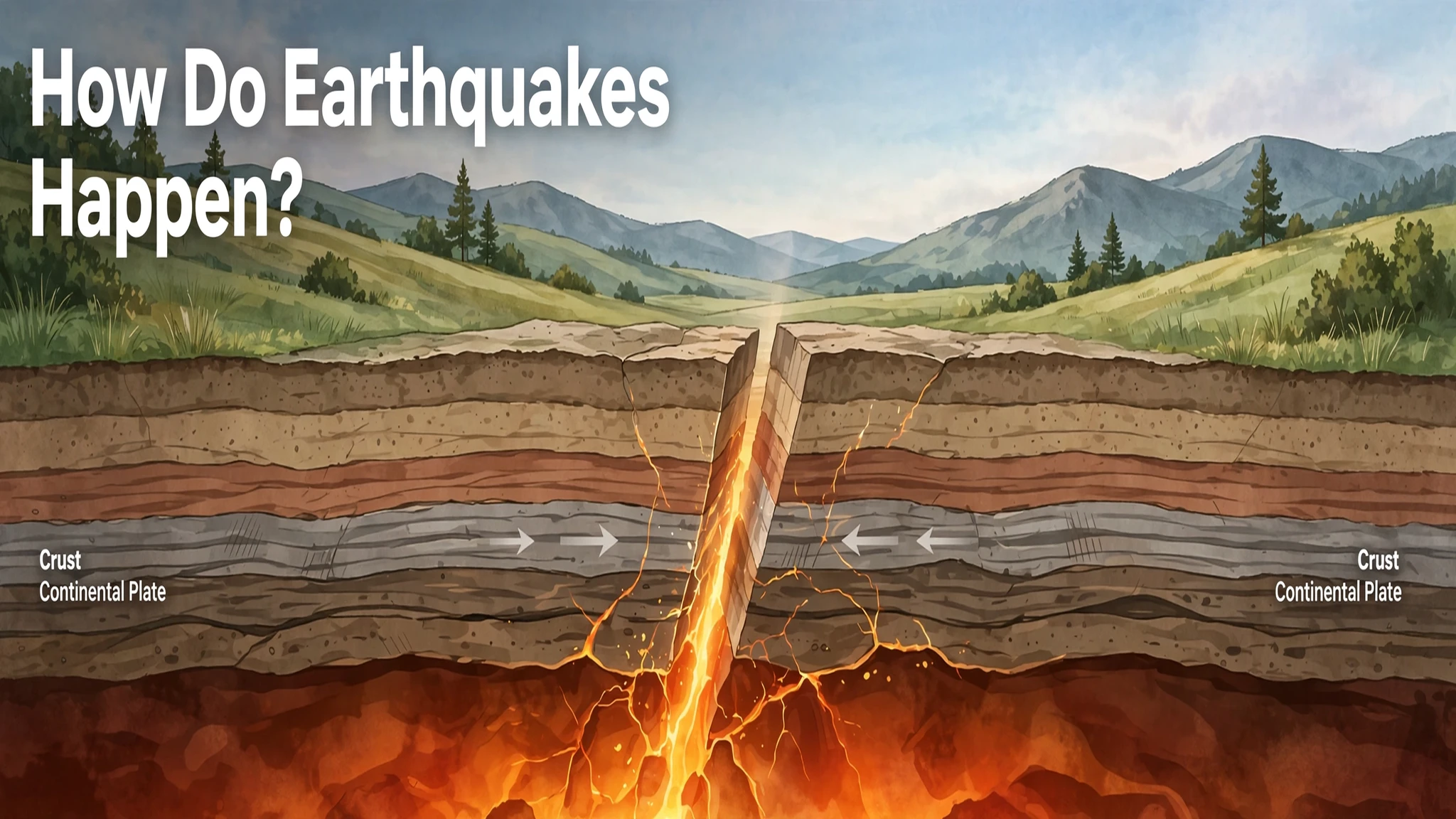
To understand an earthquake, imagine bending a stick slowly. At first it flexes elastically, storing energy, and if you let go it springs back. Bend it further and it eventually snaps, releasing the stored energy suddenly as sound, heat and motion. A fault behaves in a similar way, through a process described by elastic rebound theory. Tectonic motion slowly deforms rocks on either side of a fault, but friction locks the fault in place, preventing it from sliding. Strain builds up over years, decades or centuries, while the fault remains stuck. When the stress finally exceeds friction, the fault slips suddenly, the deformed rocks spring back toward their unstrained shape, and the stored energy is released as seismic waves.
The point inside Earth where the slip begins is called the hypocentre or focus, and the point on the surface directly above it is the epicentre. Shaking is usually strongest near the epicentre, though local geology can amplify or dampen it, so damage is not always a simple function of distance. A shallow focus, within the upper crust, tends to produce stronger surface shaking than a deep focus of the same magnitude, because the energy has less distance to travel and less rock to pass through. Deep quakes, which can occur hundreds of kilometres down in subduction zones, may be felt over a wide area but with less intense shaking at any one place.
Fault slip can take different forms. In a normal fault, the block above the fault slides down relative to the block below, typical of stretching crust. In a reverse or thrust fault, the upper block is pushed up, typical of compression. In a strike-slip fault, blocks slide horizontally past each other. Real faults often combine these motions, and the pattern of slip, along with the fault’s size, determines how much energy is released. A fault that is longer and slips farther produces a larger earthquake. The largest quakes involve faults hundreds of kilometres long slipping by metres, releasing energy equivalent to many nuclear weapons, though that comparison should be used carefully, because earthquake energy is released over a large area and over seconds to minutes, not in a single explosion.
Seismic Waves: How Shaking Travels
When a fault slips, it generates seismic waves that travel through Earth and across its surface, and understanding these waves explains why shaking feels the way it does. The fastest waves are primary waves, or P-waves, which compress and expand rock in the direction of travel, like sound waves. They travel through solids, liquids and gases, and they arrive first, often felt as a sharp jolt or a rumble. Secondary waves, or S-waves, shake rock side to side, perpendicular to travel, move more slowly, cannot travel through liquids, and usually cause stronger shaking than P-waves. The difference in arrival times between P-waves and S-waves lets seismologists locate an earthquake, because the greater the distance, the greater the time gap.
After P-waves and S-waves, surface waves arrive, travelling along Earth’s surface rather than through its interior. Love waves shake the ground horizontally, while Rayleigh waves roll the ground in an elliptical motion, like an ocean wave. Surface waves are usually the most damaging, because they have large amplitudes and long durations, and they shake buildings, bridges and the ground itself in complex ways. A person in an earthquake may first feel a jolt, then a stronger sideways shake, then a rolling motion, and that sequence reflects the arrival of different wave types, not a single shake. Buildings respond differently to each type, which is why earthquake engineering must consider frequency and direction, not only peak shaking.
Seismometers, instruments that detect ground motion, record these waves as seismograms, wiggly traces that scientists analyse for magnitude, location and fault type. Modern networks, with stations around the world, can locate a large earthquake within minutes and estimate its magnitude quickly, which is essential for tsunami warnings and emergency response. The fact that S-waves cannot pass through liquid also provided early evidence for Earth’s liquid outer core: S-waves from distant quakes are missing in a shadow zone on the opposite side of Earth, because they are blocked by the core. Earthquakes therefore do more than shake buildings; they act as a natural scan of Earth’s interior, revealing layers we cannot drill to.
Magnitude, Intensity and Why Numbers Can Confuse
Earthquake size is reported in two different ways, and confusing them is common. Magnitude measures the energy released at the source, on a logarithmic scale. The moment magnitude scale, now the standard for large quakes, is based on fault area, slip amount and rock rigidity. Each whole-number increase represents about 32 times more energy release, so a magnitude 7 quake releases roughly 32 times the energy of a magnitude 6, and about 1,000 times that of a magnitude 5. Magnitude is a single number for an earthquake, regardless of where you feel it, though early estimates may be revised as more data arrive.
Intensity, by contrast, measures shaking and damage at a particular place, on scales such as the Modified Mercalli Intensity scale, which runs from I, not felt, to XII, total destruction. Intensity varies with distance from the epicentre, local soil, building type and depth. A single earthquake therefore has one magnitude but many intensities: high near the epicentre on soft soil, lower far away on firm rock. News reports that say an earthquake was magnitude 6.5 are giving its size at the source; reports that describe shaking as strong or violent in a town are giving intensity there. Both are useful, but they answer different questions.
It is also worth correcting the idea that the Richter scale is still the main scale. The Richter scale, developed in the 1930s for southern California, saturates for large quakes and is not used for global reporting today, though the name persists in popular speech. Modern reports use moment magnitude, often abbreviated Mw, and they may initially give a preliminary magnitude that is later updated. A small change, such as from 7.1 to 7.3, is not a minor correction; because the scale is logarithmic, it represents a substantial difference in energy. Understanding this helps readers avoid both panic at a small number change and complacency at a seemingly modest magnitude.
Aftershocks, Foreshocks and Earthquake Sequences
A large earthquake is rarely a single event. It is usually followed by aftershocks, smaller quakes on or near the same fault as the crust readjusts to the main slip. Aftershocks can continue for days, weeks, months or, for very large quakes, years, decreasing in frequency and generally in size over time, though a large aftershock can still cause damage, especially to buildings already weakened by the mainshock. The largest aftershock is typically about one magnitude unit smaller than the mainshock, a pattern known as Båth’s law, though it is a statistical tendency, not a guarantee. Emergency planning must therefore account for continued shaking, not only the first event.
Foreshocks are smaller quakes that occur before a larger quake on the same fault, but they can only be identified as foreshocks in hindsight, after the mainshock occurs. Before the mainshock, a foreshock looks like any other small quake, and most small quakes are not followed by a large one. This hindsight problem is central to prediction: we can recognise patterns after the fact, but we cannot reliably say in advance whether a given small quake is a foreshock or an isolated event. Some large quakes have clear foreshock sequences, others have none, and the difference is not yet predictable.
Earthquake sequences can also be more complex than a mainshock plus aftershocks. Sometimes a series of quakes of similar size occurs without a clear mainshock, called a swarm, often associated with volcanic activity or fluid movement underground. Sometimes a large quake triggers quakes on nearby faults, through stress transfer, days or years later. The 2011 Tohoku earthquake in Japan, magnitude 9.0, for example, was followed by extensive aftershocks and changes in seismicity across the region. These sequences remind us that faults are connected systems, not isolated cracks, and that stress released on one fault can load another.
Tsunamis, Landslides and Secondary Dangers
Shaking itself is dangerous, but many earthquake deaths come from secondary effects. The most far-reaching is a tsunami, a series of ocean waves generated when an earthquake vertically displaces the seafloor, usually in a subduction zone. Unlike wind waves, which affect only the surface, a tsunami involves the whole water column and can travel across an ocean at jet speeds, slowing and growing in height as it reaches shallow coastlines. A tsunami warning system, based on seismic detection and ocean buoys, can give coastal communities minutes to hours to evacuate to high ground, and that time saves lives, but only if warnings are understood and acted on quickly.
Landslides are another major secondary danger, especially in mountainous areas. Shaking can loosen slopes, trigger rockfalls and debris flows, block roads and rivers, and bury villages. Liquefaction occurs when shaking causes water-saturated sand and soil to behave like a liquid, losing strength and causing buildings to sink or tilt, even if they were not directly damaged by shaking. Fires can follow, from broken gas lines and electrical faults, and in a city with damaged water supplies, fires can spread unchecked. The 1906 San Francisco earthquake is remembered as much for the fires that followed as for the shaking itself, a reminder that earthquake risk is a chain of hazards, not a single shake.
Building design is the most effective protection against these dangers, because we cannot stop earthquakes. Earthquake-resistant design includes flexible frames, base isolation, which separates a building from ground motion with bearings, and damping systems that absorb energy. Building codes, enforcement and retrofitting of older structures matter more than any single technology, because a well-designed code that is not enforced protects no one. In many earthquake-prone regions, the difference between a quake that kills dozens and one that kills thousands is not magnitude alone, but building quality, population density, time of day and preparedness.
Can Earthquakes Be Predicted? Honest Limits
Short-term earthquake prediction, meaning a specific location, time window and magnitude announced in advance with enough reliability to evacuate, is not currently possible, and scientists are clear about this limit. Long-term forecasting is possible in a probabilistic sense: seismologists can estimate that a given fault has, for example, a certain percentage chance of a large quake in the next 30 years, based on its slip rate and history. That forecast is useful for building codes and insurance, but it cannot say whether the quake will happen next week or in 29 years. The distinction between forecasting, a probability over a long window, and prediction, a specific imminent event, is essential and is often lost in media reports.
Early warning systems offer a partial solution. Because P-waves travel faster than damaging S-waves and surface waves, a network of sensors near a fault can detect a quake and send an alert to distant cities seconds before strong shaking arrives. Those seconds are enough to stop trains, shut off gas, open fire station doors, and let people drop, cover and hold on, but they are not enough to evacuate a city, and they do not help people very close to the epicentre, where shaking arrives almost immediately. Countries including Japan, Mexico and the United States operate such systems, and they are expanding, but they are warnings, not predictions.
Claims of animal behaviour, weather changes or other precursors predicting quakes have been studied extensively and have not produced a reliable, repeatable method. Animals may react to small foreshocks or to shaking that humans do not notice, but they do not reliably forecast large quakes days in advance. Similarly, claims about planetary alignments, moon phases or electromagnetic signals have not survived rigorous testing, though research continues into possible precursors. The honest scientific position is to invest in monitoring, building safety and rapid response, rather than in a prediction method that has not been demonstrated to work.
Staying Safe: What to Do Before, During and After
Personal safety advice should be local, because building types and risks differ, but some general principles are widely recommended by emergency agencies. Before an earthquake, secure heavy furniture, know how to turn off gas and water if instructed, keep an emergency kit with water, food, medicines and documents, and know evacuation routes and high ground if you live in a tsunami zone. During shaking, the standard advice in many countries is Drop, Cover and Hold On: drop to the ground, take cover under a sturdy table, and hold on until shaking stops. If you are outside, move away from buildings, trees and power lines. If you are driving, stop safely away from bridges and overpasses.
After shaking stops, check for injuries, avoid damaged buildings, expect aftershocks, and do not use lifts. If you are near the coast and feel strong shaking that lasts a long time, or if you receive a tsunami warning, move inland and to high ground immediately, without waiting to see the wave. Do not return to the coast until authorities say it is safe, because tsunamis come in multiple waves, and later waves can be larger than the first. In all cases, follow local official guidance over generic internet advice, because local agencies know the building stock, tsunami risk and evacuation routes for your area.
Preparedness also includes community and policy levels. Schools and workplaces should practise drills, hospitals should have backup power and supplies, and cities should plan for shelter, water and medical care after a large quake. Individuals cannot control magnitude or location, but they can control whether their home is secured, whether they know what to do, and whether they help neighbours who are elderly, disabled or alone. Earthquake safety is therefore both a personal habit and a public responsibility, and the best time to prepare is before shaking starts, not during it.
My Take:
My take is that earthquakes teach humility in a way few other natural phenomena do. We can map faults, measure waves and design buildings, but we cannot stop a fault from slipping or predict the day it will slip. That combination, knowledge without control, is uncomfortable, and it tempts people toward false certainty, whether from a prediction claim or from the belief that their area is safe because it has been quiet. I think the healthier response is to accept uncertainty and act on probability: build well, practise, and prepare, even though the quake may not come in our lifetime. Preparation is not pessimism; it is respect for a process that operates on timescales longer than a human life.
I also think earthquake science is a model for how to communicate risk honestly. Seismologists do not hide the limits of prediction; they state them clearly, they give probabilities instead of dates, and they invest in early warning and building codes that help even without prediction. That honesty builds trust, because when a quake does occur, the public is less likely to feel betrayed by a failed forecast and more likely to follow guidance. I wish other fields, from finance to health, were as clear about the difference between a forecast and a prediction, and about what their models can and cannot do. Clarity about limits is not weakness; it is the foundation of credibility.
My worry is about inequality in earthquake safety. A wealthy city with enforced codes, retrofitted schools and an early warning system can survive a magnitude 7 quake with relatively few deaths, while a poorer city with unreinforced masonry, crowded informal housing and no warning system can suffer thousands of deaths from a similar quake. The difference is not geology; it is policy, wealth and enforcement. That means earthquake deaths are not purely natural disasters; they are partly social disasters, shaped by choices about building, planning and investment. If we care about earthquake victims, we should care as much about building codes and housing as about seismology.
There is also a lesson about time. A fault that has been quiet for a century is not necessarily safe; it may be locked and accumulating strain, like a bent stick that has not yet snapped. Conversely, a region that has just had a large quake is not necessarily safe either, because aftershocks and stress transfer can trigger further quakes. Living with earthquakes means living with a risk that does not reset to zero after an event, and that does not disappear during quiet periods. That long view is hard for humans, who naturally focus on recent experience, but it is essential for planning cities, insuring homes and teaching children what to do.
Finally, I return to the waves themselves. An earthquake is not a single shake, but a sequence of waves travelling through a planet, carrying information about its interior. Seismologists use those waves to map the core, the mantle and the crust, turning a disaster into a diagnostic tool. That dual nature, destructive and informative, captures something important about science: the same event that harms people also teaches us about Earth, and that knowledge, applied to building and warning, can save people in the next event. The cycle from disaster to knowledge to protection is slow and imperfect, but it is real, and it is why I believe in investing in seismology even when it cannot predict the next quake. We may not control when the ground moves, but we can control how ready we are when it does, and readiness is a form of respect for both the planet and the people who live on it.
And that readiness starts with a simple habit: knowing what to do without thinking. Drop, cover and hold on is not a slogan; it is a muscle memory that must be practised before it is needed, because during shaking there is no time to search for advice. I hope readers will practise it, secure one heavy object this week, and check their local tsunami and evacuation guidance if they live near a coast. Those small actions, multiplied across a community, are the real earthquake protection we have, and they are available today, without waiting for a prediction breakthrough that may never come.
One more point about earthquakes deserves emphasis: the importance of local knowledge and local building traditions, which are often overlooked in global discussions. In many earthquake-prone regions, traditional building techniques, such as timber frames that flex, stone walls with wooden ties, or houses on raised platforms, evolved through trial and error over centuries, and they embody lessons that modern codes sometimes forget. Conversely, modern materials used badly, such as unreinforced concrete blocks with heavy roofs, can be more dangerous than traditional methods. The best earthquake safety therefore combines modern engineering with local knowledge: engineers who listen to builders, builders who learn seismic principles, and communities that maintain and adapt their houses over time. A code written in a capital city, without attention to local materials, skills and costs, will be ignored or circumvented, while a code developed with local builders has a chance to be followed.
I also want to stress the role of drills and education, which are cheap compared with retrofitting but save lives in ways that are hard to count. A child who has practised Drop, Cover and Hold On will act without panic, a teacher who knows evacuation routes will lead a class safely, and a neighbourhood that has practised a tsunami evacuation will move faster than one that has only read a leaflet. These behaviours must be rehearsed, not merely taught, because shaking leaves no time to think. Countries that invest in regular drills, in schools, workplaces and communities, tend to fare better in real quakes, even when their buildings are imperfect. Preparedness is a culture, built over years, and it is one of the few earthquake protections that every community can start building today, without waiting for funding or technology.
That culture of preparedness also extends to workplaces and schools in ways that are easy to overlook. A hospital that has practised moving patients during shaking, a factory that has secured chemical storage, and a school that has identified safe assembly points will all recover faster than institutions that only own equipment. Equipment without practice is like a fire extinguisher no one knows how to use: present, but not protective. Regular, realistic drills, reviewed after each exercise and updated with lessons learned, turn equipment and plans into habits, and habits are what survive when shaking, fear and confusion make deliberate thinking difficult.
Frequently Asked Questions
What causes an earthquake?
Earthquakes are mainly caused by sudden slip on a fault when tectonic stress exceeds friction. Plates move slowly, strain builds up on a locked fault, and when it slips, stored energy is released as seismic waves.
What is the difference between magnitude and intensity?
Magnitude measures energy released at the source, on a logarithmic scale, and is one number per earthquake. Intensity measures shaking and damage at a particular place, and varies with distance, soil and building type.
Can scientists predict earthquakes?
No reliable short-term prediction of a specific quake’s time, place and size is currently possible. Scientists can give long-term probabilistic forecasts for faults, and early warning systems can alert distant places seconds before strong shaking arrives.
Why do some earthquakes cause tsunamis and others not?
Tsunamis are mainly caused by earthquakes that vertically displace the seafloor, usually large subduction-zone quakes under the ocean. Strike-slip quakes, which move mainly horizontally, and small quakes are less likely to generate a large tsunami.
What should I do during an earthquake?
In many countries the recommended action is Drop, Cover and Hold On: drop to the ground, cover under sturdy furniture, and hold on until shaking stops. If near the coast and shaking is strong and long, move to high ground for possible tsunami risk and follow local official guidance.
Are small earthquakes a warning of a bigger one?
Not necessarily. Most small quakes are isolated and are not followed by a large quake. Foreshocks can only be identified as such after a mainshock occurs, so a small quake alone does not reliably predict a larger event.
Sources
- https://en.wikipedia.org/wiki/Earthquake
- https://www.usgs.gov/programs/earthquake-hazards/science/earthquakes
- https://www.britannica.com/science/earthquake-geology
- https://www.usgs.gov/programs/earthquake-hazards/earthquake-magnitude-energy-release-and-shaking-intensity
- https://www.ready.gov/earthquakes