How Do Satellites Stay in Orbit? Explained Simply
In this post
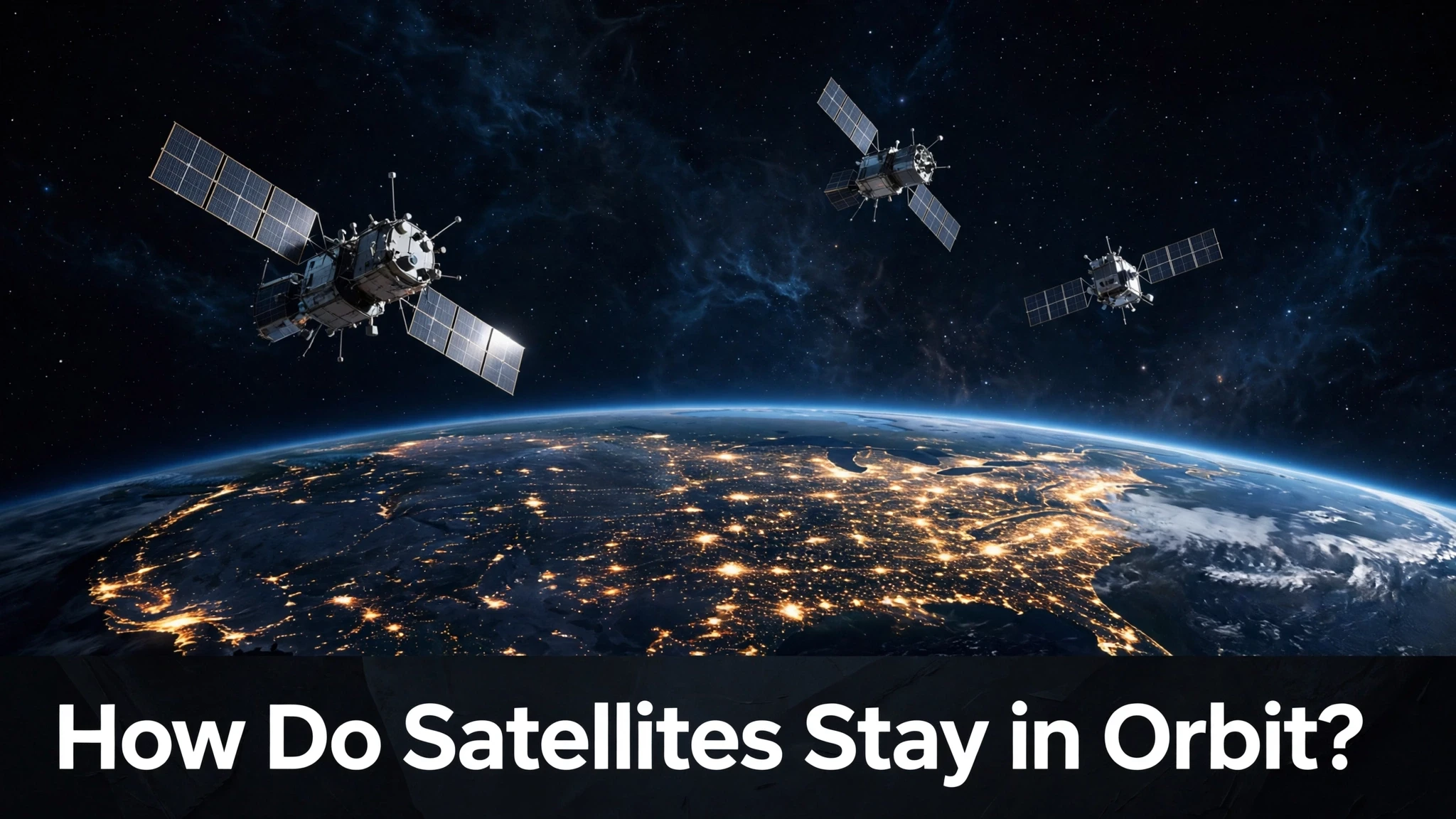
A satellite weighing several tonnes circles the Earth at twenty-eight thousand kilometres per hour, three hundred kilometres above the ground, and it never falls down, never needs fuel to stay up, and never touches anything. That fact feels impossible the first time you think about it, because everything you have ever dropped has fallen straight to the floor. The answer is that a satellite is falling, all the time, but it is moving sideways so fast that the ground curves away beneath it at the same rate, so it keeps missing the Earth. This is called free fall, and it is the same condition astronauts feel on the International Space Station when they float: they are not beyond gravity, they are falling around the planet. Gravity at the height of the space station is still about ninety percent as strong as it is on the ground, so the station is held firmly, and its speed is what keeps it from hitting the surface. Once you understand that orbit is a fall that never lands, the rest of satellite science, from the different heights of orbits to the reason satellites eventually fall back, starts to make sense.
Orbit Is Falling Sideways, Not Floating
Imagine throwing a ball from the top of a tall hill. If you throw it gently, it lands nearby. If you throw it harder, it lands further away, because it travels sideways while it falls. If you could throw it fast enough, and there were no air to slow it down, the ball would fall towards the Earth but the Earth would curve away beneath it, so the ball would never reach the ground. That is an orbit. The ball is constantly falling towards the centre of the Earth, and constantly moving forward, and the combination of those two motions is a circle. Isaac Newton described this idea in the seventeenth century with a thought experiment about a cannon on a mountain, and the first satellite, Sputnik 1, proved it in 1957 when it circled the Earth at about eight thousand metres per second and stayed up for three months.
The speed needed to stay in a low orbit, about four hundred kilometres up, is roughly seven point eight kilometres per second, which is twenty-eight thousand kilometres per hour, or about twenty-three times the speed of sound. At that speed, a satellite crosses the sky in minutes and circles the Earth in about ninety minutes. The speed matters because gravity pulls the satellite down at a fixed rate, and only a fast sideways motion keeps the fall matching the curve of the planet. If the satellite slowed down, it would fall lower, meet thicker air, slow down more, and spiral into the atmosphere. If it sped up too much, it would climb into a higher orbit or escape the Earth entirely. Orbit is therefore a balance, not a place, and the balance is maintained by speed, not by engines.
Gravity in Space Is Still Strong
One of the most common misunderstandings about space is that there is no gravity there, and that astronauts float because gravity has switched off. That is wrong. The International Space Station orbits at about four hundred kilometres, and gravity there is still about eight point seven metres per second squared, compared with nine point eight on the ground, which means it is still about ninety percent as strong. The astronauts float because they are in free fall, falling around the Earth at the same rate as the station, not because gravity has disappeared. If you were in a lift whose cable had snapped, you would float inside it for the same reason, even though gravity is still pulling you down. The feeling of weightlessness is the feeling of falling without hitting anything, and it lasts as long as the fall lasts.
Gravity weakens with distance, following the inverse square law, which means that doubling the distance from the centre of the Earth reduces gravity to a quarter of its strength. A satellite in geostationary orbit, thirty-six thousand kilometres up, feels gravity only about two percent as strong as on the ground, but that weak pull is still enough to hold it, because the satellite is moving more slowly, about three kilometres per second, and its orbit takes exactly one day. The Moon, which is three hundred and eighty-four thousand kilometres away, is held by Earth’s gravity even though the pull there is tiny. There is no place in the solar system where gravity is zero, and every satellite, planet and moon is held by the same force, differing only in distance and speed.
Low, Medium and Geostationary Orbits
Satellites live at different heights because different jobs need different views. Low Earth orbit, from about two hundred to two thousand kilometres up, is where the International Space Station flies, where most Earth observation satellites work, and where the Starlink internet constellation operates. A satellite in low orbit circles the Earth in about ninety minutes, sees a small area in great detail, and passes over a given place several times a day, but it must move very fast and it meets a thin trace of atmosphere that slowly drags it down. Medium Earth orbit, from about two thousand to thirty-five thousand kilometres, is where navigation satellites such as GPS live, at about twenty thousand kilometres, circling the Earth in about twelve hours and covering a large area with each satellite.
Geostationary orbit is a special height, thirty-five thousand eight hundred and eighty-six kilometres above the equator, where a satellite circles the Earth in exactly twenty-four hours, the same time the Earth takes to spin once, so the satellite appears to hover over a fixed point on the ground. That is why a satellite television dish can point at one spot in the sky and never move, and why weather satellites that watch the same region use this orbit. The price is distance: the signal takes about a quarter of a second to travel up and back, which makes geostationary internet feel slow, and the view is broad rather than detailed. Higher still, beyond geostationary orbit, are the orbits used by deep-space missions and by satellites that watch the Sun, while the James Webb Space Telescope sits at a point one and a half million kilometres from Earth, held in place by the balance of gravity between the Earth and the Sun. Each orbit is a trade between speed, coverage, detail and delay.
What Launches a Satellite and Keeps It There
A satellite reaches orbit on a rocket, which must accelerate it to orbital speed while also lifting it above the thickest part of the atmosphere. The rocket burns for several minutes, climbing steeply at first and then tilting sideways to build horizontal speed, because sideways speed is what makes an orbit. Once the satellite is released, the rocket’s job is done, and the satellite coasts on its own momentum, needing no engine to stay up. Most satellites carry small thrusters for occasional corrections, called station keeping, which adjust the orbit when the atmosphere drags it down or when the satellite needs to move to a new position, but those thrusters fire for seconds or minutes at a time, not continuously. A satellite that ran out of fuel would not fall immediately, it would slowly lose height over months or years as the thin air at its altitude stole its speed.
The atmosphere does not end at a sharp line. At four hundred kilometres, the air is extremely thin, but there is still enough of it to create drag, and the International Space Station loses about two kilometres of height per month to that drag, so visiting spacecraft regularly boost it back up. During periods when the Sun is active, the upper atmosphere expands and the drag increases, which is why some satellites fall sooner than expected. The Kármán line, at one hundred kilometres, is the commonly used boundary of space, but the air above it is still real, and every satellite in low orbit is slowly fighting it. That is why satellites have a limited life even when their electronics work perfectly: the orbit itself decays, and the only cure is fuel or a boost from another spacecraft.
Why Satellites Eventually Fall
Every satellite in low Earth orbit will eventually fall back, because the drag of the thin atmosphere never stops. A satellite at two hundred kilometres may last only days, a satellite at four hundred kilometres may last years, and a satellite at eight hundred kilometres may last decades, but the direction is always downward. When a satellite falls low enough, the air becomes thick, friction heats the metal, and most of the satellite burns up in a streak of light, which is what you see when a meteor or a re-entering satellite crosses the sky. Larger pieces can survive to the ground, which is why operators plan a controlled re-entry, steering the satellite into a remote part of the ocean, usually the South Pacific, where the risk to people is lowest. The International Space Station, when it is retired, is planned to be guided into that same ocean area.
Satellites in higher orbits do not fall in the same way. A geostationary satellite, when it runs out of fuel, is moved to a graveyard orbit a few hundred kilometres higher, where it will drift harmlessly for centuries, because there is almost no atmosphere at that height to drag it down. Navigation satellites in medium orbit will stay up for thousands of years. The growing number of satellites, more than ten thousand active in 2025, has created a new problem called space debris, because a dead satellite, a spent rocket stage, or a fragment from a collision can hit another satellite at orbital speed and create more fragments. That chain reaction, called the Kessler syndrome, is the reason space agencies track debris and design satellites to de-orbit themselves at the end of their lives. Orbit is not a permanent home, it is a loan from physics, and the loan must be repaid.
The Space Station, the Moon and Beyond
The International Space Station is the largest object in orbit, about the size of a football field, weighing more than four hundred tonnes, and it has been continuously occupied since November 2000, which makes it the longest-running human presence in space. It circles the Earth sixteen times a day, and its crew of six or seven astronauts conduct experiments in weightlessness, study the Earth, and test the systems that will be needed for a journey to the Moon and Mars. The station is supplied by cargo spacecraft from several countries, and its crew return to Earth in capsules that use a heat shield and parachutes to survive re-entry. The station proves that humans can live in orbit for a year or more, though the effects of weightlessness on bone and muscle mean that astronauts must exercise for two hours a day.
The Moon is Earth’s natural satellite, and it stays in orbit for the same reason an artificial satellite does: it is falling towards the Earth while moving sideways fast enough to keep missing it. The Moon’s orbit takes about twenty-seven days, and it is slowly moving away from the Earth by about three point eight centimetres a year, because the tides transfer energy from the Earth’s spin to the Moon’s orbit. Beyond the Moon, the same rules govern planets around the Sun, moons around Jupiter, and the Voyager spacecraft that have left the solar system. Orbit is a universal idea, not a human invention, and every satellite we launch is a small, fast, artificial moon, following the same law that holds the Earth to the Sun and the Moon to the Earth.
How to See a Satellite From Your Garden
You can see satellites with your own eyes, without a telescope, on a clear evening just after sunset or just before sunrise, when the sky is dark but the satellite above is still in sunlight. The International Space Station is the brightest, appearing as a steady white light moving quickly across the sky, brighter than any star and faster than any aeroplane, taking about five minutes to cross from one horizon to the other. Starlink satellites often appear as a train of lights shortly after launch, before they spread out into their final positions, and many people mistake them for something strange because they move in a line. The best time to look is when the Sun is below the horizon but the satellite is still lit, which is usually within an hour or two of sunset, and a dark sky away from city lights helps.
Websites and apps run by space agencies can tell you exactly when the station will pass over your town, and some will send an alert to your phone. When you watch it, remember what you are seeing: a machine the size of a football field, carrying people, falling around the Earth at twenty-eight thousand kilometres per hour, and missing the ground by a margin that physics has guaranteed since Newton. It will cross your sky in minutes, and it will be gone before you have finished pointing it out to a friend. That brevity is part of the wonder, because it reminds you how fast orbit really is, and how much of our modern life, from weather forecasts to phone maps, depends on machines that never stop falling.
My Take:
I think orbit is the most elegant idea in all of science, because it turns falling, which we think of as failure, into flying. A satellite does not defeat gravity, it does not escape it, and it does not ignore it. It uses gravity, it falls, and it falls so well that it never lands. That is a different kind of victory from the rocket’s roar, and I find it more beautiful, because it is quiet, it lasts for years, and it costs no fuel once it is done. We spend our lives trying to overcome forces, and orbit teaches us that sometimes the smarter move is to work with the force, to let it pull you, and to steer by speed rather than by strength.
My strongest feeling is about the astronauts who float on the space station, because they live in a fall that never ends, and that is a strange way to live. They exercise for two hours a day to keep their bones from weakening, they sleep in bags tied to the wall, and they watch sixteen sunrises in a single day. I think they understand something the rest of us forget, which is that weight is not a property of a thing, it is a relationship between a thing and the planet beneath it. When that relationship changes, everything changes, and the human body, which evolved for gravity, has to learn a new way to be. I respect them for that, and I think their work, which looks like floating and taking photographs, is actually the hardest job in the world.
I also believe the story of Sputnik matters more than we admit, because it was a metal ball the size of a beach ball, beeping as it circled the Earth, and it changed the world. It proved that orbit was possible, it scared governments into funding science, and it started the space age that gave us weather satellites, GPS, and the internet in the sky. A beep from space was enough to change history, and I think that is a reminder that a small thing, done first and done well, can matter more than a large thing done late. We remember the first satellite, not the hundredth, because the first one proved the idea, and proof is what moves the world.
Another thing I care about is space debris, because it is the first pollution problem we have created in a place we cannot clean. On Earth, we can pick up litter, we can filter water, we can plant trees, but in orbit, a fragment moving at twenty-eight thousand kilometres per hour cannot be picked up, and it will keep circling for decades, threatening every satellite that follows. I think we have a duty to design satellites that clean up after themselves, to de-orbit them at the end of their lives, and to stop treating orbit as an empty sky. It is not empty, it is crowded, and the crowding is our doing. If we are careless with the sky, we will lose the very tools, weather forecasting, navigation, communication, that make modern life possible.
Finally, I think watching the space station cross the sky is one of the best free experiences a person can have, because it makes the abstract real. You can read about orbital speed, you can memorise the numbers, but seeing a light cross the sky in five minutes, knowing that people are inside it, falling around the planet, changes how you feel about the world. It reminds you that the Earth is a ball, that the sky is not a ceiling, and that human beings have learned to live in a fall. I would like more people to look up, to check the passing times, and to stand in their garden and watch, because that moment of looking up is the beginning of curiosity, and curiosity is the beginning of every discovery that matters.
I also think the story of the first satellite, Sputnik, is a reminder that a small thing can change the world, because Sputnik was a metal sphere the size of a beach ball, weighing eighty-three kilograms, and it did nothing but beep. That beep, heard around the world, proved that orbit was possible, it frightened governments into funding science, and it started the space age. I find that extraordinary, because a beep is the simplest signal imaginable, and yet it was enough to change history. It tells me that you do not need a grand machine to change the world, you need a first step, taken boldly, and a signal that others can hear. The satellites that followed, the weather satellites, the GPS satellites, and the space station, all began with that beep.
Another belief I hold is about the view from orbit, because astronauts who have seen the Earth from space often say the same thing: the planet looks fragile, blue, and without borders, and that view changes how they think about the world. They see no lines on the ground, no countries, no walls, only a thin atmosphere holding everything we know, and they come back with a sense of responsibility that they did not have before. I think more leaders should see that view, because it would remind them that the Earth is one place, and that the problems we face, climate, pollution, and war, do not respect borders. The view from orbit is not a luxury, it is a lesson, and it is a lesson that a satellite, falling forever around the planet, can teach us, if we are willing to look up and listen.
I also want to say something about the people who track satellites, because they do a job that most of us never think about. They watch the sky, they calculate orbits, they warn operators when two satellites might collide, and they do it with computers and telescopes, day and night. Their work is invisible, but without it, the sky would be far more dangerous, and a collision in orbit could destroy satellites that millions of people depend on for weather, navigation, and communication. I think that kind of quiet, careful work deserves respect, because it is the work that keeps the modern world running, and it is done by people who love the sky and who understand that orbit is not empty, it is a shared road, and every user of that road has a duty to drive carefully.
Frequently Asked Questions
Why do satellites not fall to Earth?
Satellites are falling towards Earth all the time, but they move sideways so fast that the ground curves away beneath them, so they keep missing the planet. This continuous fall around Earth is an orbit.
Is there gravity in space?
Yes, gravity in low orbit is still about ninety percent as strong as on the ground. Astronauts float because they are in free fall, not because gravity has disappeared.
How fast does a satellite travel?
A satellite in low orbit travels at about seven point eight kilometres per second, or twenty-eight thousand kilometres per hour, and circles Earth in about ninety minutes.
What is geostationary orbit?
Geostationary orbit is about thirty-five thousand eight hundred kilometres above the equator, where a satellite circles Earth in exactly twenty-four hours, so it appears to stay over one fixed point.
Why do satellites eventually fall?
Thin air in low orbit creates drag that slowly steals a satellite’s speed, so it loses height over months or years and eventually burns up in the atmosphere unless it is boosted or steered down.
Can I see the space station from Earth?
Yes, on a clear evening after sunset the station appears as a bright, steady light moving quickly across the sky, and apps can tell you the exact time it will pass over your town.