How Do Stars Die? Supernova Explained
In this post
- A Star Lives by Balancing Two Forces
- Small Stars: The Quiet Death of a Red Giant
- Massive Stars: Collapse, Bounce and Explosion
- The Other Supernova: A White Dwarf That Goes Too Far
- Neutron Stars, Pulsars and Magnetars
- How Dying Stars Made Us
- Watching Stars Die: From Ancient Records to Modern Surveys
- My Take:
A Star Lives by Balancing Two Forces
A star is a balance act that lasts millions or billions of years. Gravity pulls its gas inward, trying to collapse it, while pressure from nuclear fusion in its core pushes outward, holding it up. In the core, hydrogen nuclei fuse into helium, releasing energy that heats the gas and creates the pressure that resists gravity. As long as fuel remains and fusion continues, the star stays stable, shining steadily. When the fuel runs out, the balance breaks, and the star must change. How it dies depends almost entirely on one factor: its mass.
Mass decides the star’s temperature, its lifetime and its ending. Massive stars burn bright and fast, living only millions of years, while low-mass stars burn dimly and slowly, living tens or hundreds of billions of years, longer than the universe has existed. Our Sun is a middle-weight star, with a lifetime of about ten billion years, of which about half has passed. When astronomers say a star dies, they do not mean it vanishes instantly; they mean it leaves the stable fusion phase and transforms into a new kind of object, sometimes explosively, sometimes gently, over thousands or millions of years.
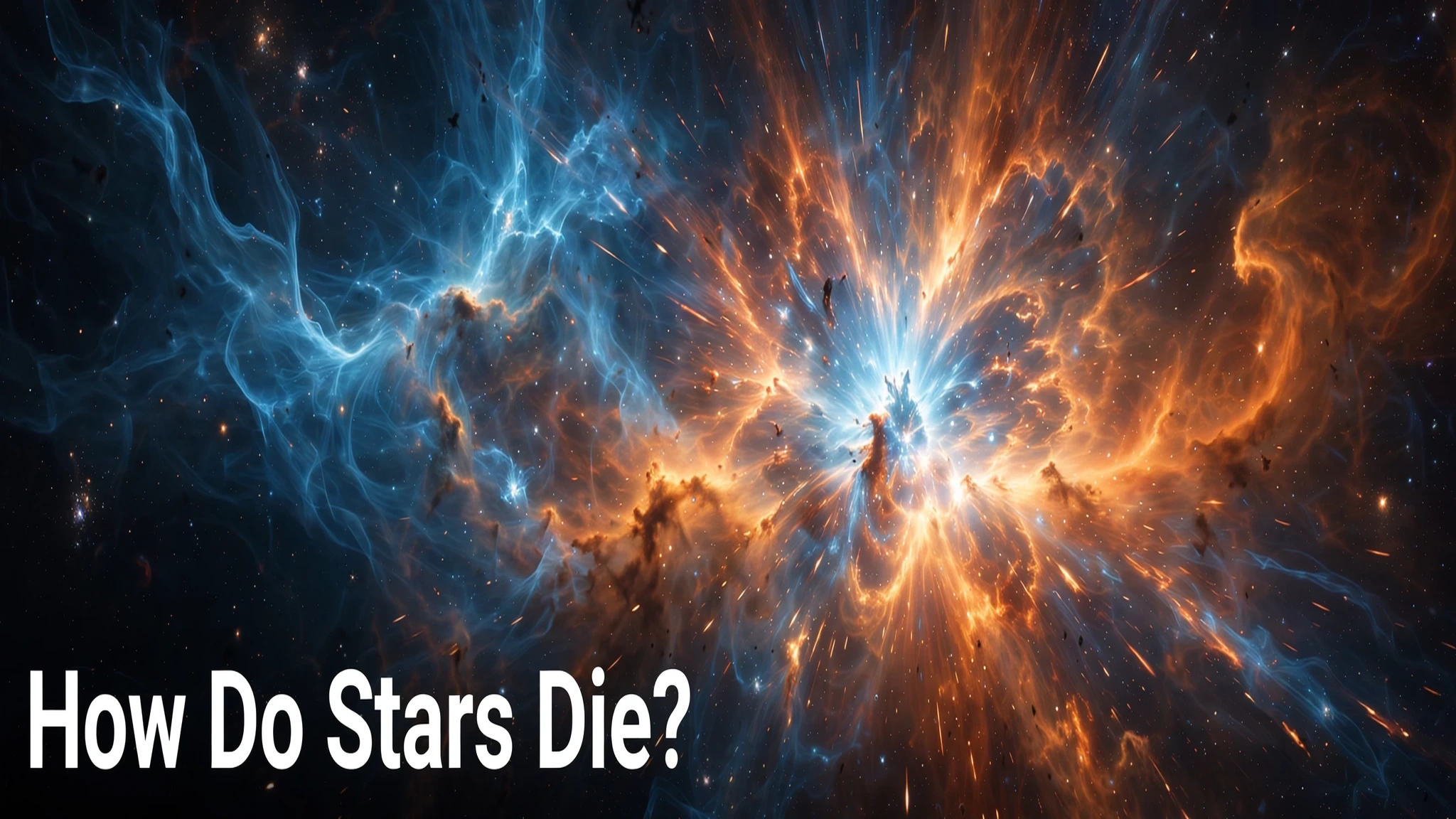
The elements a star makes also depend on mass. Low-mass stars make mainly helium and carbon. Massive stars, with hotter cores, can fuse heavier elements in stages, up to iron, through a series of burning shells. Iron is a turning point, because fusing iron does not release energy; it absorbs it. When a massive star’s core becomes iron, fusion can no longer hold up gravity, and collapse begins. That collapse, and the explosion that may follow, is a supernova, and it is one of the most energetic events in the universe.
Small Stars: The Quiet Death of a Red Giant
Stars like the Sun, and smaller, end quietly by astronomical standards. When hydrogen in the core runs out, the core contracts and heats, while hydrogen fusion continues in a shell around it. The outer layers expand and cool, turning the star into a red giant, hundreds of times larger than before, though less dense. For the Sun, this expansion in about five billion years will be enough to engulf Mercury and Venus, and possibly Earth, though the exact fate of Earth is still debated because the Sun will also lose mass and its gravity will weaken. The red giant phase is dramatic for nearby planets, but it is not an explosion; it is a slow swelling.
After the red giant phase, the core contracts again, helium fuses into carbon and oxygen, and the outer layers are eventually shed as a glowing shell of gas called a planetary nebula, a name that is misleading because it has nothing to do with planets; early telescopes made these round shells look like planets. The remaining core, no longer fusing, becomes a white dwarf: a dense, Earth-sized remnant, initially hot, that slowly cools over billions of years. A teaspoon of white dwarf material would weigh tonnes on Earth, because the matter is compressed by gravity to extraordinary density, held up not by fusion but by quantum pressure from electrons.
White dwarfs are stable, but they are not eternal in the sense of shining forever. They cool, fade and, over timescales far longer than the current age of the universe, would become cold black dwarfs, though no black dwarf is thought to exist yet because the universe is not old enough. A white dwarf in a binary system can have a second, violent ending, which we will meet below, but a single white dwarf simply cools in the dark. It is a quiet ending for most stars in the universe, including, eventually, our Sun.
Massive Stars: Collapse, Bounce and Explosion
Massive stars, roughly eight times the Sun’s mass or more, die very differently. Their cores fuse elements in onion-like layers: hydrogen to helium, helium to carbon, carbon to oxygen and neon, and so on, until an iron core forms. Each stage burns faster than the last, so the final stages may last only years, months or days, after millions of years of hydrogen burning. When the iron core reaches a critical mass, about 1.4 times the Sun’s mass, known as the Chandrasekhar limit, electron pressure can no longer support it, and it collapses in less than a second.
The collapse is extreme. The core, initially thousands of kilometres across, shrinks to tens of kilometres, and protons and electrons are forced together to form neutrons, releasing a flood of neutrinos. The infalling outer layers hit the suddenly stiff neutron core and rebound, sending a shock wave outward. Whether that shock alone, helped by neutrino heating and turbulence, is enough to explode the star is a detailed question that supercomputer simulations still study, but the outcome in many cases is a supernova: the outer layers are blown off at a significant fraction of the speed of light, shining for weeks or months as brightly as a whole galaxy. The energy released is staggering, and most of it escapes as neutrinos, not light, which is why neutrino detectors on Earth can, in principle, detect a nearby supernova before its light arrives.
The remnant left behind depends on the original mass. If the collapsed core is below about two to three solar masses, it becomes a neutron star, an object about twenty kilometres across, denser than a white dwarf, held up by neutron pressure, spinning rapidly and often magnetised. If the core is heavier, gravity wins completely and it becomes a black hole, an object whose gravity is so strong that not even light can escape from within its event horizon. The boundary between neutron star and black hole is not perfectly known, because the physics of matter at such densities is still uncertain, and astronomers continue to refine it from observations of supernova remnants and gravitational waves.
The Other Supernova: A White Dwarf That Goes Too Far
Not all supernovae come from massive stars collapsing. Type Ia supernovae come from white dwarfs in binary systems, and they are especially important because they serve as cosmic distance markers. In the standard picture, a white dwarf pulls matter from a companion star, or merges with another white dwarf, until its mass approaches the Chandrasekhar limit. At that point, carbon fusion ignites suddenly throughout the star, in a runaway thermonuclear explosion that destroys the white dwarf completely, leaving no remnant. Because these explosions start from a similar mass, they reach a similar peak brightness, which lets astronomers use them as standard candles to measure distances across the universe.
Type Ia supernovae helped reveal that the universe’s expansion is accelerating, a discovery that led to the idea of dark energy and to a Nobel Prize. That connection shows how a stellar death can illuminate cosmology: by measuring how bright a distant Type Ia supernova appears, astronomers can infer its distance, and by measuring its redshift, they can infer how fast the universe was expanding when its light left. The pattern did not match a decelerating universe, and the discrepancy pointed to acceleration. The result depends on careful calibration, because not all Type Ia supernovae are perfectly identical, but the method has been tested against many other distance measures and remains central to cosmology.
Other supernova types are classified by their spectra, the pattern of light they emit. Type II supernovae show hydrogen lines, indicating a massive star that retained its hydrogen envelope, while Types Ib and Ic lack hydrogen, and Ic also lacks helium, indicating stars that lost their outer layers before exploding, perhaps through strong winds or interaction with a companion. These classifications are useful, but they describe what we see, not always a unique cause, and astronomers now recognise a wider variety of explosions, including superluminous supernovae, faint supernovae and explosions that interact with surrounding gas. The universe’s ways of killing stars are more varied than a simple two-type scheme suggests.
Neutron Stars, Pulsars and Magnetars
A neutron star is one of the strangest objects that a star can become. It packs more mass than the Sun into a sphere the size of a city, so its density is comparable to an atomic nucleus. Its surface gravity is billions of times Earth’s, and a mountain on a neutron star could be only millimetres high before gravity flattened it. Neutron stars spin rapidly, because collapse conserves angular momentum, like a figure skater pulling in their arms, so a star that once rotated slowly can spin hundreds of times per second after collapse. If its magnetic poles sweep past Earth as it spins, we detect regular pulses of radio waves, and we call it a pulsar, a cosmic lighthouse.
Magnetars are neutron stars with exceptionally strong magnetic fields, thousands of trillions of times Earth’s field. They occasionally release bursts of X-rays and gamma rays when their crusts crack or their magnetic fields rearrange, in events called starquakes. These bursts can briefly outshine other sources in the sky, and they remind us that a dead star is not inert; it stores enormous magnetic and rotational energy that can be released suddenly. The study of pulsars and magnetars also tests physics under conditions that cannot be reproduced on Earth, including the behaviour of matter at nuclear density and magnetic fields far beyond laboratory strengths.
Neutron star mergers add another chapter. When two neutron stars in a binary spiral together and merge, they release gravitational waves, ripples in spacetime predicted by Einstein, and they can produce a short gamma-ray burst and a kilonova, a glowing explosion powered by radioactive decay of heavy elements formed in the merger. The first such event detected in both gravitational waves and light, in 2017, confirmed that neutron star mergers make heavy elements such as gold and platinum, solving a long-standing question about where those elements come from. A star’s death, in this case, is also a birthplace for the rarest elements on Earth.
How Dying Stars Made Us
The most poetic and scientifically accurate claim about stellar death is that we are made of star stuff, a phrase popularised by Carl Sagan. It is true in a specific sense: hydrogen and helium were made in the early universe, but carbon, oxygen, nitrogen, calcium, iron and most other elements in our bodies were made inside stars or in their explosions. A massive star fuses elements up to iron in its core, and a supernova explosion, with its flood of neutrons, builds heavier elements beyond iron in seconds, scattering them into space. That enriched gas later collapses into new stars, planets and, eventually, living things.
Without supernovae, the universe would contain only hydrogen, helium and a little lithium, and there would be no rocky planets, no water as we know it, and no chemistry complex enough for life. The iron in our blood, the calcium in our bones, the oxygen we breathe and the silicon in rocks all passed through at least one generation of stars. The Sun itself is a later-generation star, formed from gas already enriched by earlier supernovae, which is why the solar system contains heavy elements at all. Stellar death is therefore not only an ending; it is a recycling process that makes later generations richer and more complex.
This recycling also explains why astronomers study supernova remnants, the expanding shells of gas left after an explosion. Remnants such as the Crab Nebula, left by a supernova observed in 1054, and Cassiopeia A, show shock waves heating gas, forming dust and triggering new star formation in nearby clouds. A supernova can both destroy and create: its blast can compress a cloud and start new stars, while its radiation can also disperse a cloud and stop formation. The balance depends on environment, and it is one of the feedback processes that shape galaxies over billions of years.
Watching Stars Die: From Ancient Records to Modern Surveys
Humans have watched supernovae for millennia, though they did not know what they were. Chinese, Japanese, Korean and Arab astronomers recorded guest stars that appeared suddenly, shone for weeks or months, and faded. The supernova of 1054, which created the Crab Nebula, was recorded in several cultures, and the supernova of 1572, studied by Tycho Brahe, helped challenge the idea that the heavens were unchanging, because a new star had appeared where none had been. These records are still valuable today, because they let modern astronomers date remnants and study their expansion over centuries.
Modern supernova hunting is automated and global. Wide-field telescopes scan the sky nightly, software compares new images with old ones, and candidate explosions are flagged within hours for follow-up by larger telescopes and space observatories. This speed matters, because the earliest light from a supernova carries information about the star that exploded and its surroundings. Neutrino and gravitational-wave detectors add an early warning system for nearby events, potentially alerting astronomers before the light arrives. The next supernova in our own galaxy, which has not been seen since 1604, will be one of the most studied events in history, and astronomers are prepared with detectors that did not exist for earlier events.
Supernovae also remain a tool for measuring the universe. Type Ia supernovae, calibrated as standard candles, map cosmic expansion, while core-collapse supernovae reveal how massive stars evolve and how galaxies are enriched. As surveys grow larger and more sensitive, astronomers expect to find supernovae earlier, fainter and farther away, including the first generation of stars, whose explosions may have been different from today’s. Each new detection refines the story of how stars live, die and seed the universe, and each refinement brings us closer to understanding our own origins.
My Take:
My take is that stellar death is misnamed, because a star that dies as a supernova does not end so much as transform and give. A white dwarf cooling in the dark is an ending, in a quiet sense, but a supernova is a redistribution: the star’s outer layers become a nebula, its core becomes a neutron star or black hole, and its elements become the raw material for planets and people. I find that transformation more hopeful than a simple ending, because it means nothing in the universe is wasted on the largest scale. Matter is reused, energy is spread, and the death of one star becomes the birth condition for the next generation. It is a cycle, not a full stop.
I also think the mass rule is a useful lesson in how simple causes produce wildly different outcomes. One number, the star’s mass, decides whether it swells gently, explodes violently, leaves a city-sized neutron star, or collapses into a black hole. That sensitivity to initial conditions appears everywhere in nature, from weather to ecosystems, and it warns against expecting every star, or every system, to behave the same way. When we look at the night sky and see stars of different colours and brightness, we are seeing different masses at different ages, each on its own path to a different death. The sky is not a collection of identical lights; it is a population with life histories.
My worry is that popular accounts of supernovae focus only on the explosion and miss the slow, patient physics that makes it possible. An explosion that lasts weeks is the visible tip of millions of years of fusion, contraction and shell burning. If we only show the flash, we teach that stars die suddenly, when in fact they die after a long, structured life, with warning signs that astronomers can read in advance. I would rather teach the life cycle as a whole, from hydrogen burning to iron core to collapse, so that the explosion feels earned rather than random. A story with a long build-up is more truthful, and more interesting, than a story that starts with a bang.
There is also a humbling scale to this story that I do not want to lose. A supernova can outshine a galaxy, yet its light takes years to reach us, and its remnant will expand for thousands of years before fading into the interstellar medium. Our entire recorded history fits inside the fading of a single bright supernova remnant. That scale does not make human life meaningless, as some pessimistic readings suggest; it makes it precious, because we are a brief, complex arrangement of atoms that were forged in exactly such explosions, able to look up and understand where those atoms came from. Self-knowledge on that scale is rare in the universe, as far as we know, and it is worth celebrating.
Finally, I return to the elements in our bodies. When I read that gold comes from neutron star mergers and iron comes from supernovae, I no longer see jewellery or blood as ordinary materials. They are relics of violent, distant events, carried across space and time into a human body. That knowledge does not change how gold shines or how blood works, but it changes how I value them: not as commodities, but as evidence of a cosmic history that includes us. A star died so that a planet could form, and a planet formed so that a person could wonder about stars. That loop, from star to person to wonder, is the most elegant ending I can imagine for a story that begins with a balance between gravity and fire.
And if there is one practical lesson, it is to watch the sky with patience. The next galactic supernova could appear tonight or in a century, and when it does, it will be visible to the naked eye, a new star where none was before. People who have never looked up may suddenly look up, and astronomers will have a flood of data. I hope that moment, when it comes, is met not with fear, but with curiosity, because it will be a reminder, written in light, that the universe is still active, still changing, and still making the elements of future worlds from the deaths of old stars.
One more perspective makes stellar death even more remarkable: the timescales involved. A massive star may live for only ten million years, a blink in cosmic terms, yet its supernova remnant will expand and enrich space for hundreds of thousands of years, and the elements it scatters may take billions of years to become part of a new star, a planet and a person. A low-mass star, by contrast, may shine for a hundred billion years, longer than the universe has existed, and its quiet death as a white dwarf will be followed by a cooling that lasts longer still. The universe therefore contains stars at every stage, from newborn protostars to ancient white dwarfs, and when we look at the sky we are seeing a snapshot of many lifetimes at once. That snapshot is why astronomy can study stellar evolution at all: we cannot watch one star live and die, but we can watch many stars at different ages and piece together the story.
I also think about the human side of supernova observation. Ancient astronomers who recorded guest stars did not know they were watching stellar deaths; they knew only that the sky had changed, and they wrote it down carefully enough that modern astronomers can still use their records. That continuity, from a court astronomer in China to a supercomputer simulation today, is a quiet triumph of record-keeping and curiosity. It reminds me that science is a long conversation across centuries, and that a careful observation made without understanding can still become crucial evidence later. When the next galactic supernova appears, the people who record it, whether professional astronomers or backyard observers, will be contributing to a story that future scientists will still be reading.
Frequently Asked Questions
How does a star die?
A star dies when its core fuel runs out and fusion can no longer balance gravity. Low-mass stars swell into red giants and leave white dwarfs, while massive stars collapse and may explode as supernovae, leaving neutron stars or black holes.
What is a supernova in simple terms?
A supernova is a powerful stellar explosion. It can occur when a massive star’s iron core collapses, or when a white dwarf in a binary system undergoes runaway fusion, briefly shining as brightly as a whole galaxy.
What is the difference between a Type Ia and a Type II supernova?
Type Ia supernovae come from exploding white dwarfs and show no hydrogen in their spectra, while Type II supernovae come from collapsing massive stars that retained hydrogen. Type Ia events are used as cosmic distance markers.
What is left after a supernova?
The remnant depends on mass. A lower-mass collapse leaves a neutron star, a higher-mass collapse leaves a black hole, and a Type Ia explosion leaves no stellar remnant, only an expanding shell of gas.
Will the Sun explode as a supernova?
No. The Sun is too low in mass for a supernova. It will become a red giant, shed its outer layers as a planetary nebula, and leave a cooling white dwarf.
Where do heavy elements like gold come from?
Elements up to iron are mainly made by fusion in stars, while heavier elements such as gold and platinum are made largely in supernova explosions and neutron star mergers, then scattered into space to form later stars and planets.