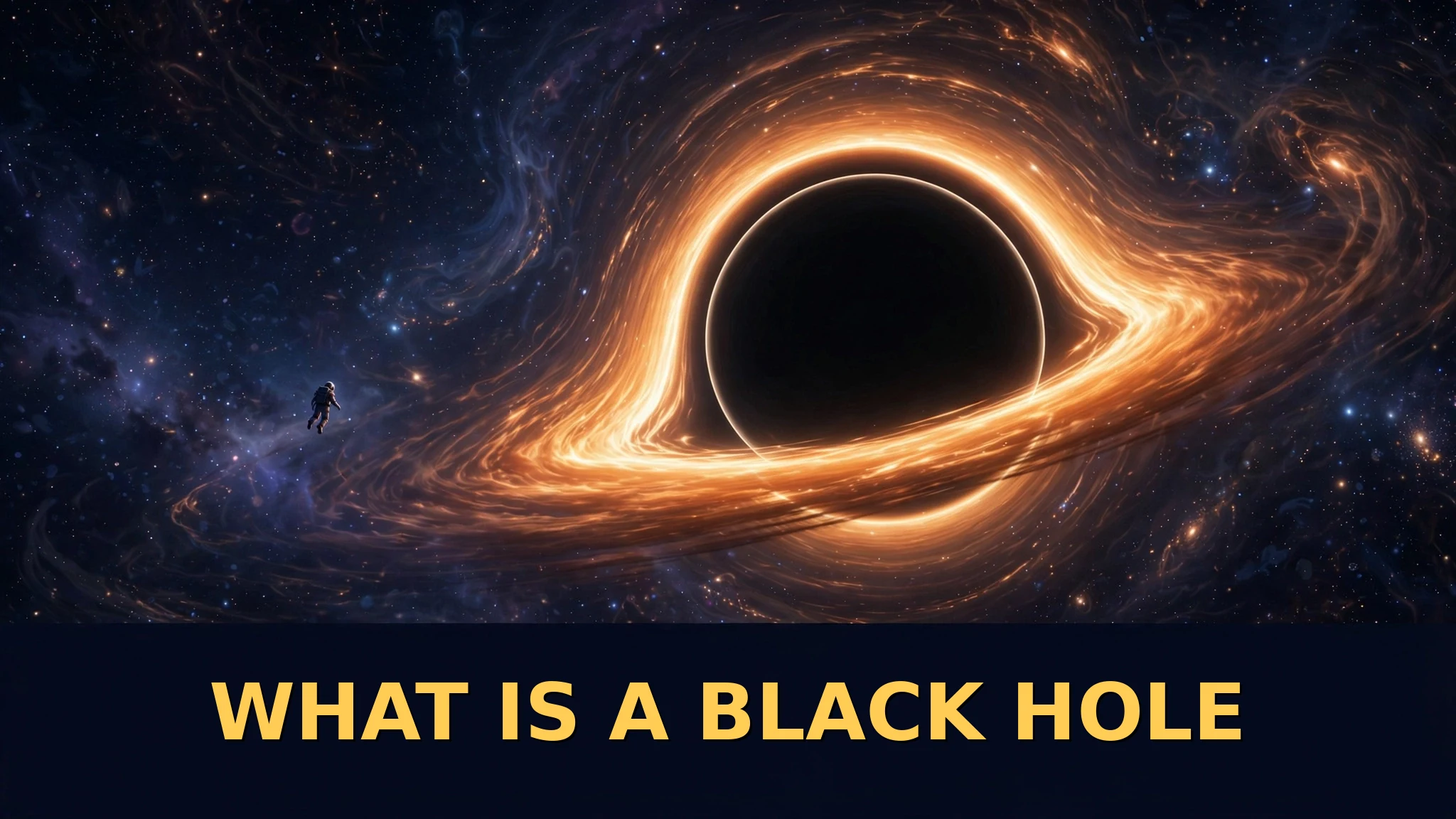
What Is A Black Hole
In this post
Look up at the night sky on a clear night. Every star you see is a giant ball of hot gas, shining far away. Now here is a strange and exciting thought: some of those stars, when they die, turn into something so dark that even light cannot come out of it. Scientists call that thing a black hole. It is one of the most searched questions in space — what is a black hole? Is it a hole? Is it dangerous? Can it swallow the Earth one day?
In this post, you will get simple and honest answers — the real story, step by step, the way scientists at NASA explain it.
A Black Hole Starts With A Dying Giant Star
A black hole is not a hole in space like a hole in the ground. It is a place in space where a huge amount of matter has been squeezed into a very tiny space. Because so much matter is packed into so small a place, its gravity — the pulling force — becomes unbelievably strong.
Most black holes are born from very big stars — much, much heavier than our Sun. A star shines because deep inside it, a kind of fire keeps burning. That fire pushes outward, while the star’s own weight pushes inward. For millions of years, the two pushes stay balanced, and the star lives a calm life.
But one day the fuel runs out. The fire becomes weak, and nothing can hold the star up against its own weight any more. Its heavy centre falls in on itself, while the outer parts blast outward in a huge explosion called a supernova. The centre keeps falling inward, smaller and smaller, crushed by its own gravity, until almost all of it is packed into a point: the singularity. Imagine a whole mountain squeezed into a tiny marble — that is the kind of squeezing we are talking about, and far beyond it.
The Event Horizon: The Border Of No Return
Around that crushed centre, there is an invisible border. Scientists call it the event horizon. This border is the most important part of the black hole story, so let us understand it slowly.
Everything in the universe has a speed limit: the speed of light. Nothing can travel faster. To escape from any planet or star, something must move fast enough to beat its gravity — a rocket leaving Earth, for example, must reach a very high speed. But inside the event horizon, the speed needed to escape is more than the speed of light itself, and that is impossible. So once anything crosses that border, it can never come back out. Not a rocket, not a signal, not even a beam of light.
That is why it is called “black”. Light is what lets us see things. If no light can come out of a place, that place looks perfectly black to our eyes and our telescopes. And anything falling in gets stretched longer and thinner by the extreme pull near the centre, like soft candy pulled from both ends — an effect scientists call spaghettification.
If It Is Invisible, How Do Scientists See A Black Hole?
This is the question every child asks, and it is a very good question. If a black hole gives out no light, how do we know it is there at all?
Scientists cannot see the black hole itself. But they can see what it does to the things around it. It is like a windy day: you cannot see the wind, but you can see the trees bending and the leaves flying, so you know the wind is real and strong.
First, there is the falling gas. Space is not fully empty; it holds clouds of gas and countless stars. When gas falls toward a black hole, it does not fall straight in. It circles around it, faster and faster, like water going around a drain. Moving that fast, the gas becomes extremely hot — millions of degrees — and throws out X-rays, a type of light our eyes cannot see but special space telescopes can. These X-rays are sent out before the gas crosses the border, so they escape and reach us. For scientists, that glow is a big sign: something heavy and dark is sitting there, eating.
Second, there are the orbiting stars. Stars near a black hole circle it the way Earth circles the Sun. By watching how fast they travel, scientists can work out how heavy the invisible thing in the middle must be. If that centre is far too heavy to be any normal star, yet gives out no light of its own, the answer is a black hole. NASA’s Hubble Space Telescope has used exactly this method — measuring fast-moving gas and stars — to confirm black holes at the centres of galaxies.
The First Photo Of A Black Hole In 2019
For many years, all the proof was indirect — bending trees, but never the wind itself. Then came April 2019, a date space lovers will always remember.
A worldwide team called the Event Horizon Telescope did something clever. No single telescope on Earth is sharp enough to picture a black hole, because black holes are so far away that they look tiny from here. So the team joined many radio telescopes in different countries and made them work together as one giant telescope — as big as the Earth itself.
Their first target was the giant black hole in the centre of a galaxy called Messier 87, known as M87*, about 53 million light-years away from us. The picture they released showed something beautiful and strange: a bright, glowing orange ring with a dark circle in the middle. The ring is super-hot gas circling the black hole. The dark circle is the black hole’s shadow — the place where light has been captured and cannot reach us. For the first time in history, human beings had seen the face of a black hole.
Later, the same team turned the same giant telescope system toward home — to the most interesting black hole of all, the one in our own galaxy.
Sagittarius A*: The Giant At The Heart Of Our Galaxy
Our galaxy, the Milky Way, has a supermassive black hole at its centre: Sagittarius A*, spoken as “Sagittarius A-star”. Supermassive means exactly what it sounds like — this is no small black hole made by one star. It carries the mass of about four million Suns, packed into one dark place at the galaxy’s heart.
Astronomers had watched stars near the Milky Way’s centre racing around an invisible point at amazing speeds, and the maths kept giving the same answer: only a supermassive black hole could pull them like that. In 2022, the Event Horizon Telescope team released the first picture of Sagittarius A* too — again a glowing ring around darkness, shimmering in the image because the gas around it moves and changes so fast.
Here is the part that surprises most people: our galaxy’s giant black hole is quiet. Compared with some other galactic black holes, it takes in only a small amount of material. The stars around it — including our Sun, at a very safe distance — keep following their normal paths around the galaxy’s centre, as they have done for billions of years.
Is Earth In Danger From A Black Hole?
Now the honest answer to the question in everyone’s mind: should we be scared?
No. And the reasons are simple.
First, black holes are not hungry monsters roaming around space swallowing planets. A black hole pulls strongly only on things that come very close. Far away, its gravity behaves like the gravity of any object of the same weight. NASA gives a helpful example: if our Sun were replaced by a black hole of exactly the same mass, Earth would keep circling it in the same orbit as today. We would suffer from cold and darkness, with no sunlight — but gravity would not suddenly drag us in.
Second, distance protects us. Sagittarius A* is more than 26,000 light-years away — and one light-year is the distance light travels in a full year, so imagine how far that really is. No known black hole is anywhere near our solar system, and black holes do not travel around hunting planets. Our Sun, by the way, will never become a black hole at all; it is far too small.
Black holes are extreme, strange, and worth studying — but they endanger nothing except the unlucky gas and stars that wander too close.
One last wonder: near a black hole, time itself passes more slowly, as Einstein’s theory of general relativity predicted long before any photo existed — and the glowing rings in the photos match what that theory expected. Studying these strange objects is also how we learn how galaxies like ours were born and grew.
Frequently Asked Questions
Is a black hole really a hole? No. It is not an empty hole or a tunnel, but a huge amount of matter crushed into a very small space, which makes its gravity extremely strong.
Can a black hole swallow the whole universe? No. It only affects things that come close to it. Far away, its pull is like that of any object with the same mass, and the universe is far too big and spread out.
What happens if something falls into a black hole? Once it crosses the event horizon, it can never come back out, because escaping would need a speed faster than light. Near the centre, the pull stretches matter extremely thin — spaghettification.
How did scientists take a photo of something invisible? They did not photograph the black hole itself. With the Event Horizon Telescope — many radio telescopes working as one Earth-sized telescope — they captured the glowing hot gas around it. The dark middle is the black hole’s shadow.
Will the Sun become a black hole one day? No. Only very massive stars, much heavier than the Sun, can collapse into black holes. The Sun is too small and will end its life in a much quieter way.
Sources
- NASA, “Black Holes” — Imagine the Universe: https://imagine.gsfc.nasa.gov/science/objects/black_holes2.html
- NASA Science, “Hubble Black Holes”: https://science.nasa.gov/mission/hubble/science/universe-uncovered/hubble-black-holes/
- NASA Jet Propulsion Laboratory, “Telescopes Get Extraordinary View of Milky Way’s Black Hole”: https://www.jpl.nasa.gov/edu/resources/teachable-moment/telescopes-get-extraordinary-view-of-milky-ways-black-hole/
- The picture on this page is an original illustration made for Talha M Blog.