How Esports Became Big Business
In this post
- From Arcades to Internet Cafés: The Early Years
- Streaming Changed Everything: Twitch and YouTube
- Tournaments, Prize Money and Stadium Events
- Teams, Franchises and the League Model
- Sponsorship, Media Rights and the Money Flow
- Players as Athletes: Training, Health and Careers
- Esports in Schools, Universities and Mainstream Culture
- Challenges: Sustainability, Regulation and Fair Play
- The Future: Mobile, Global Growth and New Audiences
- How Esports Is Watched: Broadcasts, Casters and Fan Culture
- Esports and Traditional Sports: Learning From Each Other
- My Take:
Esports, competitive video gaming played by professionals in front of live and online audiences, grew from arcade contests and bedroom tournaments into a global industry worth billions of dollars in reported revenue. Today, major tournaments fill stadiums, streaming audiences rival traditional sports broadcasts, sponsors invest heavily, and professional players earn salaries, prize money, and endorsement income. Understanding how that happened means tracing a path from early arcade high scores, through internet cafés and online streaming, to franchised leagues, global tournaments, and mainstream media coverage.
From Arcades to Internet Cafés: The Early Years
Competitive gaming began long before esports had a name. In the 1970s and 1980s, arcade players competed for high scores, and early tournaments, such as Atari’s Space Invaders championship in 1980, attracted thousands of participants. Those events were novelties rather than industries, but they proved a basic point: people enjoy watching skilled players compete, even when the game is simple. In the 1990s, fighting games, real-time strategy games, and first-person shooters created head-to-head competition in arcades and on early home computers, with local tournaments in game shops and community halls.
In South Korea, internet cafés, known as PC bangs, became crucial to esports growth. Affordable hourly computer access let young players practise StarCraft and other strategy games for hours, while local tournaments and television channels turned top players into celebrities. South Korea’s fast broadband, dense cities, and gaming culture created a model that other countries later copied: accessible venues, regular competitions, and media coverage that treated gamers as athletes. Without that early Korean ecosystem, esports might have remained a niche hobby in the West for much longer.
Streaming Changed Everything: Twitch and YouTube
The decisive turning point for esports business was streaming. Before Twitch and YouTube Gaming, watching esports required attending an event, buying a DVD, or finding a low-quality stream. Streaming made tournaments free, global, and interactive: fans could watch live from anywhere, chat with each other, follow favourite players, and subscribe to channels. That accessibility transformed audience size. A tournament final that once attracted thousands in a hall could now attract millions online, with peak viewers, chat activity, and social media clips spreading excitement far beyond the venue.
Streaming also created new careers. Professional players became streamers, coaches became analysts, and commentators became personalities with their own followings. Sponsors noticed that esports audiences were young, digitally fluent, and hard to reach through traditional television advertising. Brands that once ignored gaming began sponsoring teams, tournaments, and streamers, buying naming rights, product placements, and branded content. Streaming platforms themselves became businesses, earning revenue from advertising, subscriptions, and donations, while sharing income with creators who attracted audiences. That creator economy is central to modern esports business.
Tournaments, Prize Money and Stadium Events
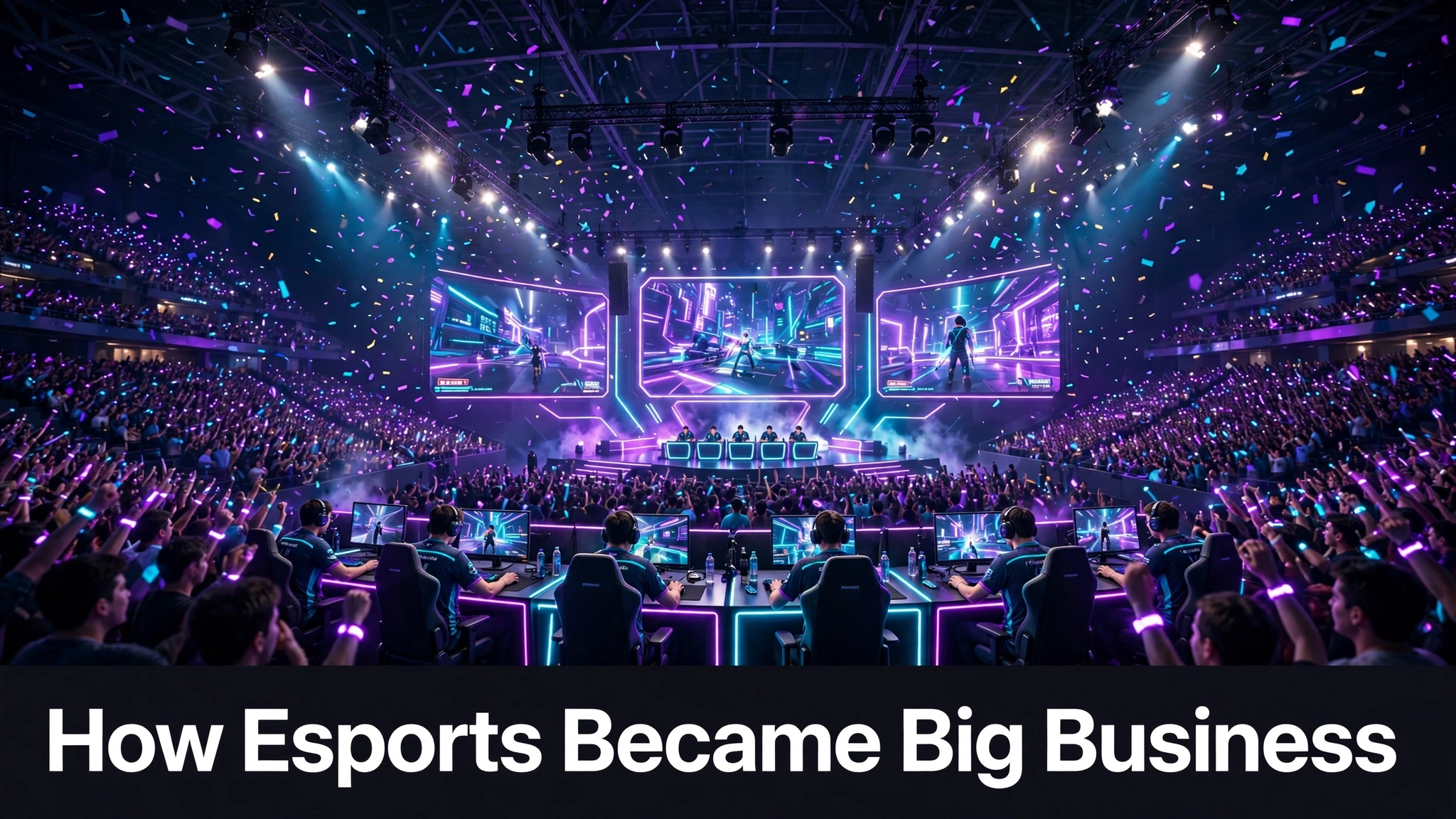
Major tournaments turned esports into spectacle. Games such as League of Legends, Dota 2, Counter-Strike, Valorant, and Fortnite developed annual world championships with large prize pools, professional production, live audiences, and global broadcasts in multiple languages. Dota 2’s International famously used crowdfunding, with fans buying in-game items that added to the prize pool, producing prize totals that at times exceeded those of many traditional sports events. League of Legends World Championship finals have filled stadiums and attracted tens of millions of viewers, with opening ceremonies, music performances, and elaborate stage production rivalling major sports finals.
Prize money, however, is only part of player income. Top players earn salaries from teams, streaming revenue, sponsorship deals, and content creation, which can be more stable than tournament winnings. Lower-tier players face a harder reality: many earn little, compete without contracts, and struggle to break into top leagues. That gap between stars and aspiring professionals is a real challenge for esports, similar to the gap in traditional sports, where only a small elite earns large incomes. Sustainable business models must therefore support development leagues, academy teams, and player welfare, not only showcase finals.
Teams, Franchises and the League Model
As esports grew, teams professionalised. Early teams were groups of friends sharing prize money and travel costs. Modern teams are organisations with owners, managers, coaches, analysts, physiotherapists, content creators, and commercial staff. They sign players to contracts, provide training facilities, known as gaming houses or performance centres, and build brands through merchandise, social media, and fan engagement. Some teams became famous beyond a single game, with fans following the organisation across multiple titles, much like following a football club across competitions.
Franchised leagues, modelled partly on American sports, changed team economics further. In franchised systems, a limited number of teams buy permanent slots in a league, sharing revenue and gaining stability, rather than facing relegation each season. That stability attracted investors, including traditional sports owners, celebrities, and venture capital firms, who saw esports as a growth market. Franchising also brought risks: high buy-in costs, pressure to deliver returns, and concerns that closed leagues limit opportunities for new teams. Some leagues later adjusted or abandoned franchising, showing that esports is still experimenting with the best business model.
Sponsorship, Media Rights and the Money Flow
Esports revenue comes from several streams, and understanding them explains why the industry grew so fast. Sponsorship is the largest stream in many reports, with brands paying to associate with teams, players, tournaments, and streams. Media rights, payments from broadcasters and platforms to show tournaments, grew as audiences grew, though they remain smaller than in traditional sports. Merchandise, tickets, in-game purchases, and publisher revenue also contribute, with game publishers playing a unique role: unlike football, where no single company owns the sport, each esport is owned by a publisher who controls rules, updates, and competitive licences.
That publisher control is both a strength and a risk. Publishers can invest in tournaments, balance games for competition, and promote esports through in-game events, which helps growth. But publishers can also change a game, reduce support, or close a competitive scene, leaving teams and players vulnerable. Successful esports therefore depend on a partnership between publishers, tournament organisers, teams, and players, with clear rules, revenue sharing, and long-term planning. When that partnership works, everyone benefits; when it breaks down, players and fans suffer most.
Players as Athletes: Training, Health and Careers
Professional esports players train intensely, often for eight to twelve hours a day, practising mechanics, strategies, team communication, and review of past matches. Coaches analyse opponents, design tactics, and manage team dynamics, much like in traditional sports. Reaction time, hand-eye coordination, decision-making under pressure, and teamwork are all trained systematically. Top teams now employ sports psychologists, fitness coaches, and nutritionists, recognising that physical health affects mental performance, even in a seated sport.
Player welfare has become a major discussion. Long hours, repetitive strain injuries, eye strain, poor posture, burnout, and mental health pressures affect many professionals, especially teenagers who enter the industry early. Short careers are common: many players peak in their late teens or early twenties, then retire due to declining reaction time, burnout, or team changes. Responsible organisations now limit practice hours, provide exercise programmes, support education, and plan post-career transitions into coaching, analysis, content creation, or management. Fans and sponsors should support those welfare measures, because healthy players produce better competition and longer careers.
Esports in Schools, Universities and Mainstream Culture
Esports has entered education and mainstream culture in ways that would have seemed impossible twenty years ago. Schools and universities run esports programmes, teams, and scholarships, treating competitive gaming as an extracurricular activity that teaches teamwork, communication, strategy, and digital skills. Universities in the United States, South Korea, and other countries offer esports degrees, management courses, and varsity teams, while high schools use esports to engage students who may not participate in traditional sports. That educational growth gives esports legitimacy and creates new jobs in coaching, production, marketing, and event management.
Mainstream culture followed: celebrities, athletes, and musicians invested in teams, appeared in tournaments, or played games with professionals. Traditional sports clubs launched esports divisions, broadcasters added esports coverage, and major events such as the Asian Games included esports as medal events in some editions. The Olympic movement has also explored esports, though debates continue about which games fit Olympic values, especially violent titles. That debate itself shows how far esports has come: it is no longer asking for attention, it is being asked to fit into the world’s most prestigious sporting institutions.
Challenges: Sustainability, Regulation and Fair Play
Despite growth, esports faces serious challenges. Match-fixing, cheating, doping with performance-enhancing substances, and underage exploitation have all occurred, and the industry needs stronger regulation, independent oversight, and player unions to address them. Revenue volatility is another risk: sponsorship spending can fall during economic downturns, streaming audiences can shift to new platforms, and a game’s popularity can fade quickly when a new title appears. Teams that spend heavily on salaries and facilities without sustainable revenue can collapse, leaving players unpaid and fans disappointed.
Regulation is complicated by global reach and publisher ownership. Different countries have different laws on gambling, age restrictions, labour rights, and broadcasting, while tournaments cross borders online. Player contracts, transfer rules, and dispute resolution vary by game and league, creating confusion. The industry is gradually developing standards, including player associations, codes of conduct, and anti-cheat systems, but progress is uneven. For esports to become a stable, long-term business rather than a boom-and-bust cycle, it needs transparent governance, fair revenue sharing, and protection for its youngest and most vulnerable participants.
The Future: Mobile, Global Growth and New Audiences
The future of esports is likely to be more mobile, more global, and more diverse. Mobile esports already dominates in parts of Asia, Africa, and Latin America, where smartphones are more accessible than gaming PCs or consoles. Mobile titles attract huge audiences, lower entry costs, and create opportunities for players who cannot afford expensive equipment. That shift could reshape which games, regions, and business models dominate esports in the next decade, with South Asia, Southeast Asia, and the Middle East playing larger roles.
Virtual reality, augmented reality, and new streaming technologies may also change how fans watch and interact with esports, from virtual arenas to interactive broadcasts where viewers influence camera angles or vote on highlights. Artificial intelligence may improve coaching analysis, anti-cheat detection, and personalised viewing. Yet the core appeal will remain human: skilled players competing under pressure, teams working together, and fans sharing excitement in real time. Technology will change the packaging, but not the fundamental reason people watch: they want to see excellence, drama, and stories unfold live.
How Esports Is Watched: Broadcasts, Casters and Fan Culture
Esports broadcasts differ from traditional sports broadcasts in ways that explain their appeal to young audiences. Matches are streamed with multiple camera angles, in-game viewpoints, instant replays, and data overlays showing gold, kills, objectives, and player statistics in real time. Casters, the commentators of esports, combine play-by-play excitement with analytical insight, explaining complex strategies in simple language for new viewers while satisfying experienced fans with deeper detail. Analyst desks break down drafts, rotations, and team fights between maps, using telestrators and replays much like football pundits, but with a faster, more informal style that suits streaming culture.
Fan culture in esports is participatory in a way traditional sports rarely match. Fans create memes, highlight clips, fan art, and analysis videos within minutes of a match ending, spreading moments across social media far beyond the original broadcast. They follow players on streaming platforms daily, not only during tournaments, building personal connections that keep interest alive between events. Cosplay, watch parties, and online communities turn tournaments into social events, even for fans watching alone at home. That participation is a business asset: engaged fans buy merchandise, subscribe to channels, attend events, and attract sponsors, creating a cycle where community growth drives commercial growth, which in turn funds better production and larger tournaments.
Esports and Traditional Sports: Learning From Each Other
Traditional sports and esports often compete for attention, sponsors, and young audiences, but they can also learn from each other in practical ways. Traditional sports have decades of experience in governance, youth protection, anti-doping, and league stability, while esports has expertise in streaming, digital fan engagement, and global online competition. Football clubs that launched esports teams learned about streaming audiences and content creation, while esports organisations that hired traditional sports managers learned about sponsorship sales, facility management, and player welfare systems. That exchange benefits both sides, provided each respects the other’s strengths rather than assuming one model fits every sport. The future of sports entertainment is likely to blend live stadium atmosphere with digital interactivity, and organisations that learn across that divide will adapt fastest.
Broadcasting rights form another revenue layer that separates modern esports from its early tournament days. Major events now sell streaming and broadcast packages, and platforms compete for exclusive coverage because live matches hold viewers for hours, unlike short video clips. Advertisers value that attention, and organisers use it to fund larger prize pools, better production, and player salaries. The risk is dependence on a single platform or game publisher, so successful leagues spread coverage across several channels and regions. When audiences can watch free or cheaply, the crowd grows, and that crowd is the asset every sponsor and broadcaster is ultimately paying to reach.
My Take:
My take is that esports became big business because it solved a problem traditional sports struggled with: reaching young audiences where they already spend time, online, interactively, and globally. I remember when gaming was dismissed as a waste of time, and I find it remarkable how quickly that perception changed once streaming let anyone watch a world final for free, chat with fans worldwide, and follow a favourite player daily. That accessibility is esports’ greatest strength, and traditional sports should learn from it rather than dismiss it. A sport that is easy to watch, easy to understand at a basic level, and easy to follow between events will grow faster than a sport hidden behind paywalls and infrequent broadcasts.
I also believe esports must take player welfare and sustainability more seriously if it wants to be respected as a long-term industry rather than a trendy boom. The stories of young players burning out, suffering wrist injuries, or retiring at 22 with no education or savings should trouble fans and sponsors alike. Teams that invest in health, education, reasonable practice hours, and post-career planning are not being soft; they are being professional, in the same way football clubs invest in academies and medical teams. Sponsors should reward teams with good welfare records, and fans should celebrate organisations that treat players as people, not only as content. A business built on exhausted teenagers will not last, but a business built on healthy, supported professionals can grow for decades.
Another point I feel strongly about is that esports should not try to copy traditional sports exactly, nor should traditional sports try to control esports. Esports has its own strengths: global online audiences, creator culture, rapid innovation, and accessibility for players who cannot afford traditional sports equipment or facilities. It also has its own weaknesses: publisher control, short game lifespans, and uneven regulation. The future lies in learning from each other while respecting differences. Traditional sports can learn about streaming, fan interaction, and digital engagement from esports, while esports can learn about governance, youth protection, and long-term league stability from traditional sports. That mutual learning will benefit both worlds far more than rivalry or imitation.
Finally, I think the most exciting part of esports’ future is its global, inclusive potential. A talented player in a small town with a smartphone and internet access can practise, compete online, and be discovered without moving to a major city or joining an expensive academy. That accessibility gives esports a democratic promise that many traditional sports struggle to match. If the industry protects that promise with fair pathways, affordable entry, and support for players from poorer regions, it will continue to grow in places traditional sports have overlooked. If it becomes only a closed world of wealthy franchised teams and expensive equipment, it will lose what made it special. The business is already big; the challenge now is to make it fair, sustainable, and open, so that the next generation of players and fans can belong to it too. I also think parents and teachers should take esports seriously without fearing it blindly. Gaming, like any passion, needs balance: time for study, exercise, sleep, and family, alongside time for play and competition. A child who plays esports in a structured team, with a coach, a schedule, and clear expectations, learns teamwork, communication, and discipline, just as in traditional sports. A child who plays alone for endless hours without structure, sleep, or exercise faces real risks. The difference is not the game itself, but the environment around it. Schools, clubs, and families that provide structure, coaching, and welfare support will help young players enjoy esports safely, while those that ignore it entirely will miss a chance to guide a passion that young people already have.
Another point worth making is about careers beyond playing. Esports needs casters, analysts, producers, event managers, marketers, coaches, referees, and developers, and those careers often last longer than playing careers. Young fans who love esports but do not become professional players can still build meaningful work in the industry by learning broadcasting, video production, data analysis, or community management. Universities and training programmes should therefore teach those skills alongside playing, so that esports creates a full ecosystem of jobs, not only a narrow path for a few stars. That broader ecosystem also makes the industry more resilient, because it does not depend solely on the popularity of one game or the success of one team.
Finally, I would ask sponsors and publishers to remember the fans who built esports before it was profitable. Early fans watched low-quality streams, attended small tournaments, and supported players without salaries or fame, because they loved the games and the competition. Those fans deserve affordable viewing, fair ticket prices, and respect for community content, not only premium products aimed at wealthy audiences. If esports honours its community roots while growing professionally, it will keep the loyalty that made it big in the first place. Growth without community trust is fragile, but growth built on community, fairness, and player welfare can last for generations, and that is the kind of big business esports should aspire to be. One final practical point for aspiring players: treat education and skill-building as part of your esports plan, not as a distraction from it. Learn communication, analysis, and time management alongside mechanics, because those skills help in teams, in streaming, and in any career after playing. A player who can explain a strategy clearly, review a match honestly, and manage a schedule reliably is valuable to teams even when form dips, and employable far beyond gaming when a playing career ends. Esports rewards talent, but it sustains people who combine talent with professionalism, learning, and respect for teammates, fans, and opponents alike. That combination of skill, character, and continuous learning is what turns a promising player into a lasting professional, and it is what will keep esports growing responsibly for many years to come, for players, teams, and fans everywhere around the world, today and in the future.
A quieter driver of the business is the grassroots pipeline that now feeds professional teams. School and university leagues, local gaming cafes, and open online qualifiers give unknown players a route in without an agent or a famous name. Scouts watch these smaller events because raw reaction speed and teamwork show up early, long before a player reaches a major stage. Sponsors have followed the same path, backing amateur tournaments to reach young audiences who ignore traditional advertising. This bottom-up system keeps the talent pool wide and explains why new stars keep appearing from countries that had no esports history a decade ago.
Frequently Asked Questions
What is esports?
Esports is professional competitive video gaming, where players and teams compete in organised tournaments watched by live and online audiences.
How do esports players earn money?
Players earn salaries from teams, tournament prize money, streaming revenue, sponsorship deals, and content creation, though incomes vary greatly between stars and lower-tier players.
Which games have the biggest esports scenes?
League of Legends, Dota 2, Counter-Strike, Valorant, and Fortnite are among the largest, with major annual tournaments, large audiences, and significant prize pools.
Why did streaming help esports grow?
Streaming made tournaments free, global, and interactive, allowing millions to watch live, chat, and follow players, which attracted sponsors and mainstream attention.
Is esports a real sport?
Esports involves training, strategy, teamwork, and competition under pressure, and it is recognised in events such as the Asian Games, though debate continues about its status in the Olympic movement.
What are the biggest risks in esports?
Risks include player burnout and injuries, unsustainable team spending, match-fixing and cheating, publisher control over games, and uneven regulation across countries.