How to Organize a Small Kitchen: Ideas
In this post
- Start by Decluttering Before You Buy Storage
- Create Zones: Prep, Cook, Clean, and Store
- Use Vertical Space, Walls, and Doors
- Drawers, Cupboards, and Counter Rules That Actually Work
- Food Storage, Labelling, and Shopping That Support Order
- Small Kitchen Layouts, Lighting, and Safety
- Organizing for Different Cooks: Families, Singles, and Renters
- Keeping Order When Life Gets Busy: Weekly Resets and One-In-One-Out
- Budget Organization: Free Fixes Before Paid Products
- Kitchen Safety, Cleaning, and Zones for Small Spaces
- My Take:
A small kitchen does not have to feel cramped, chaotic, or impossible to cook in. Most small kitchens suffer not from lack of space but from lack of zones, too many rarely used items, and counters used as storage instead of workspace. Organising a small kitchen means giving every item a logical home, using walls and doors, keeping daily tools within reach, and moving occasional tools elsewhere. It also means accepting trade-offs: a kitchen that works well may hold fewer gadgets, fewer duplicate tools, and clearer counters. This guide gives practical ideas that work in rented flats, family kitchens, and tight budgets, without requiring a full renovation.
Start by Decluttering Before You Buy Storage
Buying boxes before decluttering is the most common organising mistake. New containers hide clutter instead of removing it, and they cost money while the real problem remains too many items. Begin by emptying one cupboard at a time, not the whole kitchen at once. Sort items into keep, move elsewhere, donate, and discard. Keep daily tools: one good knife set or a few essential knives, one cutting board for vegetables and one for meat if you cook both, a few pans that cover most meals, and plates and cups matched to household size plus a small margin for guests. Move seasonal or party items to a higher shelf, another room, or a labelled box.
Check duplicates honestly. Many kitchens hold three spatulas, four baking trays, and gadgets used once a year. Keep the best version of each tool and let the rest go. Check expiry dates in food cupboards, discard stale spices that have lost flavour, and combine half-empty packets. A decluttered kitchen often reveals surprising space: a half-empty cupboard, a drawer that can hold utensils, a shelf freed for daily food. Only after this step should you measure spaces and buy storage that fits actual items, not imagined ones. Decluttering first also saves money, because you buy fewer containers and avoid storing things you will never use.
Create Zones: Prep, Cook, Clean, and Store
Professional kitchens work by zones, and small kitchens benefit even more from this idea. Divide your kitchen into four zones, even if zones overlap on one counter. The prep zone needs a cutting board, knives, bowls, and easy access to vegetables and spices. The cooking zone needs pans, oils, spatulas, and heat-safe tools near the hob. The cleaning zone needs the sink, dish rack, bin, and cleaning supplies. The storage zone needs food, plates, cups, and dry goods. When zones are clear, cooking becomes a flow rather than a search.
Place items where they are first used, not where they look tidy. Plates near the dishwasher or drying area save steps, spices near the prep or cooking area save reaching across the room, and cleaning supplies under the sink save trips. Keep the counter between sink and hob as clear as possible, because that is usually the main prep space. If only one counter exists, use a large cutting board over the sink or a foldable shelf as temporary prep space, then clear it after cooking. Label zones mentally for family members so everyone returns items to the same place. Zones reduce arguments, speed up cooking, and make a small kitchen feel larger because movement has purpose.
Use Vertical Space, Walls, and Doors
Small kitchens often waste vertical space while counters overflow. Walls above counters, the sides of cupboards, and the inside of doors can hold many daily items without taking counter space. Install a rail with hooks for utensils, mugs, or measuring cups, keeping them visible and reachable. Use magnetic strips for knives, but place them safely away from children’s reach and where blades will not fall on food areas. Hang pots from a sturdy rail or hooks if ceiling height and landlord permission allow, and use the inside of cupboard doors for spice racks, measuring spoons, or cleaning charts.
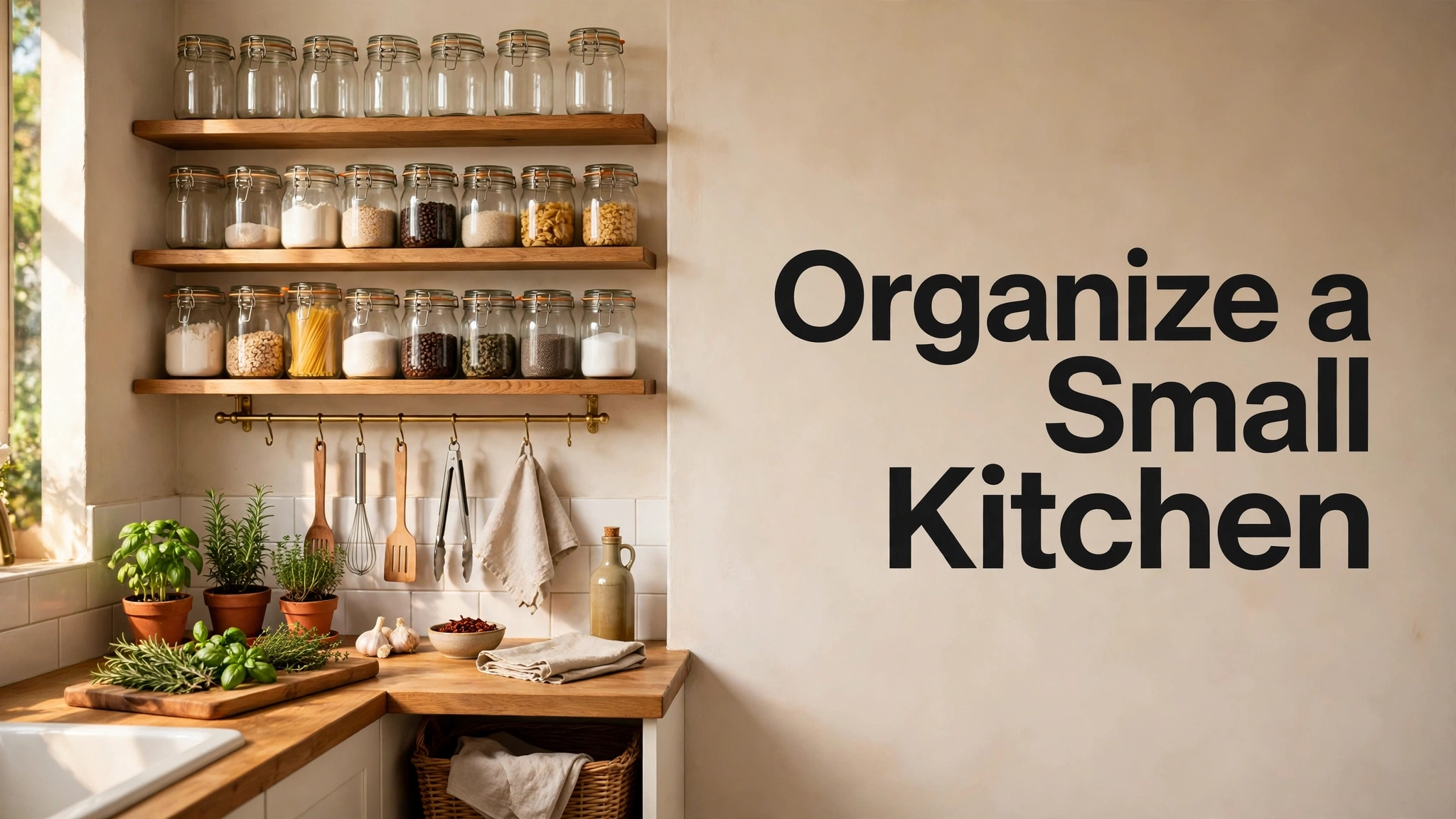
Shelving needs care: open shelves look beautiful but require discipline, because clutter on open shelves looks messy instantly. Use open shelves for attractive daily items, such as plates, bowls, or jars, and closed cupboards for mixed or less attractive items. Stack shelves inside tall cupboards to use height, and use shelf risers so small items do not hide behind tall ones. Stackable bins and turntables, sometimes called lazy Susans, help in deep corner cupboards where items disappear. Always measure before buying, check weight limits, and use secure fixings for wall storage, especially above cooking areas where heat and steam occur.
Drawers, Cupboards, and Counter Rules That Actually Work
Drawers work best with dividers, not loose piles. Use adjustable dividers or small trays to separate cutlery, cooking tools, and gadgets. Keep sharp tools in a tray or knife block, not loose where hands reach blindly. A single junk drawer is acceptable if it is contained: limit it to one drawer, use small boxes inside, and clear it monthly. Without a limit, junk spreads to every drawer. In cupboards, group like with like: baking together, breakfast together, canned food together, and cleaning supplies together. Put heavy items low, light items high, and daily items at eye level.
Counter rules protect workspace. Allow only daily items on counters: a kettle or coffee maker if used daily, a knife block, a fruit bowl, and perhaps a small tray for oils. Everything else lives in a cupboard. Appliances used weekly, such as a blender or food processor, can live on a high shelf or in another room if kitchen space is truly tight. Use trays to group counter items so they look intentional and can be moved as one unit for cleaning. Clear counters after each meal, not at the end of the day, because evening clearing feels larger and more tiring. A clear counter invites cooking, while a crowded counter invites takeaway and waste.
Food Storage, Labelling, and Shopping That Support Order
Food storage is where small kitchens either stay organised or collapse. Use clear, stackable containers for flour, rice, lentils, and cereals, because seeing contents prevents buying duplicates and helps you notice low stock. Label containers with contents and purchase or expiry dates where relevant, especially for spices and baking items. Store food by category and by use: breakfast foods together, cooking staples together, snacks in one box that can be lifted out for children or guests. Keep a small basket for items to use first, such as food near expiry, and check it before shopping.
Fridge organisation mirrors cupboard organisation. Keep ready-to-eat food on upper shelves, raw meat sealed on lower shelves where it cannot drip, and condiments in the door. Use one clear box for small jars so they do not fall behind larger items. Shop with a list based on what you already own, and avoid bulk buying perishables for a small kitchen unless you have freezer space and a plan to use them. A small kitchen stays organised when shopping matches storage capacity. Overbuying, even at a good price, creates clutter, waste, and extra cleaning, which costs more than the saving.
Small Kitchen Layouts, Lighting, and Safety
Layout choices affect how large a small kitchen feels. Keep pathways clear, avoid blocking the fridge or oven doors with bins or racks, and leave enough space to open cupboards fully. A foldable table or a wall-mounted drop-leaf table can serve as extra prep space or a dining spot without permanently taking floor space. Rolling trolleys are useful because they can move to where work happens and tuck away afterwards, but they must not block exits or create tripping hazards. Choose light colours for storage boxes and keep lighting bright over prep areas, because dark corners hide clutter and make cooking harder.
Safety matters more in tight spaces. Keep flammable items away from the hob, store knives safely, avoid overloading wall shelves, and keep cleaning chemicals separate from food and out of children’s reach. Ventilation helps too: use an extractor or open a window while cooking to reduce grease settling on surfaces. Clean as you cook where possible, because a small kitchen fills with dishes quickly and a tidy-as-you-go habit prevents a mountain at the end. Finally, review organisation every few months. Households change, cooking habits change, and a system that worked last year may need one shelf moved or one category changed. Small adjustments keep the system alive.
Organizing for Different Cooks: Families, Singles, and Renters
A family kitchen, a single-person kitchen, and a renter kitchen need different organisation, even in the same small space. Families need durable zones, child-safe storage, and a snack box children can reach without climbing. Keep sharp tools and cleaning products high or locked where needed, and keep children’s plates and cups low so they can help set tables. Singles can keep fewer plates and pans, use smaller containers, and free a whole cupboard for work or hobby storage if cooking is simple. Renters should favour removable solutions: tension rods, over-door racks, adhesive hooks that remove cleanly, and freestanding trolleys, rather than drilling or permanent shelves without permission.
Shared kitchens need extra clarity. Label shared versus personal items where needed, agree on counter rules, and keep communal tools in obvious zones so new housemates learn quickly. A small whiteboard or label on a cupboard door can prevent daily questions. For cooks with limited mobility, place daily tools at waist height, use pull-out shelves or turntables to avoid deep reaching, and keep heavy pots low but reachable without lifting overhead. Organisation should fit the people who actually cook, not an ideal cook in a magazine. When a system fits its users, it survives busy weeks; when it fits only a photograph, it collapses at the first busy dinner.
Keeping Order When Life Gets Busy: Weekly Resets and One-In-One-Out
Even a good system drifts when life gets busy, so plan a short weekly reset instead of waiting for chaos. Once a week, spend fifteen minutes returning stray items to zones, wiping one shelf, checking food near expiry, and clearing the junk drawer if it overflowed. A weekly reset is far easier than a monthly overhaul, and it keeps small problems small. Combine the reset with another routine, such as after weekly shopping or before a weekend meal, so it becomes a habit rather than an extra chore. Involve family by assigning one zone per person for the reset, which keeps it fast and fair.
A one-in-one-out rule prevents slow re-cluttering. When a new gadget, pan, or set of plates enters a small kitchen, an old or duplicate item leaves. This rule forces honest choices: is the new item better than what it replaces, and will it be used weekly? Seasonal items deserve a separate review twice a year: keep what was used last season, store or donate what was not. If an item has not been used in a year and is not seasonal or sentimental, it is a strong candidate to leave. Small kitchens stay organised not by one big effort but by these small, repeated decisions that protect space for daily cooking.
Budget Organization: Free Fixes Before Paid Products
Small kitchen organisation does not require a large budget, and the best order is free fixes first, cheap fixes second, and larger purchases last. Free fixes include decluttering, rezoning, labelling with paper and tape, and clearing counters after meals. Cheap fixes include drawer dividers made from small boxes, shelf risers, adhesive hooks where allowed, and one turntable for a problem cupboard. Measure before buying any of these, and buy one item, test it for a week, and only then buy more. Bulk buying organisers before testing often creates a drawer full of unused plastic that itself needs organising.
Larger purchases, such as a rolling trolley, wall rail, or extra shelving, should solve a proven problem, not a hoped-for one. Check weight limits, landlord rules, and cleaning access before installing anything permanent. A trolley that blocks a door, a rail that cannot hold pots safely, or a shelf that collects grease above a hob can make a kitchen worse. Keep receipts and original fittings for rented homes. The most budget-friendly kitchen is one where fewer items are owned, each item has a zone, and storage is added slowly to support that system. Saving money and saving space often come from the same decision: own less, place wisely, and maintain weekly.
Kitchen Safety, Cleaning, and Zones for Small Spaces
Organisation and safety overlap in small kitchens because tight spaces increase risks. Keep knives in a block or tray, store heavy pots low, and keep cleaning chemicals separate from food in a labelled box out of children’s reach. Wipe spills immediately, because a small kitchen floor becomes slippery quickly, and keep a fire blanket or extinguisher accessible if you have one, following local safety guidance. Clean as you cook, because cluttered counters near a hot hob create hazards as well as stress. Check that oven, hob, and fridge doors open fully without hitting bins or trolleys, and keep exits clear at all times.
Cleaning routines support organisation. Wipe cupboard fronts weekly, clean the sink daily, and deep-clean one zone monthly on rotation, such as spices in one month and baking in the next. That rotation prevents a single overwhelming clean and keeps zones honest. Use washable shelf liners in food cupboards where helpful, and label cleaning products clearly so family members do not confuse them with food. A small kitchen that is organised, clean, and safe feels larger and calmer, because movement is predictable and hazards are visible. Safety is not an extra task; it is the reason zones, clear counters, and labelled storage matter in the first place.
My Take:
I used to think my small kitchen was a problem to endure until I could afford a bigger one. I blamed the size for every frustration: no counter space, no room for guests, nowhere to put a new gadget. Then I decluttered one cupboard properly and discovered the real problem was not size but accumulation. I owned tools for meals I never cooked, plates for guests who rarely came, and food I had forgotten. Removing those items did not make the kitchen larger, but it made it usable, and usability changed my mood about cooking. A kitchen that works feels larger than a kitchen that merely looks large in a photograph.
Zones changed cooking for me more than any storage product. Before zones, I walked back and forth across a tiny room, opening cupboard after cupboard, while food burned or vegetables waited. After zones, my hands learned where things lived, and cooking became calmer. I could chop while a pan heated, clean a board while rice cooked, and finish a meal without a frantic search. That calm matters, especially after a long workday when energy is low. A well-zoned small kitchen respects tired cooks. It does not demand perfection; it reduces decisions at the exact moment decisions feel hardest.
I also learned to resist beautiful organisation that does not survive real life. Matching jars and open shelves look wonderful online, but in my home they required constant tidying and dusting, and they made me feel guilty when life got busy. I now prefer closed cupboards for most items and a few clear containers for staples I actually use. Beauty in a working kitchen means clear counters, labelled food, and tools that return to the same place without thought. That kind of beauty lasts through a busy week, while picture-perfect beauty often lasts until the first family dinner. I would rather have a kitchen that stays organised on a tired Tuesday than one that photographs well on a Sunday.
Money was another lesson. I once bought storage boxes, racks, and organisers hoping they would fix the kitchen, and they mostly added clutter. The cheapest and most effective changes were free: removing duplicates, moving plates near the sink, putting spices near cooking, and clearing counters after meals. Only after those free changes did I buy two items that truly helped: drawer dividers and a turntable for a deep cupboard. Buying after decluttering meant every purchase solved a known problem. For anyone on a tight budget, that order matters. Storage should serve a system, not replace one.
There is also a family lesson here. In a small kitchen, one person’s mess affects everyone immediately, because there is nowhere for mess to hide. Shared rules therefore matter more than in a large kitchen. We agreed on three simple rules: clear counters after meals, return tools to zones, and one junk drawer only. Those rules are easy to remember and easy to check, which makes them fair. Children can follow zone rules if zones are logical, and guests can help without asking where everything goes. A small kitchen teaches cooperation quickly, because the space itself makes selfish habits visible. That visibility, handled kindly, can build better household habits overall.
Finally, I think small kitchens deserve more respect in home advice. Much advice assumes large kitchens, large budgets, and spare rooms for overflow, which leaves small-kitchen cooks feeling like failures. A small kitchen, organised well, can produce excellent meals, host friends for tea, and feel warm and efficient. Its limits can even improve cooking, by encouraging simpler meals, fresher ingredients bought in smaller amounts, and less waste. I no longer wait for a bigger kitchen to enjoy cooking. I cook in the kitchen I have, keep it organised in ways that survive real life, and adjust the system when life changes. That acceptance, more than any product, made my small kitchen feel like enough.
I also learned that cooking in a small kitchen improves when I simplify meals on busy days. A small kitchen does not need to produce elaborate dinners every night to be successful. Simple meals with fresh ingredients, one pan, and a clear counter are often healthier, cheaper, and less stressful than complex meals that fill every surface. Organisation supports simplicity by making the right tools easy to find and the wrong clutter easy to ignore. When I plan a week of simple meals, shopping matches storage, leftovers fit the fridge, and the kitchen stays calm. That planning, more than any rack, keeps order.
Another lesson concerns guests and hospitality. I once avoided inviting people because my kitchen felt too small to host properly. Organised zones changed that fear. I learned to prepare food in advance, use the table rather than the counter for serving, and accept help in small, clear tasks. Guests do not need a large kitchen to feel welcome; they need a host who is calm, food that is ready, and a place to sit. A small, organised kitchen can host tea, simple meals, and conversation perfectly well. The size of the kitchen never determined the warmth of the welcome, but my anxiety about size did, until organisation reduced that anxiety.
Finally, I think small kitchens teach a useful form of contentment. Living with limits forces choices about what truly matters: which tools earn their space, which foods deserve a shelf, which meals are worth the effort. Those choices, made honestly, reduce waste and increase appreciation for what remains. My kitchen now holds fewer things, but everything in it is used, loved, or genuinely useful. That feels richer than a larger kitchen filled with forgotten gadgets. If you live with a small kitchen, do not wait for more space to enjoy cooking. Declutter one cupboard, set one zone, clear one counter, and let those small wins build a kitchen that works for your real life today.
One more reflection helps me keep the system honest: I review my kitchen each season and ask which tool, food, or container earned its space in the last three months. If the answer is unclear, the item moves to a trial box for a month before leaving. That gentle test avoids regret and keeps decisions calm. It also reminds me that organisation is not a one-time project with a finish line, but a living habit that changes as cooking, family, and budget change. A kitchen that adapts stays useful; a kitchen frozen in one perfect arrangement soon feels out of date.
Frequently Asked Questions
How do I organize a small kitchen with no pantry?
Use zones, vertical wall storage, door racks, stackable clear containers, and a single snack or staple box. Keep daily items at eye level and move seasonal items to higher shelves or another room.
What should stay on a small kitchen counter?
Only daily items, such as a kettle, knife block, fruit bowl, or oil tray. Weekly appliances and rarely used tools should live in cupboards or on higher shelves to protect prep space.
How can I declutter a small kitchen fast?
Empty one cupboard at a time, keep the best version of each tool, discard expired food, donate duplicates, and only buy storage after measuring the items you actually kept.
Are open shelves good for small kitchens?
Open shelves work for attractive daily items like plates and jars, but closed cupboards suit mixed or less tidy items better. A mix of both usually stays tidier than all-open shelving.
How do I use a deep corner cupboard better?
Use a turntable, pull-out baskets, or stackable bins, group like items together, and place daily items at the front so nothing hides behind tall containers.
How often should I reorganize a small kitchen?
Review zones and food storage every few months, and clear one drawer or cupboard monthly. Small adjustments keep the system working as cooking habits and household needs change.