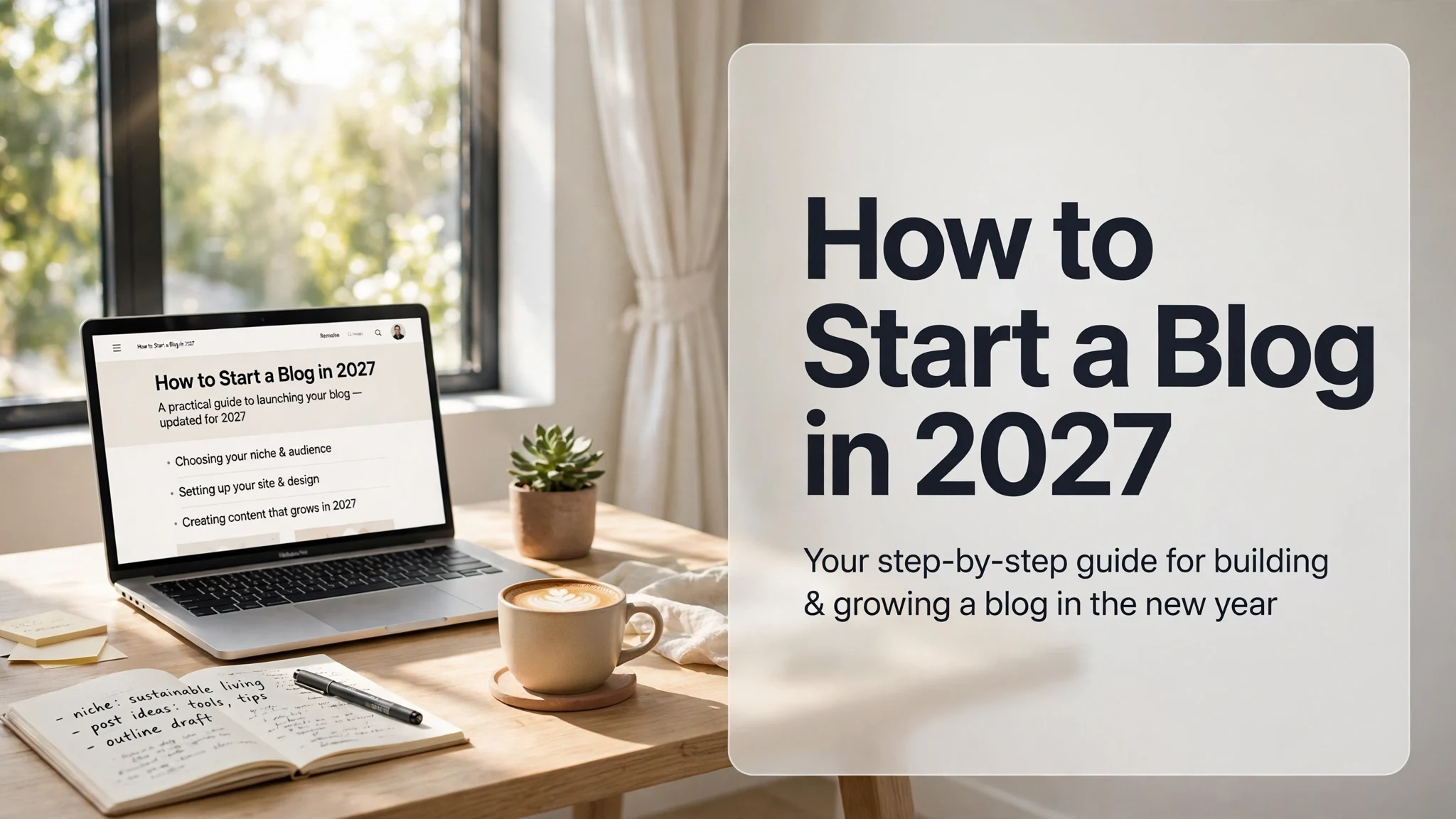
How to Start a Blog in 2027 From Zero
In this post
- Choose a Topic People Actually Search For
- Set Up the Site the Simple Way
- Write Your First Ten Posts Before You Worry About Traffic
- Make Your Posts Easy to Find on Search
- Design, Speed and the Reader’s First Impression
- Get Your First Readers Without Paying for Ads
- Stay Consistent and Keep Improving
- Your First Month: A Simple Launch Plan
- My Take:
Starting a blog in 2027 feels harder than it used to, because the internet is crowded, social media is loud, and everyone seems to have advice that contradicts everyone else’s. Yet blogging still works, and it works for a simple reason: people still search for answers, still read articles that help them, and still trust a person who writes honestly about something they know. A blog is not dead; it has simply become more honest, and the blogs that survive are the ones that help real people.
The mistake most beginners make is starting with the technology instead of the idea. They spend weeks choosing a theme, a logo, and a name, and then discover they have nothing to say. The right order is the opposite: decide who you are writing for and what problem you will solve, then build the simplest site that lets you publish, then write, and keep writing. Everything else can be learned and improved later.
This guide takes you from zero to a live blog with your first readers, step by step, in plain language. It covers choosing a topic, setting up the site, writing posts people actually want to read, and getting those posts found, without assuming you know anything about code or marketing.
Choose a Topic People Actually Search For
A blog needs a topic that is narrow enough to stand out and large enough to have readers, and that balance is called a niche. A blog about everything will compete with everyone and win against no one, while a blog about one clear subject, such as budget travel in Europe, beginner gardening, or easy recipes for busy parents, can become the place people return to. Your niche should sit where three things meet: something you know or can learn, something people search for, and something you enjoy enough to write about for a year.
Check whether people actually search for your topic before you commit to it. Type your ideas into a search engine and look at the suggestions, the questions people ask, and the articles that already rank, because those results tell you what readers want and how crowded the topic is. If every result is from a huge website with years of history, your topic may be too competitive; if there are no results at all, nobody may be searching for it. The sweet spot is a topic where real people ask real questions and the existing answers are thin or outdated.
Your own experience is an advantage that big websites cannot copy. A person who has actually done something, cooked the recipe, visited the place, or solved the problem, writes differently from someone who only researched it, and readers can feel the difference. Choose a topic where your experience, your story, or your point of view adds something real, because that is what will make your blog different from the hundreds of others on the same subject.
Set Up the Site the Simple Way
You do not need to build a blog from scratch, and you do not need to write code. The simplest path for most beginners is a hosted platform or a simple website builder, where you choose a name, pick a design, and start writing in an afternoon. WordPress is the most popular choice, because it is flexible, widely supported, and used by millions of blogs, but simpler platforms can be better if you want to start quickly and do not want to manage technical details.
Your domain name is your address on the internet, and it should be short, easy to spell, and easy to remember. Avoid numbers, hyphens, and clever spellings that people will mishear, and choose a name that fits your topic rather than a name that tries to be funny. A simple name that says what the blog is about will serve you far better than a clever name that confuses people, and you can always change the design later without changing the name.
Do not spend money on expensive tools at the start. A domain, basic hosting, and a free theme are enough to launch, and you can add paid tools later when the blog earns money or when you know exactly what you need. The most important thing is to publish, because a blog with ten posts and a simple design is a real blog, while a blog with a perfect design and no posts is only a plan.
Write Your First Ten Posts Before You Worry About Traffic
Your first posts should answer the questions your readers are actually asking, not the questions you find interesting in theory. Think about the problems your reader has, the mistakes they make, and the things they wish someone had told them, and write posts that solve one problem each. A post that helps one person properly is worth more than a post that tries to cover everything and helps no one.
Write in a clear, simple style, as if you are explaining something to a friend. Use short paragraphs, clear headings, and examples from your own experience, because readers on the internet scan before they read, and a wall of text will lose them. Start with the answer or the main point, then explain it, then give an example, and finish with a clear next step, so the reader leaves with something useful.
Aim for ten solid posts before you spend serious time on promotion, because ten posts give a new visitor a reason to stay, a reason to return, and a sense of what your blog is about. One post is a start, but it is not a blog, and a visitor who arrives at a blog with a single post will leave and may never return. Write the ten posts first, publish them, and then start telling people about the blog.
Make Your Posts Easy to Find on Search
Search is the most reliable source of readers for a new blog, because people who search for an answer are already interested in your topic. The basics of search are simple: use the words your reader would type in your title and headings, answer the question clearly and early, and write a post that is genuinely helpful and complete. You do not need to learn complicated techniques at the start; you need to write posts that answer real questions better than the posts already out there.
Each post should focus on one main topic and one main search phrase, and the title should say clearly what the post is about. Avoid clever titles that hide the subject, because a reader searching for an answer will click the title that matches their question, not the one that sounds witty. Use headings to break the post into sections, because headings help both readers and search engines understand the structure of your article.
Link to your own related posts when it helps the reader, because internal links keep visitors on your blog longer and help search engines understand which posts are related. Link to other trustworthy websites when they have useful information, because that shows you care about the reader more than about keeping them on your page. Good links are a sign of a generous, trustworthy blog, and readers remember that.
Design, Speed and the Reader’s First Impression
A blog’s design should be clean and simple, because the reader came for the words, not for the decoration. Choose a readable font, a light background, and a layout that works on a phone, because most readers will visit on their phones, and a blog that is hard to read on a small screen will lose them. Test your blog on your own phone, and if you find it hard to read, your visitors will too.
Speed matters more than beauty: a blog that loads slowly will lose readers before they read a single word, so keep your images small, avoid unnecessary features, and choose a fast, simple theme. A visitor who waits more than a few seconds for a page to load will leave, and they may not return, so speed is not a technical detail; it is a reader’s first impression of your blog.
Make it easy for readers to find your best posts, subscribe, and contact you. A simple menu, a search box, and a short introduction that says who you are and what the blog is about will help a new visitor understand your blog in seconds. Do not clutter the page with pop-ups and adverts at the start, because a new blog needs readers more than it needs revenue, and a clean page will earn more trust than a crowded one.
Get Your First Readers Without Paying for Ads
Your first readers will come from people you already know and from communities where your topic is discussed, so tell friends, share your posts where your readers already gather, and answer questions in those places with genuine help rather than spam. A thoughtful answer in a forum or a group, with a link to a post that truly helps, will bring more readers than a hundred posts shared without context, and it will build your reputation at the same time.
Social media can help, but it should not be your only plan, because social platforms change their rules and your posts can disappear from view in hours. Use social media to share your posts and to talk to readers, but build your blog as your home, where your work lives permanently and where search can find it for years. An email list is the most valuable thing you can build, because it lets you reach your readers directly, without depending on any platform.
Be patient, because a new blog grows slowly, and the first months are the hardest. Most blogs take six months to a year before search traffic becomes steady, and the bloggers who succeed are usually the ones who kept publishing when nobody seemed to be reading. Write for the reader you want, not for the numbers you wish you had, and the numbers will follow the work.
Stay Consistent and Keep Improving
Consistency matters more than speed, so choose a publishing rhythm you can maintain for a year, whether that is one post a week or two posts a month, and stick to it. A blog that publishes regularly builds trust with readers and with search engines, while a blog that publishes ten posts in a month and then nothing for three months looks abandoned. It is better to publish one good post a week for a year than to publish thirty posts in a month and then stop.
Keep learning from your readers and from your own results: look at which posts get read, which ones get shared, and which ones bring comments, and write more of what works. Ask readers what they want, read their comments, and use their questions as ideas for new posts, because your readers will tell you what they need if you listen. A blog that grows with its readers is a blog that lasts.
Finally, remember why you started. A blog is a long project, and the people who succeed are usually those who enjoy the writing itself, not only the result. If you enjoy helping your readers, learning your topic, and improving your craft, the blog will grow, and the growth will feel like a reward rather than a chore. Start simple, write honestly, publish regularly, and let the blog become what it is meant to be.
Your First Month: A Simple Launch Plan
In your first week, do only three things: choose your topic, set up a simple site, and write your first three posts, because those three actions turn an idea into a real blog. Do not spend the week choosing a logo or reading advice; spend it writing, because the writing is the blog and everything else is decoration. By the end of the week you will have a live site with real posts, and that is a bigger achievement than a month of planning.
In your second and third weeks, write two more posts each week, share them where your readers gather, and ask a few friends to read them and tell you honestly what they think. Use their feedback to improve, not to feel discouraged, because early feedback is a gift that shows you what is clear and what is confusing. Start a simple email list, even if only a few people join, because those first subscribers are the foundation of your future audience.
In your fourth week, look back at what you have made: a blog with ten posts, a few readers, and a clearer idea of what your audience wants. That is a real launch, and it is more than most people ever achieve, because most people never publish at all. From here, the work is simple: keep writing, keep sharing, and keep improving, one week at a time, because a blog is built in weeks, not in a day, and the first month is the hardest and the most important.
My Take:
My honest view is that most people who want to start a blog spend far too long preparing and far too little time writing, and that is the single biggest reason blogs fail. They choose a name, redesign the theme, research tools, and read advice for weeks, and then they have no posts, no readers, and no momentum. A blog is made of posts, not plans, and the best day to publish your first post is today, with a simple design and an honest article, because a real post teaches you more than a month of planning ever will.
I also believe the niche matters more than the platform, because a clear topic gives your blog a reason to exist and gives your reader a reason to return. A blog about everything is a blog about nothing, and a reader who arrives at a site that covers ten unrelated subjects will not know why they should come back. A blog about one clear subject, written by someone who cares about it, will attract readers who care about the same thing, and those readers are the foundation of everything that follows.
Another point I keep returning to is the first ten posts, because they are the real launch of a blog. One post is a beginning, but ten posts are a blog: they show a visitor what you write about, they give search engines something to find, and they give you the confidence that comes from having done the work. Write those ten posts before you worry about traffic, design, or money, because they are the foundation, and a foundation built well will support everything you add later.
I would also say that writing simply is a strength, not a weakness, and the best blogs are the ones that explain things clearly. Readers do not come to a blog to admire complicated sentences; they come because they have a problem and they want an answer, and a clear, honest, simple answer will always beat a clever, confusing one. Write as if you are talking to a friend, use examples from your own life, and say what you mean, because clarity is what builds trust.
My honest view is that search is the most honest source of traffic, because it brings people who already want what you wrote. Social media can bring a rush of visitors, but they leave quickly, while a reader who finds your post through search has a question and stays to read the answer. Write posts that answer real questions, use the words your reader would use, and be patient, because search traffic grows slowly and then steadily, and it is the traffic that lasts.
I also believe you should not spend money you do not have on a new blog, because the tools you need at the start are cheap or free. A domain, basic hosting, and a free theme are enough, and every expensive tool, course, or plugin can wait until the blog earns money or until you know exactly why you need it. The bloggers who spend hundreds before they publish are often buying a feeling of progress rather than progress itself, and the feeling fades while the bill remains.
Another point I keep returning to is consistency, because it is the least exciting advice and the most important. A blog that publishes one good post every week for a year will beat a blog that publishes thirty posts in a month and then stops, because readers and search engines both reward reliability. Choose a pace you can keep, protect it, and let the habit do the work, because the habit is what turns a beginner into a blogger.
I would also say that your own experience is your greatest advantage, and you should use it without apology. A person who has actually done the thing they are writing about, made the mistakes, and learned from them, writes with a confidence that research alone cannot give. Do not hide your story behind generic advice; put it in the post, because your story is what makes your blog different from every other blog on the same topic, and readers can feel the difference.
My honest view is that an email list is the most valuable asset a blogger can build, and you should start it early, even when you have only a few readers. Social platforms change, algorithms shift, and a post can disappear, but an email list is yours, and it lets you reach the people who chose to hear from you. Offer something useful, ask readers to join, and write to them as you would to a friend, because those readers are the heart of your blog.
Finally, I believe blogging is worth doing because it is one of the few things on the internet that you truly own. Your posts, your readers, and your voice belong to you, not to a platform, and they can grow for years, helping people you will never meet. Start simple, write honestly, publish regularly, and be patient, because the bloggers who last are not the ones who started perfectly; they are the ones who started and did not stop.
My honest view is that the first month is the whole secret of blogging, because it is the month when most people quit, and the people who survive it are the ones who go on to build something real. The first month is not about traffic or money; it is about proving to yourself that you can publish regularly, that you can finish posts, and that you can keep going when nobody seems to be reading. If you can publish ten posts in your first month, you have done something most aspiring bloggers never do, and you have built a habit that will carry you through the slow months that follow. Do not aim for perfection in the first month; aim for completion, because completion is the skill that matters, and perfection can wait.
I also believe you should write the post you wish you had found when you started, because that is the post your reader is searching for right now. Think back to the question you had, the mistake you made, or the confusion you felt, and write the clear, honest answer you wanted then, because somewhere in the world another person has exactly that question today. A blog built from those answers, one honest post at a time, will always find readers, because it was written for a real person with a real problem, and that person is the reason blogging works at all.
Frequently Asked Questions
How much does it cost to start a blog in 2027?
You can start a blog for the cost of a domain name and basic hosting, which is usually a small monthly amount. A free theme and free tools are enough to launch, and you can add paid tools later when the blog grows or earns money.
What is the best platform to start a blog?
WordPress is the most popular and flexible choice for most bloggers, because it is widely supported and can grow with your blog. Simpler hosted platforms can be better if you want to start quickly without managing technical details.
How do I choose a niche for my blog?
Choose a topic where your knowledge or experience, what people search for, and what you enjoy writing about meet. Check search suggestions and existing articles to see whether people ask real questions and whether the topic is too competitive or too small.
How many posts do I need before I launch my blog?
Aim for about ten solid posts before you promote your blog seriously, because ten posts give a new visitor a reason to stay and return. You can launch with fewer, but a blog with only one or two posts looks unfinished to visitors.
How long does it take for a blog to get readers?
Most new blogs take six months to a year before search traffic becomes steady, because search engines need time to find and trust new sites. Publishing regularly, answering real questions, and sharing posts where your readers gather will help growth, but patience is essential.
Do I need to know how to code to start a blog?
No, you do not need to know how to code to start a blog in 2027. Modern platforms and website builders let you publish, design, and manage a blog without writing code, and you can learn technical skills gradually if you want to.