Idir: The Life Story Behind Algeria's Kabyle Voice
In this post
- A Childhood in the Mountains of Kabylia
- A Vava Inouva and a Song Heard Around the World
- Paris, Exile, and the Long Quiet Years
- Identités and a Return to the Stage
- La France des Couleurs and Songs for a Mixed Country
- Ici et Ailleurs and the Final Album
- A Voice That Kept a Language Alive
- The Mountains Remember Him
- My Take:
Idir was a quiet man with a gentle voice, and yet his song “A Vava Inouva” became one of the most famous pieces of music ever to come out of North Africa, a lullaby in the Kabyle language that was heard around the world. He was born in the mountains of Kabylia, in Algeria, a region with its own language, its own traditions, and its own fierce pride, and he spent his life singing in that language, Tamazight, at a time when few singers dared to do so on a big stage. His music was soft, acoustic, and full of the sound of the mountains, and it carried a message that was both simple and powerful, that a small language and a small culture deserve to be heard.
What makes Idir’s story special is the contrast between the man and the fame. He was not a loud star, he did not seek the spotlight, and he did not make music for money or for fashion. He made music because he loved his language and his home, and because he believed that a song could keep a culture alive. That belief carried him from a village in Kabylia to concert halls in Paris, and it made him a hero to the Berber people, not only in Algeria but in the diaspora in France and beyond.
He died in 2020, in Paris, and his death was mourned by people who had grown up with his songs, who had learned Tamazight from his lyrics, and who saw in him a keeper of their identity. This is the story of how a quiet man from the mountains became the voice of a people.
A Childhood in the Mountains of Kabylia
Idir, whose real name was Hamid Cheriet, was born on 25 October 1949 in Aït Lahcène, a village in the region of Kabylia, in the mountains of northern Algeria. Kabylia is a land of steep hills, olive trees, and stone villages, a place where the Berber people, who call themselves Amazigh, have lived for centuries, speaking their own language, Tamazight, and keeping their own traditions. A child growing up there learns the language of the mountains, the songs of the village, and the pride of a people who have held on to their identity through many invasions and many changes.
His childhood was shaped by that landscape, by the sound of the wind in the olive trees, by the voices of women singing at home, and by the stories told by elders in the village. Music in Kabylia is not a separate art. It is part of daily life, sung at weddings, at harvests, and at gatherings, and a child absorbs it without thinking about it. Idir absorbed it, and he began to sing the songs he heard, first quietly and then with more confidence, learning the melodies and the words that had been passed down for generations.
School was part of his life as well, and he studied in Algeria, where the language of instruction was French and Arabic, and where Tamazight, his mother tongue, was not taught in school. That absence is important, because it shows the world Idir grew up in, a world where his own language was treated as less important than the languages of the state. He learned French and Arabic, and he used them, but his heart stayed with Tamazight, and his music would become a way to give that language a place in the world.
As a young man he moved to Algiers to study, and he is widely reported to have studied geology at university, a serious, scientific subject that seems far from music. That detail matters, because it shows that his first plan was not fame. He was preparing for an ordinary working life, as a geologist who would study the rocks and the land of his country, and music was a passion that ran beside his studies. Many young artists face that same choice, between a safe profession and an uncertain art, and Idir stood at it for a while, weighing what he loved against what seemed sensible.
The mountains stayed with him even as he left them, and the sound of Kabylia stayed in his ear. He carried the village with him to Algiers, and later to Paris, and his songs would always return to that landscape, to the olive trees, to the stone houses, and to the people who lived there. That loyalty to his home is the foundation of his whole career, and it is the reason his music feels so honest and so rooted.
A Vava Inouva and a Song Heard Around the World
Idir’s life changed in 1973, when he recorded “A Vava Inouva”, a song that would become one of the most famous pieces of North African music ever made. The title means “Oh father Inouva” in Tamazight, and the song is a lullaby, a gentle, haunting melody that tells a story of a father and a daughter, of a mountain, and of a home. It was originally written as a simple song, and Idir sang it with a soft, clear voice, accompanied by a guitar and a choir of young voices, and the result was a piece of music that sounded both ancient and new at the same time.
The song was first heard on Algerian radio, and it spread quickly, because listeners had never heard anything quite like it. A song in Tamazight, sung with such beauty and such simplicity, was a new thing on the radio, and it touched people deeply, not only in Kabylia but across Algeria and in the diaspora in France. The melody was easy to remember, the words were full of the imagery of the mountains, and the feeling was one of warmth and longing, a feeling that every listener could understand, even if they did not speak Tamazight.
“A Vava Inouva” became a hit, and it made Idir famous, not only in Algeria but in France and beyond, where the song was played on radio and where its gentle sound stood out among the louder pop music of the time. It was translated and covered by singers in other languages, and it became a symbol of Berber culture, a song that proved a small language could produce a great work of art. For Idir, it was both a gift and a burden, because the song was so famous that it threatened to overshadow everything else he made, and he spent the rest of his career living with its shadow.
The success of the song also brought him attention from the music world, and he began to record more songs, to perform on stage, and to build a career as a singer. He did not rush to copy the success of “A Vava Inouva” with a similar song. He took his time, and he wrote and recorded songs that came from the same place, from his love of Kabylia and Tamazight, and from his belief that music could keep a culture alive. That patience gave his work a coherence that many one-hit singers lack, and it is the reason his later albums are still respected today.
By the end of the 1970s, Idir was known as the voice of Kabylia, a singer whose name was associated with a whole people and a whole language, and whose song “A Vava Inouva” had become an anthem. He had not sought that role, but he accepted it, and he carried it with a quiet dignity that became his trademark. He was not a loud star. He was a gentle one, and his gentleness was part of his power.
Paris, Exile, and the Long Quiet Years
In the years that followed, Idir moved to Paris, as many Algerian artists did, and he lived there for much of his life, singing for the Berber diaspora and for French audiences who had come to love his music. Paris was a different world from Kabylia, a big city full of noise and movement, and Idir lived in it quietly, working on his music, performing at concerts, and keeping his connection with his homeland alive through song. He was not a star who chased fame. He was a musician who lived simply, and who let his songs speak for him.
The years in Paris were also years of waiting, because Idir did not release music as often as other singers, and his public life became quieter. He performed, he recorded, but he did not seek the spotlight, and his fans sometimes wondered where he had gone. That quietness was not a sign of failure. It was a sign of a man who was comfortable with his own pace, who believed that a song should be released when it was ready, and who did not want to make music for the sake of being visible. That patience is rare, and it is one of the reasons his work has lasted.
During these years he also became a symbol for the Berber people, who were fighting for recognition of their language and their culture in Algeria and in the wider world. Tamazight was not an official language in Algeria for many years, and Berber activists looked to Idir as a cultural hero, a singer who had proved that Tamazight could be beautiful, could be modern, and could be heard around the world. He did not become a politician, and he did not make speeches, but his songs were a form of protest, a quiet, powerful statement that his language mattered.
His life in Paris was also a life of exile, in the sense that he was far from the mountains he loved, and that distance gave his songs a new feeling of longing. He sang about Kabylia from a flat in Paris, and the distance made the songs more emotional, more full of the ache of being away from home. That ache is familiar to every migrant, and it is the reason his music resonated with Algerians in France, who heard in his voice their own longing for the villages they had left.
By the time he reached middle age, Idir was recognised as a cultural figure of great importance, even if he was not a commercial star in the usual sense. He had a loyal audience, a set of songs that were loved, and a reputation for honesty and integrity that few singers could match. He had also shown that a quiet, gentle singer could have a lasting impact, without shouting, without scandal, and without chasing fame.
Identités and a Return to the Stage
In 1999 Idir released the album “Identités”, a record that marked his return to the wider public and that became one of the most important albums of his career. The album brought together musicians from many countries and many styles, including the French-Spanish singer Manu Chao and the Algerian singer Khaled, and it mixed Kabyle music with rock, with reggae, and with the sounds of the wider world. The title, which means “identities”, fitted the album perfectly, because it was a record about who we are, about the many cultures that make up a single person, and about the right to be proud of all of them.
“Identités” was a success, and it introduced Idir to a new generation of listeners, young people in France and in Algeria who had not been alive when “A Vava Inouva” was first released, and who discovered his music through the album’s modern, international sound. The record proved that Idir was not a singer of the past. He was a living artist, capable of making music that spoke to the present, and of working with musicians from other cultures without losing his own identity. That ability to collaborate, to listen, and to learn, is a sign of a great artist, and Idir showed it in full on “Identités”.
The album also brought him back to the stage, with concerts in France and in other countries, where audiences who had loved his early songs came to hear him sing again, and where new listeners discovered his work for the first time. A live Idir concert was a quiet, emotional event, with the singer and his guitar, and a crowd that listened in silence, moved by the beauty of the songs. Those concerts reminded everyone why his music mattered, and they gave him a new energy, a sense that his work was still needed.
The success of “Identités” also gave him a platform to speak about the Berber cause, about the importance of Tamazight, and about the rights of minority cultures, and he used that platform with the same quiet dignity that marked his whole career. He did not shout, and he did not make grand claims. He sang, and he let the songs do the talking, and the songs said more than any speech could have. That is the power of music, and Idir understood it better than most.
By the end of this period, Idir had done something remarkable. He had returned after a long quiet time, he had made an album that was both modern and rooted, and he had shown that a singer from the mountains of Kabylia could still speak to the world. The album remains a landmark in North African music, and it is a key part of his legacy.
La France des Couleurs and Songs for a Mixed Country
In 2007 Idir released the album “La France des couleurs”, a title that means “France of colours”, and a record that spoke directly to the experience of living in a multicultural France. The album was a celebration of diversity, of the many peoples, languages, and cultures that make up modern France, and it featured collaborations with singers from many backgrounds. It was a political album in the best sense, not a lecture but a set of songs that showed how beautiful a mixed country can be, and how music can bring people together across the lines that divide them.
The album was well received, and it showed a different side of Idir, a singer who was not only thinking about Kabylia but about France, the country where he lived, and about the future of a society that was becoming more diverse every year. He sang about tolerance, about respect, and about the joy of meeting people from other cultures, and he did it with the same gentle voice that had made “A Vava Inouva” famous. The message was simple, but it was important, and it came at a time when France was struggling with questions of identity and immigration.
His work on this album also showed his generosity as an artist, his willingness to share a stage and a song with younger singers, and to learn from them as well as teach them. He was not a star who kept his distance. He was a musician who believed in collaboration, and who understood that music grows when it is shared. That generosity is part of his legacy, and it is one of the reasons other musicians loved working with him.
The years around “La France des couleurs” were also years when Idir’s health began to decline, and when his public appearances became less frequent. He continued to sing, but he did so more quietly, and his fans understood that the man they loved was growing older and that his voice, like all voices, was changing. They loved him anyway, because the feeling in his songs had not changed, and because his music had become a part of their lives that no illness could take away.
Ici et Ailleurs and the Final Album
In 2017 Idir released “Ici et ailleurs”, a title that means “Here and elsewhere”, and an album that looked back on his life and his career with a quiet, reflective feeling. The record brought together new versions of his old songs, as well as new material, and it featured collaborations with a range of artists, including the French singer Francis Cabrel and the Algerian singer Takfarinas. It was a fitting final album, a summary of a life spent between here and elsewhere, between Kabylia and Paris, between Tamazight and French, and between the past and the present.
The album was received with warmth, and it reminded listeners of the full range of Idir’s work, from the lullaby of “A Vava Inouva” to the international sound of “Identités”, and from the gentle acoustic songs of his youth to the more reflective work of his later years. It was a record that a listener could play from start to finish and hear a whole life in it, a life lived quietly, with dignity, and with a deep love for a language and a people.
His final years were marked by illness, and he spent time in hospital in Paris, where he was treated for a lung condition that had troubled him for some time. He faced that illness with the same quiet dignity that had marked his whole life, without complaint and without drama, and his fans followed his health with concern, hoping for his recovery. He continued to be a figure of respect, even when he could no longer perform, because his songs were still being played and his name was still loved.
Idir died on 2 May 2020 in Paris, at the age of 70, and his death was mourned in Algeria, in France, and in the Berber diaspora around the world. The tributes that followed spoke about his voice, his gentleness, and his importance as a keeper of Berber culture, and his songs were played again on radio and on streaming platforms, as a new generation discovered his work. His death was a loss, but it was also a reminder of how much he had given, and of how his music would keep his memory alive.
A Voice That Kept a Language Alive
Idir’s greatest legacy is not only his songs but the language they carried, Tamazight, a language that was for many years marginalised in Algeria and in the wider world. By singing in Tamazight, by making a hit song in Tamazight, and by building a career in Tamazight, Idir proved that the language was beautiful, that it could be modern, and that it deserved to be heard. That proof mattered to the Berber people, who had been told for generations that their language was less important than Arabic or French, and who found in Idir’s songs a reason to be proud.
His music also taught a generation of young Berbers to love their own culture, to learn Tamazight, and to sing its songs, and that teaching will outlast his life. A language lives only if it is spoken and sung, and Idir kept Tamazight alive by singing it, by recording it, and by carrying it to concert halls around the world. That is a rare and precious achievement, and it is the reason his name is spoken with such respect in Kabylia and in the diaspora.
Today his songs are still played, his albums are still listened to, and his name is still known as the voice of Kabylia, a quiet man from the mountains who became a legend by singing softly and truly. His story is a reminder that a singer does not need to be loud to be heard, and that a gentle voice, singing in its own language, can travel further than a loud voice singing in a borrowed one.
The Mountains Remember Him
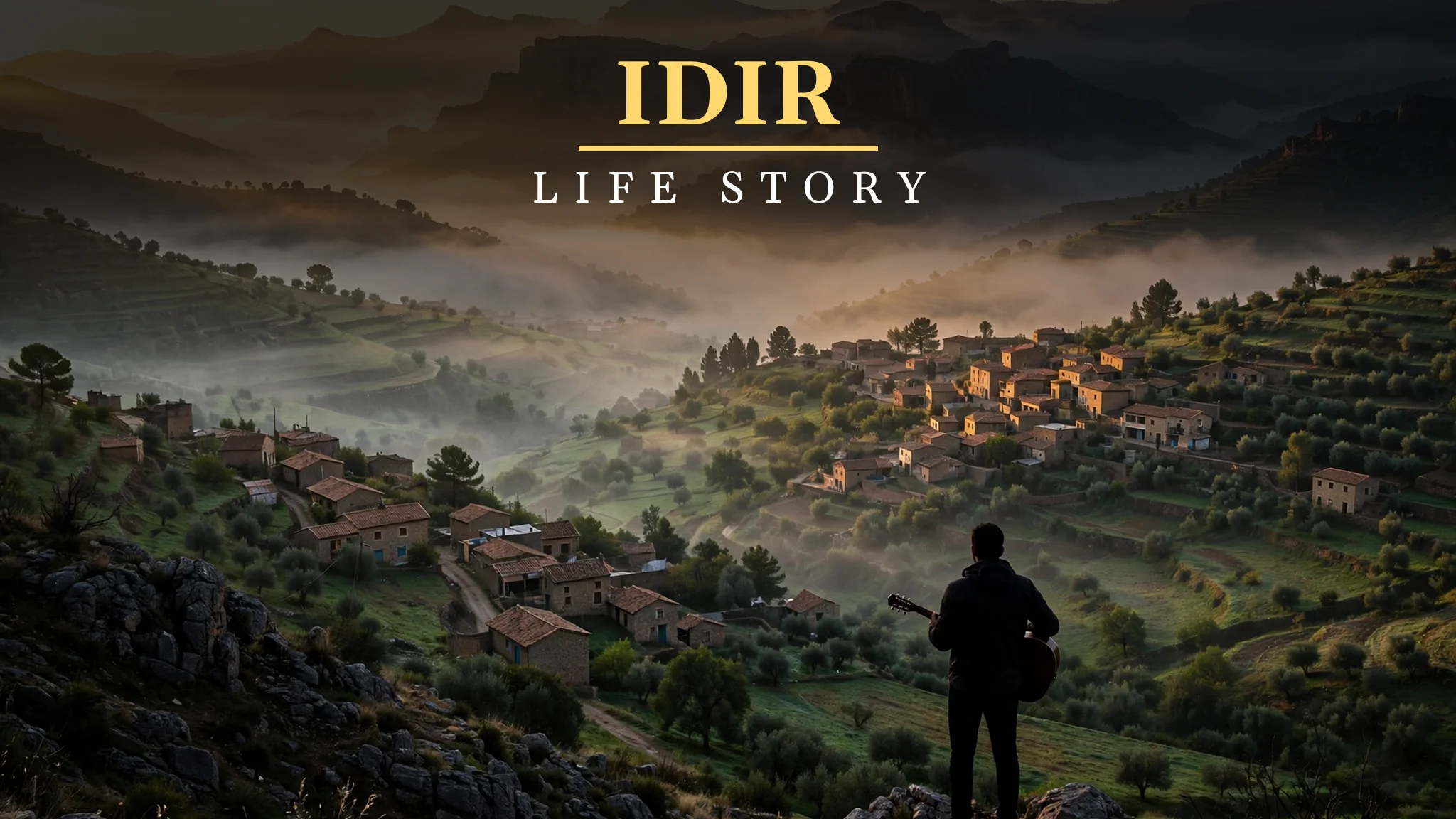
In Kabylia, the mountains that Idir sang about still stand, and the villages he came from still sing his songs, at weddings, at gatherings, and in homes where his voice is still heard on the radio. His legacy is not only in Paris or in Algiers. It is in the stone houses of Aït Lahcène, in the olive trees, and in the people who remember him as a son of their village who became a voice for their whole people. That kind of legacy, rooted in a place, is the strongest kind, because it is carried by the land itself.
For a young person in Kabylia today, Idir’s story is a reminder that a life can start in a small village and reach the world, without losing the village. He left, he sang, he became famous, and he never forgot where he came from, and that loyalty is a lesson for anyone who leaves home to seek a better life. Home is not something you leave behind. It is something you carry with you, in your language, in your songs, and in your heart, and Idir carried it all his life.
My Take:
I think Idir was one of the gentlest and most important singers in this whole set, and I say that because his fame came from a lullaby. A lullaby is a song sung to a child, a soft, quiet thing, and “A Vava Inouva” is a lullaby that became famous around the world. That fact tells me something about the power of gentleness, that a soft voice, singing in a small language, can be heard further than a loud voice shouting in a big one. Idir proved that, and his life is a lesson in the strength of quiet things. He did not need to shout to be heard. He needed only to sing truly, and the world listened.
What I admire most about him is his loyalty to Tamazight, his mother tongue, a language that was not taught in school, that was not an official language for many years, and that was treated as less important than Arabic and French. Idir sang in Tamazight anyway, and he made a hit song in Tamazight, and he built a career in Tamazight, and that choice was a brave one. It would have been easier to sing in French or Arabic, to reach a bigger audience more quickly, but he chose the harder path, the path of his own language, and that choice gave his music a truth that no other choice could have given it. I think about how many young Berbers must have heard his songs and felt proud of their language for the first time, and that feeling is worth more than any chart position.
His album “Identités” is the part of his career I think about most, because it shows a man who was willing to grow, to collaborate, and to learn from other musicians, even after he was already famous. He worked with Manu Chao, with Khaled, and with singers from many countries, and he made a record that was both modern and rooted, both international and Kabyle. That is a hard balance to strike, and Idir struck it with grace. He did not lose himself in the collaborations. He brought himself to them, and he let the other musicians bring themselves too, and the result was music that was richer than any one of them could have made alone. I think that generosity is a model for any artist, in any field.
I also think about the long quiet years, when Idir did not release music often and his public life became less visible. Many singers would panic in that situation, and would release anything to stay in the spotlight, but Idir did not. He waited, he worked quietly, and he released music when it was ready. That patience is a form of confidence, a belief that your work will be valued even if it is not constantly in front of people. I admire that confidence, because it is the opposite of the panic that drives so much of modern music, and it is the reason his albums, when they did come, were worth waiting for.
There is a sadness in his story too, the sadness of a man who lived far from the mountains he loved, in Paris, singing about a home he could not always return to. That feeling of exile is familiar to every migrant, and Idir’s songs carry it with a gentleness that makes it bearable. He did not sing about exile with anger, as Rachid Taha did, but with longing, with a soft ache that makes the listener feel the distance and the love at the same time. Both approaches are valid, and Idir’s approach is the one that moves me most, because it is the approach of a man who loved his home so much that he could not shout about it. He could only sing about it softly, as if he were afraid to wake it.
I think about his death in 2020, at the age of 70, in Paris, far from Kabylia, and I find that image both sad and fitting. He lived his life between two places, and he died in the place where he had lived for so long, but his songs carry him home, to the mountains, to the olive trees, and to the village where he was born. That is the power of music, that it can carry a person home even after death, and Idir’s music does that, every time “A Vava Inouva” is played, every time a young Berber learns the words and sings them, and every time a listener in Paris or in Algiers hears his gentle voice and thinks of home.
If I am honest, I do not think Idir’s music is for everyone. It is quiet, it is slow, and it is in a language that most listeners do not understand, and some people will find it too gentle, too simple, or too far from the pop music they know. I understand that, and I do not think every singer needs to be loud or fashionable. The world needs quiet singers too, singers who remind us that music can be a lullaby, a prayer, and a memory, not only a party. Idir was such a singer, and his quietness is not a weakness. It is his greatest strength, because it allows the listener to hear the feeling in the song, without distraction.
I also want to say something about the Berber people, and about what Idir meant to them. For a people whose language and culture were marginalised for many years, a singer like Idir is not only an artist. He is a keeper of identity, a person who proves that their language is beautiful and that their culture is worth celebrating. That role is a heavy one, and Idir carried it with dignity, without making speeches and without seeking power. He carried it by singing, and singing is enough, when the song is true. I think that is a lesson for anyone who cares about a minority culture, that art can do what politics cannot, by making a language loved rather than merely tolerated.
When I think about young musicians today, I hope they listen to Idir and learn from him, not only about how to sing, but about how to be patient, how to be loyal to your roots, and how to make music that is honest rather than fashionable. He shows that a career can be built slowly, that a song can be a lullaby and still be famous, and that a singer can be gentle and still be a legend. Those are valuable lessons, and they are lessons that Idir’s life teaches without a single lecture, simply by the example of how he lived and how he sang.
In the end, I think Idir’s story is about a man who kept a language alive by singing it, and who kept a culture alive by loving it. He was born in a small village in the mountains, he sang a lullaby that became famous around the world, and he died in Paris, far from home, but his songs keep him at home, in Kabylia, in the hearts of the people who loved him. That is a beautiful legacy, and it is one that will last for as long as there are Berber children who learn “A Vava Inouva” and sing it to their own children. I will keep listening to his songs, and I will keep thinking about the quiet man from the mountains who became the voice of a people, because his story reminds me that gentleness is a form of strength, and that a soft voice can travel further than a loud one.
I hope his music is discovered by new listeners, and I hope young people in Kabylia and in the diaspora know his name and understand what he achieved. He was not only a great singer. He was a bridge between a village and the world, between a language and a song, and between a father and a daughter in a lullaby that will never be forgotten. His life is a reminder that art can be quiet and still be powerful, and that a single song, sung truly, can change the way a whole people see themselves. That is a gift, and I am grateful for it.
I want to end by thinking about the mountains themselves, the hills of Kabylia where Idir was born, and where his songs are still sung. Those mountains have seen many singers come and go, but they remember Idir, because his voice carried their sound to the world, and because his songs will keep carrying it for as long as people listen. A mountain does not forget, and neither will the people who loved his music. His story is not finished, because his songs are still being sung, and they will keep being sung for many years to come.
I also think about the children who learn Tamazight today, in Kabylia and in France, and about how Idir’s songs help them. A language is not learned only from books. It is learned from songs, from stories, and from the voices of people who love it, and Idir’s voice is one of the best teachers a young Berber child could have. When a child sings “A Vava Inouva”, they are not only learning words. They are learning that their language is beautiful, that it can make a song that the whole world loves, and that it is worth keeping. That lesson will stay with them for the rest of their lives, and it is a gift that Idir gave to a whole generation.
Another thought that stays with me is the way his music crossed borders without losing its home. A song in Tamazight, recorded by a quiet man from a small village, can now be heard in Paris, in Montreal, and in Algiers, sung by people who left Kabylia years ago and by people who have never been there at all. That travel is not a small thing. It means that a language once treated as too local for big music is now heard on big stages, and that young Berbers living abroad can hear a piece of home whenever they press play. Idir did not plan to be a bridge, but his music became one, and that role will last longer than any single hit.
Finally, I think his story shows that a singer does not need to be famous in the usual sense to be important. Idir was not a pop star with millions of followers on social media, and he did not chase fame, but he was important to his people in a way that no pop star could be, because he kept their language alive. That kind of importance is quiet, and it is easy to overlook, but it is the most lasting kind, because it is rooted in culture rather than in fashion. I hope his name is remembered, and I hope his songs keep being sung, because the world needs more singers like him, quiet, honest, and true.
I also think about the way his songs will age, and about whether a child ten years from now will still learn “A Vava Inouva” as a lullaby. I believe they will, because Idir’s best songs are not built on a fashion that fades. They are built on a gentle voice, a simple melody, and a feeling of home that does not go out of date, and those things travel well across time. A lullaby, sung truly, will mean as much to a Berber child in ten years as it does today, because the feeling behind it does not change. That is the test of a folk song, and Idir’s best work passes it with ease.
One last thought stays with me, about the village of Aït Lahcène itself, with its stone houses, its olive trees, and its mountain air, and about how a singer can carry a whole village in his voice. Idir carried that village with him, from Kabylia to Paris, in his sound and in his pride, and when listeners in other countries hear his songs, they hear a little of that village too. That is a beautiful thing for a singer to do, to make a place audible, and his songs will keep doing it, long after he has gone.
Frequently Asked Questions
When was Idir born?
Idir, whose real name was Hamid Cheriet, was born on 25 October 1949 in Aït Lahcène, a village in Kabylia, Algeria. He grew up in the mountains of northern Algeria before moving to Algiers and later to Paris.
What is Idir’s most famous song?
“A Vava Inouva” is his best-known song, a gentle lullaby in the Kabyle language that became famous around the world after its release in 1973. It remains a symbol of Berber culture.
What language did Idir sing in?
He sang mainly in Tamazight, the Berber language of Kabylia, as well as in French and Arabic. His choice to sing in Tamazight was a key part of his identity and his importance to Berber culture.
What is Idir’s album Identités?
“Identités” is his 1999 album, a record about identity that brought together musicians from many countries, including Manu Chao and Khaled. It marked his return to a wider audience after a long quiet period.
When did Idir die?
Idir died on 2 May 2020 in Paris, at the age of 70, after a period of illness. His death was mourned in Algeria, in France and in the Berber diaspora around the world.
Why is Idir important to Berber culture?
He is important because he proved that Tamazight could produce great, famous music, and because his songs gave the Berber people a voice and a source of pride. He is remembered as the voice of Kabylia.


