Imelda May: The Life Story Behind the Rockabilly Star
In this post
Imelda May does not sing like a singer from today. She sings like a singer from a smoky club in the 1950s, with a voice that is strong, warm, and full of life. She wears dresses from that time, she styles her hair in that way, and she sings rockabilly music as if it never went away. When she steps onto a stage, the room changes. It feels older, brighter, and more alive, and the audience is pulled back to a time when music was played live, loud, and with joy.
She was born in Dublin, and she grew up in a working-class part of the city where music was a normal part of life. She did not come from a rich family, and she did not have an easy road to fame. She sang in small clubs, she worked with other musicians, and she kept going for many years before the wider world noticed her. When her album Love Tattoo became a hit, she was already a mature singer with a clear idea of who she was. She was not a young star made by a television show. She was a woman who had earned her place.
Her story is about style, strength, and staying true to a sound that many people had forgotten. She has sung rockabilly, jazz, blues, and soul, and she has worked with some of the biggest names in music. She has also written poetry, acted, and spoken openly about her life as a mother and as a woman in a hard business. This is the story of how a girl from the Liberties in Dublin became one of Ireland’s most loved singers.
A Girl From the Liberties in Dublin
Imelda May was born Imelda Clabby on 10 July 1974 in Dublin, Ireland. She grew up in the Liberties, an old working-class area of the city, close to the centre. The Liberties has a long history, with markets, churches, and a strong sense of community, and Imelda grew up in that world. Her family was not wealthy, but they were close, and music was a big part of their home life. She heard songs on the radio, she heard people singing in pubs, and she began to love the sound of a good voice at an early age.
As a young girl, she was drawn to the music of the 1950s, to rock and roll, to rockabilly, and to the singers who had a strong and clear voice. She liked the way those singers dressed, the way they moved on stage, and the way their songs made people want to dance. She was not interested in following the fashion of the moment. She was interested in a sound that felt timeless, and she began to imagine herself as a singer in that style. That early love of old music would shape her whole career.
At school, she was a bright and lively girl, but she did not always fit in with the quiet life of the classroom. She liked to perform, she liked to dress up, and she liked to be noticed. She began to sing in public when she was still young, and she learned that a good performance could change the mood of a room. She also learned that being a singer was hard work. It was not only about having a good voice. It was about practice, about learning songs, and about being brave enough to stand in front of people and sing.
The Liberties gave her a strong sense of who she was. She was a Dublin girl, from a working-class family, and she was proud of that. She did not try to hide where she came from, and she did not try to sound like someone else. Her accent, her style, and her attitude all came from her home, and they stayed with her as she became famous. That pride in her roots is one reason why people in Ireland love her. She is one of their own, and she has never forgotten it.
Singing in Small Clubs and Learning the Craft
As a teenager and a young woman, Imelda May began to sing in clubs and pubs around Dublin. She worked with different bands, she learned the songs of the 1950s, and she built a reputation as a singer who could hold a room. She sang rockabilly, blues, and jazz, and she learned how to work with musicians, how to read a crowd, and how to keep a show moving. Those early years were not glamorous. The pay was low, the rooms were small, and the work was hard, but she was learning her craft.
She also worked as a backing singer and as a member of other bands, and she learned a great deal from the musicians around her. She learned that a singer must listen to the band, that a song is a team effort, and that a good performance is built on trust between the people on stage. She met her future husband, Darrel Higham, who was a guitarist with a deep love of rockabilly music, and together they shared a passion for the old sounds that they both loved. Their shared love of music became a central part of their life together.
During these years, Imelda also learned about the music business, and about how hard it is for a woman to be taken seriously as a singer of rockabilly music. Many people saw rockabilly as a man’s world, and many record companies did not know what to do with a woman who wanted to sing in that style. Imelda did not let that stop her. She kept singing, she kept dressing in her own way, and she kept building an audience who loved her for who she was. She was patient, and she was determined, and she knew that her time would come if she kept working.
She released her first album, No Turning Back, in 2003. It was a small release, and it did not make her famous, but it showed that she was a serious singer with a clear sound. She continued to tour, to play at festivals, and to build her name in Ireland and in Britain. Those years of hard work in small clubs were the foundation of her later success. She had learned to sing, to perform, and to survive in a hard business, and when the big chance came, she was ready for it.
Love Tattoo and the Moment the World Noticed
In 2008, Imelda May released the album Love Tattoo. The album was full of rockabilly songs, with a strong beat, a clear voice, and a sense of fun that was missing from much of the music of the time. Songs like Johnny Got a Boom Boom and Big Bad Handsome Man showed that she could sing with power and with humour, and that she could make old-style music feel fresh and alive. The album became a hit in Ireland, and it began to find listeners in Britain and in other countries.
The success of Love Tattoo was not an overnight accident. It came after many years of work in small clubs, and it came because Imelda had a clear idea of her sound. She was not trying to copy the pop music of the day. She was trying to make the music she loved, in the way she loved to make it, and the audience responded to that honesty. People who had never heard rockabilly before fell in love with her voice, and people who had loved rockabilly for years were glad to see a new singer who understood it so well.
She began to appear on television, to play at larger venues, and to tour in many countries. She worked with the musician Jools Holland, who became a strong supporter of her work, and she appeared on his television show, where her performance was seen by millions of people. She also worked with other famous musicians, and her name began to be known beyond Ireland. She was no longer a singer from a small Dublin club. She was a star, and she was taking her music to the world.
Love Tattoo remains one of her most loved albums, and it remains a fine example of how a singer can bring an old style back to life without making it sound like a museum piece. Imelda did not copy the 1950s. She took the best of that time, the energy, the style, and the joy, and she made it her own. That is why the album still sounds fresh today, and why it still makes people want to dance when they hear it.
Mayhem, Tribal, and a Singer at the Top
In 2010, Imelda May released her next album, Mayhem. The album was louder and bolder than Love Tattoo, and it showed a singer who was confident and ready to take risks. The title track, Mayhem, was a strong rockabilly song, and the album also included songs that showed her range as a singer, from blues to soul. Mayhem became a hit in Ireland and in Britain, and it confirmed that Imelda was not a one-album singer. She was a real artist with a long career ahead of her.
She followed Mayhem with Tribal in 2014. The album was named for the tribal feeling of a live show, and it was full of energy and rhythm. Songs like Tribal and Wild Woman showed a singer who was not afraid to be loud, strong, and direct. The album was praised by critics, and it was loved by her fans, who had come to expect a high standard from her. She toured widely to support the album, and her live shows became known for their energy, their style, and the joy that Imelda brought to the stage.
During these years, Imelda also became a mother, and she spoke openly about the challenge of being a singer and a mother at the same time. She talked about the difficulty of touring while raising a child, and about the need for women in music to be able to have a family and a career. Her honesty about that part of her life was welcomed by many people, and it made her more than just a singer. She became a voice for women who were trying to balance work and family in a hard world.
She also worked with other famous musicians during this period, including Jeff Beck, who invited her to sing with him, and other artists who admired her voice. Those collaborations showed that her talent was recognised by her peers, and that she was not only a popular singer but also a respected musician. Her work in these years was at a high level, and it showed that she had grown from a club singer into a star who could hold her own on any stage in the world.
A New Sound, Poetry, and a Life Beyond One Style
In 2017, Imelda May released Life Love Flesh Blood, an album that was very different from her earlier rockabilly work. The album was produced by the American musician T Bone Burnett, and it had a slower, more soulful sound, with songs about love, loss, and the body. It was a brave change, because many of her fans loved her rockabilly style, and a new sound could have disappointed them. Instead, the album was praised as one of her best works, and it showed that she was not afraid to grow and to try new things.
The album included songs that were more personal than her earlier work, and it showed a woman who was thinking deeply about her life. She sang about the end of her marriage to Darrel Higham, about being a mother, and about finding her own way in the world. The songs were honest and moving, and they showed a different side of Imelda, a quieter and more thoughtful side that had always been there, but that had not been heard as clearly before. It was a turning point in her career, and it proved that she was more than a rockabilly singer.
In 2021, she released 11 Past the Hour, an album that continued that more personal and soulful direction, with songs that spoke about her life, her family, and her hopes for the future. The album was well received, and it showed that Imelda was still growing as a writer and as a singer. She also began to write poetry, and she published a book of poems called A Lick and a Promise, which showed her talent with words in a new form. Her poetry was praised, and it showed that her love of language went beyond songwriting.
She also acted, appearing in a television drama, and she became a familiar voice on Irish radio and television, where she spoke about music, about poetry, and about life in Dublin. She was no longer only a singer. She was a writer, an actor, and a public figure who used her voice to talk about things that mattered to her. That growth is a sign of a real artist, one who is not afraid to try new things and to learn new skills, even after many years in the business.
Hard Times, Strength, and Speaking Out
Imelda May has spoken openly about the hard parts of her life, including the end of her marriage, the challenge of raising a daughter while touring, and the pressure of being a woman in the music business. She has talked about the need for women to be treated with respect, and about the way that women in music are often judged by their looks rather than by their talent. Her honesty about those things has made her a role model for many young women, and it has shown that a singer can be strong and vulnerable at the same time.
She has also spoken about the importance of mental health, and about the need for people to talk about their feelings rather than hiding them. She has used her platform to support charities, to raise money for people in need, and to speak out about issues that matter to her, including the rights of women and children. That work is not a side project for her. It is a central part of who she is, and it comes from her own life in Dublin, where she learned that community and kindness matter more than fame.
There have been professional hardships as well. The change in her musical style after Life Love Flesh Blood was a risk, and not every fan followed her on that journey. Some people wanted her to stay a rockabilly singer forever, and they were disappointed when she tried a new sound. Imelda has accepted that, and she has said that an artist must grow, even if it means losing some listeners. That is a brave position, and it shows that she values her own growth more than easy success.
She has also had to deal with the loss of people she loved, and with the normal hardships of a long life in music. Touring is tiring, recording is hard work, and fame brings its own pressures. Through all of it, she has kept her sense of humour, her love of Dublin, and her wish to sing in a way that is true to herself. That strength is one reason why her fans stay loyal to her, year after year. They know that she is not pretending. She is a real person, singing real songs about a real life.
Dublin Today and a Voice That Still Shines
Today, Imelda May is still a working singer, writer, and performer in Ireland. She tours, she writes, she appears on television, and she keeps her connection with Dublin strong. She is a mother, a poet, and a singer, and she brings all of those parts of her life into her work. Her later albums show a woman who is comfortable with who she is, and who is still asking questions about love, about life, and about what comes next.
Her legacy is not only her rockabilly albums. It is the example she sets for young singers, especially for young women from working-class backgrounds, who want to make music in their own way. She shows that you do not need to come from a rich family, and you do not need to follow the fashion of the moment, to become a star. You need a good voice, a clear idea of who you are, and the patience to keep working for many years. Imelda had all of those things, and she used them well.
Her songs are still played on the radio, her albums are still loved by her fans, and her live shows are still full of energy and joy. Love Tattoo and Mayhem are still danced to at parties and at festivals, and Life Love Flesh Blood is still listened to by people who want a quieter and more thoughtful song. Her poetry is also finding new readers, and her work as an actor and as a broadcaster is bringing her to new audiences. She is a singer who has grown, and who continues to grow, and that is a rare and valuable thing.
Imelda May’s story is still being written. She continues to sing, to write, and to perform, and she does it in her own way, with style, strength, and honesty. For a young girl in Dublin today who dreams of being a singer, her story is a hopeful one. It says that a girl from the Liberties can become a star, not by changing who she is, but by being more fully herself, and by singing the songs she loves with all her heart.
She also became known for her work as a presenter and as a voice for Irish culture, appearing on radio and television to talk about music, about Dublin, and about the books and poems she loves. That public role suited her, because she is a natural talker, with a warm Dublin humour and a clear way of explaining why a song matters. She has used those appearances to support young singers, to praise the musicians who came before her, and to remind listeners that Irish music is a living thing, not a museum piece. Her work off the stage has made her a familiar and loved figure in Ireland, beyond her records.
My Take:
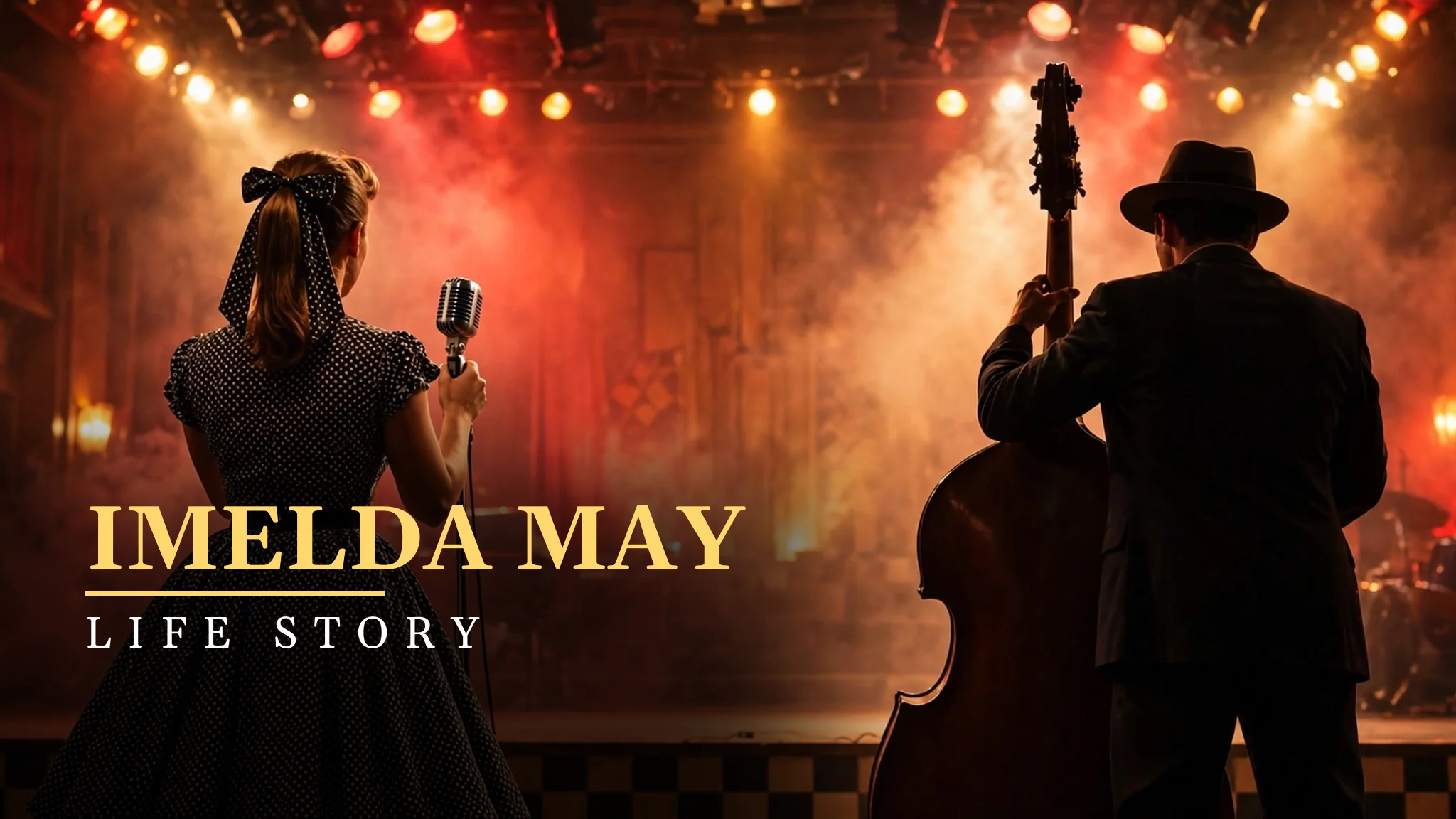
When I think about Imelda May, the first thing I see is not a face. It is a style. I see a polka-dot dress, a bow in the hair, a red lip, and a woman standing in front of a microphone with a double bass beside her. That image stays with me, because it is so clear and so confident. She does not look like other singers. She looks like herself, and that takes courage. In a music world where many singers dress the same and sound the same, Imelda chose a look from the 1950s and made it her own. I admire that, because it shows that she knew who she was long before the world knew her name.
I love her voice, because it is strong without being harsh, and warm without being soft. When she sings a rockabilly song, I can hear the joy in it. She is not singing to show off. She is singing because she loves the song, and that love comes through in every note. When she sings a slower song, like the ones on Life Love Flesh Blood, I can hear a different side of her, a quieter and more thoughtful side, and I can hear that she is singing about her own life. That range is rare, and it tells me that she is a real singer, not a singer who can only do one thing well.
I think about her childhood in the Liberties, and I feel a deep respect for where she came from. She was not born into a rich family, and she did not have a life of comfort. She grew up in a working-class part of Dublin, and she learned to sing in small clubs for small pay. That beginning matters, because it gave her a strong sense of who she is. She did not forget her roots when she became famous. She still talks about Dublin, she still lives in Ireland, and she still sings with a Dublin heart. I think that is why people in Ireland love her so much. She is one of them, and she has not pretended to be anyone else.
What moves me most about her story is the patience of it. She sang for many years before Love Tattoo made her famous. She was not a teenager when she became a star. She was a grown woman, a mother, and a singer who had already learned her craft. That is a different kind of success from the success of a young pop star, and I think it is a better kind. She did not become famous before she was ready. She became famous when she was ready, and that meant she could handle it. She knew what she wanted, she knew what she did not want, and she did not let fame change her. I think young singers should see that. Fame at a young age is not always a gift. Fame at the right time, after years of work, can be a gift, because the singer is strong enough to carry it.
I also think about the fact that she is a woman in a music style that was often seen as a man’s world. Rockabilly was full of male singers and male guitarists, and many people did not expect a woman to lead a rockabilly band. Imelda did not ask for permission. She stepped onto the stage, she sang with power, and she made the audience listen. That is a brave thing to do, and it has opened doors for other women who want to sing in that style. I admire her for that, not only as a singer, but as a person who refused to be put in a small box because of her sex. She showed that a woman can be strong, loud, and joyful on stage, and still be herself.
Her change of sound on Life Love Flesh Blood is something I think about a lot. Many singers would have stayed with the style that made them famous, because it is safe and it sells. Imelda took a risk. She made a slower, more soulful album, and she sang about the end of her marriage, about being a mother, and about finding her own way. That album could have failed, and some fans could have walked away. Instead, it became one of her best works, and it showed that she was willing to grow. I respect that risk, because growth is hard, and it is easy to stay safe. She chose to grow, and her music is better for it. It also tells me that she trusts her listeners to grow with her, and that trust is a beautiful thing.
I feel sad when I think about the end of her marriage, because a marriage ending is always painful, especially when there is a child involved. Imelda has spoken about that pain with honesty, and she has not tried to hide it or to make it sound easy. I respect that honesty, because it is easy to pretend that everything is fine when it is not. She did not pretend. She sang about it, she wrote about it, and she kept going. That is a strong way to live, and it is a lesson for anyone who has been through a hard time. You do not have to hide your pain. You can turn it into something honest, and that honesty can help other people who are going through the same thing.
I also admire her work as a poet. Many singers write songs, but few of them write poetry that stands on its own. Imelda’s book of poems showed that she has a real talent with words, and that her love of language goes beyond music. I think that is a sign of a true artist. She is not only a singer. She is a writer, and she cares about words, about rhythm, and about the way a sentence can hold a feeling. That care for words is in her songs as well, and it is one reason why her songs are so good. She does not use cheap words. She uses words that matter.
When I think about her as a mother, I feel respect for the way she has balanced her career and her family. Touring is hard for any parent, and it is especially hard for a mother who is away from her child for long periods. Imelda has spoken about that challenge, and she has not pretended that it is easy. She has said that she wants to be a good mother and a good singer, and that both things matter to her. I think many working mothers will understand that feeling, and I think it makes her more than just a star. It makes her a real person, trying to do her best in a hard world, and that is something I can admire.
I think about her live shows, and I wish I could see one. I have heard that her concerts are full of energy, with the band playing loudly, the audience dancing, and Imelda singing with joy. That joy is important, because music should be joyful, and too much music today is serious and sad. Imelda brings joy to a room, and that joy is a gift. She reminds me that music is not only about pain and loss. It is also about dancing, about laughing, and about feeling alive. Her rockabilly songs do that, and I think the world needs more of that joy.
If I have a worry about her story, it is that some people might see her only as a style, as a dress and a hairstyle, and miss the talent underneath. Her style is wonderful, but it is not the whole story. Underneath the style is a strong voice, a good songwriter, a poet, and a woman who has worked hard for many years. I do not want her style to hide her talent. I want people to listen to her songs, to hear her voice, and to understand that she is a serious artist, not a costume. Her style is a part of her, but her talent is the bigger part, and it deserves to be heard.
I also think about what her story teaches young women. It teaches them that they do not need to follow the fashion of the moment to succeed. They can love an old style, they can dress in their own way, and they can sing the music they love, and still find an audience. It teaches them that they can be strong and feminine at the same time, that they can be a mother and a star at the same time, and that they can change their sound when they need to grow. Those are important lessons, and Imelda teaches them not by giving speeches, but by living her life in public with honesty and courage.
In the end, I think Imelda May is a singer who brings joy and strength together. She sings with power, she dresses with style, and she lives with honesty. She has taken an old sound and made it new, she has taken a hard life and made it into art, and she has done it without losing herself. I will keep listening to her music, not only because it makes me want to dance, but because it reminds me that a person can be true to who they are, even when the world wants them to be someone else. That is a lesson worth learning, and Imelda May teaches it every time she steps onto a stage.
I also want to remember her kindness, because it is a part of her story that is easy to miss. She has used her fame to help charities, to support other musicians, and to speak out for women and for children. She does not make a big show of that work, but she does it steadily, year after year. That kindness comes from her life in Dublin, where community matters, and where people help each other. I think that is the best part of her story. A star who remembers where she came from, and who uses her voice to help others, is a star worth following.
When I think about her future, I hope she keeps growing, keeps writing, and keeps singing in her own way. I hope she makes more albums, writes more poetry, and plays more concerts, and that she does it all on her own terms. I also hope that new listeners keep finding her music, and that they hear in it what I hear: a strong Dublin voice, singing with joy, with style, and with truth. That voice deserves to be heard for a long time, and I believe it will be.
I think about her early albums, No Turning Back and Love Tattoo, and about how long it took her to become famous. She was not a young star made overnight. She was a singer who worked in small clubs for many years, learning her craft, before the world noticed her. That long apprenticeship is something I respect, because it shows that she did not rush. She waited until she was ready, until her voice was strong, until her style was clear, and until she knew who she was. When fame came, she was ready for it, and she handled it with grace. That is a lesson for any young singer who is in a hurry to be famous.
I also think about the way she dresses, and about how her style is a part of her art. Her polka-dot dresses, her victory rolls, and her red lipstick are not a costume. They are a statement, a way of saying that she loves the 1950s, that she loves rockabilly, and that she will not change her style to please a record company. I admire that, because it takes courage to be different in a world that wants everyone to look the same. Her style is a part of her identity, and it makes her instantly recognisable, even before she sings a note.
When I hear her sing a blues song, I hear a different side of her, a slower and more soulful side, and I realise how versatile she is. She is not only a rockabilly singer. She is a singer who can sing jazz, blues, soul, and folk, and who can do it all well. That versatility is rare, and it shows that she is a true musician, not only a performer with a good look. Her voice can be loud and joyful, and it can be soft and tender, and both are true. I think that range is one of her greatest strengths, and it is why her later albums, with their slower and more personal songs, work so well.
Frequently Asked Questions
Where in Dublin did Imelda May grow up?
Imelda May, born Imelda Clabby on 10 July 1974, grew up in the Liberties, an old working-class area of Dublin where music, markets, and a strong sense of community shaped her early life and her love of singing.
What kind of music is Imelda May best known for?
Imelda May is best known for rockabilly music in a 1950s style, with a strong beat and a clear voice, heard on albums such as Love Tattoo and Mayhem, though she has also sung jazz, blues, soul, and slower personal songs.
Which Imelda May album first made her famous?
The album Love Tattoo, released in 2008, first made Imelda May famous, with songs such as Johnny Got a Boom Boom and Big Bad Handsome Man bringing her rockabilly sound to listeners in Ireland, Britain, and beyond.
How did Imelda May change her sound on Life Love Flesh Blood?
On Life Love Flesh Blood, released in 2017 and produced by T Bone Burnett, Imelda May moved from loud rockabilly to a slower and more soulful sound, singing honestly about love, loss, motherhood, and the end of her marriage.
Is Imelda May also a poet as well as a singer?
Yes, Imelda May is also a poet, and she published a book of poems called A Lick and a Promise, which showed her talent with words beyond songwriting and was praised by readers and critics.
Who did Imelda May work with on television in Britain?
Imelda May worked with the musician and broadcaster Jools Holland, who became a strong supporter of her work and gave her a wide audience when she performed on his television show in Britain.
Does Imelda May still perform and record today?
Yes, Imelda May still performs, records, writes, and appears on television in Ireland, with later albums such as 11 Past the Hour showing that she continues to grow as a singer and as a writer.


