Why Prices Always End 99
In this post
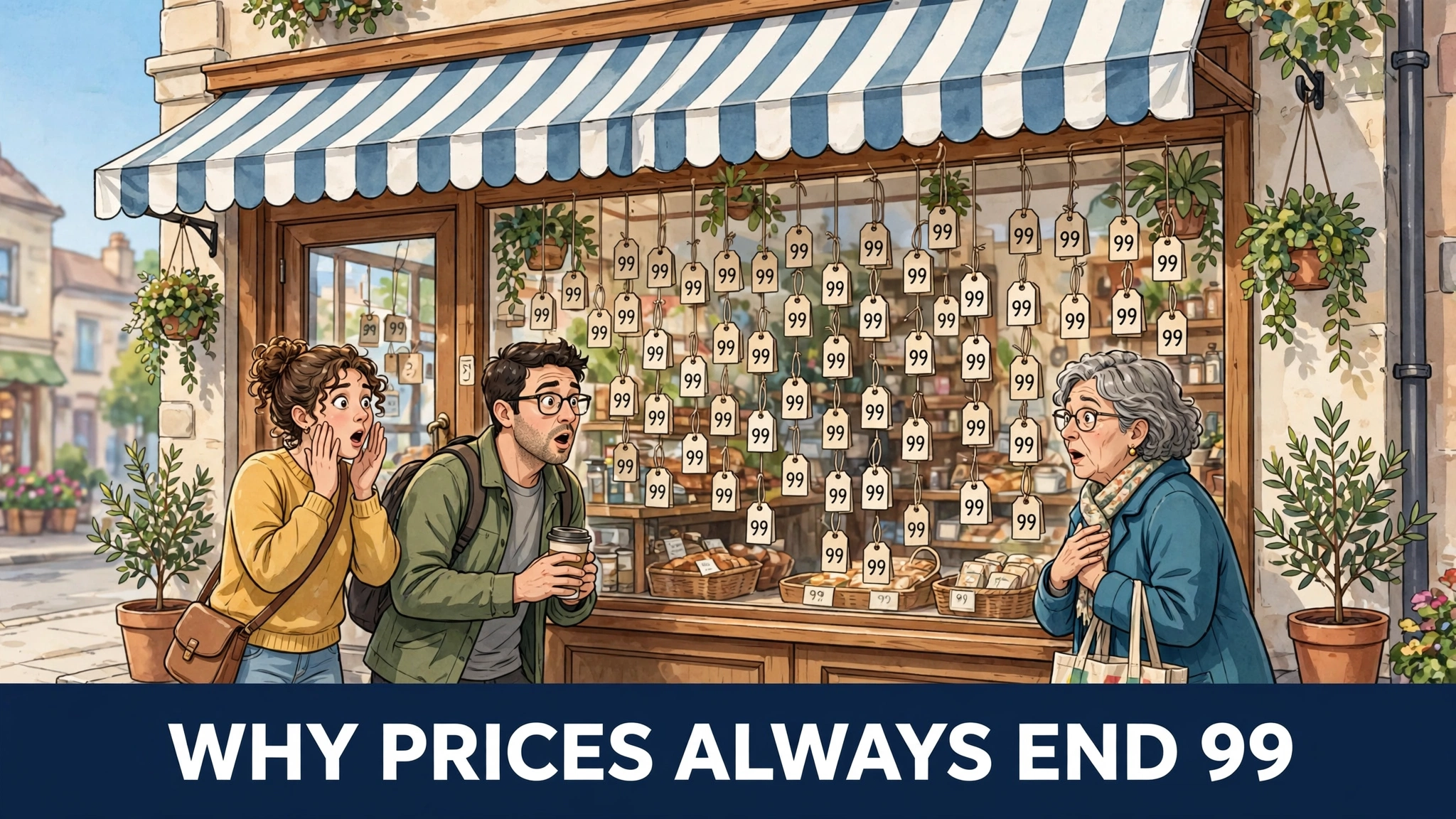
Walk into almost any shop on Earth and play a little game. Read the price tags one by one: 4.99, 19.99, 499.99, 999. It is as if the world’s shopkeepers signed a secret agreement to fear round numbers.
Now think about the strangeness of it. The difference between 9.99 and 10.00 is a single cent — a coin so small that many people would not bend down to pick it up from the pavement. Yet shops guard that one-cent gap like a treasure, and researchers have shown they are right to do so. That tiny gap changes what your brain believes the price is, changes how much a shop sells, and has done so for well over a hundred years.
Why? The answer involves the way your mind reads numbers, a clever old trick to stop dishonest cashiers, and the reason one famous brand would rather charge you a clean, proud 500.
Your Brain Reads Prices From The Left
The biggest reason is hidden in the way we read. In most languages we read from left to right, and the brain starts judging a number before it has finished reading it. The first digit lands with full force; the digits after it get far less attention.
So when your eyes meet 9.99, the giant 9 at the front does the talking. Your mind quietly files the price under “nine and something” — closer to 9 than to 10 — and the two 9s at the end barely get a vote. Scientists who study buying behaviour call this the left-digit effect, or left-digit bias. The price has not fooled your eyes; it has fooled the order in which your brain does its work.
This is also why a price cut only works its magic when the first digit changes. Dropping from 10.00 to 9.99 feels like a real fall. Dropping from 9.60 to 9.59, though a cent is a cent, feels like nothing at all — the all-important left digit never moved.
The Research: One Cent That Feels Like Twenty-Five
Feelings are one thing; proof is another. So researchers at the University of Chicago’s Booth School of Business dug into mountains of real shop data. Chicago Booth researcher Avner Strulov-Shlain studied price records for 1,710 popular products in 248 stores of one American retail chain, plus data on 12 products sold by more than 60 chains in 11,000 stores.
Three findings stand out. First, the habit is everywhere: between a quarter and a third of all prices in the data ended in 99 cents. Second, shoppers reacted to a rise from 4.99 to 5.00 — one cent, remember — as if the price had jumped by 15 to 25 cents. The left digit changed, and demand fell as though the price had leapt. Third, and most surprising, the shops themselves misunderstood their own trick. Their pricing behaviour suggested they believed customers treated the one-cent rise as a rise of only about 1.5 to 3 cents. In other words, the effect on buyers was many times stronger than the sellers realised — and by underestimating it, retailers were giving up an estimated 1 to 3 percent of their potential gross profits.
The same research shows how fiercely shops protect a 99 ending. When the cost of making an item rose, a retailer might hold the selling price at 2.99 and quietly accept a thinner profit, rather than cross the dreaded line into the next number and watch demand drop.
The Old Story Of The Honest Cash Register
Psychology explains why the trick works today. But how did it begin? For that, retail history tells a famous story — and it is worth saying honestly, as Shopify’s own guide to pricing puts it, that this is “the story goes”: a widely repeated explanation from the early days of the cash register, rather than a single documented invention.
Back in the early days of the cash register, shop owners had a thief problem, and the thief often stood behind their own counter. If an item cost a round 5 dollars and the customer handed over exactly 5 dollars, a dishonest clerk could slip the money into a pocket without ever opening the till. No record, no evidence, no sale as far as the owner knew.
Odd prices broke the crime. Price the item at 4.99, and the customer paying with a 5-dollar note needs a cent of change. To get that cent, the clerk must open the cash register — and opening the register records the sale. Suddenly every transaction leaves a trace, the day’s records can be checked against the cash inside, and pocketing money becomes far riskier. The same logic applied to bigger notes: a price just under 50 forced the drawer open, where a round 50 might never have done so.
Whether or not this was the true first cause, the habit spread through the retail world and never left. A 1997 study reported in Marketing Bulletin found that more than 90 percent of advertised prices at the time ended in an odd numeral. The cash registers changed beyond recognition; the prices did not.
Why Some Prices Stay Proudly Round
If 99 endings are so powerful, why do some famous products carry prices like a flat 100, 500 or 1,000? Because the 99 trick carries a smell with it: the smell of a bargain. It says “deal”, “discount”, “good value”. That is wonderful for soap and shirts. It is poison for a perfume, a honeymoon, or a handbag that wants to be desired.
Research published in the Journal of Consumer Research, reported by ScienceDaily, explains the other side of the coin. Across five studies, researchers Monica Wadhwa and Kuangjie Zhang found that a rounded price — say 100.00 — encourages people to judge a product by feeling, while a non-rounded price pushes them to judge by reason. When a purchase is driven by feelings, the round price actually wins. Their example is easy to picture: a camera bought for a family holiday sold better at a round price, while the same camera bought for a class project sold better at a precise, non-rounded price.
The researchers suggest that things bought for pleasure and personal joy — holiday packages, clothing, handbags, even houses — can benefit from rounded prices, while practical goods such as appliances and toothpaste do better with exact-looking numbers. Shopify’s pricing guide makes the matching point from the seller’s side: shops that want to look upscale deliberately use whole numbers, and endings of .00 are associated with luxury products, while odd endings advertise a bargain.
A 99 ending, then, is not just a number trick. It is a message. And some brands refuse to send it.
The Trick Is Alive On Your Phone Screen
You might think all this belongs to the age of paper tags. It does not. Open any shopping app and count the endings: the 99s march across the screen exactly as they marched across the shelves. Online, the left-digit effect may bite even harder, because shoppers scroll fast, compare six products in six seconds, and let the first digit do nearly all the deciding before the brain catches up.
Digital sellers also use price endings as a private language. Shopify notes that some large retailers use the final digits of a price as a staff code — for example, certain endings quietly mark items that will be reduced again in the next markdown round, while others mark final clearance that will never drop further. The tag is talking to the shop’s own workers over your shoulder.
So the next time a price ends in 99, read it the slow way: round it up in your head — 9.99 is 10 — and then decide if you still want the thing. The trick works on every brain, including yours and including the shopkeeper’s. The only defence is knowing it is there.
Frequently Asked Questions
What is the left-digit effect? It is the brain’s habit of judging a price mostly by its first digit, because we read numbers from left to right. A price of 9.99 is filed as “nine-something” and feels much cheaper than 10.00, even though the real difference is one cent.
Did shops really use 99 prices to stop cashiers stealing? That is the famous historical explanation: an odd price forced the clerk to open the cash register to give change, and opening the register recorded the sale, making it harder to pocket the money. It is a widely told story about the early cash-register era — presented by pricing guides as “the story goes” — and the habit certainly became universal afterwards.
How strong is the effect, really? Stronger than most sellers think. Chicago Booth research found that shoppers reacted to a one-cent rise from 4.99 to 5.00 as if the price had risen by 15 to 25 cents, and that retailers lose an estimated 1 to 3 percent of potential gross profits by underestimating the bias.
Why do luxury and holiday products use round prices? Because round prices work through feelings, not calculation. Research reported by ScienceDaily found that feeling-driven purchases — holidays, handbags, a camera for a family trip — are more likely to be bought at rounded prices, and a round price also signals quality and confidence instead of a bargain.
How can I stop the trick working on me? Read every price twice: once as written, and once rounded up to the next whole number. Then ask whether the item is still worth it at the honest, rounded figure. That one habit removes most of the magic.
Sources
- Chicago Booth Review, “Many Retailers Are Making a Basic Mispricing Mistake”: https://review.chicagobooth.edu/marketing/2019/article/many-retailers-are-making-basic-mispricing-mistake
- ScienceDaily, “When the price just feels right: Do rounded numbers appeal to our emotions?”: https://www.sciencedaily.com/releases/2015/01/150122084344.htm
- Shopify, “Odd Even Pricing: Definition, Strategy & Examples”: https://www.shopify.com/ie/blog/what-is-odd-even-pricing
- The picture on this page is an original illustration made for Talha M Blog.