Irene Papas: The Life Story Behind Greece's Tragic Actress
In this post
- A Girl From Chiliomodi Who Dreamed of the Stage
- The Stage, the Classics, and a Voice for Tragedy
- The Guns of Navarone, Zorba, and International Fame
- Electra, Antigone, and the Great Roles of Her Life
- A Long Life, Honours, and a Quiet Farewell
- The Films of Michael Cacoyannis and a Partnership in Art
- A Voice, a Face, and the Art of Tragedy
- My Take:
Irene Papas was an actress who seemed to carry the whole history of Greece in her face. When she appeared on screen, audiences saw not only a woman, but a figure from ancient tragedy, a queen, a mother, a widow, a woman who had suffered and who had survived. She played Electra, Antigone, Clytemnestra, and many other great roles, and she played them with a power that few actors have ever matched. She was also a star of international cinema, appearing in The Guns of Navarone and Zorba the Greek, films that made her known around the world. Her story is the story of a Greek girl who became the face of Greek tragedy for the modern world.
She was born on 3 September 1926 in Chiliomodi, a village near Corinth, as Eirini Lelekou. She grew up in a Greece that was going through war and hardship, and she studied acting in Athens, at the National Theatre’s drama school. She began her career on the stage, playing the great roles of Greek tragedy, and she soon moved into film. Her early films in Greece made her a star at home, and then her work in international films made her a star abroad. She was an actress of great dignity, great beauty, and great seriousness, and she never treated acting as a light thing. For her, it was a calling, and she gave it her whole life.
She lived for ninety-six years, and she died on 14 September 2022 in Chiliomodi, the village where she was born. Her life spanned almost a century of Greek history, from the years before the Second World War to the modern age, and her work spanned the great age of international cinema. She was honoured in Greece and around the world, and she remains one of the most respected actresses Greece has ever produced. This is her story.
A Girl From Chiliomodi Who Dreamed of the Stage
Eirini Lelekou, who became Irene Papas, was born on 3 September 1926 in Chiliomodi, a village in the region of Corinthia, in the Peloponnese. It was a small, rural place, where life was hard and where the ancient world was never far away. The ruins of Corinth, the temples, and the stones of ancient Greece were part of the landscape, and a child growing up there could feel the presence of the past in everyday life. Irene grew up with that feeling, and it stayed with her. When she later played the great women of Greek tragedy, she was not acting a part from a book. She was giving voice to a world she had known since childhood.
Her family moved to Athens, and there she had the chance to study. She went to the Royal School of Dramatic Art at the National Theatre of Greece, one of the most respected acting schools in the country. There she learned the craft of acting, and she learned the great plays of the ancient Greeks: the tragedies of Sophocles, Euripides, and Aeschylus. Those plays are the foundation of Western theatre, and they demand an actor who can speak with power, who can feel deeply, and who can carry the weight of a great story. Irene learned to do all of that, and she became one of the finest classical actresses of her generation.
Her early years were also years of war. Greece was occupied during the Second World War, and the years that followed were hard. But the theatre was a place of strength, and Irene found in it a way to speak about suffering, about courage, and about the human spirit. She began to act on the stage in Athens, and audiences noticed her at once. She had a presence that was rare: tall, dignified, with dark eyes and a voice that could fill a theatre. She was not a light actress. She was a tragic actress, and that was her gift. She could play grief, anger, and love with a truth that moved people deeply.
The Athens of the late 1940s was a city rebuilding itself, and its theatre was rebuilding too. Irene was part of that rebuilding, and she helped to make Greek theatre a living art again. She played in the great tragedies, and she also played in modern plays, and she showed that she could do both. But it was tragedy that suited her best, and it was tragedy that would make her famous. The girl from Chiliomodi had found her calling, and she would follow it for the rest of her life.
The Stage, the Classics, and a Voice for Tragedy
Irene Papas built her reputation on the stage, playing the great heroines of Greek tragedy. She played Electra, the daughter who seeks revenge for her father’s murder. She played Antigone, the woman who defies a king to bury her brother. She played Clytemnestra, the queen who kills her husband. These are roles that demand everything from an actor: a powerful voice, a strong body, and a deep understanding of human suffering. Papas had all of that, and her performances became legendary. Audiences in Greece and around the world who saw her on stage never forgot it.
She also performed in the ancient theatres of Greece, including the great theatre at Epidaurus, where the tragedies were first performed more than two thousand years ago. To play Electra at Epidaurus, under the open sky, with the stones of the ancient theatre around you, is a special experience for an actor, and Papas did it with a power that matched the place. She was not only acting. She was continuing a tradition that was older than any other in theatre, and she was doing it in the very place where it began. That connection, between the actress and the ancient stones, is part of why her performances felt so true.
Her stage work also took her abroad. She performed in London, in Paris, in New York, and in many other cities, and audiences who did not speak Greek could still feel the power of her acting. Tragedy does not need translation when it is played with truth. A face, a voice, and a gesture can say what words cannot, and Papas understood that. She was an actress who could make an audience feel grief, even if they did not understand a single word she spoke. That is a rare gift, and it is why she became known as one of the great tragic actresses of the twentieth century.
The stage remained her first home throughout her life, even after she became famous in film. She returned to it again and again, because it was where she felt most alive, and where her talent was most fully used. A film can be edited, a performance can be cut, but a stage performance is live, and it demands everything from the actor in the moment. Papas loved that demand, and she met it with a seriousness and a dignity that made her one of the most respected actresses of her time.
The Guns of Navarone, Zorba, and International Fame
Irene Papas became known to international audiences through her work in film, beginning in the 1950s and reaching its peak in the 1960s. One of her early international films was The Guns of Navarone, released in 1961, a war film about a group of Allied soldiers on a mission to destroy German guns on a Greek island. Papas played Maria, a Greek resistance fighter, and her performance, strong and dignified, made her stand out even among a cast of famous actors. The film was a huge success, and it introduced her to audiences around the world.
Her most famous international role came in 1964, in Zorba the Greek, directed by Michael Cacoyannis and starring Anthony Quinn as Zorba. Papas played the Widow, a young woman in a Cretan village who is shunned by her community and who suffers a tragic fate. It is a small role, but it is a powerful one, and Papas played it with a dignity and a sadness that made it unforgettable. The film became a classic, and it is still one of the best-known Greek films ever made. Papas’s performance in it is a big part of why the film is so moving. She showed, in a few scenes, the cruelty of a closed community and the strength of a woman who refuses to be broken.
She also worked with Cacoyannis on films of the great tragedies, including Electra in 1962 and Iphigenia in 1977. These films brought the ancient plays to the screen with a power and a beauty that had never been seen before, and Papas’s performances in them are regarded as definitive. Her Electra is a woman consumed by grief and by the need for revenge, and Papas played her with a fire that is still startling to watch. Her Iphigenia is a young woman sacrificed by her father, and Papas played her with a tenderness and a tragedy that moved audiences deeply. These films are the heart of her legacy in cinema.
Her international career also included work in many countries, with directors from Italy, France, and other places. She played in The Trojan Women in 1971, another film of a Greek tragedy, and she appeared in Captain Corelli’s Mandolin in 2001, a film set in Greece during the Second World War. She was an actress who could work anywhere, and who was respected everywhere, because her talent was not limited to one country or one language. She was a Greek actress, but she was also a world actress, and the world knew it.
Electra, Antigone, and the Great Roles of Her Life
The roles that defined Irene Papas were the great women of Greek tragedy, and she played them throughout her life, on stage and on screen. Electra was perhaps the most important of these roles. Electra is a daughter who has watched her father murdered, and who lives only for revenge. It is a role that demands anger, grief, and a fierce intelligence, and Papas played it with all of those qualities. Her Electra is not a victim. She is a woman who chooses her path, and who pays the price for it. That strength, that refusal to be pitiful, is what made Papas’s Electra so powerful.
Antigone was another great role. Antigone is a young woman who defies the king to bury her brother, knowing that she will be punished with death. It is a play about conscience, about duty, and about the courage to stand alone. Papas played Antigone with a quiet dignity that made her defiance feel both heroic and human. She did not shout. She stood, she spoke, and she accepted her fate. That stillness, that calm in the face of death, is one of the most moving things in her acting, and it is a quality that ran through all her great roles.
She also played Clytemnestra, Medea, and other tragic heroines, each one different, each one played with a deep understanding of the character’s pain. These are not easy roles. They ask an actress to feel grief, anger, and love at their most extreme, and to make the audience feel them too. Papas did that, again and again, for decades. She was not an actress who played tragedy lightly. She lived it, on stage and on screen, and she gave it her whole self. That commitment is why her performances are still studied by actors and by students of theatre today.
Her work in these roles also made her a cultural ambassador for Greece. When she played Electra or Antigone in London or New York, she was not only performing a play. She was showing the world the greatness of Greek culture, and the power of its ancient stories. She carried Greece with her wherever she went, and she did it with a dignity that made people respect not only her, but her country. That is a legacy that goes beyond acting. It is a legacy of cultural pride, and of a woman who gave her life to the stories of her people.
A Long Life, Honours, and a Quiet Farewell
Irene Papas lived a long life, and she was honoured many times for her work. In Greece, she was treated as a national treasure, and she received awards and recognition for her contribution to theatre and to film. Abroad, she was also honoured, and she was invited to festivals, to retrospectives, and to celebrations of her work. She was a woman who had given her life to art, and the world thanked her for it. But she remained a private person, and she did not seek fame for its own sake. She sought only to do her work well, and to honour the great plays she loved.
In her later years, she lived quietly, mostly in Greece, and she spoke rarely in public. She had given so much on stage and on screen, and in her old age she chose a quieter life. She was still respected, still admired, and still remembered by audiences who had seen her perform. Young actors looked up to her, and film lovers continued to watch her great performances. She was a living link to the great age of Greek theatre and cinema, and her presence was a reminder of a time when acting was a serious and noble art.
She died on 14 September 2022, in Chiliomodi, the village where she was born, at the age of ninety-six. Her death was mourned in Greece and around the world, and tributes came from actors, directors, and cultural figures who had admired her for decades. She was buried in her village, in the place where her story had begun. It was a fitting end for a woman who had carried Greece with her throughout her life, and who had returned, at the end, to the place where she started.
Her legacy is the legacy of a great tragic actress, one of the finest of the twentieth century. Her performances in Electra, Antigone, Zorba the Greek, and The Guns of Navarone are still watched, still studied, and still loved. They are performances of great power and great dignity, and they show what acting can be when it is done with total commitment. Irene Papas gave her life to those performances, and they will live on long after her death. She was Greece’s tragic actress, and the world is richer for having seen her.
The Films of Michael Cacoyannis and a Partnership in Art
Irene Papas’s film career is closely tied to the director Michael Cacoyannis, a Greek filmmaker who shared her love of the ancient tragedies and who made some of the finest films of Greek drama ever put on screen. Together, they made Electra in 1962, The Trojan Women in 1971, and Iphigenia in 1977, films that brought the great plays to audiences around the world. Cacoyannis understood Papas’s talent, and he gave her roles that used it fully. She understood his vision, and she brought it to life with a power that few actresses could match. Their partnership was one of the great partnerships in Greek cinema, and it produced films that are still regarded as classics.
Electra, made in 1962, is perhaps their finest work together. The film tells the story of a daughter who seeks revenge for her father’s murder, and Papas played Electra with a fire that is still startling to watch. The film was shot in the Greek landscape, with the ancient ruins and the harsh light of the country as a backdrop, and Papas’s performance matched that landscape: stark, powerful, and unforgettable. The film was shown at festivals around the world, and it won praise for its beauty and its power. It is still one of the best films ever made from a Greek tragedy, and Papas’s Electra is the reason.
Iphigenia, made in 1977, is another great work. The film tells the story of a young woman sacrificed by her father, Agamemnon, so that the Greek fleet can sail to Troy. Papas played Clytemnestra, Iphigenia’s mother, a woman who watches her daughter die and who vows revenge. It is a role of great depth, a mother torn between love and rage, and Papas played it with a dignity and a pain that moved audiences deeply. The film is a meditation on war, on sacrifice, and on the cost of power, and Papas’s performance is at its heart. Together, these films show what happens when a great director and a great actress share a vision, and work together to bring ancient stories to modern audiences.
Cacoyannis and Papas also worked together on Zorba the Greek, in which Papas played the Widow, and their collaboration there, too, produced a performance of great power. Their partnership lasted for decades, and it is a reminder that great art is often made by people who trust each other, who share a love of the same stories, and who are willing to work together over many years. Papas and Cacoyannis shared that trust, and Greek cinema is richer for it. Their films are a legacy that will be watched for as long as people care about tragedy, about Greece, and about the power of great acting.
A Voice, a Face, and the Art of Tragedy
Irene Papas’s acting was built on two things: a voice and a face. Her voice was deep, strong, and clear, and it could fill a theatre without shouting. When she spoke the words of a tragedy, the audience could hear every syllable, and could feel the weight of each one. Her voice was not a pretty voice. It was a powerful voice, a voice that carried grief, anger, and love, and that made the ancient words feel alive. She had trained that voice at the National Theatre’s drama school, and she had used it on stage for decades, and it became one of the most recognisable voices in Greek theatre and film.
Her face was equally powerful. It was a face that could show suffering without exaggeration, a face that could be still and yet full of feeling. When she played Electra, her face showed anger and grief at the same time. When she played the Widow in Zorba the Greek, her face showed dignity and sadness, and the audience could see her whole story in a single look. That ability to speak with the face, to say what words cannot, is a rare gift, and it is why her performances are so moving. A viewer who does not understand Greek can still understand her face, and can feel what she feels, and that is the mark of a great actress.
Her art of tragedy was also an art of restraint. She did not overact. She did not shout or wave her arms. She stood, she spoke, and she let the words and the feeling do the work. That restraint made her performances more powerful, not less, because it trusted the audience to pay attention, and to feel what was happening. In a world where acting is often loud and showy, Papas’s restraint was a reminder that the strongest performances are often the quietest, and that a single look can say more than a long speech. That lesson is one that actors still learn from her today.
In the end, her voice and her face together made her one of the great tragic actresses of the twentieth century. She was not only a Greek actress. She was a world actress, and her performances are studied in drama schools, shown in retrospectives, and loved by audiences who have never been to Greece. Her art was the art of tragedy, and it was an art that she practised with total commitment, for more than sixty years. That commitment is her legacy, and it is why she will be remembered as one of the finest actresses Greece has ever produced.
My Take:
When I think about Irene Papas, I think about a face, because her face was one of the most powerful faces in cinema. It was a face that could show grief, anger, love, and dignity, sometimes all at once, and without a single word. When she played Electra, you did not need to understand Greek to feel her pain. You could see it in her eyes, in the set of her mouth, and in the way she stood. I think that is a rare gift, and it is why she became one of the great actresses of her time. A face like that does not come from training alone. It comes from a deep understanding of human suffering, and from a willingness to feel it fully.
I think about the ancient theatres of Greece, and about what it must have felt like to play Electra at Epidaurus, under the open sky, with the stones of a theatre that is more than two thousand years old around you. That is a special experience, and Papas had it, again and again. She was not only acting a play. She was continuing a tradition that began before any other theatre in the world, and she was doing it in the very place where it began. I think about that, and I feel a kind of awe. A modern actress, standing where ancient actors stood, speaking words that were written thousands of years ago, and making them feel alive. That is a beautiful thing, and Papas did it with a power that few others could match.
What I like most about her work is its seriousness. She did not treat acting as a game. She treated it as a calling, as a way of speaking about the deepest things in life: grief, revenge, love, and death. Her performances are not light. They are heavy, and they ask the audience to feel deeply. I think that is a brave way to act, because it asks the audience to be serious too. In a world where so much entertainment is light and easy, Papas’s work reminds us that art can be serious, and that seriousness can be beautiful. Her Electra is not an easy watch, but it is a rewarding one, because it shows us something true about what it means to be human.
I think about Zorba the Greek, and about her role as the Widow, a small role that she made unforgettable. The Widow is a woman who is punished by her village for loving, and who dies because of their cruelty. Papas played her with a dignity that made the village’s cruelty feel even more terrible, and her death feel even more tragic. It is a performance that stays with you, even though she is on screen for only a short time. I think that is a lesson: you do not need a big role to make a big impression. You need to bring truth to the role you have, and Papas brought truth to the Widow, and the audience has never forgotten her.
I also think about her life, and about how she lived for ninety-six years, from 1926 to 2022, and saw Greece change in ways that few people have seen. She was born in a village, she lived through war, through dictatorship, through democracy, and through the modern age, and she carried all of that history in her work. Her performances are not only about ancient Greece. They are also about modern Greece, about a country that has suffered and survived, and about a people who have known grief and who have kept going. Papas embodied that spirit, and her work is a part of Greece’s modern history as well as its ancient history.
There is a sadness in her story too, and it is the sadness that is in the tragedies she played. Electra, Antigone, and the Widow are all women who suffer, and Papas played their suffering with a truth that is hard to watch. I think about that, and I wonder what it cost her to play those roles again and again, to live in grief night after night, on stage and on screen. It must have been hard, and it must have taken a toll. But she did it, because she believed that those stories needed to be told, and that the audience needed to hear them. That is a kind of courage, to give yourself to suffering in art, so that others can understand it better.
I think about the young actors who look at her work today, and about what they learn. They learn that acting can be a serious art, that a face can tell a story, and that a voice can carry the weight of history. They learn that a Greek actress can be a world actress, and that the ancient plays are still alive, still relevant, and still powerful. Papas’s work is a school for actors, and it will be studied for as long as people care about theatre and film. That is a legacy that few actors achieve, and it is one that she earned through a lifetime of work.
If I have a criticism, it is not a criticism of Papas herself. It is a sadness that her kind of acting, serious, classical, and tragic, is not as common today as it once was. Today, films are often fast, loud, and light, and there is less room for a slow, serious performance like hers. I think that is a loss, because the world needs actors who can play grief and dignity with truth. I hope young audiences discover her films, because they will find in them a kind of acting that is rare today, and that is worth learning from. Her Electra alone is a lesson in what acting can be.
I also think about her privacy, and about how she lived quietly in her later years, away from the noise of fame. That is a dignified way to live, and it suits her. She gave her life to the stage and to the screen, and when she was old, she chose to live quietly, in the village where she was born. I respect that choice, because it shows that she knew what mattered. Fame was not the point. The work was the point, and when the work was done, she could rest. That is a good way to end a life, and it is a fitting end for a woman who had given so much.
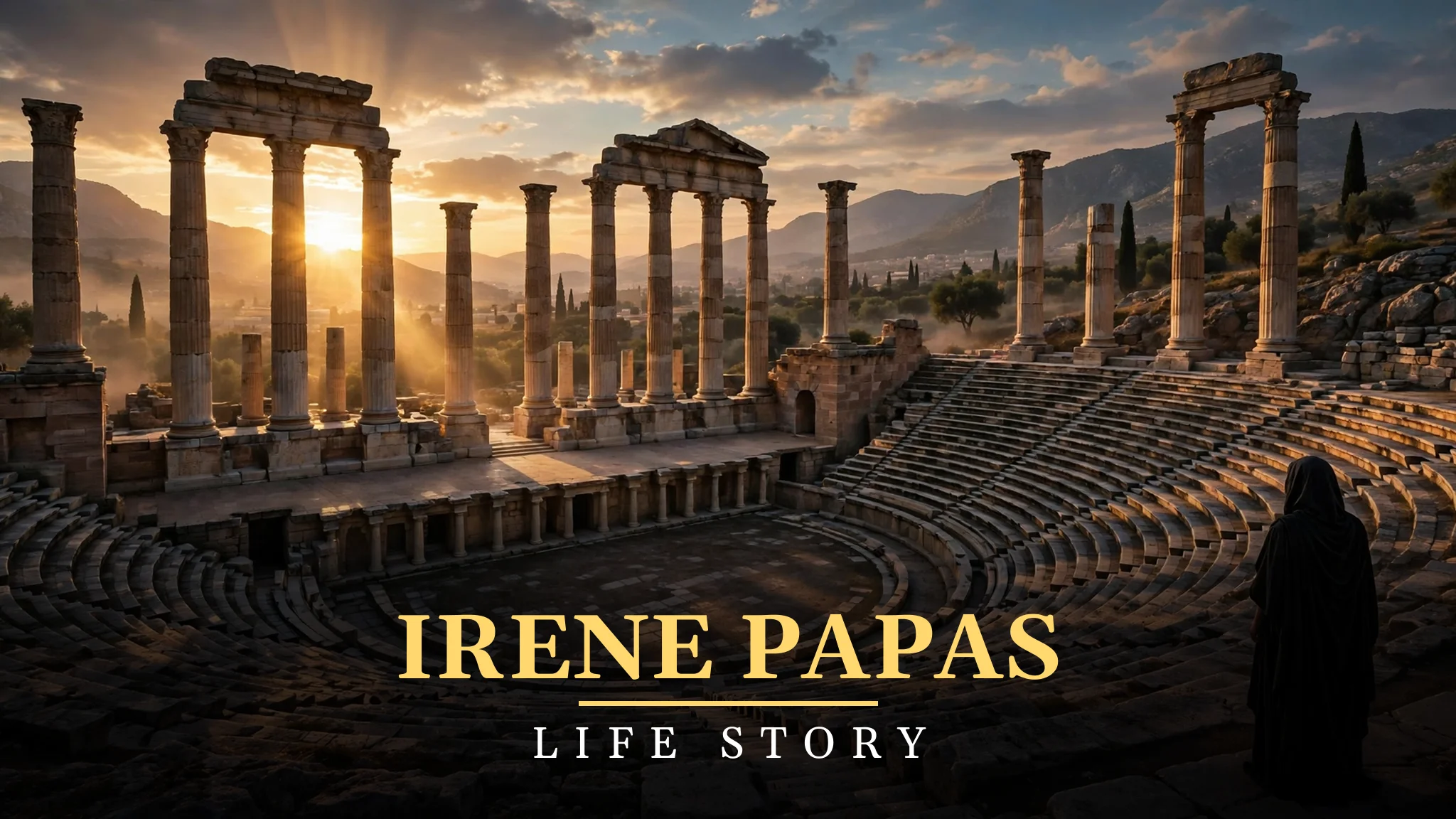
One more thought stays with me, and it is about the image of a hooded figure in an ancient amphitheatre at sunset. That image fits Papas, because she was an actress who belonged to the ancient theatres, to the stones, to the columns, and to the tragedies that were first performed there. She was a modern woman, but she carried the ancient world with her, and she gave it a voice for our time. When I think of her, I think of that figure, standing alone in the amphitheatre, with the sun setting behind the columns, and with the whole history of Greece in her presence. That is Irene Papas, and that is why she will be remembered.
In the end, I think Irene Papas teaches us that acting can be a serious and noble art, and that a single actress can carry the history of a whole culture in her face and in her voice. She was born in Chiliomodi, she studied in Athens, she played Electra and Antigone on the great stages of the world, and she starred in Zorba the Greek and The Guns of Navarone. She lived for ninety-six years, and she gave her life to tragedy, to Greece, and to the art of acting. I would tell a new viewer to start with Zorba the Greek, then to watch Electra, and then to watch Iphigenia, and to look at her face. You will see a woman who understood suffering, who understood dignity, and who understood what it means to be human. That is Irene Papas, Greece’s tragic actress.
I think about her partnership with Michael Cacoyannis, and about how great art is often made by people who trust each other. Cacoyannis trusted Papas with the greatest roles in Greek tragedy, and Papas trusted Cacoyannis to film them with care. Together, they made Electra, Iphigenia, and The Trojan Women, films that are still regarded as classics. That partnership is a lesson: a great director and a great actress, working together over many years, can create something that neither could create alone. Papas and Cacoyannis did that, and Greek cinema is richer for it.
I also think about her voice, and about how it carried the ancient words. Her voice was deep and strong, and it could fill a theatre without shouting. When she spoke the words of Sophocles or Euripides, the audience could hear every syllable, and could feel the weight of each one. I think that is a rare gift, and it is one that comes from training, from discipline, and from a deep love of language. Papas loved the words she spoke, and that love is audible in every performance. She did not rush them. She gave them time, and she let them live.
I think about her face again, and about how it could say what words could not. A face that is still, and yet full of feeling, is a powerful thing, and Papas had such a face. When she played the Widow in Zorba the Greek, her face showed dignity and sadness, and the audience could see her whole story in a single look. That is a lesson for actors: you do not need to shout to be heard. You need to be true, and to let your face speak, and the audience will listen. Papas did that, and her performances are proof that stillness can be more powerful than noise.
I think about her long life, and about the history she lived through. She was born in 1926, she lived through war, through dictatorship, through democracy, and through the modern age, and she carried all of that history in her work. Her performances are not only about ancient Greece. They are also about modern Greece, about a country that has suffered and survived, and about a people who have known grief and who have kept going. Papas embodied that spirit, and her work is a part of Greece’s modern history as well as its ancient history.
I also think about the young actors who study her work today, and about what they learn. They learn that acting can be a serious art, that a face can tell a story, and that a voice can carry the weight of history. They learn that a Greek actress can be a world actress, and that the ancient plays are still alive, still relevant, and still powerful. Papas’s work is a school for actors, and it will be studied for as long as people care about theatre and film. That is a legacy that few actors achieve, and it is one that she earned through a lifetime of work.
One more thought stays with me, and it is about the village of Chiliomodi, where she was born and where she died. She travelled the world, she performed in London, Paris, and New York, and she became a world star, but she returned, at the end, to the village where she started. I think that is a fitting end, and a beautiful one. A woman who carried Greece with her throughout her life returned to the place where her story began, and she rests there now. That is a full circle, and it is a reminder that no matter how far we travel, home is always there, waiting for us.
I think about the ancient plays, and about how they are still alive because actresses like Papas kept them alive. Electra, Antigone, and the other great heroines could have become museum pieces, words in a book that no one reads. Papas made them live, on stage and on screen, and she showed that they still speak to us, about grief, about justice, and about courage. That is a gift to the world, and it is one that will last as long as people care about theatre.
I also think about the young actors who will watch her films in the future, and about what they will learn. They will learn that acting can be serious, that a face can tell a story, and that a voice can carry history. They will learn that a Greek actress can be a world actress, and that the ancient plays are still powerful. Papas’s work is a school, and it will teach actors for generations to come.
Frequently Asked Questions
When and where was Irene Papas born?
Irene Papas was born on 3 September 1926 in Chiliomodi, a village near Corinth in Greece, as Eirini Lelekou. She grew up in a Greece that was going through war, and she later studied acting at the National Theatre’s drama school in Athens.
What are Irene Papas’ most famous film roles?
Her most famous film roles include Maria in The Guns of Navarone (1961), the Widow in Zorba the Greek (1964), Electra in Electra (1962), and Iphigenia in Iphigenia (1977). She also appeared in The Trojan Women and in Captain Corelli’s Mandolin.
What Greek tragedy roles did Irene Papas play on stage?
She played the great heroines of Greek tragedy on stage, including Electra, Antigone, Clytemnestra, and Medea, and she performed in the ancient theatre at Epidaurus. Her stage performances became legendary in Greece and abroad.
When did Irene Papas die?
She died on 14 September 2022 in Chiliomodi, the village where she was born, at the age of ninety-six. Her death was mourned in Greece and around the world, and she was buried in her village.
Why is Irene Papas called Greece’s tragic actress?
She is called that because she was one of the finest interpreters of Greek tragedy in the twentieth century, playing Electra, Antigone, and other great heroines with a power and dignity that few actors have matched, on stage and on screen.
Did Irene Papas work outside Greece?
Yes, she worked in many countries, appearing in British, Italian, French, and American films, and performing on stage in London, Paris, and New York. She was respected around the world as a great classical actress.


