Islam Makhachev: The Life Story Behind MMA's New Champion
In this post
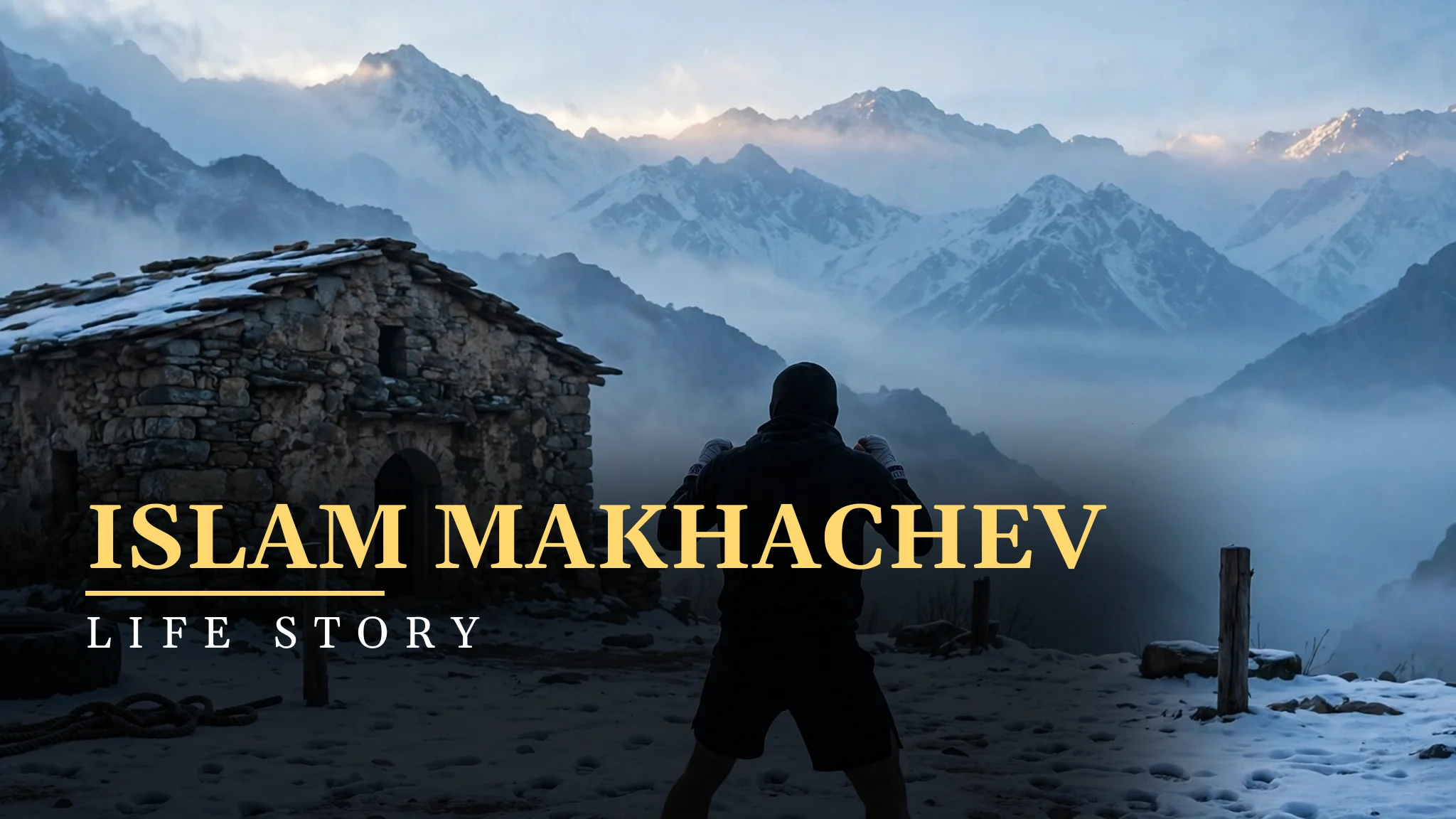
Islam Makhachev is the fighter who was always going to be a champion, and the fighter who had to wait the longest to prove it. For years, he was known as the man Khabib Nurmagomedov believed in, the training partner, the friend, the heir. People said he was the next Khabib, and they meant it as a compliment, but it was also a burden, because being the next someone is never as simple as it sounds. Islam had to become himself, in the cage, in front of the world, and he did it, slowly and steadily, winning fight after fight, until he could no longer be ignored. He won the lightweight title in 2022, he defended it four times, he beat Alexander Volkanovski twice, and he became one of the best pound-for-pound fighters in the world. Then, in 2025, he gave up his lightweight title, moved up to welterweight, and won a second title there, becoming a two-weight champion. His story is about patience, about loyalty, and about a man who waited for his moment and then took it with both hands.
He grew up in Makhachkala, the capital of Dagestan, a city on the Caspian Sea, where wrestling is a way of life and where young boys learn to fight before they learn to read. His family was poor, and he trained in wrestling and sambo from childhood, under the guidance of Abdulmanap Nurmagomedov, Khabib’s father, who became his coach and his mentor. Islam and Khabib grew up together, training in the same gym, running in the same mountains, and dreaming of the same thing: becoming champions. When Khabib retired, Islam carried the torch, and he did it with a quiet determination that is all his own. He is not Khabib. He is Islam, and his story, while it is linked to Khabib’s, is his own story, of a boy from Dagestan who became a champion in two divisions.
This is the story of that boy, of his rise, his title, his defences, and his move to a new weight. It is a story about waiting, about working, and about what happens when patience finally pays off.
Makhachkala, Wrestling, and Abdulmanap’s Gym
Islam Ramazanovich Makhachev was born on 27 October 1991 in Makhachkala, the capital of Dagestan, a republic in southern Russia, on the western shore of the Caspian Sea. Dagestan is a mountainous region, home to many different peoples, with a strong tradition of wrestling, sambo, and martial arts. Life in Makhachkala was hard, and Islam grew up in a family that valued discipline, faith, and hard work. He was a quiet boy, and he was drawn to sport from an early age, training in wrestling and in sambo, a Russian martial art that combines wrestling and judo. He trained in a gym run by Abdulmanap Nurmagomedov, Khabib’s father, a coach who was known throughout Dagestan for his discipline and his ability to produce champions.
Abdulmanap became Islam’s coach, his mentor, and a father figure, and he taught him the same lessons he taught Khabib: discipline matters more than talent, respect matters more than fame, and a man should keep his word. Islam trained alongside Khabib, who was three years older, and the two boys became close friends, training partners, and brothers in all but blood. They ran in the mountains, they wrestled on hard floors, they swam in cold rivers, and they learned to be tough. Islam was not as naturally gifted as Khabib, and he knew it, but he worked harder, he listened, and he improved, year after year. He won titles in sambo, becoming a world sambo champion, and he began fighting in MMA, winning his early fights in Russia and building a reputation as a wrestler who could not be stopped.
Islam’s early MMA career was a mix of wins and one early loss. He won his first fights in Russia, he joined the M-1 Global promotion, and he built a record that caught the attention of the UFC. In 2015, at the age of twenty-three, he signed with the UFC, and he made his debut in October of that year, against Leo Kuntz, winning by submission in the second round. It was a solid debut, and it showed that Islam could compete at the highest level. But his next fight, against Adriano Martins, a Brazilian fighter, ended in a knockout loss in the first round, the only loss of Islam’s career to this day. It was a painful defeat, and it taught Islam a lesson that would define his career: he could not rely only on his wrestling. He had to improve his striking, his defence, and his ability to handle a powerful puncher. He went back to the gym, he worked, and he never lost again.
The Long Climb and the Win Streak
After losing to Adriano Martins in October 2015, Islam Makhachev did not lose another fight. He won his next fights, beating Chris Wade, Nik Lentz, and Gleison Tibau, and he built a win streak that would eventually reach fifteen fights in the UFC, one of the longest in the history of the promotion. He was not a flashy fighter, and he was not a trash-talker. He was a quiet, disciplined wrestler, who took his opponents down, controlled them, and wore them down, in the same style as Khabib. He was often overlooked, and he was often avoided, because other fighters did not want to face a wrestler as good as Islam, and because a win over him would not make them famous. Islam did not complain. He kept winning, he kept training, and he waited for his chance.
The wait was long. For years, Islam was ranked in the top ten of the lightweight division, but he could not get a title shot, because the division was full of stars, and because the UFC was focused on other fighters. He beat Drew Dober in March 2021, submitting him in the third round, he beat Thiago Moisés in July 2021, submitting him in the fourth round, and he beat Dan Hooker in October 2021, submitting him in the first round, in a fight that took place in Abu Dhabi, in front of a crowd that cheered for Islam as if he were fighting at home. Each win brought him closer to a title, and each win showed that he was ready. He was not only a wrestler. He was a complete fighter, with good striking, good submissions, and a cardio that allowed him to fight hard for five rounds.
In February 2022, Islam fought Beneil Dariush’s replacement, Bobby Green, and he won by knockout in the first round, showing that his striking had improved. The win put him in line for a title shot, and in October 2022, he finally got it, against Charles Oliveira, the former lightweight champion, in Abu Dhabi, at UFC 280. Oliveira was a Brazilian fighter known for his submissions and his striking, and he was a dangerous opponent. Islam fought a brilliant fight, taking Oliveira down in the second round and submitting him with an arm-triangle choke. He became the UFC lightweight champion, and he did it in front of a crowd that included Khabib, who was in his corner, and who had guided him since childhood. It was a moment of triumph, not only for Islam, but for Dagestan, for Abdulmanap, who had died two years earlier, and for Khabib, who had passed the torch to his friend and training partner.
The Volkanovski Defences and Pound-for-Pound Number One
Islam Makhachev’s first title defence came in February 2023, against Alexander Volkanovski, the featherweight champion, in Perth, Australia, in front of a huge home crowd. Volkanovski was ranked as the number one pound-for-pound fighter in the world, and he was moving up to lightweight to challenge Islam. The fight was close and hard, going five rounds, with Islam winning a unanimous decision. Many people watching thought Volkanovski had done enough to win, and the decision was debated, but the result stood. Islam had defended his title, and he had beaten the best pound-for-pound fighter in the world. It was a great win, and it showed that Islam could beat a smaller, faster fighter, as well as a bigger, stronger one.
The rematch came in October 2023, in Abu Dhabi, on short notice, after Volkanovski stepped in to replace Charles Oliveira, who had pulled out with an injury. This time, Islam won clearly, knocking Volkanovski out in the first round with a head kick, a finish that shocked the MMA world. It was a stunning performance, and it showed that Islam’s striking had improved, and that he was not only a wrestler. He was a complete champion, and he was the best lightweight in the world, beyond any argument. He defended his title again in June 2024, against Dustin Poirier, a former interim champion, in New Jersey, submitting him in the fifth round with a choke, in a fight that was close and hard, and that showed Islam’s heart and his ability to win a war.
Islam’s fourth title defence was scheduled for January 2025, against Arman Tsarukyan, a young Armenian fighter he had beaten in 2019, and the rematch was expected to be a hard fight. Tsarukyan pulled out with an injury, and Islam fought Renato Moicano, a Brazilian, instead, submitting him in the first round. The win was Islam’s fourth defence, a record for the lightweight division, and it made him the longest-reigning lightweight champion in UFC history in terms of defences. He had beaten Volkanovski twice, Poirier, Oliveira, and Moicano, and he was ranked as the number one pound-for-pound fighter in the world. He was the king of the lightweight division, and it seemed as though no one could beat him. He beat Dan Hooker in October 2021, in Abu Dhabi, submitting him in the first round with a kimura, a shoulder lock that forced Hooker to tap out. Hooker was a tough New Zealand fighter, a lightweight who had moved up to face Islam, and he was expected to test Islam’s striking. Islam took him down quickly, controlled him, and finished him in less than three minutes. It was a stunning performance, and it showed that Islam could finish a fight on the ground against a larger opponent, in front of a crowd that cheered for him as if he were fighting at home. The win put him in line for a title shot, and it proved that he was ready. He also beat Thiago Moisés in July 2021, in Las Vegas, submitting him in the fourth round with a rear-naked choke, in a fight that showed his patience and his control on the ground. Moisés was a tough Brazilian fighter, and Islam took him down again and again, wearing him down until the finish came.
Giving Up Lightweight and Winning Welterweight
In May 2025, Islam Makhachev made a decision that surprised many people: he vacated the UFC lightweight title, the belt he had held since October 2022 and defended four times, and he announced that he would move up to welterweight, to challenge for a second title. The decision was brave, because Islam was giving up a title he had worked so hard to win, and he was moving to a heavier division, where the fighters would be bigger and stronger. It was also a decision that showed his ambition. He did not want to stay at lightweight, defending his title against the same opponents, year after year. He wanted a new challenge, a new division, and a chance to become a two-weight champion, like Khabib’s rival Georges St-Pierre, and like many of the greats before him.
The welterweight title fight came in November 2025, against Jack Della Maddalena, the Australian welterweight champion, at UFC 322 in New York. Della Maddalena was a skilled striker, a former champion, and a fighter who was expected to test Islam. Islam fought a brilliant fight, taking Della Maddalena down, controlling him, and winning a clear unanimous decision after five rounds. He became the UFC welterweight champion, a two-weight champion, and one of only a handful of fighters to win titles in two divisions. The win was a triumph, and it showed that Islam’s wrestling, his control, and his discipline could work at welterweight as well as at lightweight. He had done what Khabib had never done: he had won a second title, in a heavier division, and he had proved that he was not only the heir to Khabib, but a great champion in his own right.
Khabib’s Shadow and Becoming Himself
Islam Makhachev’s career has always been linked to Khabib Nurmagomedov, and that link has been both a blessing and a burden. Khabib believed in Islam, he trained with him, he cornered him, and he passed on the lessons his father had taught them both. That support was invaluable, and Islam has always been grateful for it. But it also meant that people saw Islam as the next Khabib, as a copy, rather than as a fighter in his own right. Islam has had to prove, again and again, that he is not a copy. He is a different fighter, with a different style, a different personality, and a different story. He is quieter than Khabib, he is more patient, and he is, in some ways, a more complete striker. He has won titles in two divisions, something Khabib never did, and he has done it by being himself, not by trying to be someone else.
The relationship between Islam and Khabib is close, and it is based on respect, on friendship, and on a shared history. They grew up together, they trained together, and they dreamed together. Khabib is now Islam’s coach, and he is in his corner for every fight, guiding him, advising him, and supporting him. That relationship is one of the most important in MMA, and it is a reminder that even in an individual sport, a fighter needs a team, a coach, and a friend who believes in him. Islam has had that in Khabib, and Khabib has had that in Islam, and together they have built a legacy that will last. Islam is no longer in Khabib’s shadow. He has stepped out of it, and he has become a champion in his own light.
The Quiet Champion and His Future
Islam Makhachev is known as a quiet champion, a man who does not trash-talk, who does not seek attention, and who lets his fighting speak for him. He is a devout Muslim, he speaks about his faith with pride, and he lives a disciplined life, training hard, spending time with his family, and staying close to his roots in Dagestan. He is married, he has children, and he is a father who wants to be a good role model for his kids. He does not live a glamorous life, and he does not seek fame for its own sake. He trains, he fights, and he goes home, in the same way that Khabib did, and in the same way that Georges St-Pierre did. That humility is part of why he is so respected, in Dagestan, in Russia, and around the world.
His future is bright, and it is still being written. He is the welterweight champion, he is ranked as one of the best pound-for-pound fighters in the world, and he has the chance to defend his new title, to build a reign at welterweight, and to become one of the greatest fighters of all time. He is still only in his mid-thirties, and he has time to achieve even more. Whether he defends his welterweight title, whether he moves back to lightweight, or whether he retires as a two-weight champion, his legacy is already secure. He is a champion in two divisions, a man who waited patiently for his chance, and a fighter who proved that hard work, discipline, and loyalty can take you to the top of the world.
Training in the Mountains and the Sambo Base
Islam Makhachev’s fighting style was built in the mountains of Dagestan, in training camps that were very different from the modern gyms of Las Vegas or Los Angeles. The boys from Abdulmanap’s gym ran up mountain roads in the early morning, they wrestled on hard floors, they swam in cold rivers, and they trained in conditions that would have broken many athletes. Islam did all of that, alongside Khabib, and he learned to be tough in a way that cannot be taught in a comfortable gym. The mountains taught him endurance, the cold water taught him discipline, and the wrestling taught him control. Those lessons stayed with him, and they became the foundation of his style in the UFC, a style built on pressure, on control, and on a refusal to give up.
Sambo was the other half of Islam’s education. Sambo is a Russian martial art, developed for the military, that combines wrestling, judo, and submissions, and it is the sport in which both Khabib and Islam won world titles before they ever fought in MMA. Islam became a world sambo champion, and he learned to throw, to control, and to submit opponents in a way that few MMA fighters can match. His sambo background gave him a different kind of grappling from Brazilian jiu-jitsu, a style that is more aggressive, more focused on control, and more suited to MMA. When Islam takes an opponent down in the UFC, he does not only hold them. He controls them, he wears them down, and he makes them feel helpless, in the same way that Khabib did, and in the same way that Abdulmanap taught them both to do.
Islam’s striking also improved over the years, and it is a part of his game that is often overlooked. He was never a natural striker, and he lost his only fight to a puncher, Adriano Martins, in 2015. After that loss, he worked hard on his boxing, on his kicks, and on his defence, and he became a complete fighter. His head kick knockout of Volkanovski in October 2023 showed how far his striking had come, and it showed that he was not only a wrestler. He was a champion who could win on the feet as well as on the ground, and that completeness made him one of the best fighters in the world. The mountains, the sambo, and the hard work in Abdulmanap’s gym gave Islam everything he needed, and he used it all, fight after fight, until he became a champion in two divisions.
The bond between Islam and the other fighters from Dagestan is also a central part of his story. He trains with a team of Dagestani fighters, men who grew up together, who speak the same language, and who share the same values. They train together, they corner each other, and they support each other, in the same way that a family supports its members. Islam is not a lone fighter. He is part of a team, a community, and a tradition, and that tradition is one of the reasons he has been so successful. He carries Dagestan with him into every fight, and he fights not only for himself, but for his family, his friends, and his home. That is a powerful motivation, and it is one that has carried him to the top of the world.
My Take:
I have followed Islam Makhachev’s career for years, and the thing that strikes me most is his patience. He lost his second UFC fight, in 2015, and he did not lose again. He won fifteen fights in a row, he waited years for a title shot, and he never complained, never trash-talked, and never demanded attention. He simply kept winning, kept training, and kept waiting, until the UFC could no longer ignore him. That patience is rare, and it is admirable. In a world that wants everything now, that wants fame at twenty, and success at twenty-five, Islam waited, and he worked, and he became a champion at thirty-one. I think that is a lesson for anyone who feels as though they have been overlooked, or who feels as though their chance will never come. Keep working, keep winning, and your chance will come. Islam’s did, and he took it with both hands.
I also think about his relationship with Khabib, and about what it means to be the heir to a legend. Khabib believed in Islam, he trained with him, and he passed on his father’s lessons to him. That support was a gift, but it was also a burden, because people saw Islam as the next Khabib, rather than as Islam. Islam had to prove that he was not a copy, that he was a fighter in his own right, with his own style, his own personality, and his own story. He did that, by winning the lightweight title, by defending it four times, and by winning a second title at welterweight, something Khabib never did. That is a remarkable achievement, and it shows that Islam is not living in Khabib’s shadow. He has stepped out of it, and he has become a champion in his own light. I think that is a lesson for anyone who follows a great person, whether it is a father, a brother, or a mentor. You do not have to be them. You have to be yourself, and you have to find your own way to greatness. Islam did that, and I admire him for it.
What I admire most about Islam as a fighter is his completeness. He is a wrestler, like Khabib, but he is also a striker, with good hands, good kicks, and a head kick that knocked out Volkanovski in their rematch. He is a grappler, with submissions that have finished many opponents, and he is a thinker, a man who studies his opponents and who fights with intelligence. He is not the best wrestler in the sport, and he is not the best striker, but he is the best at putting it all together, and at using the right skill at the right moment. That completeness made him almost impossible to beat at lightweight, and it has made him a champion at welterweight as well. I think that is the mark of a truly great fighter. It is not about being the best at one thing. It is about being good at everything, and about knowing when to use each skill. Islam knows, and he uses that knowledge brilliantly.
The Oliveira fight in October 2022 is the fight I think about most, because it was Islam’s moment, the night he became a champion. Oliveira was a dangerous opponent, a former champion, and a man known for his submissions. Islam took him down in the second round and submitted him with an arm-triangle choke, a finish that was both brutal and beautiful. It was a perfect performance, and it showed that Islam was ready, that he had waited long enough, and that he was the best lightweight in the world. I think about Khabib, in Islam’s corner that night, and about Abdulmanap, who had died two years earlier, and about how proud they both must have been. Islam had carried their lessons into the cage, and he had become a champion. That is a moment that will stay with me, because it shows what happens when patience, hard work, and loyalty come together.
I also think about the Volkanovski fights, because they show Islam’s ability to adapt. In the first fight, in Perth, Volkanovski pushed him hard, and Islam won a close decision. In the rematch, in Abu Dhabi, Islam knocked Volkanovski out in the first round with a head kick. That is a remarkable improvement, from a close decision to a first-round knockout, in eight months, against the same opponent. It shows that Islam learns, that he studies, and that he improves. He did not rest on his first win. He went back to the gym, he worked on his striking, and he came back better. That is the mark of a great champion, and it is a lesson for all of us. Do not be satisfied with a win. Learn from it, improve, and come back stronger. Islam did that, and he proved it in the rematch.
The move to welterweight in 2025 is a decision that I admire, because it took courage. Islam gave up his lightweight title, a belt he had held for three years and defended four times, to move up to a heavier division and challenge for a second title. Most champions would not do that. They would stay where they are comfortable, defend their title, and make money. Islam chose a new challenge, and he won, beating Jack Della Maddalena in November 2025 to become a two-weight champion. That win shows his ambition, and it shows that he is not afraid to take a risk. I think that is a lesson for anyone who has achieved success in one area and who is wondering whether to try something new. Do not stay comfortable. Take a risk, try something new, and see what you can achieve. Islam did, and he became a two-weight champion. That is an inspiration.
I also want to say something about Islam’s quietness, because he is a quiet man in a loud sport, and that quietness is a strength. He does not trash-talk, he does not boast, and he does not seek attention. He trains, he fights, and he goes home. That humility is rare, and it is admirable. In a sport where the loudest fighters often get the most attention, Islam proves that a quiet, disciplined, respectful champion can be just as successful, and can be loved just as much. He shows that you do not have to be a villain to be a star, and that you do not have to insult people to sell a fight. You have to be good, and you have to be honest, and the rest will follow. I think that is a lesson that goes far beyond sport, and it is one that I hope young people hear.
His faith is another part of his story that I respect. Islam is a devout Muslim, and he speaks about his faith with pride, and he lives by its values. He does not use his faith to judge others, and he does not use it to seek attention. He lives it quietly, as a part of who he is, and as a source of strength. I think that quiet faith has helped him to stay calm under pressure, to stay disciplined in training, and to stay humble in victory. That is a lesson for all of us. When you know who you are and what you believe, you can face pressure without falling apart, and you can win without losing yourself. Islam does that, and I admire him for it.
If I had to choose one word to describe Islam Makhachev, it would be patient. He was patient as a young fighter, waiting for his chance, patient as a contender, winning fight after fight without a title shot, and patient as a champion, defending his title and waiting for the right moment to move up. That patience is rare, and it is the reason he has achieved so much. Most fighters want everything now, and they become frustrated when it does not come. Islam waited, and he worked, and he became a champion in two divisions. I think that is a powerful message, and it is one that I want to remember. Patience is not weakness. It is strength, and it is the foundation of greatness. Islam Makhachev is patient, and he is great, and his story proves that the two things go together.
I also think about Dagestan, and about what Islam means to his home. He is a hero there, a man who came from Makhachkala, who trained in Abdulmanap’s gym, and who became a world champion. He has not forgotten Dagestan, and he has used his fame to help his community, to support young fighters, and to give back. That is a beautiful part of his story, and it is one that shows his character. He is not a man who forgot where he came from. He is a man who carried his home with him, and who brought his success back to it. I think that is a legacy to be proud of, and it is one that will inspire young people in Dagestan for generations.
Finally, I want to say something to anyone who reads Islam’s story and feels inspired by it. Do not try to be Islam Makhachev. Try to be like him in the ways that matter: be patient, work hard, be loyal to the people who believed in you, and never be afraid to take a new challenge. Islam’s story is not only about fighting. It is about a boy from Dagestan who waited for his moment, who became a champion, and who then took on a new challenge and became a champion again. If you can do that, in whatever you do, you will have a life to be proud of, whether you ever win a title or not. Islam won titles, and he won them brilliantly, but the titles are not the most important part of his story. The most important part is the patience, the loyalty, and the man himself. I also think about the loss to Adriano Martins in 2015, because it is the only loss of Islam’s career, and it taught him more than any win ever could. He was knocked out in the first round, by a puncher, and he learned that his wrestling alone was not enough. He went back to the gym, he worked on his striking, on his defence, and on his ability to handle power, and he never lost again. That is a remarkable response to a defeat, and it shows Islam’s character. He did not make excuses, he did not blame his team, and he did not give up. He learned, he improved, and he came back stronger. I think that is a lesson for anyone who has ever been knocked down, in sport or in life. Getting knocked down is not the end. It is a chance to learn, and to come back better. Islam did that, and he has not lost since, in more than a decade.
There is also a lesson in Islam’s story about loyalty. He has been loyal to Khabib, to Abdulmanap, to his team, and to Dagestan, throughout his career. He did not leave his gym when he became famous, he did not forget his coach when he became a champion, and he did not change who he was when the world started watching. That loyalty is rare, and it is admirable. In a sport where fighters often change teams, change coaches, and chase money, Islam stayed loyal, and that loyalty has been rewarded. He is a champion in two divisions, and he is respected by everyone who knows him. I think that loyalty is a value that we should all try to live by, because the people who believed in you before you were famous are the people who matter most, and Islam has never forgotten that. I also think about the Poirier fight in June 2024, because it shows Islam’s heart. Poirier was a tough American fighter, a former interim champion, and he pushed Islam hard for five rounds. Islam was tired, he was hurt, and he was behind on the cards, but in the fifth round, he took Poirier down and submitted him with a choke. That win shows that Islam can win a war, not only a technical fight, and that he has the heart of a champion. I think that is a lesson. Talent is not enough. You need heart, you need toughness, and you need the ability to keep going when you are tired and hurt. Islam showed that heart against Poirier, and he proved that he was a true champion.
Frequently Asked Questions
How did Islam Makhachev become UFC lightweight champion?
He beat Charles Oliveira by submission in the second round at UFC 280 in Abu Dhabi in October 2022, taking him down and finishing him with an arm-triangle choke. Khabib Nurmagomedov was in his corner for the fight.
How many times did Islam Makhachev defend the lightweight title?
He defended it four times, against Alexander Volkanovski twice, Dustin Poirier, and Renato Moicano, between February 2023 and January 2025. That is a record for the lightweight division.
Why did Islam Makhachev move to welterweight?
He vacated the lightweight title in May 2025 to move up and challenge for a second title. He beat Jack Della Maddalena by unanimous decision at UFC 322 in November 2025 to become welterweight champion.
What is Islam Makhachev’s only professional loss?
He lost to Adriano Martins by knockout in the first round in October 2015, in only his second UFC fight. He has not lost since, winning every fight after that defeat.
How is Islam Makhachev connected to Khabib Nurmagomedov?
They grew up together in Dagestan, training in the same gym under Khabib’s father, Abdulmanap. Khabib is now Islam’s coach and corner man, and Islam is seen as his successor and close friend.
Where is Islam Makhachev from?
He was born in Makhachkala, the capital of Dagestan, in southern Russia. He trained in wrestling and sambo from childhood, and he remains proud of his Dagestani roots.


