James Caan: The Life Story Behind the Godfather Star
In this post
- A Butcher’s Son in the Bronx
- Football, the Stage, and a New York Actor
- Brian’s Song and the First Stardom
- The Godfather and Sonny Corleone
- Misery, Elf, and a Career That Kept Going
- Family, the Later Years, and a Sudden Goodbye
- Rollerball, Thief, and the Leading Man
- Las Vegas, Dogville, and the Later Years
- The Yards, City of Ghosts, and the Character Actor
- My Take:
James Caan was a force of nature on screen. He was big, he was loud, and he was full of life, and when he played Sonny Corleone in The Godfather, he gave the film a fire that no one else could match. He could be funny, charming, and terrifying, sometimes in the same scene, and audiences loved him for it. He was a Bronx boy who became a Hollywood star, and he never lost the energy of the streets where he grew up.
He came from a working family, the son of a butcher, and he played football before he ever thought about acting. He studied at the Neighborhood Playhouse in New York, he worked on the stage, and he built a career that lasted more than sixty years. He played gangsters, football players, gamblers, writers, and fathers, and he brought the same fierce honesty to each one.
His story runs from the Bronx to Hollywood, from a small part in a western to one of the most famous films ever made, from a violent death on a toll road to a warm, funny father in a Christmas film. It is the story of a man who lived large, worked hard, and left a mark on American film that will not fade.
A Butcher’s Son in the Bronx
James Edmund Caan was born on 26 March 1940 in the Bronx, New York, to a Jewish family. His father, Arthur, was a butcher, and his mother, Sophie, was a homemaker. He grew up in Sunnyside, Queens, in a working-class neighbourhood where people knew each other, where family mattered, and where a boy learned to be tough. He was the second of three children, and he grew up in a home full of noise, love, and hard work.
As a boy, he was strong and athletic. He played football at school, and he was good at it, and he also showed an interest in acting. He was not a quiet child. He was loud, funny, and full of energy, and people noticed him. He liked to perform, and he liked to make people laugh, and that energy stayed with him for the rest of his life.
He went to school in New York, and he later went to Michigan State University, where he played football, and then to Hofstra University, where he began to study acting. He was a young man trying to find his path, and he tried more than one before he found the stage. He was not sure what he wanted to be, but he knew he wanted a life that was bigger than the one he had been born into.
The Bronx and Queens years gave him his voice and his manner. He spoke fast, with a New York accent, and he carried himself like a man from the streets. That quality stayed with him, and it made his characters feel real. When he played a tough man from New York, you believed him, because he was one.
Football, the Stage, and a New York Actor
At Hofstra, Caan began to take acting seriously. He studied at the Neighborhood Playhouse in New York, one of the most respected acting schools in America, where he learned the craft of acting from the inside. He was a serious student, and he worked hard, because he knew he had started late and that he had to catch up. He appeared in plays off-Broadway, and he built a reputation as a strong, energetic actor who could play many kinds of men.
He also worked in television, appearing in small parts and learning how to act in front of a camera. He was a young actor in New York in the 1960s, a time when the city was full of talent, and he was one of many who were trying to make it. He did not become famous quickly. He worked, he learned, and he waited for his chance.
His first film roles came in the 1960s, when he appeared in Lady in a Cage in 1964, a thriller, and in El Dorado in 1966, a western starring John Wayne. He played a young gunman in El Dorado, and he held his own against one of the biggest stars in Hollywood. It was a small part, but it showed that he could work with the best, and that he was not afraid of a big stage.
The stage years mattered because they gave him a foundation. He learned how to act, how to listen, and how to use his body and his voice. He was not just a tough guy. He was a trained actor, and that training showed in everything he did. He could be loud, but he could also be quiet, and he knew when to do each one.
Brian’s Song and the First Stardom
Caan’s first major success came in 1971, when he played Brian Piccolo in Brian’s Song, a television film about the friendship between two Chicago Bears football players, Brian Piccolo and Gale Sayers. Piccolo was a young player who died of cancer, and Caan played him with a warmth and a humour that moved audiences deeply. The film became one of the most loved television films ever made, and it brought Caan wide attention.
He played Piccolo as a funny, brave man who faced death with courage, and he made the character feel like a real person, not like a saint. Audiences cried, and they remembered him. It was a performance that showed he could be tender as well as tough, and that he could carry a film on his own.
In the same period, he appeared in The Gambler in 1974, playing a literature professor who is addicted to gambling, a role that showed his ability to play a complex, self-destructive man. He played the part with a raw, painful honesty, and it remains one of his finest performances. He was becoming known as an actor who could play men who were falling apart, and who could make their pain feel real.
He also appeared in many other films in the early 1970s, building his reputation as a serious actor. He was not yet a major star, but he was on his way, and directors were beginning to trust him with bigger parts. He had the talent, he had the training, and he had the energy, and it was only a matter of time before the right role came along.
The Godfather and Sonny Corleone
In 1972, Caan played Sonny Corleone in The Godfather, the eldest son of the Corleone family, a hot-headed, passionate man who is loyal to his family and quick to anger. The film, directed by Francis Ford Coppola, became one of the most famous films ever made, and Caan’s performance was at its heart. Sonny is a man of fire, and Caan played him with a ferocity that made the character unforgettable.
His most famous scene is his death, when Sonny is shot at a toll booth, a scene that is still shocking today. He played the scene with a violence and a pain that made audiences gasp, and it became one of the most talked-about moments in film history. He was nominated for an Academy Award for Best Supporting Actor for the role, and he became known around the world.
The Godfather changed his life. He was now a star, and he was offered many more roles. But it also set a pattern. People began to offer him many parts as tough, violent men, and he took many of them, because they suited him. He was Sonny Corleone, and Sonny was hard to escape. He played the part so well that audiences never forgot it, and that is both a gift and a burden for an actor.
In the years that followed, he appeared in films such as The Godfather Part II, in a brief flashback, and in many other pictures that showed his range. He played in Rollerball in 1975, a science fiction film about a violent sport, and in Thief in 1981, a film by Michael Mann about a professional thief. He was a leading man now, and he carried films with his energy and his presence.
Misery, Elf, and a Career That Kept Going
Through the 1980s and 1990s, Caan worked steadily, taking roles in films of many kinds. He appeared in Misery in 1990, playing Paul Sheldon, a writer who is held captive by a fan played by Kathy Bates. The role asked him to show a man who is frightened, trapped, and trying to survive, and he played it with a quiet intensity that made the film terrifying. Bates won an Academy Award for her performance, and Caan’s work opposite her was a central part of the film’s success.
He also appeared in Dick Tracy in 1990, in Honeymoon in Vegas in 1992, a comedy, and in many other films that showed his range. He could be funny, he could be frightening, and he could be warm, and he moved between those qualities with ease. He was a working actor, and he took the parts that interested him, even when they were not leading roles.
In 2003, he appeared in Elf, a Christmas comedy starring Will Ferrell as a man who grew up among elves and who comes to New York to find his father. Caan played Walter Hobbs, the father, a busy businessman who has forgotten how to love. The film became a beloved holiday classic, and Caan’s performance as a stern father who slowly learns to love his son won him a new audience of children and families. It showed that he could be gentle as well as tough, and that his range was wider than many people thought.
He also worked in television, starring in the series Las Vegas from 2003 to 2007, playing Ed Deline, the head of security at a casino. The role was a perfect fit for him, because it asked him to be tough, smart, and charming, and he played it with the same energy he had brought to his earliest roles. He was in his sixties, and he was still a star.
Family, the Later Years, and a Sudden Goodbye
Caan’s personal life was full and complex. He was married four times, and he had five children, including Scott Caan, who became an actor himself. He was a devoted father, and he spoke often about his children and about the importance of family. He was also a martial artist, and he trained in karate for many years, earning a high rank. He was a man of many interests, and he lived his life with the same energy he brought to his acting.
In his later years, he continued to work, appearing in films and television, and he remained a beloved figure in Hollywood. He was known for his humour, his honesty, and his generosity to younger actors. He was a man who had seen a lot, and who was not afraid to speak his mind. He was a Bronx boy who had made it, and he never forgot where he came from.
He died on 6 July 2022, at the age of eighty-two, in Los Angeles. The news shocked the film world, because he had seemed active and full of life, and he was still working. Tributes came from actors, directors, and fans around the world, all of whom remembered him as a great actor and as a warm, funny man. His son Scott spoke about him with love, and the film world mourned the loss of one of its most vibrant stars.
Today, James Caan is remembered as one of the great actors of his generation, and as the man who played Sonny Corleone in one of the greatest films ever made. He was loud, he was funny, he was fierce, and he was unforgettable. He lived large, he worked hard, and he left a mark on American film that will not fade.
Rollerball, Thief, and the Leading Man
In 1975, Caan starred in Rollerball, a science fiction film about a violent sport of the future, playing Jonathan E., the greatest player in the game, a man who refuses to retire even when the corporations who run the sport want him gone. The film is dark and exciting, and Caan played Jonathan with a quiet, stubborn strength that made the character feel real. He was not just an athlete. He was a man fighting for his freedom, and audiences loved him for it.
In 1977, he appeared in A Bridge Too Far, a large war film about the failed Allied operation in the Netherlands, playing a sergeant who fights bravely in a hopeless battle. The film had a huge cast of stars, and Caan held his own among them, playing a working soldier with the same honesty he brought to all his roles. He was not a general. He was a man on the ground, and he made the audience feel what war was like for ordinary soldiers.
In 1981, he played Frank in Thief, a film by Michael Mann about a professional thief who wants to retire and live a normal life. Frank is a careful, disciplined man who has built his life around his work, and Caan played him with a cool, controlled energy that made the film feel real. It is one of his finest performances, and it showed that he could play a quiet, thinking man as well as a loud, violent one. He was a leading man now, and he could carry a film on his own.
He also directed a film, Hide in Plain Sight, in 1980, a drama about a man whose children are taken into a witness protection programme. Directing gave him a new way to tell stories, and he approached it with the same energy he brought to acting. He was not content to just act. He wanted to understand the whole process, and he was willing to take the risk of directing. It was another sign of how seriously he took his craft.
Las Vegas, Dogville, and the Later Years
In 2003, Caan took on a leading role in the television series Las Vegas, playing Ed Deline, the head of security at a large casino, a former CIA man who runs the place with a firm hand. The role was a perfect fit for him, because Ed is tough, smart, and charming, and Caan played him with the same energy he had brought to his earliest roles. The series ran for five seasons, and it gave him a new audience on television, including younger viewers who had never seen The Godfather.
He also appeared in Dogville in 2003, a strange and powerful film by Lars von Trier, playing the Big Man, a gangster who arrives at the end of the film and changes everything. The role was small but important, and Caan played it with a calm authority that made the character feel dangerous. He was willing to work with directors from other countries, and to take on strange, difficult films, because he cared about the work, not just about the money.
In 2000, he appeared in The Way of the Gun, playing a veteran criminal, and in The Yards, a crime film set in New York. He continued to work in films of many kinds, taking strong roles in his sixties and seventies. He was a working actor, and he did not stop, because he loved the work and because directors kept calling him.
His final film was Fast Charlie, released in 2023, after his death, in which he played Stan Mullen, an ageing hitman who runs a crew of killers. It was a fitting final role, because it asked him to play a tough, ageing man, and he played it with the same fire he had brought to Sonny Corleone fifty years earlier. He was eighty-two when he filmed it, and he was still a force on screen. His death in July 2022, before the film was released, was a shock, but the film stands as a final reminder of his talent.
The Yards, City of Ghosts, and the Character Actor
In 2000, Caan played Frank Olchin in The Yards, a crime film set in New York, about a young man who gets involved in a corrupt contracting business. Frank is a powerful, dangerous man who controls the yards, and Caan played him with a calm authority that made the character feel real. He was in his sixties, and he was still playing men who could command a room with a look, and he did it as well as he ever had. He was not a young gangster anymore. He was an older man, a boss, and he played the part with the weight of a lifetime behind it.
In 2002, he played Marvin in City of Ghosts, a film by Matt Dillon about a con man hiding in Cambodia, playing a mysterious American who helps the hero. The role was small but important, and Caan played it with a world-weary charm that made the character feel like a man who had seen everything. He was willing to work with young directors, and to take on small parts in independent films, because he cared about the work, not just about the money. He was a working actor, and he took the parts that interested him.
In 2016, he played Harold Grainey in The Good Neighbor, a thriller about two teenagers who set up cameras in the home of an old man, and who discover that he is not what he seems. The role was a perfect fit for Caan, because Harold is a quiet, lonely man with a secret, and Caan played him with a sadness and a dignity that made the film far more moving than a simple thriller. He was seventy-six years old, and he was still giving performances that surprised audiences.
He continued to work into his eighties, taking roles in films and television, and he remained a beloved figure in Hollywood. He was known for his humour, his honesty, and his generosity to younger actors. He was a man who had seen a lot, and who was not afraid to speak his mind. He was a Bronx boy who had made it, and he never forgot where he came from. His career spanned more than sixty years, and it is one of the longest and most varied in American film.
My Take:
When I think about James Caan, the first thing I feel is energy. He was a loud, big, full-of-life actor, and when he was on screen, you could not look away. He played Sonny Corleone with a fire that made the whole of The Godfather feel alive. He was not a quiet actor. He was a force, and that force is what made him unforgettable. I love that about him, because so many actors try to be subtle, and Caan was not subtle. He was real, and he was loud, and he was honest.
I admire where he came from. He was the son of a butcher in the Bronx, a working-class boy who played football and who dreamed of something bigger. He did not grow up with money or with connections. He earned his place by working hard, by studying at the Neighborhood Playhouse, and by taking small parts until the right one came along. That is a long, hard road, and he walked it with the same energy he brought to his acting. I think that road is the heart of his story. He was a working man who became a star, and he never forgot that he was a working man.
What I find most interesting is his performance in Brian’s Song. He plays Brian Piccolo, a football player who dies of cancer, and he plays the part with a warmth and a humour that is deeply moving. It is a television film, not a big Hollywood movie, but it is one of the most loved films ever made, and Caan’s performance is the reason why. He shows Piccolo as a funny, brave man who faces death with courage, and he makes the audience love him. That is a difficult thing to do, because it asks the actor to show both humour and pain at the same time. Caan does it, and he does it beautifully.
The Godfather is the film everyone talks about, and for good reason. Sonny Corleone is a terrifying character, a man who is loyal to his family and quick to anger, and Caan plays him with a ferocity that is hard to watch. His death scene, at the toll booth, is one of the most shocking moments in film history. I have watched it many times, and it still makes me gasp. He plays the scene with a violence that feels real, and that is why it stays in your mind. He was nominated for an Oscar for the role, and he deserved it. Sonny is one of the great characters in American film, and Caan made him unforgettable.
What I find remarkable is that the same man who played Sonny also played Walter Hobbs in Elf. Walter is a stern, busy father who has forgotten how to love, and Caan plays him with a warmth that slowly grows through the film. It is a Christmas comedy, and it is a beloved film, and Caan’s performance is a central part of why it works. He shows that he can be gentle as well as fierce, and that his range is wider than many people thought. Children who have never seen The Godfather know him as the father in Elf, and they love him for it. That is a wonderful thing.
I also think about Misery, because it shows another side of him. He plays Paul Sheldon, a writer who is held captive by a fan, and he plays the part with a quiet intensity that makes the film terrifying. He is trapped, he is frightened, and he is trying to survive, and Caan shows all of that without shouting. It is a very different kind of performance from Sonny, and it proves that he was not only a loud actor. He could be quiet, and he could be scared, and he could make the audience feel his fear.
There is something sad in his story too. He was married four times, and he had five children, and his personal life was not always easy. He lived large, and he paid a price for it. He was a man who loved life, who loved his family, and who sometimes struggled to balance the two. I think that struggle is part of his acting. His characters are often men who love too much, who fight too hard, and who cannot control their own fire. That fire is what makes them great, and it is also what destroys them. Sonny is like that, and so is the gambler in The Gambler. Caan understood those men, because he understood that fire in himself.
I admire his work in Las Vegas, the television series, because it showed that he could still be a star in his sixties. He played Ed Deline, the head of security at a casino, and he played the part with the same energy he had brought to his earliest roles. He was tough, smart, and charming, and audiences loved him for it. It proved that he had not lost anything with age. He was still James Caan, still loud, still funny, and still full of life.
Another thing I notice is his son Scott, who became an actor himself. Scott played in Hawaii Five-0 and in many films, and he has spoken about his father with love and respect. That tells me something about Caan as a father. He was a man who loved his children, and who passed on his love of acting to his son. That is a beautiful legacy, and it is one that will last beyond his own films.
His death in 2022 was a shock, and it still feels too soon. He was eighty-two, he was still working, and he seemed full of life. To lose him so suddenly is a sad ending to a full career. I think about his family, and about the people who loved him, and I feel the loss, even though I never met him. That is the power of his work. He made us feel like we knew him, because he was so open, so loud, and so alive on screen.
If I have a criticism, it is that Hollywood sometimes typecast him as the tough guy, and did not always give him the chance to play softer, quieter roles. He could do those roles, as Brian’s Song and Elf prove, but the industry often saw him only as Sonny. I think that is a waste of his talent, and I wish he had been given more chances to show his full range. But he made the most of what he was given, and he turned even small parts into memorable performances.
For a young reader, I think the lesson of his life is about energy and honesty. He was a loud, energetic man, and he did not try to hide it. He used his energy in his acting, and he made it his strength. That is a useful lesson: do not hide who you are. Use it. If you are loud, be loud. If you are funny, be funny. If you are fierce, be fierce. Caan was all of those things, and he turned them into a great career.
I also think his story teaches something about hard work. He studied, he worked on the stage, he took small parts, and he built his career one role at a time. He did not become famous overnight. He worked for years, and when his chance came, he was ready. That steady work is what made him great. A person who works every day, even when the work is hard, will go further than a person who waits for fame to find them.
When I look at his whole life, I see a man who was a butcher’s son, a football player, a student, an actor, a father, and a star, and who did all of those things with a fierce, joyful energy. He played Sonny, he played Brian Piccolo, he played a writer in Misery, and he played a father in Elf, and he made each one feel real. He died too soon, but his work remains, and people will keep watching his films for many years to come.
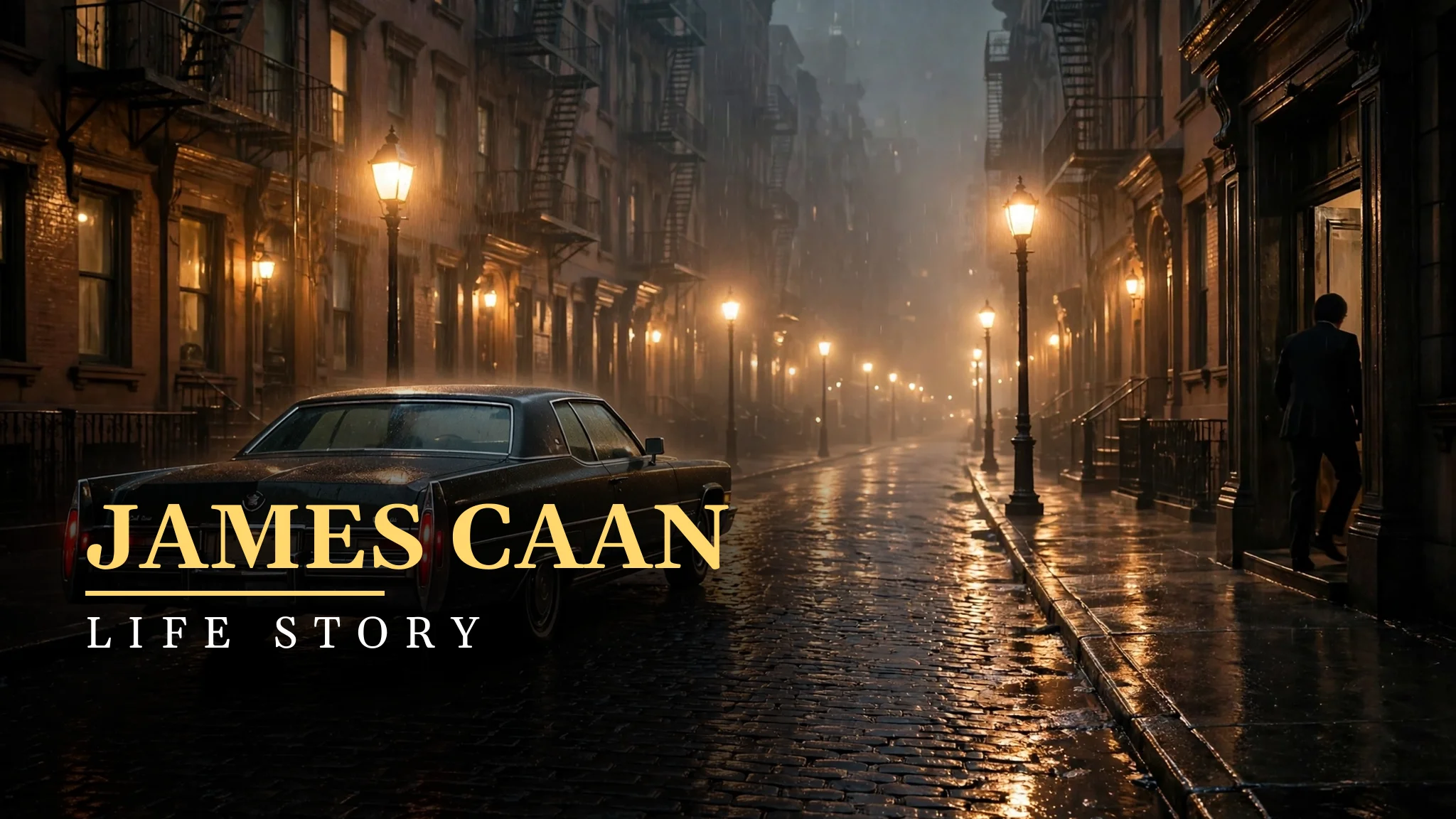
One more thought stays with me. When I picture him, I picture the rainy street in the image for this story: a black Cadillac on wet cobblestones, gas lamps glowing, and a man in a suit stepping into a doorway. That is a good picture of his life, because he was always stepping into a new place, with energy and with courage, and he never looked back.
I also think about Rollerball, because it shows a different kind of hero. He plays Jonathan E., the greatest player in a violent sport of the future, a man who refuses to retire even when the people who run the sport want him gone. It is a dark film, but Caan plays Jonathan with a quiet, stubborn strength that makes the character feel real. He is not just an athlete. He is a man fighting for his freedom, and audiences loved him for it. I think that role tells me something about Caan himself. He was a man who refused to quit, who kept working even when people told him to stop, and who fought for his place, year after year.
Another thing I notice is Thief, the film by Michael Mann, where he plays Frank, a professional thief who wants to retire and live a normal life. It is one of his finest performances, and it shows a quiet, controlled side of him that many people forget. He is not loud in that film. He is careful, disciplined, and thoughtful, and he makes Frank feel like a real man, not like a movie criminal. I love that he could play both Frank and Sonny, two very different men, and make both feel true. That is the mark of a great actor.
I think about Dogville as well, because it is such a strange film, and Caan’s small role in it is so powerful. He plays the Big Man, a gangster who arrives at the end, and he plays the part with a calm authority that changes the whole film. It is a brave choice to take a small role in a difficult film by a foreign director, but Caan did it, because he cared about the work. He was not afraid of strange films, and he was not afraid of small parts. He just wanted to do good work, and Dogville is good work.
When I think about Las Vegas, the television series, I feel a deep admiration for his longevity. He was in his sixties when the show began, and he played Ed Deline, the head of security at a casino, with the same energy he had brought to his earliest roles. He was tough, smart, and charming, and audiences loved him for it. The show ran for five seasons, and it gave him a new audience, including young viewers who had never seen The Godfather. That is a rare gift: to find a new audience late in a career, and to win them over with the same qualities that made you famous decades earlier.
I also think about Fast Charlie, his final film, released after his death. He plays an ageing hitman, and he plays the part with the same fire he brought to Sonny Corleone fifty years earlier. He was eighty-two, and he was still a force on screen. That is a fitting end to a great career. He did not fade away. He kept working, right up to the end, and his last performance is a reminder of everything he was: loud, fierce, funny, and unforgettable.
I also think about The Yards, because it shows that he was still playing powerful men in his sixties. He plays Frank Olchin, a boss who controls the contracting yards in New York, and he plays the part with a calm authority that makes the character feel real. He is not a young gangster anymore. He is an older man, a boss, and he plays the part with the weight of a lifetime behind it. I think that role is a good example of how Caan grew as an actor. He did not try to play young men forever. He played his age, and he played it well, and that honesty is what made his later performances so strong.
Another thing I notice is The Good Neighbor, where he plays Harold Grainey, a quiet, lonely old man with a secret. It is a small film, but Caan plays the part with a sadness and a dignity that makes it far more moving than a simple thriller. He was seventy-six when he made it, and he was still giving performances that surprised audiences. I think that is a remarkable thing. Most actors slow down as they get older. Caan kept going, and he kept finding new kinds of men to play, right up to the end. That is why his career lasted more than sixty years, and why people still love him.
Frequently Asked Questions
Where was James Caan born?
James Caan was born on 26 March 1940 in the Bronx, New York, to a Jewish family, and he grew up in Sunnyside, Queens. His father was a butcher, and he grew up in a working-class neighbourhood where family and toughness mattered.
Who did James Caan play in The Godfather?
In The Godfather from 1972, he played Sonny Corleone, the hot-headed eldest son of the Corleone family, whose violent death at a toll booth became one of the most famous scenes in film history. The role brought him an Academy Award nomination for Best Supporting Actor.
What is Brian’s Song and why is it famous?
Brian’s Song from 1971 is a television film about the friendship between Chicago Bears players Brian Piccolo and Gale Sayers, with Caan playing Piccolo, who died of cancer. His warm, funny, and brave performance made it one of the most loved television films ever made.
Who did James Caan play in Misery?
In Misery from 1990, he played Paul Sheldon, a writer held captive by a fan played by Kathy Bates, who won an Academy Award for her role. His quiet, frightened performance as a man trying to survive is central to the film’s terror.
What is James Caan’s role in Elf?
In Elf from 2003, he played Walter Hobbs, the busy businessman father of Will Ferrell’s character, a stern man who slowly learns to love his son. The Christmas comedy became a beloved classic and gave Caan a new audience of children and families.
Did James Caan have a son who became an actor?
Yes, his son Scott Caan became an actor, known for Hawaii Five-0 and many films, and he has spoken about his father with love and respect. James Caan had five children in total from his four marriages.
When did James Caan die?
He died on 6 July 2022, at the age of eighty-two, in Los Angeles, after a career of more than sixty years. Tributes came from actors, directors, and fans around the world, remembering him as a great actor and a warm, funny man.


