Lars von Trier: The Life Story Behind Denmark's Boldest Director
In this post
Lars von Trier is the most famous and the most controversial director Denmark has ever produced. His films are about suffering, about faith, about women who are punished for being good, about men who do terrible things, and about the end of the world. He made Breaking the Waves, about a woman who sacrifices herself for her husband, Dancer in the Dark, about a woman who goes blind and is executed, Dogville, about a town that turns on a stranger, and Melancholia, about two sisters waiting for a planet to hit the earth. His films are not easy to watch, and they are not meant to be. They are meant to make you feel, to make you think, and to make you uncomfortable.
He was born in Copenhagen, Denmark, and he grew up in a family where ideas mattered more than comfort. He studied at the Danish National Film School, he made short films, and he became one of the most talked-about young directors in Europe. He created Dogme 95 with Thomas Vinterberg, a set of rules that said films should be made simply, without tricks. He founded the film company Zentropa, and he built a career that has lasted for more than forty years, a career full of awards, of arguments, and of films that people cannot forget.
What makes his story worth telling is the boldness in it. He does not make safe films. He makes films that divide people, that some call masterpieces and others call cruel, and he does it with a confidence that is rare. This is the story of a Danish director who became one of the most important filmmakers in the world, by telling stories that no one else dared to tell, in a way that no one else dared to tell them.
A Childhood in Copenhagen
Lars von Trier was born on 30 April 1956 in Copenhagen, Denmark. His birth name was Lars Trier, and he later added von to his name, a name he chose for himself as a young filmmaker. He grew up in the Danish capital, in a family where his mother worked in the civil service and his stepfather worked in the film industry. He was a curious child, and he loved films from an early age. He made short films as a boy, using a camera his mother gave him, and he showed a talent for storytelling that was clear even then.
As a child, Lars was thoughtful and intense. He liked to think about big questions, about life, about death, about God, and about why people suffer. He was not a child who was happy with simple answers. He wanted to understand the world, and he wanted to understand people, even when the answers were painful. That intensity stayed with him, and it later became the heart of his films, which are full of big questions and painful answers.
When he was a teenager, he began to think more seriously about film. He watched the work of other directors, he made short films, and he dreamed of going to film school. He was not yet sure he could make a living from it, but he knew that film was where he felt most alive. He applied to the Danish National Film School in Copenhagen, and he was accepted. He studied there, and he graduated in 1982, at the age of twenty-six, with a film called Images of Liberation, which won awards and brought him to the attention of the Danish film world.
His time at film school was important, because it was where he met other young filmmakers, and where he began to develop his own style. He was a serious student, and he worked hard, but he was also a rebel, a young man who did not want to follow the rules, and who wanted to make films in his own way. That rebellious spirit stayed with him, and it is why his films are so different from anyone else’s.
Film School, Early Films and Europa
Lars studied at the Danish National Film School, and he graduated in 1982. His graduation film, Images of Liberation, was about the Second World War, and it won awards in Denmark and in other countries. He went on to make his first feature films, The Element of Crime in 1984, a film about a detective in a dark and rainy Europe, and Epidemic in 1987, a film about a director trying to make a film about a plague. Both films were strange and beautiful, and they showed that Lars had a unique vision, a way of seeing the world that was unlike anyone else’s.
In 1991, he directed Europa, known in America as Zentropa, a film about an American who comes to Germany after the Second World War and becomes a sleeping car conductor on a train. The film was shot in black and white, with colour in some scenes, and it was a visual masterpiece, full of strange images and haunting music. It won awards at the Cannes Film Festival, and it brought Lars to the attention of a wider international audience. He was becoming one of the most talked-about young directors in Europe, and he was only in his thirties.
He also founded the film company Zentropa in 1992, with producer Peter Aalbaek Jensen, a company that would become one of the most important film companies in Denmark, producing many of Lars’s films and the films of other Danish directors. Zentropa was known for its bold and provocative films, and for its willingness to take risks. It was a home for Lars, and for other filmmakers who wanted to make films that were different, that were brave, and that were unafraid to shock.
During this time, Lars also began to think about Dogme 95, a set of rules for making films that he would create with Thomas Vinterberg in 1995. The rules said that films should be shot on location, with a handheld camera, with natural light, with no special effects, and with no music that was not part of the scene. It was a bold idea, and it was controversial, but it also inspired filmmakers around the world. Lars was a leader, not just a director, and he was changing the way people thought about cinema.
Dogme 95 and Breaking the Waves
In 1995, Lars von Trier and Thomas Vinterberg created Dogme 95, a manifesto for a new kind of cinema. The manifesto said that films had become too polished, too glossy, and too fake, and that they needed to return to basics, to real locations, to real light, to real sound, and to real acting. It was a provocative idea, and it was meant to shock the film world, and it did. Filmmakers around the world took up the Dogme rules, and made films that were raw, honest, and different. Lars was at the centre of that movement, and he became known as a revolutionary, a man who wanted to change cinema.
In 1996, Lars directed Breaking the Waves, a film about a young woman named Bess, played by Emily Watson, who lives on a remote island in Scotland, who marries a man who works on an oil rig, and who, when he is paralysed in an accident, believes that God wants her to sacrifice herself to save him. The film was a powerful and painful work, about faith, about love, about sacrifice, and about a woman who is punished for being good. It won the Grand Prix at the Cannes Film Festival, and Emily Watson was nominated for an Academy Award for Best Actress. It was a huge success, and it made Lars one of the most important directors in the world.
Breaking the Waves was shot with a handheld camera, with natural light, and with a style that felt like real life, even though it was not a Dogme film in the strict sense. It showed that Lars could tell a story about a woman, about faith, and about suffering, with an honesty and a power that few directors could match. He was praised by critics, and he was also criticised by some, who felt that the film was cruel to its heroine, that it punished a good woman for being good. That argument has followed Lars throughout his career, and it is one that he has never fully answered, because his films are meant to provoke, not to comfort.
He went on to direct The Idiots in 1998, a Dogme film about a group of people who pretend to be mentally disabled, and Dancer in the Dark in 2000, a film about a woman named Selma, played by Bjork, who is going blind, who works in a factory in America, and who is executed for a crime she did not mean to commit. Dancer in the Dark won the Palme d’Or at Cannes, the festival’s highest prize, and Bjork won the award for Best Actress. Lars was at the height of his powers, and he was making films that were loved and hated in equal measure.
Dogville, Melancholia and the Later Films
In 2003, Lars directed Dogville, a film about a woman named Grace, played by Nicole Kidman, who arrives in a small town in America, seeking refuge, and who is slowly exploited and abused by the people of the town. The film was shot on a bare stage, with no sets, with chalk lines on the floor to show where the houses were, and with a style that was like a play. It was a bold and strange film, and it divided critics, but it also became one of his most famous works. It was about America, about kindness, about cruelty, and about how a community can turn on a stranger.
He went on to direct Manderlay in 2005, a sequel to Dogville, and The Boss of It All in 2006, a comedy about a man who pretends to be the boss of a company, and Antichrist in 2009, a horror film about a couple who lose their child and go to a cabin in the woods, where terrible things happen. Antichrist was a shocking film, and it was criticised by many, but it also showed that Lars was not afraid to go to dark places, to show violence and pain in a way that made audiences uncomfortable. He was a director who did not want to be liked. He wanted to be felt.
In 2011, he directed Melancholia, a film about two sisters, Justine and Claire, played by Kirsten Dunst and Charlotte Gainsbourg, who are waiting for a planet called Melancholia to hit the earth and destroy it. The film was beautiful and sad, with images of a wedding, of a garden, of a planet in the sky, and it won Kirsten Dunst the award for Best Actress at Cannes. It was one of Lars’s most loved films, and it showed that he could make a film about the end of the world that was also about depression, about family, and about the quiet acceptance of death.
He went on to direct Nymphomaniac in 2013, a long film in two parts, about a woman named Joe who tells her life story to a man who finds her beaten in an alley, and The House That Jack Built in 2018, a film about a serial killer, played by Matt Dillon, who tells the story of his murders. Both films were controversial, and both divided critics, but they also showed that Lars was still working, still pushing, and still unafraid to shock. He was in his sixties, and he was still making films that people could not ignore.
Controversy, Health and a Long Career
Lars von Trier’s career has been marked by controversy, and he has often said things in interviews and at press conferences that have shocked people. At the Cannes Film Festival in 2011, he made comments at a press conference for Melancholia that were widely reported as offensive, and he was declared persona non grata by the festival, meaning he was not welcome to return for several years. He later apologised, and he was allowed to return to Cannes in 2018 with The House That Jack Built. The incident is a part of his story, and it shows how his provocative style, which works in his films, can cause trouble when it leaves the screen.
He has also spoken openly about his mental health, about his depression, about his anxiety, and about his struggles with alcohol. He has said that making films is a way for him to deal with his fears, and that his films are a reflection of his own inner life. That honesty has made him a sympathetic figure to many, even when his films are hard to watch. He is not a director who hides behind his work. He is a director who puts himself into his work, with all his flaws and all his pain.
In 2022, it was announced that Lars had been diagnosed with Parkinson’s disease, a condition that affects movement and that has no cure. The news was met with sadness by fans and by the film world, who recognised him as one of the most important directors of his generation. He has continued to work, and he has spoken about his condition with honesty, saying that he is still making films, still writing, and still living his life. His story is not finished, and his fans wait with hope for whatever he does next.
He lives in Denmark, and he is a father, a husband, and a director who values his privacy, even though he is one of the most famous people in Danish culture. He gives interviews when he has a new film, he talks about his work with passion and with humour, and then he goes home to his family and his life. That balance is important to him, and it is one of the reasons his films feel so personal. He is not making films for fame. He is making films because he has something to say, and because he cannot not say it.
A Director Who Changed Cinema
Lars von Trier’s influence on cinema is large. He created Dogme 95, which changed the way filmmakers thought about simplicity and honesty. He founded Zentropa, which became one of the most important film companies in Denmark. He made Breaking the Waves, Dancer in the Dark, Dogville, and Melancholia, films that are now regarded as classics, and that are studied in film schools around the world. He has won the Palme d’Or, the Grand Prix at Cannes, and many other awards, and he is recognised as one of the greatest directors of his generation.
His films are not for everyone, and they are not meant to be. They are for people who are willing to be challenged, to be uncomfortable, and to think deeply about life, about death, about faith, and about human nature. He has shown that a film can be a work of art, a provocation, and a question, all at the same time. He is proud of Denmark, and he often talks about it, about its culture, and about the way it shaped him. He is a Danish director who works in the world, and who has changed the world of cinema.
As he moves into his seventies, Lars is still a working director, still choosing projects, still learning. His story is not finished, and his fans wait with hope for whatever he does next. He is a director, a father, and a man who has faced controversy, illness, and loss, and who has kept going, and his story is one of the most important in European film. He shows that a director can be bold, can be difficult, and can still make films that matter, that move people, and that last.
Zentropa and Building a Film Company
In 1992, Lars von Trier founded the film company Zentropa with producer Peter Aalbæk Jensen, and it became one of the most important film companies in Denmark. Zentropa was not a normal film company. It was bold, it was provocative, and it was willing to take risks that other companies would not take. It produced Lars’s films, it produced the films of other Danish directors, and it became a home for filmmakers who wanted to make films that were different, that were brave, and that were unafraid to shock. Lars was not just a director. He was a builder, a person who wanted to create a place where Danish films could be made, where young directors could learn, and where stories could be told in a new way.
Zentropa also became known for its work in other areas, including television, and for its willingness to experiment with new ways of making films. It was a company that believed in art, in provocation, and in the idea that a film could change the way people think. Lars was at its centre, and his vision shaped it. He wanted Zentropa to be a place where filmmakers were free, where they could make the films they believed in, without having to please everyone. That freedom is a big part of his legacy, and it is why Zentropa is still one of the most respected film companies in Europe.
He also used Zentropa to support other directors, including Thomas Vinterberg, Susanne Bier, and many others, who made films with the company and who benefited from its support. Lars was not just making his own films. He was helping to build a film culture in Denmark, a culture that was independent, that was brave, and that was willing to tell stories that mattered. That work is a big part of his story, and it is why he is respected not just as a director, but as a person who helped Danish cinema to grow.
The company has faced challenges, including financial difficulties and controversies, but it has survived, and it continues to make films today. Lars’s role in Zentropa shows that he is not just an artist. He is also a businessman, a leader, and a person who understands that films need a home, a company, and a team to make them. He built that home, and he built it in Denmark, for Danish filmmakers, and for the world. That is a remarkable achievement, and it is one that should not be forgotten when people talk about his films.
My Take:
When I think about Lars von Trier, I feel many things at once, and that is why he is so hard to write about. I admire him, I am troubled by him, I am moved by him, and I am sometimes angry with him. That mix of feelings is, I think, exactly what his films are meant to create. He does not want me to feel one simple thing. He wants me to feel many things, to be confused, to be uncomfortable, and to think. I respect that, because it is easy to make a film that makes people feel good. It is harder to make a film that makes people think, and Lars does that, again and again.
I admire Breaking the Waves most of all, because it is a film about faith that does not give easy answers. Bess believes that God wants her to sacrifice herself, and she does it, and she dies. Is she a saint, or is she a victim? Is her faith beautiful, or is it madness? I do not know, and Lars does not tell me. He lets me sit with the question, and that question stays with me long after the film ends. That is a brave way to make a film, to not give the audience an answer, to trust them to think for themselves. Many directors are afraid to do that. Lars is not afraid.
What moves me about Melancholia is the way it shows depression. Justine is depressed, and she cannot enjoy her wedding, she cannot enjoy her life, and she feels that the world is ending. Then a planet really does come to end the world, and Justine becomes calm, because the end she has always felt inside is now happening outside. That is a powerful image, and it is one that people who have felt depressed understand at once. Lars has talked about his own depression, and I think that is why Melancholia feels so true. He is not making a film about depression from the outside. He is making it from the inside, and that makes it more honest, and more moving.
I also think about Dogville, and how it shows the cruelty of a community. Grace comes to a town seeking help, and the town helps her at first, and then slowly, step by step, they exploit her, they abuse her, and they turn her into a slave. It is a painful film to watch, because it shows how good people can do bad things, little by little, until they have done something terrible. I think about that film when I hear about communities turning on outsiders, and I ask myself, would I be one of the people who helps, or one of the people who turns away? That is a hard question, and Lars forces me to ask it. That is a valuable thing, even if it is uncomfortable.
I am troubled by some of his films, and I want to be honest about that. Antichrist and The House That Jack Built are films that I find hard to watch, because they show violence against women in a way that feels cruel, and I am not always sure what Lars is trying to say. Is he criticising violence, or is he enjoying it? I do not know, and that uncertainty makes me uneasy. I think it is all right to feel uneasy about a film, and to ask hard questions about it. Lars would want me to ask those questions, because his films are meant to provoke, not to comfort. I do not have to love every film he makes to respect him as a director. I can admire his boldness and still feel troubled by some of his choices. That is a mature way to watch a film, and Lars teaches me to watch that way.
I also think about his comments at Cannes in 2011, and how they hurt people. I do not want to excuse what he said, because words matter, and a public figure should be careful with them. But I also think that Lars is a man who provokes, who says things to shock, and who sometimes goes too far. He apologised, and he was allowed to return to Cannes, and I think that is right. People can make mistakes, and they can learn from them. I hope Lars learned from that incident, and I hope he is more careful now. That is not a small thing. It is a human thing, to make a mistake and to try to do better.
I admire his honesty about his mental health, and about his Parkinson’s disease. He has talked about his depression, about his anxiety, and about his illness, with a openness that is rare for a famous director. He does not hide it. He says, this is who I am, this is what I am facing, and I am still working. That takes courage, and it gives hope to other people who are facing illness or depression. It says, you can be ill, you can be afraid, and you can still make art, still live, still love. I respect him for that, and I am grateful for his honesty.
For a young reader, I think the lesson from Lars is complicated, and that is as it should be. He teaches me to be bold, to tell the stories no one else dares to tell, and to not be afraid of being disliked. But he also teaches me to be careful with my words, to think about the impact of what I say, and to be responsible for my art. Both lessons are true, and they live together in his story. That is what makes him such an important figure. He is not simple, and his films are not simple, and the world is not simple either. I think that is a valuable lesson, and I want to remember it.
In the end, I think Lars von Trier is a reminder that cinema can be a place for big questions. It can ask about God, about suffering, about the end of the world, and about what it means to be human. His films do not give easy answers, and that is why they last. I am grateful for his films, even the ones that trouble me, because they make me think, and thinking is a good thing. I hope he keeps making films for as long as he can, and I hope he is well. The world needs directors who ask hard questions, even when the answers are painful.
I also think about Zentropa, and how it shows another side of Lars. He is not just a director. He is a builder, a person who created a company, a home for filmmakers, and a place where Danish cinema could grow. That is a different kind of creativity, and it is one that many people forget when they talk about his films. He did not just make Breaking the Waves and Melancholia. He also built a company that helped other directors to make their films, and that is a generous thing to do. It shows that he cares about Danish cinema, not just about his own career, and that he wants to leave something behind that is bigger than himself.
There is another side to him that I want to mention, and that is his humour. His films are often dark, but he himself is funny, in interviews, in a dry and Danish way. He makes jokes, he laughs at himself, and he does not take himself too seriously, even though his films are very serious. That humour is important, because it shows that he is a human being, not just a provocateur. He is a man who loves film, who loves to talk about it, and who loves to make people laugh, even when his films make them cry. I think that humour is a part of his art, and it is one that people sometimes miss because they focus on the darkness in his films.
I also think about his early films, Europa and The Element of Crime, and how beautiful they are. They are films about a dark and rainy Europe, about trains, about detectives, and about a world that is falling apart. They are visual masterpieces, full of strange images and haunting music, and they show that Lars was a visual artist from the start, a director who could make a film that looked like a painting. I love that about him, because it shows that his talent is not just in his stories, but in his images, in the way he sees the world, and in the way he shows it to us. His films are beautiful, even when they are painful, and that beauty is a part of their power.
I think about the young filmmakers who look at Lars and see a role model. They see a man who made films his own way, who created Dogme 95, who founded Zentropa, who won the Palme d’Or, and who never compromised on his vision. That story tells them that they do not have to follow the rules, that they can create their own rules, and that they can make films that are true to themselves. I hope those young filmmakers remember that, and I hope they are brave enough to be different, just as Lars was. The film world needs more directors who are willing to be different, even when it is hard.
I also want to say something about his illness, because it is a part of his story now. He was diagnosed with Parkinson’s disease in 2022, and he has spoken about it with honesty. That takes courage, and it gives hope to other people who are facing illness. It says, you can be ill, you can be afraid, and you can still make art, still live, still love. I respect him for that, and I am grateful for his honesty. He is not hiding his illness. He is facing it, just as he faces everything else in his life, with honesty and with courage.
I also think about the way he has influenced other directors. Dogme 95 inspired filmmakers around the world to make simpler, more honest films, and his own films inspired a generation of directors to be bold, to take risks, and to tell stories that no one else dared to tell. That influence is hard to measure, but it is real, and it is felt in film schools, in festivals, and in cinemas around the world. Lars did not just make films. He changed the way people think about film, and that is a bigger achievement than any single award. I hope young directors remember that, and I hope they are brave enough to change cinema themselves, just as he did.
I also think about the way his films ask me to sit with discomfort. Most films want me to feel good at the end, to leave the cinema smiling. Lars does not do that. He leaves me with a question, with a feeling I cannot quite name, and with a sense that the world is more complicated than I thought. That is not a comfortable feeling, but it is a valuable one, because it makes me think, and thinking is how we grow. I am grateful for that discomfort, even when I do not enjoy it, because it has taught me to look more carefully at the world, and at myself.
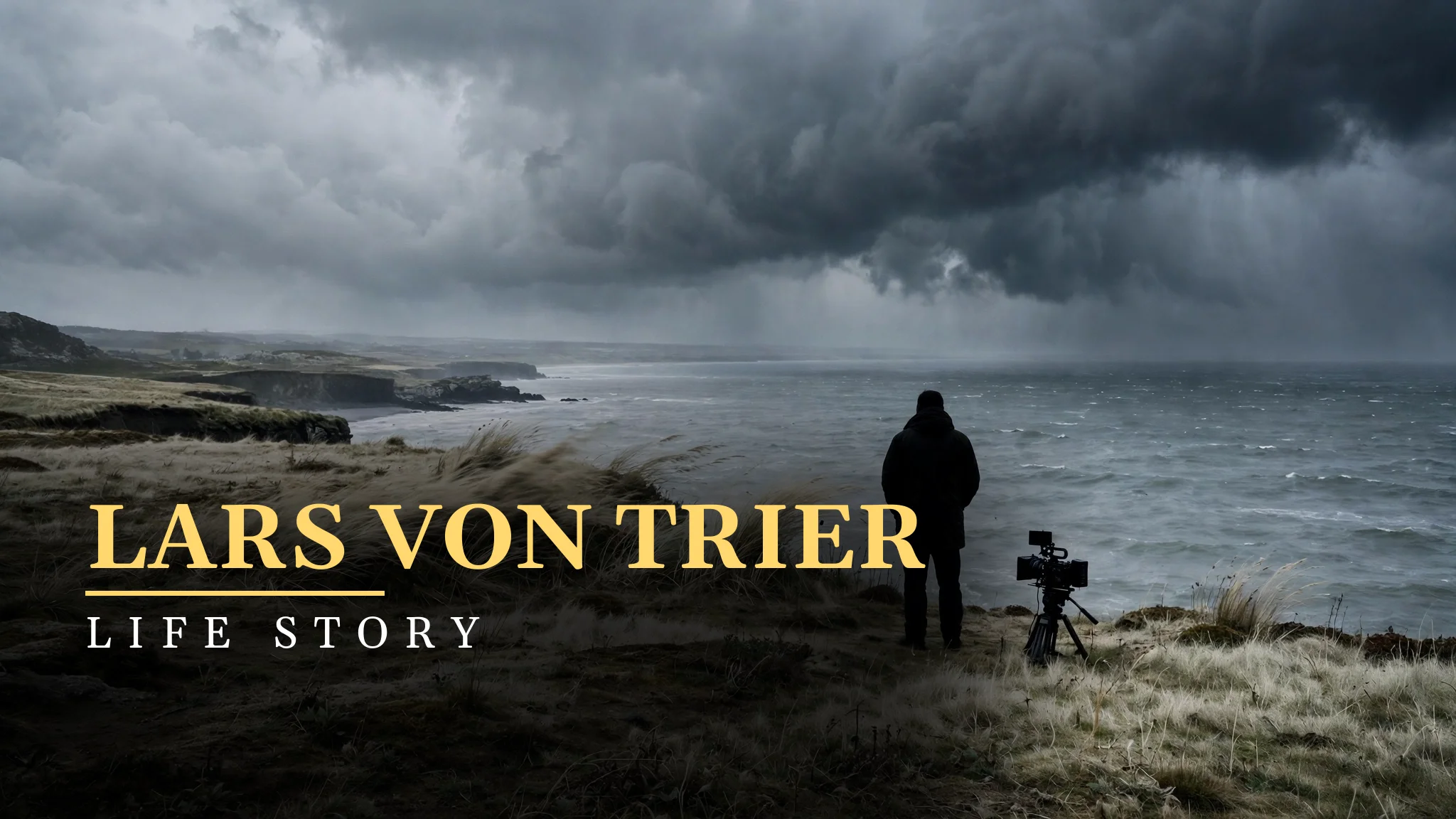
One more thought stays with me. I think about the stormy cliff in the image, with its dark clouds and its grey sea, and how it fits Lars. His films are like that cliff: wild, dark, beautiful, and a little bit dangerous. But they are also honest, and they face the storm head on, without looking away. I hope he keeps standing on that cliff, keeps filming, and keeps asking his hard questions. He is a director, but he is also a questioner, and that is the best kind of director.
Frequently Asked Questions
Where was Lars von Trier born and how old is he?
Lars von Trier was born Lars Trier on 30 April 1956 in Copenhagen, Denmark, which makes him 70 years old in 2026. He grew up in Copenhagen, studied at the Danish National Film School, and graduated in 1982.
What is Lars von Trier most famous for?
He is most famous for directing Breaking the Waves in 1996, Dancer in the Dark in 2000, Dogville in 2003, and Melancholia in 2011. He also co-created Dogme 95 with Thomas Vinterberg and founded the film company Zentropa.
What is Zentropa?
Zentropa is the film company Lars von Trier founded in 1992 with producer Peter Aalbaek Jensen. It became one of the most important film companies in Denmark, producing Lars’s films and the films of other Danish directors, and it was known for bold and provocative work.
What is Melancholia about?
Melancholia, released in 2011, is about two sisters, Justine and Claire, played by Kirsten Dunst and Charlotte Gainsbourg, waiting for a planet called Melancholia to hit the earth. Kirsten Dunst won Best Actress at Cannes for her performance as Justine.
Did Lars von Trier win the Palme d’Or?
Yes, he won the Palme d’Or at the Cannes Film Festival in 2000 for Dancer in the Dark, a film about Selma, played by Bjork, a woman going blind who is executed for a crime. Breaking the Waves won the Grand Prix at Cannes in 1996.
What happened to Lars von Trier at Cannes in 2011?
At a press conference for Melancholia in 2011, he made comments that were widely reported as offensive, and Cannes declared him persona non grata. He later apologised, and he returned to Cannes in 2018 with The House That Jack Built.
Is Lars von Trier still making films?
He was diagnosed with Parkinson’s disease in 2022, and he has spoken about it openly. He continues to work and to write, and he remains one of the most important directors in European cinema, with a career spanning more than forty years.


