Janelle Monáe: The Life Story Behind the Futuristic Star
In this post
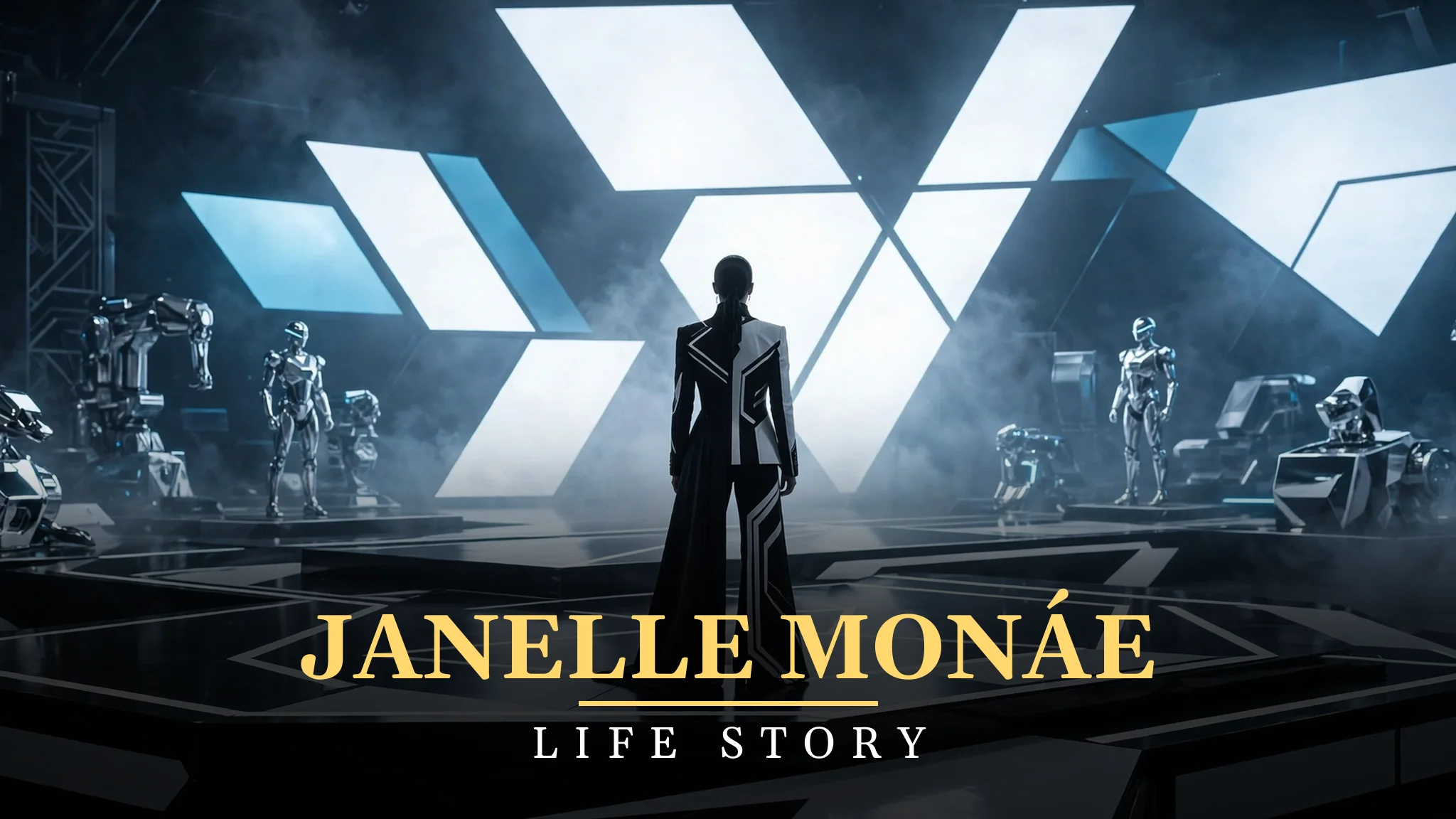
Janelle Monáe is a singer, songwriter, and actress who has built a career on imagination. She does not make ordinary pop music. She makes albums that tell a story about a robot, about a city, about a future where people are free to be themselves. She wears black and white, she performs with a band, and she acts in films that are about history, mystery, and the future. She is a performer who thinks in big ideas, and who uses music, film, and fashion to bring those ideas to life.
Her story began in Kansas, where she grew up in a working-class family and learned to sing, dance, and perform while she was still a child. She was not a child star. She was a young woman who moved to New York, who studied at a famous theatre school, and who worked hard to build a career as an artist. She was discovered by a famous rapper who heard her music and believed in her, and she used that chance to create a world of her own.
What makes her story worth telling is the way she has used art to talk about freedom, identity, and the future. She has made albums about a robot named Cindi Mayweather, she has played a mathematician in Hidden Figures, she has played a detective in Glass Onion, and she has made music that is both futuristic and deeply human. This is the story of how a girl from Kansas City became Janelle Monáe, and how she became one of the most original artists of her generation.
Growing Up in Kansas City
Janelle Monáe Robinson was born on 1 December 1985 in Kansas City, Kansas. She grew up in a working-class family, and she was raised in a community where church, school, and music were central parts of life. She began singing in church while she was still a child, and she learned how to sing with feeling, how to hold a note, and how to move an audience. She also learned how to dance, and she took part in talent shows and in local performances.
At school, she took part in choir and in musicals, and she showed a talent that stood out from other young performers. She was not only a singer. She was a performer who could act, dance, and sing, and who could tell a story on stage. Her teachers encouraged her, and her family supported her. She dreamed of becoming a performer, but she did not have a clear path to that dream.
After high school, she moved to New York City to study at the American Musical and Dramatic Academy, a well-known theatre school. She learned how to act, how to dance, and how to perform on stage. She also began to write songs, and she began to think about what kind of artist she wanted to be. She was not interested in being an ordinary pop star. She wanted to be an artist who told stories, who created worlds, and who used music to say something important.
She left the academy after a short time, and she moved to Atlanta, Georgia, where she began to work on her music. She performed in small venues, she wrote songs, and she built a following. She was still young, but she was already a performer with a clear vision and a clear point of view. She was ready for a bigger chance, and she was looking for a way to share her music with the world.
Metropolis, Cindi Mayweather, and a New World
Janelle Monáe first became known for her concept albums about a robot named Cindi Mayweather. She released an EP called Metropolis: Suite I (The Chase) in 2007, which introduced Cindi as an android who falls in love with a human and who is hunted by the authorities. The EP was a mix of funk, soul, pop, and science fiction, and it showed a singer who could tell a story through music in a way that few other artists could.
She was discovered by the rapper Big Boi of Outkast, who heard her music and was impressed by her talent. He helped her to get a record deal, and she began to work on a full album. She also founded her own label, Wondaland Records, with other artists, and she used it to release music on her own terms. She wanted to control her own work, and she wanted to create a world that was hers.
Her debut album, The ArchAndroid, was released in 2010. The album continued the story of Cindi Mayweather, and it included songs that mixed funk, soul, rock, and classical music. It was a critical success, and it showed that Monáe was not only a singer. She was an artist who could create a whole universe through music. She toured to support the album, and she performed with a band and with dancers, creating a live show that was like a theatre production.
She followed The ArchAndroid with The Electric Lady in 2013, which continued the story and included collaborations with Prince, Erykah Badu, and other artists. Prince became a mentor to her, and he helped her to understand how to be an artist who controls her own work. She learned from him, and she used that lesson to build a career that was independent and original.
Dirty Computer, Hidden Figures, and Film Stardom
In 2018, Janelle Monáe released Dirty Computer, an album that was more personal and more direct than her earlier work. The album was about freedom, identity, and the right to be yourself. It included the songs Make Me Feel, Pynk, and Django Jane, and it became one of her most famous albums. She also released a film to go with the album, an emotion picture that told the story of a woman who is trying to remember who she is. The album was nominated for a Grammy Award for Album of the Year, and it showed that Monáe could make music that was both futuristic and deeply personal.
She also became known as an actress, appearing in the film Moonlight in 2016, which won the Academy Award for Best Picture. She played Teresa, a kind and strong woman who helps a young boy. She also appeared in Hidden Figures in 2016, playing Mary Jackson, a mathematician and engineer at NASA who fought against racism and sexism to do her work. The film was a huge success, and it showed that Monáe could act in a historical drama as well as sing.
She continued to act in films, including Harriet in 2019, where she played Marie, and Glass Onion: A Knives Out Mystery in 2022, where she played Helen Brand, a woman who is trying to solve a mystery. Her performance in Glass Onion was widely praised, and it showed that she could carry a film as a leading actress. She was not only a singer who acted. She was an actress who could hold her own next to major film stars.
Her work in film has shown a range that few singers have. She can play a mathematician, a detective, a mother, and a futuristic robot, and she can do it with a depth that makes each character feel real. She has used her acting work to reach new audiences, and she has shown that she is a performer who can work in many different places.
The Age of Pleasure and a Freer Sound
In 2023, Janelle Monáe released The Age of Pleasure, an album that was more joyful and more open than her earlier work. The album included songs about love, freedom, and pleasure, and it showed a singer who was comfortable in her own skin. She toured to support the album, and she performed with a band and with dancers, creating a live show that was celebratory and free.
The album was a change from Dirty Computer, which was more serious and more political. The Age of Pleasure was about joy, and it showed that Monáe could make music that was fun as well as meaningful. She did not want to be limited to one sound or one story. She wanted to try new things, and she wanted to show different sides of herself as an artist.
She has also continued to work as a fashion icon, known for her black-and-white style, her tuxedos, and her bold looks on the red carpet. She uses fashion as a way to tell a story, and she uses it to challenge ideas about gender, race, and identity. She is not a singer who wears what she is told to wear.Monáe does not wear what she is told to wear. She wears what she wants to wear, and she uses fashion as a form of art.
She has also used her platform to support causes she believes in. She has spoken about racial justice, about LGBTQ rights, and about the need for young people to have a voice. She does not do this quietly. She does it in interviews, on stage, and in her music. She believes that fame should be used for something more than selling records, and she acts on that belief.
Wondaland, Mentorship, and Building a Community
Janelle Monáe founded Wondaland Records with other artists, including Chuck Lightning and Nate Wonder, and she has used the label to support other musicians. She believes in building a community of artists who can work together, who can support each other, and who can make music that is original and honest. She is not only a solo artist. She is a leader who helps other artists to find their voice.
She has also worked as a mentor to young artists, and she has talked about the importance of having a team that believes in you. She learned from Prince, who was a mentor to her, and she has tried to pass that mentorship on to others. She believes that art is not a solo job. It is a community job, and it is better when artists work together.
She has also continued to make music, to act, and to perform live. She is still in her late thirties, and she is still working. She is not trying to be a young pop star. She is trying to be herself at every age, and she is making music that fits the life she is living now. That is a rare thing in pop music, and it is a legacy that will last.
Her work with Wondaland has also shown that she understands how the music business works, and that she wants to change it. She wants artists to own their work, to control their careers, and to be free to make the music they want to make. That is a vision that matters, especially for young Black artists who want to work in music on their own terms.
Glass Onion, Moonlight, and Acting in Major Films
Janelle Monáe has acted in some of the most important films of the last ten years. She appeared in Moonlight in 2016, a film that won the Academy Award for Best Picture. She played Teresa, a kind and strong woman who helps a young boy named Chiron. Her performance was quiet, warm, and honest, and it showed that she could act in a drama without singing or dancing. She did not try to steal the scene. She tried to be real, and that realness made her character feel like a person the audience could trust.
She also appeared in Hidden Figures in 2016, playing Mary Jackson, a mathematician and engineer at NASA. The film told the story of three Black women who worked at NASA during the space race, and who fought against racism and sexism to do their work. Monáe played Jackson with a confidence and a humour that made the character feel alive. She showed that she could act in a historical drama, and that she could hold her own next to major film stars. The film was a huge success, and it introduced Monáe to a new audience who had never heard her music.
She continued to act in films, including Harriet in 2019, where she played Marie, a free Black woman who helps Harriet Tubman. She also appeared in Glass Onion: A Knives Out Mystery in 2022, where she played Helen Brand, a woman who is trying to solve a mystery and to find justice for her sister. Her performance in Glass Onion was widely praised, and it showed that she could carry a film as a leading actress. She played two roles in the film, and she did it with a skill that surprised many critics.
Her work in film has shown a range that few singers have. She can play a mathematician, a detective, a mother, and a futuristic robot, and she can do it with a depth that makes each character feel real. She has used her acting work to reach new audiences, and she has shown that she is a performer who can work in many different places. She is not only a singer who acts. She is an actress who can sing, and who can do both with skill.
She has also talked about how acting helps her as a musician. She learns from each role, and she brings what she learns back to her music. She understands characters, she understands stories, and she understands how to tell a story through performance. That understanding makes her albums feel more like films, and her films feel more like music. She is a storyteller in every medium she works in, and that is a rare thing.
Her film work has also given her a chance to work with directors who are known for their vision, including Barry Jenkins, Theodore Melfi, and Rian Johnson. She has learned from each of them, and she has used what she learned to become a better performer. She does not take her film work lightly. She prepares for each role, she studies the script, and she works hard to understand the character. That preparation is a big part of why her performances feel so real.
What Janelle Monáe Means Today
Today, Janelle Monáe is known as a singer, a songwriter, an actress, and an artist who has created a whole universe through music and film. She has Grammy nominations, she has acted in Oscar-winning films, and she has a career that has lasted for more than fifteen years. She is one of the most original artists of her generation, and she has proved that a singer can be a storyteller, a fashion icon, and a film star at the same time.
Her legacy is about more than hit songs. It is about imagination, about freedom, and about a career that was built on big ideas. She created Cindi Mayweather, she made Dirty Computer, she played Mary Jackson in Hidden Figures, and she played Helen Brand in Glass Onion. Each of those works shows a different side of her, and each one is worth remembering. She has shown that an artist can be many things at once, and that she does not have to choose one identity.
She is also a role model for young artists, especially for Black women and for LGBTQ people who want to work in music and film. She has shown that a voice from Kansas City can reach the biggest stages in the world, and that a person can be successful while being herself. She has done it with grace, with honesty, and with a vision that is hard to forget.
Her story is still being written. She could make more albums, she could act in more films, and she could take on new roles that surprise everyone. What is clear is that she has already made a mark, and that she has done it by being herself, by working hard, and by never giving up.
Monáe has also performed at major festivals, including Coachella and other large events, where she has sung for tens of thousands of people. Her live shows are known for their energy, their theatre, and their strong musicianship. She performs with a band and with dancers, she tells a story through her songs, and she makes a large stage feel like a theatre. She does not stand still and sing. She moves, she dances, and she acts, and she does it all with a confidence that comes from years of training. That is a rare thing in pop music, and it is a big part of why her shows are so respected.
She has also worked as a producer for other artists through Wondaland Records, helping young musicians to find their voice and to make music on their own terms. She believes in building a community, and she uses her label to support artists who might not otherwise get a chance. She does not keep her knowledge to herself. She shares it, and she encourages others to try. That generosity is a big part of why her work is respected, and why Wondaland has become known as a place for original artists.
Her fashion work has also been recognised by major magazines and by the fashion industry. She has appeared on magazine covers, she has worked with designers, and she has become known for her bold and original style. She uses fashion to challenge ideas about gender, race, and identity, and she does it with a confidence that makes people take notice. She is not a singer who follows trends. She creates trends, and she uses them to say something important.
Monáe has also been open about her identity, and about the importance of being yourself. She has talked about being pansexual, about being non-binary in her own way, and about the need for people to be free to love who they love. She does not hide who she is. She celebrates it, and she uses her art to say that it is okay to be different.She celebrates who she is and uses her art to show that being different is okay. That message matters, especially for young people who feel like they do not fit in. She shows them that it is okay to be yourself, and that you can be successful while being yourself.
My Take:
When I think about Janelle Monáe, the first thing I notice is her imagination. She does not make ordinary pop music. She makes albums about a robot, about a future city, about freedom and identity. She creates worlds, and she invites listeners to step inside them. I admire that, because many singers make songs that sound like everyone else’s. Monáe makes songs that sound like no one else’s. That takes a kind of courage, and it takes a kind of vision that is rare in pop music.
I also admire the way she uses fashion as art. She wears black and white, she wears tuxedos, and she uses her look to challenge ideas about gender, race, and identity. She chooses her own clothes rather than wearing what she is told to wear. She wears what she wants to wear, and she uses fashion to tell a story. I think that is a powerful thing. Fashion can be a form of art, and Monáe treats it that way. She does not follow trends. She creates them.
What I find most interesting is Dirty Computer. It is an album about freedom, about being yourself, and about the right to love who you love. It is also a film, an emotion picture that tells the story of a woman who is trying to remember who she is. That is a big idea, and Monáe brings it to life with music, film, and performance. I think that is why the album was nominated for a Grammy for Album of the Year. It is not just a collection of songs. It is a work of art that uses many different forms to tell one story.
I think about her acting, because it shows a range that few singers have. She played Mary Jackson in Hidden Figures, a mathematician at NASA who fought against racism and sexism. She played Helen Brand in Glass Onion, a woman who is trying to solve a mystery. She played Teresa in Moonlight, a kind and strong woman who helps a young boy. Each of those roles is different, and each one shows a different side of her as an actress. She is not only a singer who acts. She is an actress who can hold her own next to major film stars.
What saddens me is that her music is sometimes too original for the charts. She makes albums that are conceptual, that tell a story, and that do not fit neatly into a pop format. That can make it hard for her to get radio play, and it can make it hard for her to sell as many records as a more conventional pop star. I think that is unfair, because her music is good, and it deserves to be heard by more people. I hope people listen to her albums with the care they deserve, and I hope they see the imagination behind them.
I also think about her mentorship from Prince. Prince was a mentor to her, and he helped her to understand how to be an artist who controls her own work. She learned from him, and she has tried to pass that lesson on to other artists through Wondaland Records. That is a generous thing to do. Many stars keep their knowledge to themselves. Monáe shares it, and she builds a community of artists who can work together. I think that is a big part of why her work feels so alive. It is not only about her. It is about a community.
If I have a worry, it is that people remember her only for her futuristic style and not for her whole career. Her black-and-white look is famous, and it will always be part of her story. But her career is bigger than a look. She made The ArchAndroid, she made Dirty Computer, she acted in Hidden Figures and Glass Onion, and she founded Wondaland. Each of those works shows a different side of her, and each one is worth remembering. I hope people see the whole picture.
I also think about what her story teaches a young artist. The lesson is not that you should try to be futuristic. The lesson is that you should have a vision, you should trust it, and you should be willing to work hard to bring it to life. Monáe had a vision of Cindi Mayweather, she trusted it, and she built a whole universe around it. Preparation and vision made the chance possible. Without the years of study and work, the vision would have been just an idea. With the work, it became a career.
Another lesson is about freedom. Monáe writes about the right to be yourself, to love who you love, and to live without fear. That is a message that matters, especially for young people who feel different or who feel like they do not fit in. She does not hide who she is. She embraces her identity and lets her art say that difference is something to celebrate. I think that is a powerful message, and I think it is one that will last.
I also admire the way she has handled her career as an adult. She is no longer a young singer from Kansas City. She is a woman in her late thirties who writes about love, freedom, and joy. She is honest about the hard parts, and that helps her fans who are going through hard times themselves. I think that is a generous thing to do. Many stars pretend that life is perfect. Monáe does not. She talks about the real parts, and that makes her music feel more real.
When I look at her career as a whole, I see a person who has been through a lot and who is still standing. She was a theatre student, she became a singer, she became an actress, and she became a leader of a record label. That is a story of imagination, and it is a story that gives hope to anyone who wants to make art that is original. You can create a world, and you can invite people to step inside it.
In the end, I think Janelle Monáe teaches us that art is not only about entertainment. It is about imagination, freedom, and the right to be yourself. She has used music, film, and fashion to tell stories that matter, and she has done it with a vision that is rare. I think that is a lesson worth remembering, and I think it is why her story will still matter in twenty more years.
One more thought stays with me, and it is about the feeling of her live shows. When you watch Monáe perform, you are watching a person who has created a whole world, and who is inviting you to step inside it. That is a powerful thing. Many performers give you a song. Monáe gives you a universe. I hope she keeps creating for a long time, because the world needs artists like her.
I also think about her film work, because it shows a range that few singers have. She played Teresa in Moonlight, Mary Jackson in Hidden Figures, and Helen Brand in Glass Onion. Each of those roles is different, and each one shows a different side of her as an actress. She is not only a singer who acts. She is an actress who can hold her own next to major film stars. I think that is a remarkable achievement, and it shows that she is a performer who can work in many different places. She learns from each role, and she brings what she learns back to her music.
Another thing I keep coming back to is her work in Moonlight. It is a quiet film, and her role as Teresa is quiet too. She does not sing, she does not dance, and she does not try to steal the scene. She tries to be real, and that realness makes her character feel like a person the audience can trust. I think that is a hard thing to do, especially for a singer who is used to performing on stage. Monáe did it with a calm and steady confidence, and it showed that she understood acting as a craft, not just as a chance to be famous in another medium.
I also think about her role in Hidden Figures. She played Mary Jackson, a mathematician at NASA who fought against racism and sexism. That is a historical role, and it required her to understand a real person who lived a real life. She did that with a confidence and a humour that made the character feel alive. She showed that she could act in a historical drama, and that she could make a real person feel real on screen. That is a skill that takes research, preparation, and empathy. Monáe brought all three to the role.
There is also something I admire about the way she has used fashion as a form of protest. She wears black and white, she wears tuxedos, and she uses her look to challenge ideas about gender, race, and identity. She is not a singer who wears what she is told to wear. She wears what she wants to wear, and she uses fashion to tell a story. I think that is a powerful thing. Fashion can be a form of art, and Monáe treats it that way. She does not follow trends. She creates them, and she uses them to say something important.
I also wonder what she might do next in film. She could direct a film, she could write a screenplay, or she could take on a role that surprises everyone. She has the range to do all of those things, and she has the audience to support them. She has already shown that she can work in music, film, and fashion. She could surprise people again with a new kind of work. I am curious to see what she chooses, and I think that curiosity is a good sign.
Finally, I think about what it means to be an artist who creates worlds. Monáe created Cindi Mayweather, she created Metropolis, and she created Dirty Computer. Each of those worlds is different, and each one invites listeners to step inside it. That is a rare thing in pop music. Many singers make songs. Monáe makes universes. I hope she keeps creating for a long time, because the world needs artists who think in big ideas and who are brave enough to share them.
I also think about her festival performances, because they show a different side of her as a performer. She performs with a band and with dancers, she tells a story through her songs, and she makes a large stage feel like a theatre. She does not stand still and sing. She moves, she dances, and she acts, and she does it all with a confidence that comes from years of training. I think that is a rare thing in pop music. Many singers give you a song. Monáe gives you a whole show, and that is why her live performances are so respected.
Another thing I keep coming back to is her openness about her identity. She has talked about being pansexual and about the need for people to be free to love who they love. She does not hide who she is. She celebrates it, and she uses her art to say that it is okay to be different. I think that message matters, especially for young people who feel like they do not fit in. She shows them that it is okay to be yourself, and that you can be successful while being yourself. That is a powerful lesson, and it is one that will last. I also think about her work as a producer for other artists, because it shows a generous side of her. Through Wondaland Records she helps young musicians find their voice and make music on their own terms. She does not keep her knowledge to herself. She shares it, and she encourages others to try. That generosity is a big part of why her work is respected, and why Wondaland has become known as a home for original artists who might not otherwise get a chance.
Frequently Asked Questions
Where was Janelle Monáe born?
She was born on 1 December 1985 in Kansas City, Kansas, where she grew up singing in church and performing in talent shows as a child.
Who is Cindi Mayweather in Janelle Monáe’s music?
Cindi Mayweather is a robot character at the centre of Monáe’s concept albums, starting with Metropolis: Suite I in 2007 and continuing through The ArchAndroid and The Electric Lady.
What is Janelle Monáe’s most personal album?
Her most personal album is Dirty Computer, released in 2018, which is about freedom, identity, and the right to be yourself, and it was nominated for a Grammy.
Who did Janelle Monáe play in Hidden Figures?
She played Mary Jackson, a mathematician and engineer at NASA, in Hidden Figures, released in 2016, a film about Black women who worked at NASA.
What role did Janelle Monáe play in Glass Onion?
She played Helen Brand in Glass Onion: A Knives Out Mystery, released in 2022, a woman trying to solve a mystery, in a performance widely praised by critics.
What is Wondaland Records?
Wondaland Records is a label founded by Monáe with other artists, used to release music on her own terms and to support a community of original artists.


