Jean Harlow: The Life Story Behind Hollywood's Blonde Bombshell
In this post
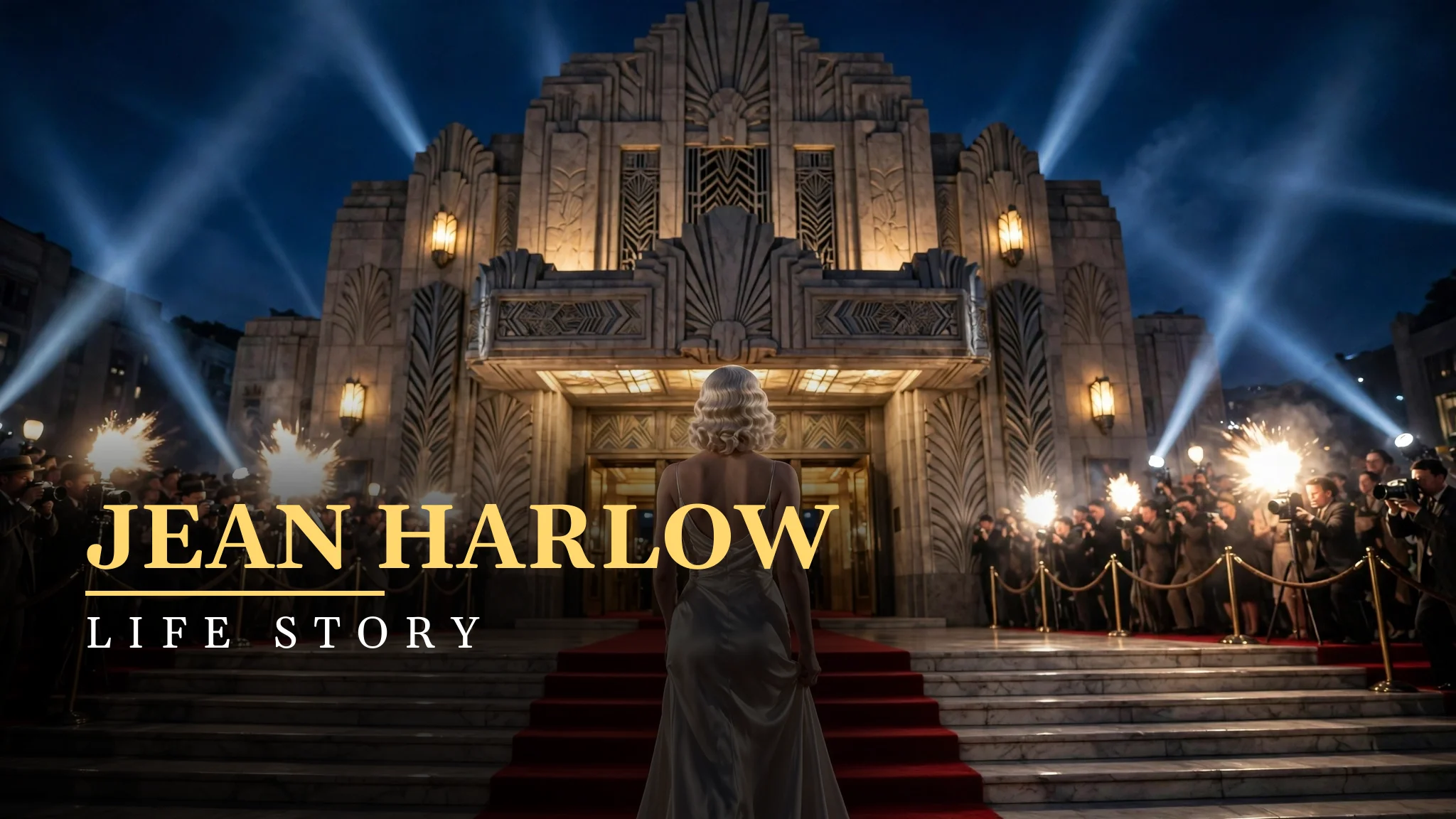
Jean Harlow was the original Blonde Bombshell, and she was one of the brightest stars Hollywood ever had. She had platinum blonde hair, a warm laugh, and a way of speaking that was funny, direct, and full of life. She was a star for only a few years, but in those years she became one of the most famous women in the world. She made films with Clark Gable, Spencer Tracy, and William Powell, and she was loved by audiences for her humour, her beauty, and her honesty. She died at twenty six, and the world was shocked. She had been a star for such a short time, and she had given so much, and then she was gone.
She was born in Kansas City, Missouri, and she grew up in a comfortable home. She was married at sixteen, and she moved to Los Angeles with her husband. She had no plan to become a star, but she was discovered by a film producer, and she was given a chance. She worked hard, she learned her craft, and she became a star in a few short years. She was a woman who loved to laugh, who loved her friends, and who worked hard to be a good actress. She was also a woman who faced hard times, including the death of her husband, and she kept going.
Her story is a sad one, because she died so young, but it is also a story of a woman who lived fully, who worked hard, and who gave joy to millions of people. She made films that are still loved today, and she is still remembered as the Blonde Bombshell, the woman with the platinum hair and the warm heart. She was Jean Harlow, and her life, though short, was a bright and shining one. This is the story of how a girl from Kansas City became a legend, and what she left behind when she died at twenty six.
A Girl From Kansas City Who Married Young
Harlean Harlow Carpenter was born on 3 March 1911 in Kansas City, Missouri. Her father, Mont Clair Carpenter, was a dentist, and her mother, Jean Harlow, was a beautiful and lively woman who had wanted to be an actress herself. Harlean was an only child, and she grew up in a comfortable home. She was a pretty girl, with blonde hair and a bright smile, and she liked to perform for her family. She went to school, she made friends, and she dreamed of a life that was bigger than the one she knew. Her mother encouraged her, and she gave her the love and support she needed to follow her dreams.
When Harlean was still a child, her parents separated, and her mother took her to live in Chicago and then in Los Angeles. Her mother was a strong and determined woman, and she believed in her daughter. She took Harlean to auditions, she encouraged her to act, and she supported her in every way she could. Harlean was a young girl, but she was already learning about the world of show business, and she was learning that it was a hard world, full of competition and disappointment.
When she was sixteen years old, Harlean married Charles McGrew, a young man from a wealthy family. The marriage was short, and it ended in divorce in nineteen twenty nine, after only two years. She was a teenager, and she had married too young, and she had learned a hard lesson about love. She was in Los Angeles, she was divorced, and she had no money and no plan. She began to work as an extra in films, taking small parts that paid a little money, and she hoped that something better would come along. She was a pretty young woman with blonde hair, and people in Hollywood noticed her.
She was given small parts in films, and she learned how a film set worked. She watched the other actors, she took lessons, and she worked hard. She was not a trained actress, but she was a natural, and she had a warmth and a humour that came through on screen. She was also a woman who was willing to work hard, and who was not afraid to be laughed at. That willingness to be funny, even if it meant looking silly, would become one of her greatest strengths as an actress. She was on her way to becoming a star, and she did not know it yet.
Discovered by Howard Hughes and Hell’s Angels
In nineteen twenty nine, Harlean was spotted by Howard Hughes, a rich and powerful film producer, who was making a film called Hell’s Angels, a big drama about pilots in the First World War. Hughes thought she had the look of a star, and he gave her the leading female role in the film. She was eighteen years old, and she had never played a leading role before. The film was a huge and expensive production, and it was a success. Harlean, who was now called Jean Harlow, after her mother, became famous overnight. She was a star, and the whole world knew her name.
Hell’s Angels was a film about war, love, and flying, and it was one of the most expensive films ever made at the time. Jean played Helen, a young woman who loves a pilot, and she gave a performance that was fresh and charming. She was not a great actress yet, but she was a natural, and audiences loved her. Her platinum blonde hair, which she had bleached to a bright white gold, became her trademark, and millions of women copied it. She was the Blonde Bombshell, and the name suited her, because she was beautiful, bright, and full of life.
The film made her a star, but it also put her in a box. People saw her as a sex symbol, a beautiful blonde who was there to look pretty, and they did not see her as a serious actress. She knew that, and she wanted to prove that she could act. She worked hard, she took lessons, and she chose parts that let her show her humour and her talent. She was a woman who wanted to be taken seriously, and she was willing to work for it. She was also a woman who loved to laugh, and she brought that laughter to her films.
She signed a contract with Metro-Goldwyn-Mayer, one of the biggest studios in Hollywood, and she began to make films for them. She was a star now, and she had a steady income, a nice home, and a life that many people envied. But she was also a young woman who had been married and divorced, who had lost her father, and who was still learning about life. She was famous, but she was also lonely at times, and she relied on her mother, who was her closest friend and her greatest support. Her mother lived with her, and she looked after her, and she helped her through the hard times.
Platinum Blonde, Red Dust, and a Star With Clark Gable
In nineteen thirty one, Jean Harlow starred in Platinum Blonde, a comedy in which she played a rich and beautiful woman who falls in love with a newspaper reporter. The film was a success, and it showed that she could be funny as well as beautiful. She was praised for her performance, and she was given more and better parts. She was becoming a star who could carry a film on her own, and she was learning how to act with skill and with humour. She was a natural comedian, and audiences loved her for it.
In nineteen thirty two, she starred in Red-Headed Woman, a drama in which she played a woman who uses her beauty to climb the social ladder. The film was bold for its time, because it dealt with a woman who was not good, and who did not apologise for it. Jean played the part with wit and energy, and she showed that she could play a complex and difficult character. The film was a success, and it added to her reputation as a serious actress. She was not only a pretty blonde. She was a woman who could act, and she was proving it again and again.
Later that same year, she starred in Red Dust, a drama set on a rubber plantation in Indochina, in which she played opposite Clark Gable. She played Vantine, a tough and funny woman who works in a bar, and who falls in love with Gable’s character. The film was a great success, and it began one of the most loved partnerships in Hollywood. Harlow and Gable made six films together, and audiences loved them as a pair. He was tall, dark, and strong, and she was blonde, bright, and funny, and together they made films that were full of life. Red Dust is still one of her best films, and it is still watched today.
She continued to work steadily through the early nineteen thirties, and she became one of the most popular stars in America. She starred in Dinner at Eight in nineteen thirty three, a drama about a group of rich people who come to dinner, and she played a funny and vulgar woman who steals every scene she is in. She starred in Bombshell in nineteen thirty three, a comedy about a film star who is tired of her life, and she played the part with wit and humour. She was at the height of her fame, and she was one of the biggest stars in the world. She was also a woman who was working very hard, and who was tired, but she kept going, because she loved her work.
China Seas, Dinner at Eight, and the Height of Fame
In nineteen thirty three, Jean Harlow starred in Dinner at Eight, a drama about a group of rich and powerful people who come together for a dinner party. She played Kitty Packard, the vulgar and funny wife of a businessman, and she stole every scene she was in. The film had a strong cast, including Marie Dressler, John Barrymore, and Wallace Beery, and Harlow held her own beside them. She was funny, she was loud, and she was full of life, and audiences loved her for it. The film was a great success, and it showed that she could work with the best actors in Hollywood and still stand out. She was not only a pretty blonde. She was a comic actress, and she was a great one.
In nineteen thirty five, she starred in China Seas, a drama set on a ship travelling to China, in which she played opposite Clark Gable again. She played a woman who loves Gable’s character, a ship’s captain, and who has to compete with another woman for his love. The film was a success, and it showed that Harlow and Gable were still a popular pair. She was beautiful, she was funny, and she was warm, and she made the audience care about her character. The film was a big production, and it was one of the most popular films of the year. Harlow was at the height of her fame, and she was one of the biggest stars in the world.
She also starred in Bombshell in nineteen thirty three, a comedy about a film star who is tired of her life and who wants to escape from Hollywood. The film was a joke about Harlow’s own life, and she played the part with wit and humour. She was a star playing a star, and she did it with a smile. The film was a success, and it showed that she could laugh at herself, and at the world of Hollywood. That is a rare quality in a star, and it is one of the reasons people loved her. She did not take herself too seriously, and she was willing to make fun of the very thing that had made her famous.
During these years, she was one of the highest paid actresses in Hollywood, and her face was on magazine covers, on posters, and in advertisements. She was a star, and she was loved by millions of people. She worked hard, she made film after film, and she rarely took a break. She was a professional, and she did her job well. She was also a woman who loved her friends, who loved to laugh, and who loved to live. She was a bright and shining star, and the world was watching her, and waiting to see what she would do next. She did not know that she had only a few years left, and that her brightest years were also her last.
Marriage, Loss, and a Heart That Kept Breaking
Jean Harlow’s personal life was full of sadness, even as her career was at its height. In nineteen thirty two, she married Paul Bern, a film producer who was much older than she was. The marriage lasted only two months, because Bern died by suicide in September nineteen thirty two, a shock that left Harlow heartbroken and confused. She was twenty one years old, and she had lost her husband in a terrible way. She did not talk about it in public, and she kept her grief private, but it was a hard time for her, and it left a mark on her for the rest of her life.
She married again in nineteen thirty three, to Harold Rosson, a cameraman, and the marriage lasted only a year. She was young, she was famous, and she was learning about love in a hard way. She wanted a home and a family, but the life she was living made that very hard. She was a star, and she was always working, and she had little time for a normal life. She was also a woman who was close to her mother, and her mother was her main support. The two of them lived together, and they were very close, and that closeness gave Harlow a sense of safety in a world that could be hard on young women.
In the mid nineteen thirties, she became engaged to William Powell, a popular actor, and the two of them were happy together. Powell was a kind and gentle man, and he loved Harlow deeply. They planned to marry, but Harlow became ill, and the wedding never happened. She was a woman who had found love at last, and she was about to lose it, not through divorce, but through death. It was a sad ending to a love story that had seemed so happy, and it is one of the saddest parts of her life.
She was also a woman who worked very hard, and who did not look after her health. She had been ill as a child, and she had problems with her kidneys, but she did not tell people about it. She kept working, she kept filming, and she kept smiling, even when she was in pain. She was a professional, and she did not want to let anyone down. That toughness was a part of who she was, but it also meant that she did not get the help she needed in time. She was a star who gave everything to her work, and she paid a high price for it.
Libeled Lady, Saratoga, and the Final Film
In nineteen thirty six, Jean Harlow starred in Libeled Lady, a comedy in which she played opposite William Powell, Spencer Tracy, and Myrna Loy. She played a woman who is involved in a libel case, and she gave a performance that was funny, warm, and charming. The film was a great success, and it showed that she was at the top of her game as a comic actress. She was praised for her work, and she was loved by audiences. She was twenty five years old, and she was one of the biggest stars in Hollywood, and she seemed to have a long and happy career ahead of her.
In nineteen thirty seven, she began work on Saratoga, a drama about horse racing, in which she played opposite Clark Gable again. The film was a big production, and it was going well, but Harlow became ill during filming. She had a high fever, she was in pain, and she was taken to hospital. She was found to have kidney failure, a serious condition that had been building for some time. She was only twenty six years old, and she was very ill. The studio stopped filming, and everyone hoped that she would recover, but she did not. She died on 7 June nineteen thirty seven in Los Angeles, at the age of twenty six.
Her death shocked the world. She was so young, so beautiful, and so full of life, and then she was gone. The film Saratoga was finished using a double for the scenes she had not completed, and it was released after her death. It was a success, and audiences went to see it to say goodbye to a star they loved. Her funeral was attended by thousands of people, and her mother was heartbroken. She had lost her only child, and she had lost the daughter she had loved and supported for her whole life. It was a terrible loss, and it left a hole in Hollywood that was never quite filled.
She was buried in a private service, and her legacy lives on in her films. Red Dust, Dinner at Eight, Bombshell, and Libeled Lady are still watched today, and her performance in them is still praised. She was a star who burned brightly and briefly, and she left behind work that is still loved. She was Jean Harlow, the Blonde Bombshell, and she will be remembered as one of the great stars of Hollywood, a woman who lived fully, worked hard, and died too young.
She was also a woman who changed the way blonde actresses were seen in Hollywood. Before Harlow, blonde actresses were often shown as sweet and innocent. Harlow was blonde, but she was also funny, tough, and direct, and she showed that a blonde woman could be clever and strong. She opened a door for other blonde actresses who came after her, and she did it with humour and with grace. That is a legacy that goes beyond any single film, and it is one that deserves to be remembered.
My Take:
When I think about Jean Harlow, the first thing I feel is sadness, because she died so young. She was twenty six years old, and she had so much more to give. She was a talented actress, a funny woman, and a beautiful star, and she had a long career ahead of her. She died of kidney failure, a condition that might have been treated if it had been found sooner, and that makes her death even sadder. She was a young woman who worked hard, who did not complain, and who kept going even when she was ill. She deserved more time, and she did not get it. That is a tragedy, and it is one that still moves people today, almost ninety years after she died.
I admire her for her humour, because she was one of the funniest actresses in Hollywood. She could make audiences laugh with a look, with a line, and with a way of speaking that was direct and honest. She was not afraid to be vulgar, she was not afraid to be silly, and she was not afraid to laugh at herself. That takes courage, especially for a beautiful woman in Hollywood, where women are expected to be pretty and quiet. Harlow was pretty, but she was also loud, funny, and full of life, and audiences loved her for it. She was a comedian, and she was a great one, and she deserves to be remembered as one.
Her work with Clark Gable also impresses me, because they were a perfect pair. He was tall, dark, and strong, and she was blonde, bright, and funny, and together they made films that were full of life. Red Dust is still one of my favourite films, because it shows two people who are tough, who are funny, and who fall in love in a hard place. Harlow played Vantine with wit and warmth, and she held her own beside Gable, who was one of the biggest stars in the world. That is a hard thing to do, and she did it well. She was not only Gable’s leading lady. She was his equal, and the films are better because of her.
What makes me sad about her story is how hard she worked, and how little she looked after herself. She had kidney problems, but she did not tell people about them, and she kept working even when she was in pain. She was a professional, and she did not want to let anyone down, but that professionalism cost her life. I think that is a warning for all of us. Work is important, but health is more important, and we should look after ourselves, even when we are busy. Harlow did not do that, and she died at twenty six, and that is a loss that could have been avoided. I wish she had taken better care of herself, and I wish someone had helped her to do so.
I also think about her mother, and how close they were. Her mother had wanted to be an actress herself, and she gave her daughter the love and support she needed to become a star. She lived with Harlow, she looked after her, and she was there when Harlow died. That is a sad thing, for a mother to lose her only child, and it is a thing that no parent should have to face. Harlow’s mother lived for many years after her daughter’s death, and she kept her daughter’s memory alive. That love is the heart of Harlow’s story, and it is a love that deserves to be remembered with respect.
Her marriage to Paul Bern is the saddest part of her personal life, and I want to be careful with it. She was twenty one years old, she had been married for two months, and her husband died by suicide. That is a terrible thing to go through, and she did not talk about it in public. She kept her grief private, and she went back to work. That takes a kind of strength that is easy to miss, because it does not look like strength. It looks like a woman going to work, smiling for the camera, and getting on with her life. But that is strength, and it is the strongest kind. She faced a terrible loss, and she kept going, and that is a brave thing to do.
I think about her engagement to William Powell, and how happy she must have been. Powell was a kind man, and he loved her deeply, and they planned to marry. She died before the wedding, and Powell was heartbroken. That is a sad ending to a love story, and it is a reminder that life can be cruel, even to people who seem to have everything. Harlow had fame, she had money, and she had love, and then she lost her life. That is a hard truth, and it is one that we should remember with kindness, not with gossip. She was a person, and she deserved a long and happy life, and she did not get it.
If I compare her with other stars of her time, what stands out is how young she was, and how much she had already done. She was a star for only a few years, but she made films that are still loved today, and she became a legend. Other stars worked for decades, and they had time to learn, to grow, and to make mistakes. Harlow did not have that time. She rose quickly, she worked hard, and she died young. That is a sad thing, but it is also a sign of how talented she was. She did in a few years what many stars take a lifetime to do, and she did it with humour, with warmth, and with grace.
For a young reader, I think the lesson is simple. Work hard, be funny, and look after your health. Jean Harlow worked hard, she was funny, and she did not look after her health, and she died at twenty six. That is a warning, and it is a lesson that many young people need to hear. Fame is not worth your health, and work is not worth your life. Take care of yourself, see a doctor when you are ill, and do not be afraid to rest. Harlow did not do that, and she paid a high price. We can learn from her, and we can take better care of ourselves, because of her story.
I also think her story teaches us to be kind to people who are going through hard times in public. Harlow was hurt in public, she was talked about in public, but she did not ask for pity. She asked for work, and she did her work well. We should remember that famous people are people too, and they feel pain just as we do. When we read about a star’s heartbreak, we should be kind, not curious. Harlow deserved kindness, and she gave kindness to others. That is a good example for all of us.
In the end, I think Jean Harlow matters because she was a great actress, a funny woman, and a beautiful star, and because she died too young. Her films are still watched, her laugh is still heard, and her name is still known. She was the Blonde Bombshell, and she was much more than that. She was a daughter, a wife, a fiancee, and a friend, and she was loved by many people. She died at twenty six, at home in Los Angeles, after a short and bright life. I am sad that she died so young, and I am glad that her films are still here, so that people can still see her, hear her laugh, and remember her. That is a legacy, even if it is a sad one, and it deserves to be remembered with love and with respect.
One more thought stays with me. When I watch Red Dust today, I see a young woman who is tough, funny, and full of life, and I feel happy too. That is a simple thing, but it is a powerful thing. A film made more than ninety years ago can still make people smile, and that is the magic of Jean Harlow. She gave joy to people who needed it, and she kept giving it long after she died, through her films. That is a beautiful legacy, and it is one that deserves to be remembered with love.
I also think about her work in Dinner at Eight, and how it shows what a great comic actress she was. She played Kitty Packard, a loud and funny woman, and she stole the film from some of the best actors in Hollywood. That takes talent, and it takes courage, because she was not afraid to be vulgar, to be loud, and to be funny. She was a beautiful woman, and she could have played only pretty parts, but she chose to be funny, and she was brilliant at it. I wish more people remembered her as a comedian, because she was one of the best.
There is another lesson in her story, about the importance of looking after your health. She was ill, she was in pain, and she kept working. She did not tell people how ill she was, and she did not get the help she needed in time. That is a sad thing, and it is a thing that still happens today, when people work too hard and do not look after themselves. We should learn from her, and we should take care of ourselves, even when we are busy. Health is more important than work, and life is more important than fame. Harlow did not learn that in time, but we can learn it from her.
When I think about her at twenty six, dying in a hospital in Los Angeles, I feel sad for her, and for her mother, and for William Powell, who loved her. She had so much more to give, and she did not get the chance. She was a star, a daughter, and a fiancee, and she was loved by many people. She died too young, and the world lost a great actress. I am glad that her films are still here, so that people can still see her, hear her laugh, and remember her. That is a legacy, even if it is a sad one, and it deserves to be honoured.
In the end, I think Jean Harlow teaches us that life is short, and that we should live it fully, work hard, laugh often, and look after ourselves. She lived fully, she worked hard, and she laughed often, but she did not look after herself, and she died at twenty six. That is a warning, and it is a lesson that many young people need to hear. Be happy, be funny, and be kind, but also be careful with your health. Harlow was a bright star, and she burned out too soon, but her light is still here, in her films, and it will be here for a long time to come.
I will remember Jean Harlow as a young woman who laughed, who worked, and who shone brightly for a short time. She was the Blonde Bombshell, and she was much more than that, a funny actress, a loving daughter, and a brave woman. Her films will still be watched, her laugh will still be heard, and her name will still be known. That is a fine legacy for a life that lasted only twenty six years, and it is one she earned with every film she made.
When I think about her now, I think about a young woman with platinum hair, a warm laugh, and a brave heart, who gave everything to her work and who left the world too soon. She was Jean Harlow, and she will always be the original Blonde Bombshell, a star who shone brightly, even if only for a short time.
I also think about how much she gave to the world of comedy, and how young actresses still learn from her today. They watch Red Dust and Dinner at Eight, they study her timing, and they try to copy her warmth and her wit. She taught them that a funny woman must be brave, must work hard, and must not be afraid to laugh at herself. That is a lesson that will last as long as people make comedies, and it is a legacy that no award can match. She was a teacher as well as a star, because her films are her classroom, and actresses are still her students.
Frequently Asked Questions
When was Jean Harlow born and when did she die?
Jean Harlow was born Harlean Harlow Carpenter on 3 March 1911 in Kansas City, Missouri, and she died on 7 June 1937 in Los Angeles at the age of twenty six. She died of kidney failure, after becoming ill during the filming of Saratoga.
Why was Jean Harlow called the Blonde Bombshell?
She was called the Blonde Bombshell because of her platinum blonde hair, which she bleached to a bright white gold, and her beautiful and lively screen presence. The name became famous after Hell’s Angels in nineteen thirty, and it stayed with her for the rest of her short life.
What was Jean Harlow’s first big film?
Her first big film was Hell’s Angels in nineteen thirty, a drama about pilots in the First World War, produced by Howard Hughes. She played the leading female role at eighteen, and the film made her a star overnight.
What films did Jean Harlow make with Clark Gable?
She made six films with Clark Gable, including Red Dust in nineteen thirty two, China Seas in nineteen thirty five, and Saratoga in nineteen thirty seven. They were a popular screen pair, and audiences loved their humour and chemistry together.
Was Jean Harlow married?
She was married three times, to Charles McGrew, Paul Bern, and Harold Rosson, and she was engaged to William Powell at the time of her death. Her marriage to Paul Bern lasted only two months before he died by suicide in nineteen thirty two.
What was Jean Harlow’s last film?
Her last film was Saratoga, made in nineteen thirty seven, in which she starred opposite Clark Gable. She became ill during filming and died before it was finished, and the film was completed using a double for her remaining scenes.
How did Jean Harlow die?
She died of kidney failure at twenty six, after becoming ill during the filming of Saratoga. She had suffered from kidney problems for some time, and her condition became serious very quickly. Her death shocked Hollywood and the world.


