Jean-Jacques Goldman: The Life Story Behind France's Quiet Hitmaker
In this post
Jean-Jacques Goldman is the quietest giant in French music. He wrote some of the most loved songs in France, he sang them in a clear and warm voice, and then he stepped back from the stage, choosing a quiet life over fame. He did not chase the spotlight, he did not appear on television often, and he did not give many interviews, yet his songs are heard every day in France, in cars, in homes, and in concert halls, because they are part of the life of the country.
He was born in Paris, he grew up in a family that loved music and books, and he became famous in the early 1980s with songs that spoke about hope, about love, and about the power of music itself. He wrote Il suffira d’un signe, Quand la musique est bonne, Je te donne, and Là-bas, and each of those songs became a classic. He also wrote for other singers, most famously for Céline Dion, giving her the album D’eux, which became the best-selling French-language album of all time.
He founded Les Enfoirés, a charity concert for the Restos du Coeur, and he gave his time and his songs to help people who were hungry. He retired from the stage in 2004, and he has lived quietly since then, but his songs have not retired. They are still sung, still loved, and still taught to new generations, because they are honest, hopeful, and full of heart.
A Boy from Paris with a Guitar
Jean-Jacques Goldman was born in Paris on 11 October 1951, to Jewish parents who had come to France from Eastern Europe. His father was a doctor, and his mother was a teacher, and the family lived in a modest home where books, music, and discussion were part of daily life. He grew up with his brothers, Robert, who later became a songwriter, and Pierre, who became a political activist, and the house was full of ideas, of arguments, and of a love of learning that stayed with Jean-Jacques for the rest of his life.
He was a shy and thoughtful boy, and he did not like to be the centre of attention. He liked to play the guitar, he liked to listen to the Beatles and to other English and American bands, and he began to write small songs when he was still a teenager. He studied at a good school, and he went on to study economics, but music was always his real love, and he spent his free time playing in bands, singing in small clubs, and learning how to write a song that people would remember.
He played in a group called Taï Phong in the 1970s, a band that mixed rock and pop, and he learned to work with other musicians, to sing harmonies, and to perform on stage. He was not the loudest member of the band, but he was the one who wrote the best songs, and people who heard him said that he had a gift for melody and for words. He was a quiet worker, and he kept writing, even when the band did not become famous, because he believed that a good song would find its audience in time.
He also worked in a shop selling sports goods for a time, and he lived a normal life, away from show business, while he wrote songs in the evenings. That normal life gave him a view of ordinary people, of workers, of families, and of the small hopes that make a life worth living, and that view is in his songs, which are about ordinary people, not about stars. He was a man of the people, even before he became a star, and that is why his songs feel so close to real life.
Il suffira d’un signe and the First Fame
In 1981, Jean-Jacques Goldman recorded Il suffira d’un signe, a song about hope, about a sign that things will get better, and it became a huge hit in France. The song was simple, with a clear melody and honest words, and it made his name known all over the country. He sang it in a warm voice, with a guitar, and the audience loved it because it spoke about a feeling that everyone knows, the hope that a small sign can change a life. It was a perfect first hit, because it showed his gift for writing about hope in a simple and direct way.
He followed it with Quand la musique est bonne in 1982, a song about the joy of music, about singing together, and about the power of a good tune to lift the heart. The song became another hit, and it is still played today, at parties, in schools, and on the radio, whenever people want to hear a song about music itself. He was not writing about fame or about money. He was writing about the joy of singing, and that joy was infectious, because it was honest and because it was shared.
He recorded Comme toi in 1982, a tender song about a little girl, and about the cruelty of war, and it showed a deeper side of his work. The song is quiet, sad, and full of love, and it is one of his most respected songs, because it speaks about a child with a warmth that is rare in pop music. He did not write it to be a hit. He wrote it because he felt it, and the audience felt it too, because the song was true.
He toured France, he played in large halls, and he became one of the most popular singers in the country, but he did not change his quiet manner. He wore simple clothes, he played guitar, and he sang with a band that played with care. He did not need a glittering show, because his songs were the show, and the audience came to hear them. He was a star, but he was also a man who lived simply, and that simplicity became his mark.
Je te donne, Là-bas, and the Great Songs
In the mid-1980s, Goldman wrote some of his greatest songs, including Je te donne in 1985, a song he recorded with the Welsh singer Michael Jones, about giving everything to a person you love, in two languages, French and English. The song became a huge hit, and it showed his gift for writing about love in a way that was both personal and universal. He sang it with Michael Jones, and the two voices together made the song feel like a conversation between friends, and the audience loved it.
He recorded Là-bas in 1987, a duet with the singer Sirima, about a woman who wants to leave and to see the world, and about a man who asks her to stay. The song is a dialogue, with two voices, two dreams, and a sadness that comes from loving someone who wants to go away. It became one of his most loved songs, and it is still played today, because it speaks about a feeling that many couples know, the wish to travel and the wish to stay, both at once. Sirima died in a tragic accident in 1989, and the song became a tribute to her as well as a great hit.
He also recorded Envole-moi, a song about flying away, about freedom, and about the wish to leave the ground and to see the world from above. The song is joyful, hopeful, and full of energy, and it became a favourite at his concerts, where the audience sang along with every word. He wrote about hope, about love, and about freedom, and he did it with a melody that was easy to sing, and with words that were easy to remember, and that is why his songs are still sung by children in schools today.
He worked with Michael Jones and with other musicians, forming a trio that toured France and that gave concerts that were warm, joyful, and full of music. He was not a solo star who stood alone. He liked to work with friends, to share the stage, and to let other voices shine. That generosity is part of his character, and it is why musicians loved to work with him, because he gave them space, he listened to them, and he made the music better for everyone.
Writing for Céline Dion and for Others
In the 1990s, Goldman became one of the most sought-after songwriters in France, and he wrote for many singers, most famously for Céline Dion. He wrote the album D’eux in 1995, with songs including Pour que tu m’aimes encore, and the album became the best-selling French-language album of all time, selling in millions around the world. He wrote in French for a singer from Quebec, and he gave her songs that were both French and universal, about love, about loss, and about the wish to be loved. The album made him famous as a songwriter far beyond France, and it showed that his words could travel across the world.
He also wrote for other singers, including Patricia Kaas, Johnny Hallyday, and many others, and he gave them songs that fitted their voices and their styles. He was not a writer who gave the same song to everyone. He listened to each singer, he learned their voice, and he wrote a song that was made for them, and that care made him a great songwriter. He was a quiet man, but his songs were heard by millions, and his words became part of the lives of people in many countries.
He did not take all of the credit for his success, and he shared it with the singers who sang his songs. He said that a song is only complete when it is sung, and that the singer gives it a life that the writer cannot give alone. That humility is part of his character, and it is why singers loved to work with him, because he respected them, he listened to them, and he made them feel like partners, not like tools.
He continued to record his own albums in the 1990s, and his concerts were full, but he was already thinking about a quieter life. He had a family, he had children, and he wanted to be with them, away from the noise of show business. He was a star, but he was also a father, and he tried to keep his family life private, because he believed that a singer should be known for his songs, not for his personal life. That privacy is part of why he is so respected in France.
Les Enfoirés and a Heart for Charity
In 1986, Goldman helped to found Les Enfoirés, a group of singers and artists who give concerts to raise money for the Restos du Coeur, a charity founded by the comedian Coluche to feed people who are hungry. He wrote the song La Chanson des Restos, which became the anthem of the charity, and he performed in the first concerts, giving his time and his voice to help others. The concerts became a tradition in France, held every year, with many stars taking part, and they have raised money for millions of meals. Goldman was at the heart of that work, and he gave it with a quiet generosity that did not seek applause.
He believed that a famous person should use their fame for something useful, and he did so, not only with Les Enfoirés, but with other charities as well. He gave money, he gave time, and he gave his songs, and he did it without making a show of it. He did not talk about his charity work in interviews, and he did not use it to promote himself. He simply did it, because he believed it was right, and because he had grown up in a family that valued helping others.
He also worked for other causes, speaking out against racism, against war, and against injustice, and he used his songs to say what he believed. He was not a loud campaigner, but he was steady, and people listened to him because they trusted his sincerity. He was a man who had seen the suffering of his own family, who had lost a brother in a tragic way, and who understood that the world can be cruel, and that kindness is a choice that must be made again and again.
Les Enfoirés continues today, long after Goldman stopped performing with them, and his song is still sung at every concert. That is a legacy that goes beyond music, a legacy of a man who used his talent to feed people, and who showed that a song can be a meal, a hope, and a hand held out to someone in need. He is remembered in France not only as a singer, but as a kind man, and that is a rare and beautiful thing.
Retiring from the Stage and a Quiet Life
In 2004, Jean-Jacques Goldman retired from the stage, after a final tour that was filled with emotion. He sang his greatest songs, he thanked his audience, and he said goodbye, not with a big show, but with a quiet concert that felt like a farewell to friends. He was fifty-three years old, he was still popular, and he could have kept singing for many more years, but he chose to stop, because he wanted a quiet life, with his family, away from the noise of fame. That choice surprised many people, but it was typical of the man he had always been, a man who valued privacy over applause.
He has lived quietly since then, first in London and later in Marseille, with his family, and he rarely appears in public. He does not give interviews often, he does not appear on television, and he does not sing in public, except for rare occasions. He writes songs for others, he helps young artists, and he lives a normal life, going to the market, reading books, and spending time with his children. He is a star who chose to become an ordinary man, and that choice has made him even more loved, because people respect a person who knows when to stop.
He has said little about his retirement, and he has not explained it in detail, but his friends say that he wanted to be a father first, and a singer second, and that he wanted his children to grow up away from the cameras. He is a devoted father, and he has tried to give his family a normal life, even though he is one of the most famous singers in France. That is a difficult thing to do, and he has done it with care, by stepping back, by staying quiet, and by letting his songs speak for him.
His songs have not retired, and they are still played every day in France. Children learn them in school, adults sing them in cars, and new singers cover them, because they are honest, hopeful, and full of heart. He may be quiet, but his voice is still in the air, and it will keep singing for a long time, as long as people love music, love, and hope.
Why Goldman Still Matters
Jean-Jacques Goldman matters because he wrote songs that are part of the life of France, songs that are sung at school, at home, and in concert halls, and that are known by almost everyone in the country. Il suffira d’un signe, Quand la musique est bonne, Je te donne, and Là-bas are not only hits. They are part of the French language, part of the culture, and part of the memory of generations who grew up with them. He is a songwriter who gave France its soundtrack, and that is a rare honour.
He also matters because he showed that a star can be quiet, kind, and humble, and still be great. He did not chase fame, he did not seek scandal, and he did not change his style to follow fashion. He wrote honest songs, he sang them with care, and he gave his time to charity, and that is a model for any artist who wants to be remembered for the right reasons. He is a man who used his talent well, and who left the stage when it was time, with dignity and with grace.
His work for Céline Dion also matters, because it showed that French songs can travel the world, and that a French writer can give a singer from another country a song that becomes a global hit. D’eux is still the best-selling French-language album of all time, and it is a proof that a good song, well written, can cross borders, languages, and cultures, and can touch millions of people who have never been to France.
A Hitmaker Who Chose Quiet
Goldman chose quiet over fame, and that choice is part of his legacy. He could have kept touring, he could have kept recording, and he could have stayed in the spotlight for many more years, but he chose to step back, to live with his family, and to let his songs do the work. That is a brave choice, because fame is addictive, and many stars cannot let it go. He let it go, and he found a different kind of happiness, in a quiet life, in a home, and in the knowledge that his songs were still singing without him.
His life is a story about balance, about work and rest, about fame and privacy, and about giving and receiving. He gave France songs, he gave charity concerts, and he gave his time to others, and in return he received love, respect, and a place in the heart of the country. He did not take more than he gave, and that is a rare thing for a star, and it is why he is still loved, even though he has not sung on stage for more than twenty years.
When a listener today hears Quand la musique est bonne, they hear a song about the joy of music, and they hear a man who loved music, who gave it to the world, and who then stepped back to listen. That is a beautiful image, a hitmaker who chose quiet, and who left his songs to sing for him. His voice is still in the air, in the schools, in the cars, and in the homes of France, and it will keep singing, as long as people love a good song, as long as children learn his melodies, and as long as a new listener hears Il suffira d’un signe for the first time and feels hope rise in their heart.
My Take:
When I think about Jean-Jacques Goldman, I think first about quietness. He did not shout, he did not chase fame, and he did not try to be the loudest person in the room. He wrote songs, he sang them in a warm voice, and he let the songs do the work. I admire that, because it takes a special kind of confidence to be quiet in a loud world. Most stars try to be louder than the next one, but Goldman proved that a quiet man can be more powerful than a loud one, if his words are true and his melodies are honest. That is a lesson I carry with me.
I admire his song Il suffira d’un signe, because it is about hope, about a small sign that things will get better, and it is a song that has helped many people through hard times. He wrote it in 1981, and it is still played today, because hope does not go out of date. I think about the people who have heard that song when they were sad, when they were tired, or when they did not know what to do next, and I realise that a song can be a kind of help, a small light in a dark room. Goldman gave that light to France, and he gave it with a simple melody and honest words, and that is a beautiful gift.
What moves me most is his work for Les Enfoirés, and for the Restos du Coeur, a charity that feeds people who are hungry. He helped to found the concerts, he wrote La Chanson des Restos, and he gave his time and his voice to help others, without making a show of it. That is a rare kind of generosity, to give without asking for applause, and it is a part of his character that I respect deeply. He was a star, but he did not forget that other people were hungry, and he used his fame to feed them. That is a lesson for anyone who has a talent, to use it for good, not only for yourself.
I also think about his album for Céline Dion, D’eux, and about how he wrote songs in French for a singer from Quebec, and how those songs became the best-selling French-language album of all time. That is a remarkable achievement, because it shows that a good song can cross borders, languages, and cultures, and can touch millions of people who have never been to France. He listened to Céline, he learned her voice, and he wrote songs that were made for her, and that care made the album great. He was a writer who respected his singer, and that respect is part of why his work lasts.
His retirement from the stage in 2004 also impresses me, because it shows that he knew when to stop. He was fifty-three, he was still popular, and he could have kept singing for many more years, but he chose to step back, to live with his family, and to find a quiet life. That choice takes courage, because fame is addictive, and many stars cannot let it go. Goldman let it go, and he found a different kind of happiness, in a home, in a family, and in the knowledge that his songs were still singing without him. I think that is a wise way to live, to know when to stop, and to let your work speak for you.
I think about his childhood in Paris, and about the family that loved books, music, and discussion, and I realise that his songs come from that home. He grew up in a house where ideas mattered, where people talked, and where music was a part of daily life, and that home shaped him into a songwriter who cares about words, about meaning, and about people. He did not grow up in a house of show business. He grew up in a house of learning, and that learning is in his songs, which are thoughtful, clear, and full of heart.
His song Comme toi also stays with me, because it is about a little girl, and about the cruelty of war, and it is one of the most tender songs he ever wrote. He did not write it to be a hit. He wrote it because he felt it, and the audience felt it too, because the song was true. I think that is a lesson for any songwriter, to write about what you feel, not about what you think will sell, and to trust that the audience will hear the truth. Goldman did that, and his songs are still heard today, because they were written with feeling, not with a plan to be famous.
I also admire the way he worked with other musicians, especially Michael Jones, and the way he shared the stage with friends. He was not a solo star who stood alone. He liked to work with others, to let other voices shine, and to make the music better for everyone. That generosity is part of his character, and it is why musicians loved to work with him. He gave them space, he listened to them, and he made them feel like partners, not like tools. That is a good way to work, in music and in any job, to share, to listen, and to let others shine.
There is a sadness in his story too, and it is the sadness of losing his brother Pierre, who died in a tragic way, and of growing up in a family that knew suffering. He has spoken little about that loss, and I respect his silence, because grief is a private thing. But I think that loss is in his songs, in the tenderness, in the hope, and in the wish for a better world. He understood that life can be cruel, and he used his songs to answer that cruelty with kindness, with hope, and with love. That is a brave way to live, and it is a gift to his audience.
I think about his song Là-bas, and about the woman who wants to leave and to see the world, and about the man who asks her to stay. That song is a dialogue, with two voices, two dreams, and a sadness that comes from loving someone who wants to go away. I think many couples have felt that, the wish to travel and the wish to stay, both at once, and Goldman gave that feeling a tune. He did not take sides. He let both voices speak, and he let the listener decide what to feel. That is a kind and wise way to write a song, to let both people be right, and to let love be complicated.
His quiet life in Marseille also makes me think about happiness, and about what it means to be happy after fame. He lives quietly, he goes to the market, he reads books, and he spends time with his family, and he does not need applause to be happy. That is a lesson that many stars never learn, that happiness is not in the spotlight, but in a home, in a family, and in a simple life. Goldman learned it, and he chose it, and that choice has made him even more loved, because people respect a person who knows what matters.
When I hear Quand la musique est bonne today, I hear a song about the joy of music, and I feel that joy myself, because the song is simple, warm, and full of life. It is a song that makes people sing along, in cars, in schools, and at parties, and that shared singing is a kind of happiness that Goldman gave to France. He did not write it to be a hit. He wrote it because he loved music, and that love is in every note. I think that is the best reason to write a song, to share a joy, not to chase a chart.
I also think about the way his songs are taught in schools, and about how children learn them, sing them, and grow up with them. That is a rare honour for a songwriter, to become a part of a country’s education, and it shows that his words are not only pop songs. They are part of the French language, part of the culture, and part of the memory of generations. He gave France its soundtrack, and that soundtrack will keep playing, as long as children learn to sing in school.
In the end, I think Goldman teaches us that a quiet life can be a great life, and that a quiet song can be a great song. He did not chase fame, he did not seek scandal, and he did not change his style to follow fashion. He wrote honest songs, he sang them with care, and he gave his time to charity, and that is a model for any artist who wants to be remembered for the right reasons. I hope readers listen to his songs, from Il suffira d’un signe to Là-bas to Pour que tu m’aimes encore, and hear the journey in them, from a shy boy in Paris to a hitmaker who chose quiet.
I hope young songwriters learn from him, not only how to write a good melody, but how to live a good life. He showed that you do not need to be loud to be heard, that you do not need to be famous to be great, and that you do not need to keep singing to be loved. You need to write true words, to sing them with care, and to use your talent for good, and if you do that, your songs will last, as his have lasted, in the schools, in the cars, and in the homes of France.
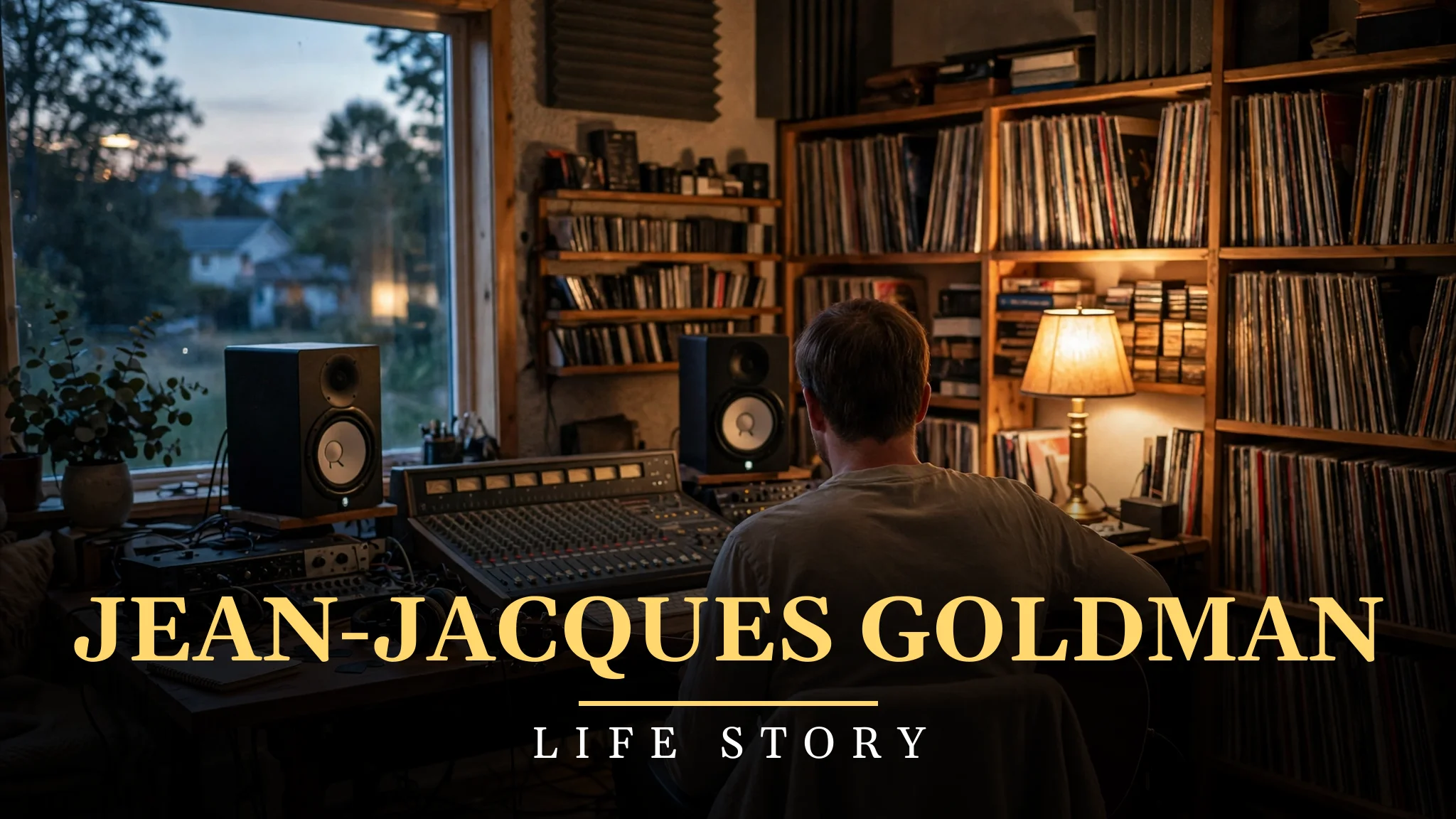
Finally, I think about the image of a man at a mixing desk in a warm home studio, with shelves of records, a guitar by the window, and the dusk outside. That image is Goldman, a quiet worker, a man who loves music, and a man who chose a simple life. I hope that image stays with readers, and I hope they remember that a great artist can be quiet, kind, and humble, and that a soft voice can be the strongest voice in the room, if it sings the truth.
I also think about the way he has been a model for other songwriters, and about how many young writers in France have learned from his care for words. He showed that a pop song can have a clear story, a true feeling, and a melody that is easy to sing, all at once, and that is a hard thing to do. Many writers try to do one of those things, but Goldman did all three, again and again, and that is why his songs are still studied, still covered, and still loved by new artists who want to learn how to write a song that lasts.
His family life also stays with me, because he tried to give his children a normal life, away from the cameras, and he succeeded by stepping back from fame. That is a difficult choice, and it is a loving choice, because a child who grows up in the spotlight often finds it hard to be themselves. Goldman gave his children a quiet home, a normal school, and a father who was present, and that is a gift that is worth more than any hit song. I respect him for that, and I think it is a part of his legacy that deserves to be remembered.
Finally, I think Goldman shows us that a song can be a kind of hope, and that hope is a real thing, not only a feeling. Il suffira d’un signe is about a sign that things will get better, and that sign can be a song, a friend, or a small moment of kindness. He gave France that sign, in a song, and he gave it with a warm voice and a clear heart. I hope readers hear that sign when they listen to his songs, and I hope they carry it with them, as I do, whenever life feels hard and a little hope is needed.
I also think about the way his songs are sung by children in schools, and about how a child who learns Quand la musique est bonne today will carry that song for the rest of their life, just as their parents did. That is a rare honour for a songwriter, to become a part of a country’s childhood, and it shows that his words were not only pop songs. They were part of the French language, part of the culture, and part of the memory of generations, and they will keep being sung, as long as children learn to sing in school, and as long as people love a good song.
Frequently Asked Questions
When was Jean-Jacques Goldman born and is he still alive?
Jean-Jacques Goldman was born in Paris on 11 October 1951, and he is still alive, living quietly with his family, first in London and later in Marseille. He retired from the stage in 2004, but his songs are still played every day in France.
What is Jean-Jacques Goldman’s most famous song?
His most famous songs include Il suffira d’un signe from 1981, Quand la musique est bonne from 1982, Je te donne from 1985, and Là-bas from 1987, a duet with Sirima. Each one is a classic of French pop, and they are still sung in schools and in homes.
Did Jean-Jacques Goldman write for Céline Dion?
Yes, he wrote the album D’eux in 1995 for Céline Dion, including the song Pour que tu m’aimes encore. The album became the best-selling French-language album of all time, selling in millions around the world.
What are Les Enfoirés and what did Goldman do for them?
Les Enfoirés is a group of singers and artists who give concerts to raise money for the Restos du Coeur, a charity that feeds people who are hungry. Goldman helped to found the group in 1986, wrote La Chanson des Restos, and performed in the first concerts.
Why did Jean-Jacques Goldman retire from the stage?
He retired in 2004, after a final tour, because he wanted a quiet life with his family, away from the noise of fame. He was fifty-three, still popular, but he chose privacy over applause, and he has lived quietly since then.
What is the song Comme toi about?
Comme toi, recorded in 1982, is a tender song about a little girl, and about the cruelty of war. It is one of Goldman’s most respected songs, because it speaks about a child with warmth and with sadness, and it shows his gift for writing about serious subjects with care.
Who is Michael Jones in Goldman’s career?
Michael Jones is a Welsh singer and guitarist who worked with Goldman, recording Je te donne with him in 1985 and touring as part of a trio. He was a close musical partner, and their voices together made the song a great hit.


