José Feliciano: The Life Story Behind Puerto Rico's Guitar Legend
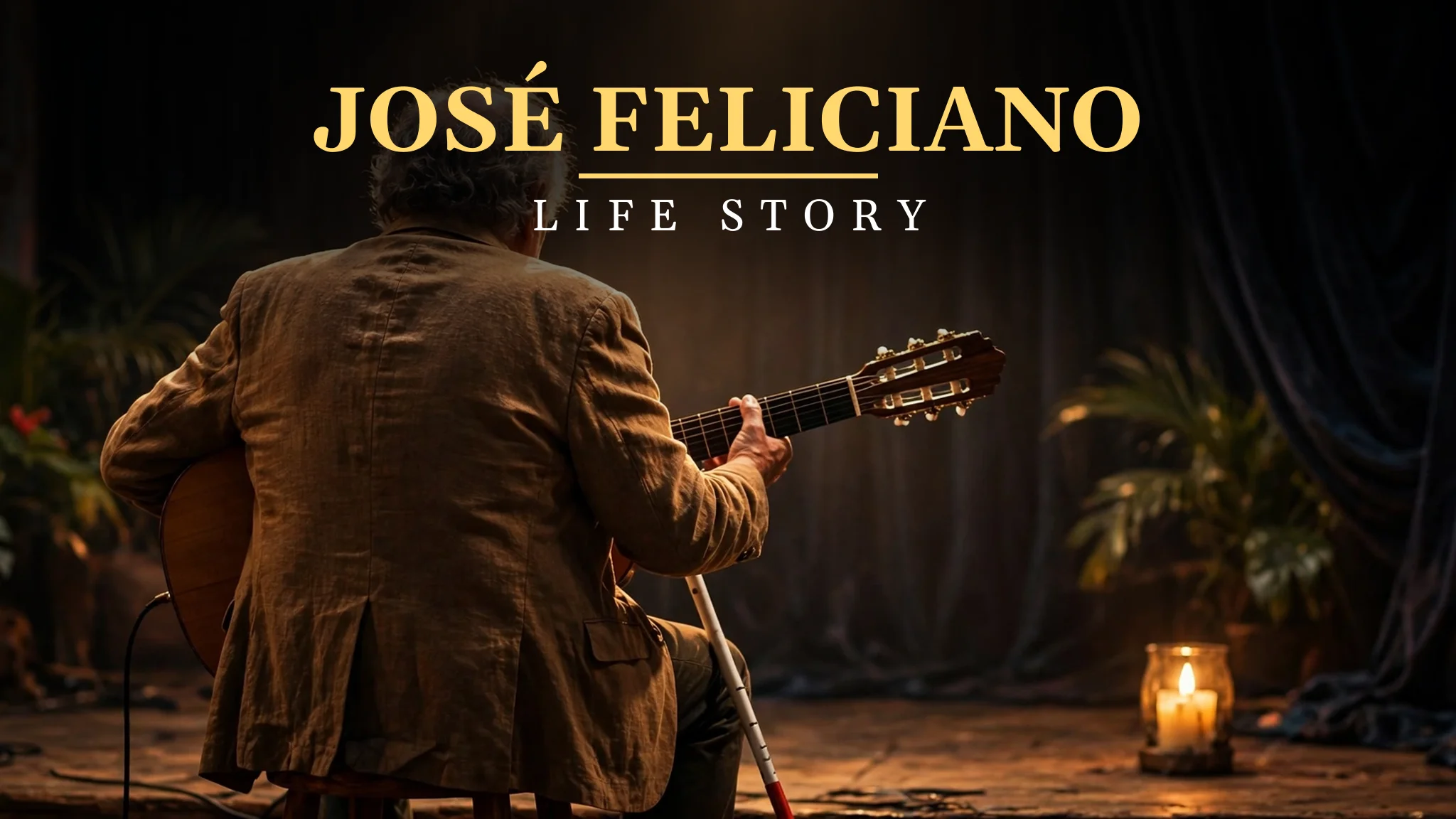
In this post
José Feliciano is a guitar legend, a singer with a warm, soulful voice, and a man who has inspired millions of people around the world. He was born blind, in a small town in Puerto Rico, and he learned to play the guitar by listening, by feeling, and by practising for many hours. He became famous with his version of Light My Fire, a song that showed his unique guitar style, and he became beloved with Feliz Navidad, a Christmas song that is played every year, in many countries, and that brings joy to families at Christmas time.
He was born in Lares, Puerto Rico, in 1945, and he moved to New York with his family when he was five years old. He grew up in the Bronx, in a poor family, and he learned music in a world that was not always kind to a blind child. He did not let his blindness stop him. He learned the guitar, he learned to sing, and he learned to play with a feeling that few musicians can match. He became a star, he won Grammy Awards, and he played in the greatest concert halls in the world.
What makes his story special is the way he turned a challenge into a gift. He could not see, but he could hear, and he could feel music in a way that many sighted people cannot. His guitar playing is full of feeling, his voice is full of soul, and his songs are full of warmth. He has faced hardship, he has faced controversy, and he has kept singing, kept playing, and kept inspiring. This is the story of how a blind boy from Lares became a guitar legend, and why his music still matters today.
A Boy From Lares
José Monserrate Feliciano García was born on 10 September 1945 in Lares, a town in the mountains of Puerto Rico. He was born blind, because of congenital glaucoma, a condition that affects the eyes from birth. His family was poor, and life was hard, but music was part of his home. His father played the guitar, and José listened to him with great care. He heard the strings, he heard the melodies, and he wanted to play. He was a child who could not see, but he could hear, and hearing became his way of learning the world.
As a boy, he learned to play the guitar by listening and by feeling. He held the guitar, he felt the strings, and he learned where each note was by touch and by sound. It was not easy, and it took many hours of practice, but he did not give up. He loved music, and he wanted to play it. He also learned to sing, and his voice was warm and soulful, even when he was young. His family supported him, and they encouraged him to follow his love of music, even when others doubted that a blind boy could become a musician.
Lares was a small town, with a strong sense of community, and José grew up in a world of Puerto Rican music, of boleros, of folk songs, and of the sounds of the island. He absorbed those sounds, and they became part of his music. He did not yet know that he would become famous, but he knew that music was his life. He played, he sang, and he dreamed, and his dreams were big, even though his world was small. The boy from Lares was on his way, and his journey would take him far from his home town.
His early years were shaped by family, by music, and by the challenge of blindness. He learned to be independent, to listen carefully, and to trust his ears and his hands. Those skills made him a better musician, because he listened more deeply than many sighted people. He heard the music in a way that was his own, and he played it with a feeling that was his own. The boy who could not see became a man who could make others feel, through his guitar and his voice, and that is a remarkable story.
Moving to New York
When José was five years old, his family moved to New York City, to the Bronx, in search of a better life. The move was a big change for a young blind boy. New York was a large, loud, busy city, very different from the small town of Lares. He had to learn a new place, a new language, and a new way of life, and he had to do it without sight. It was hard, but he was brave, and he learned quickly. He listened to the sounds of the city, he learned English, and he found music in his new home.
In New York, he heard many kinds of music. He heard jazz, he heard rock and roll, he heard folk music, and he heard Latin music, and he absorbed them all. He played his guitar, he sang, and he performed in small places, in coffee houses, and in clubs. He was a teenager, and he was already a talented musician, with a unique style. He played the guitar with a flamenco touch, with fast fingers, and with a feeling that was all his own. People who heard him were amazed, because they had never heard a guitar played like that.
He also went to school in New York, and he learned to read Braille, to write, and to study music. He was a good student, and he worked hard, even when it was difficult. He faced prejudice, because some people did not believe that a blind Puerto Rican boy could become a star, but he did not let that stop him. He believed in himself, he believed in his music, and he kept playing. His family supported him, and his friends encouraged him, and together they helped him to build the confidence he needed.
New York gave him his career. It was there that he was discovered, that he recorded his first albums, and that he became famous. The city was hard, but it was also full of chances, and José took them. He played in Greenwich Village, the centre of folk music in New York, and he was heard by people who could help him. He was a young man with a guitar, a voice, and a dream, and he was ready to make that dream real. The boy from Lares had become a New Yorker, and his music was about to reach the world.
The Guitar and a Unique Sound
José Feliciano’s guitar playing is unique, and it is the heart of his music. He plays the guitar with a flamenco style, with fast, intricate fingerwork, and with a feeling that is both Spanish and Latin. He also plays with a soulful touch, with blues, with jazz, and with rock, and he mixes those sounds in a way that is his own. His guitar is not only an accompaniment. It is a voice, and it speaks with great feeling. When he plays, listeners can hear his life, his struggles, and his joy, in every note.
He learned to play by ear, by listening, and by feeling, and that way of learning gave him a special sound. He did not learn from books alone. He learned from hearing, from trying, and from playing for many hours. His fingers learned the guitar by touch, and his ears learned the music by sound. That combination made his playing natural, fluid, and full of life. He could play fast, he could play slow, and he could play with a tenderness that made listeners cry. His guitar was an extension of himself, and it was his way of seeing the world.
He also sang with his guitar, and his voice and his guitar worked together. His voice is warm, soulful, and full of feeling, and it matches his guitar perfectly. He sings in English and in Spanish, and he sings with the same honesty in both languages. He does not sing to impress. He sings to tell a story, to share a feeling, and to connect with his listeners. That honesty is one reason his music has lasted. A singer who sings with feeling is a singer who is remembered, and José is remembered for his feeling.
His unique sound made him stand out in the 1960s, a time when many singers sounded alike. José did not sound like anyone else. He sounded like himself, with a guitar that was flamenco, a voice that was soul, and a feeling that was Latin. That uniqueness is what made him famous, and it is what keeps his music loved today. He did not copy others. He created his own sound, and the world came to listen to it. That is a lesson for any musician. Find your own sound, and trust it, even if it is different from everyone else.
Light My Fire and the Breakthrough
In 1968, José Feliciano released his version of Light My Fire, a song by the American rock band The Doors, and it became a huge hit. His version was different from the original. It was slower, more soulful, and full of his unique guitar playing. It showed his talent, his feeling, and his ability to take a song and make it his own. Light My Fire reached the top of the charts in many countries, it was played on the radio everywhere, and it made José a star. It was his breakthrough, and it changed his life.
The song’s success was not luck. It was the result of many years of work, of learning his guitar, and of building a sound that was ready for the world. José sang Light My Fire with a passion that listeners could feel, and he played it with a guitar style that was unlike anything else on the radio. People who heard it remembered it, and they wanted to hear more. He was invited to perform on television, he was asked to tour, and he became known in many countries. Light My Fire opened doors, and José walked through them with his guitar.
The song also won him Grammy Awards, including Best New Artist, and it brought him recognition as one of the great musicians of his time. He was a blind Puerto Rican singer, playing a rock song in his own style, and he had become a star in America and in the world. That is a remarkable achievement, and it is one that inspired many people, especially people with disabilities, who saw in José a proof that talent can overcome any challenge. He was not only a singer. He was an inspiration, and his success gave hope to many.
After Light My Fire, José continued to record and to tour, and he became known as a versatile artist, who could sing in English and Spanish, who could play many styles, and who could connect with audiences in many countries. His breakthrough had shown the world his gift, and the world wanted more. He gave it, with new albums, new songs, and new concerts, and he kept his unique sound. Light My Fire was the start, but it was not the end. It was the beginning of a long career, and José was ready for it.
Feliz Navidad and a Christmas Classic
In 1970, José Feliciano recorded Feliz Navidad, a Christmas song that he wrote himself, and it became one of the most loved Christmas songs in the world. Feliz Navidad is a simple song, with a few words in Spanish and a few words in English, and a joyful melody that is easy to sing. It wishes listeners a Merry Christmas and a Happy New Year, and it does so with warmth and with joy. The song is played every Christmas, in many countries, in shops, in homes, and on the radio, and it brings a smile to everyone who hears it. It is a classic, and it is José’s most famous song.
The song’s simplicity is its strength. It has only a few lines, it is easy to learn, and it is sung by children and by adults, in Spanish and in English. It is a bilingual song, and it brings together two languages, two cultures, and many people, in a single, joyful wish. José wrote it with love, and he sang it with joy, and that joy is in every note. Feliz Navidad is not a complex song. It is a simple, honest wish, and that is why it has lasted for more than fifty years. It is a song that belongs to everyone, at Christmas time.
Feliz Navidad also showed José’s talent as a songwriter. He did not only sing other people’s songs. He wrote his own, and he wrote one that became a classic. That is a rare achievement, and it is one that few songwriters can claim. A Christmas song that is still played fifty years later is a great legacy, and it is one that José is proud of. He has said that he is happy when people sing Feliz Navidad, because it means that his music is part of their Christmas, part of their family, and part of their joy. That is a beautiful thing, and it is a gift that keeps giving.
Today, Feliz Navidad is played every year, and it is loved by new generations who were not born when José recorded it. Children learn it in school, families sing it at home, and it is a part of Christmas in many countries. José’s voice is still heard, his guitar is still played, and his song is still bringing joy. That is a legacy that will last for many years, and it is one that few artists can match. A single Christmas song, written with love, has become a part of the world’s Christmas, and José Feliciano is the man who gave it to us.
The Anthem, Controversy, and Resilience
In 1968, José Feliciano was invited to sing the American national anthem at the World Series, a major baseball event, and his performance became controversial. He sang the anthem in a slow, soulful style, with his guitar, and many people were upset, because they expected a traditional performance. Some people criticised him, and his career suffered for a time. It was a difficult moment, and it showed how hard it can be for an artist who tries something new in a traditional setting. José faced the criticism with dignity, and he kept singing.
The controversy hurt him, but it did not stop him. He continued to record, to tour, and to perform, and he rebuilt his career, one concert at a time. He learned from the experience, and he kept his unique style, because he believed in it. He did not change his way of singing to please his critics. He stayed true to himself, and his fans stayed true to him. That resilience is admirable, and it is one reason his career has lasted so long. An artist who gives up after criticism will not last, but an artist who keeps going, with faith in his work, will find his audience again.
The anthem performance is now seen differently, as a brave and soulful interpretation, and many people now praise it. It was ahead of its time, and it showed that the anthem could be sung with feeling, not only with formality. José was a pioneer, and pioneers often face criticism, because they do something new. He faced it, he survived it, and he kept his music. That is a lesson about courage. Do not be afraid to try something new, even if people criticise you. If you believe in your art, keep doing it, and time may prove you right. José’s anthem is now remembered with respect, and that is a proof of his courage.
Through his long career, José has faced other challenges, including the challenges of being blind in a sighted world, and of being a Puerto Rican in America. He has faced them with dignity, with humour, and with a love of music that has never faded. He is a resilient man, and his resilience is in his music. When he sings, listeners can hear a man who has faced hard times, and who has kept singing through them. That is a powerful message, and it is one that inspires many people. José Feliciano is not only a guitar legend. He is a symbol of resilience, and his life is a lesson in courage.
Later Years, Honours, and a Living Legend
José Feliciano has continued to record, to tour, and to perform in his later years, and he remains one of the most loved musicians in Latin music. He has won many Grammy Awards, including a Latin Grammy Lifetime Achievement Award, and he has been honoured in Puerto Rico, in the United States, and in many other countries. Those honours are a recognition of a lifetime of work, and he has accepted them with grace. He thanks his fans, he thanks his family, and he thanks music, because he knows that his success comes from many people, not only from himself.
He has recorded many albums, in English and in Spanish, and each one shows a different side of his art. He sings romantic songs, he sings folk songs, and he sings Christmas songs, and he does all of it with his unique guitar and his warm voice. He has worked with other musicians, he has collaborated with stars, and he has tried new sounds, but he has stayed true to his own style. He is not a singer who chases fashion. He is a singer who sings with feeling, and his listeners love him for it. His later albums show that he is still creative, and that he still has new music to share.
He is also a proud Puerto Rican, and he speaks about his island with love. He carries Puerto Rico with him in his music, in his songs, and in his heart, and his listeners can hear it. He has used his fame to help his island, and to inspire young Puerto Ricans, especially those with disabilities, to believe in themselves. He is a role model, and he takes that role seriously. He shows that a blind boy from Lares can become a world star, if he works hard, if he believes, and if he never gives up. That is a powerful message, and it is one that many young people need to hear.
Today, José Feliciano is seen as a guitar legend, a singer, a songwriter, and an inspiration. His songs are played on the radio, they are sung at Christmas, and they are loved by people of all ages. His life is a story of talent, of hard work, of resilience, and of a love of music that has never faded. It is a story that will be told for many years, and a music that will be played for many years to come. José Feliciano is a living legend, and his guitar is still singing, still teaching, and still inspiring.
A Guitar That Sees With Sound
José Feliciano’s guitar sees with sound, and that is the most beautiful fact about him. He cannot see with his eyes, but he can see with his ears, with his hands, and with his heart. His guitar is his way of seeing the world, and it is a way that is full of feeling, full of colour, and full of life. When he plays, listeners can hear what he hears, and they can feel what he feels. That is a gift, and it is one that few musicians have. He has turned blindness into a different kind of sight, a sight that comes through music.
His legacy is also in his songs, in Light My Fire, in Feliz Navidad, and in many others, songs that are still played and still loved. His guitar style has influenced many young players, who listen to his recordings, try to copy his touch, and learn from his feeling. They may not reach his level, but they learn from trying, and they carry his influence forward. That is how a tradition lives, through listening, through practice, and through teaching. José has given that gift to many, and it will last long after his own playing ends.
Today, when people talk about the guitar, they talk about José Feliciano as one of the greats. When they talk about Puerto Rican music, they talk about him as a legend. When they talk about Christmas, they talk about Feliz Navidad. His life is a story of a blind boy who learned to see with sound, who became a star, and who gave the world songs that will last. It is a story of talent, of courage, and of love, and it is a story that will be told for many years to come.
My Take:
When I think about José Feliciano, I think about courage. He was born blind, in a small town in Puerto Rico, and he learned to play the guitar by listening, by feeling, and by practising for many hours. He did not let his blindness stop him. He turned it into a different kind of sight, a sight that comes through sound, and he made music that has touched millions of people. I find that amazing, and I find it inspiring. If a blind boy from Lares can become a guitar legend, then anyone with a dream can find a way, if they work hard, if they believe, and if they never give up. That is a lesson I will never forget.
I admire José because his guitar playing is unique. He plays with a flamenco touch, with fast fingers, and with a feeling that is all his own. When I hear his guitar, I do not only hear notes. I hear a man who has lived, who has struggled, and who has loved music deeply. His guitar is not only an instrument. It is a voice, and it speaks with great feeling. I think that is because he learned by ear, by listening, and by feeling, and that way of learning gave him a sound that is natural and true. He did not copy others. He found his own sound, and the world came to listen to it. That is a lesson for any musician. Find your own sound, and trust it, even if it is different from everyone else.
I also admire his version of Light My Fire, and I think it shows his talent as an artist. He took a rock song by The Doors, and he made it his own, slower, more soulful, and full of his guitar. That takes courage and creativity. It is much easier to copy a song exactly, to sing it the way it was first sung, and to avoid risk. José took the risk, and he was rewarded. Light My Fire became a hit, it won him a Grammy, and it made him a star. I think that is a lesson about creativity. Do not be afraid to make a song your own. Take it, feel it, and sing it in your voice. If it is honest, people will love it.
What I love most about José is Feliz Navidad. It is a simple Christmas song, with a few words in Spanish and a few words in English, and a joyful melody that is easy to sing. It is played every Christmas, in many countries, and it brings a smile to everyone who hears it. I think that is a beautiful legacy. A single song, written with love, has become a part of the world’s Christmas, and it will be sung for many years to come. When I hear Feliz Navidad, I feel happy, I feel the joy of Christmas, and I feel grateful to José for giving us that song. It is a gift that keeps giving, year after year, and it is one that few songwriters can claim.
I think about the anthem controversy, and I find that part of his story very moving. He sang the American national anthem in a slow, soulful style, and many people were upset. His career suffered for a time, but he did not give up. He kept singing, kept playing, and rebuilt his career, one concert at a time. I admire that resilience. It is easy to give up after criticism, to change your style to please others, and to lose yourself. José did not. He stayed true to himself, and time proved him right. His anthem is now remembered with respect, as a brave and soulful interpretation. That is a lesson about courage. Do not be afraid to try something new, even if people criticise you. If you believe in your art, keep doing it, and time may prove you right.
What can a reader learn from José Feliciano? I think the first lesson is about overcoming challenges. He was born blind, and he became a guitar legend. If you face a challenge, do not let it stop you. Find another way, use your other gifts, and keep working. The second lesson is about finding your own sound. José did not copy others. He created his own guitar style, and the world loved it. Be yourself, trust your ear, and let your music be honest. The third lesson is about resilience. He faced criticism, he faced hardship, and he kept singing. Do not give up after a hard time. Keep going, and your work will find its listeners again.
I also think about his Puerto Rican roots, and about the way he carries his island in his music. He sings in Spanish and in English, and he sings with a Latin feeling that is warm and soulful. He has not forgotten Lares, and he has not forgotten Puerto Rico, even when he lives and works in the United States. He carries his home with him, in his songs, in his voice, and in his heart, and his listeners can hear it. I think that is a lesson for anyone who leaves home. Carry your roots with you, sing your own songs, and let your new home make you stronger, not weaker. Home is not only a place. It is a sound, a memory, and a song, and José carries his home in his music.
I think about his role as an inspiration, especially for people with disabilities, and I find that very moving. When a blind boy becomes a guitar legend, it gives hope to many people who face challenges. It says that talent can overcome any obstacle, if you work hard and if you believe. José is a role model, and he takes that role seriously. He shows young people, especially young Puerto Ricans with disabilities, that they can dream big, and that they can succeed. That is a powerful message, and it is one that many people need to hear. His life is not only a musical story. It is a human story, and it inspires everyone who hears it.
If I could meet José Feliciano, I would thank him for Feliz Navidad, and I would ask him how he wrote it, how he found those simple words, and how he knew it would become a classic. I think his answer would be simple, because great songs often come from simple feelings. I would also ask him about his guitar, about how he learned to play by feeling, and about what music means to him. I think his answer would be full of feeling, because music is his way of seeing the world. I would ask him to play a little, just for me, and I would listen with great joy, because his guitar is one of the great sounds in the world.
In the end, I think José Feliciano matters because he showed that blindness is not a barrier to greatness, that a unique guitar sound can change the world, and that a simple Christmas song can become a classic. He showed that a boy from Lares can become a star, that a singer can sing in two languages, and that a musician can face criticism and keep going. When I hear his guitar now, I do not only hear notes. I hear a lifetime of work, courage, and love, and I feel grateful that he shared it with the world. That is a life to admire, and a story to remember.
I also think his story gives hope to anyone who feels different. José was different, because he was blind, because he was Puerto Rican, and because his guitar style was unique. He did not try to hide his difference. He used it, he made it his strength, and he became a legend because of it. If you feel different, do not hide it. Use it, make it your gift, and let the world hear it. Your difference may be your greatest strength, just as José’s blindness became his way of hearing music more deeply. That is a hopeful message, and it is one I will carry with me.
I think about the Christmas season, and about how Feliz Navidad is played in shops, in homes, and on the radio, and I find that beautiful. A song written by a blind boy from Puerto Rico is now a part of Christmas for millions of families, in many countries, in many languages. That is a remarkable journey, from Lares to the world, from a small town to every Christmas. José’s song has travelled farther than he ever imagined, and it will keep travelling, year after year. That is a legacy to celebrate, and a story to remember for a long time.
I also want to say something about the importance of listening in his music. José learned by listening, and he plays by listening, and his music teaches us to listen more carefully. In a loud world, we often do not listen. We hear, but we do not really listen. José listens deeply, and his music invites us to do the same. When I hear his guitar, I try to listen more carefully, to hear the feeling in each note, and to understand what he is saying. That is a lesson worth learning. Listen deeply, and you will hear more, feel more, and understand more. José’s life teaches us that.
When I finish thinking about José Feliciano, I feel inspired to work harder, to be braver, and to listen more carefully. He practised for a lifetime, he faced criticism, he kept his unique sound, and he gave the world songs that will last. Those are not only musical qualities. They are human qualities, and they can guide any life. I hope I can learn from him, and I hope that readers of this story can learn from him too. His guitar is still playing, his songs are still being sung, and his life is still inspiring. That is a great legacy, and it is one that will last for many years.
I think about the young guitar players who listen to his recordings today, and I am glad. They hear his fast fingers, they try to copy his touch, and they learn that the guitar can be a voice for feeling, for soul, and for Latin music. They may not reach his level, but they learn from trying, and they carry his influence forward. That is how music lives, through listening, through practice, and through teaching. José has given that gift to many, and it will last long after his own playing ends. That is a legacy to admire, and a story to remember.
I also think about his voice, warm and soulful, and about how it matches his guitar perfectly. When he sings, listeners feel that he is singing from his heart, not only from his throat. That honesty is rare, and it is why his music has lasted. A singer who sings with feeling is a singer who is remembered, and José is remembered for his feeling. I hope that I can bring the same honesty to my own work, whatever it is, and that readers can feel that honesty in this story. José’s life is a reminder that feeling matters more than technique, and that a song sung with heart will always find its listeners.
I also think about the way his music brings together English and Spanish, and how Feliz Navidad, with only a few words in each language, can be sung by people who speak only one of them. That is a beautiful kind of unity, a song that does not divide by language, but brings people together in a shared wish. José’s bilingual music is a bridge, and it is one that many listeners cross every Christmas, singing together in two languages.
When I hear José Feliciano now, I think of a man who cannot see the world with his eyes, but who sees it more clearly than many of us, through sound, through feeling, and through music. His guitar is his eyes, and it shows him a world full of beauty, full of love, and full of song. I hope his music keeps opening our eyes too, to the beauty that we can hear, if we only listen carefully enough.
Frequently Asked Questions
When was José Feliciano born?
José Feliciano was born on 10 September 1945 in Lares, Puerto Rico, and he was born blind because of congenital glaucoma.
What is José Feliciano best known for?
He is best known as a guitar legend, for his hit version of Light My Fire in 1968, and for his Christmas classic Feliz Navidad, recorded in 1970.
What is Feliz Navidad about?
Feliz Navidad is a simple Christmas song, written by José Feliciano, that wishes listeners a Merry Christmas and a Happy New Year in Spanish and English.
How did José Feliciano learn to play guitar?
He learned to play by listening and by feeling, holding the guitar, feeling the strings, and practising for many hours, since he was born blind and could not learn by sight.
Did José Feliciano win Grammy Awards?
Yes, he won Grammy Awards, including Best New Artist for Light My Fire, and he was later honoured with a Latin Grammy Lifetime Achievement Award.
Why was his national anthem performance controversial?
In 1968 he sang the American national anthem at the World Series in a slow, soulful style, and many people criticised it at the time, though it is now remembered with respect.
Is José Feliciano still performing?
Yes, he has continued to record, tour, and perform in his later years, playing his guitar and singing his songs in English and Spanish around the world.


