Jovanotti: The Life Story Behind Italy's Joyful Star
In this post
- A Boy From Rome and a Childhood in Cortona
- The DJ, the Clubs, and Jovanotti for President
- Una Tribu che Balla and the Turn to Songwriting
- L’Albero, Capo Horn, and the World Traveller
- Safari, A Te, and the Song That Everyone Knows
- The Jova Beach Party and the Joy of the Beach
- The Traveller’s Notebook: Africa, the World, and the Music of Everywhere
- My Take:
Lorenzo Cherubini, known to the world as Jovanotti, is the happiest man in Italian music. He is a singer, a rapper, a songwriter, and a traveller, a man who has spent almost forty years making music that makes people dance, smile, and believe that life is good. He started as a disc jockey in the clubs of Rome, he became a rap star when rap was new in Italy, and then he grew into one of the most loved and most original artists in the country, a man who writes songs about love, about the world, and about the joy of being alive.
He was born in Rome, he grew up in Cortona, a beautiful town in Tuscany, and he has travelled the world, from Africa to South America to the beaches of Italy, collecting sounds, stories, and friends wherever he goes. His music is a mix of rap, pop, reggae, and world music, and it is full of energy, of rhythm, and of a belief that music can bring people together. His songs A te and Serenata rap are known by every Italian, and his concerts, especially the Jova Beach Party, are famous for their joy, for the dancing, and for the feeling that everyone is part of one big celebration.
Jovanotti is also a man who thinks deeply about the world. He writes songs about the environment, about peace, and about the need to take care of each other, and he does it with a smile, not with anger. He is a husband, a father, and a traveller, and he is still, in his late fifties, making music, touring, and dancing on the beach. This is the story of how a boy from Rome became the joyful voice of Italy.
A Boy From Rome and a Childhood in Cortona
Lorenzo Cherubini was born on 27 September 1966 in Rome. His family moved to Cortona, a beautiful hill town in Tuscany, when he was still a boy, and he grew up there, in a place of old streets, of hills, and of a slower and warmer way of life. Cortona is a town that has been there for thousands of years, a town of artists and of farmers, and it gave Lorenzo a sense of history, of beauty, and of the simple pleasures of life.
As a boy, he loved music, and he listened to the records that came from America and from England, to the funk, the soul, and the hip hop that was new in those years. He also loved to dance, and he loved to be the centre of attention, a boy who was full of energy, who talked a lot, and who made people laugh. He was not a quiet child. He was a lively one, a boy who wanted to move, to sing, and to be heard.
He went to school in Cortona, and he studied, but his heart was in music, and in the world outside the classroom. He began to work as a disc jockey, playing records at parties and in clubs, and he learned what makes people dance, what makes them happy, and what makes a night unforgettable. He was a natural DJ, a man who could read a crowd, who could choose the right record at the right moment, and who could make a room full of strangers feel like friends.
Rome and Cortona both stayed with him. Rome gave him the energy, the noise, and the clubs. Cortona gave him the calm, the beauty, and the sense of home. He has lived between the two worlds ever since, a man of the city and a man of the hills, a traveller who always comes home.
The DJ, the Clubs, and Jovanotti for President
In the 1980s, Lorenzo became a DJ in the clubs of Rome, playing hip hop, funk, and dance music, and he became known for his energy and his skill. He took the stage name Jovanotti, a name that comes from the Italian word giovanotti, young men, and that suited him, because he was young, and because his music was for young people. He was one of the first DJs in Italy to rap, to talk over the music, and to make the crowd dance with his words as well as with his records.
In 1987, he released his first single, È qui la festa?, Is the Party Here?, a song that asked the question every young person asks on a Saturday night, and that became a hit in the clubs. In 1988, he made his first album, Jovanotti for President, a record that included the song Gimme Five, a song about basketball, about energy, and about being young. The album was a success, and it made Jovanotti one of the most famous young singers in Italy.
He followed it with La mia moto, My Motorbike, in 1989, an album about freedom, about riding, and about the joy of being young and alive. The album was full of energy, and it showed that Jovanotti was not just a DJ. He was a singer, a songwriter, and a performer, a man who could make a whole room dance, and who could make a whole country sing along.
In those early years, Jovanotti was a pop star, a man who made fun and energetic music for young people. But he was also a serious artist, a man who listened, who learned, and who was already thinking about how to grow, how to change, and how to make music that would last longer than a single summer. That growth would come in the 1990s, and it would change his career forever.
Una Tribu che Balla and the Turn to Songwriting
In 1991, Jovanotti made Una tribù che balla, A Tribe That Dances, an album that showed a new side of him, a side that was more thoughtful, more musical, and more interested in the world. The album mixed rap with pop, with funk, and with the sounds of other cultures, and it showed that Jovanotti was not just a party singer. He was a musician who wanted to explore, to learn, and to grow.
In 1992, he made Lorenzo 1992, an album that included the song Muoviti muoviti, Move, and that continued his journey from rap to songwriting. In 1994, he made Lorenzo 1994, an album that included two of his most famous songs, Serenata rap, Rap Serenade, and Piove, It’s Raining. Serenata rap is a love song, a song about a boy who sings to a girl, and it became one of the most loved Italian songs of the 1990s, because it was funny, romantic, and full of the energy of youth.
Piove is a different kind of song, a song about rain, about sadness, and about the feeling of being alone, and it showed that Jovanotti could write a serious song, a song about feelings, not just about dancing. The album was a success, and it proved that Jovanotti was growing up, and that his audience was growing up with him. He was no longer just the DJ from Rome. He was a songwriter, a man who could write a song that made people laugh, and a song that made people cry.
During these years, he also began to travel, to Africa, to South America, and to other parts of the world, and he brought back the sounds and the stories he found there. His music became richer, more colourful, and more open to the world, and he became known as a traveller, a man who collected music the way other people collect photographs.
L’Albero, Capo Horn, and the World Traveller
In 1997, Jovanotti made Lorenzo 1997, L’albero, The Tree, an album that included the song Bella, Beautiful, a song about a woman, about love, and about the beauty of life. Bella became one of his most famous songs, and it showed that Jovanotti could write a love song that was both simple and deep, a song that spoke to everyone, in every language, because the feeling in it was universal.
In 1999, he made Capo Horn, Cape Horn, an album named after the southern tip of South America, a place of storms and of adventure. The album was inspired by his travels, and it mixed the sounds of Latin America with the sounds of Italy, and it showed that Jovanotti was a citizen of the world, a man who belonged everywhere and nowhere, and who found his home in music.
He continued to travel and to make albums, including Il quinto mondo, The Fifth World, in 2002, and Buon sangue, Good Blood, in 2005, each one showing a new side of his music, and each one finding an audience in Italy and abroad. He worked with musicians from all over the world, and he learned from them, and they learned from him, and his music became a bridge between cultures, between languages, and between people.
He also became a father, and his family became important to him. He married Francesca Valiani in 2008, and they have a daughter named Teresa. He has spoken about how becoming a father changed him, how it made him think about the future, about the world his daughter would grow up in, and about the need to take care of the planet. That care would become a central part of his later work, and of his concerts on the beach.
Safari, A Te, and the Song That Everyone Knows
In 2008, Jovanotti made Safari, an album that became one of the biggest successes of his career. The album included the song A te, To You, a love song that is now regarded as one of the most beautiful Italian songs ever written. A te is a simple song, a song about a man who sings to the woman he loves, and who tells her that she is the most important thing in his life. It is a song that is played at weddings, at anniversaries, and at moments of love all over Italy, and it has become a part of the life of the country.
Safari was a huge success, and it won awards, and it showed that Jovanotti, who had started as a rapper, had become one of the great songwriters of Italy. He could write a song that was simple and true, a song that spoke to everyone, and a song that would last. A te is that kind of song, and it is the song that defines him, the song that people will remember him by, long after the dancing and the parties are over.
He followed Safari with Ora, Now, in 2011, an album that included the song Il più grande spettacolo dopo il Big Bang, The Greatest Show After the Big Bang, a song about life, about the universe, and about the joy of being alive. The album was another success, and it showed that Jovanotti was still growing, still writing, and still able to surprise his audience.
In 2015, he made Lorenzo 2015 CC, an album that continued his journey, and in 2017, he made Oh, vita!, Oh, Life!, an album produced with the American producer Rick Rubin, a man who has worked with some of the greatest musicians in the world. The album was a new chapter, a record that was simpler, more direct, and more focused on the songs, and it showed that Jovanotti was still willing to learn, still willing to change, and still willing to take risks.
The Jova Beach Party and the Joy of the Beach
In 2019, Jovanotti did something that no Italian artist had ever done before: he created the Jova Beach Party, a series of concerts on the beaches of Italy, where he sang, where people danced, and where the sea, the sun, and the music came together in a celebration of summer. The concerts were held on beaches all over Italy, from the north to the south, and they brought together tens of thousands of people, who danced in the sand, who swam in the sea, and who sang along to his songs.
The Jova Beach Party was more than a concert. It was a festival, a party, and a statement about the environment, about the need to take care of the beaches, the sea, and the planet. Jovanotti worked with environmental organisations, he talked about the plastic in the sea, and he asked his audience to help clean the beaches, to take care of the world, and to leave it better than they found it. It was a joyful way to talk about a serious subject, and it worked, because people listened, and because they danced, and because they cared.
The Jova Beach Party returned in 2022 and in 2025, and it became one of the most loved events in Italian music, a summer tradition, a time when people come together, on the beach, at sunset, to sing and to dance. Jovanotti is the heart of it, a man in his fifties who dances like a boy, who sings like a friend, and who makes everyone feel that they are part of something good.
He has also continued to make music, to tour, and to write, and he is still, in his late fifties, one of the most energetic and most loved artists in Italy. He is a man who has never stopped, who has never become bitter, and who has never lost his joy. That is a rare and wonderful thing, and it is why his fans love him, and why they will keep coming to his concerts, on the beach and everywhere else, for as long as he sings.
The Traveller’s Notebook: Africa, the World, and the Music of Everywhere
Jovanotti’s music changed when he began to travel, and travelling has been a central part of his life and his art for more than thirty years. He went to Africa, to South America, and to many other parts of the world, not as a tourist, but as a musician, a man who wanted to listen, to learn, and to bring back the sounds he found. He played with local musicians, he learned their rhythms, and he mixed them with his own music, creating a sound that is Italian and African and Latin American at the same time, and that belongs to no single country.
His album Capo Horn, from 1999, was inspired by his travels in South America, and it is full of the sounds of that continent, of its rhythms, its guitars, and its voices. His later albums continued that journey, with songs that mix rap with reggae, with pop, and with the music of the world, and that show a man who is open to everything, and who believes that music does not have borders. He has said that travelling taught him to listen, and that listening taught him to be a better musician, and a better person.
He also worked with the American producer Rick Rubin on the album Oh, vita!, in 2017, a man who has worked with some of the greatest musicians in the world. Rubin helped him to make a simpler and more direct record, a record that focused on the songs, on the voice, and on the feeling, and that showed Jovanotti was still willing to learn, still willing to change, and still willing to take risks, even after thirty years in music.
His travels also made him think about the planet, about the environment, and about the need to take care of the world. The Jova Beach Party is not just a concert. It is a statement about the beaches, the sea, and the plastic that pollutes them, and Jovanotti has used it to ask his audience to help clean the beaches, to take care of the world, and to leave it better than they found it. He does it with a smile, not with anger, because he believes that people listen when they are happy, and that joy is a better teacher than fear.
He has also written songs about peace, about the need to understand each other, and about the belief that music can bring people together, even when politics divides them. He is a man who thinks deeply about the world, but who expresses those thoughts with joy, with rhythm, and with a dance, and that is a rare and valuable thing. He does not preach. He sings, and he dances, and he invites the audience to sing and to dance with him, and in that sharing, something important happens: people who are different find that they have something in common, and that something is music.
Jovanotti is a traveller, a musician, and a citizen of the world, and he is still, in his late fifties, travelling, learning, and making music. He is a man who has never stopped, who has never become bitter, and who has never lost his joy. That is a rare and wonderful thing, and it is why his fans love him, and why they will keep coming to his concerts, on the beach and everywhere else, for as long as he sings.
Jovanotti also opened the door for Italian rap, and for the many rappers who came after him. Before him, rap in Italy was a copy of American rap, sung in English, and far from the lives of Italian young people. Jovanotti rapped in Italian, about Italian streets, about Italian girls, and about Italian life, and he showed that rap could belong to Italy, and that it could be funny, romantic, and true. The rappers who followed him, in the 1990s and later, owe him a great deal, because he proved that Italian rap could find an audience, and that it could be more than an imitation. He did not just make rap songs. He made Italian rap possible.
In 2025, he released the album Il corpo umano, The Human Body, a record about the body, about movement, about dancing, and about the joy of being alive in a physical world. The album was followed by a tour, and by the return of the Jova Beach Party, and it showed that Jovanotti, in his late fifties, was still growing, still writing, and still dancing. He is a man who has never stopped, who has never become bitter, and who has never lost his joy, and that is a rare and wonderful thing, and it is why his fans love him, and why they will keep coming to his concerts, on the beach and everywhere else, for as long as he sings.
My Take:
When I think about Jovanotti, I think about joy. That is a simple word, but it is a hard thing to find in music, and it is even harder to keep for almost forty years. Many singers start with joy, and then they lose it, because fame makes them tired, because life makes them bitter, or because they forget why they started. Jovanotti never lost it. He is still, in his late fifties, dancing on a beach, singing to a crowd, and smiling like a boy who has just discovered music. I admire that, because joy is not a small thing. It is a choice, and it is a gift, and Jovanotti gives it to his audience every time he sings.
I think A te is one of the most beautiful love songs ever written in Italian, because it is simple, and because it is true. It is a song about a man who sings to the woman he loves, and who tells her that she is everything to him. There are no big words, no clever tricks, and no showing off. There is just a melody, a voice, and a feeling, and that is enough. When I hear it, I think about the people I love, and about how hard it is to say what they mean to me, and Jovanotti says it for me, in a song. That is what a great love song does. It says what we cannot say, and it says it better than we ever could.
What I love most about Jovanotti is that he grew. He started as a DJ, making fun and energetic music for young people, and he could have stayed there, making the same music forever, and making a lot of money. Instead, he grew. He learned to write songs, he learned to travel, he learned about the world, and he became a songwriter, a traveller, and a man who thinks about the planet, about peace, and about the future. That growth is a brave thing, because it means leaving behind what worked, and trying something new, and not knowing if it will work. Jovanotti tried, and it worked, and his music became richer because of it.
I also think about Serenata rap, and about how that song changed Italian music. It was a rap song, but it was also a love song, a song about a boy who sings to a girl, and it showed that rap could be romantic, could be funny, and could be Italian. Before Jovanotti, rap in Italy was a copy of American rap. After him, it was something else, something Italian, something that belonged to the streets of Rome and to the towns of Tuscany. He made rap his own, and he opened the door for a whole generation of Italian rappers who came after him. That is a great legacy, and it is one that he should be proud of.
There is something I find inspiring about the Jova Beach Party, because it is a new idea, a concert on a beach, at sunset, with the sea behind the stage, and with people dancing in the sand. It is a simple idea, and it is a beautiful one, because it brings music back to nature, to the sun, to the sea, and to the joy of being alive. Jovanotti also used the Beach Party to talk about the environment, about the plastic in the sea, and about the need to take care of the planet, and he did it with a smile, not with anger. That is a wise way to talk about a serious subject, because people listen when they are happy, and they remember when they are dancing.
I also think about his travels, and about how much they changed his music. He went to Africa, to South America, and to many other places, and he brought back the sounds, the rhythms, and the stories he found there. His music became a mix of many cultures, and it showed that music does not have borders. A song can be Italian and African and Latin American at the same time, and it can still be true. That is a lesson for all of us: do not stay in one place. Go out, meet people, listen to their music, and bring it home with you, and your life will be richer for it.
One thing I notice about Jovanotti is his energy. He is in his late fifties, and he dances on stage like a young man, he sings with all his heart, and he gives everything he has to his audience. That energy is not an act. It comes from a love of music, a love of people, and a love of life. I think that is why his fans love him, because they can feel that energy, and because it makes them feel alive too. A concert is not just about hearing songs. It is about sharing energy, and Jovanotti shares his energy generously, with everyone in the room.
If I have one criticism, it is only that I wish more people outside Italy knew his work. He is famous in Italy, but in the rest of the world, many people have never heard of him. That is a shame, because his music is joyful, and the world needs joy. But perhaps that is also a part of his charm. He is an Italian artist, singing in Italian, about Italian life, and about the world, and he does not need to be famous everywhere. He needs to be true, and he is true, and that is enough.
In the end, I think Jovanotti’s story teaches us to be joyful, to be curious, and to keep growing. He started as a DJ in the clubs of Rome, he became a rap star, he became a songwriter, he became a traveller, and he became the man who dances on the beach at sunset, singing to a crowd that dances with him. He did it by being open, by being honest, and by never losing his joy. That is a life worth living, and a music worth listening to. I will keep listening to his songs, because every time I hear them, I remember that life is good, that music is good, and that joy is a choice we can make, every day, if we are brave enough to make it.
There is one more thing I want to say about Jovanotti, and it is about his travels, and about how they changed his music. He went to Africa, to South America, and to many other places, not as a tourist, but as a musician, a man who wanted to listen, to learn, and to bring back the sounds he found. That is a brave way to travel, because it means being open, being humble, and admitting that you do not know everything. He did that, and his music became richer, more colourful, and more open to the world, and he became a citizen of the world, a man who belongs everywhere and nowhere, and who finds his home in music. I admire that, because it shows that travel is not about seeing sights. It is about listening, and about learning, and Jovanotti does both.
I also think about his work with Rick Rubin, and about how brave it was for a man who had been making music for thirty years to work with a new producer, and to make a simpler and more direct record. Many artists, after thirty years, stop learning, and they repeat what worked before. Jovanotti did not. He went to America, he worked with Rubin, and he made Oh, vita!, an album that was simpler, more honest, and more focused on the songs. That takes courage, because it means admitting that you can still learn, and that you do not know everything. I respect him for that, and I think it is why his music is still fresh, even after almost forty years.
If I could ask him one question, I would ask him about Cortona, about the hill town in Tuscany where he grew up, and about whether he ever misses it, and whether he ever wants to go back and live there. I think he would say that he carries Cortona with him, wherever he goes, and that it lives in his songs, in his voice, and in his heart, and that going back would not change anything, because home is not a place. It is a feeling, and he feels it every time he sings, every time he dances, and every time he looks at his audience. That is a wise answer, and I believe it.
I also think about his daughter Teresa, and about how becoming a father changed him, and made him think about the future, about the world his daughter would grow up in, and about the need to take care of the planet. That care is now a central part of his work, in the Jova Beach Party, in his songs about the environment, and in his talks about the plastic in the sea. I think that is a beautiful thing, because it shows that a father who loves his daughter wants to leave her a better world, and that he is willing to use his music to do it. That is a good example for all of us, famous or not.
Another thought that stays with me is about his energy, and about how he dances on stage like a young man, even though he is in his late fifties. That energy is not an act. It comes from a love of music, a love of people, and a love of life. I think that is why his fans love him, because they can feel that energy, and because it makes them feel alive too. A concert is not just about hearing songs. It is about sharing energy, and Jovanotti shares his energy generously, with everyone in the room, and with everyone on the beach, and that is a gift.
I also want to say something about his growth, because it is the most impressive part of his story. He started as a DJ, making fun and energetic music for young people, and he grew into a songwriter, a traveller, and a man who thinks about the planet, about peace, and about the future. That growth took courage, because it meant leaving behind what worked, and trying something new, and not knowing if it would work. He tried, and it worked, and his music became richer because of it. I hope young artists learn from that, because the worst thing an artist can do is to stay the same, and the best thing is to grow, even when it is hard, even when it is scary.
Finally, I want to say why I will keep listening to his songs. It is not because he is famous, or because he has made hit records, or because his concerts are legendary, although all of those things are true. It is because his songs remind me that life is good, that music is good, and that joy is a choice we can make, every day, if we are brave enough to make it. He started as a DJ in the clubs of Rome, he became a rap star, he became a songwriter, he became a traveller, and he became the man who dances on the beach at sunset, singing to a crowd that dances with him. He did it by being open, by being honest, and by never losing his joy. That is a life worth living, and a music worth listening to, and I will keep listening, because every time I hear his songs, I remember that joy is real, and that it is worth sharing.
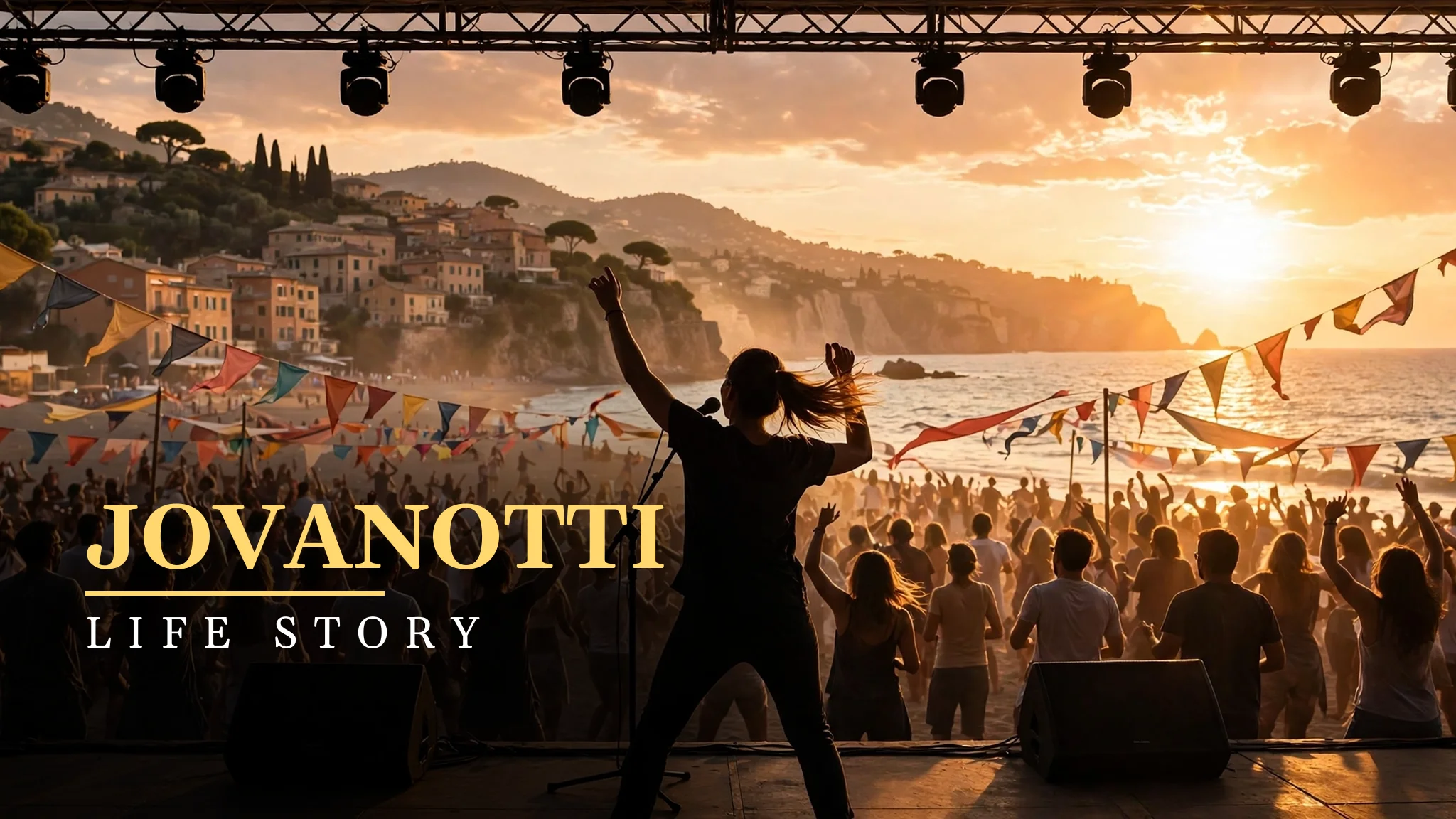
One more image stays with me about Jovanotti, and it is the beach at sunset, with the sea behind the stage, with colourful flags flying, and with thousands of people dancing in the sand, singing his songs, and smiling at each other. It is a simple image, and it is a beautiful one, because it shows what music can do when it is made with joy: it can bring people together, it can make them forget their worries, and it can remind them that life is good. I hope the Jova Beach Party continues for many years, because the world needs more moments like that, moments of joy, of dancing, and of being together, under the sun, by the sea, with music in the air.
Frequently Asked Questions
When was Jovanotti born and what is his real name?
Jovanotti was born on 27 September 1966 in Rome, Italy. His real name is Lorenzo Cherubini, and Jovanotti is his stage name, from the Italian word giovanotti, meaning young men.
What is A te about?
A te, To You, from the 2008 album Safari, is a love song about a man singing to the woman he loves, telling her she is the most important thing in his life. It is played at weddings and anniversaries all over Italy.
What was Jovanotti’s first hit?
His first single was È qui la festa? in 1987, and his first album, Jovanotti for President, came out in 1988 with the song Gimme Five. He first became famous as a DJ and rapper in the clubs of Rome.
What is the Jova Beach Party?
The Jova Beach Party is a series of concerts on the beaches of Italy, first held in 2019, where Jovanotti sings and the audience dances in the sand at sunset. The concerts also raise awareness about taking care of the beaches and the sea.
What is Serenata rap?
Serenata rap, Rap Serenade, from the 1994 album Lorenzo 1994, is a love song in which Jovanotti raps a serenade to a girl. It became one of the most loved Italian songs of the 1990s.
Where did Jovanotti grow up?
He was born in Rome but grew up in Cortona, a hill town in Tuscany, where his family moved when he was a boy. He has lived between Rome and Cortona ever since.


