Joy Division: The Life Story Behind the Post-Punk Legends
In this post
Joy Division are one of the most important and most tragic bands in British music history, even though they were only together for four years, from 1976 to 1980, and even though they released only two studio albums. They made music that was dark, cold, and beautiful, they wrote songs about loneliness, about love, and about despair, and they became legends, not only because of their music, but because of the death of their singer, Ian Curtis, at the age of twenty-three, which ended the band and made their music even more haunting.
Their story is about Ian Curtis, the singer with a deep, haunting voice and a gift for writing lyrics that were poetic, personal, and disturbing, about Bernard Sumner, the guitarist, about Peter Hook, the bass player, and about Stephen Morris, the drummer, three musicians who went on to form New Order after Curtis died. It is about four young men from Manchester who loved punk, who wanted to make music that was different, and who created a sound that is still influential today.
What makes their story worth telling is the music and the tragedy behind it. They made Unknown Pleasures, with its famous cover of white lines on a black background, they made Love Will Tear Us Apart, one of the greatest songs ever written, and they made Closer, an album released after Curtis died, which is now regarded as a masterpiece. This is the story of how Joy Division became legends, and why their music still matters.
The Sex Pistols concert at the Lesser Free Trade Hall in June 1976 was a turning point for Manchester music, because it inspired many young people in the audience, including members of Joy Division, the Smiths, and many other bands, to form groups of their own, and to believe that they could make music even if they were not trained musicians.
Four Young Men in Manchester After Punk
Ian Curtis was born on 15 July 1956 in Stretford, in Manchester, and he grew up in Macclesfield, a town in Cheshire, where he went to school and where he developed a love of music, literature, and poetry. He was a bright, sensitive boy who loved books, who wrote poems, and who felt different from other children, because he was thoughtful, because he loved art, and because he did not fit in with the ordinary life around him. He left school, he worked in dead-end jobs, he married young, and he dreamed of being in a band.
Bernard Sumner was born on 4 January 1956 in Salford, in Manchester, and he grew up loving music, learning to play the guitar, and becoming a talented, inventive musician. Peter Hook was born on 13 February 1956 in Salford, and he grew up loving music, learning to play the bass, and developing a style that was melodic, high, and unlike anyone else’s. Stephen Morris was born on 28 October 1957 in Macclesfield, and he grew up loving drums, playing in local bands, and becoming a precise, powerful drummer.
The four men met in Manchester in the mid-1970s, when punk rock was exploding in Britain, with bands like the Sex Pistols playing in Manchester in 1976, at the Lesser Free Trade Hall, a concert that inspired many young people in the city to form bands of their own. Sumner, Hook, and Curtis were at that concert, or were inspired by it, and they decided to form a band, first called Warsaw, after a song by David Bowie, and then called Joy Division, after a term from a novel about the Holocaust, a name that was controversial and that reflected the darkness of their music.
They rehearsed in Manchester, they played their first gigs in small clubs, and they began to build a following in the city, playing a fast, punk-influenced sound at first, and then developing a slower, darker, more atmospheric sound that would become their trademark. They were not a typical punk band. They were thoughtful, they were musical, and they were interested in making music that was serious, that was about real feelings, and that was different from anything else at the time.
Factory Records was also important because it gave Joy Division the freedom to make music without pressure to have a hit, and Tony Wilson, who ran the label, believed in art before profit, which meant that the band could take their time, experiment, and make albums that were true to their vision, even if they did not sell millions of copies at first.
Martin Hannett’s production was also crucial, because he used echo, space, and silence to create a sound that was cold and empty, like a factory at night, and that production became as much a part of Joy Division’s identity as Curtis’s voice or Hook’s bass.
Warsaw, Unknown Pleasures, and the Factory Sound
In 1978, Joy Division signed to Factory Records, an independent label in Manchester run by Tony Wilson, a television presenter who believed in the band and who gave them the freedom to make the music they wanted. Factory was a unique label, with a distinctive design, with artists like New Order, the Happy Mondays, and many others, and with a philosophy that put art before profit. Joy Division were at the heart of Factory, and their music became the sound of the label.
Their first album, Unknown Pleasures, was released in June 1979, produced by Martin Hannett, a producer who gave the band a cold, spacious, and atmospheric sound, with echo, with space, and with a sense of emptiness that matched Curtis’s lyrics. The album included the songs Disorder, Day of the Lords, New Dawn Fades, and She’s Lost Control, and it had a famous cover, designed by Peter Saville, with white lines on a black background, representing radio waves from a pulsar, which became one of the most famous album covers in history.
Unknown Pleasures was praised by critics, it reached the top ten on the indie charts, and it made Joy Division one of the most talked-about bands in Britain, even though they were not yet famous in the mainstream. They toured the album, they played in Britain and in Europe, and they built a loyal fan base of young people who loved their dark, intense music, and who felt that the band spoke directly to them, about loneliness, about despair, and about the feeling of being lost in a modern city.
The band’s live shows were intense, with Curtis dancing in a strange, jerky way, with his arms flailing, and with the band playing loud, driving music that made the crowd feel the songs in their bodies. Curtis’s dancing was partly a result of his epilepsy, a condition he had developed as a teenager, and which caused him to have seizures on stage, a frightening experience for him and for his bandmates, and one that made their live shows both exciting and disturbing. He was a charismatic frontman, but he was also a young man struggling with a serious illness.
The song’s bass line, played by Peter Hook high on the neck of his bass, became one of the most recognisable in rock music, and it showed how Hook’s melodic style gave Joy Division a sound that was different from other post-punk bands, with the bass carrying the melody while the guitar played atmospheric, spare parts around it.
Love Will Tear Us Apart and the Hit That Came Too Late
In 1980, Joy Division released Love Will Tear Us Apart, a song that became their most famous, and one of the greatest songs ever written. The song was about Curtis’s failing marriage, about love that was breaking apart, and about the pain of trying to hold on to something that was already gone, with a beautiful melody, with a driving bass line, and with Curtis singing in a voice that was both tender and desperate. The song reached the top twenty in the UK, and it is still played today, still sung by fans, and still regarded as a masterpiece.
The song was released in June 1980, just weeks after Curtis died, and its success was therefore bittersweet, because the band’s biggest hit came after their singer was gone. It was a song about a marriage falling apart, and it was written by a man whose own marriage was falling apart, and whose life was falling apart, and that honesty is part of why the song is so powerful. It is a song that speaks to anyone who has loved someone and lost them, and it is a song that will never be forgotten.
Joy Division’s second album, Closer, was released in July 1980, two months after Curtis died, and it is now regarded as a masterpiece, with songs like Atrocity Exhibition, Isolation, Heart and Soul, and Decades, and with a sound that was even darker, colder, and more beautiful than Unknown Pleasures. The album was recorded in early 1980, when Curtis was already struggling, and it has a sense of finality, of a band making its last statement, and of a singer saying goodbye, even if he did not know it at the time.
The album reached the top ten in the UK, it was praised by critics, and it is still loved by fans today, as a record that captures a band at the peak of its powers, making music that was both personal and universal, both dark and beautiful. It is a sad album, but it is also a great album, and it is a testament to the talent of all four members, and to the vision of Martin Hannett, who produced it with care and with imagination.
Curtis also kept notebooks full of lyrics, poems, and ideas, and those notebooks show a young man who was thoughtful, well-read, and deeply concerned with the world around him, and who used writing as a way to make sense of his feelings, even when those feelings were painful and difficult to express.
Ian Curtis, Epilepsy, and a Life Falling Apart
Ian Curtis was a talented, sensitive, and troubled young man, who struggled with epilepsy, with depression, and with the pressure of being in a band, of being a husband, and of being a father to a young daughter. He had his first epileptic seizure as a teenager, and the condition got worse as he got older, with seizures happening on stage, in the studio, and at home, and with medication that made him tired, depressed, and unable to concentrate. He was also struggling with his marriage to Deborah Curtis, whom he had married when he was nineteen, and with a relationship with another woman, which made him feel guilty and torn.
Curtis wrote lyrics that were poetic, personal, and disturbing, about loneliness, about despair, about feeling trapped, and about wanting to escape, and those lyrics are now seen as a window into his mind, a cry for help from a young man who was in pain. He read books by Kafka, by Dostoevsky, and by other writers who wrote about alienation and despair, and he used their ideas in his songs, creating lyrics that were both literary and deeply personal. He was a gifted writer, and his songs are still studied today for their poetry and their honesty.
On 18 May 1980, the night before Joy Division were due to fly to America for their first tour there, Curtis died by suicide at his home in Macclesfield, at the age of twenty-three. His death shocked the band, his family, and his fans, and it ended Joy Division, because the remaining members decided that they could not continue without him. It was a tragedy, and it was a loss that is still felt today, almost forty-five years later, by people who loved his music and who wish that he had lived longer.
Curtis’s death is a sad part of Joy Division’s story, and it should be remembered with care and with respect, not as a romantic legend, but as a real tragedy, a young man who was ill, who was depressed, and who did not get the help he needed. His bandmates, his family, and his friends have all spoken about how they wish they had understood more, how they wish they had helped more, and how his death changed their lives forever. It is a reminder that mental illness is real, that epilepsy is real, and that people who are struggling need support, not silence.
New Order’s Blue Monday also showed how the remaining members could take the lessons they learned in Joy Division, about rhythm, about space, and about atmosphere, and turn them into dance music, creating a sound that was both new and familiar, and that became hugely influential in the 1980s.
New Order, Closer, and What Came After
After Curtis died, the remaining members of Joy Division, Bernard Sumner, Peter Hook, and Stephen Morris, decided to form a new band, called New Order, with Sumner taking over as singer, and with Gillian Gilbert joining on keyboards. New Order became one of the most successful bands of the 1980s, with songs like Blue Monday, which became the best-selling twelve-inch single of all time, and with albums that mixed rock, dance, and electronic music. They were a different band from Joy Division, brighter, more danceable, and more optimistic, but they carried the legacy of Joy Division with them, and they never forgot Curtis.
New Order’s success showed that Sumner, Hook, and Morris were talented musicians in their own right, and that they could make great music without Curtis, even though they missed him and even though their new band was very different. Hook later left New Order, and he formed his own band, Peter Hook and the Light, playing Joy Division songs live, and keeping the band’s music alive for new generations. Sumner and Morris continued with New Order, releasing albums and touring, and becoming one of the most respected bands in British music.
Joy Division’s music, meanwhile, continued to grow in popularity, with new fans discovering Unknown Pleasures and Closer, with Love Will Tear Us Apart becoming a classic, and with the band’s influence spreading to many other bands, from U2 to the Cure to Interpol to many indie bands today. Their cover of Unknown Pleasures, with its white lines on black, became an iconic image, worn on t-shirts, posters, and tattoos around the world, even by people who had never heard the album. They became legends, not only for their music, but for their image, their story, and their tragedy.
The band’s story has also been told in films, in books, and in documentaries, including the film Control in 2007, directed by Anton Corbijn, which told the story of Ian Curtis’s life, and which was praised for its sensitive, black-and-white portrayal of a young man struggling with illness and with fame. The film introduced Joy Division to a new generation, and it reminded people that behind the legend was a real person, a husband, a father, and a young man who was in pain.
Their music has also been used in films, in television, and in advertisements, introducing their songs to new audiences, and Love Will Tear Us Apart has become a song that is known even by people who have never bought a Joy Division album, which shows how deeply their music has entered popular culture.
Their two albums are also studied in music schools, with teachers using Unknown Pleasures and Closer to talk about production, about songwriting, and about how a band can create a distinctive sound with simple instruments, played with care and with imagination.
What Joy Division Leave Behind
Joy Division left behind a body of music that is still loved today, with only two studio albums, Unknown Pleasures and Closer, both regarded as masterpieces, and with songs like Love Will Tear Us Apart, Disorder, Transmission, and Atmosphere still played on the radio, still sung by fans, and still loved by new generations. They never had a number one single, they never played stadiums, and they were only together for four years, but their influence is enormous, and their music is still regarded as some of the most important ever made in Britain.
Their legacy is also about honesty and about darkness. They sang about loneliness, about despair, about love falling apart, and about feeling trapped, and they did it with poetry, with beauty, and with a sound that was cold, spacious, and haunting. They showed that rock music could be serious, that it could be about real feelings, and that it could be art, even when it was dark. That is a powerful legacy, and it is why their fans still love them, almost forty-five years after Curtis died.
For young musicians, Joy Division are an example of what is possible if you are talented, if you work hard, and if you believe in your own ideas. They started in Manchester, they made music in a rehearsal room, they signed to an independent label, and they became legends. They did it with talent, with hard work, and with a love of music. They also did it with courage, with honesty, and with a willingness to be different. They were not perfect, and their story is tragic, but their music remains, and it will remain for as long as people listen to rock music.
They also showed that a band from Manchester, from a grey industrial city, can make music that speaks to the whole world, that a song about loneliness in Macclesfield can be loved in America, in Japan, and everywhere else, because loneliness is universal.
Their rehearsals in Manchester were also a time of learning how to play together, how Curtis would bring lyrics, Sumner would bring guitar parts, Hook would bring bass lines, and Morris would bring drums, and how those four parts would fit together to create a sound that was greater than any one of them alone.
They also learned how to deal with the press, with fans, and with the music business, because their success brought attention that was not always friendly, and they had to be smart, careful, and true to themselves in order to survive it.
Their early gigs in Manchester were also important, because they taught Joy Division how to play to a small crowd, how to win over people who had never heard them before, and how to build a following one gig at a time.
My Take:
When I think about Joy Division, the first thing I think about is sadness. Their music is sad, it is dark, and it is beautiful, and it makes me feel the pain that Ian Curtis felt when he wrote it. When I hear Love Will Tear Us Apart, I hear a song about a marriage falling apart, about love that is breaking, and about the feeling that nothing can save it. That is a sad song, but it is also a beautiful song, and it is one of the greatest songs ever written. I think their sadness is the reason their music has lasted, because sadness is a feeling that everyone has felt, and their music gives it a voice.
I admire Ian Curtis most of all, because he was a gifted writer, a charismatic singer, and a young man who was in pain. He wrote lyrics that were poetic, personal, and disturbing, about loneliness, about despair, and about feeling trapped, and he did it with an honesty that is rare in pop music. He was only twenty-three when he died, and he had already written songs that will be remembered forever. I think that is a remarkable achievement, and it is also a tragedy, because he had so much more to give, and he did not get the chance to give it.
I also think about Bernard Sumner, Peter Hook, and Stephen Morris, because they were talented musicians who made great music with Curtis, and who went on to make great music as New Order after he died. They were friends, they were bandmates, and they lost a friend in the most terrible way. I respect them for continuing, for forming New Order, and for keeping music alive, even after such a loss. That takes courage, and it takes strength, and I admire them for it.
I think about their Manchester roots, too, because Manchester is a city that has produced so many great bands, from Joy Division to the Smiths to Oasis, and Joy Division are at the heart of that history. They wrote about Manchester, about its grey skies, its industrial streets, and its people, and they did it with a sense of place that made their songs feel real. They were not trying to be Londoners. They were Manchester lads, and they were proud of it, and that pride came through in their music.
There is a part of their story that I find very sad, and that is Curtis’s epilepsy and his depression. He had seizures on stage, he was tired from his medication, and he was struggling with his marriage and with his life. He did not get the help he needed, and he died by suicide, which is a tragedy that should not be romanticised. I think it is important to talk about mental illness honestly, and to say that people who are struggling need support, need understanding, and need help. Curtis’s death is a reminder of that, and it is a lesson that we should all remember.
I also think about their music, because it is so distinctive. Peter Hook’s bass playing is high, melodic, and unlike anyone else’s, Stephen Morris’s drumming is precise and powerful, Bernard Sumner’s guitar is atmospheric and spare, and Curtis’s voice is deep, haunting, and full of feeling. Together, they made a sound that was cold, spacious, and beautiful, a sound that has influenced many bands, from U2 to Interpol to many indie bands today. I think their sound is one of the most original in rock history, and it is why their music still sounds fresh today.
If I have a criticism, it is that Joy Division’s music can be hard to listen to, especially for people who are not used to dark, intense music. Their songs are slow, they are sad, and they are not easy to sing along to, and some people may find them depressing. I understand that. Their music is not for everyone, and it is not meant to be. It is for people who feel lonely, who feel different, and who need a song that understands them. I think that is a strength, not a weakness, but I also think it is fair to say that their music is not light or easy.
Another thing I think about is how their music has lasted. Unknown Pleasures was released in 1979, more than forty-five years ago, and it is still regarded as one of the greatest albums ever made. It is still played, still discussed, and still loved by people who were not born when it was made. That is a rare thing. Most music fades after a few years. Joy Division’s music does not fade. It stays, because the songs are well written, because the playing is superb, and because the feelings in them are true.
I think about their influence, too. They changed the way post-punk bands sounded, the way bass guitar was played, and the way lyrics were written. They showed that a band could be dark, could be serious, and could be popular, all at the same time. Many bands that came after them learned from them, and many still do. They opened a door, and many other artists walked through it. That is a legacy that goes beyond their own songs.
For a young reader, I think the lesson from Joy Division is about being yourself, even when you feel different, and about turning your feelings into art. Curtis wrote about his loneliness, his despair, and his pain, and he turned those feelings into songs that have helped millions of people feel less alone. That is a powerful thing to do, and it is a hopeful message for anyone who feels lonely. You are not alone, and your feelings matter, and you can turn them into something beautiful.
I also think their story teaches something about the importance of getting help when you are struggling. Curtis was ill, he was depressed, and he did not get the help he needed, and he died. That is a tragedy, and it is a reminder that we should talk about mental health, that we should support each other, and that we should not be afraid to ask for help. If you are struggling, please talk to someone, please get help, and please know that you are not alone. That is a lesson that Joy Division’s story teaches me, and it is one I will always remember.
In the end, I think Joy Division will be remembered as one of the greatest bands ever, not only because they made great albums, but because they gave a voice to loneliness, because they wrote beautiful songs, and because their music still makes people feel less alone. They were four young men from Manchester who became legends, and they became legends because they were talented, because they worked hard, and because they made music that spoke to people. I love their music, I respect their story, and I will keep listening to them for as long as I can.
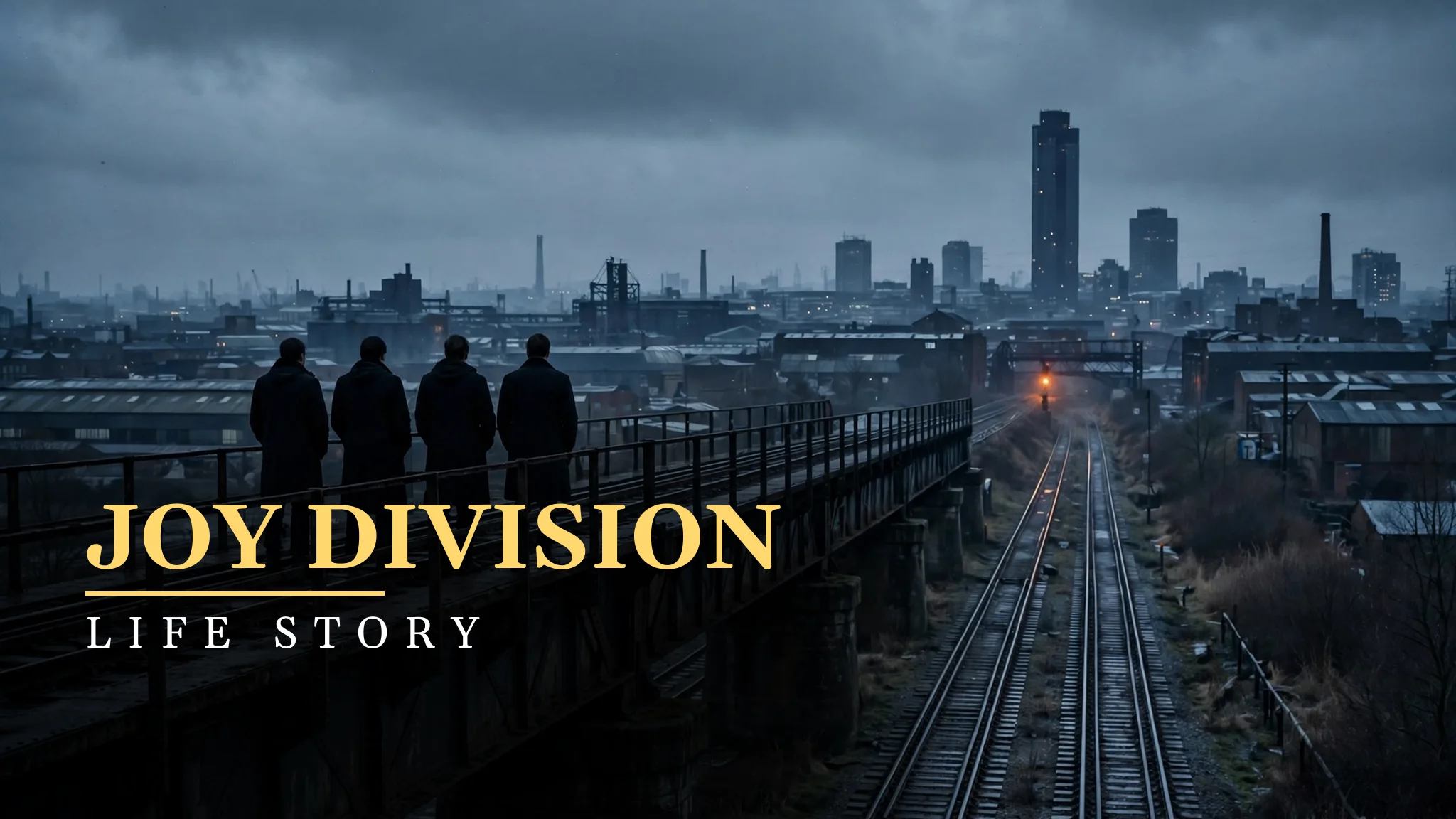
One more thought stays with me. When I think about Joy Division, I think about the image of four men in dark coats standing on a railway bridge, looking out over a grey industrial city, and I think about how that image captures their music: grey, cold, and industrial, but also beautiful and full of hope. Their music is like that city, grey on the surface, but with a light underneath, and it is still there, still shining, still loved. I think that is a beautiful image, and it is one I will always remember.
I also think about the film Control, because it told Curtis’s story with sensitivity and with care, in black and white, and it introduced Joy Division to a new generation. The film showed Curtis as a real person, a husband, a father, and a young man who was in pain, not just as a legend, and that is important, because it reminds us that behind every great band is a real person, with real feelings, and real struggles.
I think about the future, too. Joy Division will never play together again, because Curtis has died, but their music will remain, their albums will remain, and their songs will be remembered. They have left a legacy that will last for generations, and they have shown that music can be dark, can be beautiful, and can be important. I am grateful that I have been able to hear their music, and I am grateful that they made it.
Finally, I want to say that Joy Division teach me something about the power of music to help people who feel alone. Their songs are about loneliness, but they also make lonely people feel less alone, because they show that someone else has felt the same way, and that is a kind of comfort that only music can provide. That is a gift, and it is one that I will always treasure.
I also think about Peter Hook’s bass playing, because it is so distinctive, high, melodic, and full of feeling, and it gives Joy Division a sound that no other band has, with the bass carrying the song while the guitar and drums create space around it, which is a reversal of the usual roles in a rock band, and a sign of their originality.
I think about Stephen Morris’s drumming, too, because it is precise, powerful, and full of drive, with a metronomic quality that gives the band its relentless, machine-like feel, and his playing is a major part of why their music sounds so cold, so industrial, and so haunting.
I think about the way their songs are used by other artists, with bands covering Love Will Tear Us Apart, Disorder, and Transmission, and how those covers show that their songs are strong enough to work in many different styles, and that their melodies and lyrics are timeless.
I also think about the way their music sounds on a cold, grey day, when the sky is dark and the rain is falling, and how a Joy Division song can make that day feel a little less lonely, because it puts words to feelings that are hard to express, and it shows that someone else has felt the same way.
I think about the importance of talking about mental health, because Curtis’s story shows what can happen when a young man is struggling and does not get enough help, and I hope that his story encourages people to talk, to listen, and to support each other, especially when someone is in pain.
I think about the way New Order kept Curtis’s memory alive, by playing Joy Division songs in their early shows, by talking about him in interviews, and by never forgetting the friend they lost, which is a tribute that is both sad and beautiful, and a sign of how much he meant to them.
I also think about how their music helps people who feel different, because it does not tell them to be happy, but instead tells them that it is okay to feel sad, that sadness is a real feeling, and that it can be turned into something beautiful, which is a comforting message for anyone who has ever felt alone.
Finally, I want to say that Joy Division remind me that music can be a lifeline, that a song can reach a person who feels lost, and that it can make them feel understood, even when no one else does, and that is a gift that is worth more than any record sale or any award.
That lifeline, that feeling of being understood, is why I will keep listening to Joy Division, and why I believe their songs will still be there for lonely people, for outsiders, and for anyone who needs a song that understands them, for many years to come.
I will keep playing their records on grey days, on lonely days, and on days when I need a song that understands me, because Joy Division have always been there for me, and for millions of others like me.
Frequently Asked Questions
How did Joy Division form in Manchester?
Joy Division formed in Manchester in 1976, after Bernard Sumner, Peter Hook, and Ian Curtis were inspired by a Sex Pistols concert, first calling themselves Warsaw, then Joy Division, and signing to Factory Records in 1978.
What is Unknown Pleasures and why is its cover so famous?
Unknown Pleasures, released in June 1979, is their debut album, produced by Martin Hannett, with a cover by Peter Saville showing white lines on black representing radio waves from a pulsar, now one of the most famous album covers ever.
What is Love Will Tear Us Apart about?
Love Will Tear Us Apart, released in June 1980, is about Curtis’s failing marriage and love breaking apart, with a beautiful melody and a driving bass line, and it became their most famous song, released just weeks after Curtis died.
What happened to Ian Curtis?
Ian Curtis struggled with epilepsy and depression, had seizures on stage and at home, and died by suicide on 18 May 1980 at twenty-three, the night before Joy Division were due to fly to America, ending the band.
What did the other members do after Curtis died?
Bernard Sumner, Peter Hook, and Stephen Morris formed New Order, with Sumner as singer and Gillian Gilbert on keyboards, becoming one of the most successful bands of the 1980s with Blue Monday and many other hits.
What is Closer and when was it released?
Closer, released in July 1980 two months after Curtis died, is their second album, with Atrocity Exhibition, Isolation, and Decades, regarded as a masterpiece and a final statement from a band at its peak.
How many albums did Joy Division release?
They released only two studio albums, Unknown Pleasures in 1979 and Closer in 1980, but both are regarded as classics, and their influence on post-punk and indie music is enormous.


