The Smiths: The Life Story Behind the Indie Legends
In this post
The Smiths are one of the most loved and most influential British bands of all time, even though they were only together for five years, from 1982 to 1987, and even though they never had a number one single. They made music that was clever, funny, sad, and beautiful, they wrote songs about being young, about being different, about love, and about Manchester, and they became a band that meant everything to their fans, who still love them today, almost forty years after they broke up.
Their story is about Morrissey, the singer with a distinctive voice and a gift for words, and Johnny Marr, the guitarist with a gift for melody, and about Andy Rourke on bass and Mike Joyce on drums, the other two members who gave the band its rhythm and its drive. It is about four young men from Manchester who met, who made music together, who became famous, and who fell apart, because Morrissey and Marr, the two creative forces, could no longer work together.
What makes their story worth telling is the music and the words. They made This Charming Man, How Soon Is Now?, There Is a Light That Never Goes Out, and The Queen Is Dead, songs that are still loved today, and they made albums that are still regarded as classics. They were not a typical rock band. They were a band for outsiders, for bookish teenagers, for people who felt different, and they gave those people a voice. This is the story of how The Smiths became legends, and why their music still matters.
Morrissey’s early life also shaped his writing, because he grew up in a house full of books, with a mother who loved music and a father who worked in a hospital, and he spent hours in the library, reading poetry and novels, which gave him a vocabulary and a way of seeing the world that was different from other teenagers in Manchester.
Morrissey and Marr Meet in Manchester
Steven Patrick Morrissey was born on 22 May 1959 in Davyhulme, in Manchester, and he grew up in Stretford, a working-class area of the city, in an Irish Catholic family. He was a shy, bookish boy who loved music, literature, and film, and who felt different from other children, because he was sensitive, because he loved poetry, and because he did not fit in with the tough, football-loving culture around him. He left school, he worked in dead-end jobs, he wrote letters to music papers, and he dreamed of being a singer, even though he had no band and no clear plan.
Johnny Marr was born John Martin Maher on 31 October 1963 in Ardwick, in Manchester, also in an Irish Catholic family, and he grew up loving the guitar, learning to play by listening to records, and becoming a talented, inventive guitarist while still a teenager. He played in local bands, he was known in Manchester as a promising young musician, and he was looking for a singer and a songwriter to work with, someone who could match his musical talent with words that were just as good.
In 1982, Marr knocked on Morrissey’s door in Stretford, after hearing that Morrissey was a singer looking for a band, and he asked him if he wanted to form a group together. Morrissey said yes, and the two of them began to write songs together, with Marr writing the music and Morrissey writing the lyrics, in a partnership that would become one of the greatest in British music. They were very different people: Morrissey was shy, intense, and literary, while Marr was confident, musical, and driven, but together, they made something special.
They recruited Andy Rourke, a bass player who was a friend of Marr’s from school, and Mike Joyce, a drummer from Manchester, and they called themselves The Smiths, a simple, ordinary name that was deliberately plain, in contrast to the glamorous names of other bands at the time. They rehearsed in Manchester, they played their first gig in October 1982, and they began to build a following in the city, playing in small clubs and making demo tapes that they sent to record labels and to radio DJs.
The band also became known for their distinctive look, with Morrissey wearing a hearing aid, carrying gladioli flowers on stage, and wearing simple clothes, which was a deliberate contrast to the glamorous, made-up look of many pop stars at the time, and which made them stand out as a band for ordinary people, not for celebrities.
Hand in Glove, This Charming Man, and the First Album
In 1983, The Smiths released their first single, Hand in Glove, on the independent label Rough Trade, and it became a hit on the indie charts, with its jangling guitar, its romantic lyrics, and Morrissey’s distinctive vocal. It was followed by This Charming Man, a bright, joyful song with a famous guitar riff, which reached the top twenty-five in the UK and became one of their best-loved songs. The band were becoming known, not only in Manchester, but across Britain, as a new kind of indie band, with clever lyrics, with beautiful melodies, and with a singer who was unlike anyone else.
Their debut album, The Smiths, was released in February 1984, and it reached number two in the UK, with songs like Reel Around the Fountain, What Difference Does It Make?, and This Charming Man. The album was praised by critics, and it showed a band that was already confident and distinctive, with Marr’s guitar playing at the centre, and Morrissey’s lyrics about love, about loneliness, and about being young. They toured the album, they appeared on television, and they built a loyal fan base of young people who felt that the band spoke directly to them.
The Smiths were different from other bands of the time, because they did not look like rock stars, they did not act like rock stars, and they did not make music that sounded like anyone else. Morrissey wore a hearing aid on stage, he carried flowers, he wore a National Health Service pair of glasses, and he sang about being shy, about being lonely, and about being different. Marr played guitar with a style that was melodic, fast, and full of invention, and the band’s rhythm section gave the songs a drive and a danceability that made them work in clubs as well as on the radio.
Their early success brought them attention from the press, from fans, and from other musicians, and they became one of the most talked-about bands in Britain. They were on the cover of music papers, they were interviewed on television, and they were loved by a generation of young people who saw themselves in Morrissey’s lyrics. They were not a band for everyone, but for their fans, they were the most important band in the world.
The recording of The Queen Is Dead was also a time of intense creativity, with Marr writing music quickly, Morrissey writing lyrics in his notebooks, and the band working in the studio to capture a sound that was both polished and raw, with songs that were recorded live and with a sense of urgency that comes through in the finished album.
The band’s touring in America also introduced them to a new audience, with fans in the United States loving their jangling guitars and Morrissey’s lyrics, even though they were very British in their references, and that international following showed that their music could cross borders, even when it was about Manchester life.
Meat Is Murder, The Queen Is Dead, and the Peak
In 1985, The Smiths released their second album, Meat Is Murder, which reached number one in the UK, and which included the songs How Soon Is Now?, a long, atmospheric song with a famous tremolo guitar effect, and The Headmaster Ritual, a song about school and about cruelty. The album was more political than their debut, with songs about vegetarianism, about animal rights, and about corporal punishment in schools, and it showed Morrissey’s growing confidence as a lyricist, writing about subjects that other pop singers avoided.
In 1986, they released their third album, The Queen Is Dead, which is now regarded as one of the greatest albums ever made, not only by The Smiths, but by any British band. The album included the songs The Queen Is Dead, Bigmouth Strikes Again, There Is a Light That Never Goes Out, and The Boy with the Thorn in His Side, and it was a perfect mix of humour, anger, sadness, and beauty. It was praised by critics, it reached number two in the UK, and it is still loved by fans today, as a record that captures a band at the peak of its powers.
The Queen Is Dead was followed by the album Strangeways, Here We Come in 1987, which included the songs Girlfriend in a Coma, Last Night I Dreamt That Somebody Loved Me, and I Started Something I Couldn’t Finish, and which was recorded while the band were falling apart. The album was a success, but it was also a sad record, because it was clear that the band were coming to an end, and that Morrissey and Marr could no longer work together. It was their last album, and it is still regarded as a classic, even though it was made in difficult circumstances.
The mid-1980s were the peak years for The Smiths. They were touring the world, playing in Britain, in America, and in Europe, and they were known as one of the best live bands of their time, with Morrissey as a charismatic, unpredictable frontman, and Marr as a brilliant guitarist. They had a loyal fan base, they had critical acclaim, and they had a string of hit singles and albums, but they were also under strain, with arguments about money, about direction, and about the future of the band.
Morrissey’s lyrics also drew on his love of literature, quoting Oscar Wilde, referencing the writer Shelagh Delaney, and using lines from films and books, which gave his songs a depth that rewarded listeners who recognised the references, and which made his writing feel like a conversation with other artists across time.
How Soon Is Now and the Sound of the Smiths
How Soon Is Now? is one of The Smiths’ most famous songs, and it is a good example of their sound: Marr’s guitar, with its tremolo effect, creates a shimmering, hypnotic atmosphere, while Morrissey sings about being shy, about being lonely, and about not knowing how to talk to people. The song was originally a B-side, but it became one of their best-loved tracks, and it has been used in films and television, introducing the band to new audiences who may never have heard their albums.
The Smiths’ sound was distinctive, because Marr played guitar in a way that was melodic, fast, and full of arpeggios, rather than playing simple chords or loud riffs, and because Morrissey sang in a voice that was clear, expressive, and full of character. Rourke’s bass playing was also melodic and inventive, and Joyce’s drumming was solid and danceable, giving the songs a rhythm that made them work in clubs. Together, they made music that was both intelligent and danceable, both sad and joyful, and that combination is why their songs have lasted.
Their lyrics were also distinctive, because Morrissey wrote about subjects that other pop singers avoided, about being shy, about being gay, about being lonely, about hating school, about loving books, and about feeling like an outsider. He wrote with humour, with anger, and with poetry, and his words made young people who felt different feel less alone. He quoted Oscar Wilde, he referenced films and books, and he made pop music feel like literature, which was a new thing in the 1980s, and which is why his lyrics are still studied today.
The Smiths’ influence can be heard in many bands that came after them, from the Stone Roses to Oasis to the Arctic Monkeys, and from Radiohead to many indie bands today. They showed that a band could be clever, could be literary, and could be popular, all at the same time, and that a singer could be shy, could be different, and could still be a star. That is a legacy that goes beyond their own songs, and it is why they are regarded as one of the most important British bands ever.
After the break-up, Marr’s work as a guitarist also showed his range, playing with many different bands, from the Pretenders to Modest Mouse, and proving that he was not only a Smiths guitarist, but a musician who could adapt to many styles and still make music that was unmistakably his own.
The Break-Up in 1987 and the Aftermath
In 1987, The Smiths broke up, after only five years together, when Johnny Marr left the band, saying that he was exhausted, that he was unhappy with the band’s direction, and that he could no longer work with Morrissey. The break-up was sudden, and it shocked their fans, who had loved the band and who had hoped that they would continue for many years. Morrissey and Marr, the two creative forces, had fallen out, and the band could not continue without both of them.
After the break-up, Morrissey became a successful solo artist, releasing albums like Viva Hate in 1988, with the hit single Everyday Is Like Sunday, and continuing to make music, to tour, and to write songs that were loved by his fans. Marr became a sought-after guitarist, playing with bands like the Pretenders, the The, and Modest Mouse, and later releasing solo albums of his own, and becoming known as one of the greatest guitarists in British music. Rourke and Joyce also worked as musicians, and Joyce later took Morrissey and Marr to court over royalties, a case that was widely reported and that damaged the relationship between the former band members.
The Smiths have never reunited, despite many offers and many rumours, and Morrissey and Marr have both said, at different times, that a reunion is unlikely, because their relationship is too damaged, and because they have moved on with their solo careers. Fans still hope for a reunion, but it seems unlikely, and the band’s legacy remains in their four studio albums, their singles, and their live recordings, which are still loved today.
The break-up was sad, because The Smiths were a great band, and they could have made more great music together, but it was also understandable, because Morrissey and Marr were both strong-willed, creative people, who wanted different things, and who could no longer work together. Their story is a reminder that even the greatest partnerships can end, and that sometimes, it is better to stop than to continue making music that is not true to yourself.
Their songs have also been covered by many other artists, from bands to solo singers, who have taken Smiths songs and made them their own, which is a sign of how strong the songwriting is, and how the melodies and lyrics can work in many different styles and still sound beautiful.
Their influence can also be heard in the way modern indie bands write lyrics, with many young songwriters citing Morrissey as an influence, and trying to write songs that are clever, funny, and sad at the same time, which is a difficult balance that Morrissey mastered better than almost anyone else.
What The Smiths Leave Behind
The Smiths left behind a body of music that is still loved today, with four studio albums, The Smiths, Meat Is Murder, The Queen Is Dead, and Strangeways, Here We Come, all regarded as classics, and with songs like This Charming Man, How Soon Is Now?, There Is a Light That Never Goes Out, and The Queen Is Dead still played on the radio, still sung by fans, and still loved by new generations. They never had a number one single, but they had a loyal fan base, critical acclaim, and an influence that is still felt today.
Their legacy is also about giving a voice to outsiders. They sang about being shy, about being different, about being lonely, and about being young, and they did it with humour, with poetry, and with beauty. They showed that pop music could be intelligent, that it could be literary, and that it could speak to people who felt that they did not fit in. That is a powerful legacy, and it is why their fans still love them, almost forty years after they broke up.
For young musicians, The Smiths are an example of what is possible if you are talented, if you work hard, and if you believe in your own ideas. They started in Manchester, they made music in a rehearsal room, they got a record deal with an independent label, and they became legends. They did it with talent, with hard work, and with a love of music. They also did it with humour, with style, and with a gift for words. They were not perfect, and their story has sad parts, but their music remains, and it will remain for as long as people listen to British pop.
They also showed that a band can be successful on an independent label, that it does not need a major record company to make great music, and that fans will find good music even if it is not on the radio every day.
The band’s first gigs in Manchester were also important, because they taught the Smiths how to play to a small crowd, how to win over people who had never heard them before, and how to build a following one gig at a time, which is a skill that many bands never learn.
They also learned how to deal with the press, with fans, and with the music business, because their success brought attention that was not always friendly, and they had to be smart, careful, and true to themselves in order to survive it.
Their rehearsals in Manchester were also a time of learning how to write together, how Morrissey would bring lyrics and Marr would bring music, and how the two would fit together like pieces of a puzzle, creating songs that were greater than the sum of their parts.
My Take:
When I think about The Smiths, the first thing I think about is Morrissey’s voice and his words. He sings about being shy, about being lonely, and about being different, and he does it with a voice that is clear, expressive, and full of feeling. When I hear There Is a Light That Never Goes Out, I hear a song about wanting to be with someone, about not wanting to go home, and about the feeling that love can save you from a lonely life. That is a beautiful song, and it is one of the reasons The Smiths have lasted so long.
I admire Johnny Marr most of all, because he is one of the greatest guitarists in British music. He plays with melody, with speed, and with invention, and his guitar parts are instantly recognisable, from This Charming Man to How Soon Is Now? to The Queen Is Dead. He was only a teenager when he formed the band, but he was already a brilliant musician, and he wrote music that was both clever and beautiful. I respect that kind of talent, because it takes more than luck to write a guitar part that people will remember for forty years.
I also think about Morrissey, because he is a complicated and controversial figure, and I have mixed feelings about him. I love his lyrics, I love his voice, and I love his early work with The Smiths, but I also find some of his later statements difficult, and I do not agree with everything he has said. I think it is possible to love an artist’s music and to disagree with the artist, and I think The Smiths’ music is great, even if Morrissey as a person is complicated. That is a hard thing to say, but I think it is honest.
I think about their Manchester roots, too, because Manchester is a city that has produced so many great bands, from Joy Division to the Smiths to Oasis, and The Smiths are proud of that history. They wrote about Manchester, about its streets, its rain, and its people, and they did it with a sense of place that made their songs feel real. They were not trying to be Londoners. They were Manchester lads, and they were proud of it, and that pride came through in their music.
There is a part of their story that I find sad, and that is their break-up after only five years. They were a great band, they could have made more great music together, and they fell apart because Morrissey and Marr could no longer work together. I wish they had found a way to stay together, or at least to end more kindly, but I understand that creative partnerships can be difficult, especially when both people are strong-willed and talented. Their break-up is a reminder that even the best bands can end too soon.
I also think about their fans, because Smiths fans are among the most loyal in music, and they have kept the band’s music alive for decades, buying the records, going to tribute concerts, and teaching their children the songs. They are a community of people who felt different, who felt like outsiders, and who found a voice in The Smiths. That is a powerful thing for a band to do, and it is why their music still matters. They gave outsiders a home, and that home is still there today.
If I have a criticism, it is that The Smiths’ music can sometimes feel a little too clever and a little too self-conscious, with lyrics that are full of references to books and films that not everyone will understand. I understand why Morrissey does it. He is a literary person, and he likes to show his knowledge. But as a listener, I sometimes want a song that is simple and direct, without a reference to Oscar Wilde or to a film I have never seen. I think their best songs are when the cleverness and the feeling work together, as they do in There Is a Light That Never Goes Out.
Another thing I think about is how their music has lasted. The Queen Is Dead was released in 1986, almost forty years ago, and it is still regarded as one of the greatest albums ever made. It is still played, still discussed, and still loved by people who were not born when it was made. That is a rare thing. Most music fades after a few years. The Smiths’ music does not fade. It stays, because the songs are well written, because the playing is superb, and because the feelings in them are true.
I think about their influence, too. They changed the way indie bands sounded, the way lyrics were written, and the way young people saw themselves. They showed that a band could be clever, could be literary, and could be popular, all at the same time. Many bands that came after them learned from them, from the Stone Roses to Oasis to the Arctic Monkeys, and many still do. They opened a door, and many other artists walked through it. That is a legacy that goes beyond their own songs.
For a young reader, I think the lesson from The Smiths is about being yourself, even when you feel different. Morrissey was shy, he was bookish, he loved poetry, and he did not fit in, but he turned that difference into art, and he found fans who felt the same way. That is a hopeful message for anyone who feels like an outsider. You do not have to fit in. You can be yourself, and you can find people who love you for it. The Smiths proved that, and their fans are proof of it today.
I also think their story teaches something about partnership. Morrissey and Marr were very different people, but together, they made something that neither of them could have made alone. Morrissey needed Marr’s music, and Marr needed Morrissey’s words, and together, they made magic. That is a lesson for anyone who works in a team. You do not have to be the same as the person you work with. You have to respect each other, listen to each other, and work together. That is how great things are made.
In the end, I think The Smiths will be remembered as one of the greatest British bands ever, not only because they made great albums, but because they gave a voice to outsiders, because they wrote beautiful songs, and because their music still makes people feel less alone. They were four young men from Manchester who became legends, and they became legends because they were talented, because they worked hard, and because they made music that spoke to people. I love their music, I respect their story, and I will keep listening to them for as long as I can.
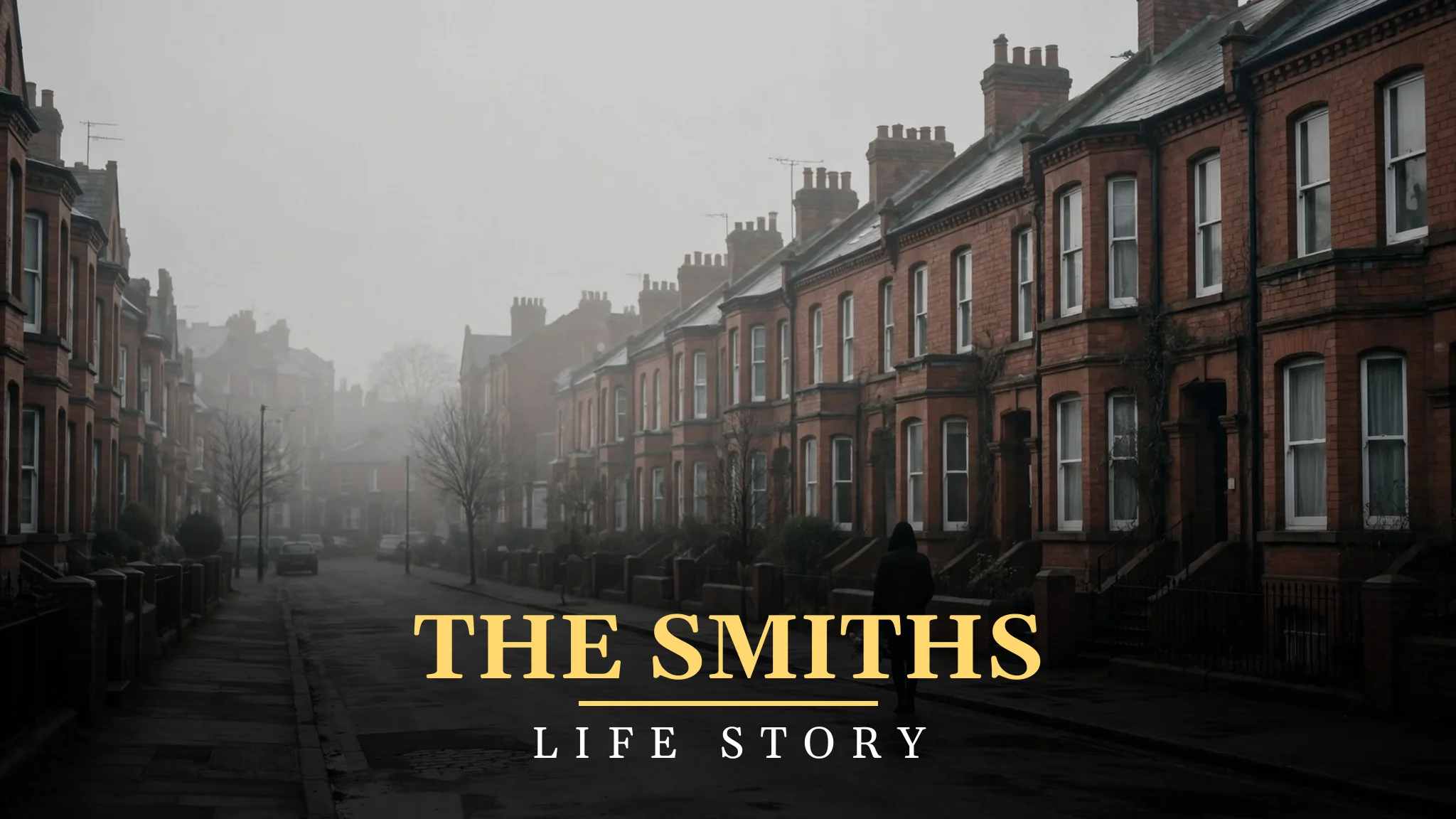
One more thought stays with me. When I think about The Smiths, I think about the image of a lone figure with flowers walking down a foggy Manchester street, and I think about how that image captures their music: lonely, beautiful, and full of hope. Their music is like that walk, quiet and thoughtful, but with flowers in hand, which is a sign of love and of beauty in a grey world. I think that is a beautiful image, and it is one I will always remember.
I also think about the way their songs are used in films and television, introducing their music to new audiences, and how songs like How Soon Is Now? have become part of popular culture in a way that few indie songs ever do. That is a sign of how timeless their music is, and how it continues to find new listeners, even decades after it was made.
I think about the future, too. The Smiths will probably never reunite, and that is sad, but their music will remain, their albums will remain, and their concerts will be remembered. They have left a legacy that will last for generations, and they have shown that indie music can be clever, can be beautiful, and can be important. I am grateful that I have been able to hear their music, and I am grateful that they made it.
Finally, I want to say that The Smiths teach me something about loneliness. Their songs are about feeling lonely, about feeling different, and about wanting to be loved, and they make those feelings sound beautiful, which is a kind of magic. They show that loneliness is not something to be ashamed of, and that it can be turned into art. That is a hopeful message for anyone who feels lonely, and it is one that I will always remember.
I also think about Andy Rourke, because his bass playing is a major part of the Smiths’ sound, with melodic lines that are as memorable as Marr’s guitar, and his death in 2023 was a sad loss for fans who loved his work, and a reminder that the band’s rhythm section deserves more credit than it often gets.
I think about Mike Joyce, too, because his drumming gave the Smiths their drive and their danceability, and his later court case over royalties showed how difficult it can be for band members to be treated fairly, even in a band that was loved by millions, and that is a sad part of their story that should be remembered honestly.
I think about the way their songs make me feel, especially on a grey Manchester day, when the rain is falling and the sky is dark, and how a Smiths song can make that grey day feel beautiful, because it puts words to feelings that are hard to express, and it makes loneliness feel a little less lonely.
I also think about the way Morrissey’s voice sounds on their records, clear and expressive, with a northern accent that he never tried to hide, and how that honesty about where he comes from is part of their appeal, because it shows that you can be yourself and still be loved all over the world.
I think about the Smiths’ fans in Manchester, who still walk the streets where Morrissey and Marr lived, who visit the places mentioned in their songs, and who keep the band’s memory alive in the city, which is a sign of how deeply their music is rooted in a place, and how that place has become part of their legend.
I think about the way their break-up still hurts fans, even after almost forty years, because they were a band that meant so much to so many people, and because their music was so personal, so honest, and so beautiful that it is hard to accept that it ended so soon, after only five years and four albums.
I also think about how their music helps me when I feel like an outsider, because it does not tell me to fit in, but instead tells me that being different is okay, and that there are other people who feel the same way, and that is a comforting message that I have carried with me for many years.
Finally, I want to say that The Smiths remind me that a short career can still be a great one, that five years and four albums can be enough to change music forever, if the music is good enough, honest enough, and beautiful enough to be remembered.
That short, brilliant career, five years that changed British music, is why I will keep listening to The Smiths, and why I believe their songs will still be loved by outsiders, by bookish teenagers, and by anyone who has ever felt different, for many years to come.
I will keep playing their records on grey days, on lonely days, and on days when I need a song that understands me, because The Smiths have always been there for me, and for millions of others like me.
Frequently Asked Questions
How did Morrissey and Johnny Marr meet in Manchester?
Johnny Marr knocked on Morrissey’s door in Stretford in 1982 after hearing he was a singer looking for a band, and they formed The Smiths together, with Marr writing music and Morrissey writing lyrics in a partnership that became legendary.
What was The Smiths’ first hit single?
Their first single was Hand in Glove in 1983 on Rough Trade, followed by This Charming Man, a bright song with a famous guitar riff that reached the top twenty-five and became one of their best-loved songs.
What is The Queen Is Dead and why is it so important?
The Queen Is Dead, released in 1986, is their third album, often called one of the greatest albums ever made, with There Is a Light That Never Goes Out, Bigmouth Strikes Again, and The Boy with the Thorn in His Side.
What is How Soon Is Now? about?
How Soon Is Now? is a long, atmospheric song about being shy, lonely, and not knowing how to talk to people, with Marr’s tremolo guitar creating a hypnotic sound, originally a B-side that became one of their most famous tracks.
Why did The Smiths break up in 1987?
Johnny Marr left in 1987, saying he was exhausted and unhappy with the band’s direction, and Morrissey and Marr could no longer work together, ending the band after only five years and four studio albums.
Did The Smiths ever reunite after breaking up?
No, despite many offers and rumours, Morrissey and Marr have never reunited as The Smiths, both pursuing solo careers, and a reunion seems unlikely because their relationship remains damaged.
How many albums did The Smiths release?
They released four studio albums: The Smiths in 1984, Meat Is Murder in 1985, The Queen Is Dead in 1986, and Strangeways, Here We Come in 1987, all regarded as classics of British indie music.


