Julien Clerc: The Life Story Behind France's Enduring Pop Voice
In this post
Julien Clerc has been singing in France for more than fifty years, and his voice is still one of the most loved in the country. He sang La Cavalerie when he was young, he sang Ma préférence when he was in love, and he sang Femmes je vous aime when he wanted to thank the women in his life, and each of those songs is still played today, in homes, in cars, and on the radio. He is a singer, a pianist, and a man of the stage, and he has kept his audience for half a century, because his songs are honest, warm, and full of heart.
He was born in Paris, he grew up in a house full of music, and he became famous in 1968, in a time when France was changing fast. He sang in the musical Hair, he recorded his first hits, and he became a star of French pop, with a voice that was clear, strong, and full of feeling. He did not chase fashion, and he did not change his style to please the moment. He sang his own songs, in his own way, and the audience came to him, year after year, decade after decade.
He is still alive, still singing, and still loved, and his story is one of a man who worked hard, who loved his audience, and who never stopped making music, even when the world around him changed. He has had a long career, a long love life, and a long list of songs that are part of the life of France, and that is a legacy that few singers ever earn.
A Boy from Paris with a Piano
Paul-Alain Leclerc was born in Paris on 4 October 1945, just after the Second World War had ended. His father was a worker in UNESCO, and his mother was a pianist, so music was in the house from the start. He grew up in a comfortable home, he went to school in Paris, and he learned to play the piano, to sing, and to listen to the songs of the day. He was a bright boy, but he did not like school, and he preferred to play music, to write songs, and to dream about a life on stage.
He heard the Beatles, he heard French chanson, and he began to play in small bands as a teenager, learning to sing, to play, and to perform in front of a crowd. He was tall, he was handsome, and he had a voice that was clear and strong, and people who heard him in small clubs said that he had a gift. He did not want to be a quiet singer. He wanted to be a star, with a piano, with a band, and with a crowd that sang along, and he worked towards that dream with a fierce determination.
He took the stage name Julien Clerc, a name that sounded French and elegant, and he began to sing in Paris, in cafes and in small halls, where his voice began to attract attention. He was not an overnight success, and he spent years learning his craft, playing piano, writing songs, and singing in the background. He watched other singers, he learned how they held a stage, and he kept writing, even when the first attempts failed, because he believed that a good song would find its audience in time.
He also studied, and he tried to live a normal life, but music pulled him away from his books, and he knew that he had to choose. He chose music, and he never looked back, because the piano was his home, and the stage was where he felt most alive. That choice, made when he was still a young man, shaped the rest of his life, and it gave France one of its most enduring voices.
La Cavalerie and the First Fame
In 1968, Julien Clerc recorded La Cavalerie, a song about a cavalry, about horses, and about a young man who dreams of adventure, and it became a huge hit in France. The song was bright, lively, and full of energy, and it made his name known all over the country. He sang it with a clear voice, with a piano, and with a band that played pop, and the audience loved it, because it was a song about youth, about freedom, and about the joy of being alive. It was a perfect first hit, because it showed his voice, his style, and his gift for writing about the feelings of young people.
He followed it with other songs, and he became a star of French pop, touring France, playing in large halls, and appearing on television. He was young, he was handsome, and he had a voice that could be tender and strong in the same song, and young people loved him, especially young women, who bought his records in large numbers. He was becoming a pop star, and he was enjoying it, but he was also working hard, because he knew that a first hit is not enough, and that a singer needs to keep writing, keep singing, and keep growing, if he wants to last.
He also sang in the French production of the musical Hair in 1969, a show about young people, about freedom, and about love, and his performance was praised. He played a young man who wanted a different life, and he sang with a passion that made the audience feel the spirit of the time. The show was a success, and it gave him a new kind of fame, as a singer who could act, and as an actor who could sing. He was a man of the stage, and he loved the theatre, because it was direct, because the audience was close, and because a mistake could not be hidden.
He recorded Ce n’est rien in 1971, a song about love that is nothing, and about the small things that make a relationship, and it became another hit. He was no longer a new star. He was a singer who had earned his place, and who was building a career that would last for decades, with songs that were honest, warm, and full of heart. He was a voice of his generation, and his generation was listening.
Ma préférence and the Songs of Love
In 1978, Julien Clerc recorded Ma préférence, a song about a woman who is his preference, his favourite, and his love, and it became one of his most loved songs. The song is tender, romantic, and full of feeling, and it is still played today, at weddings, at anniversaries, and on the radio, whenever people want to hear a song about love. He sang it with a soft voice, with a piano, and with a band that played with care, and the audience loved it, because it spoke about a love that is simple, honest, and true. It is a song that has become a classic of French pop.
He recorded Femmes je vous aime in 1982, a song about women, about loving them, thanking them, and admiring them, and it became another great hit. The song is warm, respectful, and full of love, and it showed that Clerc could write about women with a tenderness that was rare in pop music. He did not sing about women as objects. He sang about them as people, with strength, with beauty, and with a heart, and that respect made the song loved by women and by men alike. It is still one of his most famous songs, and it is still sung by audiences who know every word.
He also recorded Partir, a song about leaving, about the wish to go away and to see the world, and Si on chantait, a song about singing together, and each one showed his gift for writing about the feelings that everyone knows. He was a songwriter who understood the heart, and who could put its feelings into words that people recognised as their own. His songs were not grand, but they were true, and that truth is why they are still played today, long after the fashion of his time has gone.
He toured France, Europe, and other countries, and his concerts were full, with lights, with a band, and with a crowd that sang every word. He was a star, but he was also a man who worked hard, who rehearsed, and who gave his best every night. He did not take his fame for granted, and he did not treat his audience as if they were only fans. He treated them as friends, and he thanked them, night after night, for coming to hear him sing.
Love, Family, and a Life in Public
Julien Clerc’s personal life has been as full as his career, with loves that have shaped his songs and his life. He lived with the actress Miou-Miou, and they had a daughter, Jeanne, who was born in 1978, and who later became an actress herself. He loved Miou-Miou, and he wrote songs about her, but the relationship ended, as many young loves do, and he had to learn to live with that loss, and to sing about it with honesty. He was a father, and he tried to give Jeanne a normal life, even though he was famous, and he took her to school, played with her, and kept his home as quiet as he could.
He later married Hélène Grémillon, a writer, and they had a son, Léon, and he found a new kind of happiness, a quieter love, with a woman who understood his work and his need for privacy. He has spoken about his family with warmth, and he has said that being a father is the most important thing in his life, more important than any hit song or any concert. He is a man who values home, and his songs about family and about love come from that value, and they are among the best he ever wrote.
His relationships have been in the newspapers, and his life has been discussed in public, but he has kept his private life as private as he could, because he believes that a singer should be known for his songs, not for his personal life. He has not chased scandal, and he has not used his family to promote himself. He has simply lived, loved, and sung, and he has let his songs tell the story of his heart, in a way that is honest and that is respectful to the people he has loved.
He has also been a father to his children, and he has tried to be present, even when his work took him away. He has taken them on tour, he has played piano for them, and he has written songs for them, and those songs are among the most tender in his career. He is a man who loves deeply, even if he does not show it in a loud way, and his love for his family is the centre of his private life, even when his public life is full of noise.
Utile, the Later Years, and a Voice That Lasts
In 1992, Julien Clerc recorded Utile, an album that became a great success, with songs about being useful, about helping others, and about the value of a life well lived. The album showed that he had grown as an artist, and that he could write about serious subjects with a maturity that his early songs did not have. He was no longer only the young singer of La Cavalerie. He was a man who had lived, who had loved, and who had learned, and his songs reflected that learning, with a depth that his audience respected.
He continued to record in the 1990s and 2000s, and his albums sold well, but he was already a legend, and he did not need to chase hits. He toured France, he played in large halls, and he sang to audiences who had grown up with him and to young listeners who had discovered him through their parents. He was a star who had lasted for more than thirty years, and he had done it by working, by changing, and by respecting his audience, and that is a rare achievement in show business.
He has acted in films and on stage as well, taking roles that used his voice, his presence, and his charm, and he has shown that he can be an actor as well as a singer. He was not a singer who acted for fun. He was an artist who loved the stage, in all its forms, and who used it to tell stories, whether in a song or in a play. His work in the theatre, especially in Hair, showed that he had a gift for the stage, and that gift has stayed with him for his whole career.
He has also worked for charities, helping children, helping people who are sick, and speaking out for causes he believes in. He is a star who believes that fame should be used for something useful, and he has done so, giving money, giving time, and giving his voice to help others. He is not a loud campaigner, but he is steady, and people listen to him because they trust his sincerity, and because they know that his songs come from a kind heart.
Why Clerc Still Matters
Julien Clerc matters because he has been a voice in France for more than fifty years, and his songs are part of the life of the country. La Cavalerie, Ma préférence, Femmes je vous aime, and Utile are played in homes, in cars, and on the radio, and new singers still record them. He is a singer, a pianist, and a man of the stage, and he has kept his audience for half a century, because his songs are honest, warm, and full of heart. That is a legacy that few singers ever earn.
He also matters because he showed that a singer can grow older and still be loved, and that a voice can grow deeper and stronger with time. He did not try to stay young forever. He sang about growing older, about time passing, and about the changes that come with age, and his fans loved him for that honesty. He was a young star, he became a mature singer, and he is now an elder of French pop, and each stage of his life has given him new songs to sing, and new listeners to hear them.
His love story with his family also matters, because it shows that a long career can be balanced with a long love, and that a star can be a father, a husband, and a friend, as well as a singer. He has lived a full life, with love, with loss, and with music, and that fullness is in his songs, which are about the whole of life, not only about one part of it. He is a man who has lived, and his songs are the proof of that life.
A Voice That Has Sung for Fifty Years
Clerc has sung for more than fifty years, and his voice is still one of the most loved in France. He began as a young man with a piano, he became a star with La Cavalerie, and he is now a legend, with a catalogue of songs that are part of the French language. He did not do it by luck. He did it by work, by writing, by singing, and by respecting his audience, night after night, for half a century. That is a rare achievement, and it is one that deserves to be remembered.
His concerts are still filled with people of all ages, his records are still sold, and his name is still spoken in France whenever a great singer is discussed. He is a part of French culture, and his songs are part of the life of the country. He is a star who has lasted, because he has worked, because he has changed, and because he has respected the people who came to hear him sing.
When a listener today hears Ma préférence, they hear a man who sang about love with tenderness, and they hear a voice that still carries that tenderness, even after many years. That is a gift that Clerc left behind, a song that will last as long as people love, and as long as people sing about love with all their heart. He is a singer, and his voice is still singing.
The Piano, the Stage, and the Concerts
Julien Clerc’s concerts have always been centred on the piano, and that is part of why they feel so warm. He sits at the piano, he plays, and he sings, and the audience listens in silence, because they do not want to miss a word. He does not need a big show, because his piano and his voice are the show, and the audience comes to hear them. He has played in the Olympia, in large halls, and in festivals, and each concert has the same feeling, a man at a piano, singing to friends who have come to hear him.
He has worked with good musicians, with a band that plays with care, and with arrangers who understand his songs. He does not play alone, but he is always the centre, the man at the piano who leads the music, who sets the pace, and who tells the story. His concerts are long, with many songs, and with stories between them, about his life, about his family, and about the people who wrote to him. The audience feels that they know him, and in a way they do, because he has put so much of his life into his songs.
He has also sung in other countries, in Europe, in Canada, and in other places where French is spoken, and his concerts there have been warm, because his songs travel well. He sings in French, and his audience in other countries loves him, because his voice, his piano, and his feeling tell the story of each song, even when the words are strange to the listener. That is a rare gift, and it is why his name is known far beyond France, in every country where French music is loved.
His stage manner is calm, elegant, and a little distant, but also warm, because he loves the audience, and he shows it by singing with care, by playing with precision, and by thanking them, night after night, for coming to hear him. He is not a star who shouts, and he is not a star who dances wildly. He is a man at a piano, singing about love, about time, and about life, and that simplicity is his strength, and it is why his concerts are still loved after more than fifty years.
My Take:
When I think about Julien Clerc, I think first about time. He has been singing for more than fifty years, and that is hard to understand until you try to imagine it. Most singers have ten good years, or twenty if they are lucky. Clerc has had a lifetime, and he has filled it with songs that still feel new. I admire that more than any single hit, because a single hit can be luck. A lifetime of work is a choice, made again and again, every day, for decades. He chose to write, to practise, to tour, and to care about his audience, long after he could have retired and lived on his old songs.
I admire his song Ma préférence, because it is about a woman who is his preference, his favourite, and his love, and it is a song that is tender, romantic, and full of feeling. He sang it with a soft voice, with a piano, and with a band that played with care, and the audience loved it, because it spoke about a love that is simple, honest, and true. I think many people have a person who is their preference, a person they love more than anyone else, and Clerc gave that feeling a tune. That is a gift, to take a simple love and to make it into a song that millions of people can sing together.
What moves me most is his song Femmes je vous aime, because it is about women, about loving them, thanking them, and admiring them, and it is a song that shows respect. He did not sing about women as objects. He sang about them as people, with strength, with beauty, and with a heart, and that respect made the song loved by women and by men alike. I think that is a rare quality in pop music, to write about women with tenderness and with respect, and Clerc did it, and he did it with a warmth that is still felt today, whenever the song is played.
I also think about his early hit La Cavalerie, and about the young man who sang about horses, about adventure, and about the joy of being alive. That song is bright, lively, and full of energy, and it made his name known all over France when he was only twenty-three. I think about the young Clerc, with a piano, with a band, and with a dream, and I realise that he had a gift from the start, a gift for melody, for words, and for a voice that could carry a song. He did not waste that gift. He used it, year after year, for fifty years, and that is a life well lived.
His work in the musical Hair also impresses me, because it shows that he was a man of the stage, not only a singer in a studio. He played a young man who wanted a different life, and he sang with a passion that made the audience feel the spirit of the time. The show was about freedom, about love, and about youth, and Clerc was perfect for it, because he was young, he was passionate, and he believed in the message. That is a part of his story that is often forgotten, but it is important, because it shows that he was an actor as well as a singer, and that he loved the theatre.
I think about his family, and about the way he has tried to give his children a normal life, even though he is famous. He has a daughter, Jeanne, with Miou-Miou, and a son, Léon, with Hélène Grémillon, and he has spoken about being a father with warmth. He is a man who values home, and his songs about family and about love come from that value. I respect that, because a star who puts his family first, even when his work takes him away, is a man who understands what matters, and Clerc does.
There is a sadness in his story too, and it is the sadness of a man who has lived in public for more than fifty years, and who has had to share his private life with the world. He has had relationships that ended, he has had family problems, and he has had to deal with the press, and that is hard for anyone. I do not judge him for his personal life, because a life in public is hard, and he has handled it with dignity. But I do see a lesson in it, that fame does not make family life easy, and that a star needs to protect his home, even when the world wants to know everything.
I also admire the way he has grown older as a singer, and the way his songs have grown deeper with him. He recorded Utile in 1992, an album about being useful, about helping others, and about the value of a life well lived, and it showed that he had grown as an artist. He was no longer only the young singer of La Cavalerie. He was a man who had lived, who had loved, and who had learned, and his songs reflected that learning, with a depth that his audience respected. That is a beautiful way to age, to accept the years and to find new things to say.
His piano playing also stays with me, because he is a pianist as well as a singer, and his piano is the heart of his music. He plays with a clear and strong touch, and his songs are built around the piano, with a melody that is easy to sing and a harmony that is rich. I think that is a part of his gift, that he is a musician, not only a voice, and that he understands music from the inside, as a player, not only as a singer. That understanding makes his songs stronger, and it is why musicians respect him.
When I hear Ce n’est rien today, I hear a song about love that is nothing, and about the small things that make a relationship, and I understand why it became a hit in 1971. It is a simple song, but it is full of truth, because love is often made of small things, a look, a word, a moment, and Clerc gave those small things a tune. That is a gift, to make a simple song that carries a large feeling, and Clerc had that gift from the start, and he has kept it for fifty years.
I think about the way he has toured France, Europe, and other countries, and about the concerts that were filled with people of all ages, who sang every word with him. That is a rare bond between a singer and an audience, and it is why his concerts are still loved. He did not just sing. He gave a show, with a piano, with a band, and with a voice that filled a hall, and he thanked his audience, night after night, for coming to hear him. That gratitude is a part of his character, and it is why his fans have stayed with him for so long.
In the end, I think Clerc teaches us that a long career is built on work, on respect, and on love, and that a singer who cares about his audience will be loved in return. He did not chase fashion, he did not seek scandal, and he did not change his style to please the moment. He sang his own songs, in his own way, and the audience came to him, year after year, decade after decade. I hope readers listen to his songs, from La Cavalerie to Ma préférence to Femmes je vous aime, and hear the journey in them, from a young man with a piano to a legend who has sung for fifty years.
I hope young singers learn from him, not only how to sing a love song, but how to play piano, how to write honestly, and how to respect an audience. He showed that you do not need to be loud to be loved, that you do not need to be perfect to be great, and that you do not need to chase fame to be a star. You need to be yourself, to work hard, and to care about the people who come to hear you, and if you do that, your voice will last, as his has lasted, in France and beyond.
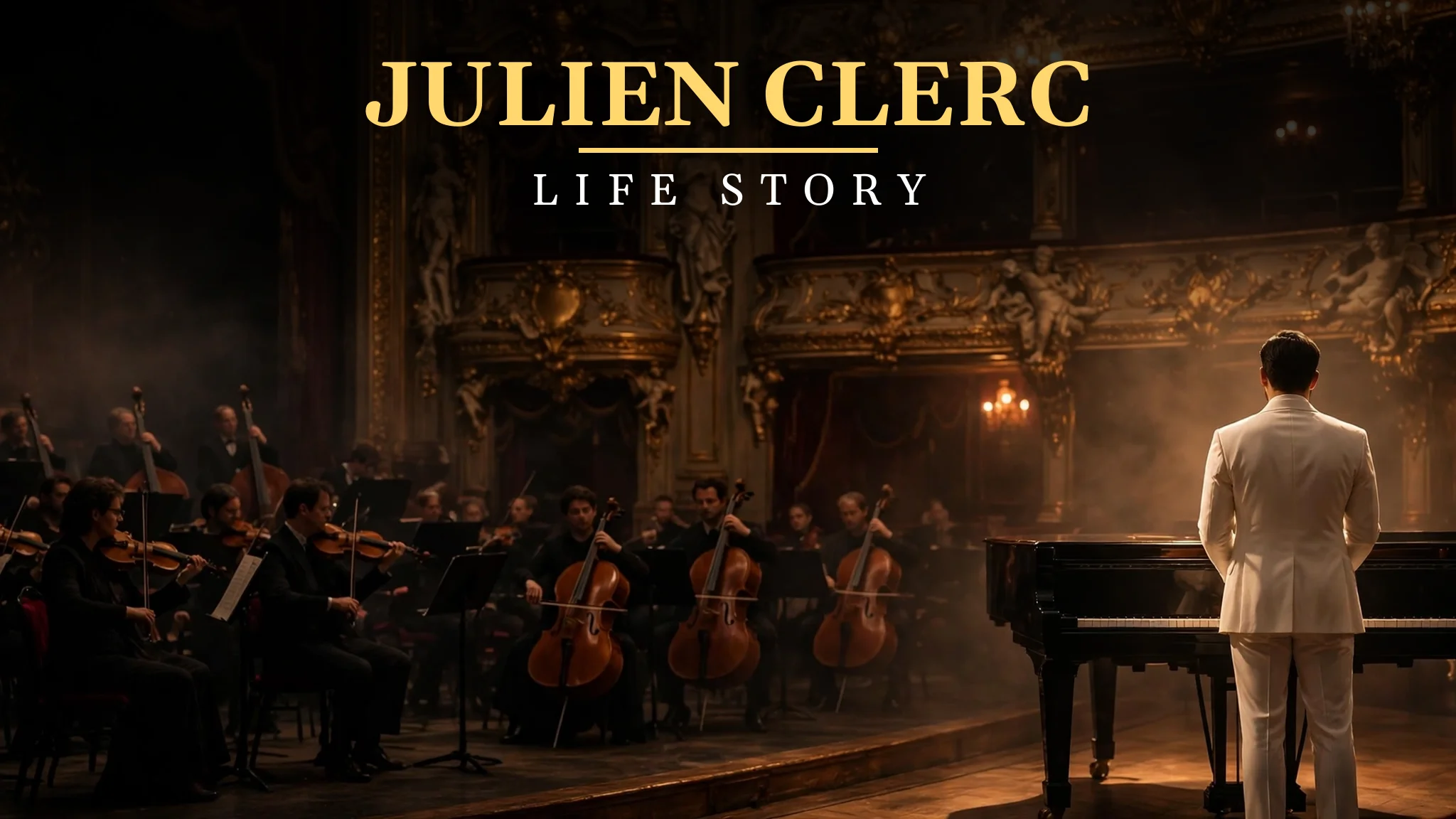
Finally, I think about the image of a man in a white suit, standing at a grand piano in a gold theatre, with an orchestra playing beside him. That image is Clerc, elegant, calm, and a little distant, but also warm, because the man at the piano loves the music, loves the audience, and loves the city that gave him his voice. I hope that image stays with readers, and I hope they remember that a great singer can be elegant and kind at the same time, and that a quiet voice can be the strongest voice in the room, if it sings the truth.
I also think about the way he has worked with other writers, and about how his songs were often made by two people, a lyricist and a composer, working together. He worked with Étienne Roda-Gil, with Jean-Loup Dabadie, and with other great writers, and each partnership gave him new words, new ideas, and new songs. That collaboration is a part of his success, because a good song is often made by two minds, one that writes the words and one that writes the music, and Clerc knew how to work with both, with respect and with trust.
His charity work also stays with me, because he has given money, time, and his voice to help children and people who are sick, without making a show of it. He believes that fame should be used for something useful, and he has done so, quietly and steadily. That is a rare quality, and it is one that his friends remember after his concerts, that he is a kind man, not only a star. I think that kindness is a part of his legacy, and it deserves to be remembered alongside his songs.
I think about the way he has kept his voice strong for more than fifty years, and about how he has taken care of it, by rehearsing, by resting, and by singing with care. A voice is a fragile thing, and many singers lose it by shouting, by smoking, or by working too hard, but Clerc has kept his, because he has treated it with respect. That is a lesson for any singer, to care for your voice, to rest it, and to use it wisely, so that it will last, as his has lasted, for half a century.
When I hear Partir today, I hear a song about leaving, about the wish to go away and to see the world, and I understand why it became a hit. It is a simple song, but it is full of longing, and it speaks about a feeling that everyone knows, the wish to leave home and to find a new life. Clerc gave that feeling a tune, and his audience sang it back, because they had felt it too, and that shared feeling is what makes a song last.
Finally, I think Clerc shows us that a singer can be elegant and kind at the same time, and that a quiet voice can be the strongest voice in the room. He wore a white suit, he sat at a grand piano, and he sang about love, about time, and about life, and he did it with a calm that made him stand out in a noisy world. I hope readers remember that image, and I hope they listen to his songs with a quiet heart, because that quiet is where his music lives, and where it will keep living for a long time.
I also think about the way he has kept his audience for more than fifty years, and about how rare that is in pop music. Most singers have a few good years, and then they fade, but Clerc has stayed, because he has worked, because he has changed, and because he has respected the people who came to hear him sing. That respect is a two-way street, and it is why his concerts are still full, why his records are still sold, and why his name is still spoken with love in France, whenever a great singer is discussed, and whenever a young person hears Ma préférence for the first time.
Frequently Asked Questions
When was Julien Clerc born and is he still alive?
Julien Clerc was born as Paul-Alain Leclerc in Paris on 4 October 1945, and he is still alive, still singing, and still loved in France. He has been a star for more than fifty years, since his first hit in 1968.
What is Julien Clerc’s most famous song?
His most famous songs include La Cavalerie from 1968, Ce n’est rien from 1971, Ma préférence from 1978, and Femmes je vous aime from 1982. Ma préférence is one of the most loved love songs in French pop.
Did Julien Clerc act in the musical Hair?
Yes, he sang in the French production of the musical Hair in 1969, playing a young man who wanted freedom and love. The show was a success, and it gave him a new kind of fame as a singer who could act on stage.
Who are Julien Clerc’s children?
His daughter Jeanne, born in 1978, is from his relationship with the actress Miou-Miou, and his son Léon is from his marriage to the writer Hélène Grémillon. Jeanne became an actress, and Léon grew up in a house full of music.
What is Femmes je vous aime about?
Femmes je vous aime, recorded in 1982, is a song about women, about loving them, thanking them, and admiring them. It is a warm and respectful song, and it is still one of Clerc’s most famous works.
What is the album Utile about?
Utile, recorded in 1992, is an album about being useful, about helping others, and about the value of a life well lived. It showed that Clerc had grown as an artist, and it became a great success in France.
Why has Julien Clerc lasted for more than fifty years?
He has lasted because he writes honest songs, he sings with a clear and warm voice, he plays piano, and he respects his audience. He did not chase fashion, and he grew older with his fans, singing about love, time, and life with a maturity that they loved.


