Kalush Orchestra: The Life Story Behind Ukraine's Eurovision Winners
In this post
- A Town, a Name, and a New Sound
- Stefania: A Song Written for a Mother
- The Road to Eurovision 2022
- A Win That Meant More Than Music
- Life After Turin: Tours, New Music, and Change
- The Sound and the Style That Made Them Stand Out
- Legacy: A Song, a Country, and a Moment in History
- Stefania on Stage Around the World
- My Take:
Kalush Orchestra became known to the whole world in one spring, when a song about a mother turned into an anthem for a country at war. The band from Ukraine mixed folk music, rap and modern beats in a way that sounded both old and new at the same time. Their music carried the sound of Ukrainian village songs, the energy of hip hop, and the warmth of a family story. When they won the Eurovision Song Contest in 2022, millions of people who had never heard of them before were suddenly singing along to a song in Ukrainian.
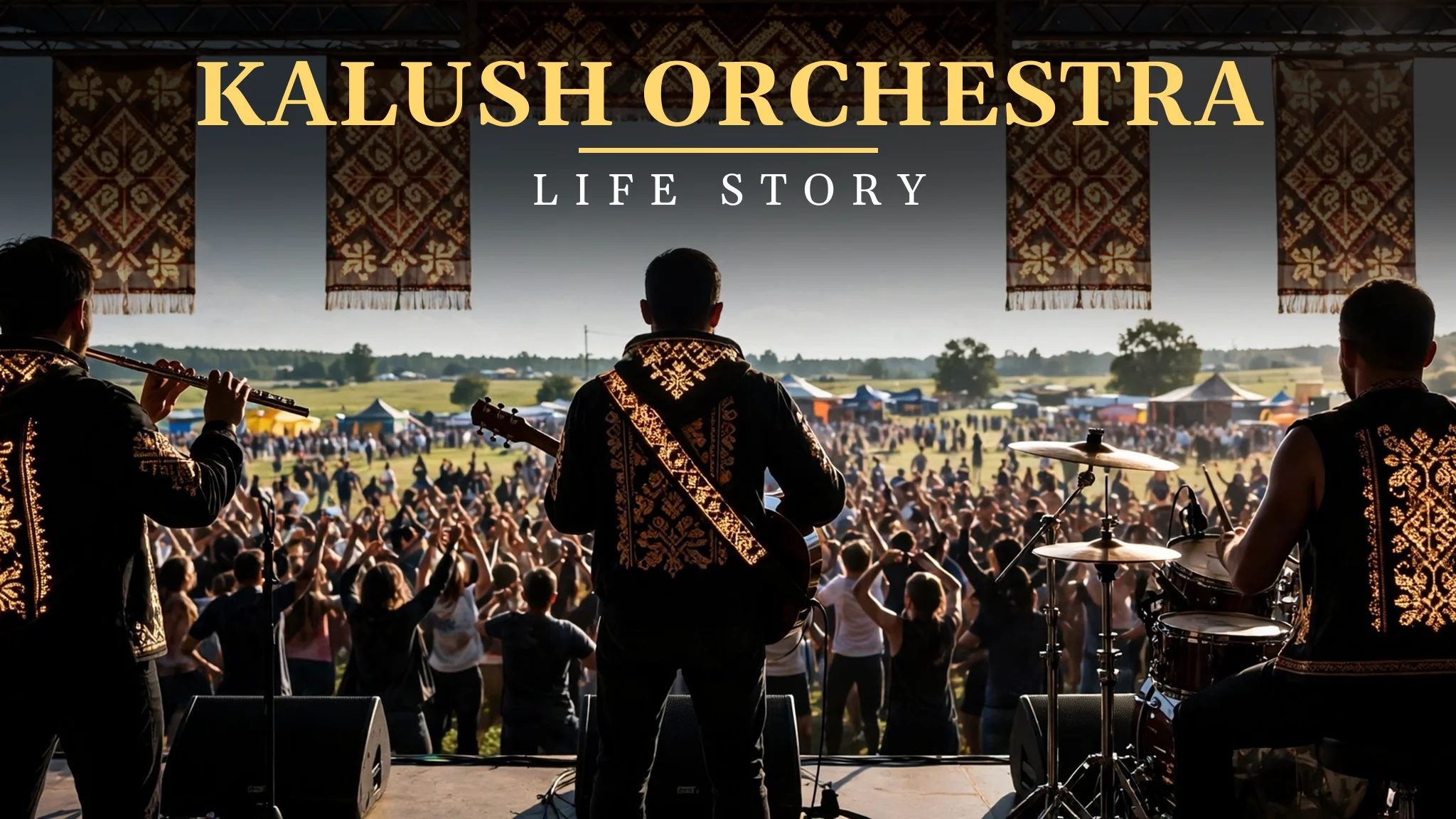
The group grew out of an earlier band called Kalush, named after the town of Kalush in western Ukraine. Its leader, Oleh Psiuk, was a rapper who loved Ukrainian folk music and wanted to bring the two worlds together. He and his bandmates wore traditional embroidered clothes on stage, used folk instruments such as the flute-like sopilka, and sang in Ukrainian at a time when many pop acts sang in English or Russian. Their style was bright, proud and easy to recognise, and it gave young Ukrainians a modern sound that still belonged to their own culture.
This is the story of how a small Ukrainian band became a symbol of hope far beyond music. It is a story about a song written for one mother, a contest that changed in a few weeks, and a group of young musicians who found themselves carrying the feelings of a whole nation on a stage in Italy. Their rise was fast, emotional and unlike almost any other Eurovision story, because it happened while their country was fighting for its survival.
A Town, a Name, and a New Sound
Kalush is a town in the Ivano-Frankivsk region of western Ukraine, and the band took its name from that place. Oleh Psiuk, the group’s founder and frontman, was born in Kalush, and the name was a way of keeping his home close to everything the band did. The town is not a big city, and it is not a famous centre of pop music. That was part of the point. The band wanted to show that important music could come from a small place, and that local roots could be a strength rather than something to hide.
The first version of the group, called simply Kalush, formed in 2019. Psiuk worked with other musicians who shared his love of hip hop and folk, and they began to build a sound that mixed rap verses with folk melodies and traditional instruments. In Ukraine, hip hop had a strong following, and folk music had a long history, but few acts had joined them in such a direct way. Kalush did not treat folk music as a decoration. They built their songs around it, letting the flute and the old melodies lead, while the rap gave the songs speed and modern energy.
Their early songs and videos found an audience at home, especially among young listeners who liked the mix of tradition and street style. The band wore vyshyvanka, the traditional Ukrainian embroidered shirt, and they used folk patterns in their clothes and in their videos. This was not a costume for a single show. It became their visual identity, and it helped people remember them. In a crowded music scene, they looked different, and they sounded different, and that difference mattered.
By 2021 the band had built enough of a following to be taken seriously as one of Ukraine’s most interesting new acts. They were not yet stars in other countries, and they were not yet known to most Eurovision viewers, but they had a clear sound, a clear look, and a leader who knew what he wanted the band to stand for. The next step would come quickly, and it would change everything, although nobody in the band could have guessed how much the world around them was about to change too.
Stefania: A Song Written for a Mother
The song that changed the band’s life was called Stefania, and it was written as a tribute to Oleh Psiuk’s mother, Stefania Psiuk. The lyrics speak with love and respect about a mother, about the road home, and about the way a mother’s care stays with a person through life. It was a personal song, not a political one, and that is part of why it touched so many people. Almost everyone has a mother, and almost everyone understands the feeling of wanting to come home to her.
Stefania mixed a folk melody with rap verses and a strong, catchy chorus that was easy to remember even if the listener did not speak Ukrainian. The flute carried the tune, the beat pushed it forward, and Psiuk’s rap told the story in a direct, warm way. The song felt joyful and proud, and it also felt tender, because the words were about family rather than fame. It was the kind of song that could work at a festival, on the radio, and in a living room, and that range helped it travel far.
When the band first performed Stefania, it was already clear that it was special. Fans in Ukraine took it to heart, and it became one of the band’s best-loved songs. The song’s mix of old and new, of folk and rap, and of personal feeling and national pride, made it stand out from other pop songs of the time. It did not try to sound like a hit from another country. It sounded like Ukraine, and that honesty gave it power.
The band could not have known that Stefania would soon take on a much larger meaning. In the weeks after the song was chosen for Eurovision, Russia launched a full-scale invasion of Ukraine, and the song about a mother became, for many listeners, a song about home, about a country, and about the people left behind. The words did not change, but the world around them did, and the song grew into something bigger than the band had planned.
The Road to Eurovision 2022
Ukraine chooses its Eurovision act through a national selection, and Kalush Orchestra entered that contest with Stefania. At first they finished second in the national final, behind the singer Alina Pash. When Pash later withdrew from the contest, Kalush Orchestra were chosen to take her place and to represent Ukraine at Eurovision in Turin, Italy. It was a sudden change, and it gave the band only a short time to prepare for the biggest stage of their lives.
The timing was extraordinary. The invasion of Ukraine had begun in February 2022, and by the time Eurovision arrived in May, the war was the main story in Europe. Kalush Orchestra were not only a band any more. They were also, in the eyes of many viewers, a voice for their country. Some members of the band had been given special permission to leave Ukraine to travel to the contest, and the band used their time in Turin to speak about the war and to ask for support for Ukraine.
On stage in Turin, the band performed Stefania with energy, colour and pride. They wore embroidered outfits, the folk flute rang out, and the chorus filled the arena. The performance was joyful, even though the situation at home was terrible, and that contrast moved many viewers. The band did not look broken or afraid on stage. They looked strong, and they sang about home with love, and that feeling reached people in many countries.
The Eurovision voting system gives points from both juries and the public, and Kalush Orchestra’s result was clear. They won the contest, and their victory in the public vote was one of the largest in Eurovision history, with a very high score from viewers across Europe. The win was celebrated in Ukraine and around the world, and it showed how music could carry a message that news reports alone could not carry.
A Win That Meant More Than Music
Winning Eurovision is a big moment for any act, but for Kalush Orchestra it meant much more than a trophy. The band had won while their country was under attack, and the victory gave many Ukrainians a moment of pride and joy in a very dark time. People at home celebrated, even as the war continued, and the song Stefania became a kind of anthem, played at gatherings, on the radio, and in videos shared around the world.
After the contest, the band used their fame to raise money and support for Ukraine. They toured in other countries, performed at charity events, and spoke to audiences about what was happening at home. They also auctioned items connected to their win, including the Eurovision trophy, to raise funds for the Ukrainian army and for people affected by the war. This was not a normal victory tour. It was a tour with a purpose, and the band took that purpose seriously.
The band’s members also had to live with the hard reality of the war. Some of them returned to Ukraine, and their lives, like the lives of millions of Ukrainians, were shaped by the fighting, by danger, and by the loss of normal life. The fame did not protect them from that reality, and it did not make the war go away. It gave them a platform, but it also gave them a responsibility, and they carried it in public.
In the years after Eurovision, Stefania remained their best-known song, and it was played at many events connected to Ukraine. The band continued to make music, and they continued to perform, but they were always linked to that one night in Turin. That is both a gift and a weight. A gift, because the world knows their name, and a weight, because every new song is compared to the one that changed their lives.
Life After Turin: Tours, New Music, and Change
After Eurovision, Kalush Orchestra toured in Europe and beyond, playing to audiences who had first seen them on television. The concerts were often emotional, with Ukrainian flags in the crowd and people singing along to Stefania even if they did not know the words. For Ukrainians living abroad, the concerts were a chance to feel close to home, and for other listeners, they were a chance to show support through music.
The band also released new music after their win, trying to build a career that went beyond one song. This is hard for any Eurovision winner, because the contest gives a huge moment of attention, and then the attention moves on to the next year’s winner. Kalush Orchestra worked to keep their sound fresh, mixing folk, rap and pop in new ways, and they kept the embroidered look and the folk instruments that made them easy to recognise.
There were also changes inside the group over time, as there are in many bands. Members came and went, and the line-up that people saw on later tours was not exactly the same as the one that won in Turin. This is normal in a band’s life, but it can be hard for fans who remember the first line-up. The band kept going, with Oleh Psiuk still at the centre, and they kept the name and the spirit that had made them famous.
Their story after Eurovision is still being written, and it is tied to the story of Ukraine itself. As long as the war continues, their music will be heard in that context, and their concerts will carry that meaning. The band has shown that it can keep performing, keep making music, and keep speaking for its country, even when the work is hard and the future is uncertain.
The Sound and the Style That Made Them Stand Out
Kalush Orchestra’s sound is built on a simple idea: folk music and hip hop can live in the same song. The sopilka, a traditional Ukrainian flute, plays melodies that sound old and familiar, while the rap verses give the song a modern, street-level energy. The beat is strong, the chorus is easy to sing, and the whole song feels both rooted and fresh. That mix is what made Stefania work, and it is what the band has kept in their later songs.
Their look is just as important as their sound. The black clothes with gold and red embroidery, the folk patterns, and the traditional hats and jackets create a strong image on stage. In a contest where many acts wear glitter and bright colours, Kalush Orchestra looked like they came from a Ukrainian village and a modern city at the same time. The image was not an accident. It was a choice, and it helped people remember them long after the music stopped.
The band’s lyrics, in Ukrainian, also set them apart. Many Eurovision acts sing in English to reach a wider audience, but Kalush Orchestra sang in their own language, and the audience responded. The words about a mother, about home, and about the land did not need translation to be felt. The emotion in the music carried the meaning, and the Ukrainian language became part of the song’s beauty.
Their style has influenced other Ukrainian musicians, and it has shown young artists that they do not need to copy sounds from other countries to succeed. A band can sing in Ukrainian, use folk instruments, wear traditional clothes, and still win the biggest song contest in Europe. That is a powerful lesson, and it is one of the reasons the band matters beyond their own career.
Legacy: A Song, a Country, and a Moment in History
Kalush Orchestra will always be remembered first for Stefania and for Eurovision 2022, and that is fair, because that moment was historic. They won a major contest in the middle of a war, and they did it with a song about a mother that became a song about a nation. Few bands ever have a moment like that, and few songs ever carry that much weight. Their place in Eurovision history is secure, and their win is likely to be talked about for many years.
Their legacy is also about Ukrainian culture. At a time when Ukraine’s identity was under attack, the band put Ukrainian language, folk music and embroidery on a world stage, and millions of people saw it and loved it. They showed that culture is not a small thing. It is a way for a people to say who they are, and to keep that identity alive even in hard times. That is a legacy that goes beyond charts and trophies.
For young musicians in Ukraine, the band is an example of what is possible. They came from a small town, they mixed old and new, they stayed true to their language, and they reached the world. That path is not easy, and it does not work for everyone, but Kalush Orchestra proved that it can work, and that proof matters to the next generation of artists who are trying to find their own sound.
In the end, the band’s story is about home. Stefania is about a mother, and a mother is the first home most people know. The band took that feeling, put it into a song, and shared it with the world at a time when home itself was in danger. That is why the song still moves people, and why the band’s story is still told with respect and with warmth.
Stefania on Stage Around the World
After Eurovision, Kalush Orchestra carried Stefania to stages in many countries, and each concert felt different from a normal pop show, because the audience was not only there to hear a song, but to show support for Ukraine and to feel close to a country that was suffering far away. In London, in Berlin, in Warsaw, in Paris and in other European cities, Ukrainian flags appeared in the crowd, people sang the chorus even when they did not speak Ukrainian, and the band’s embroidered clothes and folk flute made the stage look and sound like a piece of home that had travelled abroad. For Ukrainians living outside their country, many of whom had left because of the war, these concerts were emotional, because they could hear their language, see their patterns, and feel, for one evening, that they were not alone in a foreign place, but part of a community that still had a culture, a language, and a song of its own.
The band’s touring life after Eurovision was also hard in practical ways, because touring is tiring for any band, and Kalush Orchestra were touring while their country was at war, while their families and friends were in danger, and while the news from home was often terrible. They had to travel, to rehearse, to perform, and to smile on stage, even when they were worried, and that is a difficult thing to do night after night. Some members had to return to Ukraine, some had military duties or family duties, and the line-up changed, but the band kept going, because they believed that their music mattered, that it kept Ukraine in people’s minds, and that a concert could remind a European audience that the war was not over, even when the news moved on to other stories.
Their concerts also raised money, and that money mattered in a practical way, because it went to help the Ukrainian army, to help hospitals, and to help people who had lost their homes. The band auctioned their Eurovision trophy, they sold merchandise, and they used their fame to ask audiences to donate, and many audiences did, because they had been moved by the music and by the story behind it. This was not a normal way for a band to use fame, and it shows how seriously Kalush Orchestra took their responsibility. They could have used their win only to build a career, to make records, and to become rich, but they chose to use it to help their country, and that choice gave their touring a purpose that went beyond entertainment, and made their concerts feel like acts of solidarity, not only shows.
The sound of Stefania on a foreign stage also changed how many listeners thought about Ukrainian music, because before 2022, many people in Western Europe knew very little about Ukrainian folk music, about the sopilka, about embroidered shirts, or about the Ukrainian language. Kalush Orchestra introduced all of those things to a wide audience, in a joyful, modern way, and they did it without explaining or apologising for being Ukrainian. They simply sang, played, and wore their culture with pride, and the audience responded with love. That is a powerful form of cultural diplomacy, one that does not need a speech or a lecture, but only a good song, well performed, with honesty and with pride.
In the years since Turin, Stefania has been played at many events that have nothing to do with Eurovision, at charity concerts, at Ukrainian community gatherings, at festivals, and at moments of remembrance, and each time it is played, it carries the same feeling: love for a mother, love for home, and hope for a free Ukraine. The band may make new songs, they may change their line-up, and they may tour in new places, but Stefania will always be the song that people ask for, the song that they sing along to, and the song that defines Kalush Orchestra in the minds of millions. That is both a gift and a challenge, because a band wants to be known for more than one song, but when one song means so much to so many people, it is also a privilege to have made it, and to have shared it with the world at a time when the world needed to hear it.
My Take:
I think about Kalush Orchestra and I feel two things at once, and I do not want to hide either of them. The first is joy, because Stefania is a joyful song, and the band’s win was a joyful moment. The second is sadness, because the win happened while their country was at war, and joy in that situation is never simple. I admire the band for holding both feelings at the same time, for singing with pride on a stage in Italy while knowing what was happening at home, and for not pretending that the music made the war go away. That honesty is what makes their story stay with me.
What I love most about their music is that it does not try to be from somewhere else. So many pop acts sound the same, no matter which country they come from, because they copy the same beats and the same English words. Kalush Orchestra sound like Ukraine. The flute, the language, the clothes, the feeling of the song, all of it comes from one place, and that place is clear. I think that is brave, because it is easier to copy a safe international sound than to trust your own culture. They trusted theirs, and the world answered with love.
I also think about Oleh Psiuk and the choice to write a song for his mother. It would have been easy to write a loud song about winning, or a song about fame, or a song about the war itself. He wrote about his mother, about the road home, and about love that does not change. That is a small, personal subject, and it turned out to be the biggest subject of all, because almost everyone can understand it. I learn from that. The most personal story is often the most universal story, and the song that comes from the heart travels further than the song that is made only to be a hit.
The Eurovision win itself teaches me something about how people vote with their hearts. The juries gave the band points, but the public gave them a huge score, and that tells me that viewers were not only judging the music. They were also saying something about Ukraine, about support, about hope, and about the wish to stand with a country in trouble. Some people might say that is not fair to other acts, and I understand that view. But I also think that music has always been about more than notes. It is about feeling, about meaning, and about the moment in which it is heard, and in May 2022, Stefania meant more than any other song in that contest.
I feel sad when I think about what the band gave up to be in Turin. They left a country at war, they travelled to Italy, they performed, and then they had to go back to a reality that had not changed. Fame does not stop bombs, and a trophy does not bring back a normal life. I respect the band for using their win to raise money and to speak for Ukraine, because they could have taken the fame for themselves and said nothing. They chose to use it, and that choice cost them time and energy, but it also gave their win a purpose that lasted longer than one night.
Another thing I admire is the way the band kept going after the contest. It is hard to follow a huge win, because every new song is compared to the old one, and the world’s attention moves on quickly. Kalush Orchestra kept touring, kept making music, and kept their sound, even when the first excitement faded. That takes patience, and it takes belief in the music itself, not only in the moment of fame. I think many bands would have stopped, or changed their sound to chase a new hit, but this band stayed close to what made them special.
I also think about the young Ukrainians who watched them win. For a child or a teenager in Ukraine in 2022, life was full of fear, of sirens, of leaving home, and of not knowing what would happen next. To see a band from their own country win Eurovision, singing in Ukrainian, wearing embroidered clothes, must have felt like a small light in a dark time. I do not want to make that light sound bigger than it was, because music cannot fix a war, but I do think it matters. A moment of pride can help people keep going, and Kalush Orchestra gave their country that moment.
There is a lesson here for any artist, and it is a simple one. Do not hide where you come from. Your home, your language, your family, your folk songs, these are not things to be ashamed of, and they are not things to leave behind when you want to be modern. Kalush Orchestra took all of those things with them onto a European stage, and they won. That tells me that the world is ready for music that is honest about its roots, and that the best way to be heard is to be yourself, clearly and proudly.
I also want to be honest about the hard part of their legacy. Because their win is tied to the war, it will always be remembered in that context, and that means the band can never fully separate their music from politics and from pain. That is not their fault, and it is not something they chose, but it is real. Every interview, every concert, every new song will bring questions about the war, and that is a heavy thing to carry for a group of young musicians. I respect them for carrying it, and I hope they also get space to be a band, to make music for fun, and to grow as artists.
When I think about Stefania now, I do not only hear a Eurovision winner. I hear a son singing to his mother, and I hear a band singing to its home. That is why the song still works, even for people who do not know the words. The feeling is clear. It is love, it is longing, and it is the wish to come home safe. I think that feeling will last longer than the charts, longer than the trophy, and longer than the news of one year. It is a human feeling, and it is the reason this band matters.
For a reader who is young and trying to make something of their own, I would say this. Start with what you know, with your own town, your own family, your own songs, and build from there. Do not wait for permission to be proud of your roots. Kalush Orchestra did not wait. They sang in Ukrainian, they wore their embroidery, and they played their folk flute, and the world listened. That is a lesson I will keep, and it is the part of their story I most want to remember.
In the end, I think Kalush Orchestra teach us that music can be both small and large at the same time. Stefania is a small song about one mother, and it is also a large song about a country, about home, and about hope. The band are small in number, and they are large in the hearts of many people. I hope they keep making music, I hope Ukraine finds peace, and I hope the band one day get to sing Stefania at home, in a free and peaceful country, simply because it is a beautiful song about a mother, and not because it is also a song about a war.
I think about the band’s touring after Eurovision, and I feel both admiration and sadness, because touring is usually a happy time for a band, a time of travel, of new audiences, and of celebration, but for Kalush Orchestra, touring was also a time of worry, of news from home, and of a responsibility that most bands never have to carry. I admire them for carrying it, for singing Stefania night after night, even when they must have been tired, even when they must have wanted to be home, and even when the applause could not fix what was happening in Ukraine. That is a kind of professionalism that goes beyond music, and it shows a deep love for their country and for their audience.
Another thought that stays with me is about the Ukrainians in the audience, the people who had left their country because of the war, and who came to a Kalush Orchestra concert to feel close to home. I imagine a woman in Warsaw, or a man in Berlin, hearing the flute, hearing the Ukrainian words, and feeling, for a moment, that they are back in Ukraine, with their family, in a place that is safe. That feeling cannot be bought, and it cannot be faked, and it is a gift that the band gives to its audience, a gift of home, in a time when home is in danger. I find that deeply moving, and it makes me respect the band even more, because they are not only performers, they are also a link to home for people who have lost it.
I also think about the money the band raised, and how practical that help was. Music can sometimes feel useless in a war, like a song cannot stop a bomb, and that is true, a song cannot stop a bomb. But a song can raise money, a concert can raise awareness, and a trophy can be auctioned to buy help for soldiers and for families, and those are real, practical things. Kalush Orchestra understood that, and they used their fame in a practical way, not only in an emotional way. That practicality is a lesson for any artist who wants to help: do not only sing, do something, raise money, speak, act, and use the platform you have been given for a purpose that matters.
There is also a lesson here about culture, and about how a folk song, a flute, and an embroidered shirt can become a symbol of a whole nation. Before 2022, many people in Europe did not know what a vyshyvanka was, or what a sopilka sounded like, and now they do, because Kalush Orchestra wore and played them on the biggest stage in Europe. That is a reminder that culture is not a small, decorative thing. It is a way for a people to say who they are, to keep their identity alive, and to show the world that they exist, that they have a history, a language, and a music of their own, and that no invasion can take that away. I will remember that, and I will respect any artist who carries their culture with pride.
Finally, I think about the future of the band, and I hope that one day they can tour simply as a band, without the weight of war, without having to raise money for soldiers, and without having to speak about the invasion at every concert. I hope they can sing Stefania in a free, peaceful Ukraine, to an audience that is home, safe, and happy, and that the song can be, once again, simply a song about a mother, about love, and about coming home. That hope is a sad hope, because it has not yet come true, but it is also a real hope, and it is the hope that keeps me thinking about Kalush Orchestra, not only as Eurovision winners, but as young musicians who gave their country a voice, a song, and a moment of pride, when pride was hard to find.
I also think about the children in Ukraine who heard Stefania, and what that song must have meant to them in 2022, when their lives were turned upside down by sirens, by leaving home, and by fear. A child does not understand politics, but a child understands a song about a mother, about home, and about love, and Kalush Orchestra gave those children a song they could sing, a song in their own language, that made them feel proud, not afraid, for a few minutes. That is a small gift, but it is a real one, and it is one of the reasons I will remember this band, not only as Eurovision winners, but as singers who gave hope to young people in a dark time, and who did it with a folk flute, a rap, and a chorus that anyone can remember.
When I look at the band’s embroidered clothes, I also think about how important it is to wear your culture with pride, especially when that culture is under attack. The vyshyvanka is not only a shirt. It is a symbol of Ukraine, of its history, of its villages, and of its people, and Kalush Orchestra wore it on a European stage, in front of millions of viewers, and said, without words, this is who we are, this is where we come from, and we are proud of it. That pride is contagious, and it is inspiring, and it teaches me that my own culture, my own clothes, my own language, and my own songs are not things to hide, but things to celebrate, especially when the world is watching.
Frequently Asked Questions
Who are Kalush Orchestra and where are they from?
Kalush Orchestra are a Ukrainian folk-rap band, formed from the earlier band Kalush, and led by rapper Oleh Psiuk. They come from Ukraine, and the band took its name from the town of Kalush in western Ukraine. Their music mixes Ukrainian folk melodies and instruments with modern hip hop and pop beats.
What song did Kalush Orchestra win Eurovision with?
They won the Eurovision Song Contest in 2022 with the song Stefania. The song was written as a tribute to Oleh Psiuk’s mother, Stefania Psiuk, and it mixes a folk melody with rap verses and a strong chorus. It became one of the best-known Eurovision winners of recent years.
When did Kalush Orchestra win Eurovision?
Kalush Orchestra won Eurovision in May 2022, at the contest held in Turin, Italy. They won after a very high score in the public vote, and the win came only a few months after Russia launched its full-scale invasion of Ukraine in February 2022.
What does the song Stefania mean?
Stefania is a song about a mother, about love, respect, and the road home. Oleh Psiuk wrote it for his own mother, and the words speak about a mother’s care staying with a person through life. After the invasion, many listeners also heard it as a song about home and about Ukraine itself.
What instruments and style does Kalush Orchestra use?
The band use folk instruments such as the sopilka, a traditional Ukrainian flute, together with modern beats, rap and pop sounds. They often wear traditional embroidered clothes, called vyshyvanka, on stage, and they sing in Ukrainian. Their style mixes old folk music with modern hip hop.
Did Kalush Orchestra raise money for Ukraine after Eurovision?
Yes, after their win the band used their fame to raise money and support for Ukraine. They toured, performed at charity events, and auctioned items linked to their win, including the Eurovision trophy, to raise funds for the Ukrainian army and for people affected by the war.


