Kasabian: The Life Story Behind the Leicester Rock Band
In this post
- Leicester Roots and the Long Wait
- Club Foot and the First Album
- Empire and the Rise to the Top
- Velociraptor, 48:13 and the Glastonbury Headline
- For Crying Out Loud and the Later Years
- A Sudden Break and a New Voice
- The Alchemist’s Euphoria and Carrying On
- Songs in Sport, Film and Everyday British Life
- My Take:
Kasabian are a band that always sounded like they were heading for the biggest stage in the country. From their first singles in Leicester to their headline set at Glastonbury, they carried themselves like a band that believed it belonged at the top. Their music mixed rock guitars with dance beats, and their songs had a swagger that made them stand out from the quieter indie bands around them.
The band was formed in Leicester in 1997 by singer Tom Meighan, guitarist and songwriter Sergio Pizzorno, bassist Chris Edwards and drummer Ian Matthews, with other members joining and leaving in the early years. For a long time they were known as Saracuse, and they spent years rehearsing, playing small shows and trying to find a sound that was their own. Leicester is not a city that most people link with rock stardom, and that made the band’s rise feel even more surprising.
What makes Kasabian worth telling is the size of their journey and the drama inside it. They had number one albums, huge festival crowds and songs that became part of British life, and then they lost their singer in difficult circumstances and had to rebuild. Through all of that, Sergio Pizzorno kept writing songs, and the band kept playing. This is the story of how a group from Leicester became one of Britain’s biggest rock bands, and how they found a way to carry on when everything changed.
Leicester Roots and the Long Wait
Kasabian began in Leicester in 1997, when Tom Meighan, Sergio Pizzorno and Chris Edwards started playing together. They were young men from an ordinary English city, and they had no clear path to fame. They rehearsed in small rooms, played in pubs and clubs, and spent years learning how to be a band. In those early years they called themselves Saracuse, and they were one of many hopeful groups trying to get noticed.
The band’s early sound was shaped by the music they loved. They listened to rock bands, to dance music, and to the swagger of groups like the Stone Roses and Primal Scream. Sergio Pizzorno, who wrote most of the songs, wanted a sound that mixed guitars with the pulse of dance music, so that people could move to it as well as listen to it. That mix would become the band’s trademark, and it took years to get right.
Getting noticed was slow work. The band sent out demos, played support slots for bigger acts, and waited for a record label to take a chance on them. They changed their name to Kasabian, a name Sergio had taken from Linda Kasabian, a woman linked to the Charles Manson case, and the new name gave them a sharper identity. It was a strange name for a rock band, but it was hard to forget, and that helped them stand out.
By the early 2000s, the band had signed to RCA Records and were ready to make their first album. Drummer Ian Matthews had joined, and the line-up had settled. The years of waiting had taught them patience, and they had also taught them how to play together as a tight unit. When their chance finally came, they were ready for it in a way that many younger bands are not.
Club Foot and the First Album
Kasabian’s debut album was released in September 2004, and it announced them as a band with a big sound and big ambitions. The singles from the record, including Club Foot, L.S.F. and Processed Beats, mixed heavy guitars with electronic beats, and they sounded different from most British guitar music of the time. Club Foot became their calling card, a song that built slowly and then exploded, and it is still one of their most played tracks.
The album reached the top ten in Britain, and the band began to play larger venues. Their live shows were loud and confident, with Tom Meighan working the crowd and Sergio Pizzorno leading the band from the side of the stage. They toured with other big acts and played at festivals, and their reputation grew quickly. People who saw them live often said the same thing, that the band sounded like they were already a headline act.
The first album also showed that Kasabian were not afraid of big ideas. The songs were about power, about nights out, about feeling alive, and they were written in a direct and bold way. Some critics found the band’s confidence too much, but many listeners loved it. The band did not apologise for wanting to be big, and that honesty became part of their appeal.
The success of the debut gave the band a platform, but it also gave them a problem. They had to prove that they were not a one-album band, and that their sound could grow. Many bands make a strong first record and then fade, and Kasabian knew that the second album would matter even more. They went back to the studio with a clear sense of what they wanted to do next.
Empire and the Rise to the Top
The second album, Empire, was released in September 2006 and went straight to number one in Britain. It was a bigger and more confident record than the first, with the title track leading the way. Empire was a song about power and ambition, and it sounded like a band that had grown into its own skin. The single Shoot the Runner also became a hit, and the album gave the band their first number one.
The success of Empire changed the band’s life. They were now playing arenas, headlining festivals, and appearing on the biggest stages in Britain. Their shows became larger and more theatrical, with lights, screens and a sense of occasion. Tom Meighan became one of the most recognisable frontmen in British rock, and Sergio Pizzorno became known as one of the best songwriters of his generation.
The band’s third album, West Ryder Pauper Lunatic Asylum, released in 2009, took them even further. It featured the singles Fire and Underdog, and Fire became their biggest hit, reaching the top three in Britain. The album won the award for best album at the Brit Awards, and it was shortlisted for the Mercury Prize. Fire became a song that everyone knew, played at sports events, on television, and at every Kasabian show.
By the end of the 2000s, Kasabian were one of the biggest rock bands in Britain. They had number one albums, hit singles, and a live reputation that put them among the top acts in the country. They had come from Leicester with a strange name and a big sound, and they had made it to the top without losing the energy that had made them start.
Velociraptor, 48:13 and the Glastonbury Headline
Kasabian’s fourth album, Velociraptor!, was released in 2011 and also reached number one in Britain. It was a more experimental record, with songs that mixed rock, dance and electronic sounds in new ways. The singles Days Are Forgotten and Goodbye Kiss showed different sides of the band, and the album proved that they could keep changing without losing their audience. The band toured the record around the world, playing in America, Europe and Australia.
The fifth album, 48:13, was released in 2014 and was named after its running time of forty-eight minutes and thirteen seconds. It was a bolder and more electronic record, with songs like Eez-eh and Bumblebeee, and it also reached number one. The album showed that Sergio Pizzorno was still pushing the band’s sound forward, and that the band was not content to repeat its earlier hits.
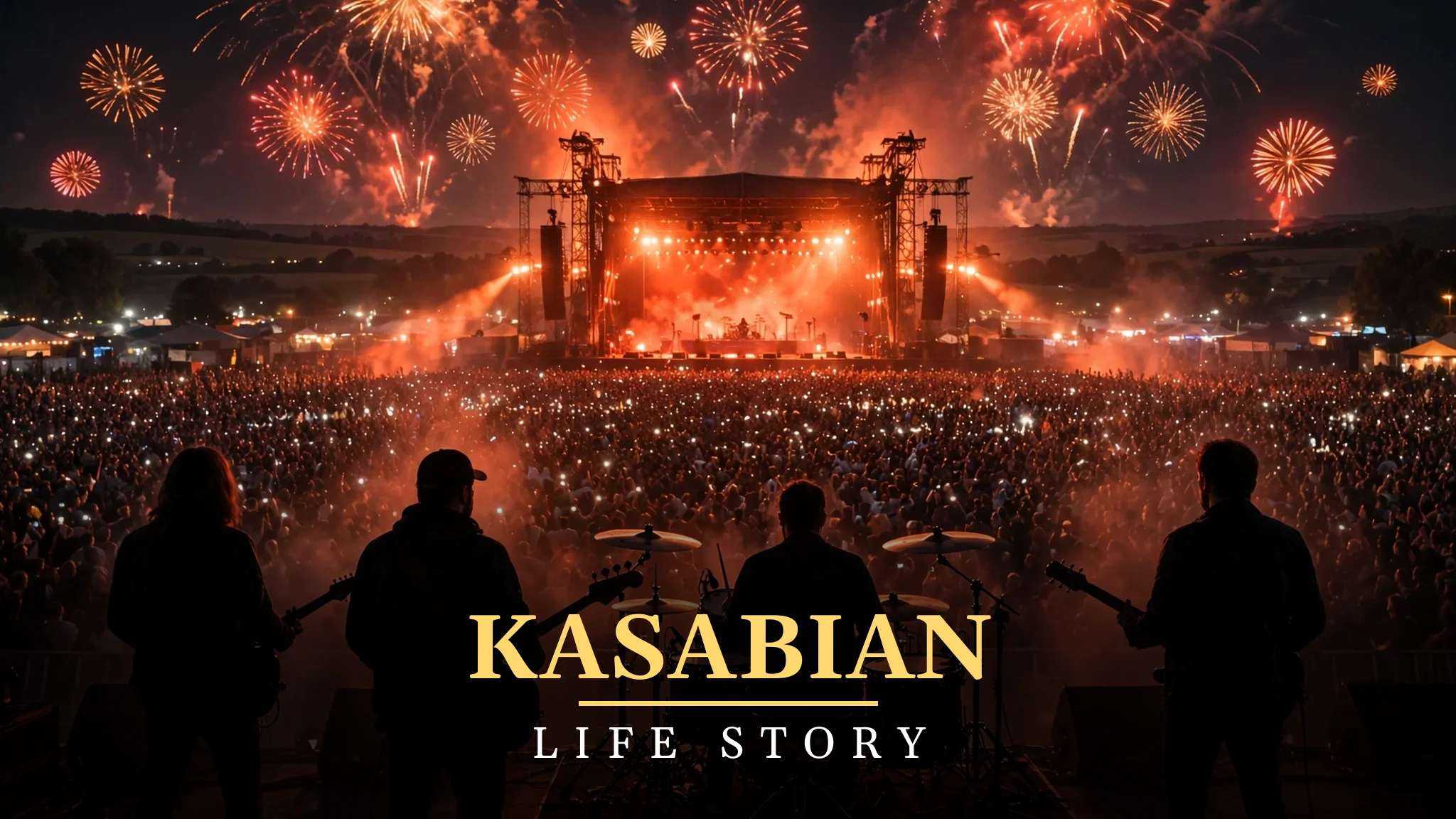
The summer of 2014 brought the biggest moment of the band’s career so far. Kasabian headlined the Pyramid Stage at Glastonbury, the largest festival in Britain, on the Sunday night. It was the moment every British band dreams of, and the band played a huge set to a vast crowd. The headline slot confirmed what many people already believed, that Kasabian were one of the biggest live bands in the country.
The Glastonbury headline was also a personal moment for the band. They had spent nearly twenty years working towards it, from small rooms in Leicester to the biggest stage in British music. The show was watched by millions on television, and it became the defining image of the band. For a group that had always believed it belonged at the top, it was proof that the belief had been right.
For Crying Out Loud and the Later Years
After Glastonbury, Kasabian continued with their sixth album, For Crying Out Loud, released in 2017. The record was more direct and guitar-led than the one before it, and it reached number one in Britain, giving the band their sixth number one album in a row. Singles like You Are in Love and Ill Ray of Hope showed that the band could still write songs that connected with a wide audience.
The band toured the album widely, playing arenas and festivals, and they seemed settled as one of Britain’s most reliable big rock acts. They had a catalogue of songs that crowds knew by heart, and their shows had a shape that fans loved. They were no longer the young band from Leicester trying to get noticed. They were an established headliner, and they played like one.
During these years the band also worked on other projects. Sergio Pizzorno wrote music for films and worked on solo material, and the band’s members pursued their own interests. But Kasabian remained the centre of their work, and the band’s identity was still built around the partnership between Tom Meighan’s voice and Sergio Pizzorno’s songs. That partnership had lasted for more than twenty years, and it seemed unbreakable.
The later years of this period were also a time of change in British music. Rock bands were no longer at the centre of the charts in the way they had been, and festivals were booking a wider range of acts. Kasabian’s ability to keep filling arenas in this changing landscape showed how strong their connection with their audience was. Their fans had grown up with them, and they kept coming back.
A Sudden Break and a New Voice
In July 2020, Kasabian announced that Tom Meighan was leaving the band. The news came after Meighan had been convicted in court of assaulting his former partner, and he pleaded guilty to the offence. The band said that Meighan was stepping away so that he could deal with his personal issues, and they made it clear that they did not accept his behaviour. It was a painful and difficult moment for the band, and for their fans, who had followed Meighan’s voice for more than twenty years.
The loss of a singer is one of the hardest things a band can face, because the voice is often the first thing people recognise. For Kasabian, the change was even harder because Meighan had been the face of the band on stage. The remaining members had to decide whether to stop or to carry on, and they chose to carry on. Sergio Pizzorno, who had always written the songs, took over as the band’s lead singer.
The decision was not easy, and the band knew that some fans would not accept the change. But they believed that the songs were strong enough to carry the band forward, and that the band’s identity was bigger than one person. They began to play live again with Pizzorno singing, and they found that audiences were willing to give them a chance. The shows were different, but the energy was still there.
The band also had to face the public reaction to Meighan’s departure. Many fans were angry and upset, and the band did not try to hide from that. They spoke honestly about the situation and said that they had made the right choice. It was a test of the band’s character, and it showed that they were willing to make a hard decision rather than pretend nothing had happened.
The Alchemist’s Euphoria and Carrying On
Kasabian’s first album with Sergio Pizzorno as lead singer, The Alchemist’s Euphoria, was released in August 2022. It reached number one in Britain, giving the band their seventh number one album, and it showed that the new line-up could work. Singles like Scriptvre and Alygatyr had a fresh energy, and the album mixed the band’s rock sound with electronic and dance elements in a way that felt like a new start.
The album’s success was important because it proved that Kasabian could survive the loss of their singer. Many bands would have stopped, but Kasabian kept going, and their audience stayed with them. The tours that followed were full of the same energy as before, and the band played both new songs and old favourites, with Pizzorno singing songs that Meighan had once sung.
Kasabian have continued to tour and record since then, and their story is now one of survival as much as success. They have had number one albums in three different decades, they have headlined Glastonbury, and they have kept a loyal audience through a major change. Their later work may not have the same surprise as their early records, but it has the weight of a band that has been through a lot and kept going.
In the end, Kasabian’s legacy is built on their songs and their live shows. Fire, Club Foot, Empire and Underdog are songs that will be played for years, and their Glastonbury headline will be remembered as one of the great moments of British rock. They are a band that came from an ordinary city, believed in themselves, and made it to the top, and then found a way to carry on when the top changed beneath them.
Songs in Sport, Film and Everyday British Life
Kasabian’s songs have become part of everyday life in Britain in a way that few bands can match. Fire is played at football matches, at sports events and on television, and it has become a song that people associate with big moments. When a crowd sings Fire together, it feels like a shared celebration, and that is a sign that a song has moved beyond the band that wrote it. It has become a piece of public music, owned by everyone who sings it.
Club Foot has also had a long life outside the band’s own shows. It has been used in films, in television programmes and in video games, and it has become a song that people recognise even if they do not know the band’s name. The song’s slow build and sudden explosion make it perfect for a dramatic moment, and directors and producers have used it again and again. That is a compliment to the song, because it means the music can carry a scene on its own.
Sergio Pizzorno has also worked outside Kasabian, writing music for films and working on solo material. His interest in cinema has shaped the band’s sound, which has always had a dramatic and visual quality. The band’s songs often feel like scenes from a film, with characters, with tension and with a sense of scale. That cinematic feeling is part of why their music works so well in films and on television, and why it has travelled so far.
The band’s visual style has also been important. Their record sleeves, their videos and their stage designs have all been made with a sense of drama, and they have often used bold images and strong colours. The cover art for their albums, from the stark design of Kasabian to the rich imagery of West Ryder Pauper Lunatic Asylum, has given each record its own identity. A band that cares about how its music looks as well as how it sounds is a band that respects its audience.
Kasabian have also been recognised by the music industry in ways that go beyond chart positions. They have won Brit Awards, they have been shortlisted for the Mercury Prize, and they have been praised by other musicians. Other bands have said that Kasabian are one of the best live acts in Britain, and that praise matters, because it comes from people who know how hard it is to play well night after night. It is one thing to be loved by fans, and another to be respected by your peers, and Kasabian have earned both.
The band’s connection with Leicester has also remained strong. They have played homecoming shows in the city, they have supported local causes, and they have spoken about their roots with pride. For a band that became famous around the world, that loyalty to home is rare, and it is why their fans in Leicester love them so much. They did not forget where they came from, and they did not pretend to be from somewhere else. They are a Leicester band, and they are proud of it.
Their songs have also found new listeners through streaming, where a playlist can bring a band to someone who has never heard of them. A young listener today might find Fire on a sports playlist, or Club Foot on a driving playlist, and then go back to hear the whole catalogue. That is a new way for music to travel, and it has helped Kasabian reach people in countries where they have never toured. Their music now belongs to a wider world than the Leicester scene where it began.
In the end, the wider story of Kasabian is a story of a band whose songs became part of public life. They did not just write good songs. They wrote songs that people use to mark big moments, to celebrate, and to feel alive. That is why their fans are so loyal, and why their music still matters. A band whose songs are sung by crowds at football matches has done something that few bands ever do, and Kasabian have done it again and again.
Before they were Kasabian, the band played under the name Saracuse, and they spent their early years playing small shows in Leicester and learning how to be a band. They changed their name after coming across the name Kasabian, taken from Linda Kasabian, and the new name gave them a fresh start. It was a small change, but it mattered, because a band’s name is the first thing people hear, and Kasabian sounded mysterious and strong. With the new name came a new confidence, and the band began writing the songs that would make their first album.
Sergio Pizzorno has also released music under his own name, as The S.L.P., and his solo album arrived in 2019. It included the song Favourites, featuring the rapper Little Simz, and it showed a different side of his songwriting, more playful and more electronic than Kasabian’s big rock anthems. The project gave him space to try ideas that might not have fitted the band, and it showed that he was not just a guitarist. He was a songwriter with many different voices, and the solo record let people hear them.
In 2024 Kasabian released Happenings, their eighth album and their second with Sergio as the singer. The record included the single Call, and it was shorter and sharper than the albums that came before it, with ten songs that moved quickly from one to the next. It showed that the band still had energy after twenty years, and that they were still willing to change. They toured the record at festivals and in arenas, and their audiences included both old fans who had followed them since the start and young listeners who had found them through streaming.
My Take:
When I think about Kasabian, the first thing I feel is the size of their ambition. I have always liked bands that want to be big and are not ashamed of it, because too many bands pretend they do not care about success when they clearly do. Kasabian never pretended. They wanted to headline Glastonbury, they wanted number one albums, and they worked until they got them. I admire that honesty, because it takes courage to say what you want and then go after it in public.
I also admire Sergio Pizzorno as a songwriter. I think he is one of the best British songwriters of his generation, not because every song is perfect, but because his songs have a shape and a swagger that you can recognise at once. When I hear Club Foot or Fire, I know what band it is within seconds, and that is a rare thing. A lot of modern rock sounds the same, but Kasabian always sounded like themselves, and I think that is because Sergio writes with a clear idea of what the band should be.
There is something I find powerful about Fire. I remember hearing it for the first time and feeling the energy of it, the way the song builds and then lets go. It is a song that makes you want to move, and it is also a song that makes you feel part of something bigger when a whole crowd sings it together. I think that is what Kasabian do best. They write songs that work in a crowd, and they understand that a great rock song is not just for listening alone. It is for sharing.
I also think about the band’s roots in Leicester, and how much it must have meant to them to come from a city that is not known for rock stars. I think it is easy to start a band in London, where everyone is watching, but it is harder to start in a smaller city and still believe you can reach the top. Kasabian believed, and they proved that a band can come from anywhere. That matters to me, because it tells young people in ordinary towns that their dreams are not silly.
The Glastonbury headline is the moment I keep returning to. I think about what it must have felt like for four men from Leicester to walk onto the Pyramid Stage on a Sunday night and see a sea of people waiting for them. I think about the years of small rooms and long drives that led to that night, and I think it must have felt like the end of a long road. I am glad they got that moment, because they earned it, and because it showed that hard work over many years can still be rewarded.
I also have to think honestly about Tom Meighan’s departure, because it is the hardest part of the story. I think the band did the right thing by asking him to leave, and I think it was brave to do it in public when it would have been easier to stay quiet. A band that keeps a singer after such behaviour is telling its fans that the music matters more than the person who was hurt, and Kasabian did not do that. I respect them for it, even though it must have been painful to lose a friend and a bandmate of more than twenty years.
I also think about Sergio stepping up to sing, and how hard that must have been. I imagine him standing on stage, singing songs that another man had sung for decades, and wondering if the crowd would accept him. I think it takes real courage to do that, because the easy choice would have been to stop. He chose to carry on, and I think the band is better for it, because it shows that Kasabian is not just one voice. It is a group of songs, a sound, and a shared history.
What I find sad in their story is that the original line-up will never play together again. I think about the early years, when the four of them were young and full of hope, and I wish that story could have ended differently. But life does not always give us the ending we want, and I think the band’s decision to carry on is a kind of answer to that sadness. They did not let one person’s actions end the whole band, and they did not let the past erase the future.
I also admire the way Kasabian mix rock and dance music. I think many rock bands are afraid of dance music, as if it makes them less serious, but Kasabian never had that fear. They used beats and electronics to make their songs move, and the result was music that worked in a club as well as in a rock venue. I think that openness is one of the reasons they lasted so long, because they were willing to take sounds from outside rock and make them their own.
There is a lesson in Kasabian for anyone who wants to build something that lasts. The lesson is that you need a clear sound, a strong songwriter, and a willingness to keep going when things change. Kasabian had all three. They had a sound that people recognised, they had Sergio writing songs year after year, and they had the strength to rebuild after losing their singer. I think many bands fail because they lack one of those things, and Kasabian survived because they had them all.
I also think about their fans, and how loyal they have been. I think Kasabian fans are the kind of people who have followed the band for twenty years, who know every word of every song, and who still go to the shows with the same excitement. That loyalty is not given lightly. It is earned by a band that shows up, plays hard, and respects its audience. Kasabian have earned it, and I think their fans have earned the band’s respect in return.
In the end, I think Kasabian teach us that success is not a straight line. It is a road with turns, with highs like Glastonbury and lows like the loss of a singer, and the test is whether you keep walking. Kasabian kept walking. They changed, they adapted, and they kept making music that mattered to them and to their fans. I would tell a young band to look at Kasabian and see that the goal is not just to get to the top. The goal is to stay there with your dignity intact, and to keep going when the road gets hard.
I will remember Kasabian as a band that sounded like a Friday night. Their music has the energy of a crowd, the swagger of a band that believes in itself, and the warmth of a group that came from an ordinary place and made it extraordinary. Even now, when I hear Fire, I feel the same lift I felt the first time, and I think that is the mark of a great rock band. They made songs that still move people, and they kept going when it would have been easier to stop.
I also think about the way Kasabian’s songs are used at football matches, and how much that must mean to the band. I imagine sitting in a stadium, hearing Fire start, and watching thousands of people stand up and sing along. It must feel strange to write a song in a small room in Leicester and then hear it sung by a whole stadium, and I think it must also feel wonderful. That is the moment when a song stops belonging to the band and starts belonging to everyone.
I also admire the way Club Foot has been used in films and in video games. I think it is a sign that a song has a life beyond the band when other people want to use it to tell their own stories. Club Foot has that life, because it builds slowly and then explodes, and that shape works for a dramatic scene. When I hear it in a film, I feel the same lift I felt when I first heard it on record, and I think that is a mark of a great song.
There is something I find hopeful about Sergio’s work in film music, because it shows that he is not just a rock songwriter. He is a musician who cares about sound, about mood, and about telling a story with music. I think that is why Kasabian’s songs feel so cinematic, because they were written by someone who thinks in images as well as in words. I like that, because it tells me that the band are looking outwards, not just inwards.
I also think about the band’s connection with Leicester, and how much it must mean to them to play homecoming shows there. I imagine walking onto a stage in your home city, seeing faces you have known for years, and playing the songs that took you away from that city and then brought you back. It must feel like a circle closing, and I think it must be one of the most emotional moments in a band’s life. Kasabian have had that moment many times, and I am glad they have.
What I find most impressive about their later work is the way they have kept their audience while changing their singer. I think about Sergio stepping up to sing, and how hard that must have been, and I think it must have taken a lot of courage to stand on stage and sing songs that another man had sung for decades. But the band took that risk, and their fans followed them. I think that is because the fans trust the band, and that trust was earned over many years of honest work.
I also think about the younger bands who have been influenced by Kasabian, and how much that must mean to them. I imagine a young guitarist in Leicester or in Manchester hearing Kasabian for the first time and thinking that a band can be big and confident and still be honest. That is a powerful idea, and I think Kasabian have given it to a whole generation of musicians. Their influence is not just in their songs. It is in the permission they give other bands to be ambitious.
There is a sadness in the way rock music has changed, where guitar bands are no longer at the centre of the charts in the way they once were. I think Kasabian have felt that change, because they came from a time when rock bands could be the biggest acts in the country. But I also think their best songs survive that change, because a great song works even when the fashion changes. Fire works today, and it will work in ten years, because it was written with energy and with heart.
In the end, I think the wider story of Kasabian is a story of songs that became part of public life. They wrote music that people use to celebrate, to feel alive, and to mark big moments, and that is a wonderful thing for a band to give people. I would tell a young musician to look at Kasabian and see that a song can be more than just a record. It can be a part of people’s lives, and that is the highest compliment a band can receive.
I also think about the band’s early days as Saracuse, and how much a name can matter. I imagine a young band in Leicester, playing to small rooms, and realising that their name does not fit the music they want to make. Changing a name takes courage, because it means starting again, but Kasabian did it, and the new name suited them. I think that is a lesson for any young band. Do not be afraid to change something that is not working, even if it feels like a big step.
I also admire Sergio’s solo record as The S.L.P., because I think it shows how much he cares about trying new things. I remember hearing Favourites with Little Simz and thinking that this was a different Sergio, lighter and more playful than the man on stage with Kasabian. That is a sign of a great musician, that he can be two different artists at once, and both of them work. I think the solo record made Kasabian better too, because it gave Sergio new ideas to bring back to the band.
There is something I find hopeful about Happenings, because it is a short and sharp record from a band that has been going for twenty years. I think many bands slow down as they get older, but Kasabian made a record that moves quickly, and that tells me they still enjoy what they do. I would tell a young musician to listen to that album and notice how energy is a choice, not just a gift of youth. Kasabian chose energy, and their music is better for it.
Frequently Asked Questions
Where are Kasabian from and when did they form?
Kasabian were formed in Leicester, England, in 1997. The band’s core members, Tom Meighan, Sergio Pizzorno and Chris Edwards, started playing together there and spent several years rehearsing before they released their first album.
What are Kasabian’s biggest songs?
Their best-known songs include Club Foot, L.S.F., Empire, Fire and Underdog. Fire became their biggest hit, reaching the top three in Britain, while Club Foot remains one of their most played live songs.
When did Kasabian headline Glastonbury?
Kasabian headlined the Pyramid Stage at Glastonbury on the Sunday night in June 2014. It was the biggest show of their career and confirmed their place as one of Britain’s top live rock bands.
Why did Tom Meighan leave Kasabian?
Tom Meighan left the band in July 2020 after he was convicted in court of assaulting his former partner. The band said he was stepping away to deal with his personal issues, and Sergio Pizzorno took over as lead singer.
Who sings for Kasabian now?
Sergio Pizzorno, who has always been the band’s main songwriter and guitarist, became the lead singer after Tom Meighan left. He sang on The Alchemist’s Euphoria, released in 2022, which reached number one in Britain.
How many number one albums have Kasabian had?
Kasabian have had seven number one albums in Britain, from Empire in 2006 through to The Alchemist’s Euphoria in 2022. Their run of chart-topping albums spans three decades.


