Kevin Bacon: The Life Story Behind the Footloose Star
In this post
- A Philadelphia Childhood in a House Full of Ideas
- New York, Theatre School, and the First Small Parts
- Footloose and the Sudden Weight of Fame
- A Few Good Men, Apollo 13, and the Working Actor
- Mystic River, the Six Degrees Game, and a Second Peak
- Music, Family, and Life Beyond the Screen
- Why Kevin Bacon Still Matters
- My Take:
Kevin Bacon is one of those actors who seems to have been in everything. If you have watched American films at any point in the last forty years, you have almost certainly seen his face. He was the dancing teenager in Footloose, the worried engineer in Apollo 13, the haunted detective in Mystic River, and the cold villain in X-Men: First Class. He has played heroes, villains, fathers, criminals, and ordinary men, and he has made each of them feel real. What makes him unusual is not just the length of his career. It is the way he has stayed working, year after year, without ever becoming a prisoner of one role.
He was born in Philadelphia, the youngest of six children in a family that valued books, art, and public life. His father was a respected city planner, and his mother was a teacher and a community activist. The house was full of talk about ideas, and young Kevin grew up listening to adults who believed that work should mean something. He found his own path early, through the theatre, and by the time he was a teenager he knew that acting was what he wanted to do. He left Philadelphia for New York while he was still young, and he began the slow, uncertain climb that every young actor faces.
The strange thing about Kevin Bacon is that his name became famous in a way that had nothing to do with any single film. People began to play a game called Six Degrees of Kevin Bacon, based on the idea that any actor in Hollywood could be connected to him through a short chain of films. The game was a joke, but it carried a real truth inside it. Bacon had worked with so many people, in so many different kinds of films, that he had become a kind of centre point for the whole industry. He took the joke in good spirit, and he even used it to raise money for charity. This is the story of a working actor who became a household name by simply never stopping.
A Philadelphia Childhood in a House Full of Ideas
Kevin Norwood Bacon was born on 8 July 1958 in Philadelphia, Pennsylvania. His father, Edmund Bacon, was an architect and city planner who helped shape the modern look of Philadelphia, and his mother, Ruth Hilda Holmes, was a teacher who cared deeply about social causes. Kevin was the youngest of six children, and the family home was a busy, talkative place. There were books everywhere, there were arguments about politics and art at the dinner table, and there was a strong sense that a person should use their talents for something good. Growing up as the youngest child meant that he watched his older brothers and sisters go out into the world first, and he learned a great deal simply by watching them.
Philadelphia in the 1960s was a city with a strong sense of its own history, and the Bacon family was part of its civic life. Edmund Bacon was a public figure in the city, a man who believed that good planning could make life better for ordinary people. Ruth Bacon was active in community work, and she taught her children to care about the world beyond their own front door. For a boy like Kevin, this was both a gift and a weight. He grew up with high expectations, but he also grew up with the knowledge that his parents believed in him. The house gave him confidence, and it gave him a sense of purpose that would stay with him long after he left home.
As a child, Kevin was drawn to performing. He liked to make people laugh, he liked to be the centre of attention at family gatherings, and he discovered that acting gave him a way to express feelings that were hard to put into ordinary words. His older siblings had their own interests, but Kevin found his own corner of the world on a stage. He took part in school plays, and he began to understand that acting was not just about pretending. It was about listening, about watching people, and about finding the truth in a character. The more he performed, the more certain he became that this was the life he wanted.
The decision to become an actor was not an easy one for a boy from a serious, intellectual family. Acting was uncertain, poorly paid at the start, and full of rejection. But Kevin’s parents supported him, and they understood that a young person must follow what they love. When he was still a teenager, he began to take the idea seriously. He studied the work of actors he admired, he went to the theatre whenever he could, and he started to think about how he might get from Philadelphia to the stages of New York. The road ahead was long, and he knew it, but he also knew that he would rather try and fail than spend his life wondering what might have been.
New York, Theatre School, and the First Small Parts
At the age of seventeen, Kevin Bacon left Philadelphia and moved to New York City to study acting. He enrolled at the Circle in the Square Theatre School, a respected school that taught actors through practical stage work rather than through theory alone. New York in the mid-1970s was a hard place for a young actor. The city was rough, money was tight, and there were thousands of talented young people competing for a small number of jobs. Bacon lived simply, he worked at whatever jobs he could find, and he spent his days in classes, rehearsals, and auditions. It was a life of small hopes and frequent disappointment, and it taught him the patience that every working actor needs.
His first break came in the theatre, where he appeared in stage productions that gave him a chance to learn his craft in front of a live audience. Theatre is a hard teacher. There is no second take, no camera to hide behind, and no editor to save a weak performance. An actor on stage must be present, must listen, and must keep going even when something goes wrong. Bacon learned these lessons early, and they stayed with him. He also learned how to work with other actors, how to take direction, and how to keep a performance fresh night after night. These skills would serve him well for the rest of his career, in film and television as much as on stage.
His first film role came in 1978, in the comedy Animal House, where he played a small part as Chip Diller, a clean-cut college student. The film became a huge success, and although Bacon’s role was small, it put him on the screen for the first time. He followed it with a role in the horror film Friday the 13th in 1980, a film that became famous in its own right. These early parts were not the kind of roles that make a star, but they were important. They gave him experience on a film set, they taught him how a camera works, and they put his face in front of audiences. For a young actor, every small part is a step forward, and Bacon took each one seriously.
The early 1980s brought more work, and more chances to show what he could do. He appeared in the film Diner in 1982, a warm and funny story about a group of young men in Baltimore, directed by Barry Levinson. The film was praised by critics, and Bacon’s performance as Timothy Fenwick Jr. showed that he could play a complex, troubled young man with real feeling. Diner was the kind of film that actors remember with pride, because it was about real people and real friendship. It also brought Bacon to the attention of directors and casting agents who were looking for young actors with depth. He was no longer just a face in the crowd. He was an actor to watch.
Footloose and the Sudden Weight of Fame
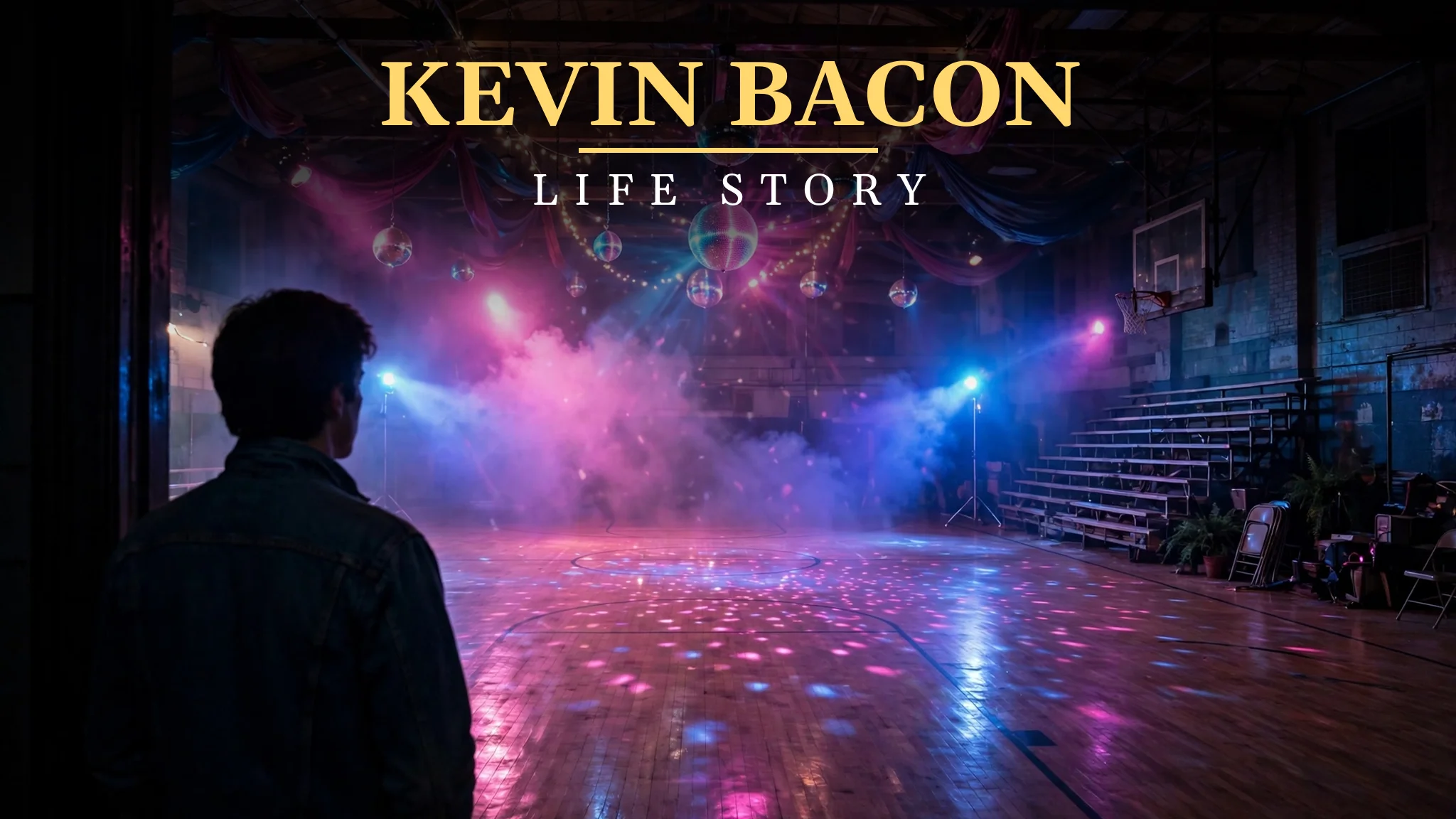
In 1984, Kevin Bacon starred in Footloose, and his life changed. He played Ren McCormack, a teenager from Chicago who moves to a small town where dancing and rock music have been banned by the local authorities. Ren is angry, restless, and full of energy, and he decides to fight the ban. The film was a huge box office success, and its soundtrack became one of the best-selling albums of the decade. Bacon danced, he fought, he argued with the town’s minister, and he became a star. For millions of young people, he was the face of rebellion, the boy who would not accept a rule that made no sense.
The fame that followed Footloose was sudden and intense. Bacon was recognised everywhere, and the film made him one of the most famous young actors in America. But fame of that kind can be a trap. An actor who becomes famous for one role can find it hard to be offered anything else. Directors see the dancer, not the actor, and audiences expect the same performance again and again. Bacon understood this danger, and he made a conscious choice to avoid it. He turned down roles that would have repeated the Footloose formula, and he looked for parts that were different, darker, and more challenging. It was a brave choice, because it meant turning down easy money, but it was also a wise one.
In the years after Footloose, he worked steadily, but he did not chase another blockbuster. He appeared in films such as Quicksilver in 1986, where he played a bicycle messenger, and White Water Summer, and he took roles on stage as well. He was building a career as a character actor, the kind of actor who can play many different people, rather than as a movie star who plays the same person in every film. This choice meant that his name was not always at the top of the poster, but it also meant that he was free. He could choose interesting work, he could work with directors he respected, and he could keep growing as an actor instead of standing still.
The late 1980s tested his patience. He was still famous, but he was not always the leading man, and some of the films he made did not do well. It would have been easy to become bitter, or to give up and take any role that paid well. Bacon did neither. He kept working, he kept learning, and he waited for the right parts. He married the actress Kyra Sedgwick in 1988, and the two of them built a life together that was grounded in family rather than in fame. That stability mattered. It gave him a home to return to, and it gave him a reason to keep going when the work was slow.
A Few Good Men, Apollo 13, and the Working Actor
The 1990s brought Kevin Bacon a new kind of success. He was no longer the young star of Footloose. He was a grown man, a husband, a father, and an actor with a deep understanding of his craft. In 1992, he appeared in A Few Good Men, playing a military lawyer in a film that starred Tom Cruise, Jack Nicholson, and Demi Moore. His role was not the biggest in the film, but it was important, and he played it with a quiet authority that showed how much he had grown. The film was a major success, and it reminded audiences and directors that Bacon was an actor of real substance.
In 1995, he appeared in Apollo 13, the story of the American space mission that went wrong and the men who brought the crew home safely. Bacon played Jack Swigert, one of the three astronauts, alongside Tom Hanks and Bill Paxton. The film was praised for its accuracy and its tension, and it became one of the most loved films of the decade. Bacon’s performance was careful and human. He played a man who was scared, who was professional, and who was determined to survive. It was the kind of role that required an actor to be believable rather than flashy, and Bacon was exactly right for it. The film earned him new respect, and it showed that he could hold his own alongside the biggest stars in Hollywood.
In the same period, he took on darker and more difficult roles. In 1996, he played a prison guard in Sleepers, a disturbing and powerful film about a group of boys who suffer abuse in a reform school. The role was deeply unpleasant, and Bacon played it without softening the character. It was a brave performance, because audiences might have hated him for it, but it was also an honest one. He was not afraid to play a villain, and he was not afraid to show the ugly side of human nature. That willingness to take risks became one of the marks of his career.
By the end of the 1990s, Bacon had built something rare in Hollywood. He had a career that did not depend on being young, or handsome, or the star of a blockbuster. He had a reputation as a reliable, talented actor who could be trusted with any part. Directors knew that he would show up prepared, that he would work hard, and that he would make the film better. That reputation is worth more than any single hit, because it lasts. It is the reason he was still working in the 2000s, in the 2010s, and beyond, while many of his contemporaries had faded away.
Mystic River, the Six Degrees Game, and a Second Peak
In 2003, Kevin Bacon gave one of the finest performances of his career in Mystic River, directed by Clint Eastwood. He played Sean Devine, a Boston detective trying to solve a murder that pulls three old friends back into each other’s lives. The film also starred Sean Penn and Tim Robbins, and it was praised around the world for its power and its sadness. Bacon’s performance was quiet and steady. He played a man who had grown up in a tough neighbourhood, who had become a policeman, and who was trying to do the right thing in a case where every choice seemed wrong. The film earned him some of the best reviews of his life, and it showed that he was at the height of his powers as an actor.
Around the same time, something unusual happened to Bacon’s name. A group of students had invented a parlour game called Six Degrees of Kevin Bacon, based on the idea that any actor could be linked to Bacon through a chain of no more than six films. The game became popular on the internet, and it turned Bacon into a kind of joke, a symbol of how connected Hollywood really is. Some actors might have been annoyed by this. Bacon was not. He laughed at it, he talked about it in interviews, and he eventually turned it into something useful. He started a charity called SixDegrees.org, which used the idea of connection to help people find and support charities. The joke had become a force for good, and Bacon had shown that he could take a strange kind of fame and use it well.
The 2000s also brought him success on television. He starred in the crime series The Following, playing a retired FBI agent hunting a serial killer, and later in City on a Hill, where he played a corrupt FBI agent in Boston. Television gave him a chance to develop a character over many hours, rather than in a single film, and he made the most of it. He also won a Golden Globe Award in 2010 for his performance in the television film Taking Chance, in which he played a Marine officer who escorts the body of a fallen soldier home. It was a quiet, respectful film, and Bacon’s performance was full of dignity. The award was a recognition of decades of honest work.
He also kept working in film, taking roles in big movies and small ones. In 2011, he played the villain Sebastian Shaw in X-Men: First Class, a part that asked him to be charming, ruthless, and frightening at the same time. He did it with ease, and younger audiences who had never seen Footloose discovered him for the first time. He appeared in comedies, in thrillers, in dramas, and in independent films. The range of his work was remarkable, and it was the result of a simple rule he had followed since the 1980s. He said yes to interesting work, and he said no to work that would trap him.
Music, Family, and Life Beyond the Screen
Away from acting, Kevin Bacon has always had a second life in music. He and his older brother Michael formed a band called The Bacon Brothers, and they have performed together for many years. The band plays a mix of rock, folk, and country, and it tours across America, playing in small theatres and clubs. For Bacon, music is not a hobby to show off. It is a real part of his life, a way to connect with audiences in a different way, and a way to spend time with his brother. The two of them write songs together, they perform together, and they have built a loyal following of people who come to hear the music, not the movie star.
His family life has been the centre of everything. He married Kyra Sedgwick in 1988, and the two of them have been together ever since, which is rare in Hollywood. They have two children, Travis and Sosie, and they have raised their family in a way that kept them grounded. Bacon has often said that his marriage is the most important part of his life, and he has lived as if he believed it. He and Sedgwick have worked together on films and on television, and they have supported each other’s careers without letting fame damage their home. In an industry where marriages often fall apart under pressure, theirs has lasted, and that is an achievement in its own right.
Bacon has also been open about the hard times. He has talked about the years when work was slow, about the fear of being forgotten, and about the money he lost in a financial fraud that affected many people. He did not hide these things, and he did not pretend that his life had been easy. He spoke about them honestly, and he kept working. That honesty is part of why people like him. He does not present himself as a perfect star. He presents himself as a working man who has had good luck and bad luck, and who has kept going through both.
In recent years, he has continued to act, to make music, and to use his name for charity. He has appeared in films and television shows, he has directed, and he has stayed close to his family. He is no longer the young dancer from Footloose, and he does not try to be. He is a man in his sixties who has built a long and varied career, and who still finds joy in the work. That is a rare and happy ending for a Hollywood story, and it is one that he earned by making good choices, one after another, for many years.
Why Kevin Bacon Still Matters
Kevin Bacon matters because he represents a kind of actor that Hollywood needs but does not always celebrate. He is not the biggest star, he is not the most famous name, and he is not the man on every magazine cover. He is something more useful. He is the actor who shows up, who does the work, who makes every film better, and who keeps going for decades. Young actors can learn more from his career than from the career of any single blockbuster star, because his career shows how to survive. It shows that you do not need one huge hit to have a good life in acting. You need talent, you need patience, and you need the courage to choose interesting work over easy money.
He also matters because of the way he handled fame. The Six Degrees game could have made him bitter. It could have made him feel that people were laughing at him. Instead, he laughed with them, and he turned the joke into a charity that has helped many people. That is a rare kind of wisdom. It takes a secure person to accept a joke about themselves, and it takes a generous person to turn that joke into help for others. Bacon did both, and he did it without making a big show of it.
His films will last. Footloose will still be watched by young people who want to dance and who want to fight a stupid rule. Apollo 13 will still be watched by people who love a true story of courage. Mystic River will still be watched by people who want to see great acting. And somewhere, in a small theatre or a living room, a young actor will watch Kevin Bacon and understand that a career is not made in one night. It is made in hundreds of small choices, made over many years, by a person who loves the work and refuses to give up.
My Take:
When I think about Kevin Bacon, the first thing I feel is respect, and the second thing I feel is a kind of comfort. He is not a star who makes me feel small, the way some huge celebrities do. He is an actor who makes me feel that hard work can actually lead somewhere. He started as a teenager from Philadelphia with a dream, and he is still working in his sixties, still acting, still making music, still finding new things to do. That is not a story about luck. Luck can give you one hit, but it cannot give you forty years of work. Forty years of work comes from showing up, from being prepared, from treating people well, and from making good choices again and again.
I admire the choice he made after Footloose more than almost anything else in his career. Think about what that moment must have felt like. He was young, he was famous, and the whole world was offering him money to dance again, to play the same boy again, to be the same star again. It would have been so easy to say yes. The money was there, the fame was there, and the audience wanted it. He said no. He chose smaller films, harder roles, and a slower path. That takes a kind of courage that I do not think people talk about enough. It is easy to be brave when you have nothing to lose. It is much harder to be brave when you have everything to lose, and you give it up anyway because you know it is the right thing for your future.
I also admire his marriage, and I do not say that lightly. Hollywood is full of short marriages, of people who fall in love fast and fall out of love faster, of couples who are destroyed by fame, by travel, by jealousy, and by the pressure of living in public. Kevin Bacon and Kyra Sedgwick have been married since 1988. That is more than thirty-five years. They raised two children, they worked together, they supported each other, and they stayed. I think that tells me more about who he is than any film role ever could. A man can play a hero on screen and be a selfish person at home. Bacon seems to have done the opposite. He played all kinds of people on screen, good and bad, and at home he was steady, loyal, and present. That is a real achievement.
What I find most interesting about him is the Six Degrees game, because it says something true about the world, not just about Hollywood. The game says that we are all connected, that the distance between any two people is smaller than we think, and that a single person can be a bridge between many different worlds. Bacon could have been angry about it. He could have said that it reduced his whole career to a joke. Instead, he saw the truth inside the joke, and he used it to help people. He built a charity on the idea that connection is a good thing, that if we are all linked, then we can all help each other. I think that is a beautiful idea, and I think it shows a generous mind. He did not need to do that. He could have ignored the game and gone on with his life. He chose to make something good out of it, and that choice says a lot about his character.
I also think about his work in music, because it shows me that he is not a person who needs to be the centre of attention all the time. In The Bacon Brothers, he is not a movie star. He is one half of a band, playing music with his brother, in small venues, for people who love the songs. That is a humble thing to do, and I respect it. Many actors would never do something that puts them in a smaller room, with a smaller audience, doing something they are less famous for. Bacon does it because he loves music, and because he loves playing with his brother. That is a man who knows what he enjoys, and who does not need the biggest stage to be happy.
There is a sadness in his story too, and I do not want to pretend it is not there. He has spoken about losing money in a fraud, about the fear that comes when work slows down, and about the pressure of being known for one role when you have so much more to give. I think about the years after Footloose, when he was working hard but not always getting the recognition he deserved. That must have been frustrating. He was a good actor, he was doing good work, and yet some people still saw him only as the dancing boy. I respect the way he handled that frustration. He did not complain in public, he did not become bitter, and he did not quit. He just kept working, and eventually the work spoke for itself. Mystic River, Apollo 13, Taking Chance, City on a Hill, these are the answers to anyone who doubted him. He did not need to argue. He just needed to keep acting.
If I have a criticism, it is a small one, and it is really about Hollywood rather than about Bacon himself. I wish he had been given more leading roles in great films in the 1990s, when he was at his best. He was good enough to carry a film on his own, and he proved it in Footloose when he was young, but after that, Hollywood often used him as a supporting actor, as the friend, the brother, the detective, the second man. That is not a bad thing, because he was wonderful in those roles, but I do wonder what might have happened if one more great director had trusted him with a leading part at the height of his powers. The answer, I think, is that he would have been just as good, and the film would have been better for it. But this is not really a complaint. He built a great career anyway, and he did it on his own terms.
What I learn from Kevin Bacon is a lesson about patience. In a world that tells young people to become famous fast, to go viral, to get rich young, his career says something different. It says that you can build a life slowly, one good choice at a time, and that the slow path can take you further than the fast one. He did not become a star overnight and then disappear. He became a working actor, and he stayed a working actor, and that is a bigger achievement than any single hit. I think about young actors who are starting out now, and I wish they would look at his career, because it shows them that there is a way to survive in a hard business without losing yourself.
I also learn something about humility from him. He has been famous for forty years, and yet he still seems like a normal person. He talks about his family, he talks about his band, he talks about his charity, and he does not act as if he is above anyone else. That is rare. Fame can make people arrogant, and it can make them cruel, but it did not do that to him. I think that is because he had a good family, a good marriage, and a good sense of who he was before he became famous. He knew that he was a boy from Philadelphia who loved to act, and fame did not change that. It just gave him more chances to do what he loved.
When I watch his films now, I see a man who got better with age. The young Bacon in Footloose is full of energy, and that is wonderful to watch. The older Bacon in Mystic River is full of depth, and that is even better. He learned how to do less on screen, how to let a small look or a quiet pause say more than a loud speech. That is the mark of a great actor, and it only comes with time. I think his best work is still ahead of him in the eyes of some people, because he keeps surprising us, and I hope he keeps working for many more years.
In the end, I think Kevin Bacon teaches us that a good career is not about one moment of glory. It is about a lifetime of honest work, about choosing well, about loving your family, about helping others when you can, and about never giving up on the thing you love. He could have been a one-hit wonder. He could have been a forgotten child star. He could have been a bitter man who never got the recognition he deserved. He is none of those things. He is a working actor, a musician, a husband, a father, and a man who turned a joke about his name into a charity. That is a life well lived, and it is a story worth telling.
One more thought stays with me. The Six Degrees game says that everyone is connected to Kevin Bacon, and in a way, that is true of all of us. We are all connected to each other, through work, through family, through friends, through the small choices we make every day. Bacon understood that, and he used it to do good. I think that is the best lesson in his whole story. Fame is not about being above other people. It is about being connected to them, and using that connection to help. He did that, and I admire him for it.
I also think about the way Bacon handled being a father in the public eye. His children grew up with a famous father, and that is not an easy thing. Children of stars often struggle, because they live in a shadow, because people expect them to be like their parents, or because they resent the attention. Travis and Sosie Bacon have both built their own lives, in music and in acting, and they have done it on their own terms. That tells me that Bacon and Sedgwick raised them well, that they gave them room to be themselves, and that they protected them from the worst of Hollywood. A father who can do that, while working in a business that eats families alive, deserves great respect.
Another thing that stays with me is his work in Taking Chance, because it is a film about dignity, about a soldier who died, and about the man who brings him home. Bacon played that Marine officer with a quiet respect that is hard to watch without feeling moved. He did not overact. He stood, he listened, he folded a flag, and he let the silence do the work. That performance won him a Golden Globe, and it should have won him more, because it is a masterclass in restraint. It shows what he learned over forty years: that sometimes the most powerful thing an actor can do is almost nothing at all.
I keep returning to the idea that Bacon’s career is a map for anyone who wants to last. He did not chase the biggest paycheque. He did not chase the loudest role. He chose work that interested him, he worked with people he respected, and he kept his family at the centre of his life. That is not a glamorous formula, and it will not make you a billionaire, but it will give you a life you can be proud of, and a career that lasts. I think that is worth more than fame, and I think Bacon would agree.
I also think about the way Bacon has handled the strange fame of the Six Degrees game over the years, because most people would have grown tired of a joke about their own name. He did the opposite. He embraced it, he laughed at it, and he turned it into a charity that has helped real people find causes they care about. That takes a rare kind of self-awareness, the ability to see yourself as the world sees you and to find the good in it rather than the insult. He could have complained, or he could have ignored it. Instead he built something useful out of it, and that is a lesson in how to take whatever life hands you, even a joke, and turn it into something that helps others. It is also a reminder that fame is not something that happens to you. It is something you choose how to use, and Bacon chose to use it well, with humour, with generosity, and with a clear sense of what matters most in life.
Frequently Asked Questions
How did Kevin Bacon first become famous?
Kevin Bacon became famous in 1984 when he starred as Ren McCormack in the film Footloose, playing a teenager who fights a small town’s ban on dancing. The film was a huge box office hit, and its soundtrack became one of the best-selling albums of the decade.
What is the Six Degrees of Kevin Bacon game?
The Six Degrees of Kevin Bacon is a parlour game based on the idea that any actor in Hollywood can be linked to Kevin Bacon through a chain of no more than six films. Bacon later used the idea to start a charity called SixDegrees.org, which helps people find and support good causes.
Who is Kevin Bacon married to?
Kevin Bacon has been married to the actress Kyra Sedgwick since 1988. They have two children, a son named Travis and a daughter named Sosie, and they have often worked together on films and television.
What are Kevin Bacon’s most famous films besides Footloose?
His most famous films include Apollo 13, in which he played astronaut Jack Swigert, Mystic River, in which he played detective Sean Devine, A Few Good Men, Sleepers, and X-Men: First Class, in which he played the villain Sebastian Shaw.
Did Kevin Bacon win a Golden Globe Award?
Yes, he won a Golden Globe Award in 2010 for his performance in the television film Taking Chance, in which he played a Marine officer who escorts the body of a fallen soldier home to his family.
What is The Bacon Brothers?
The Bacon Brothers is a band formed by Kevin Bacon and his older brother Michael Bacon. They play a mix of rock, folk, and country music, write songs together, and tour across America, performing in theatres and clubs.
What television shows has Kevin Bacon starred in?
He starred in the crime series The Following as a retired FBI agent, and in City on a Hill as a Boston FBI agent. He has also appeared in many other television shows and films across a career of more than forty years.


