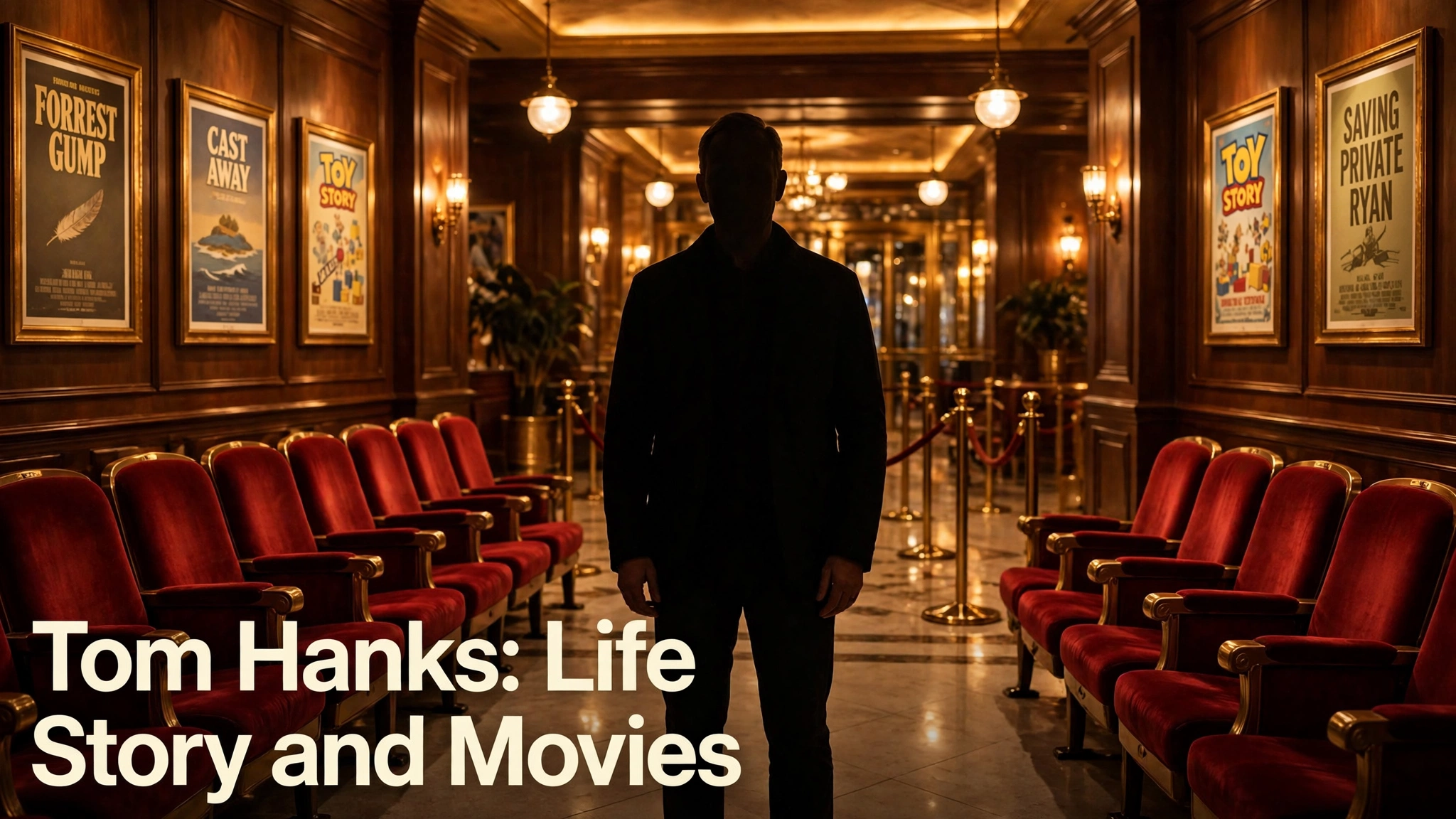
Tom Hanks: Life Story and Movies
In this post
- Early Life in California
- Television Beginnings and First Films
- From Comedy Star to Serious Actor
- Toy Story, Cast Away and a Career of Variety
- Writing, Producing and Life Beyond Acting
- Why Audiences Trust Tom Hanks
- Hanks and History: Why the Second World War Keeps Appearing
- The Typewriter, Writing and a Quieter Creativity
- Hanks in the Streaming Era and Later Roles
- Awards, Honours and Public Service
- Hanks, Narration and the Power of Voice
- My Take:
Tom Hanks is often called one of the most trusted actors in Hollywood, and the nickname fits. For more than four decades he has played ordinary people in extraordinary situations: a soldier, a castaway, a lawyer, a teacher, a toy cowboy, and a man whose life accidentally passes through American history. His life story is less dramatic than many celebrity biographies, and that is part of its appeal. It is a story of steady work, careful choices, and a reputation built slowly rather than bought with a single hit.
Early Life in California
Thomas Jeffrey Hanks was born in Concord, California, on 9 July 1956. His father worked as a travelling cook, and his mother worked in a hospital. His parents divorced when he was young, and he moved between households during his childhood, an experience he has described as shaping his independence and his ability to adapt to new places and people. He was not a child star. He discovered acting at school and in community theatre, where he learned the basic craft of performance away from Hollywood pressure.
After school, Hanks studied theatre at a community college in California and then joined a theatre festival in Cleveland, Ohio, where he worked in productions and learned stagecraft from the ground up. This theatre training matters. Stage acting teaches projection, timing, and stamina, and it gives an actor confidence without camera tricks. When Hanks moved into television and film, he brought that stage discipline with him, and it showed in his ability to carry scenes with dialogue and character rather than only with action or special effects.
Television Beginnings and First Films
Hanks first became widely known through the television sitcom Bosom Buddies, which aired from 1980 to 1982. He played a man who dresses as a woman to live in an affordable women-only hotel, a comic premise that required energy and timing. The show was short-lived, but it introduced him to audiences and to directors who noticed his comic talent. His early films, including Splash in 1984, in which he played a man who falls in love with a mermaid, confirmed that he could lead a romantic comedy with warmth and believability.
The 1980s gave him a string of comedies, from Bachelor Party to Big, in which he played a boy trapped in an adult’s body. Big, released in 1988, earned him his first Academy Award nomination for Best Actor and showed that his comedy had emotional depth. Audiences laughed, but they also believed the character’s confusion and wonder. That combination, humour plus heart, became his signature. He was not only funny; he was relatable, and relatability is rarer and harder to sustain than a joke.
From Comedy Star to Serious Actor
The late 1980s and early 1990s marked a turning point. Hanks took on more dramatic roles and proved that his range extended far beyond comedy. In Philadelphia, released in 1993, he played a lawyer dismissed from his firm after revealing he had HIV, at a time when public understanding of the disease was still limited. The performance earned him the Academy Award for Best Actor and showed his willingness to take on socially important stories. The following year, Forrest Gump, in which he played a kind-hearted man whose life crosses major events in American history, earned him a second consecutive Academy Award for Best Actor, a rare achievement.
These two wins changed how the industry saw him. He was no longer only a comic leading man. He was a dramatic actor capable of carrying serious, emotional films. Apollo 13, in which he played astronaut Jim Lovell during a near-disaster in space, and Saving Private Ryan, in which he played a captain leading soldiers in the Second World War, reinforced that reputation. Both films were commercially successful and critically praised, and both relied on Hanks’s ability to play leadership without arrogance, a quality that audiences trusted.
Toy Story, Cast Away and a Career of Variety
Alongside live-action drama, Hanks became the voice of Woody, the cowboy toy, in Pixar’s Toy Story series, beginning in 1995. Woody’s loyalty, jealousy, and growth across the films gave Hanks a second, younger audience, and the series became one of the most beloved animated franchises in history. Voice acting requires a different skill: conveying emotion through voice alone, without face or body. Hanks’s theatre and comedy training served him well, and Woody remains one of his most recognisable roles.
In Cast Away, released in 2000, he carried almost an entire film alone as a man stranded on an island, losing weight for the role and conveying loneliness, ingenuity, and hope with minimal dialogue. The film was a commercial and critical success and earned him another Academy Award nomination. Later roles have ranged from a terminally ill prison guard in The Green Mile to a wartime captain in Greyhound, a television host in A Beautiful Day in the Neighborhood, where he played Fred Rogers, and a supporting role as a talent manager in Elvis. The variety is the point: Hanks has avoided being trapped in one genre or one image.
Writing, Producing and Life Beyond Acting
Hanks is also a writer, producer, and director. He co-created the acclaimed Second World War miniseries Band of Brothers and The Pacific, and he has written books and essays, including a collection of short stories inspired by typewriters, a hobby he is known for. His interest in history, especially the Second World War, appears repeatedly in his work, and he has supported museums and educational projects related to that history. These projects show a curiosity that extends beyond performing.
His personal life is unusually stable by Hollywood standards. He has been married to actor Rita Wilson since 1988, and they have worked together on several projects. He has spoken publicly about his family, his faith, and his health, including his diagnosis of type 2 diabetes, in a straightforward way that matches his public image. He is also known for a friendly, approachable manner with fans and colleagues, stories of which circulate widely. While no public image tells the whole story of a person, the consistency of that reputation over decades is itself notable.
Why Audiences Trust Tom Hanks
The trust audiences place in Hanks is not accidental. It comes from a pattern: he plays decent people, but not perfect people. His characters make mistakes, feel fear, and struggle with duty, and he plays those flaws without making the character unlikeable. In Saving Private Ryan, his captain is brave but exhausted. In Forrest Gump, his hero is kind but limited in understanding. In Cast Away, his survivor is resourceful but broken by isolation. Audiences recognise themselves in that mix of strength and vulnerability.
That trust also comes from his choices off screen. He has generally avoided scandal, chosen projects with care, and spoken about his work with modesty rather than self-promotion. In an industry that often rewards controversy, his steadiness stands out. Younger actors sometimes cite him as a model not only for acting, but for career management: choose good scripts, work with good directors, treat crews well, and let the work speak.
Hanks and History: Why the Second World War Keeps Appearing
A striking pattern in Hanks’s work is his repeated return to the Second World War. Saving Private Ryan, Band of Brothers, The Pacific, Greyhound, and related projects all explore that conflict from different angles: soldiers landing in Normandy, paratroopers in Europe, marines in the Pacific, and a naval captain protecting a convoy. This is not a coincidence. Hanks has spoken about his fascination with the war and about the generation that fought it, and he has supported museums and educational efforts that preserve those stories. For him, history is not background decoration; it is a subject worthy of careful, respectful storytelling.
That focus also reflects a broader cultural question: how should popular film handle war? Saving Private Ryan was praised for its realistic, harrowing opening sequence, which changed how war films were made, but it was also debated for its portrayal of heroism and sacrifice. Band of Brothers was praised for following real soldiers and for showing fear, loss, and moral complexity alongside bravery. Hanks’s approach tends to emphasise ordinary soldiers rather than generals or myths, a choice that aligns with his screen persona of decent, fallible people under pressure. Whether audiences agree with every portrayal, the consistency of his historical interest shows a performer using fame to pursue a subject he genuinely cares about, not only to collect roles.
The Typewriter, Writing and a Quieter Creativity
Beyond film, Hanks is known for collecting typewriters and for writing short stories and essays. His collection of stories, inspired by typewriters, shows a writer interested in ordinary objects and the lives attached to them. This quieter creativity matters because it reveals a side of Hanks that is not about box-office success. Writing is solitary, slow, and judged by different standards than acting, and choosing to publish stories invites a different kind of criticism. That willingness to be a beginner again, in a new field, is admirable for someone who could have stayed comfortably within film.
His writing also connects to his acting. Both depend on observation, dialogue, and empathy for ordinary people. A typewriter story about a traveller, a shopkeeper, or a soldier’s family is, in miniature, the same kind of character study that defines his best films. For readers, this is a reminder that creative people are rarely only one thing. An actor can also be a writer, a producer, and a historian, and those identities enrich each other rather than competing. Hanks’s career is fuller because he allowed himself those extra identities.
Hanks in the Streaming Era and Later Roles
Hanks’s later career coincided with the rise of streaming, which changed how films reach audiences. Greyhound, a Second World War naval drama in which he starred and which he wrote, was released on a streaming platform rather than widely in cinemas, a decision driven by the pandemic period and by changing distribution models. The film found a large streaming audience, showing that Hanks’s appeal transfers to home viewing as well as to cinemas. Other later projects, including television series and streaming films, reflect a career adapting to new platforms without abandoning theatrical work entirely.
Later roles have also shown a willingness to play less sympathetic or more complex figures. In A Man Called Otto, he played a grieving, grumpy widower whose harsh exterior hides deep loss, a role that relied on his ability to make an unlikeable character sympathetic over time. In Elvis, he played Colonel Tom Parker, the manager whose control over Elvis Presley remains controversial, a supporting role that divided critics but showed he was not afraid to play a morally ambiguous figure. These choices suggest an actor still seeking challenge in his sixties and seventies, rather than resting on a beloved image.
Awards, Honours and Public Service
Hanks has received many honours beyond Academy Awards, including the Cecil B. DeMille Award, the AFI Life Achievement Award, and the Presidential Medal of Freedom, awarded in 2016. These honours recognise not only acting but also cultural contribution, including his work in preserving Second World War history and supporting museums and education. He has also been involved in narrating documentaries and supporting space exploration history, interests that connect to his roles in Apollo 13 and his broader curiosity about American history.
Public service, for Hanks, has generally taken the form of education and remembrance rather than partisan politics, although he has expressed views publicly like many citizens. His support for the National WWII Museum and related projects reflects a belief that history should be taught through personal stories, not only through textbooks. That belief aligns with his film work, which often tells large historical events through individual characters. Whether audiences share his views or not, the consistency between his films and his public projects shows a performer whose interests and work reinforce each other.
Hanks, Narration and the Power of Voice
Beyond acting, Hanks is a distinctive narrator, lending his voice to documentaries about space, war, and American history. Narration requires a different skill from acting: the voice must guide, inform, and engage without overshadowing the images. Hanks’s warm, clear delivery makes complex topics accessible, which is why museums, broadcasters, and filmmakers seek him for narration. His work on documentaries about the Second World War and space exploration connects directly to his film roles, creating a consistent public identity as a storyteller of American history.
Voice work also includes audiobooks and animated projects beyond Toy Story, where his ability to convey character through tone alone is essential. For younger audiences, hearing a familiar, trusted voice can make a documentary or story feel welcoming rather than academic. That trust, built over decades of film performances, transfers to narration in a way that few actors achieve. It is another example of how Hanks’s career extends beyond the screen, using voice as a tool for education and remembrance as well as entertainment.
My Take:
I think Tom Hanks’s career is best understood as a lesson in patience. He did not become a dramatic star overnight. He spent years in comedy, learning timing and audience connection, before the industry trusted him with Philadelphia and Forrest Gump. That slow path is unfashionable in an age of instant fame, but it gave him something instant fame rarely gives: range. Because he had already proved he could make people laugh, his dramatic performances carried an extra warmth. Because he had worked in theatre, his film acting had discipline. Patience, in his case, was not waiting; it was training, and training compounds.
I also think his reputation for decency is both real and useful to examine. It is easy to be cynical and assume any nice public image must be an act. With Hanks, the evidence is unusually consistent: colleagues praise him, audiences trust him, and his career choices support the image. At the same time, a thoughtful reader should remember that we see a public persona, not a complete person. Admiring his work does not require believing we know him personally. That distinction keeps admiration healthy. We can love Woody and Captain Miller without pretending we know Tom Hanks at home, and that is fine.
Another angle I value is his choice of ordinary heroes. Hollywood often celebrates superheroes with powers. Hanks celebrates teachers, soldiers, astronauts, and neighbours, people whose heroism is duty, endurance, and kindness. In a culture that sometimes confuses loudness with strength, his films argue quietly for a different kind of strength: showing up, telling the truth, and protecting others when it is hard. I find that message more useful than most blockbuster morals, especially for young viewers deciding what kind of adult they want to become.
Finally, I believe Hanks’s later career shows how to age gracefully in public. He has not tried to stay a young leading man forever. He has taken older, supporting, and character roles, written books, produced history projects, and allowed his image to mature. That is a skill many stars lack, because fame rewards staying frozen in a successful image. Hanks allowed himself to change, and audiences followed him. If there is a single lesson from his life, it is this: build your reputation on work and character, not on a moment, and the work will carry you through the decades when the moment fades.
I also think Hanks’s handling of health and ageing in public is worth noting. He has spoken openly about type 2 diabetes and about the physical demands of roles such as Cast Away, where weight loss was part of the performance. That openness, without turning health into a spectacle, models a balanced approach: share enough to inform and normalise, but keep medical details private. In an age when celebrities often share every health detail for attention, or hide illness entirely, his middle path feels humane. It also reminds audiences that actors’ bodies are tools of work, and that transformations seen on screen involve real physical costs that should not be copied casually.
Another thought is about his voice work, which is often underrated. Woody is not only a funny cowboy; across four Toy Story films, Woody grows from jealousy to loyalty to letting go, an emotional arc that Hanks carries almost entirely through voice. Voice acting requires precision, because the audience cannot see the actor’s face, yet Hanks makes Woody feel fully present. That skill, honed in theatre and comedy, is a reminder that the best acting is often invisible. When a performance feels natural, it is easy to forget how much technique lies behind it, and Hanks’s career is full of such invisible technique.
Finally, I believe Hanks’s greatest legacy may be cultural rather than cinematic. He has become a shorthand for decency in popular culture, referenced in jokes, memes, and everyday conversation as the person you would trust. That shorthand is flattering, but it also carries a burden: no real person can live up to a symbol. My hope is that audiences enjoy the symbol while remembering the person behind it is a working actor who made good choices, had good luck, and kept learning. That grounded admiration is more durable than hero worship, and it is the kind of admiration Hanks himself seems to encourage by his modesty and humour.
I also want to consider Hanks as a teacher, in the broad sense. His films are often used in schools and history classes, not because they are perfect history, but because they make historical events emotionally accessible. Saving Private Ryan helps students understand the human cost of war, Apollo 13 helps them understand problem-solving under pressure, and Forrest Gump, despite its simplifications, introduces major American events through a single life. Teachers should pair films with factual sources, because drama compresses and invents, but as a starting point for curiosity, Hanks’s films are unusually effective. That educational afterlife is a form of influence that box-office numbers do not capture.
Another reflection is about his marriage and family life as a public example. Hanks and Rita Wilson have been married since 1988, a long marriage by any standard, and they have spoken about supporting each other through illness, including Wilson’s breast cancer treatment and Hanks’s diabetes management. Their public discussion of health challenges, without turning them into spectacle, models how couples can face difficulty with dignity. It also reminds audiences that behind a beloved screen image are real people dealing with ordinary human problems, a reminder that can make fame feel less distant and more human.
Finally, I think Hanks’s career offers a quiet argument for kindness as a professional strategy. Treating crews well, arriving prepared, and speaking modestly about success are not only moral choices; they are practical ones, because people want to work again with someone who is reliable and kind. In an industry known for ego, Hanks’s reputation for decency has opened doors for decades. That lesson applies far beyond Hollywood: in any workplace, kindness and reliability compound, just as talent does, and over a long career they may matter even more. If you remember one thing from his story, let it be that decency is not a weakness in a competitive field; it is a long-term advantage.
Frequently Asked Questions
When was Tom Hanks born?
Tom Hanks was born in Concord, California, on 9 July 1956, and he discovered acting through school and community theatre before working in stage productions.
What was Tom Hanks’s first famous role?
He first became widely known through the sitcom Bosom Buddies and the film Splash, before Big earned him his first Academy Award nomination for Best Actor.
Which films won Tom Hanks Academy Awards?
He won consecutive Academy Awards for Best Actor for Philadelphia, released in 1993, and Forrest Gump, released in 1994, a rare back-to-back achievement.
Is Tom Hanks the voice of Woody in Toy Story?
Yes, Tom Hanks has voiced Woody, the cowboy toy, in Pixar’s Toy Story series since the first film in 1995.
What other work has Tom Hanks done besides acting?
He has worked as a writer, producer and director, including co-creating the miniseries Band of Brothers and The Pacific, and he has written books and essays.
Why is Tom Hanks called America’s dad or a trusted actor?
The nickname reflects his long pattern of playing decent, relatable characters and his steady, scandal-free public reputation, although it describes a public image rather than a private person.