Klaus Maria Brandauer: The Life Story Behind the Austrian Acting Star
In this post
Klaus Maria Brandauer is one of the most powerful actors to come out of Austria, and he is a man who has worked on stage, in film, and as a director for more than sixty years. He was born in Bad Aussee, he grew up in Austria, he studied acting, and he became a star of the Burgtheater in Vienna, one of the most famous theatres in the German-speaking world. He then became a film star with Mephisto in 1981, a film about an actor who makes a deal with the Nazis, and he went on to work in Hollywood, in Out of Africa, in Never Say Never Again, and in many other films. He is known for his strong voice, his intense eyes, and his ability to play men who are charming, dangerous, and complex.
His story is a story about the theatre, about a man who never left the stage, even after he became a film star. He is a director, a teacher, and an actor who believes that acting is a serious art, and that a real actor must work hard, must study, and must be honest. He has won awards in Germany, Austria, and America, he has been nominated for an Oscar, and he is respected by actors and directors around the world. He is a man who has lived a long and rich life in art, and who is still working today.
This is the story of a boy from a small Austrian town who became a star of the Burgtheater, a film star in Europe and Hollywood, and a director who has shaped Austrian theatre. It is a story about talent, about discipline, about the stage, and about a man who has never stopped believing in the power of acting.
A Boy From Bad Aussee Who Loved the Stage
Klaus Maria Brandauer was born Klaus Georg Steng on 22 June 1943 in Bad Aussee, a small town in Styria, Austria, during the Second World War. His mother was a teacher, and his father was a civil servant, and he grew up in a modest home in a beautiful part of Austria, surrounded by mountains, lakes, and forests. He was a boy who liked to perform, who liked to tell stories, and who had a natural gift for acting. He was lively, he was curious, and he was drawn to the theatre from an early age. He watched plays, he listened to stories, and he imagined himself on a stage.
As a young man, he studied acting at the Hochschule für Musik und Darstellende Kunst in Stuttgart, Germany, and he began to work in theatre. He was a student who took his craft seriously, who studied, who rehearsed, and who learned from his teachers. He was not a young man who wanted quick fame. He wanted to learn how to act, how to use his voice, how to move on stage, and how to tell a story with truth. He worked in theatres in Germany, and he built a reputation as a talented and serious young actor. He was learning his craft step by step, and that slow learning gave him a strong foundation.
He also changed his name, taking the name Brandauer from his mother’s family, and adding Maria as a middle name. The name Klaus Maria Brandauer is unusual, and it is memorable, and it suits a man who is both strong and sensitive, both a leading man and a character actor. He was a young actor with a new name, a new style, and a clear ambition: to become a great stage actor, and to work in the best theatres in the German-speaking world. He was on his way, and he was doing it with hard work and with talent.
The most important thing about those early years is that Brandauer came from a small town, not from Vienna or Berlin, and he had to work his way up. He was not born into a famous acting family. He was a boy from Bad Aussee who loved the stage, and who worked hard to get there. That background gave him a sense of humility, a sense of discipline, and a love of hard work that stayed with him for the rest of his career. The boy from the mountains had become a man of the theatre, and he would spend his life on stage and on screen.
The Burgtheater and a Life on Stage
In the 1970s, Klaus Maria Brandauer became a member of the Burgtheater in Vienna, one of the most prestigious theatres in the German-speaking world. The Burgtheater is a theatre with a long history, a theatre where the greatest German-speaking actors have worked, and Brandauer became one of its leading actors. He played in plays by Shakespeare, by Schiller, by Goethe, and by modern writers, and he was praised for his power, his voice, and his ability to hold an audience. He was a stage actor in the truest sense, a man who could fill a large theatre with his presence, and who could make a play feel alive and real.
He worked with great directors, he worked with great actors, and he learned more with each play. He was known as an actor who rehearsed a great deal, who studied his roles, and who gave everything to a performance. He was not an actor who relied on charm alone. He relied on hard work, on discipline, and on a deep understanding of the text. He played kings, villains, lovers, and fools, and he played them all with a power that made audiences remember him. The Burgtheater became his home, and he returned to it again and again throughout his life, even after he became a film star.
He also worked as a director in theatre, and he directed plays in Vienna, in Salzburg, and in other cities. He was a director who cared about the text, about the actors, and about the truth of a play. He was a man who loved theatre, and who believed that theatre is the most important form of acting, because it is live, it is direct, and it cannot hide. He taught young actors, he worked with students, and he shared his knowledge with the next generation. He was not only a star. He was a teacher, and a man who wanted theatre to live on.
His work at the Burgtheater gave him a reputation as one of the great stage actors of his time. He was a man who had come from a small town, who had studied, who had worked hard, and who had become a leading actor in one of the greatest theatres in Europe. That is a remarkable achievement, and it is a legacy that he is proud of. The stage was his first love, and it remained his first love, even after film made him famous around the world.
Mephisto and the Breakthrough in Film
Klaus Maria Brandauer became a film star with Mephisto, made in 1981 and directed by István Szabó. The film tells the story of Hendrik Höfgen, a German actor in the 1930s who makes a deal with the Nazi regime in order to become a star. Höfgen is a talented actor, a charming man, and a man who is willing to compromise his principles for fame. Brandauer played him with great power, showing a man who is both attractive and troubling, both talented and weak. The film won the Oscar for Best Foreign Language Film, and Brandauer’s performance was praised around the world. It was a breakthrough, and it made him a film star.
The role of Höfgen was perfect for Brandauer, because it was about an actor, about the theatre, and about the choices that artists make when they live under a dictatorship. Brandauer understood that world, because he was an actor himself, and he understood the temptation of fame, the pressure to succeed, and the cost of compromise. He played Höfgen not as a simple villain, but as a complex man, a man who loves acting, who wants to be a star, and who slowly loses himself. That complexity made the film powerful, and it made Brandauer’s performance unforgettable. It remains one of his most famous roles, and it is still studied today.
After Mephisto, he worked in many films in Europe and in Hollywood. He starred in Colonel Redl in 1985, also directed by István Szabó, a film about an officer in the Austro-Hungarian Empire, and his performance was again praised. He worked with directors in Germany, Austria, Hungary, and France, and he became known as an actor who could play complex, intelligent, and dangerous men. He was not a simple Hollywood star. He was a European actor who brought depth, intelligence, and a strong stage presence to film. Mephisto had opened the door to film, and he walked through it with skill and with courage.
The success of Mephisto also showed that Brandauer was more than a stage actor. He was a film actor who could hold the camera, who could show feeling with a look, and who could make a character feel real on screen. He was a man who had learned his craft on stage, and who now used that craft in film. That combination of stage training and film talent made him a unique actor, and it is why his performances are still remembered. The boy from Bad Aussee had become a world-famous film star, and he had done it with a role about an actor who sells his soul for fame.
Out of Africa, Never Say Never Again, and Hollywood
In the 1980s, Klaus Maria Brandauer worked in Hollywood, and he became known to audiences around the world. He starred in Never Say Never Again in 1983, a James Bond film in which he played Maximilian Largo, the villain who faces Sean Connery as Bond. The film was a success, and Brandauer’s performance as Largo was praised for its charm, its intelligence, and its danger. He was not a simple villain. He was a sophisticated, wealthy, and clever man, and he played him with a style that made him memorable. He was a Bond villain who was also a gentleman, and that made him interesting.
He also starred in Out of Africa in 1985, a film directed by Sydney Pollack, starring Meryl Streep and Robert Redford. Brandauer played Bror Blixen, the husband of Karen Blixen, played by Streep. The film was a huge success, it won the Oscar for Best Picture, and Brandauer was nominated for the Oscar for Best Supporting Actor. His performance was praised for its warmth, its humour, and its sadness. He played a man who is charming, who is flawed, and who is loved despite his faults. It was a role that showed his range, and it made him a star in Hollywood.
He worked in other Hollywood films, including The Russia House in 1990, a spy film based on the novel by John le Carré, in which he played with Sean Connery again. He was a man who could work in Hollywood, in English, and hold his own with the biggest stars. But he never left Europe, and he never left the theatre. He returned to Vienna, to the Burgtheater, and to his work as a director and teacher. He was a Hollywood star who remained a European artist, and that balance made him special. He was not seduced by Hollywood. He used Hollywood, and then he came home.
His Hollywood years showed that he could be a world star, but they also showed that he was a man who knew where he belonged. He belonged on stage, in Vienna, in the theatre, and in European film. He was a star who had seen Hollywood, who had worked there, and who had chosen to return. That choice is a sign of a man who knows himself, who knows what matters, and who is not afraid to say no to fame. He was a great actor, and he was a man of integrity.
Directing, Teaching, and a Long Career
Klaus Maria Brandauer has also worked as a director, in theatre and in film, and he has taught young actors. He directed the film Georg Elser in 1989, a film about the man who tried to kill Hitler, and he directed plays in Vienna and Salzburg. He was a director who cared about history, about truth, and about the power of a story. He was a man who wanted to tell stories that mattered, and he did it both as an actor and as a director. He was not content to only act. He wanted to shape a whole production, to work with actors, and to create a world on stage and on screen.
He has also been a teacher, working with young actors at the Max Reinhardt Seminar in Vienna, one of the most famous acting schools in the German-speaking world. He has shared his knowledge, his experience, and his love of theatre with students, and he has helped to train the next generation of actors. He is a man who believes that acting is a craft that must be learned, practised, and passed on, and he has done that with generosity. He is not only a star. He is a mentor, and a man who cares about the future of theatre.
In his later years, he has continued to act, to direct, and to work in theatre and film. He has appeared in films and television, he has played older men with power and with wisdom, and he has been honoured with awards in Austria and Germany. He was married to Karin Brandauer, a director and writer, until her death in 1992, and he has a son, Christian. He lives in Austria, he works, and he continues to be a presence in the cultural life of Vienna. He is a man who has spent his life in art, and who is still doing it, even in his eighties.
His long career is a testament to his talent, his discipline, and his love of acting. He began in a small town, he studied, he worked in theatre, he became a film star, he worked in Hollywood, and he returned to Vienna to direct and to teach. He has done it all, and he has done it with integrity. He is a man who has never stopped learning, never stopped working, and never stopped believing in the power of theatre and film.
A Legacy of Power and Integrity
Klaus Maria Brandauer’s legacy is a legacy of power, integrity, and a love of theatre. He is one of the great stage actors of his time, a man who filled the Burgtheater with his presence, and a film actor who made Mephisto, Out of Africa, and Never Say Never Again into memorable films. He won awards, he was nominated for an Oscar, and he is respected by actors and directors around the world. He showed that a stage actor can become a film star, and that a film star can return to the stage, and that both are part of the same art.
His legacy is also in the students he has taught, in the plays he has directed, and in the theatre he has helped to shape. He is a man who has given back to the theatre, who has shared his knowledge, and who has helped young actors to find their way. That is a legacy that lasts longer than any single performance, because it lives on in the work of others. He is a teacher as well as a star, and that makes his legacy richer.
He is remembered in Austria as a great actor, a director, and a cultural figure. His name is associated with the Burgtheater, with Mephisto, and with a long career that has spanned more than sixty years. He is a son of Bad Aussee who became a star of Vienna, and a star of the world, and he did it with talent, with hard work, and with integrity. That is a legacy worth celebrating, and a life worth honouring.
The Actor Who Asks What Fame Costs
Mephisto is not only a film about an actor in Nazi Germany. It is a film about a question that every artist must ask: what will you give up for fame? Hendrik Höfgen gives up his principles, his friends, and his soul, in order to become a star, and Brandauer plays him so well that the audience understands the temptation. He is charming, he is talented, and he wants to be loved, and those are human desires. But the film shows the cost of those desires, and it shows that fame can be a trap. Brandauer understood that question, because he was an actor himself, and he knew the pressure to succeed, the desire to be a star, and the temptation to compromise. His performance is powerful because it is personal, because he brings his own understanding of acting into the role.
His work in theatre also asked that question. He played in plays about power, about ambition, and about the choices that people make, and he did it with a power that made audiences think. He was a stage actor who believed that theatre should ask hard questions, not only entertain. He directed plays, he taught students, and he shared his belief that acting is a serious art, one that should tell the truth, even when the truth is hard. That belief is a part of his legacy, and it is why his work is still studied. He was not an actor who only wanted applause. He was an actor who wanted to make people think, and Mephisto is the best example of that.
His Hollywood work also showed that question. He played a Bond villain, he played a husband in Out of Africa, and he was nominated for an Oscar, but he did not let Hollywood trap him. He came back to Vienna, to the Burgtheater, and to teaching, because he knew that fame in Hollywood is not the same as a life in art. He chose art, and that choice is a lesson for anyone who wants fame: ask what it costs, and decide if you are willing to pay it. Brandauer asked that question in his work, and he answered it by staying true to theatre.
My Take:
When I think about Klaus Maria Brandauer, I think about power, and I think about a voice that can fill a theatre. He is an actor who does not whisper. He speaks, he moves, and he holds an audience with a strength that is rare. When I watch him in Mephisto, I see a man who is charming, who is talented, and who is also willing to make a deal with evil in order to be a star. That is a hard role to play, because the character is not a simple villain. He is a man who loves acting, who wants to be famous, and who slowly loses his soul. Brandauer plays him with a power that makes you understand him, even when you do not agree with him. I admire that, because it takes a great actor to make an audience understand a difficult man, and to make them think about the choices that artists make.
I think about his background, about a boy from Bad Aussee, a small town in the mountains, who became a star of the Burgtheater. That is a long journey, and it took hard work, discipline, and a love of theatre. He did not come from a famous family. He came from a modest home, he studied, he worked in small theatres, and he built his career step by step. I respect that, because it shows that talent can come from anywhere, and that hard work matters more than where you were born. He was a boy from the mountains who became a man of the theatre, and that story is inspiring for anyone who comes from a small place and dreams of a bigger stage.
What impresses me most is that he never left the theatre, even after he became a film star. Many actors leave the stage when they become famous in film, because film pays more, because it is easier, and because it makes you famous around the world. Brandauer did the opposite. He kept returning to the Burgtheater, he kept directing plays, he kept teaching young actors, and he kept believing that theatre is the home of acting. I think that is a wise and brave choice, because theatre is live, it is honest, and it cannot hide behind editing. It asks an actor to be present, to be real, and to work with other actors in real time. Brandauer understood that, and he stayed true to it. That tells me that he is a man who cares about his craft, not only about fame.
I also think about his Hollywood work, about Never Say Never Again and Out of Africa, and I am struck by how well he did in Hollywood without losing himself. He played a Bond villain, he played a husband in Out of Africa, and he was nominated for an Oscar, but he did not become a Hollywood star who forgot Europe. He came back to Vienna, to the theatre, and to his work as a director and teacher. That is a sign of a man who knows who he is, who knows where he belongs, and who is not seduced by fame. I admire that, because it is easy to be seduced by Hollywood, by money, by fame, and by the bright lights. Brandauer was not seduced. He used Hollywood, and then he came home. That is integrity, and it is a lesson I want to remember.
There is something else I keep thinking about, and it is his work as a teacher. He has taught young actors, he has shared his knowledge, and he has helped the next generation. That is a generous thing to do, and it is a sign of a man who cares about the future, not only about his own career. Many stars keep their knowledge to themselves, but Brandauer shared it. He taught at the Max Reinhardt Seminar, he directed plays, and he worked with students. I think that is a beautiful part of his legacy, because it means that his work will live on in the actors he taught, in the plays he directed, and in the theatre he helped to shape. A star who teaches is a star who gives back, and that is a kind of greatness that lasts.
I think about Mephisto again, and about the question it asks: what would you give up for fame? Hendrik Höfgen gives up his principles, his friends, and his soul, in order to become a star. Brandauer plays him so well that we understand the temptation, and we also see the cost. That is a powerful lesson, and it is a lesson that is still relevant today, when many people want fame, want followers, want to be stars, and are willing to compromise to get it. Brandauer’s performance reminds us that fame has a price, and that price can be very high. I think we should remember that, and we should ask ourselves what we are willing to give up, and what we are not. That is a question worth asking, and Mephisto asks it better than almost any other film.
If I compare Brandauer with other actors of his time, I think what makes him special is his power. He is not a quiet actor. He is a powerful actor, a man who can fill a stage, a man who can hold a camera, and a man who can make a character feel large and real. That power comes from his stage training, from his voice, from his body, and from his understanding of a role. He is an actor who gives everything to a performance, and that giving shows. I think that is a lesson for young actors: give everything, work hard, study, and do not be afraid to be powerful. Acting is not about being small or safe. It is about being true, and being true can be powerful.
For a young reader, I think the lesson is to learn your craft, to work hard, and to stay true to what you love. Brandauer learned his craft in theatre, he worked hard, he studied, and he stayed true to theatre even after film made him famous. He did not chase fame for its own sake. He chased good work, and fame followed. That tells me that if you focus on doing good work, on learning, and on being honest, you will have a long and happy career. It may not come quickly, but it will come, and it will be real. Brandauer’s career has lasted more than sixty years, and that long career is more impressive than any single film or award.
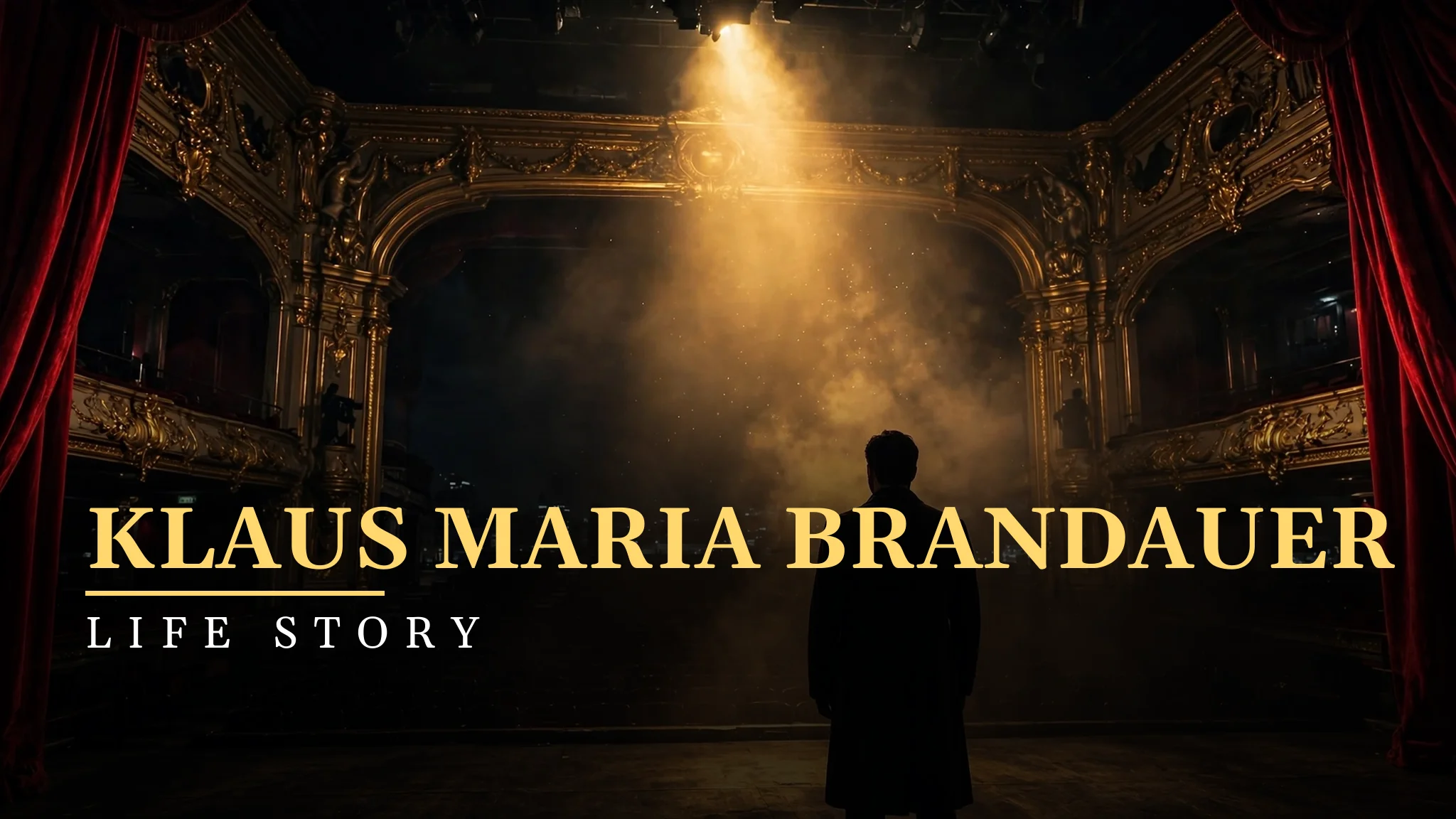
I keep thinking about the image of Brandauer alone on a grand stage, facing empty seats under a single spotlight, and I think it fits him. He is a man of the theatre, a man who stands alone on a stage and faces an audience, and who is not afraid. That image is a symbol of his life: a man who has spent his life on stage, who has faced audiences, who has told stories, and who has done it with power and with integrity. I wish him well, I wish him more work, and I wish him a life where he can continue to act, to direct, and to teach. He is a star who has lasted, and he deserves to be celebrated for that.
In the end, I think Klaus Maria Brandauer teaches us that theatre matters, that acting is a serious art, and that a life spent in art, with discipline, with integrity, and with a love of the stage, is a good life. He was a boy from Bad Aussee who became a star of the Burgtheater, a film star in Europe and Hollywood, and a teacher who has shaped the next generation. He did not have a short or simple career. He had a long, rich, and varied career, and he is still living it. That is a legacy I respect, and a life I want to honour.
One more thought stays with me, and it is about his name, Klaus Maria Brandauer. It is an unusual name, a name that is both strong and soft, both masculine and feminine, and it suits a man who can play many kinds of characters. He is a man who is not afraid to be complex, to be both strong and sensitive, and to show many sides of himself. That complexity is a gift, and it is a gift that he has used well in his acting. I think we should all be a little more complex, a little more open, and a little more willing to show who we really are. Brandauer did, and his work is richer for it.
I think about Mephisto, and I feel the weight of the question it asks: what would you give up for fame? Hendrik Höfgen gives up his principles, his friends, and his soul, and Brandauer plays him so well that we understand the temptation. He is charming, talented, and he wants to be loved, and those are human desires. But the film shows the cost, and it shows that fame can be a trap. I think we should all ask ourselves that question, and Brandauer’s performance helps us to ask it. He was an actor playing an actor, and he understood the temptation from the inside, and that understanding made his performance unforgettable.
I also think about his power as a stage actor, about a voice that can fill a theatre, and about a presence that can hold an audience. He was a man who could stand alone on a stage and face empty seats under a single spotlight, and not be afraid. That image is a symbol of his life: a man of the theatre, a man who is not afraid to be alone, to be powerful, and to tell a story. I admire that power, because it comes from hard work, from discipline, and from a love of theatre that has never faded. He is an actor who gives everything to a performance, and that giving shows.
There is a generosity in his work as a teacher that I love. He has taught young actors, he has shared his knowledge, and he has helped the next generation to find their way. Many stars keep their knowledge to themselves, but Brandauer shared it. He taught at the Max Reinhardt Seminar, he directed plays, and he worked with students. That generosity is a sign of a man who cares about the future, not only about his own career. I think that is a beautiful part of his legacy, because it means his work will live on in the actors he taught.
I think about his Hollywood years, about Never Say Never Again and Out of Africa, and I am struck by how well he did without losing himself. He played a Bond villain, he was nominated for an Oscar, and he came back to Vienna. That is a sign of a man who knows who he is, who knows where he belongs, and who is not seduced by fame. I admire that integrity, because it is easy to be seduced by Hollywood, by money, and by bright lights. Brandauer was not seduced. He used Hollywood, and then he came home. That is a lesson I want to remember.
Another thought stays with me, and it is about his name, Klaus Maria Brandauer. It is an unusual name, both strong and soft, and it suits a man who can play many kinds of characters. He is a man who is not afraid to be complex, to be both strong and sensitive, and to show many sides of himself. That complexity is a gift, and it is a gift he has used well in his acting. I think we should all be a little more complex, a little more open, and a little more willing to show who we really are. Brandauer did, and his work is richer for it.
I keep thinking about the theatre, about red velvet curtains, about a single spotlight, and about a man standing alone on a stage. That is Brandauer’s world, and it is a world I respect. He is a man who has spent his life on stage, who has faced audiences, who has told stories, and who has done it with power and integrity. I wish him well, and I hope he continues to act, to direct, and to teach for many more years. He is a star who has lasted, and he deserves to be celebrated.
Frequently Asked Questions
When was Klaus Maria Brandauer born?
Klaus Maria Brandauer was born Klaus Georg Steng on 22 June 1943 in Bad Aussee, Styria, Austria, during the Second World War.
What film made Klaus Maria Brandauer famous?
Mephisto, made in 1981 and directed by István Szabó, made him a film star. He played Hendrik Höfgen, an actor who makes a deal with the Nazi regime, and the film won the Oscar for Best Foreign Language Film.
Was Klaus Maria Brandauer nominated for an Oscar?
Yes, he was nominated for the Oscar for Best Supporting Actor for Out of Africa in 1985, in which he played Bror Blixen, the husband of Karen Blixen, played by Meryl Streep.
What role did Klaus Maria Brandauer play in a James Bond film?
He played Maximilian Largo, the villain, in Never Say Never Again in 1983, facing Sean Connery as James Bond. His performance was praised for its charm and intelligence.
Where did Klaus Maria Brandauer work in theatre?
He became a leading actor at the Burgtheater in Vienna, one of the most prestigious theatres in the German-speaking world, and he has worked there, directed there, and taught young actors throughout his career.
Did Klaus Maria Brandauer work as a director?
Yes, he directed films including Georg Elser in 1989, and he has directed plays in Vienna and Salzburg, as well as teaching at the Max Reinhardt Seminar in Vienna.
Is Klaus Maria Brandauer still working today?
Yes, he continues to act, direct, and teach in Austria, and he remains a respected figure in Austrian theatre and film in his eighties.


