Kraftwerk: The Life Story Behind the Electronic Music Pioneers
In this post
- Two Students in Düsseldorf
- Autobahn and the Sound of the Future
- The Man-Machine, Computer World, and a Lasting Legacy
- Tour de France, The Mix, and the Quiet Years
- 3-D Concerts, Museums, and a Living Legend
- The Kling Klang Studio and a Life of Work
- The Legacy of the Pioneers
- Robots, The Model, and a Vision of Tomorrow
- My Take:
Kraftwerk changed music more than almost any other band in history, and they did it without guitars, without drums, and without shouting. They used machines, synthesisers, and computers, and they made music that sounded like the future. When they released Autobahn in 1974, a song about driving on a German motorway, no one had heard anything like it. It was electronic, it was robotic, and it was beautiful. It was the sound of a new world, and it would influence almost every kind of modern music, from hip hop to techno to pop.
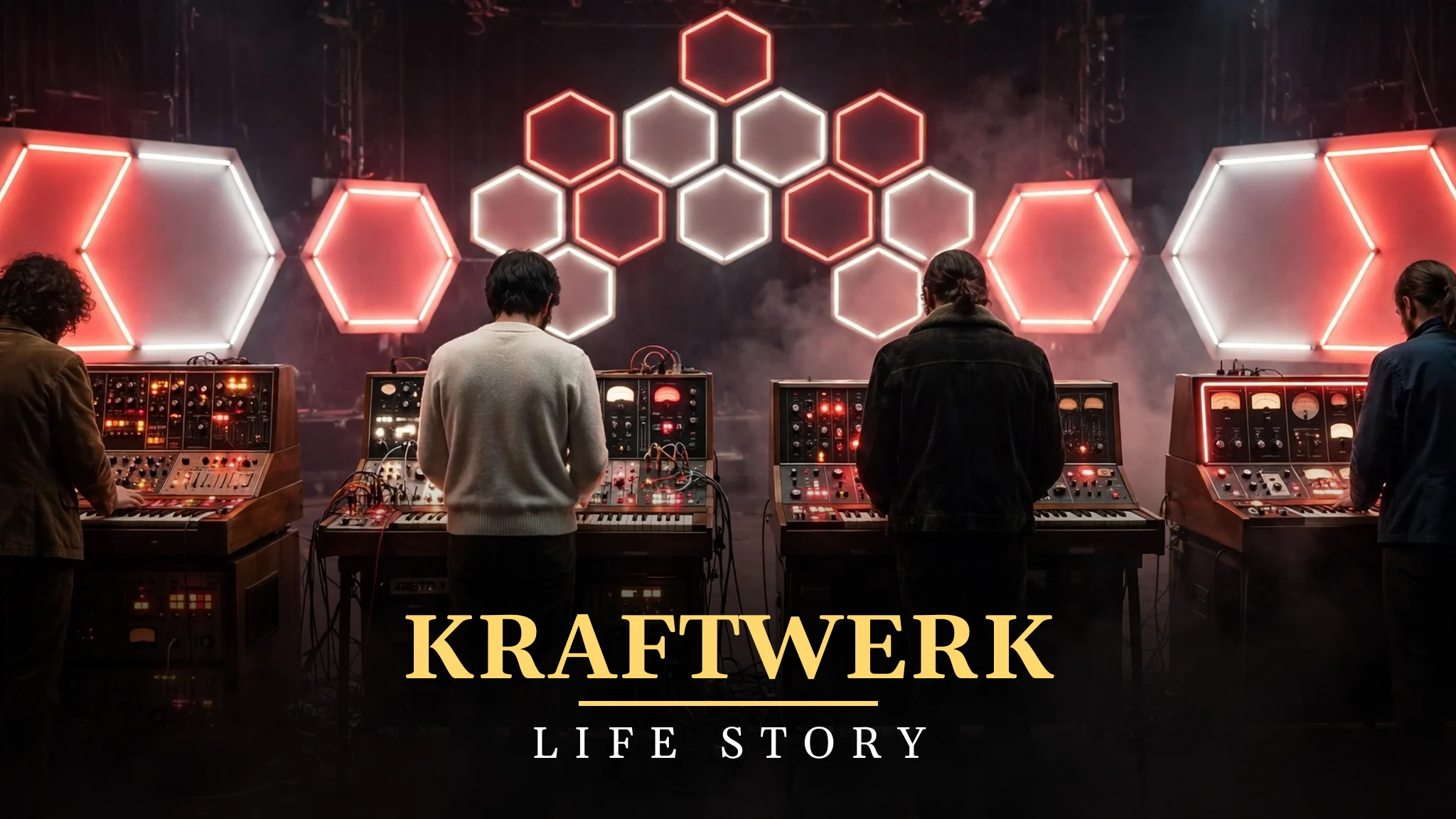
Kraftwerk was formed in Düsseldorf in 1970 by Ralf Hütter and Florian Schneider, two young musicians who wanted to make a new kind of German music. They did not want to copy American or British rock. They wanted to make music that was German, that was about machines, about cities, about the modern world, and about the future. They built a studio called Kling Klang, they built their own instruments, and they created a sound that was entirely their own.
Their influence is hard to overstate. Without Kraftwerk, there would be no electronic dance music as we know it, no hip hop sampling, no synth pop, and no techno. They were pioneers, and they were ahead of their time by decades. This is the story of how two men from Düsseldorf built machines that changed music forever, and how their band became a legend.
Two Students in Düsseldorf
Kraftwerk was formed in Düsseldorf in 1970 by Ralf Hütter and Florian Schneider, two young men who had met at a music school in the city. Düsseldorf was a city in western Germany, on the River Rhine, and it was a centre of art and culture. Hütter and Schneider were both interested in experimental music, in art, and in the idea of making something new. They did not want to play rock music like everyone else. They wanted to make music that was German, modern, and different.
Florian Schneider came from a wealthy family, and his father was an architect. Ralf Hütter was also from a comfortable background, and both men had a good education. They were not working-class musicians. They were artists, and they thought about music as art. They listened to the experimental music of the time, they were interested in the sounds of machines, and they began to experiment with electronic instruments. It was a new world, and they were at the front of it.
In the early years, Kraftwerk was not a pop band. They were an experimental group, and they made long and strange pieces of music with flutes, guitars, and early electronic instruments. Their first albums, released in the early 1970s, were not commercial successes, but they were important. They showed that Hütter and Schneider were serious about their vision, and that they were willing to work for years to find their sound.
They set up a studio in Düsseldorf called Kling Klang, which means Sound Sound, and it became their home and their laboratory. In Kling Klang, they worked for hours every day, building instruments, testing sounds, and writing music. They were not in a hurry. They were building something that would last, and they knew that it would take time. The studio was a place of work, not of fame, and they treated it like a workshop.
Autobahn and the Sound of the Future
The breakthrough came in 1974, with the album Autobahn, which means Motorway. The title song was a twenty-two-minute piece of electronic music about driving on a German motorway, with the sound of a car, the hum of the road, and a beautiful melody. It was unlike anything anyone had heard before, and it became a hit around the world. A shorter version of the song was released as a single, and it reached the charts in America and Britain. Kraftwerk was suddenly famous.
Autobahn was a turning point, not just for Kraftwerk, but for music as a whole. It showed that electronic music could be popular, that it could be beautiful, and that it could tell a story. The song was about a very German experience, driving on the Autobahn, but it spoke to people everywhere. It was the sound of the modern world, of machines and movement, and it was the sound of the future.
After Autobahn, Kraftwerk refined their sound. They became a four-man group, with Hütter and Schneider joined by Karl Bartos and Wolfgang Flür, and they began to make music that was more structured, more melodic, and more pop. They wore suits, they stood still on stage, and they looked like robots. It was a deliberate image. They wanted to look like machines, because their music was about machines, and about the relationship between humans and technology.
In 1977, they released the album Trans-Europa Express, a song about a train journey across Europe, and it became another classic. The album was a masterpiece of electronic music, and it influenced a whole generation of musicians. Hip hop artists in America sampled it, electronic musicians in Britain copied it, and pop stars around the world learned from it. Kraftwerk was no longer just a German band. They were a global influence.
The Man-Machine, Computer World, and a Lasting Legacy
In 1978, Kraftwerk released the album Die Mensch-Maschine, which means The Man-Machine, and it was their most famous work. The album included the songs The Model, which means Das Model, and The Robots, which means Die Roboter. The Model became a number one hit in Britain in 1982, and it is still one of the most famous electronic songs ever made. The album was a vision of a future where humans and machines live together, and it was both beautiful and a little frightening.
The band’s image became as famous as their music. They stood behind their synthesisers, they wore matching suits, they moved like robots, and they rarely spoke to the audience. Their concerts were not rock shows. They were performances, works of art, and they were unlike anything else in music. Fans came to see them not just to hear the music, but to see the future, to see what music could become.
In 1981, they released Computerwelt, which means Computer World, an album about computers, about the digital age, and about a world that was still to come. The album predicted the internet, predicted home computers, and predicted a world where machines would be part of everyday life. It was astonishingly ahead of its time, and it is now seen as one of the most prophetic albums in music history. Kraftwerk had seen the future, and they had put it into music.
In the years that followed, Kraftwerk worked slowly, releasing albums rarely, and touring only occasionally. Florian Schneider left the band in 2008, and he died in 2020, but Ralf Hütter kept Kraftwerk going, with new members, and the band continued to tour the world. Their influence never faded. Every electronic musician, every hip hop producer, and every pop star who uses a synthesiser owes something to Kraftwerk. They were pioneers, and their music still sounds like the future, even today.
Tour de France, The Mix, and the Quiet Years
After Computerwelt, Kraftwerk worked slowly, releasing music rarely and touring only occasionally. In 1986, they released the album Electric Café, which was later reissued as Techno Pop, and it was a more modern and dance-oriented record. It was not as successful as their earlier albums, but it showed that they were still experimenting, still interested in new sounds, and still ahead of their time. They were a band that did not rush, and they took their time to get things right.
In 1991, they released The Mix, an album of remixed versions of their classic songs, with new arrangements and new sounds. It was a way of updating their music for a new generation, and it showed that their songs were timeless, that they could be reworked and still sound fresh. The Mix was a success, and it introduced Kraftwerk to a new audience, young people who had not been born when Autobahn was released, but who loved electronic music and who discovered Kraftwerk through The Mix.
In 2003, they released Tour de France Soundtracks, an album inspired by the famous cycling race, and it was a return to form. The album was about cycling, about the body, about machines, and about the rhythm of the road, and it was beautiful and melodic. It showed that Kraftwerk was still a relevant and creative band, even after thirty years, and that they could still make music that was fresh and exciting. They toured with the album, and their concerts were a triumph, with fans of all ages coming to see them.
The 2000s were also a time when Kraftwerk’s influence became more widely recognised. Musicians, critics, and fans began to understand just how important they had been, and they were honoured with awards, with exhibitions, and with tributes. They were invited to perform at museums, at art galleries, and at festivals, and they were treated as artists, not just as pop stars. It was a recognition that was long overdue, and it was a testament to their vision and their patience.
Florian Schneider left the band in 2008, after almost forty years together, and it was a sad moment for fans. He was a co-founder, a visionary, and a key part of Kraftwerk’s sound. Ralf Hütter continued with new members, and the band kept touring and performing. Schneider died in 2020, and the music world mourned him. He was a pioneer, and his contribution to music will never be forgotten. Hütter has kept Kraftwerk alive, with respect for Schneider’s legacy, and with a commitment to the music they created together.
3-D Concerts, Museums, and a Living Legend
In the 2010s, Kraftwerk reinvented their live show with 3-D concerts, where the audience wears 3-D glasses and sees the band’s visuals in three dimensions. It was a new way of experiencing their music, and it was a triumph. They performed at the Tate Modern in London, at the Museum of Modern Art in New York, and at other major museums around the world, and they were treated as artists, not just as musicians. Their concerts were works of art, and their music was recognised as one of the most important contributions to modern culture.
They also released a live album, 3-D The Catalogue, in 2017, which documented their 3-D concerts and their classic songs. It was a success, and it showed that Kraftwerk was still a relevant and exciting live band, even in their seventies. Their concerts were not rock shows. They were performances, with visuals, with 3-D effects, and with music that was precise and beautiful. Fans came from around the world to see them, and they left with memories that lasted a lifetime.
Ralf Hütter, now in his seventies, continues to lead Kraftwerk, with new members who share his vision. He is a man who has dedicated his life to music, to art, and to the idea of the future. He is not a star who seeks fame. He is an artist who seeks perfection, and who works every day in his studio, Kling Klang, to create music that is true to his vision. He is a quiet man, a private man, and a man who lets his music speak for him.
His influence on modern music is still growing. Every electronic musician, every hip hop producer, and every pop star who uses a synthesiser owes something to Kraftwerk. They invented the sound of the future, and the future is still catching up with them. Their music is played in clubs, in films, and on the radio, and it still sounds fresh, even fifty years after it was made. That is the mark of true pioneers, and it is why Kraftwerk will be remembered as one of the most important bands in history.
Today, Kraftwerk is a living legend, a band that continues to perform, to create, and to inspire. They are not a nostalgia act. They are a band that is still relevant, still innovative, and still ahead of their time. Their story is far from over, and their fans look forward to whatever they do next. They are pioneers, and their music is the sound of the future, even today.
The Kling Klang Studio and a Life of Work
The Kling Klang studio in Düsseldorf is the heart of Kraftwerk, a place where Ralf Hütter and Florian Schneider worked for decades, building instruments, testing sounds, and writing music. It is a workshop, a laboratory, and a home, and it is where the sound of the future was created. Hütter still works there, every day, with a dedication that is rare in music. He is a man who believes in work, in craft, and in the slow process of creating something perfect.
He is a private man, and he does not give many interviews, he does not appear on television often, and he does not seek fame. He lets his music speak for him, and his music speaks loudly. He is a man who has dedicated his life to his art, and who has done it with a quiet and steady determination. That is a rare thing in a world where stars are loud and desperate for attention. Hütter is quiet, and his quietness is a form of strength.
Florian Schneider was also a private man, a musician who loved the sound of machines, who built instruments, and who created the electronic sound that defined Kraftwerk. He was a visionary, and his death in 2020 was a loss for the whole music world. He is remembered as a pioneer, a co-founder, and a man who changed music forever. His legacy lives on in every Kraftwerk song, and in every electronic record that followed.
The band’s work ethic is legendary. They rehearse for hours, they test every sound, and they do not release music until it is perfect. That is why their albums are rare, and why each one is a masterpiece. They are not a band that releases an album every year. They are a band that releases an album when it is ready, and that patience is part of their genius. They show that quality matters more than quantity, and that a few perfect albums are better than many average ones.
Their life is a life of work, of art, and of dedication. They are not rock stars in the usual sense. They are artists, craftsmen, and pioneers, who have spent fifty years building a sound that changed the world. Their story is a story of patience, of vision, and of the power of a good idea, pursued with dedication for a lifetime.
The Legacy of the Pioneers
Kraftwerk’s legacy is one of the greatest in music history. They invented electronic music as we know it, they influenced hip hop, techno, synth pop, and almost every kind of modern music, and they did it with a vision that was decades ahead of its time. Without Kraftwerk, there would be no electronic dance music, no hip hop sampling, and no modern pop as we know it. They are pioneers, and their influence is felt in every song that uses a synthesiser, a drum machine, or a computer.
Their influence on other musicians is enormous. Hip hop artists in America sampled Trans-Europe Express, techno pioneers in Detroit learned from their sound, and pop stars around the world copied their style. They are cited by almost every electronic musician as an inspiration, and their music is studied in schools and universities. They are not just a band. They are a foundation, a starting point, and a source of inspiration for generations of musicians.
They are also a symbol of German creativity, of a Germany that is innovative, artistic, and forward-looking. They made German music that was modern, that was about machines and the future, and that was proud to be German. They did not copy American or British music. They created something new, something German, and something universal. That is a powerful legacy, and it is one that Germany is proud of.
Today, Kraftwerk is recognised as one of the most important bands in history, with exhibitions in museums, with awards, and with a place in the Rock and Roll Hall of Fame, where they were inducted in 2021. It is a recognition that was long overdue, and it is a testament to their vision and their patience. They are legends, pioneers, and artists, and their music will be listened to for generations to come. The future they imagined in the 1970s is now our present, and their music still sounds like the future.
Robots, The Model, and a Vision of Tomorrow
One of Kraftwerk’s most famous ideas is the robot. On stage, they stand still like robots, they wear matching suits, and they move with mechanical precision. Their song Die Roboter, meaning The Robots, is about machines that look like humans, and it is both playful and a little frightening. It is a vision of a future where humans and machines are hard to tell apart, and it was astonishingly ahead of its time. Today, robots are part of everyday life, and Kraftwerk imagined them fifty years ago, in music that still sounds modern.
Their song Das Model, meaning The Model, is another classic, a song about a fashion model, about beauty, about the camera, and about the modern world. It became a number one hit in Britain in 1982, and it is still one of the most famous electronic songs ever made. It is a song that is both catchy and thoughtful, a pop song about the world of fashion and fame, and it shows that Kraftwerk could write hits as well as experimental music. They were not just artists. They were pop stars, too, and their songs were loved by millions.
Their vision of tomorrow also included computers, and their album Computerwelt predicted a world of home computers, of digital networks, and of a life lived through machines. In 1981, that sounded like science fiction. Today, it is our everyday life. We carry computers in our pockets, we live online, and we are connected in ways Kraftwerk imagined. That foresight is extraordinary, and it shows that artists can see the future before the rest of us. Kraftwerk saw it, and they put it into music.
Their influence on fashion and art is also important. Their suits, their robots, their minimal style, and their visuals have inspired designers, artists, and filmmakers around the world. They created a whole aesthetic, a look that is clean, modern, and futuristic, and that look is still copied today. They were not just musicians. They were designers of a future, and their vision is still shaping the way we think about technology, art, and music.
My Take:
When I think about Kraftwerk, the first thing I feel is wonder at how far ahead of their time they were. In 1974, when most bands were playing guitars and drums, Kraftwerk was making music with machines, singing about motorways, and sounding like the future. It was a bold and strange thing to do, and most people did not understand it at first. But they were right, and the future proved them right. Today, almost all pop music is electronic, and Kraftwerk saw that coming fifty years ago. That is an extraordinary vision, and I admire them for it.
I admire their patience most of all. They did not rush to release albums, they did not chase fame, and they did not follow fashion. They worked slowly, in their studio in Düsseldorf, building instruments, testing sounds, and perfecting their music. They released albums only when they were ready, and each one was a masterpiece. That is a lesson for anyone who creates something. Quality matters more than speed, and a few perfect works are better than many rushed ones. Kraftwerk shows that patience is a form of genius, and that slow work can change the world.
What moves me is their vision of the future, and how much of it came true. They sang about computers, about robots, about the man-machine, and about a world where humans and machines live together. In the 1970s, that sounded like science fiction. Today, it is our everyday life. We carry computers in our pockets, we talk to machines, and we live in a world that Kraftwerk imagined. That is a prophetic vision, and it shows that artists can see the future before the rest of us. I admire them for that foresight, and for the way they put it into music that is both beautiful and thoughtful.
I also think about their German identity, and about the way they made German music that was proud to be German. They did not sing in English to please the world. They sang in German, about German motorways, about German trains, and about German cities, and the world listened anyway. That is a powerful statement. It says that your own culture is enough, that your own language is enough, and that you do not need to copy others to be great. Kraftwerk created a German sound, and that sound became a global sound. That is a lesson for any artist, in any country. Be yourself, sing your own song, and the world will come to you.
There is something sad in their story, too, and it is the loss of Florian Schneider. He was a co-founder, a visionary, and a key part of Kraftwerk’s sound, and his death in 2020 was a loss for music. He and Ralf Hütter worked together for almost forty years, building a sound that changed the world, and then he was gone. I feel sympathy for Hütter, who lost his partner, and for the fans who lost a pioneer. It is a reminder that even the greatest partnerships end, and that we should appreciate the people we work with while they are here. Schneider’s legacy lives on, in every Kraftwerk song, and in every electronic record that followed.
I respect the way Ralf Hütter has kept Kraftwerk going, with dignity and with respect for Schneider’s memory. He did not stop, he did not give up, and he did not let the band die. He continued, with new members, with 3-D concerts, and with a commitment to the music they created together. That is a brave and loyal thing to do, to carry on a vision after losing your partner. It shows his dedication, his love for the music, and his belief that Kraftwerk’s work is not finished. I admire him for that, and I think Schneider would be proud.
When I listen to Autobahn, I think about the joy of a simple journey, of driving on a motorway, with the wind, the road, and the music. It is a song that makes a normal thing feel beautiful, and that is a gift. Kraftwerk took a motorway, a train, a computer, and a robot, and they made them into art. They found beauty in machines, in the modern world, and in the future, and they shared that beauty with us. That is a wonderful thing to do, and it is why their music still sounds fresh, even fifty years later.
I also think about their influence, and about how many musicians owe them everything. Hip hop, techno, synth pop, and modern dance music all started with Kraftwerk, and that is an enormous legacy. They did not just make hit songs. They invented a whole new kind of music, and they changed the sound of the world. That is a bigger achievement than any single hit, and it is one that few bands in history can claim. They are pioneers, and pioneers are rare. I admire them for their courage, for their vision, and for their willingness to be different.
For a young reader, I think the lesson of Kraftwerk’s life is to think differently, to be patient, and to trust your vision. They did not follow the crowd. They made music with machines when everyone else was playing guitars, they sang in German when everyone else was singing in English, and they worked slowly when everyone else was rushing. They trusted their vision, and the world eventually caught up with them. That is a lesson for anyone who has a strange idea, a different dream, or a vision that others do not understand. Trust it, work on it, and be patient. The world may take fifty years to catch up, but it will, if your vision is true.
In the end, I think Kraftwerk teaches us that music is not just entertainment. It is a way of imagining the future, of thinking about the world, and of creating something new. They imagined a world of machines and humans living together, and they put that world into music. Today, we live in that world, and their music is its soundtrack. I admire them for that, and I think their legacy is secure. They are pioneers, artists, and visionaries, and their music will be listened to for as long as people make electronic music, which is to say, for a very long time.
One more thought stays with me. When I see their 3-D concerts, with the audience wearing glasses and seeing the visuals in three dimensions, I feel the excitement of a band that is still innovating, even in their seventies. They are not a nostalgia act. They are still pushing boundaries, still experimenting, and still imagining the future. That is inspiring, because it shows that creativity does not have to stop when you get older. If you keep working, keep thinking, and keep dreaming, you can still surprise the world, even after fifty years. Kraftwerk does that, and I hope they keep doing it.
I also keep thinking about their studio, Kling Klang, and about the quiet work that happens there. It is not a glamorous place. It is a workshop, a laboratory, where two men spent decades building a sound, note by note, machine by machine. That is a reminder that great art is not made in a moment of inspiration. It is made through daily work, through patience, and through dedication. Kraftwerk’s music is the result of fifty years of work, and that work is visible in every note. I respect that, and I think it is a lesson for anyone who wants to create something lasting. Work every day, be patient, and trust the process.
Finally, I think about what their story means for Germany. They are a German band, proud of their roots, who made music that was both German and universal. They showed the world that Germany could be innovative, artistic, and forward-looking, and they did it with machines, with synthesisers, and with a vision of the future. That is a powerful legacy, and it is one that Germany should be proud of. Kraftwerk is not just a band. They are a part of German culture, a part of music history, and a part of the future, all at once.
I also think about their robots, and about the vision behind them. They stood on stage like machines, they sang about robots, and they imagined a future where humans and machines live together. That was a bold and strange idea in the 1970s, and today it is our reality. We live with robots, with computers, and with machines that think, and Kraftwerk saw it coming. That foresight is extraordinary, and it shows that artists can be prophets, seeing the future before the rest of us. I admire them for that vision, and for putting it into music that is still beautiful today.
Another thing I admire is their aesthetic, their clean suits, their minimal style, and their futuristic look. They created a whole world, a visual world, that matched their music, and that world is still copied today by designers and artists. They were not just musicians. They were designers of a future, and their vision shaped the way we think about technology and art. That is a rare achievement, and it shows that great art is about more than sound. It is about a complete vision, and Kraftwerk had one.
I think about their song Das Model, and about the way it captures the world of fashion and fame. It is a catchy pop song, but it is also a thoughtful song about beauty, about the camera, and about the modern world. It shows that Kraftwerk could write hits, not just experimental music, and that their pop songs were as clever as their art. They were a band that could do both, and that range is a sign of true genius. I admire them for it, and I think it is one of the reasons their music has lasted so long.
There is also a lesson in their story about the value of a studio, of a place to work. Kling Klang was their home, their laboratory, and their workshop, and they spent decades there, building a sound note by note. That is a reminder that great art takes time, takes a place, and takes daily work. It is not made in a moment. It is made through patience, through craft, and through dedication. Kraftwerk’s music is the result of fifty years of work, and that work is visible in every note.
I also respect the way Ralf Hütter has carried on after losing Florian Schneider. It must have been hard to lose a partner of forty years, and to keep going without him, but Hütter did it, with dignity and with respect for Schneider’s memory. He kept the band alive, he kept the vision alive, and he honoured his friend by continuing their work. That loyalty is beautiful, and it is a sign of a man who believes in what he created, and who will not let it die.
Finally, I think about what their story means for the future. They imagined a world of machines and humans, and we now live in that world. Their music is its soundtrack, and it still sounds like the future, even fifty years later. That is a remarkable thing, to make music that never ages, that always sounds ahead of its time. Kraftwerk did that, and their legacy will last as long as people make electronic music, which is to say, for a very long time. I admire them, and I am grateful for their vision.
I also think about the young electronic musicians who hear Autobahn for the first time and realise that music can be made with machines, that a motorway can be a song, and that the future can be beautiful. Kraftwerk gave them permission to think differently, to use technology as an instrument, and to imagine a new kind of music. That permission is a gift, and it is why their influence is still growing, fifty years after they started. Every new electronic artist owes them something, whether they know it or not.
In the end, I believe Kraftwerk will be remembered as the pioneers who invented the sound of the future, two men from Düsseldorf who built machines, wrote songs about motorways and robots, and changed music forever. They were patient, they were visionary, and they were ahead of their time by decades. Their music still sounds like tomorrow, and it will be listened to for as long as people make music with machines.
Frequently Asked Questions
Why is Kraftwerk important in music history?
Kraftwerk invented the sound of modern electronic music, influencing hip hop, techno, synth pop, and pop. Their albums Autobahn, Trans-Europe Express, and Die Mensch-Maschine showed that machines could make beautiful and popular music.
What is the song Autobahn about?
Autobahn is a twenty-two-minute electronic piece about driving on a German motorway, with the sound of a car and a beautiful melody. A shorter version became a hit around the world in 1974 and made Kraftwerk famous.
Who founded Kraftwerk?
Kraftwerk was formed in Düsseldorf in 1970 by Ralf Hütter and Florian Schneider, two students who met at a music school. They built the Kling Klang studio and created their electronic sound together for almost forty years.
What is Die Mensch-Maschine?
Die Mensch-Maschine, meaning The Man-Machine, is their 1978 album about humans and machines living together. It includes the songs The Model and The Robots, and it is one of the most famous electronic albums ever made.
Did Kraftwerk influence hip hop?
Yes, hip hop artists in America sampled their song Trans-Europe Express, and their beats influenced early hip hop and electro. Their music is a foundation for much of modern dance and electronic music.
Is Kraftwerk still performing today?
Yes, Ralf Hütter continues to lead Kraftwerk with new members, performing 3-D concerts in museums and festivals around the world. Florian Schneider left in 2008 and died in 2020, but Hütter keeps the band’s vision alive.


